PCB Design Best Practices for
More Reliable Manufacturing
Duane Benson
The Five Most Common Problems
1. Via in pad
2. QFN center pad
3. Footprints and marking
4. Thermal manufacturing issues
5. BOM explosion
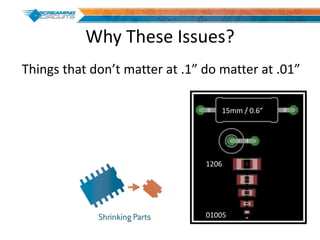
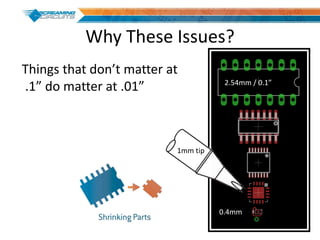
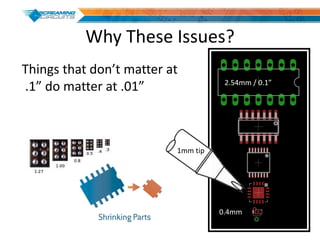
Why These Issues?
Things that don’t matter at .1” do matter at .01”
15mm / 0.6”
1206
01005
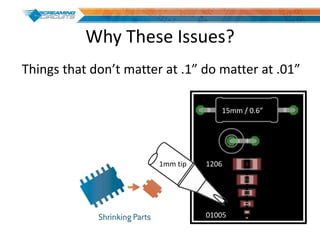
Why These Issues?
Things that don’t matter at .1” do matter at .01”
15mm / 0.6”
1206
01005
1mm tip
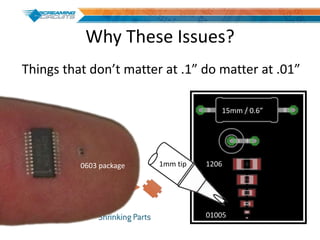
Why These Issues?
Things that don’t matter at .1” do matter at .01”
15mm / 0.6”
1206
01005
0603 package 1mm tip
Why These Issues?
Things that don’t matter at
.1” do matter at .01” 2.54mm / 0.1”
0.4mm
1mm tip
Why These Issues?
Things that don’t matter at
.1” do matter at .01” 2.54mm / 0.1”
0.4mm
1mm tip
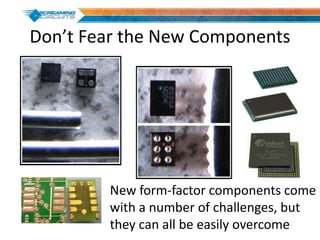
Don’t Fear the New Components
New form-factor components come
with a number of challenges, but
they can all be easily overcome
FIVE COMMON TRAPS
1. VIA IN PAD
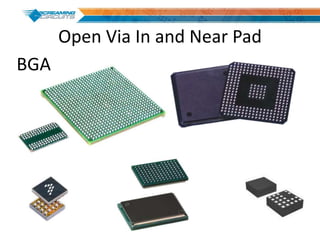
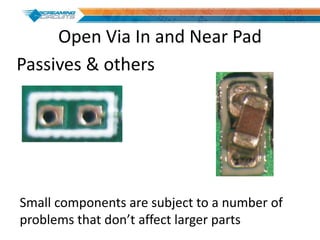
Open Via In and Near Pad
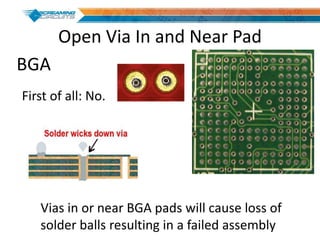
BGA
Open Via In and Near Pad
Vias in or near BGA pads will cause loss of
solder balls resulting in a failed assembly
First of all: No.
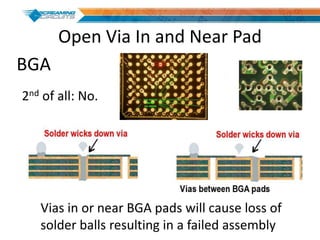
BGA
Open Via In and Near Pad
Vias in or near BGA pads will cause loss of
solder balls resulting in a failed assembly
2nd of all: No.
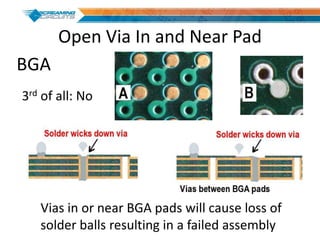
BGA
Open Via In and Near Pad
Vias in or near BGA pads will cause loss of
solder balls resulting in a failed assembly
3rd of all: No
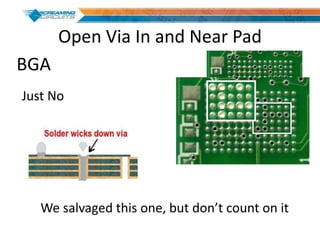
BGA
Open Via In and Near Pad
Just No
BGA
We salvaged this one, but don’t count on it
Open Via In and Near Pad
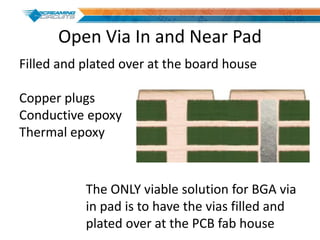
Filled and plated over at the board house
Copper plugs
Conductive epoxy
Thermal epoxy
The ONLY viable solution for BGA via
in pad is to have the vias filled and
plated over at the PCB fab house
Open Via In and Near Pad
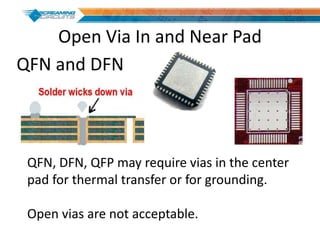
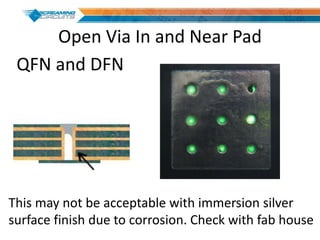
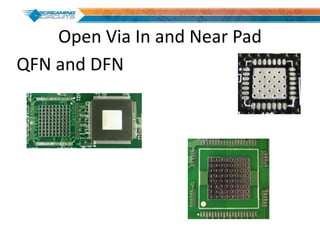
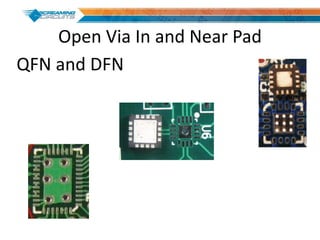
QFN, DFN, QFP may require vias in the center
pad for thermal transfer or for grounding.
Open vias are not acceptable.
QFN and DFN
Open Via In and Near Pad
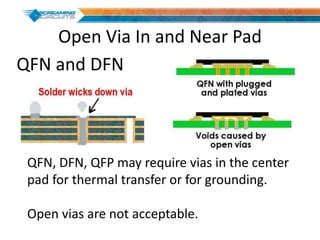
QFN, DFN, QFP may require vias in the center
pad for thermal transfer or for grounding.
Open vias are not acceptable.
QFN and DFN
Open Via In and Near Pad
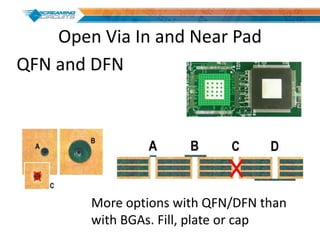
More options with QFN/DFN than
with BGAs. Fill, plate or cap
QFN and DFN
Open Via In and Near Pad
This may not be acceptable with immersion silver
surface finish due to corrosion. Check with fab house
QFN and DFN
Open Via In and Near Pad
QFN and DFN
Open Via In and Near Pad
QFN and DFN
Open Via In and Near Pad
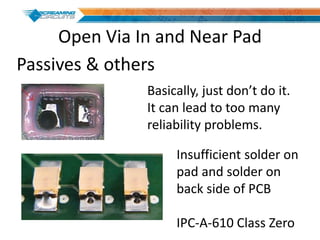
Passives & others
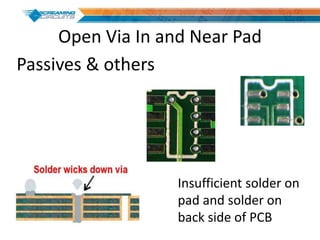
Insufficient solder on
pad and solder on
back side of PCB
Open Via In and Near Pad
Small components are subject to a number of
problems that don’t affect larger parts
Passives & others
Open Via In and Near Pad
Basically, just don’t do it.
It can lead to too many
reliability problems.
Passives & others
Insufficient solder on
pad and solder on
back side of PCB
IPC-A-610 Class Zero
FIVE COMMON TRAPS
2. QFN CENTER PAD
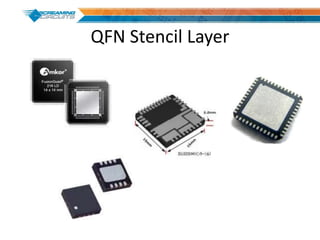
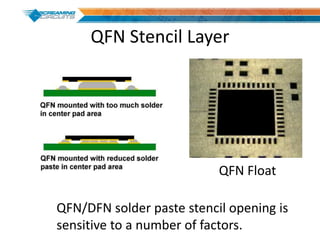
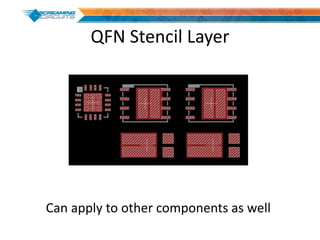
QFN Stencil Layer
QFN Stencil Layer
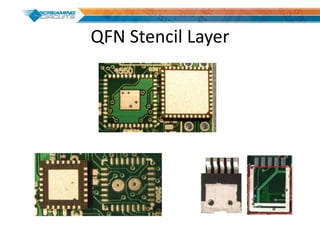
QFN/DFN solder paste stencil opening is
sensitive to a number of factors.
QFN Float
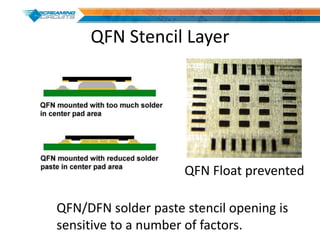
QFN Stencil Layer
QFN/DFN solder paste stencil opening is
sensitive to a number of factors.
QFN Float prevented
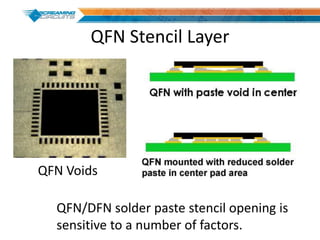
QFN Stencil Layer
QFN/DFN solder paste stencil opening is
sensitive to a number of factors.
QFN Voids
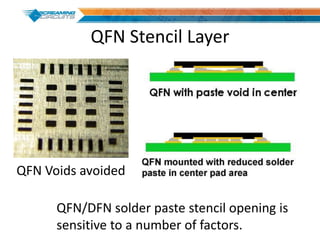
QFN Stencil Layer
QFN/DFN solder paste stencil opening is
sensitive to a number of factors.
QFN Voids avoided
QFN Stencil Layer
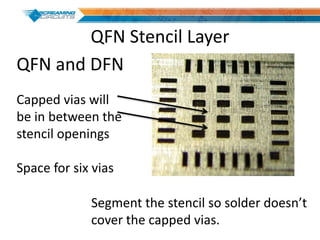
Segment the stencil so solder doesn’t
cover the capped vias.
QFN and DFN
Capped vias will
be in between the
stencil openings
Space for six vias
QFN Stencil Layer
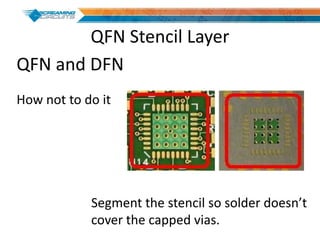
Segment the stencil so solder doesn’t
cover the capped vias.
QFN and DFN
How not to do it
QFN Stencil Layer
QFN Stencil Layer
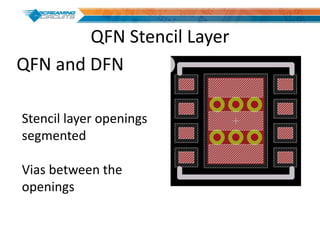
Stencil layer openings
segmented
Vias between the
openings
QFN and DFN
QFN Stencil Layer
Can apply to other components as well
FIVE COMMON TRAPS
3. FOOTPRINTS AND MARKINGS
Footprint and Marking
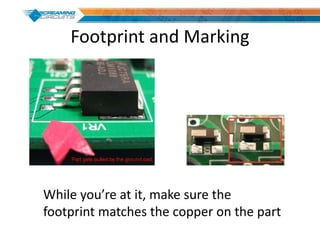
While you’re at it, make sure the
footprint matches the copper on the part
Footprint and Marking
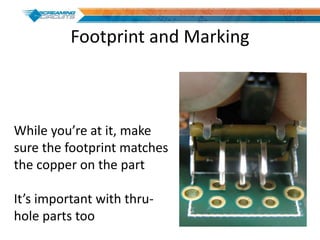
While you’re at it, make
sure the footprint matches
the copper on the part
It’s important with thru-
hole parts too
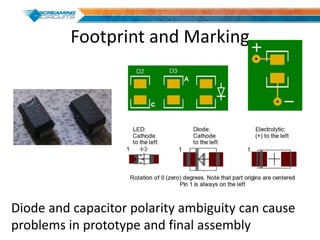
Footprint and Marking
Diode and capacitor polarity ambiguity can cause
problems in prototype and final assembly
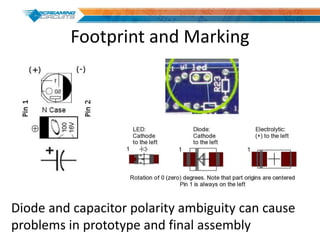
Footprint and Marking
Diode and capacitor polarity ambiguity can cause
problems in prototype and final assembly
FIVE COMMON TRAPS
4. THERMAL MANUFACTURING ISSUES
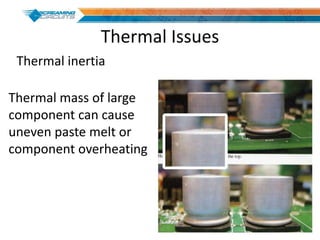
Thermal Issues
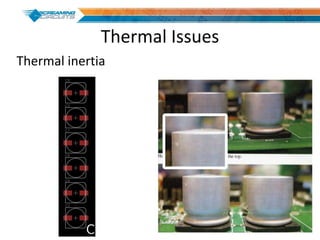
Thermal mass of large
component can cause
uneven paste melt or
component overheating
Thermal inertia
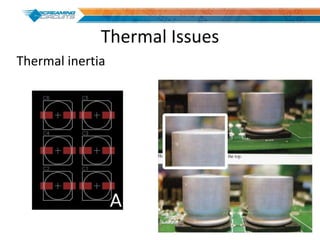
Thermal Issues
Thermal inertia
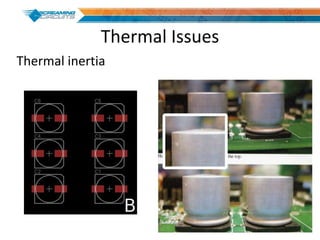
Thermal Issues
Thermal inertia
Thermal Issues
Thermal inertia
Thermal Issues
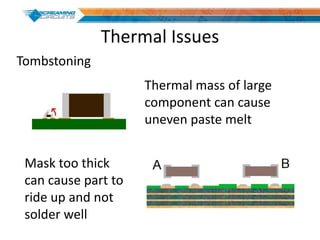
Thermal mass of large
component can cause
uneven paste melt
Mask too thick
can cause part to
ride up and not
solder well
Tombstoning
Thermal Issues
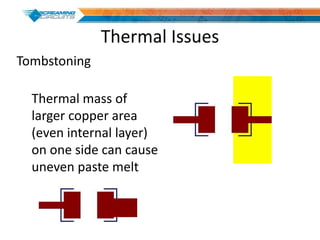
Thermal mass of
larger copper area
(even internal layer)
on one side can cause
uneven paste melt
Tombstoning
Thermal Issues
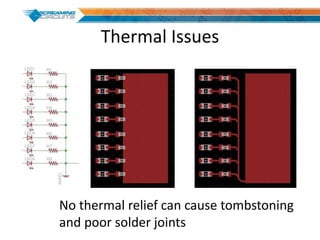
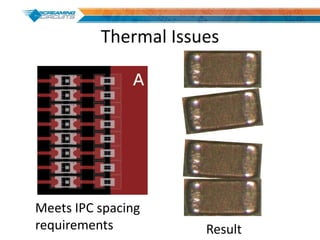
No thermal relief can cause tombstoning
and poor solder joints
Thermal Issues
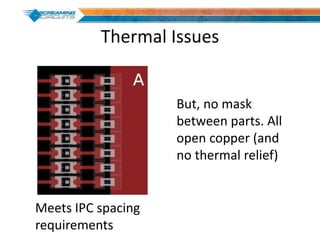
Meets IPC spacing
requirements
But, no mask
between parts. All
open copper (and
no thermal relief)
Thermal Issues
Meets IPC spacing
requirements Result
Thermal Issues
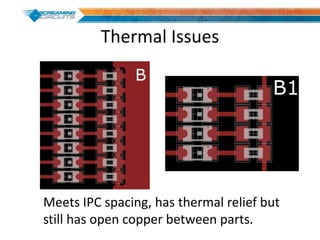
Meets IPC spacing, has thermal relief but
still has open copper between parts.
Thermal Issues
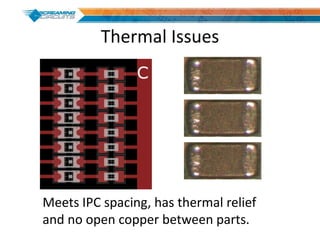
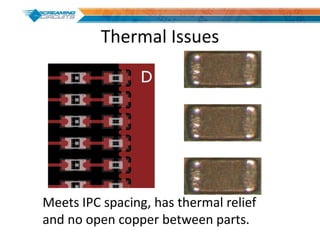
Meets IPC spacing, has thermal relief
and no open copper between parts.
Thermal Issues
Meets IPC spacing, has thermal relief
and no open copper between parts.
FIVE COMMON TRAPS
5. BOM EXPLOSION
BOM Explosion
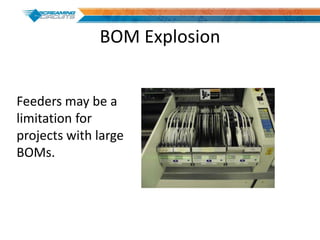
Feeders may be a
limitation for
projects with large
BOMs.
BOM Explosion
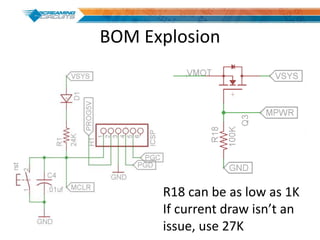
R18 can be as low as 1K
If current draw isn’t an
issue, use 27K
Summary
• No open vias in pads
• Segment your QFN stencils
• Verify footprints
• Clarify polarities
• Watch for BOM line item creep
blog.screamingcircuits.com
For additional layout advice

Pcb design best practices for more reliable manufacturing