Pad Design and Process for
  Voiding Control at QFN
        Assembly
   Derrick Herron, Dr. Yan Liu, and
         Dr. Ning-Cheng Lee

         Indium Corporation
Background
• QFN prevailing due to (1) small size & light weight; (2) easy
  PCB trace routing due to the use of perimeter I/O pads; (3)
  reduced lead inductance; and (4) good thermal and
  electrical performance due to the adoption of exposed
  copper die-pad technology
• Voiding is issue at SMT assembly due to the large coverage
  area, large number of thermal via, and low standoff
• Both design and process were studied for minimizing and
  controlling the voiding
Parameters Studied
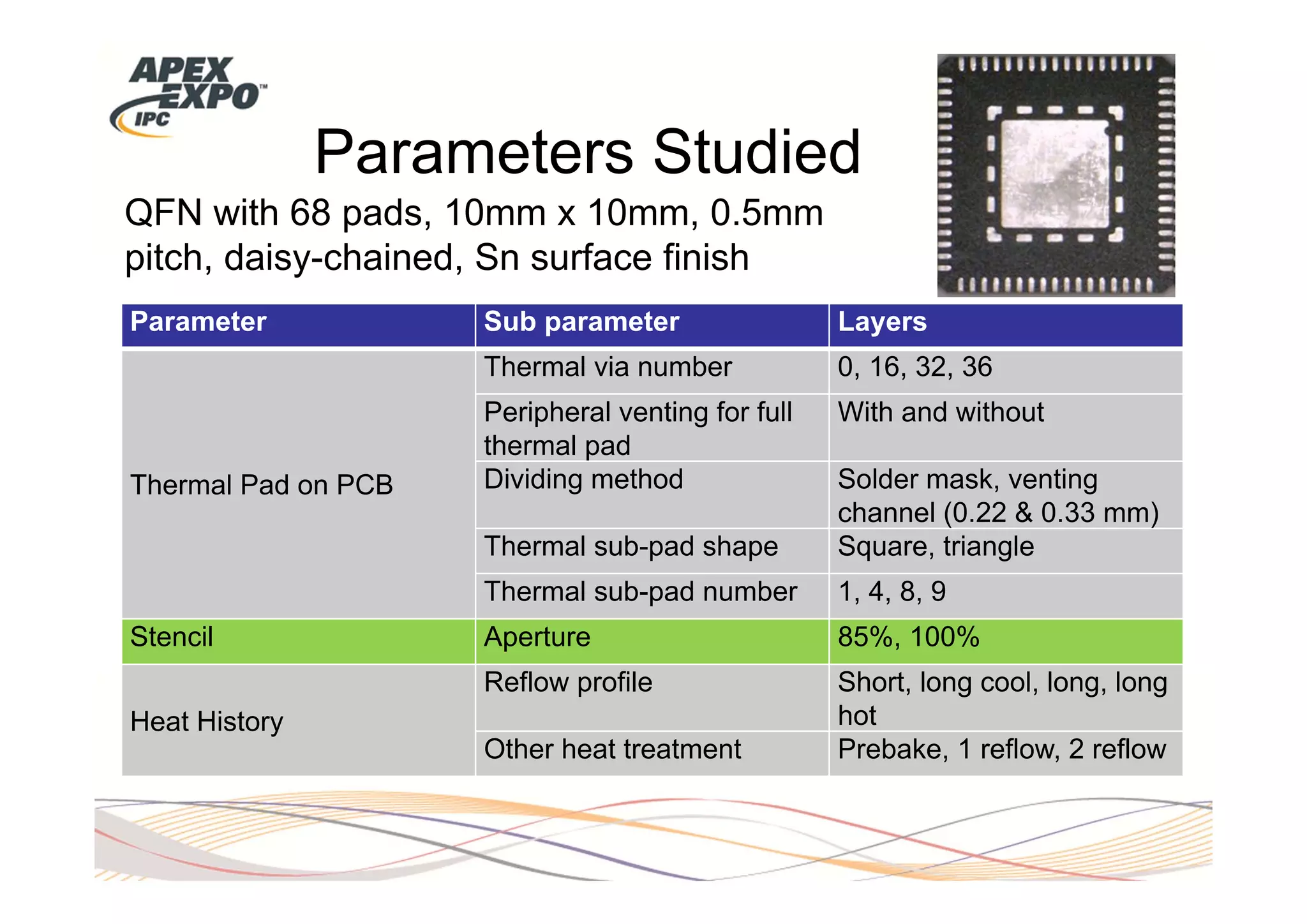
QFN with 68 pads, 10mm x 10mm, 0.5mm
pitch, daisy-chained, Sn surface finish
Parameter            Sub parameter                 Layers
                     Thermal via number            0, 16, 32, 36
                     Peripheral venting for full   With and without
                     thermal pad
Thermal Pad on PCB   Dividing method               Solder mask, venting
                                                   channel (0.22 & 0.33 mm)
                     Thermal sub-pad shape         Square, triangle
                     Thermal sub-pad number        1, 4, 8, 9
Stencil              Aperture                      85%, 100%
                     Reflow profile                Short, long cool, long, long
Heat History                                       hot
                     Other heat treatment          Prebake, 1 reflow, 2 reflow
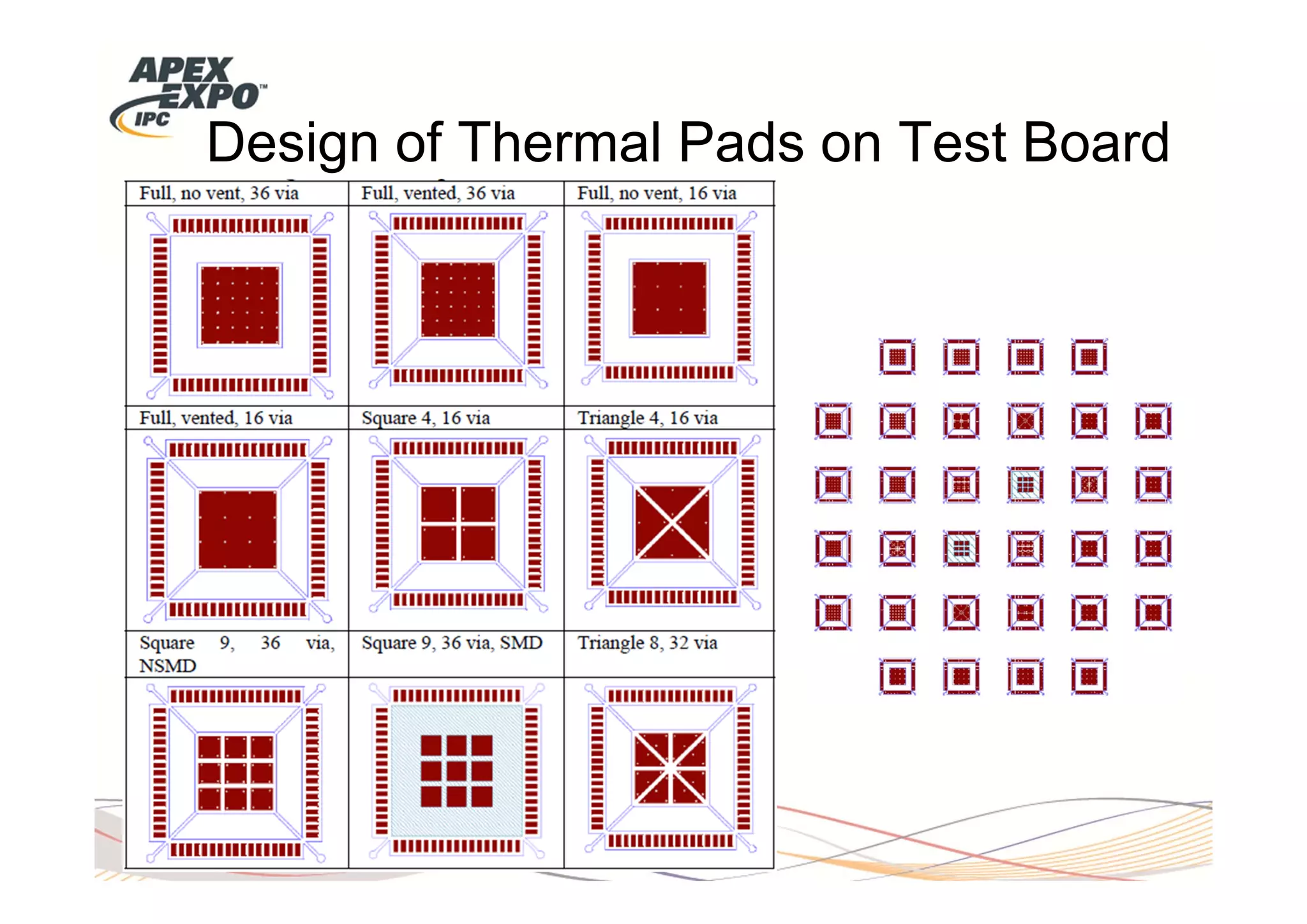
Design of Thermal Pads on Test Board
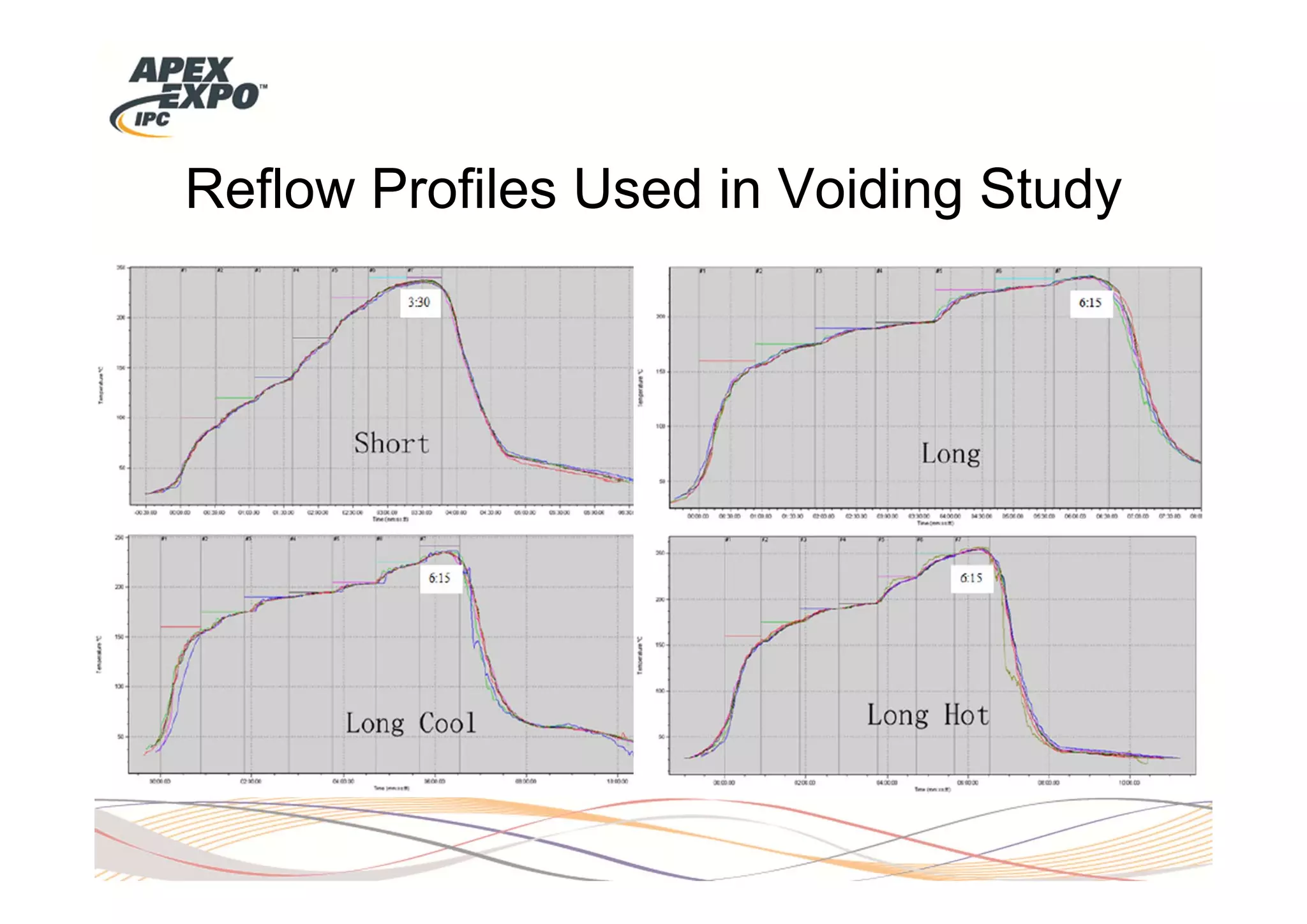
Reflow Profiles Used in Voiding Study
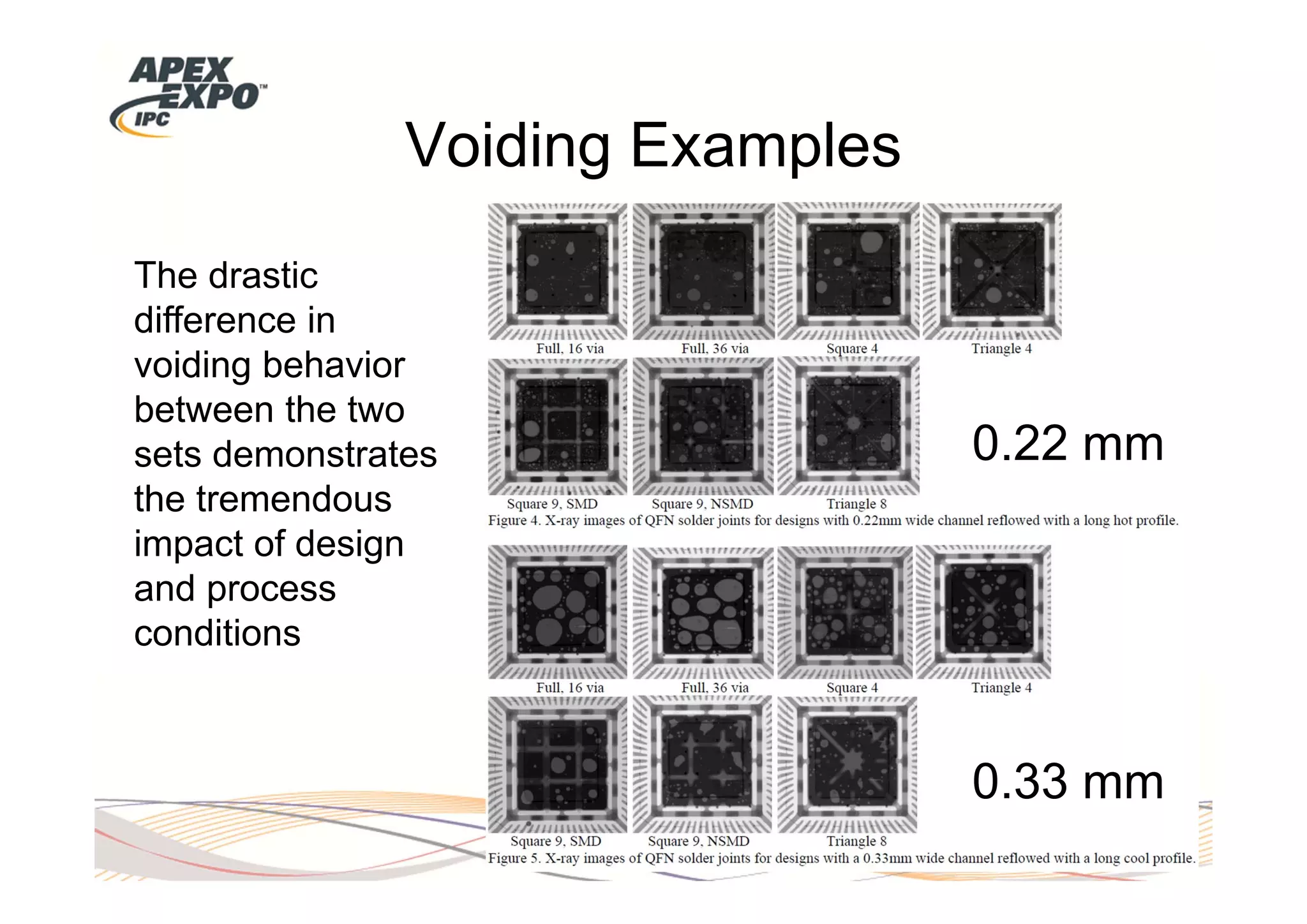
Voiding Examples
The drastic
difference in
voiding behavior
between the two
sets demonstrates                    0.22 mm
the tremendous
impact of design
and process
conditions


                                     0.33 mm
                                  6 INDIUM CORPORATION
                                          CONFIDENTIAL
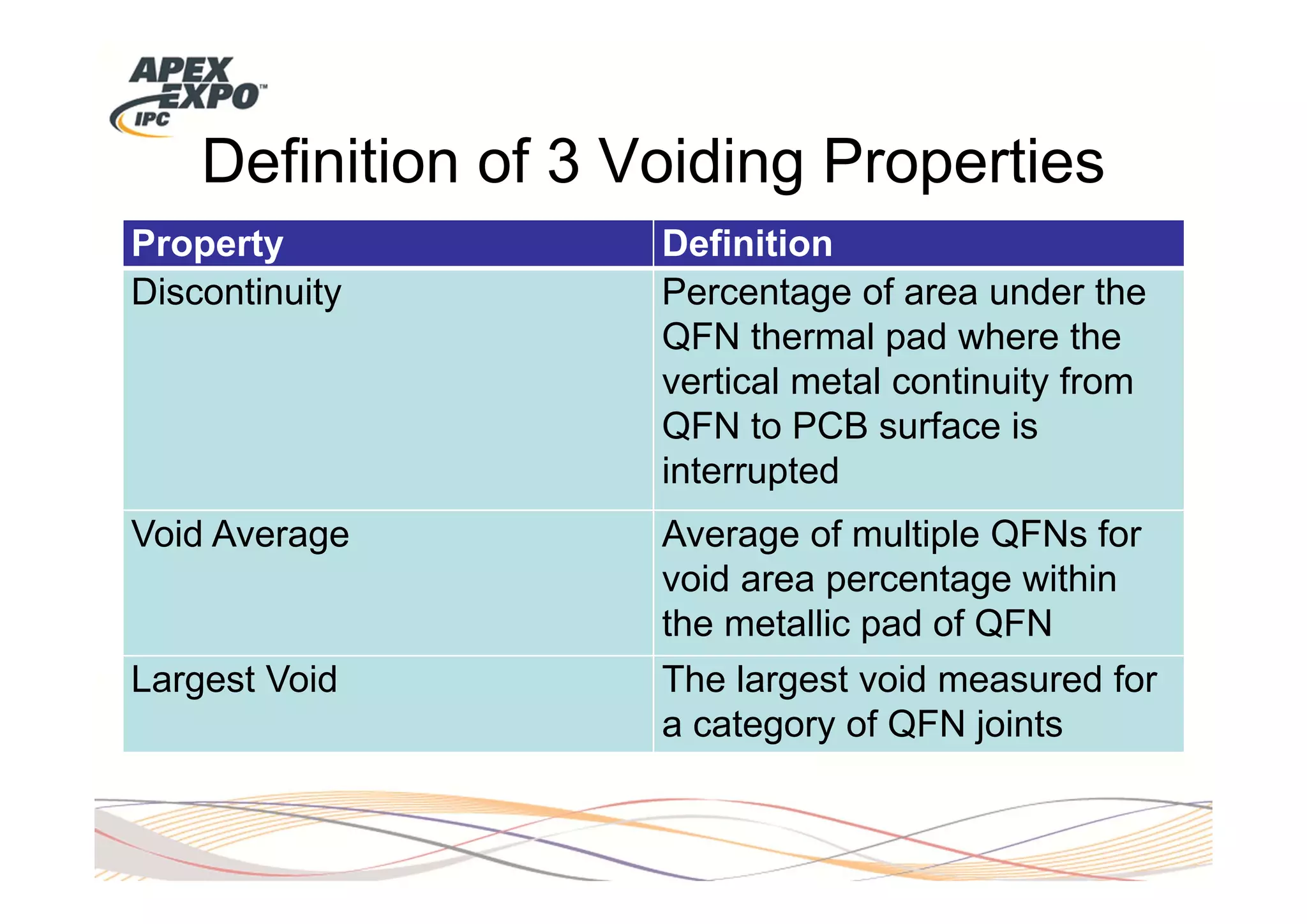
Definition of 3 Voiding Properties
Property             Definition
Discontinuity        Percentage of area under the
                     QFN thermal pad where the
                     vertical metal continuity from
                     QFN to PCB surface is
                     interrupted
Void Average         Average of multiple QFNs for
                     void area percentage within
                     the metallic pad of QFN
Largest Void         The largest void measured for
                     a category of QFN joints
Individual Voiding Data Set


Dividing the thermal
pads into sub-units
results in an abrupt drop
in the largest void but an
increase in discontinuity

Net effect: a reduction in
the uncontrollable,
harmful large voids,
replacing it with a
controlled, even
distribution of
                                  8 INDIUM CORPORATION
discontinuity                             CONFIDENTIAL
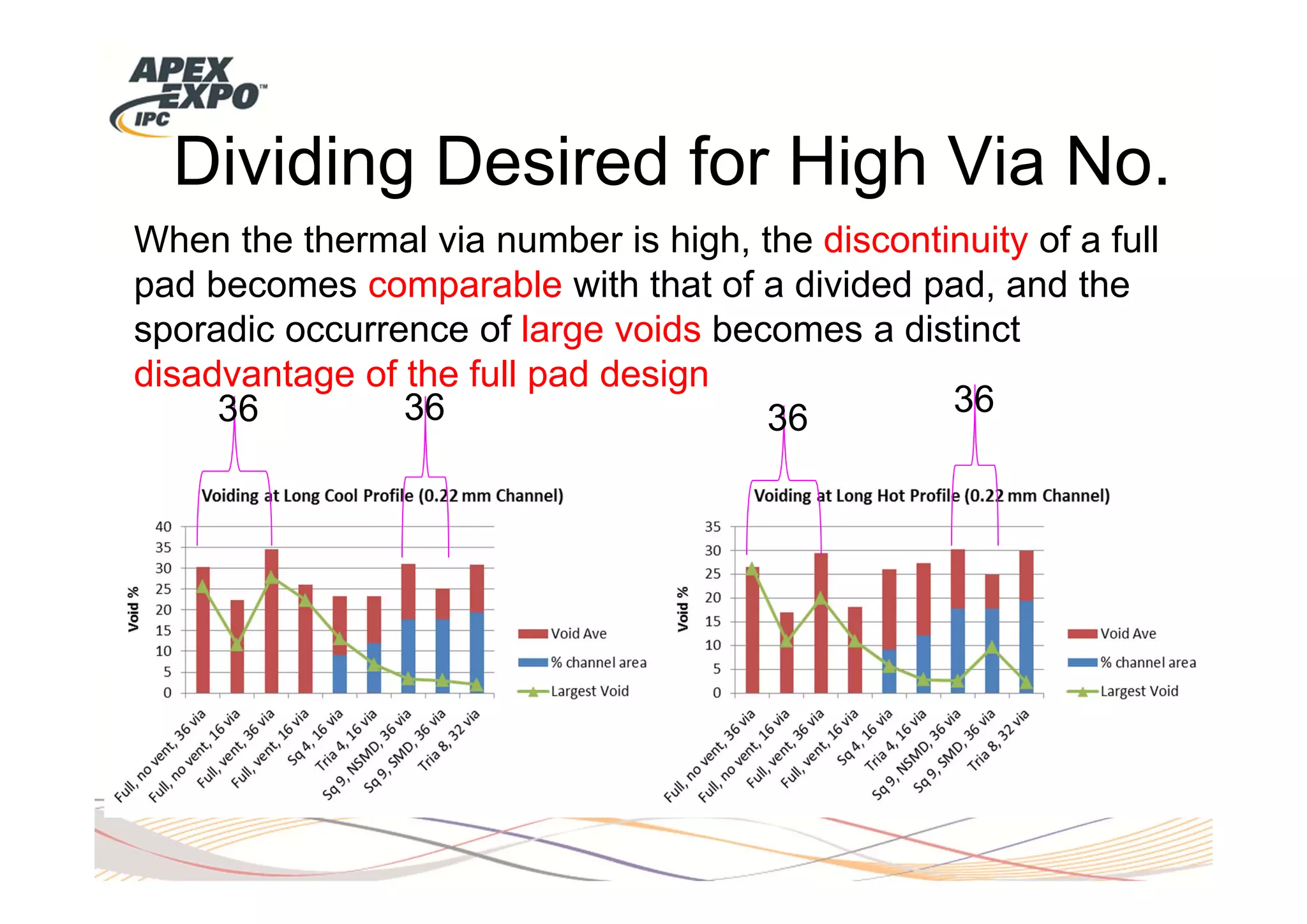
Dividing Desired for High Via No.
When the thermal via number is high, the discontinuity of a full
pad becomes comparable with that of a divided pad, and the
sporadic occurrence of large voids becomes a distinct
disadvantage of the full pad design
     36         36                               36
                                      36
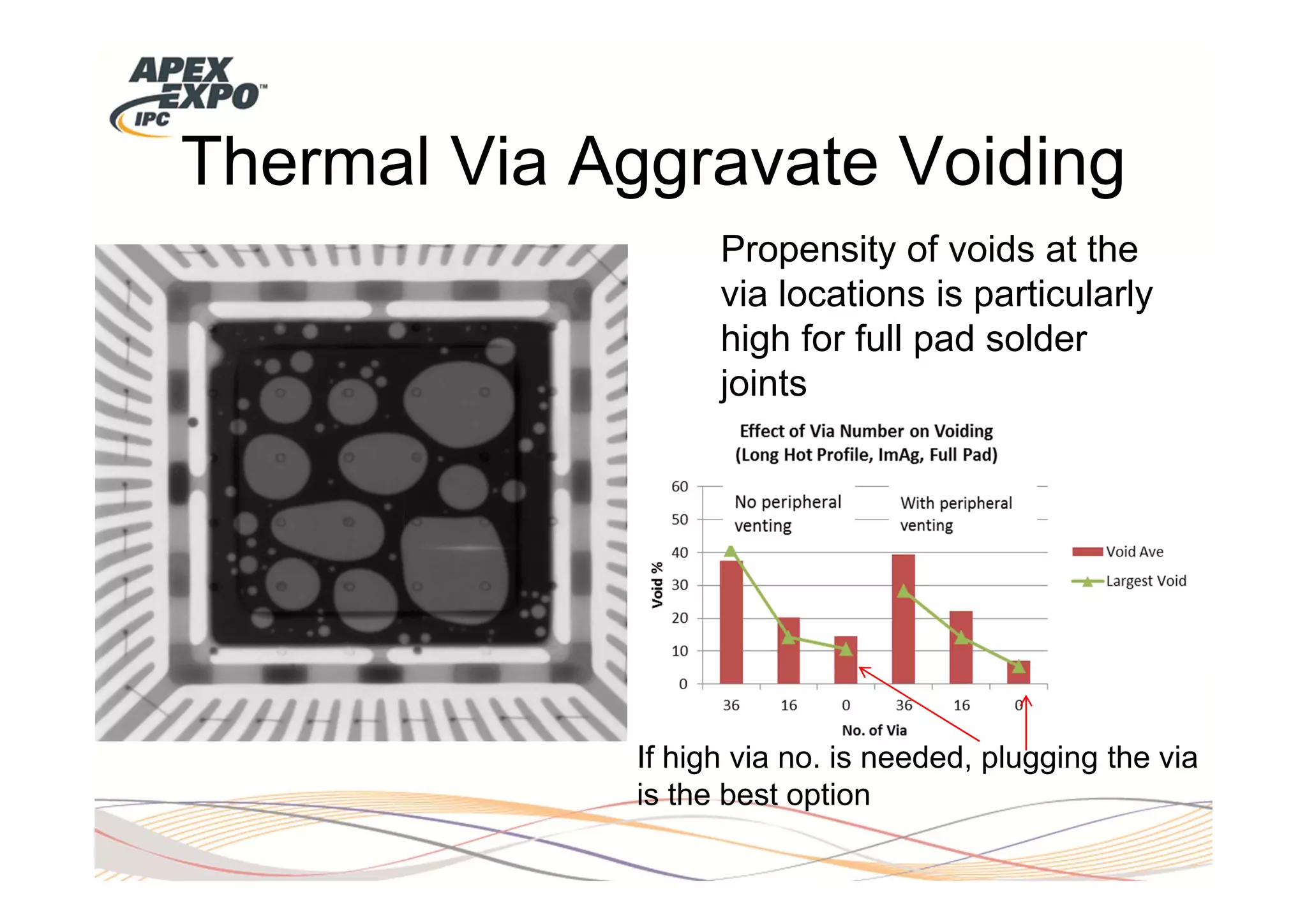
Thermal Via Aggravate Voiding
                   Propensity of voids at the
                   via locations is particularly
                   high for full pad solder
                   joints

                   Thus, voiding increase w
                   increasing via no.


             If high via no. is needed, plugging the via
             is the best option
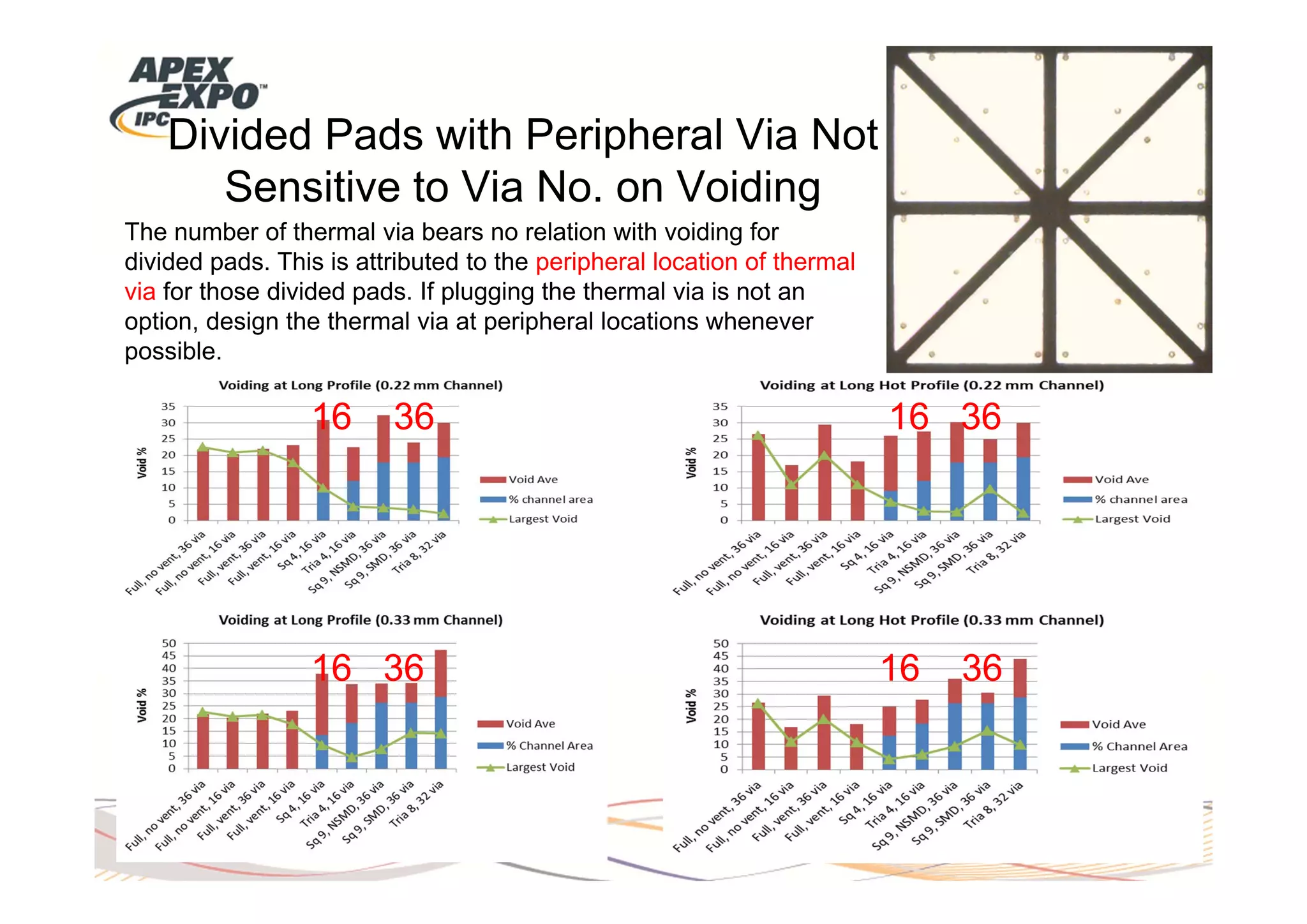
Divided Pads with Peripheral Via Not
       Sensitive to Via No. on Voiding
The number of thermal via bears no relation with voiding for
divided pads. This is attributed to the peripheral location of thermal
via for those divided pads. If plugging the thermal via is not an
option, design the thermal via at peripheral locations whenever
possible.

                 16      36                                              16 36


                 16 36                                                   16   36
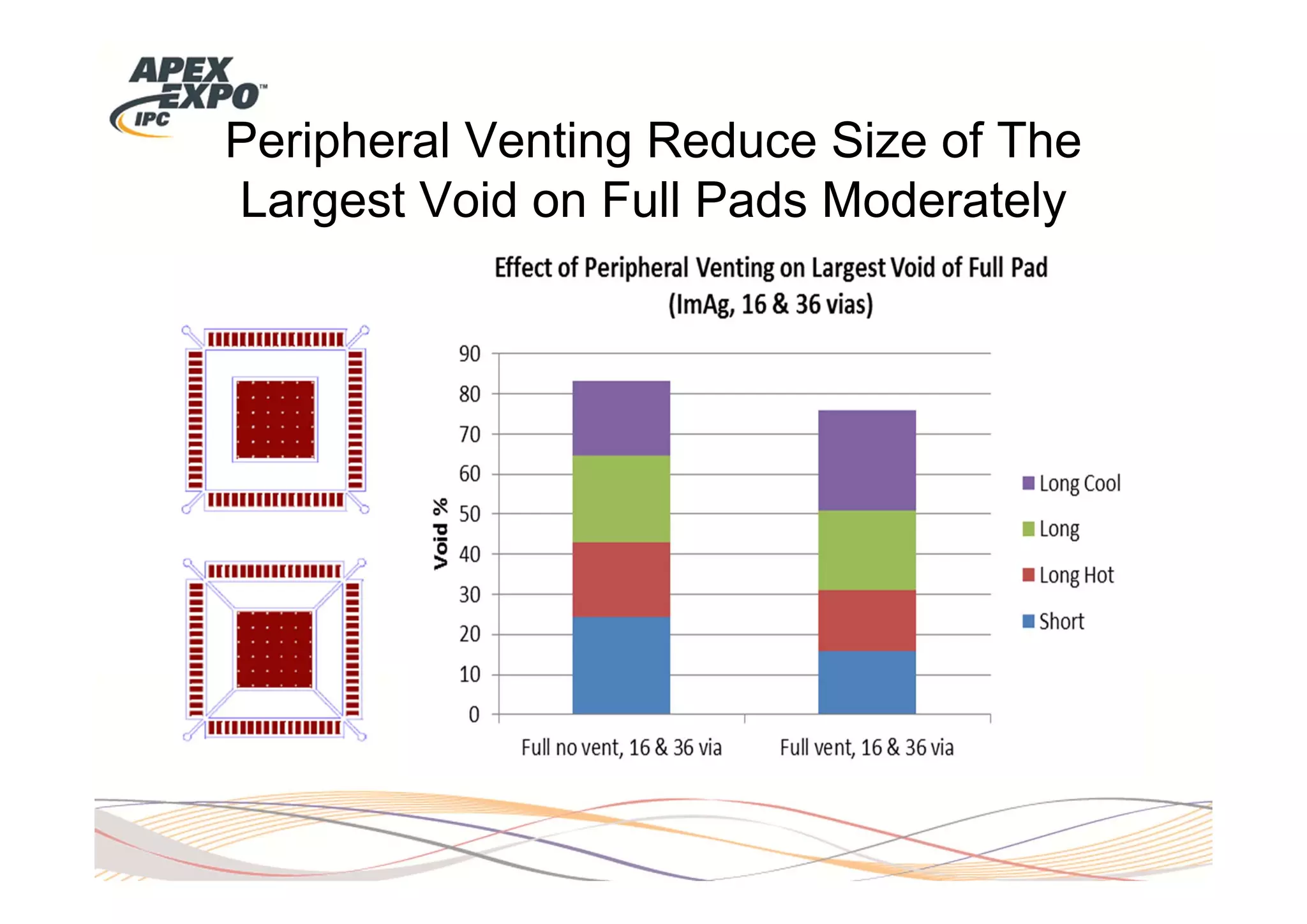
Peripheral Venting Reduce Size of The
Largest Void on Full Pads Moderately
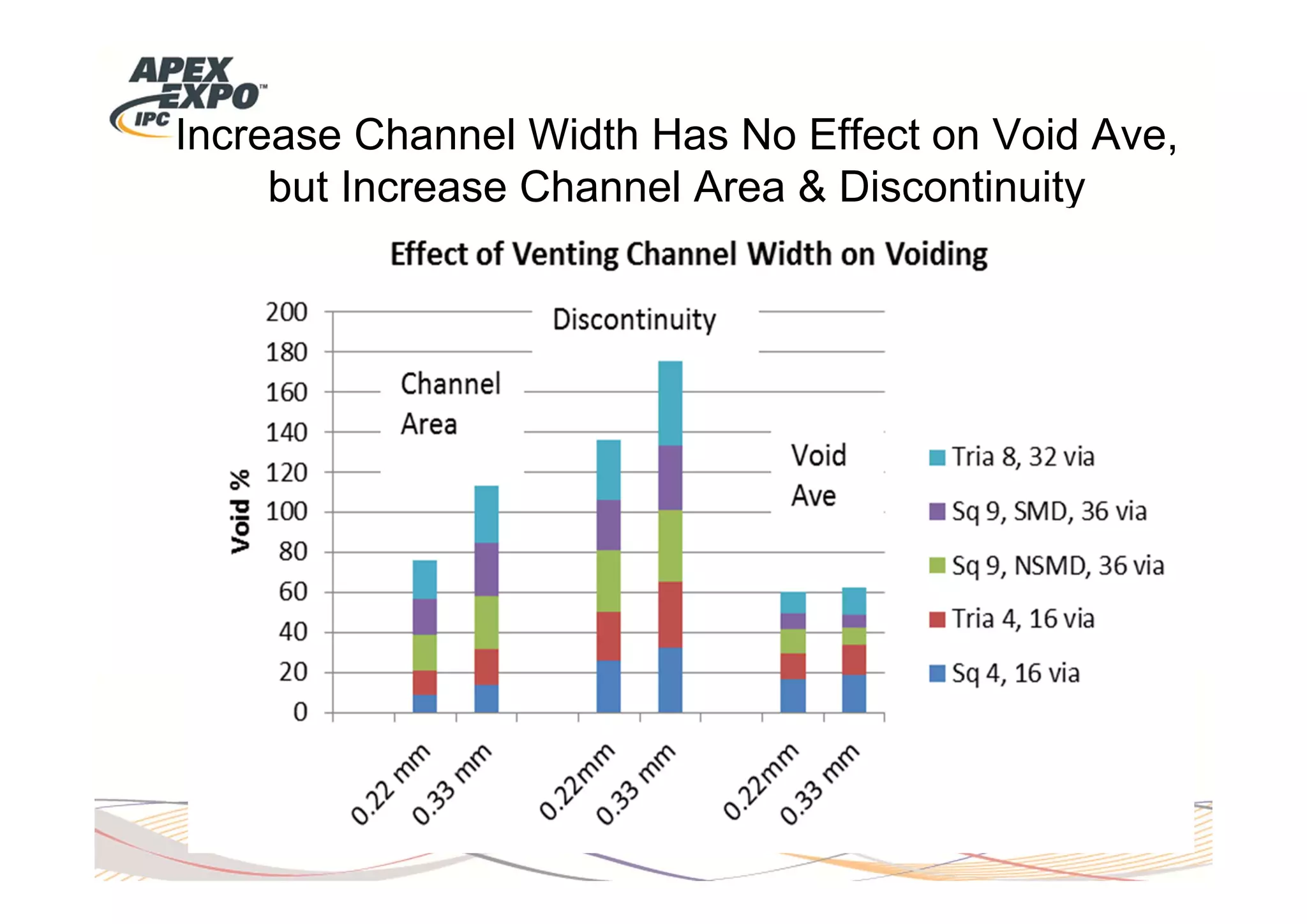
Increase Channel Width Has No Effect on Void Ave,
     but Increase Channel Area & Discontinuity
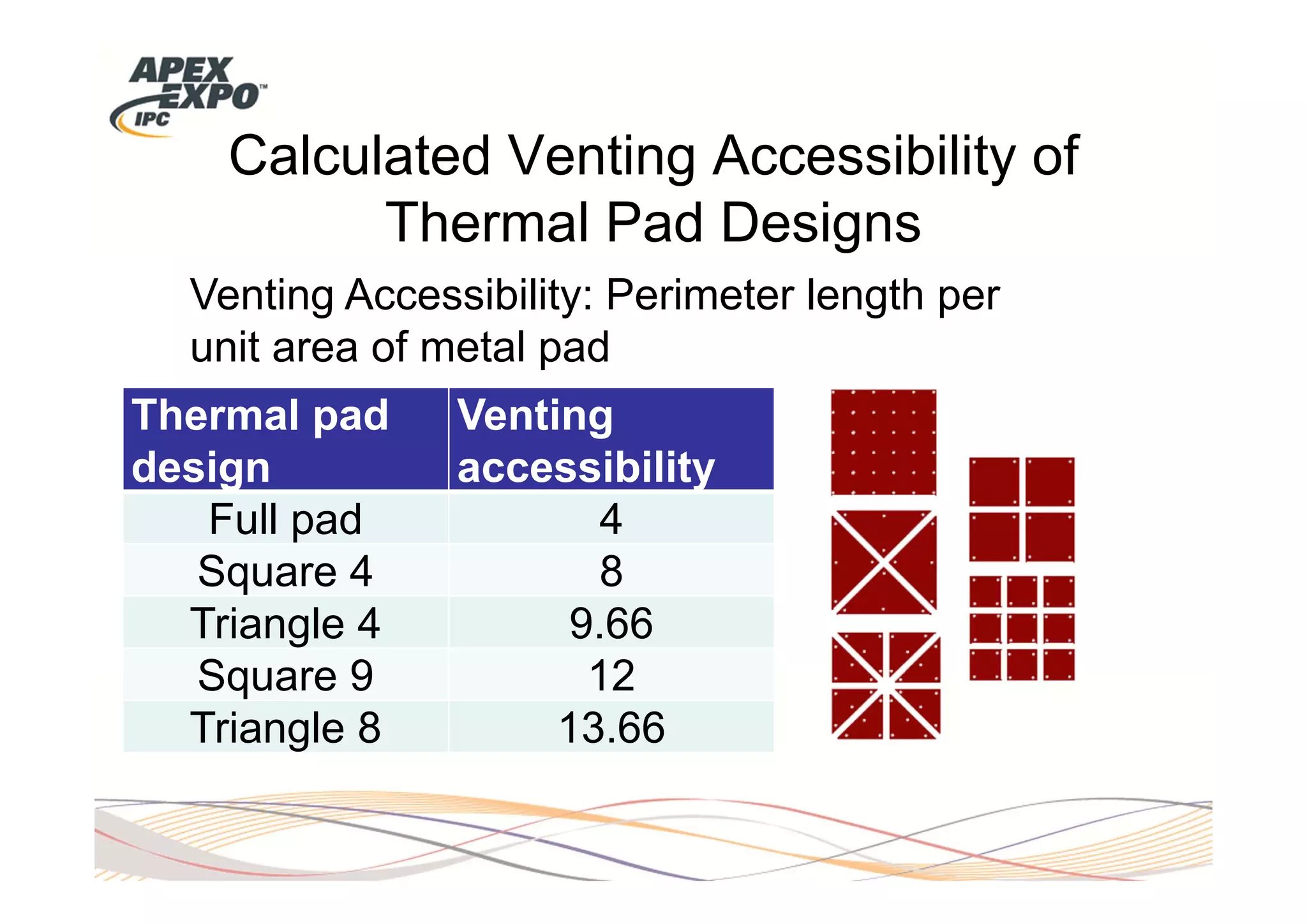
Calculated Venting Accessibility of
          Thermal Pad Designs
  Venting Accessibility: Perimeter length per
  unit area of metal pad
Thermal pad     Venting
design          accessibility
   Full pad             4
   Square 4             8
  Triangle 4          9.66
   Square 9            12
  Triangle 8         13.66
Venting Accessibility Effect on
    Largest Void & Void Average
With increasing venting accessibility, the void average and
largest void decrease readily
Divided Pad A Preferred Design
            When Voiding A Major Threat
However, the advantage of voiding reduction is offset by the increase in
discontinuity, particularly for the short profile.
For a long cool profile, the discontinuity increases only moderately with increasing
venting accessibility. In other words, when the voiding is a major threat, such as
designs with a high number of thermal vias, or when a short profile is not a viable
option, then a venting channel design becomes a favorable choice.
Divided Thermal Pads
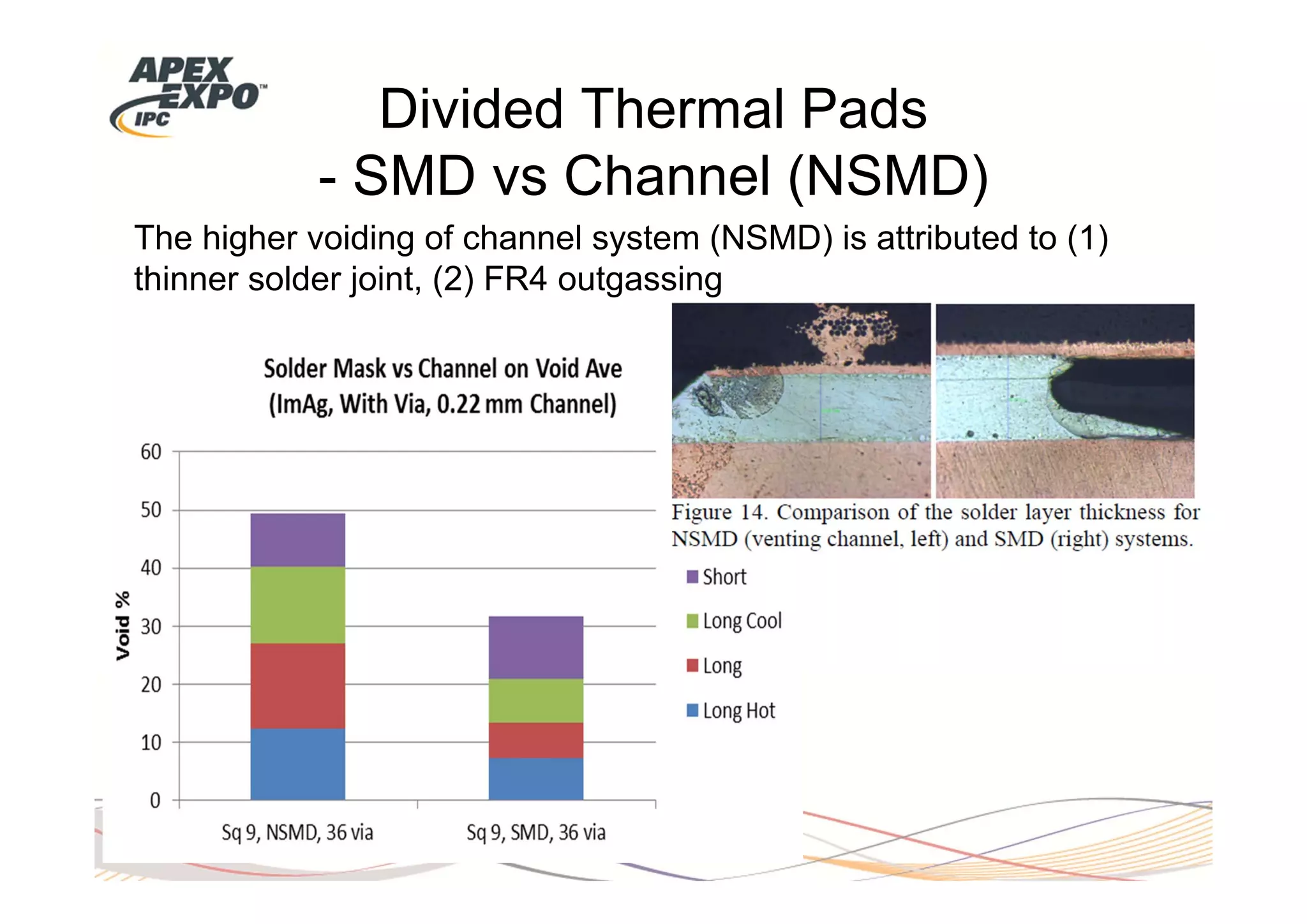
            - SMD vs Channel (NSMD)
The higher voiding of channel system (NSMD) is attributed to (1)
thinner solder joint, (2) FR4 outgassing
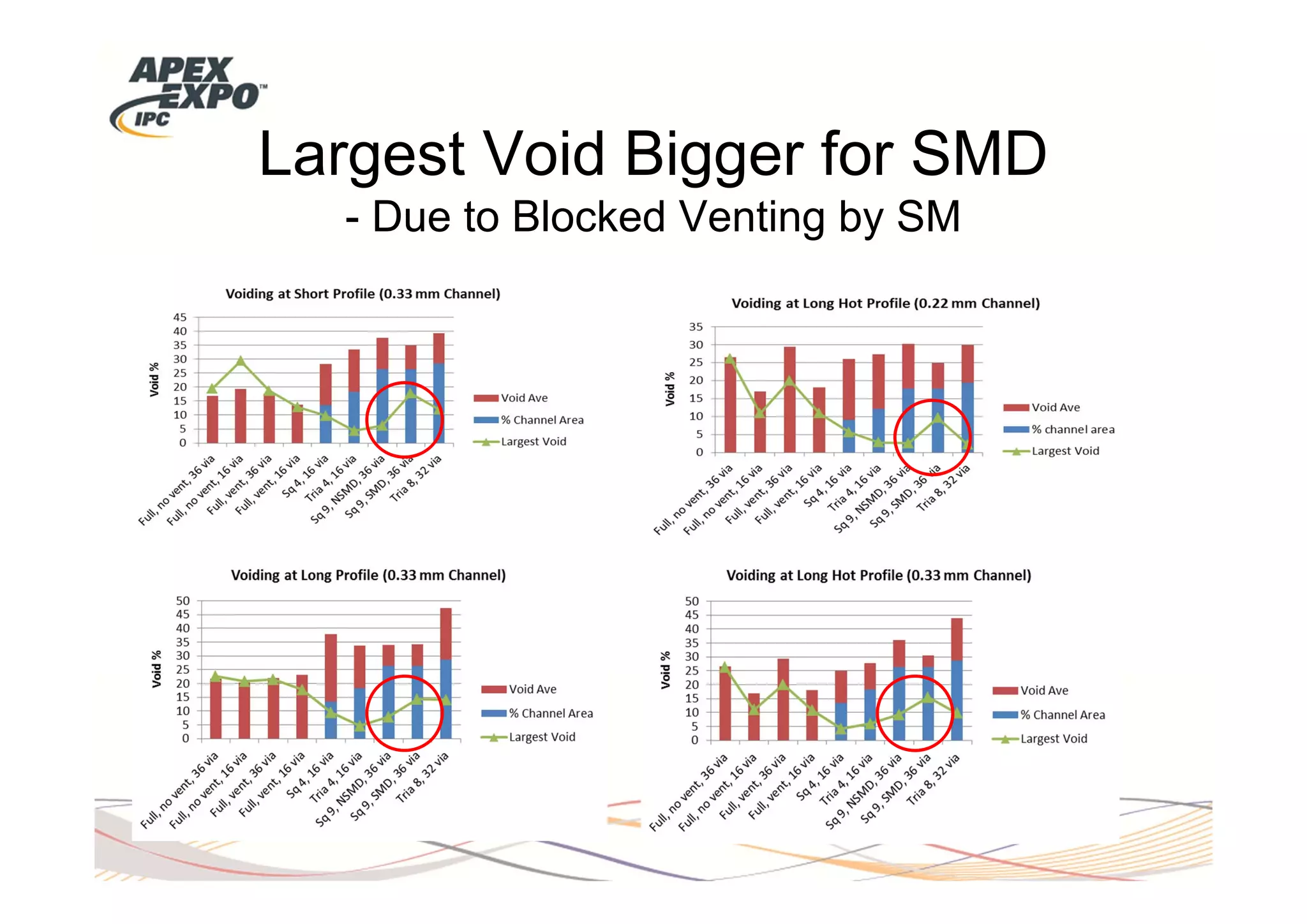
Largest Void Bigger for SMD
  - Due to Blocked Venting by SM
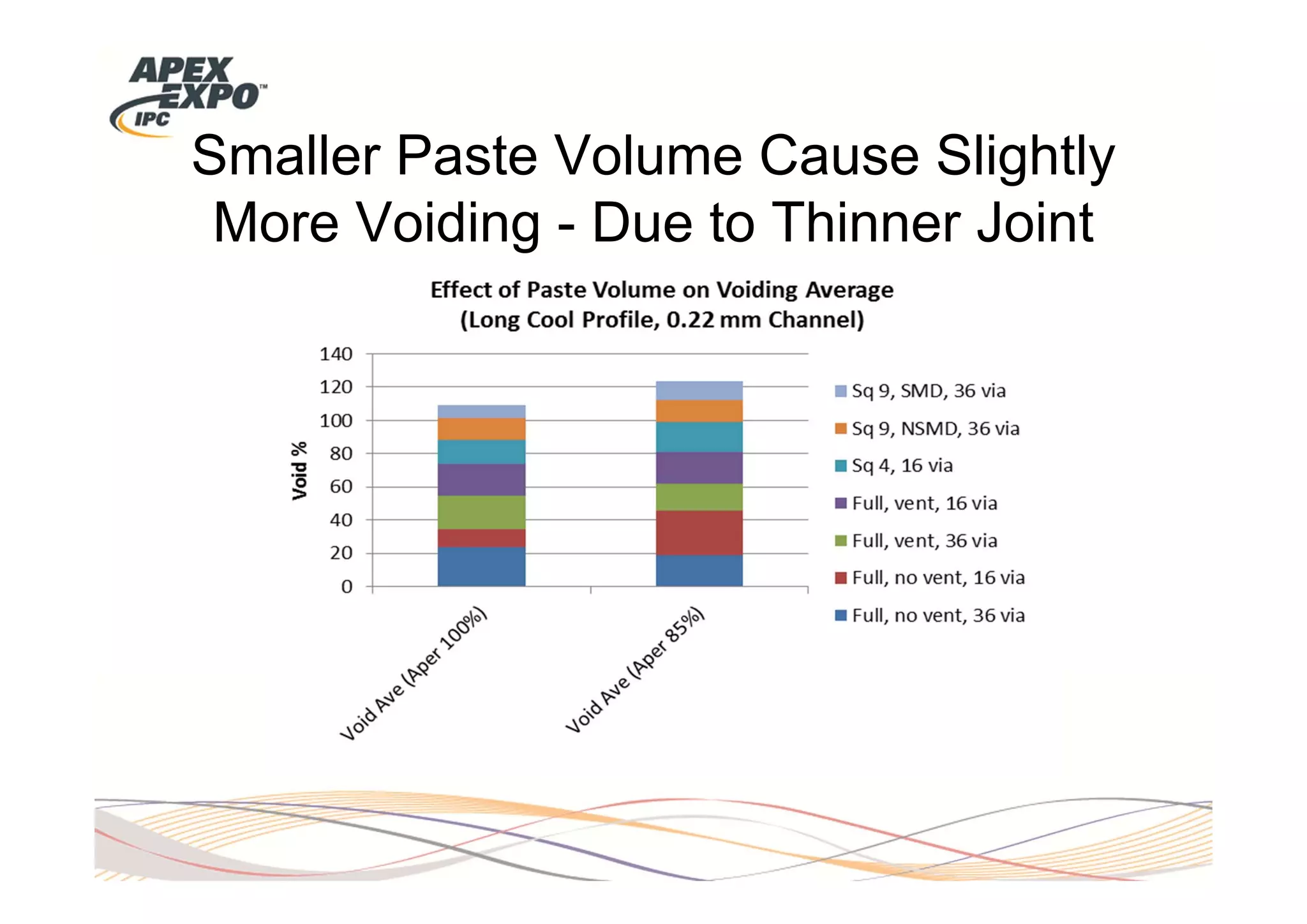
Smaller Paste Volume Cause Slightly
 More Voiding - Due to Thinner Joint
Effect of Profile on Voiding
           The short profile is preferred for a low void
           average, while the long hot profile is better
           for reducing the largest void
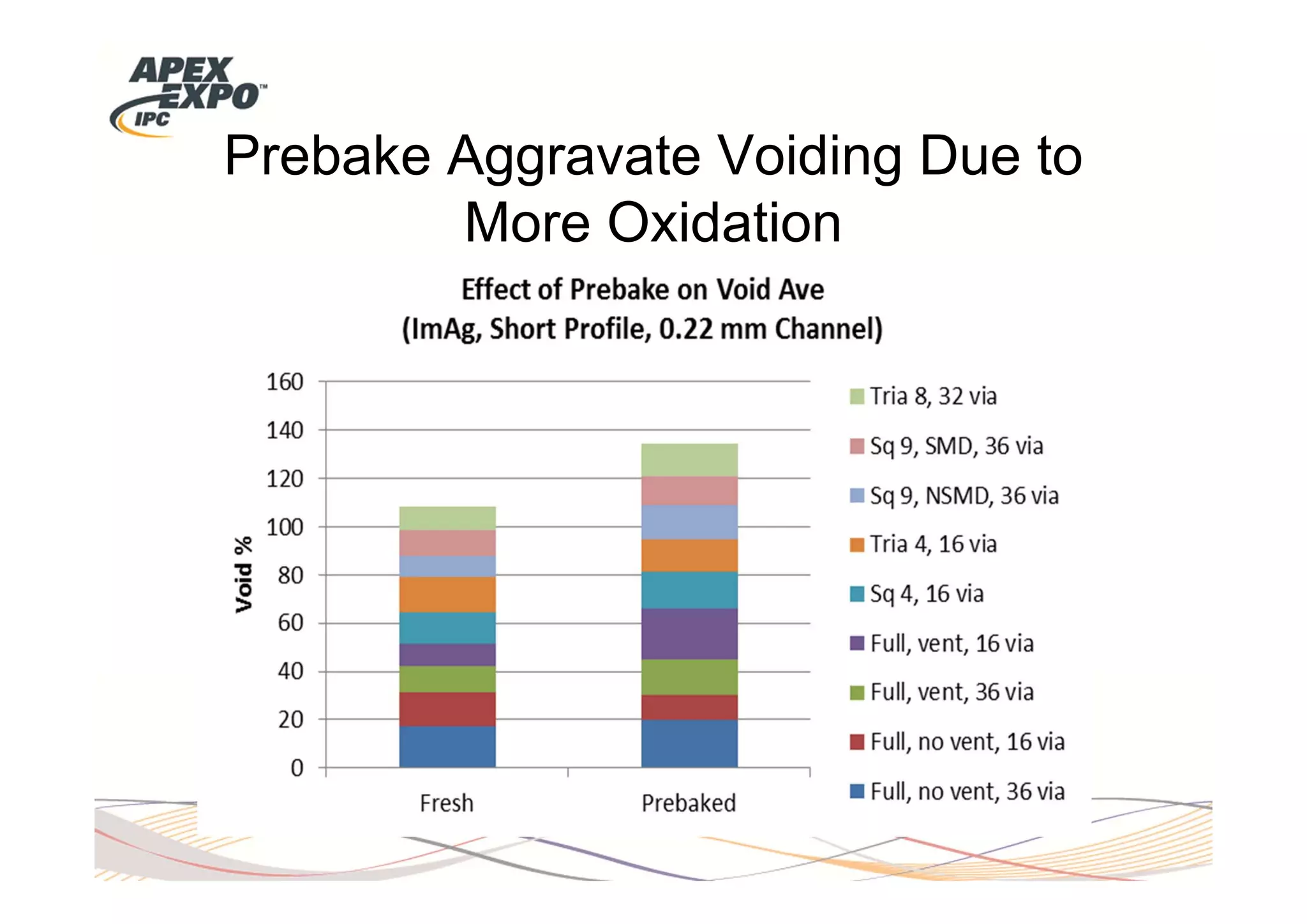
Prebake Aggravate Voiding Due to
        More Oxidation
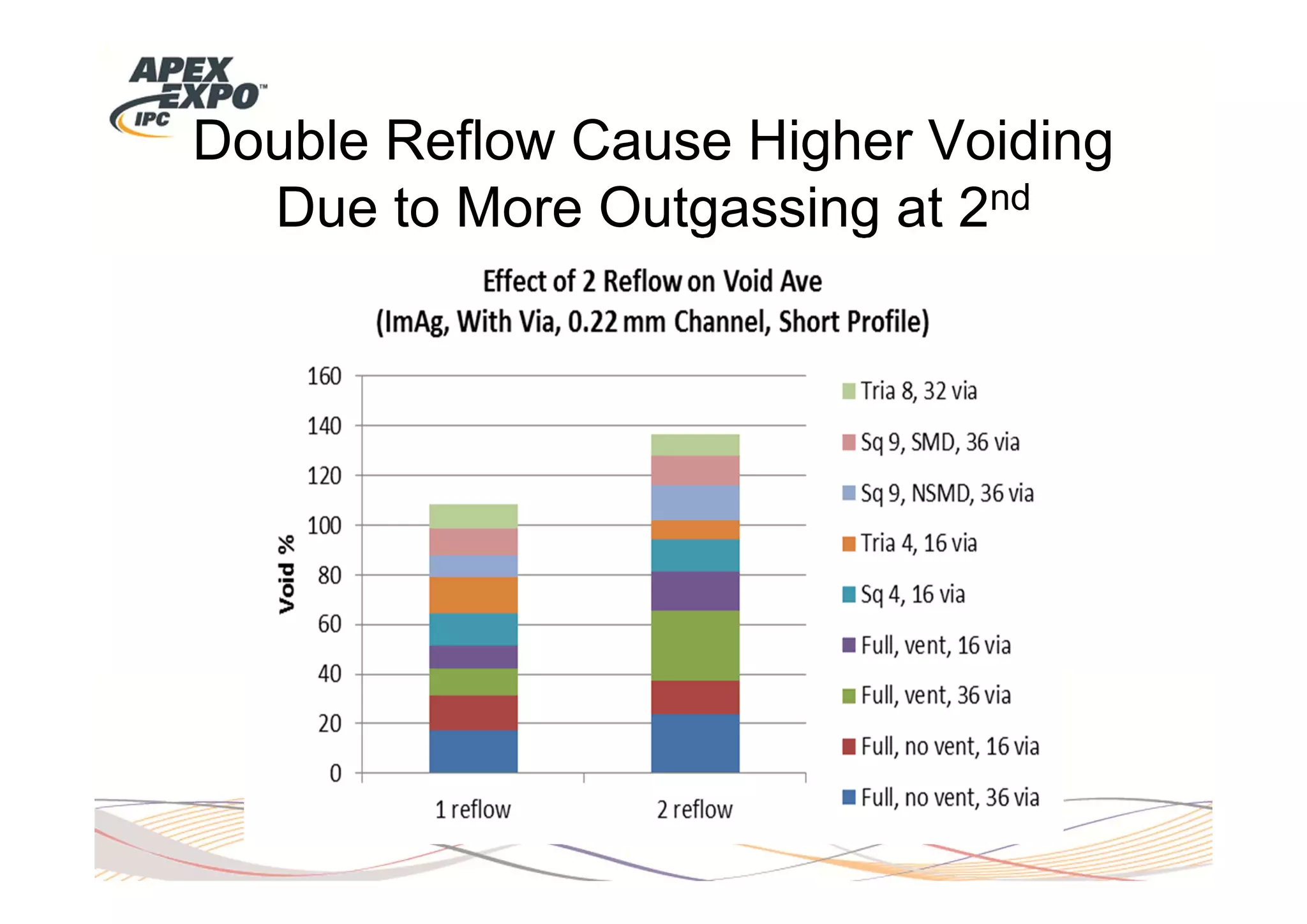
Double Reflow Cause Higher Voiding
  Due to More Outgassing at 2nd
              Reflow
Discussion (1)
• Prospect of thermal via
  – When mechanical drilled thermal via (0.3mm drill
    diam/1.2mm pitch) evolve to microvia, the via
    pitch decreases, thermal via density may
    becomes higher, & voiding may worsen
• How much voiding is too much?
  – Voiding up to 50% or even 60% OK
  – But, the largest void should be < pitch
• What is less evil?
  – High void or uneven size distribution?
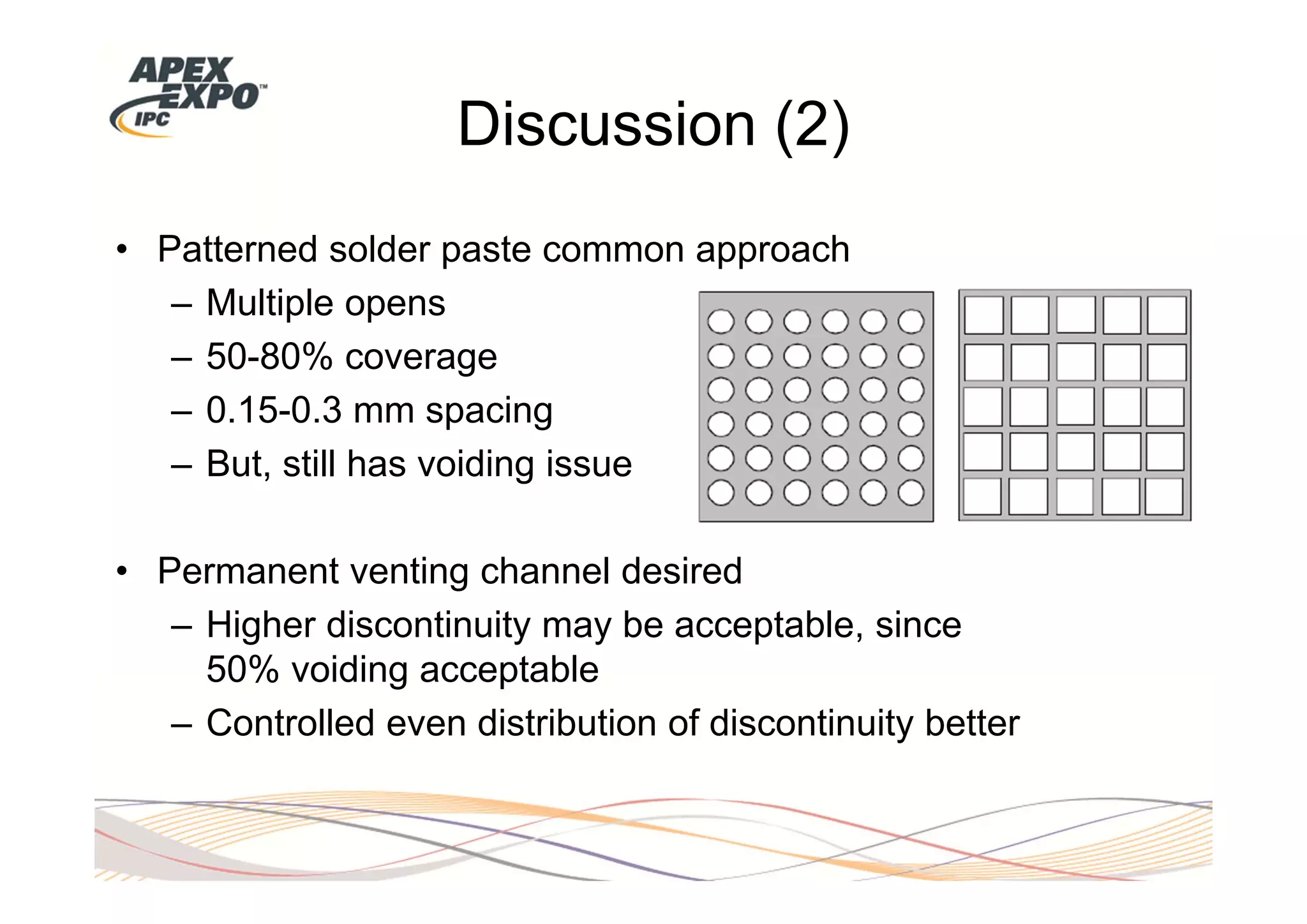
Discussion (2)
• Patterned solder paste common approach
   – Multiple opens
   – 50-80% coverage
   – 0.15-0.3 mm spacing
   – But, still has voiding issue

• Permanent venting channel desired
   – Higher discontinuity may be acceptable, since
     50% voiding acceptable
   – Controlled even distribution of discontinuity better
Discussion (3)
• Venting or being vented?
  – Remove metal to form channel less obstruction on
    vending
  – But, allow FR4 to outgass moisture from channel
• What is next?
  – Thin solder mask for SMD thermal pad
• Short vs long hot
  – Long hot more consistent, due to a wider reflow
    process window
  – Price – slightly higher void average
Conclusion (1)
• Plugging is most effective in reducing voiding
• For unplugged via situations, a full thermal pad is desired for
  a low no. of via
• For a high no. of thermal via, a divided thermal pad is
  preferred, due to better venting capability
• Placement of thermal via at the perimeter lessens voiding
  caused by via
• A wider venting channel has a negligible effect on voiding,
  but reduces joint continuity
• For a divided thermal pad, a SMD system is more favorable
  than a channel (NSMD) system, with the latter suffering more
  voiding due to a thinner solder joint and possibly board
  outgassing
Conclusion (2)
• Performance of a divided thermal pad is dictated by venting
  accessibility, not by the shape
• Voiding decreases with increasing venting accessibility,
  although the introduction of a channel area compromises
  the continuity of the solder joint
• Reduced solder paste volume causes more voiding
• A short profile and a long hot profile are most promising in
  reducing the voiding
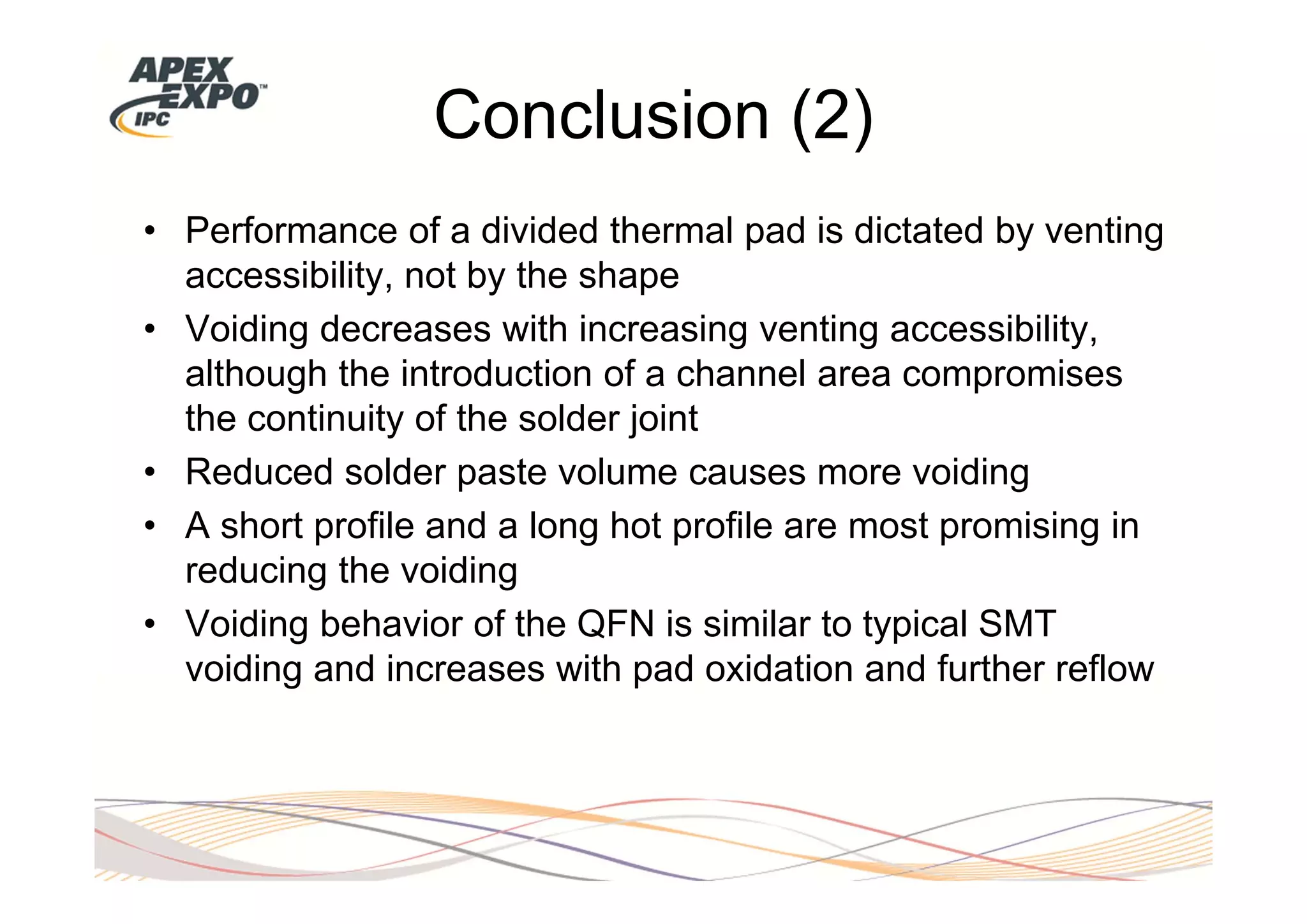
• Voiding behavior of the QFN is similar to typical SMT
  voiding and increases with pad oxidation and further reflow

Pad design and process for voiding control at QFN assembly

  • 1.
    Pad Design andProcess for Voiding Control at QFN Assembly Derrick Herron, Dr. Yan Liu, and Dr. Ning-Cheng Lee Indium Corporation
  • 2.
    Background • QFN prevailingdue to (1) small size & light weight; (2) easy PCB trace routing due to the use of perimeter I/O pads; (3) reduced lead inductance; and (4) good thermal and electrical performance due to the adoption of exposed copper die-pad technology • Voiding is issue at SMT assembly due to the large coverage area, large number of thermal via, and low standoff • Both design and process were studied for minimizing and controlling the voiding
  • 3.
    Parameters Studied QFN with68 pads, 10mm x 10mm, 0.5mm pitch, daisy-chained, Sn surface finish Parameter Sub parameter Layers Thermal via number 0, 16, 32, 36 Peripheral venting for full With and without thermal pad Thermal Pad on PCB Dividing method Solder mask, venting channel (0.22 & 0.33 mm) Thermal sub-pad shape Square, triangle Thermal sub-pad number 1, 4, 8, 9 Stencil Aperture 85%, 100% Reflow profile Short, long cool, long, long Heat History hot Other heat treatment Prebake, 1 reflow, 2 reflow
  • 4.
    Design of ThermalPads on Test Board
  • 5.
    Reflow Profiles Usedin Voiding Study
  • 6.
    Voiding Examples The drastic differencein voiding behavior between the two sets demonstrates 0.22 mm the tremendous impact of design and process conditions 0.33 mm 6 INDIUM CORPORATION CONFIDENTIAL
  • 7.
    Definition of 3Voiding Properties Property Definition Discontinuity Percentage of area under the QFN thermal pad where the vertical metal continuity from QFN to PCB surface is interrupted Void Average Average of multiple QFNs for void area percentage within the metallic pad of QFN Largest Void The largest void measured for a category of QFN joints
  • 8.
    Individual Voiding DataSet Dividing the thermal pads into sub-units results in an abrupt drop in the largest void but an increase in discontinuity Net effect: a reduction in the uncontrollable, harmful large voids, replacing it with a controlled, even distribution of 8 INDIUM CORPORATION discontinuity CONFIDENTIAL
  • 9.
    Dividing Desired forHigh Via No. When the thermal via number is high, the discontinuity of a full pad becomes comparable with that of a divided pad, and the sporadic occurrence of large voids becomes a distinct disadvantage of the full pad design 36 36 36 36
  • 10.
    Thermal Via AggravateVoiding Propensity of voids at the via locations is particularly high for full pad solder joints Thus, voiding increase w increasing via no. If high via no. is needed, plugging the via is the best option
  • 11.
    Divided Pads withPeripheral Via Not Sensitive to Via No. on Voiding The number of thermal via bears no relation with voiding for divided pads. This is attributed to the peripheral location of thermal via for those divided pads. If plugging the thermal via is not an option, design the thermal via at peripheral locations whenever possible. 16 36 16 36 16 36 16 36
  • 12.
    Peripheral Venting ReduceSize of The Largest Void on Full Pads Moderately
  • 13.
    Increase Channel WidthHas No Effect on Void Ave, but Increase Channel Area & Discontinuity
  • 14.
    Calculated Venting Accessibilityof Thermal Pad Designs Venting Accessibility: Perimeter length per unit area of metal pad Thermal pad Venting design accessibility Full pad 4 Square 4 8 Triangle 4 9.66 Square 9 12 Triangle 8 13.66
  • 15.
    Venting Accessibility Effecton Largest Void & Void Average With increasing venting accessibility, the void average and largest void decrease readily
  • 16.
    Divided Pad APreferred Design When Voiding A Major Threat However, the advantage of voiding reduction is offset by the increase in discontinuity, particularly for the short profile. For a long cool profile, the discontinuity increases only moderately with increasing venting accessibility. In other words, when the voiding is a major threat, such as designs with a high number of thermal vias, or when a short profile is not a viable option, then a venting channel design becomes a favorable choice.
  • 17.
    Divided Thermal Pads - SMD vs Channel (NSMD) The higher voiding of channel system (NSMD) is attributed to (1) thinner solder joint, (2) FR4 outgassing
  • 18.
    Largest Void Biggerfor SMD - Due to Blocked Venting by SM
  • 19.
    Smaller Paste VolumeCause Slightly More Voiding - Due to Thinner Joint
  • 20.
    Effect of Profileon Voiding The short profile is preferred for a low void average, while the long hot profile is better for reducing the largest void
  • 21.
    Prebake Aggravate VoidingDue to More Oxidation
  • 22.
    Double Reflow CauseHigher Voiding Due to More Outgassing at 2nd Reflow
  • 23.
    Discussion (1) • Prospectof thermal via – When mechanical drilled thermal via (0.3mm drill diam/1.2mm pitch) evolve to microvia, the via pitch decreases, thermal via density may becomes higher, & voiding may worsen • How much voiding is too much? – Voiding up to 50% or even 60% OK – But, the largest void should be < pitch • What is less evil? – High void or uneven size distribution?
  • 24.
    Discussion (2) • Patternedsolder paste common approach – Multiple opens – 50-80% coverage – 0.15-0.3 mm spacing – But, still has voiding issue • Permanent venting channel desired – Higher discontinuity may be acceptable, since 50% voiding acceptable – Controlled even distribution of discontinuity better
  • 25.
    Discussion (3) • Ventingor being vented? – Remove metal to form channel less obstruction on vending – But, allow FR4 to outgass moisture from channel • What is next? – Thin solder mask for SMD thermal pad • Short vs long hot – Long hot more consistent, due to a wider reflow process window – Price – slightly higher void average
  • 26.
    Conclusion (1) • Pluggingis most effective in reducing voiding • For unplugged via situations, a full thermal pad is desired for a low no. of via • For a high no. of thermal via, a divided thermal pad is preferred, due to better venting capability • Placement of thermal via at the perimeter lessens voiding caused by via • A wider venting channel has a negligible effect on voiding, but reduces joint continuity • For a divided thermal pad, a SMD system is more favorable than a channel (NSMD) system, with the latter suffering more voiding due to a thinner solder joint and possibly board outgassing
  • 27.
    Conclusion (2) • Performanceof a divided thermal pad is dictated by venting accessibility, not by the shape • Voiding decreases with increasing venting accessibility, although the introduction of a channel area compromises the continuity of the solder joint • Reduced solder paste volume causes more voiding • A short profile and a long hot profile are most promising in reducing the voiding • Voiding behavior of the QFN is similar to typical SMT voiding and increases with pad oxidation and further reflow