

Implementing Embedded
Component from Concept-to-
Manufacturing
IPC APEX 2014
Humair Mandavia,
Executive Director, Zuken SOZO Center
Agenda
ZUKEN
Embedded Components
 Overview of embedded component
technologies
 Common issues with embedded
components
 Design for embedded components from
concept-to-manufacturing
 Summary
Evolution of Computer Engineering
Past innovationsThe origin The Present
Technology continues to evolve
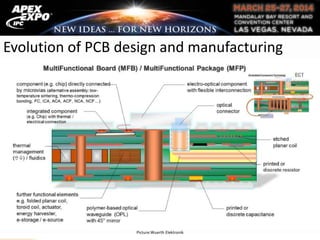
Picture:Wuerth Elektronik
Evolution of PCB design and manufacturing
IPC technology projection 2010
Introduction to embedded PCB components
• Embedded PCB Components are components (R’s, C’s,
L’s, IC’s, etc.) that are either formed or placed between
inner layers of a PCB.
• Integration of Embedded PCB Components into the
PCB, also referred to as 3D PCB integration or
technologies, further opens the door to the
miniaturization of electronics.
• Some of these technologies have been in use for over
20 years. However, ongoing advances in
manufacturing capabilities continue to make it easier
to implement in practice.
Trend of Placed Embedded Components for High
Frequency Applications [4]
General technological progression to Embedded Components [9]
Advantages and disadvantages
Advantages:
1. Reduction in outer layer surface area
2. Increase in functionality for same surface area (greater density)
• For example, the number of components in mobile phones is increasing, however
the general form factor limitations remain the same
3. Performance improvement
• Shorter trace lengths with reduced trace inductance - allows for increased circuit
speed
4. Potential decrease in total assembled costs
• PCB cost will be higher, but some cost can be offset by fewer total components for
final assembly
5. High pin-count active devices can be embedded directly within the substrate
• Protect IP
Advantages and disadvantages
Disadvantages:
1. Too many workarounds to implement within legacy 2D design
tools
2. Meeting tolerance requirements can be more difficult for formed
components
• Trimming can be slow and expensive
3. Achieving required value from formed (passive) components is
difficult
4. Prototype cost is higher
5. Embedded components can be damaged during assembly
• Rework is not possible
6. Multiple dies will increase number of power-rails
7. Impact on thermal behavior
8. Availability of bare-dies from IC vendor? (added cost)
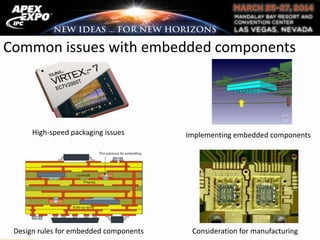
Common issues with embedded components
High-speed packaging issues
Consideration for manufacturing
Implementing embedded components
Design rules for embedded components
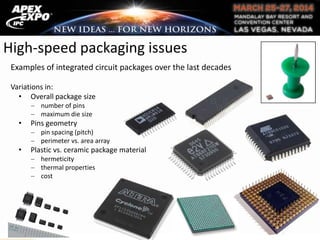
High-speed packaging issues
Examples of integrated circuit packages over the last decades
Variations in:
• Overall package size
number of pins
maximum die size
• Pins geometry
pin spacing (pitch)
perimeter vs. area array
• Plastic vs. ceramic package material
hermeticity
thermal properties
cost
High-speed packaging issues
Picture: Renesas [12]
High-speed packaging issues
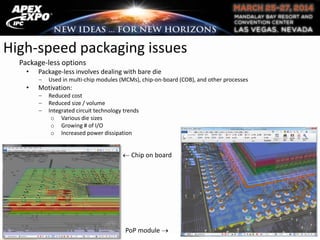
Package-less options
• Package-less involves dealing with bare die
Used in multi-chip modules (MCMs), chip-on-board (COB), and other processes
• Motivation:
Reduced cost
Reduced size / volume
Integrated circuit technology trends
o Various die sizes
o Growing # of I/O
o Increased power dissipation
Chip on board
PoP module
Placing active components
 As more functions are required for the same surface
area, there is a rapid increase in the use of
embedded placed components.
 Some component suppliers are producing specialized
low-profile components more suited for embedding
into a PCB.
 On the upper right there is a stacked SiP with 4 IC-
dies embedded shown.
 In the example right, embedded cores created by
stacking multiple prepreg layers with cavities cut out
for the components. Prepreg layers are stacked until
all components are covered.
 Pressure and heat are then applied to cure the
prepreg layers surrounding the components to create
a new core. The core with embedded components
can then be used as building blocks for the rest of
the PCB.
Embedded Component Cores
PCB with two embedded cores [3]
(Picture: FhG-IZM Berli
Placing active components
 Two methods of making connects to embedded components are shown below:
1. Solder connection:
This method requires the embedded component to be soldered to an inner layer.
Risk: solder could melt during subsequent processes.
2. Direct via connection:
For this method the component is not soldered to an inner layer trace but rather connected directly to a via.
Benefit: further reduction in trace length.
Risk: the embedded component could be damaged during blind via laser drilling or during via plating.
 From the limitations provided above, it should be clear that manufacturability is a key
limiting factor in the use of embedded placed components. Ongoing improvements in
manufacturability are being pursued to address these concerns.
Embedded PCB Connections for a Placed Capacitor [7]
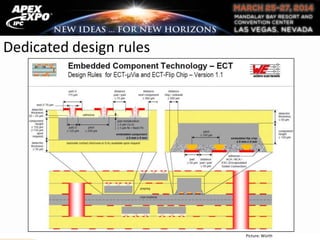
Dedicated design rules
Picture: Würth
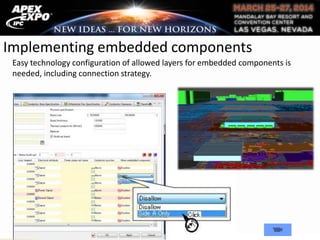
Implementing embedded components
Easy technology configuration of allowed layers for embedded components is
needed, including connection strategy.
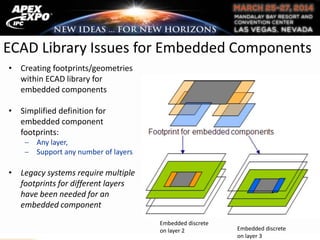
ECAD Library Issues for Embedded Components
Embedded discrete
on layer 2 Embedded discrete
on layer 3
• Creating footprints/geometries
within ECAD library for
embedded components
• Simplified definition for
embedded component
footprints:
Any layer,
Support any number of layers
• Legacy systems require multiple
footprints for different layers
have been needed for an
embedded component
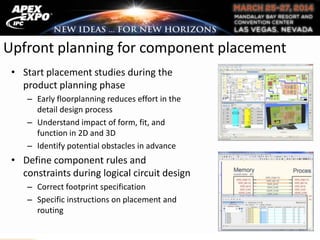
Upfront planning for component placement
• Start placement studies during the
product planning phase
– Early floorplanning reduces effort in the
detail design process
– Understand impact of form, fit, and
function in 2D and 3D
– Identify potential obstacles in advance
• Define component rules and
constraints during logical circuit design
– Correct footprint specification
– Specific instructions on placement and
routing
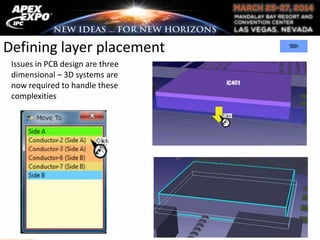
Defining layer placement
Issues in PCB design are three
dimensional – 3D systems are
now required to handle these
complexities
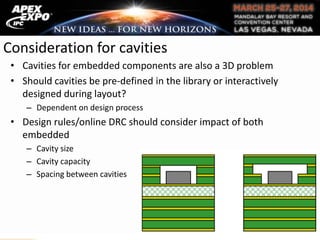
Consideration for cavities
• Cavities for embedded components are also a 3D problem
• Should cavities be pre-defined in the library or interactively
designed during layout?
– Dependent on design process
• Design rules/online DRC should consider impact of both
embedded
– Cavity size
– Cavity capacity
– Spacing between cavities
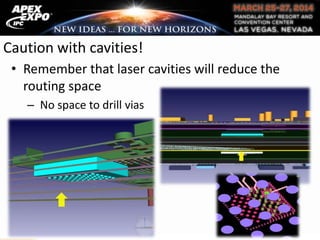
Caution with cavities!
• Remember that laser cavities will reduce the
routing space
– No space to drill vias
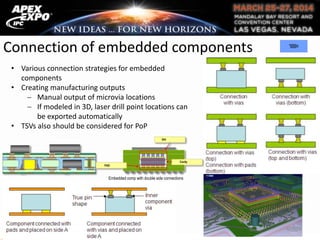
Connection of embedded components
• Various connection strategies for embedded
components
• Creating manufacturing outputs
Manual output of microvia locations
If modeled in 3D, laser drill point locations can
be exported automatically
• TSVs also should be considered for PoP
Embedded comp with double side connections
IVH
PAD
Cavity
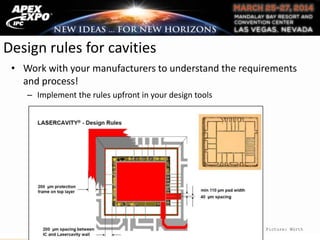
Design rules for cavities
• Work with your manufacturers to understand the requirements
and process!
– Implement the rules upfront in your design tools
Picture: Würth
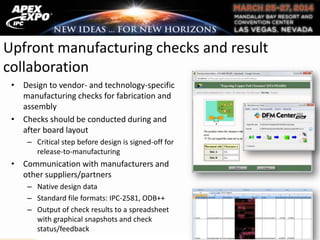
Upfront manufacturing checks and result
collaboration
• Design to vendor- and technology-specific
manufacturing checks for fabrication and
assembly
• Checks should be conducted during and
after board layout
– Critical step before design is signed-off for
release-to-manufacturing
• Communication with manufacturers and
other suppliers/partners
– Native design data
– Standard file formats: IPC-2581, ODB++
– Output of check results to a spreadsheet
with graphical snapshots and check
status/feedback
Summary/Conclusion
• It is important to understand the challenges involved with
embedded components
– Value can be realized – important to plan and drive design to
correct specification
• Work closely with your manufactures and capture guidelines
– All major ones are able to implement various embedded
component technologies
– Manufacturing process has matured in various industries:
consumer, telecom, defense, and medical
• Start placement studies as early as the product planning
phase to optimize floorplanning and understand potential
design challenges
• Working with these technologies induces a 3D problem
– Consider a true 3D design approach for implementation
• Important to design in real-time to correct design and
manufacturing rules
References
(1) “Printed Circuits Handbook: Sixth Edition, Chapter 21: Embedded Components. “, Clyde F. Coombs, Jr. (2008). New
York, NY: McGraw-Hill
(2) “Novel Substrate with Combined Embedded Capacitance and Resistance for Better Electrical Performance and
Higher Integration”, John Andresakis, Daniel Brandler, & Dong Nong, 2006 Electronic Components and Technology
Conference.
(3) “Optimization of PCB build-up layer configuration for electronic assemblies with active embedded components in
the board”, W.C. Maia Filho, M. Brizoux, & A. Grivon, 11th International Conference on Thermal, Mechanical and
Multiphysics Simulation and Experiments in Micro-Electronics and Micro-Systems, EuroSimE 2010.
(4) “Embedded Passive Components to Increase the Reliability of High-Frequency Electronic Circuits”; Yves Ousten,
Bruno Levrier, Genevieve Duchamp, & Philippe Kertesz, IXL Enseirb UMR5818, France.
(5) “Embedding components into PCBs needs accurate, reliable placement”. Eric Klaver (2011),
www.globalsmteasia.com.
(6) “Implementing HDI and Embedded Passives in a High-Reliability Aerospace Application”, Happy Holden,
Microsystems, Packaging, Assembly & Circuits Technology Conference, IMPACT 2008. 3rd International.
(7) “PCBs with embedded components emerge for capacitors”, Akihisa Seki, AEI by Dempa Publications, Inc., March
2011.
(8) “Design for Embedded Components in PCB Structures”. Dean Wiltshire, www.wirelessdesignmag.com.
(9) “Embedded Components in PCB”. Risto Tuominen, Embera Electronics.
(10) “Embedded Magnetics Opens Door to New Approach to Circuit Design”, Steven R. Kubes ECN, 55(12), 26-28,
November 2011.
(11) “Embedded Chip Packages – Technology and Application”, L.Boettcher, D.Manessis, A.Ostmann, S.Karaszkiewicz,
H.Reichl, Frauenhofer-IZM Berlin, SMTA Int. Conference 2008.
(12) Renesas: http://www.renesas.eu/products/package/characteristic/index.jsp

Implementing the latest embedded component technology from concept-to-manufacturing

  • 1.
    Implementing Embedded Component fromConcept-to- Manufacturing IPC APEX 2014 Humair Mandavia, Executive Director, Zuken SOZO Center
  • 2.
    Agenda ZUKEN Embedded Components  Overviewof embedded component technologies  Common issues with embedded components  Design for embedded components from concept-to-manufacturing  Summary
  • 3.
    Evolution of ComputerEngineering Past innovationsThe origin The Present Technology continues to evolve
  • 4.
    Picture:Wuerth Elektronik Evolution ofPCB design and manufacturing
  • 5.
  • 6.
    Introduction to embeddedPCB components • Embedded PCB Components are components (R’s, C’s, L’s, IC’s, etc.) that are either formed or placed between inner layers of a PCB. • Integration of Embedded PCB Components into the PCB, also referred to as 3D PCB integration or technologies, further opens the door to the miniaturization of electronics. • Some of these technologies have been in use for over 20 years. However, ongoing advances in manufacturing capabilities continue to make it easier to implement in practice. Trend of Placed Embedded Components for High Frequency Applications [4] General technological progression to Embedded Components [9]
  • 7.
    Advantages and disadvantages Advantages: 1.Reduction in outer layer surface area 2. Increase in functionality for same surface area (greater density) • For example, the number of components in mobile phones is increasing, however the general form factor limitations remain the same 3. Performance improvement • Shorter trace lengths with reduced trace inductance - allows for increased circuit speed 4. Potential decrease in total assembled costs • PCB cost will be higher, but some cost can be offset by fewer total components for final assembly 5. High pin-count active devices can be embedded directly within the substrate • Protect IP
  • 8.
    Advantages and disadvantages Disadvantages: 1.Too many workarounds to implement within legacy 2D design tools 2. Meeting tolerance requirements can be more difficult for formed components • Trimming can be slow and expensive 3. Achieving required value from formed (passive) components is difficult 4. Prototype cost is higher 5. Embedded components can be damaged during assembly • Rework is not possible 6. Multiple dies will increase number of power-rails 7. Impact on thermal behavior 8. Availability of bare-dies from IC vendor? (added cost)
  • 9.
    Common issues withembedded components High-speed packaging issues Consideration for manufacturing Implementing embedded components Design rules for embedded components
  • 10.
    High-speed packaging issues Examplesof integrated circuit packages over the last decades Variations in: • Overall package size number of pins maximum die size • Pins geometry pin spacing (pitch) perimeter vs. area array • Plastic vs. ceramic package material hermeticity thermal properties cost
  • 11.
  • 12.
    High-speed packaging issues Package-lessoptions • Package-less involves dealing with bare die Used in multi-chip modules (MCMs), chip-on-board (COB), and other processes • Motivation: Reduced cost Reduced size / volume Integrated circuit technology trends o Various die sizes o Growing # of I/O o Increased power dissipation Chip on board PoP module
  • 13.
    Placing active components As more functions are required for the same surface area, there is a rapid increase in the use of embedded placed components.  Some component suppliers are producing specialized low-profile components more suited for embedding into a PCB.  On the upper right there is a stacked SiP with 4 IC- dies embedded shown.  In the example right, embedded cores created by stacking multiple prepreg layers with cavities cut out for the components. Prepreg layers are stacked until all components are covered.  Pressure and heat are then applied to cure the prepreg layers surrounding the components to create a new core. The core with embedded components can then be used as building blocks for the rest of the PCB. Embedded Component Cores PCB with two embedded cores [3] (Picture: FhG-IZM Berli
  • 14.
    Placing active components Two methods of making connects to embedded components are shown below: 1. Solder connection: This method requires the embedded component to be soldered to an inner layer. Risk: solder could melt during subsequent processes. 2. Direct via connection: For this method the component is not soldered to an inner layer trace but rather connected directly to a via. Benefit: further reduction in trace length. Risk: the embedded component could be damaged during blind via laser drilling or during via plating.  From the limitations provided above, it should be clear that manufacturability is a key limiting factor in the use of embedded placed components. Ongoing improvements in manufacturability are being pursued to address these concerns. Embedded PCB Connections for a Placed Capacitor [7]
  • 15.
  • 16.
    Implementing embedded components Easytechnology configuration of allowed layers for embedded components is needed, including connection strategy.
  • 17.
    ECAD Library Issuesfor Embedded Components Embedded discrete on layer 2 Embedded discrete on layer 3 • Creating footprints/geometries within ECAD library for embedded components • Simplified definition for embedded component footprints: Any layer, Support any number of layers • Legacy systems require multiple footprints for different layers have been needed for an embedded component
  • 18.
    Upfront planning forcomponent placement • Start placement studies during the product planning phase – Early floorplanning reduces effort in the detail design process – Understand impact of form, fit, and function in 2D and 3D – Identify potential obstacles in advance • Define component rules and constraints during logical circuit design – Correct footprint specification – Specific instructions on placement and routing
  • 19.
    Defining layer placement Issuesin PCB design are three dimensional – 3D systems are now required to handle these complexities
  • 20.
    Consideration for cavities •Cavities for embedded components are also a 3D problem • Should cavities be pre-defined in the library or interactively designed during layout? – Dependent on design process • Design rules/online DRC should consider impact of both embedded – Cavity size – Cavity capacity – Spacing between cavities
  • 21.
    Caution with cavities! •Remember that laser cavities will reduce the routing space – No space to drill vias
  • 22.
    Connection of embeddedcomponents • Various connection strategies for embedded components • Creating manufacturing outputs Manual output of microvia locations If modeled in 3D, laser drill point locations can be exported automatically • TSVs also should be considered for PoP Embedded comp with double side connections IVH PAD Cavity
  • 23.
    Design rules forcavities • Work with your manufacturers to understand the requirements and process! – Implement the rules upfront in your design tools Picture: Würth
  • 24.
    Upfront manufacturing checksand result collaboration • Design to vendor- and technology-specific manufacturing checks for fabrication and assembly • Checks should be conducted during and after board layout – Critical step before design is signed-off for release-to-manufacturing • Communication with manufacturers and other suppliers/partners – Native design data – Standard file formats: IPC-2581, ODB++ – Output of check results to a spreadsheet with graphical snapshots and check status/feedback
  • 25.
    Summary/Conclusion • It isimportant to understand the challenges involved with embedded components – Value can be realized – important to plan and drive design to correct specification • Work closely with your manufactures and capture guidelines – All major ones are able to implement various embedded component technologies – Manufacturing process has matured in various industries: consumer, telecom, defense, and medical • Start placement studies as early as the product planning phase to optimize floorplanning and understand potential design challenges • Working with these technologies induces a 3D problem – Consider a true 3D design approach for implementation • Important to design in real-time to correct design and manufacturing rules
  • 28.
    References (1) “Printed CircuitsHandbook: Sixth Edition, Chapter 21: Embedded Components. “, Clyde F. Coombs, Jr. (2008). New York, NY: McGraw-Hill (2) “Novel Substrate with Combined Embedded Capacitance and Resistance for Better Electrical Performance and Higher Integration”, John Andresakis, Daniel Brandler, & Dong Nong, 2006 Electronic Components and Technology Conference. (3) “Optimization of PCB build-up layer configuration for electronic assemblies with active embedded components in the board”, W.C. Maia Filho, M. Brizoux, & A. Grivon, 11th International Conference on Thermal, Mechanical and Multiphysics Simulation and Experiments in Micro-Electronics and Micro-Systems, EuroSimE 2010. (4) “Embedded Passive Components to Increase the Reliability of High-Frequency Electronic Circuits”; Yves Ousten, Bruno Levrier, Genevieve Duchamp, & Philippe Kertesz, IXL Enseirb UMR5818, France. (5) “Embedding components into PCBs needs accurate, reliable placement”. Eric Klaver (2011), www.globalsmteasia.com. (6) “Implementing HDI and Embedded Passives in a High-Reliability Aerospace Application”, Happy Holden, Microsystems, Packaging, Assembly & Circuits Technology Conference, IMPACT 2008. 3rd International. (7) “PCBs with embedded components emerge for capacitors”, Akihisa Seki, AEI by Dempa Publications, Inc., March 2011. (8) “Design for Embedded Components in PCB Structures”. Dean Wiltshire, www.wirelessdesignmag.com. (9) “Embedded Components in PCB”. Risto Tuominen, Embera Electronics. (10) “Embedded Magnetics Opens Door to New Approach to Circuit Design”, Steven R. Kubes ECN, 55(12), 26-28, November 2011. (11) “Embedded Chip Packages – Technology and Application”, L.Boettcher, D.Manessis, A.Ostmann, S.Karaszkiewicz, H.Reichl, Frauenhofer-IZM Berlin, SMTA Int. Conference 2008. (12) Renesas: http://www.renesas.eu/products/package/characteristic/index.jsp

Editor's Notes

  • #5 To support this innovation, there has been a parallel evolution on the design and manufacturing of PCBs. Companies are working closely with their manufacturers to refine the process of producing “multi-functional” boards and packages to support the requirements for new product development using cutting-edge technologies. Some of these boards include electro-optical components with flexible interconnections, embedded optical connectors and polymer-based optical waveguide Embedding passive and active components within the substrate with laser cavities, and now placing high pin-count ICs within the substrate with microvias connecting both sides of the chip to adjacent conduct layers is a commodity these days for advanced PCB manufacturers.
  • #6 Sharon Starr, Director of Market Research at IPC, reported in 2010 that, “Embedded components, could move board manufacturers into the role of chip integrators. The board will become one large component. Embedded components have been typically used to form or place passive components on inner layers of PCBs. With the continuous push of miniaturization of electronics, the industry is further pursuing new ways to expand the implementation and manufacturing, we are already seeing companies exploring the mass production of boards with embedded processors, including the use of complex system-in-package (SiP) devices on boards to push the envelope on product form factors.
  • #7 Started with embedded passivesPushing miniaturization, 2.5/3D IC, and embedding actives into the substrate
  • #8 High-level advantages of embedded components:Reduction or optimization of real-estate Increased functionality for same surface For example, the number of components in mobile phones is increasing, however the general form factor limitations remain the samePerformance improvement Shorter trace lengths with reduced trace inductance - allows for increased circuit speedTraces closer to reference planes to improve SI characteristics or even components formed within a Faraday cage to reduce susceptibility.Potential decrease in total assembled costsPCB cost will be higher, but some cost can be offset by fewer total components for final assemblySolving thermal issuesUsing the structure of the board to dissipate heatEliminating reliability issuesComponents within a board are less susceptible to failure if the board suffers flexing in its environmentHigh pin-count active devices can be embedded directly within the substrateThis can be used to project the IP of your design
  • #9 Disadvantages of embedded components:Design and building designs with embedded components can be a challenge with current toolsMeeting tolerance requirements can be more difficult for formed components Trimming can be slow and expensiveAchieving required value from formed (passive) components is difficult Prototype cost is higherEmbedded components can be damaged during assemblyRework is not possibleMultiple dies will increase number of power-railsImpact on thermal behavior of the systemAdded cost of getting bare-dies from IC vendors or development of ASIC devices for inner layer placement
  • #10 From a design perspective, we have been planning and designing boards as if they are two-dimensional objects, but with advancements in embedded component technology, electronic design needs to be treated as a three-dimensional problem. Design teams need to work closely and intelligently from the conceptual phase of the design process, all the way down to manufacturing, and they cannot continue working only on one board or package at a time – they need to design their products as a complete system. Some of common issues found when working with embedded components include the high-speed packaging and characteristic issues, understanding the required design rules and implementing embedded components within the design, and considering the requirements for fabrication and assembly with upfront rules to design for manufacturing.
  • #11 When considering components to embed within your design, the first things to be considered are the packaging and the high-speed requirements of the device. Whether the IC is designed internally, outsourced, or purchased off the shelf, engineers have to take into account the overall size, including the total pin count and die size. Also, the spacing or pitch between the pins within the geometry, along with the package material (for embedded passive devices) has an impact on the process used to embed the component and the required stack-up for the PCB. Engineers must also consider the material of the package due to impact on hermeticity, thermal effects, cost, and other factors that determine the selection of the component that will be embedded. Examples of integrated circuit packages over the last decadesVariations in:Overall package sizenumber of pinsmaximum die sizePins geometrypin spacing (pitch)perimeter vs. area arrayPlastic vs. ceramic package materialhermeticitythermal propertiescost...characteristics of the components to be sealed, the wetting and adhesion characteristics of molten glass at sealing temperatures, and the chemical durability of glass during service. Hermeticity is often a desired result in glass sealing. A prime example of hermetic seals are in lightbulbs, in which metal conducting wires are sealed through glass in order to maintain an inert...
  • #12 This trend in IC design continues to result in high performing, miniaturized, low power consuming, and lower cost devices that require finer design rules, higher clock frequency, and lower core and I/O voltages.Design teams are then faced with newer challenges, such as more heat dissipation, greater electrical noise, and higher risk of issues with signal quality, so taking into account proper thermal and electrical noise management in advance when considering embedded components becomes even more vital to the design process.
  • #13 One solution to dealing with high-speed devices is to consider a package-less approach and embed the bare die directly within the PCB. Applying a bare die for PCB design is more commonly used for multi-chip modules (MCMs) or chip-on-board (COB) assembly technology. The benefits of this approach lead to reduced cost and savings in board area space with reduced size and volume. It also addresses some of the challenges associated with high-speed packages, such as the growing number of I/Os and increasing power dissipation. Utilizing package-less devices enables die stacking, where bare die of comparable sizes are bonded together and now connected together using through-silicon vias (TSVs), more commonly found in dense system-in-package (SiP) devices.
  • #14 If you think about board floorplanning, and considering the next generation smartphone designs or wearable computer products such as a smart watch or smart glasses, it’s a constant battle to satisfy all the functional, electrical, and mechanical requirements with so little space. This is where we are experiencing breakthrough approaches on the use and placement of embedded components in both rigid and flexible PCBs. Some component suppliers are producing specialized low-profile components more suited for embedding into a PCB for the latest applications.Some of the breakthroughs in placement of embedded components include inserting a stacked SiP within the substrate (Figure 3) and placing active components with cavities on core layers within the stack-up (Figure 4). The ability to place components on the core layers is made possible by stacking multiple prepreg layers with cavities cut out for the components. The prepreg layers are stacked until all components are covered with the proper spacing requirements. Pressure and heat are then applied to cure the prepreg layers surrounding the components to create a new core. The core with embedded components can then be used as building blocksfor the rest of the PCB.
  • #15 There are two primary methods of connecting active components within the inner layers of a PCB:One method is to solder the component directly to a conductive layer. This approach is a more proven and manufacturable method, but the risk you take is that the solder could melt during subsequent steps within the manufacturing process. The second method is to place the active component between conductive layers, directly within the laminate and connect to the conduct layers using a laser-inserted microvia. The benefit of this approach is that it allows the connection on both sides of the IC, resulting in minimized footprint of the geometry of the IC and maximized pin-outs for the device. This allows improved fan-out and routability from the device and can help reduce overall trace lengths to improve signal performance. The issue you may incur is that the embedded component could be damaged during blind via laser drilling or during via plating. By understanding these limitations and risks, it should be clear that manufacturability is a key limiting factor in the approach considered in placing active components. Many companies are working closely with their suppliers and manufacturers to help mature this process and ongoing improvements are being pursued to address these concerns. With these breakthroughs, design teams can apply new solutions to the floorplanning issues found in PCB design today and continue to innovate to create the next wave of cutting-edge products.
  • #16 Before design starts, its important to understand the required design rules. Design rules for embedded components add a layer of complexity – it’s a 3D problemIf we look at the required rules as seen in this example chart from Wurth Electronics, you have to consider many factors:build-up microvias structures, Pin and drill pitch requirements, pad-to-pad spacing spacing for components on inner layers, recommended thicknesses for the components, minimum dielectric thickness and spacing to consider between the adhesive sidewall to the edge of the component body. If we study these additional rules, we can see that many of the rules are take into account the required specifications for both the inner layers and in the Z-axis direction. We have been designing with these technologies far too often with manual and error-prone work-around, so it is important that we setup our design tools with the correct set of rules upfront to take advantage of 3D systems to design technologies within our products intelligently and accurately.
  • #17 During the setup of the design rules, designers should also take into consideration the actual layers that are allowed for embedded components and what is the mounting side, also the connection strategy used for each layer. Depending on the manufacturer or stack-up materials, engineers may have the freedom to place components on any layer or mount them on any side. If you are working with boards that require embedded components with cavities, then there might be restrictions on what layers can be used for embedded components or what side they are mounted on. It is important to collaborate closely with your manufacturing vendors to understand the process, and define these types of placement rules in your design rule library to avoid problems during the detail design phase.
  • #19 Most design teams have a system or hardware architect that starts the product concept or planning by gathering the various requirements from many sources, such as the CEO/CTO of the company, marketing, or industrial engineers. The system or hardware architect will then use a variety of different standard tools found on their desktop to start outlining the high-level details of the new product. These tools include spreadsheets, presentation slides, text documents, block diagrams, and drawing tools. Unfortunately, most of these tools were never intended for electronic design. When tackling the issue of embedded components, many of the real detail impact study cannot take place until you have an actual design file generated in the ECAD system.  To optimize the placement and partitioning of electronic systems, the best approach is to start the design planning process with a system-level product planning tool integrated with the detail design process and intended for electronic design. The system architect can accurately floorplan the designs and understand the impact of the actual real estate of the various boards to see how much space can be saved or new functions added when using embedded components to help the architect conduct trade-off studies. This approach enables designers to leverage design reuse and maintain a link with changes to determine which version of the design is best to send to production, and also helps start early planning of the next design iteration. Since the architect will have 2D and 3D views of the design along with functional block diagram and bill-of-materials (BOM), he can create outputs to start early thermal, electromagnetic, and RF analysis. He can also share information with 3D MCAD systems to collaborate on the mechanical aspects of the design such as the enclosure of the product to conduct interference checks.  During the logical circuit design phase, the hardware or electrical engineer can take the design data from the planning phase to begin work on the remaining part of the design. The hardware engineer will have more information about the details of the stack-up to be used on the project, and then communicate to the PCB designer and the manufacturer on the materials and thicknesses. This approach will help realize requirements related to impedance-controlled signals and other high-speed constraints. Depending on the process used by a given design team, it is important that the engineer can also define constraints for the embedded components during this phase to specify, for instance, the required layer and the footprint to be used during layout. The PCB designer can also determine this, but if the hardware engineer has this option, it can save time during the design process. Also the engineer should be able to attach notes with specific instructions or associate images to the schematic design to share with the PCB designer during layout.
  • #20 Once you get to the physical circuit design phase, it is time to start the detail floorplanning or placement process for the embedded components. If you are using a traditional 2D system, there may be enough functionality to place standard discrete components directly formed or mounted on inner layers. Check that there are proper design rule checks in place to ensure errors do not occur. If you are working with discrete or active components that will be placed on inner layers potentially including cavities or needing connections with microvias, then a native 3D system is more suitable. Designers have access to the necessary design rule checks to support the real-time placement tasks and it will simply model the actual connections on inner layers and manage the cavity structures. The cavity shapes may also require unique shapes per layer. It is important to define these details accurately with input from the manufacturer. Make sure to also define the design rules for cavities. Example of design rules can be seen in Figure 7. The important thing to remember when working with cavities and embedding high pin-count devices is that it does take up routing space on the inner layer, so plan for this in advance.
  • #21 Cavities for embedded components are also a 3D problemShould cavities be pre-defined in the library or interactively designed during layout?Dependent on design processDesign rules/online DRC should consider impact of both embeddedCavity sizeCavity capacitySpacing between cavities
  • #23 Now that the design rules have been assigned to your board, it is time to start the detail floorplanning or placement process for the embedded components. If you are using a traditional 2D system, there may be enough functionality to place standard discrete components directly formed or mounted on inner layers. Check that there are proper design rule checks in place to ensure errors do not occur. If you are working with discrete or active components that will be placed on inner layers potentially including cavities or needing connections with microvias, then a native 3D system is more suitable. Pin centroids are required in 2D
  • #24 The cavity shapes may be defined from the library or in the designRules such as:Component to wall spacingComponent to adjacent layer spacingPad width and pin pitchCavity to cavity clearanceCavity component density
  • #25 Design to vendor- and technology-specific manufacturing checks for fabrication and assemblyChecks should be conducted during and after board layoutCritical step before design is signed-off for release-to-manufacturingCommunication with manufacturers and other suppliers/partnersNative design dataStandard file formats: IPC-2581, ODB++Output of check results to a spreadsheet with graphical snapshots and check status/feedback
  • #26 There are many benefits of using embedded components today. When working with embedded components, it is important to understand the current and new approaches for implementation and the necessary steps and challenges within the design process. As manufacturing processes continue to mature, you can easily realize your new products with more functions within the same or less space and still achieve of the right margins for profitability. Technology has advanced, so too have the methodologies that are currently being used or explored with embedded components, including the increased use of cavities and connection options for high pin-count devices.  To gain the greatest value and result of using embedded components, start the floorplanning of your electronic system during the planning phase and take a rules-driven approach across the logical and physical circuit design phase and into manufacturing. If you can utilize a 3D platform to plan and design your printed circuit boards with embedded components, it will help you model your design and generate the outputs to manufacturing with accuracy, and can help save time across the product development cycle.