Implementation and
  Institutionalization of
 Technology to Improve
Academic Readiness Skills


                  A Case Study

         Brett Mahan, James De Lane &
         Melissa Smith
Introduction
• At some point in the history of any organization, it has adopted a
  new innovation or idea in order to improve various processes or
  generate more efficiency.
• Subsequently the new innovation results in a detrimental cycle of
  unintended outcomes
   – growing to be ineffectual
   – turning out to be unused
   – eventually becoming abused
• These negatively unplanned outcomes waste valuable resources
  and frustrate the very people the innovation was intended to
  help.
• So, how does an organization attempt to prevent substandard
  results procured from this cycle?
• During the process of diffusion theory, a
  technological innovation
  –   creates awareness
  –   arouses interest
  –   undergoes trial
  –   accomplishes adoption
• However, two steps transpire following the
  adoption of an innovation, and are essential for
  the enduring success of the innovation.
  – Implementation
  – Institutionalization
•After the determination to use an innovation,
 implementation commences through the actual
 utilization of that innovation into practice (i.e.
 teaching or instruction in a classroom).
•The Association of Education and Communication
 Technology’s (AECT) standard says
  –“using instructional materials and strategies in real
   settings . . . to facilitate appropriate use of the
   innovations by individuals in the organization.” (AECT
   Standard, 2002, Std. 3.3).
•Surry and Ely illustrate eight conditions, required
 from an organization, which contribute to the
 successful implementation of an innovation
 (Surry and Ely, n.d).
Surry and Ely’s 8
Facilitative Conditions

1. Dissatisfaction with   5. Rewards and/or
   the status quo            incentives exist
2. Knowledge and          6. Participation
   skills exist           7. Commitment
3. Availability of        8. Leadership
   resources                – of the executive officer
4. Availability of time     – within the institution or
                              project
• Increasingly, schools are seeking to incorporate
  technology into their curricular programs in order to
  – improve the quality of learning activities for the students
    in order to enhance school readiness
  – expand the efficiency and effectiveness of the teachers in
    order to complete additional pertinent work
• Technology also prevalent in the pre-kindergartens,
  preschools and other early childhood education
  institutions
• This case study examines one such pre-kindergarten
  (Forever Growing) and its devotion to providing high
  quality academic and social learning experiences.
• The director of Forever Growing plans to coordinate with
  representatives from the Instructional Design Technology
  Department at the University of Houston Clear Lake
  (UHCL).
   – UHCL will design and develop various DVDs and internet-based
     learning modules for utilization by the school
   – UHCL will construct a school web page and establish visibility in
     several of the social media forums
• This case study will evaluate whether the aforementioned
  conditions offered by Surry and Ely are present at Forever
  Growing and where they, if any, are lacking.
• Then it will identify strategies to establish these conditions
  within the school.
Background of the School
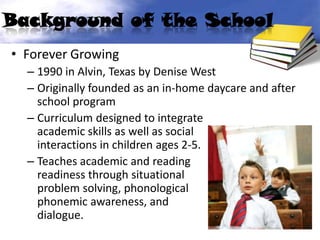
• Forever Growing
  – 1990 in Alvin, Texas by Denise West
  – Originally founded as an in-home daycare and after
    school program
  – Curriculum designed to integrate
    academic skills as well as social
    interactions in children ages 2-5.
  – Teaches academic and reading
    readiness through situational
    problem solving, phonological          and
    phonemic awareness, and              social
    dialogue.
• School employs five full time teachers and one part
  time teacher in order to split the classrooms
  according to developmentally appropriate age
  groups.
• Expenditures
  –   40% on teacher training and salary
  –   30% on curriculum materials
  –   20% on office upkeep
  –   10% on miscellaneous (marketing, billing, etc.)
• Mission statement: support small class sizes, teacher
  guidance, and the perception that the attainment of
  knowledge is a continuous process.
Specific Area of Interest
• Forever Growing
   – small, privately owned
     preschool
   – total of 6 teachers on staff
• Its small size can be an
  advantage or a
  disadvantage when it
  comes the diffusion and
  implementation of
  technological
  innovations.
• Once a technology has been adopted, an organization must establish a
  plan which includes strategies with the purpose of
   – ensuring that the innovation is integrated into the structure and culture of the
     organization
   – is appropriately managed by the workforce
• Surry and Ely describe variables which impact the effectiveness of
  implementation
   – organizational climate
   – political complexity (not applicable within this case study)
   – demographics
   – attributes of the innovation itself
• This case study will design a strategy focusing on the eight conditions
  as well as addressing the controlling variables in support for Forever
  Growing to achieve a successful implementation of the impending
  educational technology innovations.
• Institutionalization is successfully achieved when an
  innovation is “…routinely used in settings for which it was
  designed. It [the innovation] has become integral to the
  organization or the social system and is no longer
  considered to be an innovation.” (Surry & Ely, n.d.).


• At this point, the innovation is considered to be
  institutionalized as an integrated part of the organizational
  structure.
• Surry and Ely also suggest six • This case study proposes
  commonly accepted                      strategies for assessing the
  indicators of                          degree of institutionalization
  institutionalization. They             of the newly procured
  are:                                   educational technology
   – Acceptance by relevant participants innovations established at
   – The innovation is stable and        Forever Growing.
     routinized
   – Widespread use of the innovation
     throughout the institution or
     organization
   – Firm expectation that use of the
     practice and/or product will continue
     within the institution or organization
   – Continuation does not depend upon
     the actions of specific individuals but
     upon the organizational culture,
     structure or procedures
   – Routine allocations of time and
     money
School’s History and
Growth
            • Embraced an optimistic
              vision and a determined
              outlook.
            • Experienced many
              challenges and numerous
              triumphs.
            • Learned from the obstacles
              and victories
            • Believe that the school can
              overcome any adversity in
              order to achieve success
• Timeline of History and Growth
  – 1990 - Began with 5 students and grew to 12 students in just a
    couple of months.
  – 1991 - School was becoming overcrowded and had to
    reluctantly turn away children
  – 1994 - After-school program abandoned order to better assist
    the future progress of the school.
  – Currently – Supports a wonderful staff, a great facility and a
    prominent curriculum. Enrolls almost 100 full and part time
    students each year in their pre-kindergarten program.
• Forever Growing has witnessed periods of
  difficulty and hardship as well as stages of
  remarkable prosperity and growth.
Strengths and Weaknesses
• Strengths
  – Strong management system
  – High quality curriculum
  – Effective teacher training and
    staff development
• Weaknesses
  – Obtaining financial capital
  – Utilizing media instructional technology
  – Developing effective marketing materials
Responses and Results of the
School’s Current Strategy
• Largest challenge is obtaining the financial capital
  which
   – Maintains the operations
   – Supports the acquisition and implementation of resources
   – Improve the educational quality of its programs
• Addressing these challenges
   – Implements a mixture of initiatives to both raise funds and avoid
     costs.
   – Obtain full and partial scholarships from local businesses to help
     off-set tuition costs
   – Receives assistance with fund raising activities and donation
     matching from the community
   – Acquires one time financial gifts
   – Teachers have voluntarily given up their pay raises
• In spite of everything, there is not sufficient
  capital to acquire additional educational
  resources (technology implementation, training)
• Additional resources are needed
  – to support the school’s over-all efforts
  – to help students especially from lower socio-economic family
    environments
• These additional resources will
  be leveraged to overcome the
  knowledge gap which many
  students possess when they
  first enroll in Forever Growing.
The Specific Problem
• Director’s decision to bridge the shortage through a
  collaborative development project with UHCL produces
  the demand for a strategy to assure the implementation
  and institutionalization of the adopted innovations.
• This case study will review the conditions mentioned by
  Surry and Ely to establish an environment favorable for
  successful implementation and institutionalization.
• The circumstances where variables and conditions are
  deficient, strategies will be developed to establish or
  augment promising conditions for these processes.
Alternatives
• The following action based alternatives are
  suggestions for an iterative process rather
  than mutually exclusive alternatives.
• These alternatives will encompass planned
  methods which support the school through
  the diffusion processes of implementation
  and institutionalization stages, focusing on
  each stage of the process.
Assessment of Environment
for Implementation
• The executive climate at Forever Growing contains a strong and
  cohesive faculty
   – who share a common set of values and a mutual group of established goals
     for the success of the school and the students.
• Teachers exhibit a variety of technology familiarity
• The technology proposed for adoption is neither exceeding
  complex nor will it require extensive technical support to operate.
• The current conditions at the school were analyzed and evaluated
  addressing variables, where necessary, within the setting. The
  current conditions at Forever Growing support successful
  implementation of the proposed technology.
• The assessment of the school’s eight facilitating conditions (more
  information see case study)
Alternatives for
Implementation
Teachers work with UHCL instructional
designers in the analysis and design phase
of the collaborative project
 • By participating in the design and development of the
   learning modules, the affluence of the teaching staff will
   become more enhanced as the products are constructed.
    – Questions can be addressed
    – Coaching will ensure any technology gaps are overcome
 • Also help to shorten the time needed for the teachers to
   feel experienced with the final products in order to
   support implementation into the instructional programs
 • Reinforce both number two and four of Surry and Ely’s
   conditions
Identify an innovator or early
adopter among the teachers to
start peer to peer conversations
plus act as mentors and tutors
• Aligns effectively with the first achievement
  suggested previously
• Through peer conversations, the less technically
  advanced teachers will engage in an informal, less
  threatening support structure in order to answer
  questions, demonstrate concepts, and facilitate
  reassurance regarding the proposed changes
• Supports the decrease in time required to establish
  a level of comfort to use and implement the
  learning programs into daily learning activities
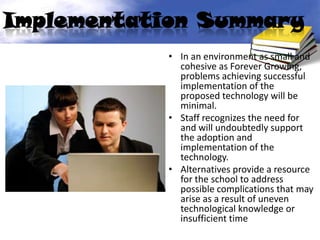
Implementation Summary
            • In an environment as small and
              cohesive as Forever Growing,
              problems achieving successful
              implementation of the
              proposed technology will be
              minimal.
            • Staff recognizes the need for
              and will undoubtedly support
              the adoption and
              implementation of the
              technology.
            • Alternatives provide a resource
              for the school to address
              possible complications that may
              arise as a result of uneven
              technological knowledge or
              insufficient time
Assessment of Environment for
Institutionalization
• All previously noted conditions supporting
  institutionalization of the proposed technology are
  substantiated except perhaps the routine allocations
  of time and money.
• Scarcity of monetary resources is one of the biggest
  challenges confronting Forever Growing.
• The project to develop a website and subscribe to
  social media forums was selected precisely to
  increase the visibility of the school beyond just the
  community
• The hope was that the increased visibility would
  result in a corresponding increase in fund raising
  success
Alternatives for
Institutionalization
• The conditions supporting successful institutionalization of an innovation
  or new technology are:
    –   Acceptance by relevant participants
    –   The innovation is stable and routinized
    –   The innovation is used throughout the entity
    –   There is a firm expectation of continuance regarding the innovation
    –   There will be routine allocations of time and money
• The current environment at Forever Growing already furnishes the
  conditions that will support institutionalization of the new technology
  once it has been adopted and implemented.
• The staff already acknowledges the need for and is supportive of the
  utilization initiative.
• The proposed technology is not complex therefore will be stable and
  easily routinized to be used throughout the school.
• Additionally, there is a strong intention to continue using the technology
  once it is implemented.
• Therefore, alternative actions are required.
Recommendations for
Future Changes
• The school director will initiate the alternatives
  recommended.
• Even if, for some reason, the initiative to acquire the
  proposed technological learning resources failed to
  materialize, the teaching staff can be trained on the
  technology which will undoubtedly pay dividends in
  the future.
• The alternatives suggested also offer a way to
  construct a professional learning community among
  the educators as well as provide a method for
  increasing decision-making input concerning the
  direction and future of the school.
How Alternatives Relate to
AECT Standard 3.3
Sub-Standard 3.3.1
•Use appropriate materials and strategies in
 various learning contexts
  – The decision by Forever Growing to adopt and implement DVDs
    and web-based learning modules into their curricular programs
    directly addresses this standard.
  – The learning modules will be used throughout the school to
    encompass a variety of subjects.
  – The alternatives and recommendations provided support the
    implementation of the proposed technology.
Sub-Standard 3.3.2
• Identify and apply techniques for integrating ECIT
  innovations in various learning contexts
  – The intended use of DVDs and web-based learning modules
    directly addresses this standard.
  – Using technology to assist in elevating the quality of the
    school’s instructional programs, will improve the foundational
    learning skills the children need throughout the K – 12 school
    environment.
Sub-Standard 3.3.3
• Identify strategies to maintain use after initial
  adoption
  – Both of the alternatives directly address this standard.
  – Involving the teaching staff in the design and development
    phase of the technology initiative creates a sense of ownership
    as well as resolves any questions or issues that may emerge
  – Additionally, using peer mentors and tutors to overcome
    knowledge deficits establishes a professional learning
    community
  – Instill a level of comfort and create an enthusiasm for the
    resources which will assure support for the continued use
  – Standards regarding integration of the technology into the
    structure and culture of the school will emerge as
    institutionalization creates permanence for the innovation
Conclusion
• Implementation and Institutionalization of the
  educational innovative technology in this case study
  does not cause an extensive or complex problem.
• Forever Growing is a small cohesive educational
  organization whose existing structure and culture
  already demonstrate many of the conditions which
  support successful implementation and
  institutionalization of the new technology.
• By following the alternatives and recommendations
  mentioned in this study, the last stages,
  implementation and institutionalization, of Forever
  Growing’s diffusion process will be a successful
  achievement.
References
•   Association for Educational Communications and Technology. (2001). What are the initial standards?
    Retrieved from http://www.aect.org/standards/initstand.html
•   Congressional and Budget Office. (2011). The Budget and Economic Outlook: Fiscal Years 2011 to
    2021. Retrieved from http://www.cbo.gov/ftpdocs/120xx/doc12039/0126_fy2011outlook.pdf
•   EDTC Curriculum Project. (n.d.). AECT rubric for the curriculum project (reflective journal). Retrieved
    from http://www.udel.edu/education/edtc/CurriculumProject.html
•   Fayol, H. (n.d.). 14 principles of management. Retrieved from
    https://blackboard9.uhcl.edu/webapps/portal/frameset.jsp?tab_group=courses&url=%2Fwebapps%2Fbla
    ckboard%2Fexecute%2Fcontent%2Ffile%3Fcmd%3Dview%26content_id%3D_164973_1%26course_id
    %3D_6328_1%26framesetWrapped%3Dtrue
•   Kolrala, S. & Sheikh, S. (2008). Software testing interview questions. Jones and Bartlett. Retrieved from
    http://my.safaribooksonline.com/book/software-engineering-and-development/software-
    testing/9781934015247/cmmi/open_parenthesis_i_close_parenthesis-
    053#X2ludGVybmFsX0ZsYXNoUmVhZGVyP3htbGlkPTk3ODE5MzQwMTUyNDcvaWk=
•   Reiser, R. & Dempsey, J.V. (2012). Trends and issues in instructional design and technology (3rd ed.).
    Allyn and Bacon.
•   Seels, B., & Richey, R. (1994). Instructional technology: The definition and domains of the field (p. 46).
    Washington, DC: Association for Educational Communications and Technology.
•   Smith, M (Producer). (2011). Forever growing: Interview with Denise West [video]. Alvin, Texas.
•   Surry, D. & Ely, D. (n.d.). Adoption, diffusion, implementation and institutionalization of educational
    technology. Retrieved from http://www.usouthal.edu/coe/bset/surry/papers/adoption/chap.htm

Case Study PowerPoint Unit 4

  • 1.
    Implementation and Institutionalization of Technology to Improve Academic Readiness Skills A Case Study Brett Mahan, James De Lane & Melissa Smith
  • 2.
    Introduction • At somepoint in the history of any organization, it has adopted a new innovation or idea in order to improve various processes or generate more efficiency. • Subsequently the new innovation results in a detrimental cycle of unintended outcomes – growing to be ineffectual – turning out to be unused – eventually becoming abused • These negatively unplanned outcomes waste valuable resources and frustrate the very people the innovation was intended to help. • So, how does an organization attempt to prevent substandard results procured from this cycle?
  • 3.
    • During theprocess of diffusion theory, a technological innovation – creates awareness – arouses interest – undergoes trial – accomplishes adoption • However, two steps transpire following the adoption of an innovation, and are essential for the enduring success of the innovation. – Implementation – Institutionalization
  • 4.
    •After the determinationto use an innovation, implementation commences through the actual utilization of that innovation into practice (i.e. teaching or instruction in a classroom). •The Association of Education and Communication Technology’s (AECT) standard says –“using instructional materials and strategies in real settings . . . to facilitate appropriate use of the innovations by individuals in the organization.” (AECT Standard, 2002, Std. 3.3). •Surry and Ely illustrate eight conditions, required from an organization, which contribute to the successful implementation of an innovation (Surry and Ely, n.d).
  • 5.
    Surry and Ely’s8 Facilitative Conditions 1. Dissatisfaction with 5. Rewards and/or the status quo incentives exist 2. Knowledge and 6. Participation skills exist 7. Commitment 3. Availability of 8. Leadership resources – of the executive officer 4. Availability of time – within the institution or project
  • 6.
    • Increasingly, schoolsare seeking to incorporate technology into their curricular programs in order to – improve the quality of learning activities for the students in order to enhance school readiness – expand the efficiency and effectiveness of the teachers in order to complete additional pertinent work • Technology also prevalent in the pre-kindergartens, preschools and other early childhood education institutions • This case study examines one such pre-kindergarten (Forever Growing) and its devotion to providing high quality academic and social learning experiences.
  • 7.
    • The directorof Forever Growing plans to coordinate with representatives from the Instructional Design Technology Department at the University of Houston Clear Lake (UHCL). – UHCL will design and develop various DVDs and internet-based learning modules for utilization by the school – UHCL will construct a school web page and establish visibility in several of the social media forums • This case study will evaluate whether the aforementioned conditions offered by Surry and Ely are present at Forever Growing and where they, if any, are lacking. • Then it will identify strategies to establish these conditions within the school.
  • 8.
    Background of theSchool • Forever Growing – 1990 in Alvin, Texas by Denise West – Originally founded as an in-home daycare and after school program – Curriculum designed to integrate academic skills as well as social interactions in children ages 2-5. – Teaches academic and reading readiness through situational problem solving, phonological and phonemic awareness, and social dialogue.
  • 9.
    • School employsfive full time teachers and one part time teacher in order to split the classrooms according to developmentally appropriate age groups. • Expenditures – 40% on teacher training and salary – 30% on curriculum materials – 20% on office upkeep – 10% on miscellaneous (marketing, billing, etc.) • Mission statement: support small class sizes, teacher guidance, and the perception that the attainment of knowledge is a continuous process.
  • 10.
    Specific Area ofInterest • Forever Growing – small, privately owned preschool – total of 6 teachers on staff • Its small size can be an advantage or a disadvantage when it comes the diffusion and implementation of technological innovations.
  • 11.
    • Once atechnology has been adopted, an organization must establish a plan which includes strategies with the purpose of – ensuring that the innovation is integrated into the structure and culture of the organization – is appropriately managed by the workforce • Surry and Ely describe variables which impact the effectiveness of implementation – organizational climate – political complexity (not applicable within this case study) – demographics – attributes of the innovation itself • This case study will design a strategy focusing on the eight conditions as well as addressing the controlling variables in support for Forever Growing to achieve a successful implementation of the impending educational technology innovations.
  • 12.
    • Institutionalization issuccessfully achieved when an innovation is “…routinely used in settings for which it was designed. It [the innovation] has become integral to the organization or the social system and is no longer considered to be an innovation.” (Surry & Ely, n.d.). • At this point, the innovation is considered to be institutionalized as an integrated part of the organizational structure.
  • 13.
    • Surry andEly also suggest six • This case study proposes commonly accepted strategies for assessing the indicators of degree of institutionalization institutionalization. They of the newly procured are: educational technology – Acceptance by relevant participants innovations established at – The innovation is stable and Forever Growing. routinized – Widespread use of the innovation throughout the institution or organization – Firm expectation that use of the practice and/or product will continue within the institution or organization – Continuation does not depend upon the actions of specific individuals but upon the organizational culture, structure or procedures – Routine allocations of time and money
  • 14.
    School’s History and Growth • Embraced an optimistic vision and a determined outlook. • Experienced many challenges and numerous triumphs. • Learned from the obstacles and victories • Believe that the school can overcome any adversity in order to achieve success
  • 15.
    • Timeline ofHistory and Growth – 1990 - Began with 5 students and grew to 12 students in just a couple of months. – 1991 - School was becoming overcrowded and had to reluctantly turn away children – 1994 - After-school program abandoned order to better assist the future progress of the school. – Currently – Supports a wonderful staff, a great facility and a prominent curriculum. Enrolls almost 100 full and part time students each year in their pre-kindergarten program. • Forever Growing has witnessed periods of difficulty and hardship as well as stages of remarkable prosperity and growth.
  • 16.
    Strengths and Weaknesses •Strengths – Strong management system – High quality curriculum – Effective teacher training and staff development • Weaknesses – Obtaining financial capital – Utilizing media instructional technology – Developing effective marketing materials
  • 17.
    Responses and Resultsof the School’s Current Strategy • Largest challenge is obtaining the financial capital which – Maintains the operations – Supports the acquisition and implementation of resources – Improve the educational quality of its programs • Addressing these challenges – Implements a mixture of initiatives to both raise funds and avoid costs. – Obtain full and partial scholarships from local businesses to help off-set tuition costs – Receives assistance with fund raising activities and donation matching from the community – Acquires one time financial gifts – Teachers have voluntarily given up their pay raises
  • 18.
    • In spiteof everything, there is not sufficient capital to acquire additional educational resources (technology implementation, training) • Additional resources are needed – to support the school’s over-all efforts – to help students especially from lower socio-economic family environments • These additional resources will be leveraged to overcome the knowledge gap which many students possess when they first enroll in Forever Growing.
  • 19.
    The Specific Problem •Director’s decision to bridge the shortage through a collaborative development project with UHCL produces the demand for a strategy to assure the implementation and institutionalization of the adopted innovations. • This case study will review the conditions mentioned by Surry and Ely to establish an environment favorable for successful implementation and institutionalization. • The circumstances where variables and conditions are deficient, strategies will be developed to establish or augment promising conditions for these processes.
  • 20.
    Alternatives • The followingaction based alternatives are suggestions for an iterative process rather than mutually exclusive alternatives. • These alternatives will encompass planned methods which support the school through the diffusion processes of implementation and institutionalization stages, focusing on each stage of the process.
  • 21.
    Assessment of Environment forImplementation • The executive climate at Forever Growing contains a strong and cohesive faculty – who share a common set of values and a mutual group of established goals for the success of the school and the students. • Teachers exhibit a variety of technology familiarity • The technology proposed for adoption is neither exceeding complex nor will it require extensive technical support to operate. • The current conditions at the school were analyzed and evaluated addressing variables, where necessary, within the setting. The current conditions at Forever Growing support successful implementation of the proposed technology. • The assessment of the school’s eight facilitating conditions (more information see case study)
  • 22.
    Alternatives for Implementation Teachers workwith UHCL instructional designers in the analysis and design phase of the collaborative project • By participating in the design and development of the learning modules, the affluence of the teaching staff will become more enhanced as the products are constructed. – Questions can be addressed – Coaching will ensure any technology gaps are overcome • Also help to shorten the time needed for the teachers to feel experienced with the final products in order to support implementation into the instructional programs • Reinforce both number two and four of Surry and Ely’s conditions
  • 23.
    Identify an innovatoror early adopter among the teachers to start peer to peer conversations plus act as mentors and tutors • Aligns effectively with the first achievement suggested previously • Through peer conversations, the less technically advanced teachers will engage in an informal, less threatening support structure in order to answer questions, demonstrate concepts, and facilitate reassurance regarding the proposed changes • Supports the decrease in time required to establish a level of comfort to use and implement the learning programs into daily learning activities
  • 24.
    Implementation Summary • In an environment as small and cohesive as Forever Growing, problems achieving successful implementation of the proposed technology will be minimal. • Staff recognizes the need for and will undoubtedly support the adoption and implementation of the technology. • Alternatives provide a resource for the school to address possible complications that may arise as a result of uneven technological knowledge or insufficient time
  • 25.
    Assessment of Environmentfor Institutionalization • All previously noted conditions supporting institutionalization of the proposed technology are substantiated except perhaps the routine allocations of time and money. • Scarcity of monetary resources is one of the biggest challenges confronting Forever Growing. • The project to develop a website and subscribe to social media forums was selected precisely to increase the visibility of the school beyond just the community • The hope was that the increased visibility would result in a corresponding increase in fund raising success
  • 26.
    Alternatives for Institutionalization • Theconditions supporting successful institutionalization of an innovation or new technology are: – Acceptance by relevant participants – The innovation is stable and routinized – The innovation is used throughout the entity – There is a firm expectation of continuance regarding the innovation – There will be routine allocations of time and money • The current environment at Forever Growing already furnishes the conditions that will support institutionalization of the new technology once it has been adopted and implemented. • The staff already acknowledges the need for and is supportive of the utilization initiative. • The proposed technology is not complex therefore will be stable and easily routinized to be used throughout the school. • Additionally, there is a strong intention to continue using the technology once it is implemented. • Therefore, alternative actions are required.
  • 27.
    Recommendations for Future Changes •The school director will initiate the alternatives recommended. • Even if, for some reason, the initiative to acquire the proposed technological learning resources failed to materialize, the teaching staff can be trained on the technology which will undoubtedly pay dividends in the future. • The alternatives suggested also offer a way to construct a professional learning community among the educators as well as provide a method for increasing decision-making input concerning the direction and future of the school.
  • 28.
    How Alternatives Relateto AECT Standard 3.3 Sub-Standard 3.3.1 •Use appropriate materials and strategies in various learning contexts – The decision by Forever Growing to adopt and implement DVDs and web-based learning modules into their curricular programs directly addresses this standard. – The learning modules will be used throughout the school to encompass a variety of subjects. – The alternatives and recommendations provided support the implementation of the proposed technology.
  • 29.
    Sub-Standard 3.3.2 • Identifyand apply techniques for integrating ECIT innovations in various learning contexts – The intended use of DVDs and web-based learning modules directly addresses this standard. – Using technology to assist in elevating the quality of the school’s instructional programs, will improve the foundational learning skills the children need throughout the K – 12 school environment.
  • 30.
    Sub-Standard 3.3.3 • Identifystrategies to maintain use after initial adoption – Both of the alternatives directly address this standard. – Involving the teaching staff in the design and development phase of the technology initiative creates a sense of ownership as well as resolves any questions or issues that may emerge – Additionally, using peer mentors and tutors to overcome knowledge deficits establishes a professional learning community – Instill a level of comfort and create an enthusiasm for the resources which will assure support for the continued use – Standards regarding integration of the technology into the structure and culture of the school will emerge as institutionalization creates permanence for the innovation
  • 31.
    Conclusion • Implementation andInstitutionalization of the educational innovative technology in this case study does not cause an extensive or complex problem. • Forever Growing is a small cohesive educational organization whose existing structure and culture already demonstrate many of the conditions which support successful implementation and institutionalization of the new technology. • By following the alternatives and recommendations mentioned in this study, the last stages, implementation and institutionalization, of Forever Growing’s diffusion process will be a successful achievement.
  • 32.
    References • Association for Educational Communications and Technology. (2001). What are the initial standards? Retrieved from http://www.aect.org/standards/initstand.html • Congressional and Budget Office. (2011). The Budget and Economic Outlook: Fiscal Years 2011 to 2021. Retrieved from http://www.cbo.gov/ftpdocs/120xx/doc12039/0126_fy2011outlook.pdf • EDTC Curriculum Project. (n.d.). AECT rubric for the curriculum project (reflective journal). Retrieved from http://www.udel.edu/education/edtc/CurriculumProject.html • Fayol, H. (n.d.). 14 principles of management. Retrieved from https://blackboard9.uhcl.edu/webapps/portal/frameset.jsp?tab_group=courses&url=%2Fwebapps%2Fbla ckboard%2Fexecute%2Fcontent%2Ffile%3Fcmd%3Dview%26content_id%3D_164973_1%26course_id %3D_6328_1%26framesetWrapped%3Dtrue • Kolrala, S. & Sheikh, S. (2008). Software testing interview questions. Jones and Bartlett. Retrieved from http://my.safaribooksonline.com/book/software-engineering-and-development/software- testing/9781934015247/cmmi/open_parenthesis_i_close_parenthesis- 053#X2ludGVybmFsX0ZsYXNoUmVhZGVyP3htbGlkPTk3ODE5MzQwMTUyNDcvaWk= • Reiser, R. & Dempsey, J.V. (2012). Trends and issues in instructional design and technology (3rd ed.). Allyn and Bacon. • Seels, B., & Richey, R. (1994). Instructional technology: The definition and domains of the field (p. 46). Washington, DC: Association for Educational Communications and Technology. • Smith, M (Producer). (2011). Forever growing: Interview with Denise West [video]. Alvin, Texas. • Surry, D. & Ely, D. (n.d.). Adoption, diffusion, implementation and institutionalization of educational technology. Retrieved from http://www.usouthal.edu/coe/bset/surry/papers/adoption/chap.htm