Developing Surface and Deep Level
Knowledge and Skill through Project
Based Learning
Michael McDowell, Ed.D.
THE NAIROBI DECISION
Problem Statement
How will you advise the Kenyan national
government in finalizing the “Nairobi
Proposal”?
• Task: Present a solution, including a submitted
literature review, to a committee that represents the
interests of local communities, business, tourism, and
science and technology.
• Expectations: The presentation will be held
on________ and the government expects the
following guidelines are adhered to_________.
Know Need to Know
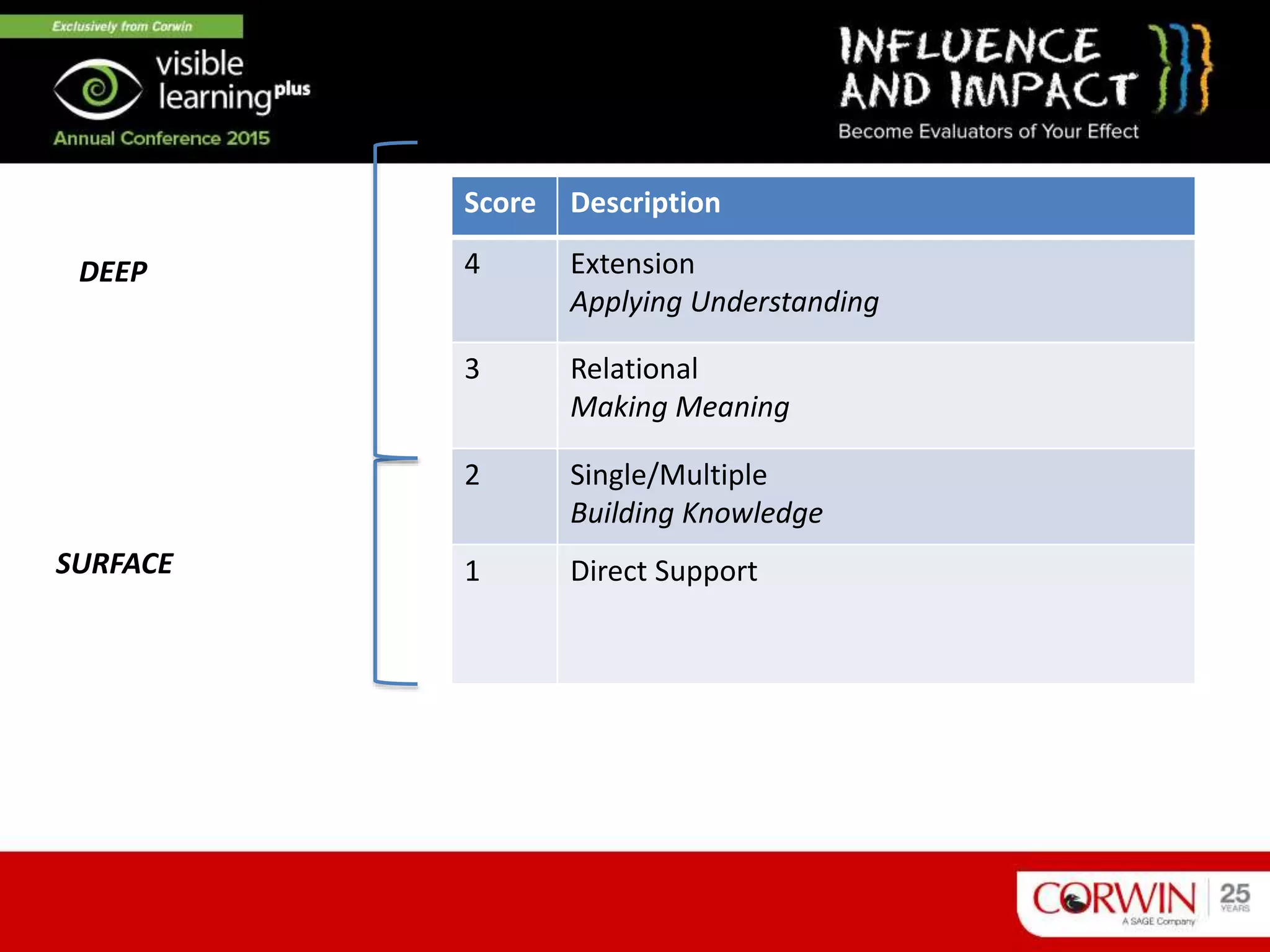
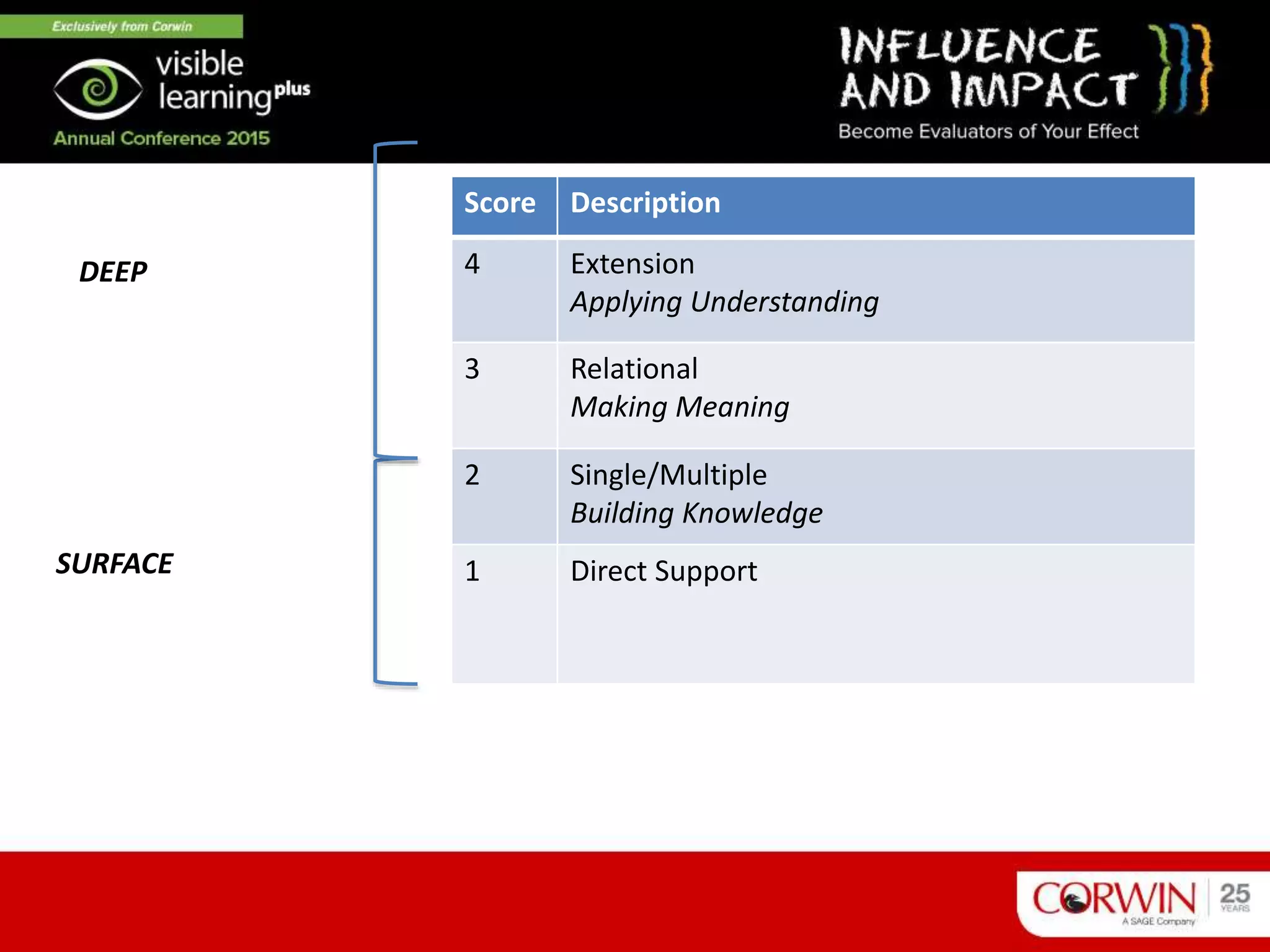
Score Description
4 Extension
Applying Understanding
3 Relational
Making Meaning
2 Single/Multiple
Building Knowledge
1 Direct Support
DEEP
SURFACE
Evaluate or refine a technological solution that reduces impacts of human
activities on natural systems.*
[Clarification Statement: Examples of data on the impacts of human activities
could include the quantities and types of pollutants released, changes to biomass
and species diversity, or areal changes in land surface use (such as for urban
development, agriculture and livestock, or surface mining). Examples for limiting
future impacts could range from local efforts (such as reducing, reusing, and
recycling resources) to large-scale geoengineering design solutions (such as
altering global temperatures by making large changes to the atmosphere or
ocean).]
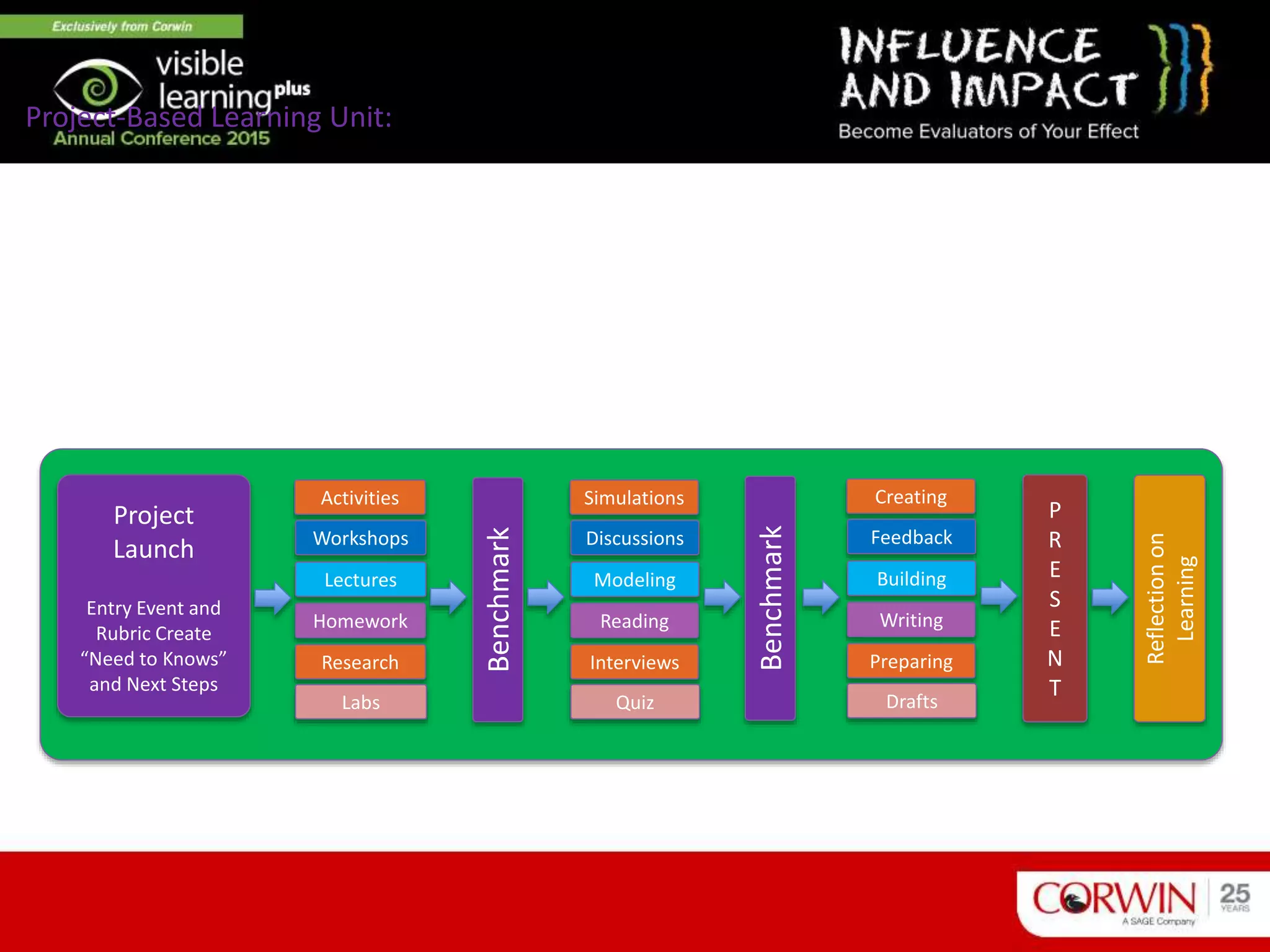
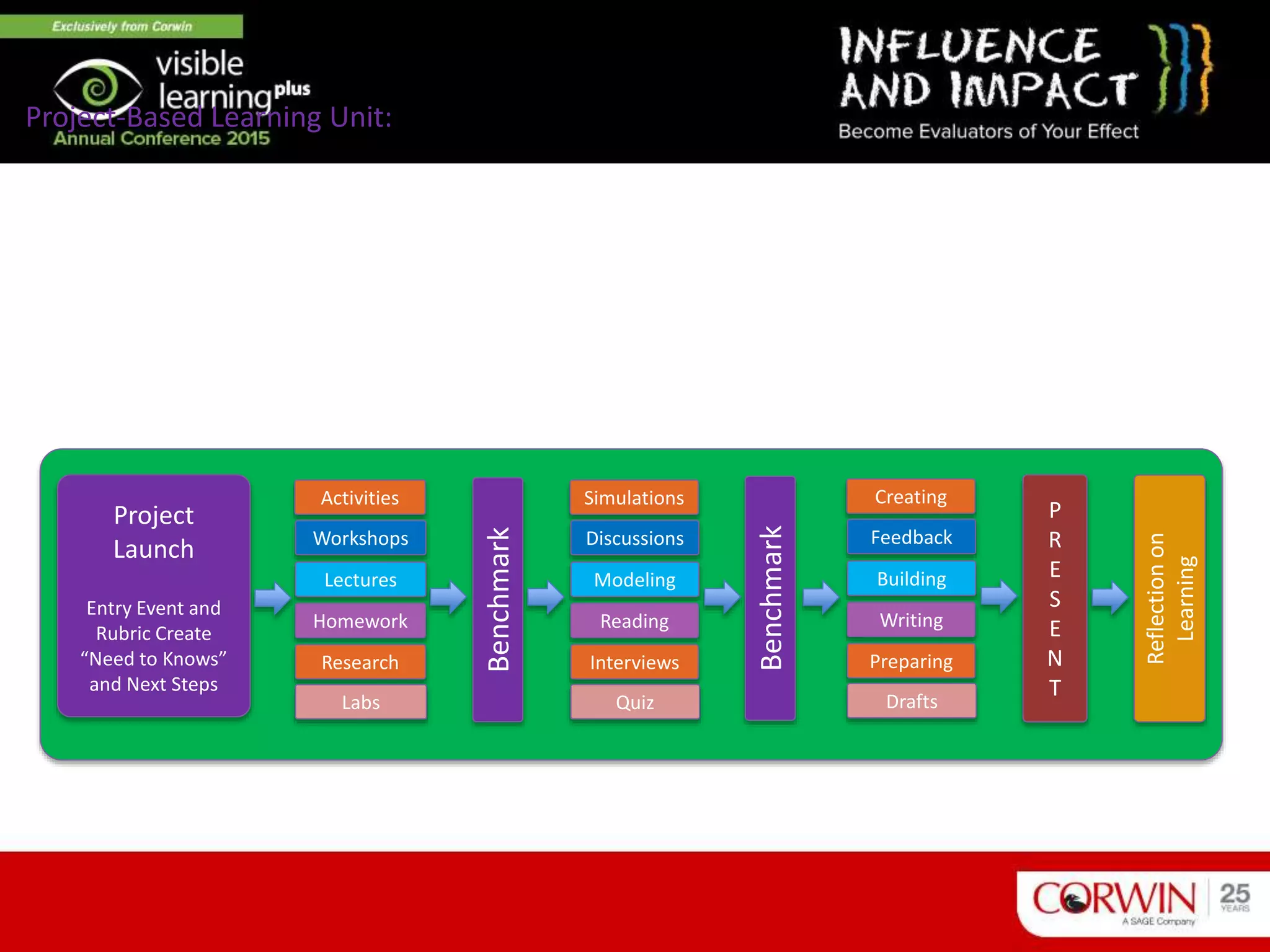
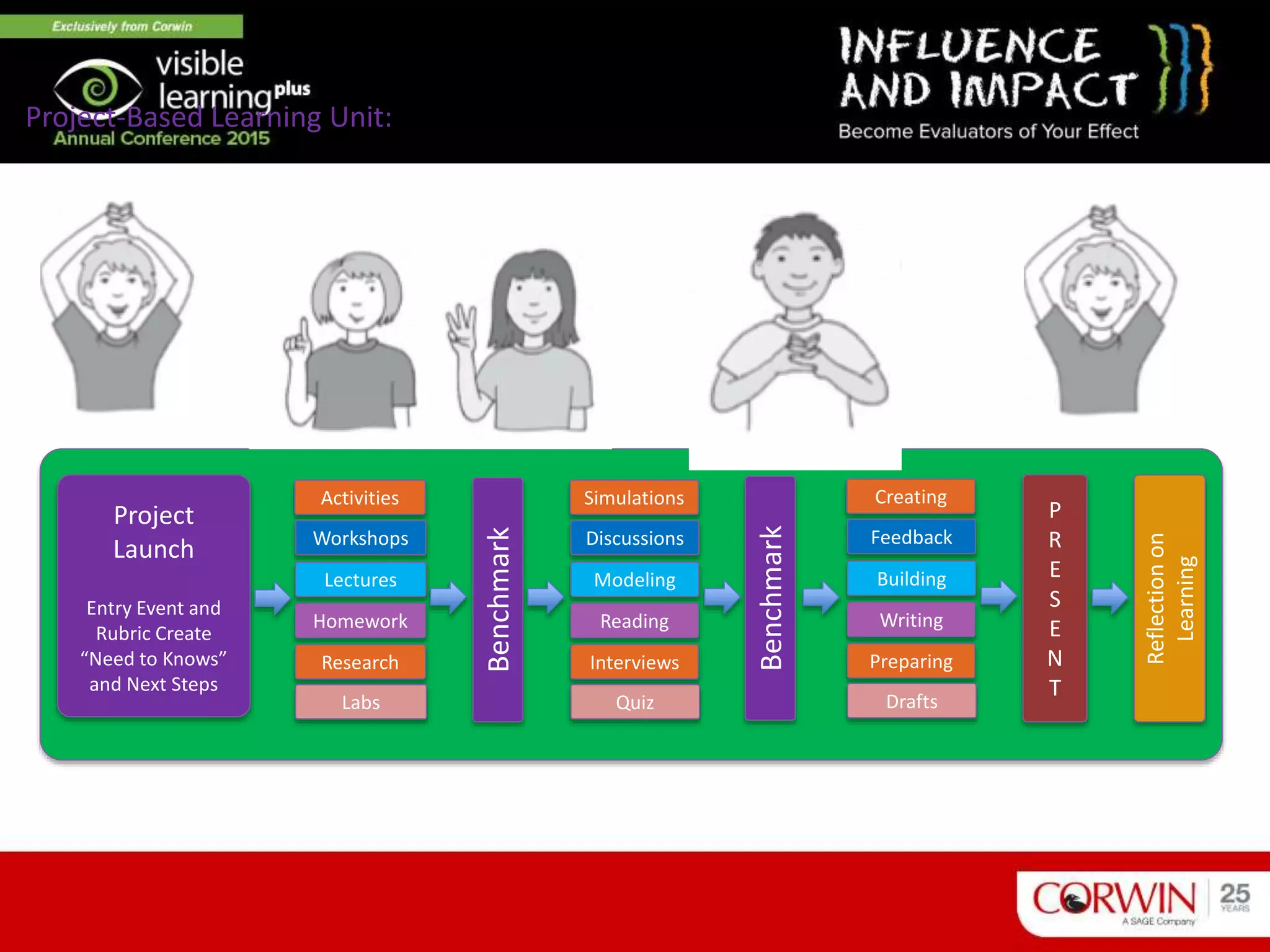
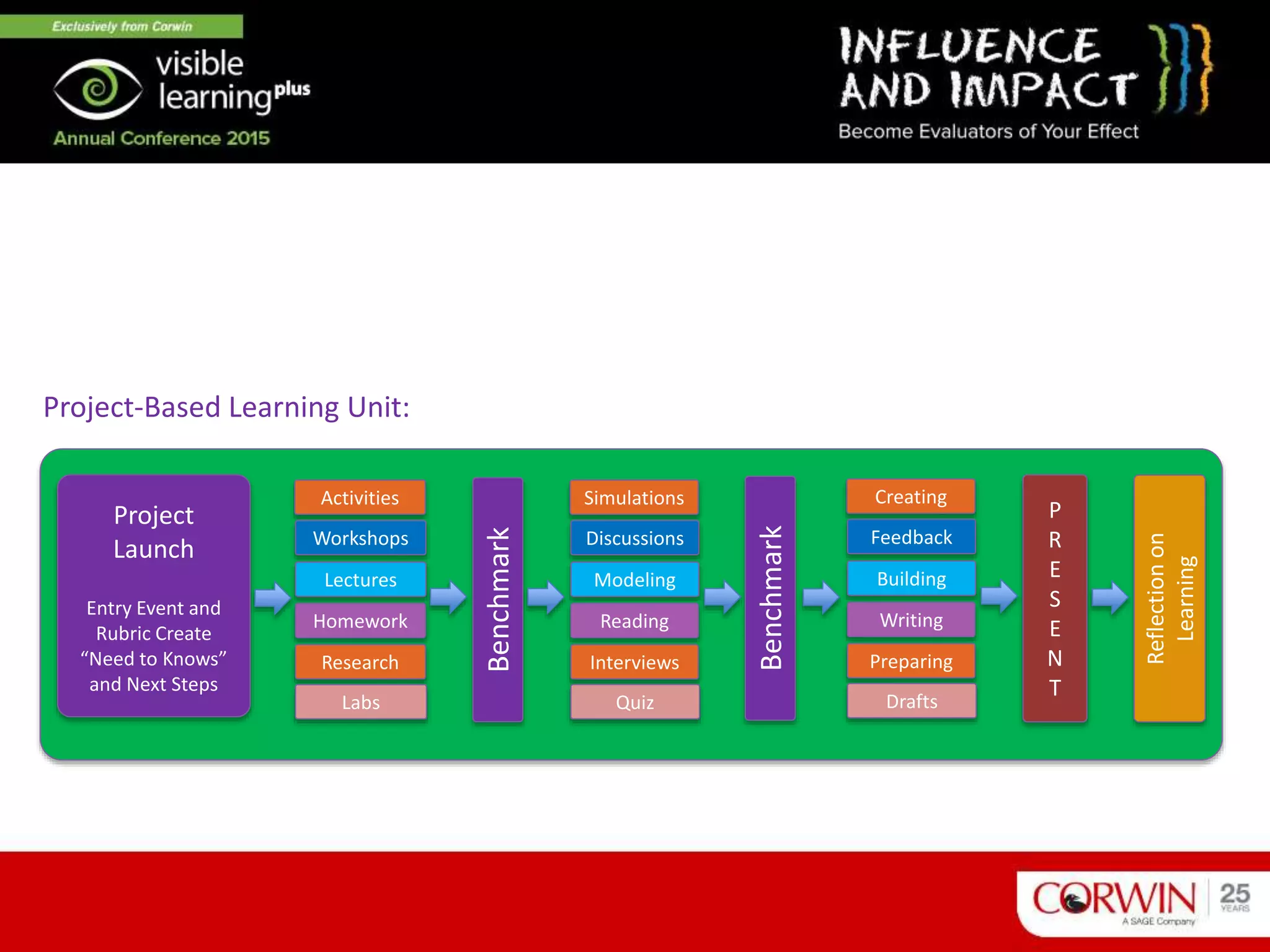
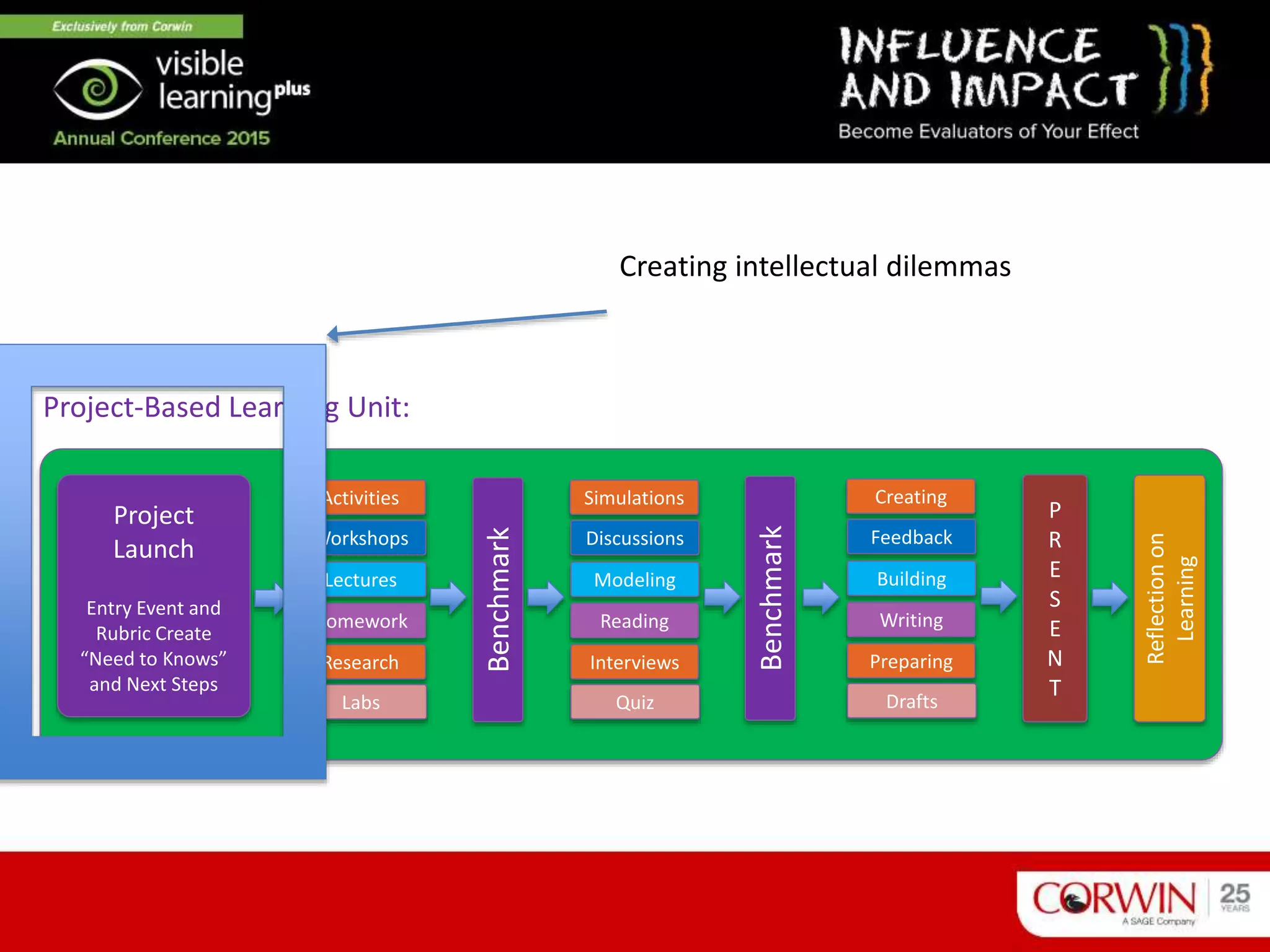
Project-Based Learning Unit:
Project
Launch
Entry Event and
Rubric Create
“Need to Knows”
and Next Steps
Activities
Workshops
Lectures
Homework
Benchmark
Research
Labs
Simulations
Discussions
Modeling
Reading
Benchmark
Interviews
Quiz
Reflectionon
Learning
P
R
E
S
E
N
T
Creating
Feedback
Building
Writing
Preparing
Drafts
How do we codify the most substantial
research-based practices to support our
learners in substantially progressing towards
and reaching mastery in the economic, social,
and civic demands of the 21st Century?
And, how do we ensure that
learners are engaged & motivated in their
learning?
#AnnualVL2015
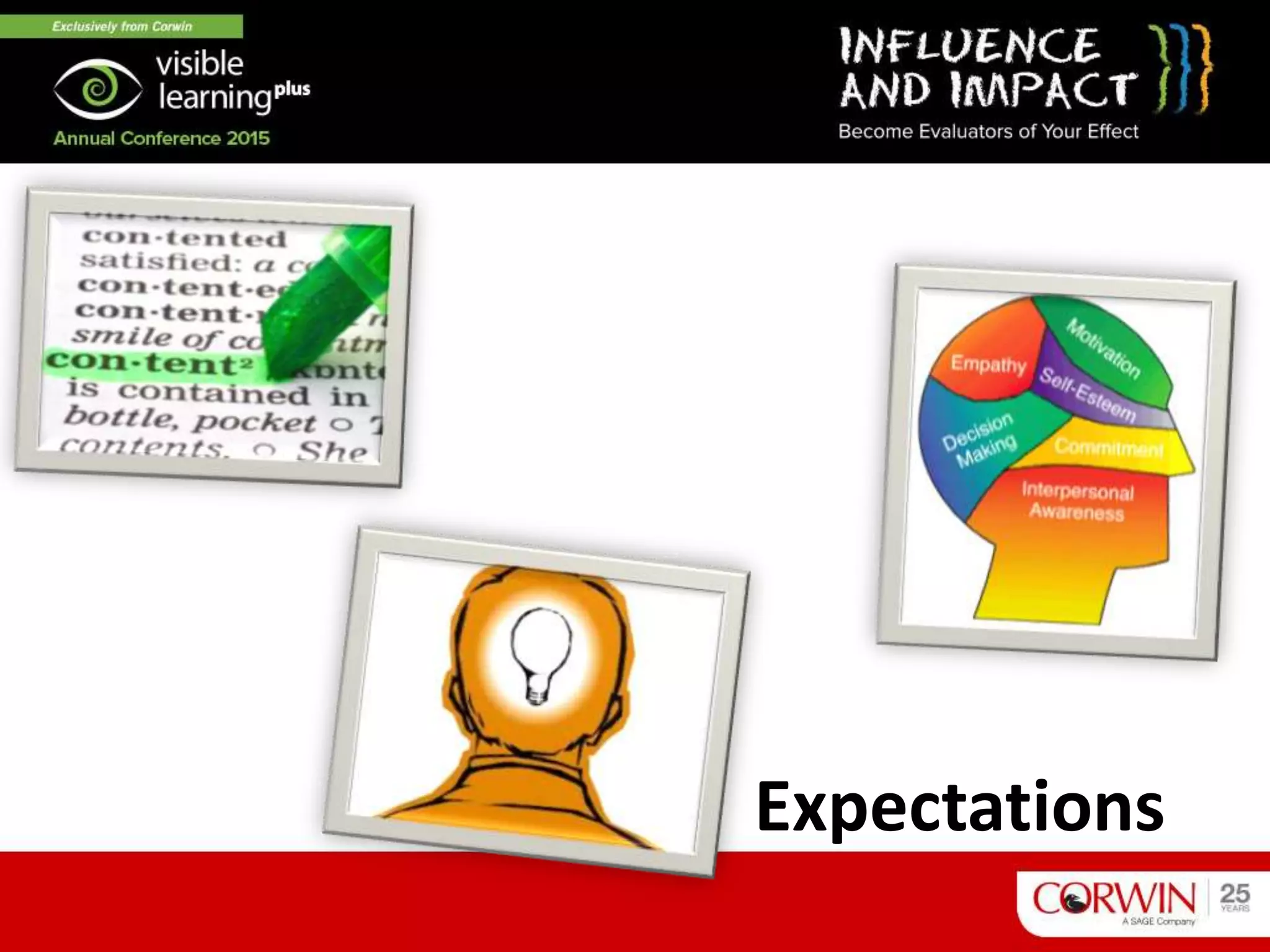
Expectations
Hypothesis
A problem or project based approach is
“the great codifier” combining the beliefs
and actions necessary to engage,
motivate, and substantially enhance
student learning in a breadth of
outcomes.
• Theory of Action If Problem and Project
Based Learning practitioners integrate the
key findings of VL into their practice, then
students will substantially progress in their
learning, and enhance their motivation and
engagement?
Learning Intentions
By the end of the session, you will…
1. Understand specific practices that have a
high probability for enhancing student
learning
2. Understand specific theories that underpin
such practices
3. Collect potential means for applying such
understanding to your classroom (and
site/district)
#AnnualVL2015
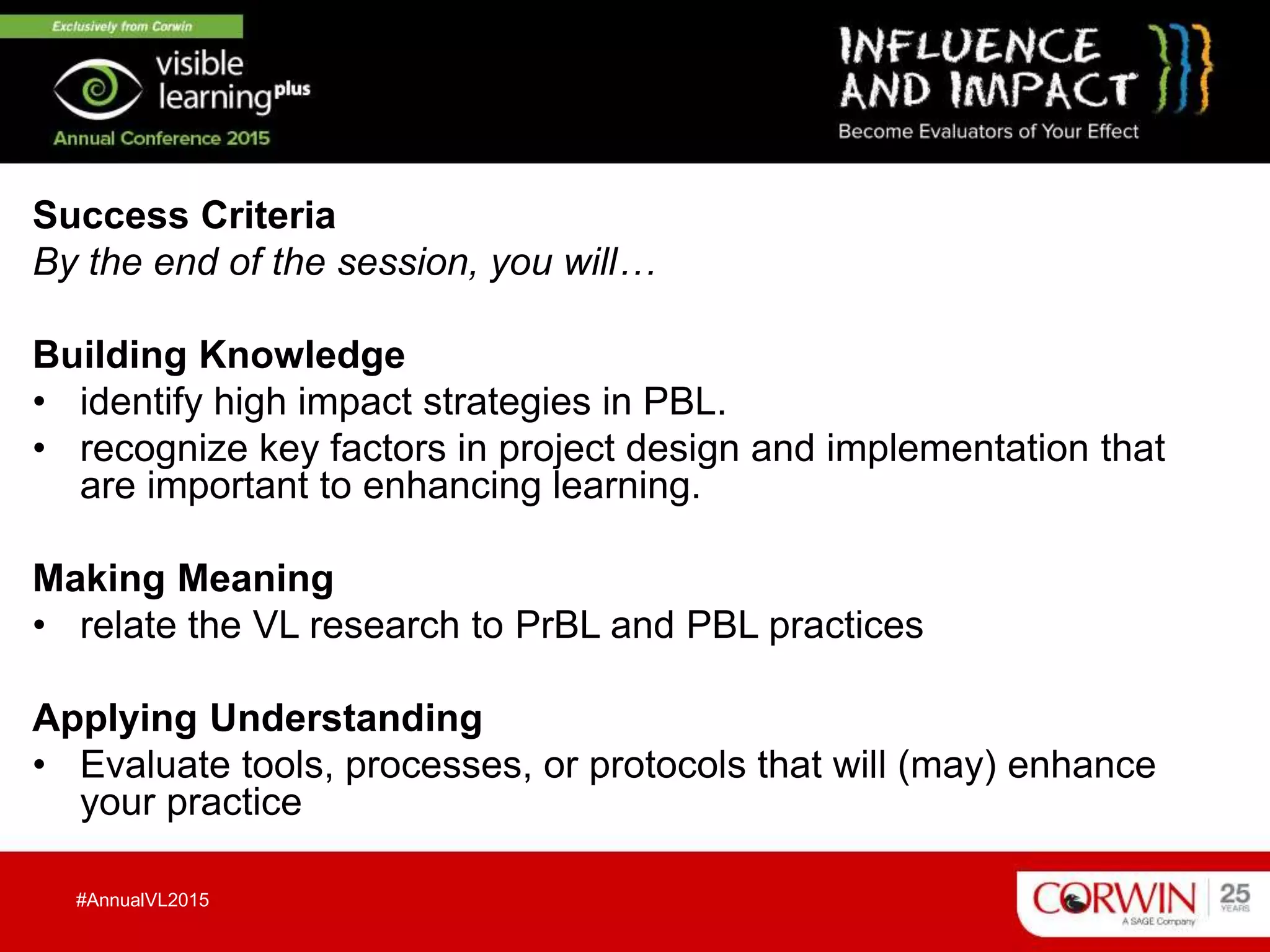
Success Criteria
By the end of the session, you will…
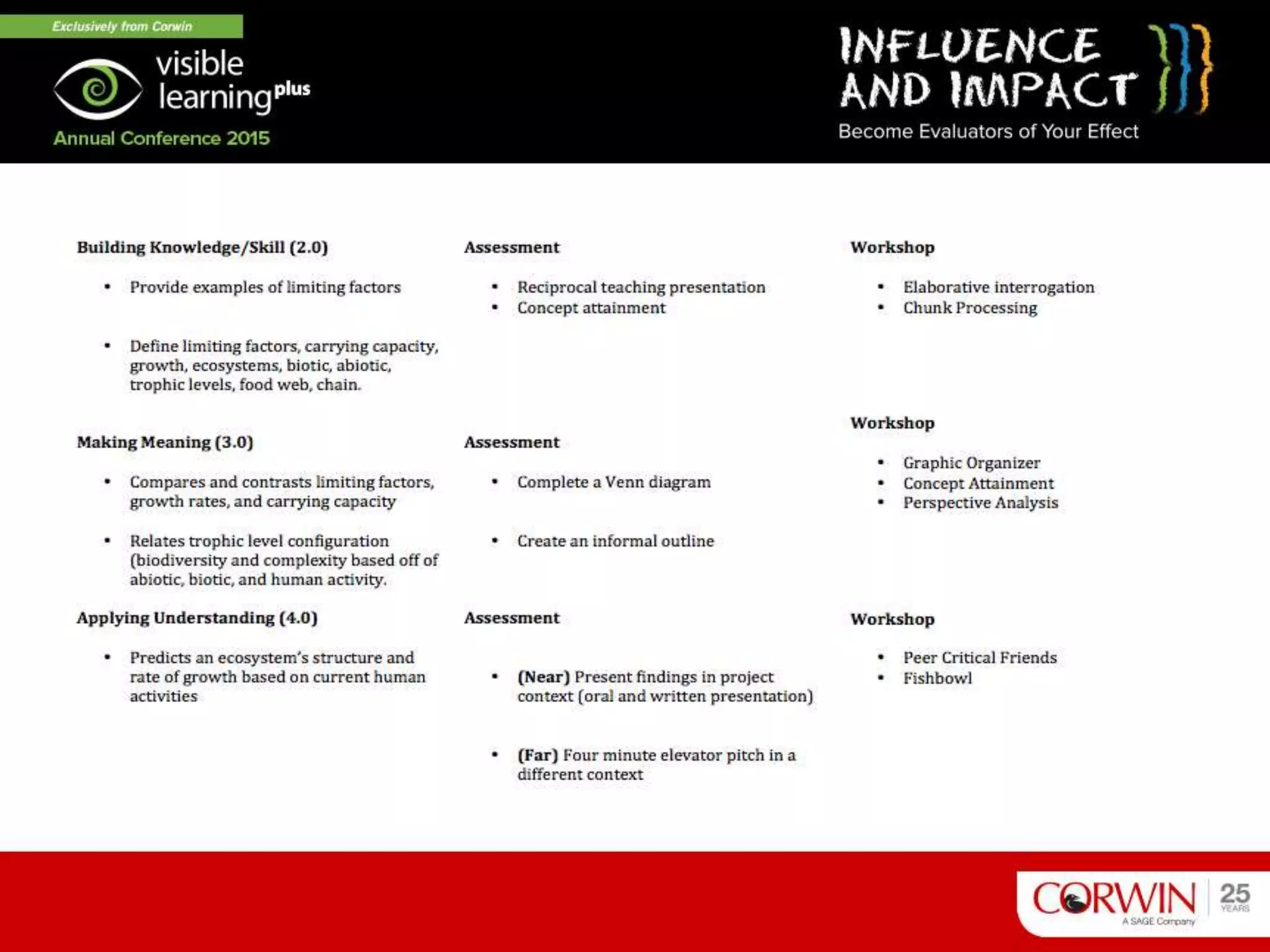
Building Knowledge
• identify high impact strategies in PBL.
• recognize key factors in project design and implementation that
are important to enhancing learning.
Making Meaning
• relate the VL research to PrBL and PBL practices
Applying Understanding
• Evaluate tools, processes, or protocols that will (may) enhance
your practice
#AnnualVL2015
Know Need to Know
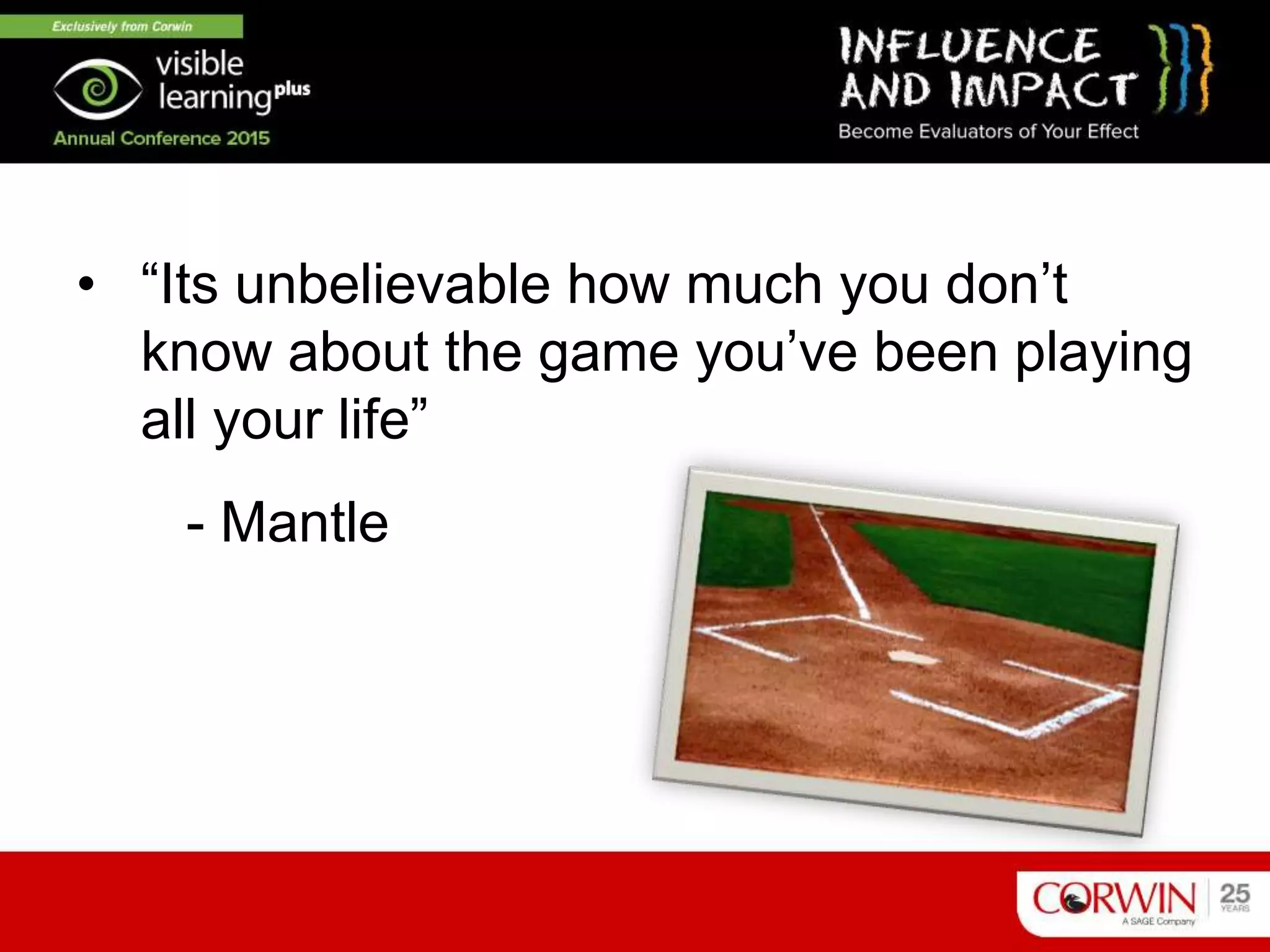
• “Its unbelievable how much you don’t
know about the game you’ve been playing
all your life”
- Mantle
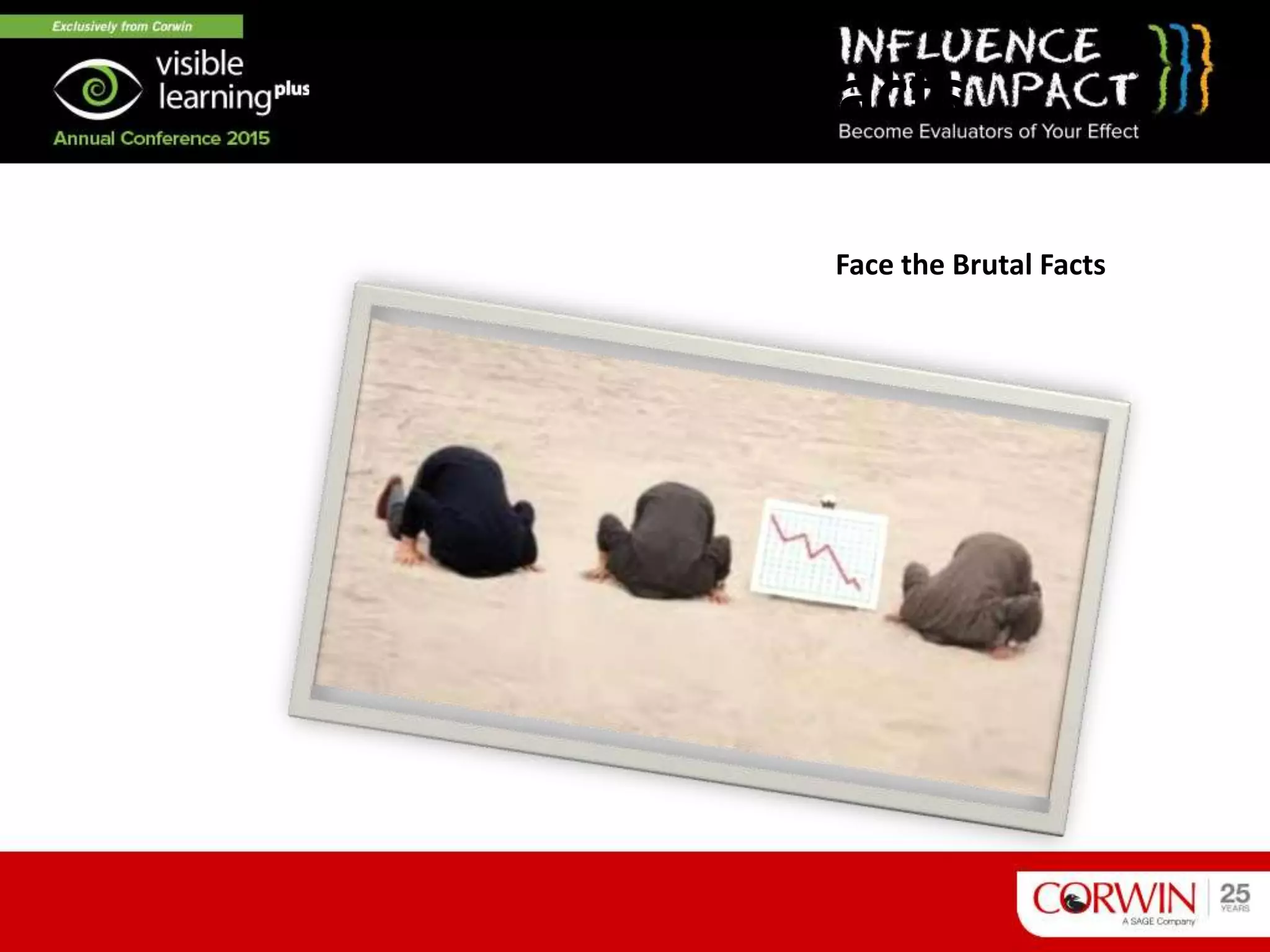
Face the Brutal Facts
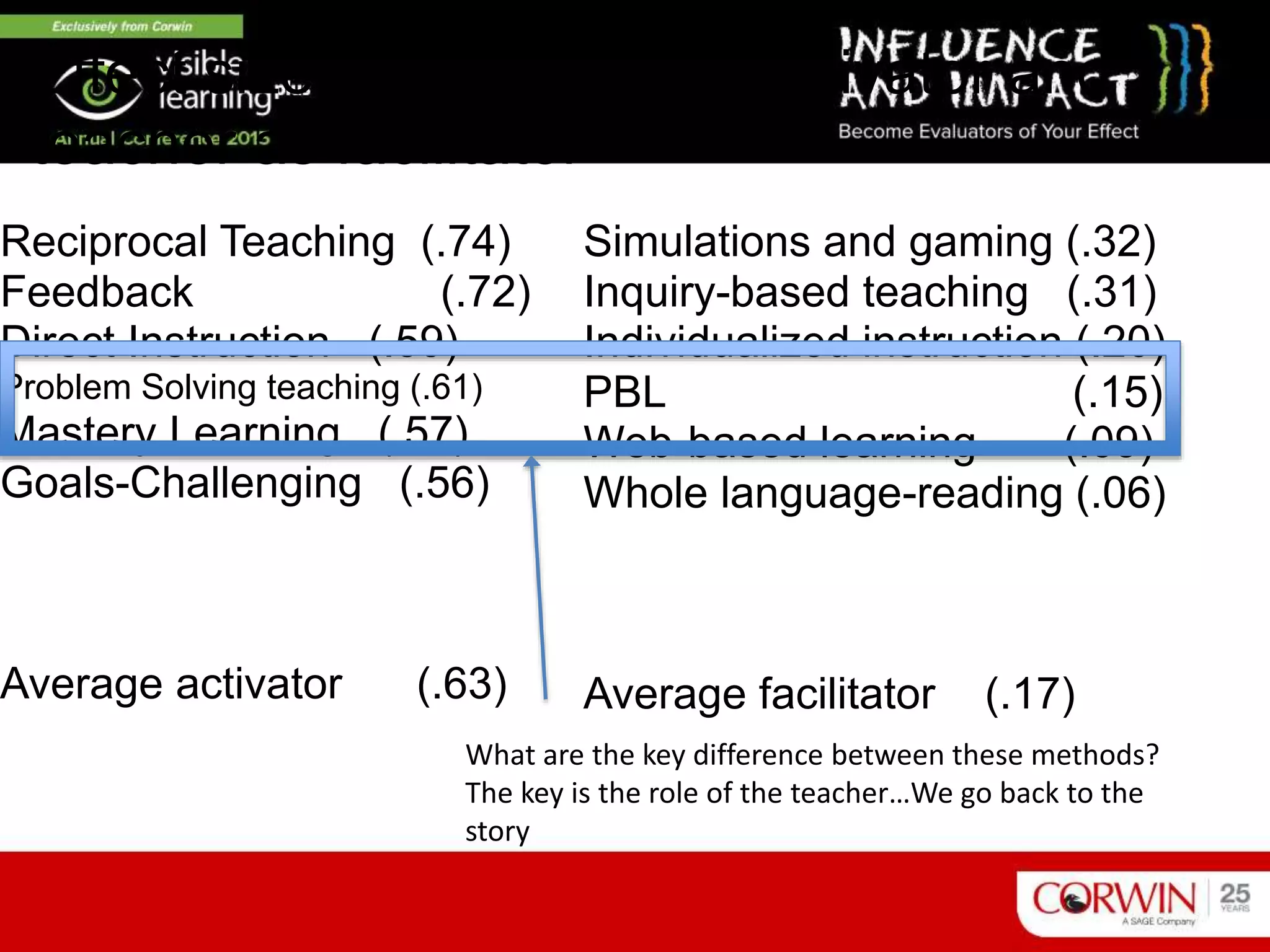
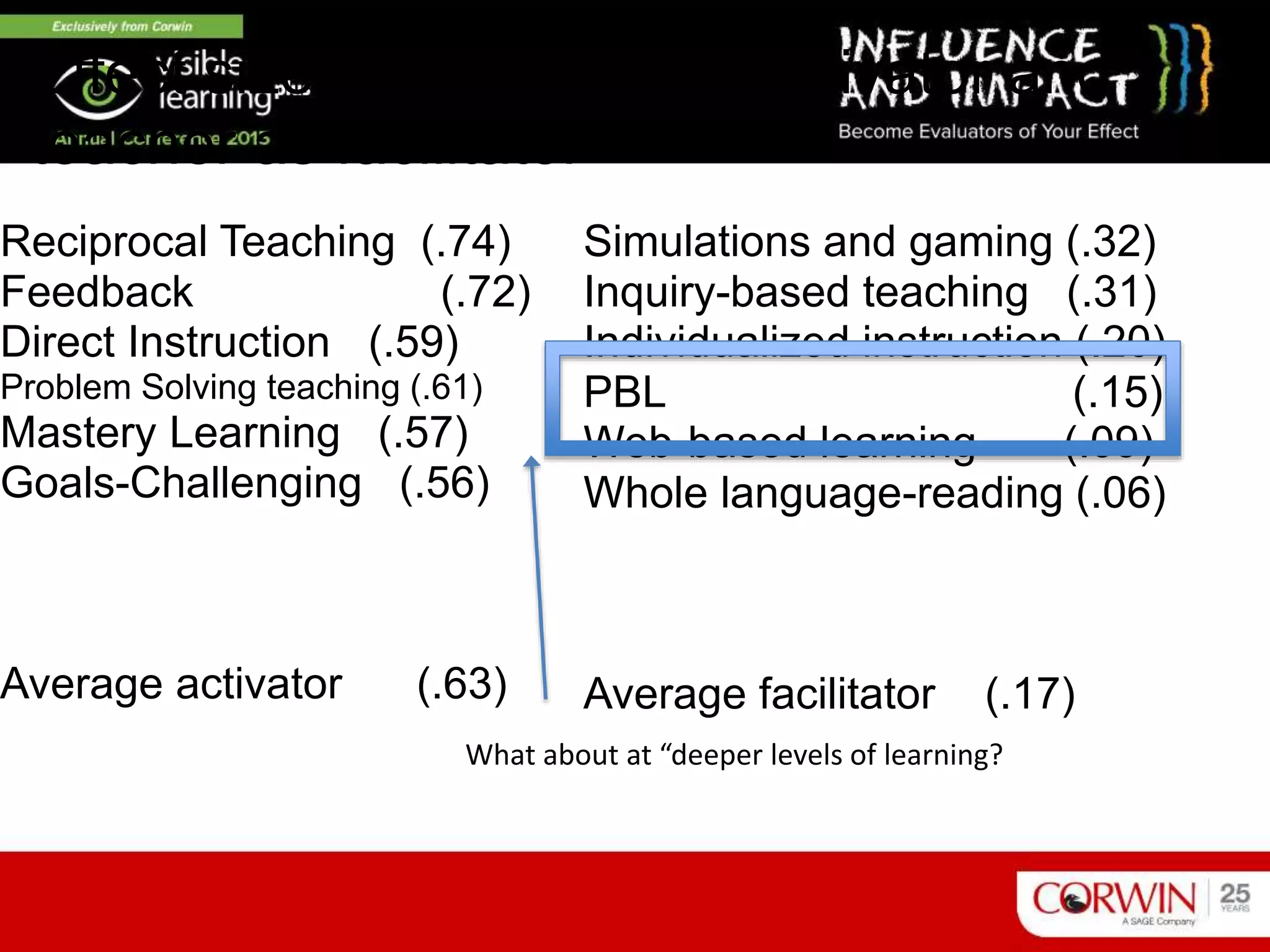
Effect sizes for teacher as activator and
teacher as facilitator
Reciprocal Teaching (.74)
Feedback (.72)
Direct Instruction (.59)
Problem Solving teaching (.61)
Mastery Learning (.57)
Goals-Challenging (.56)
Average activator (.63)
Simulations and gaming (.32)
Inquiry-based teaching (.31)
Individualized instruction (.20)
PBL (.15)
Web-based learning (.09)
Whole language-reading (.06)
Average facilitator (.17)
What are the key difference between these methods?
The key is the role of the teacher…We go back to the
story
#AnnualVL2015
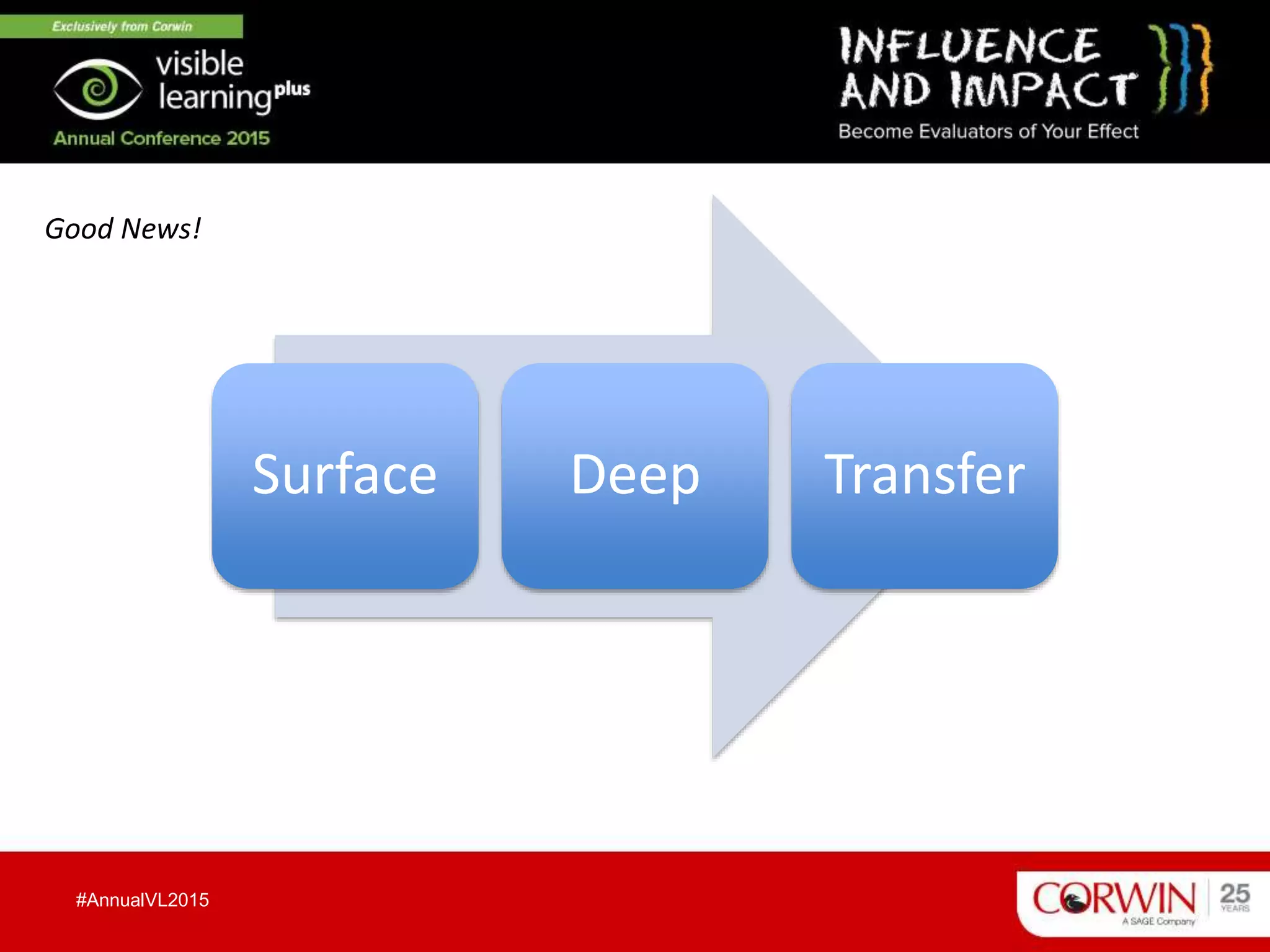
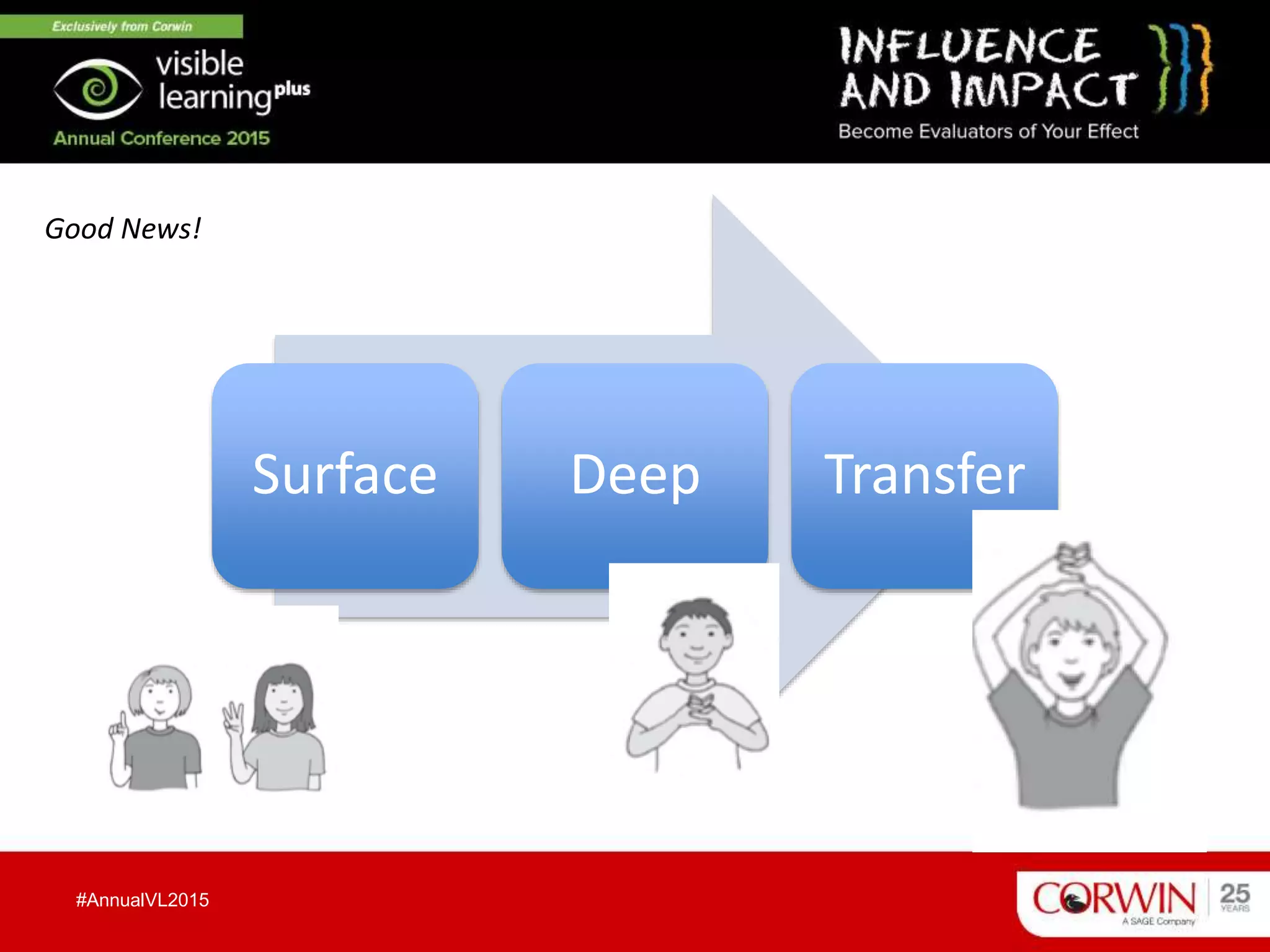
Good News!
Surface Deep Transfer
Effect sizes for teacher as activator and
teacher as facilitator
Reciprocal Teaching (.74)
Feedback (.72)
Direct Instruction (.59)
Problem Solving teaching (.61)
Mastery Learning (.57)
Goals-Challenging (.56)
Average activator (.63)
Simulations and gaming (.32)
Inquiry-based teaching (.31)
Individualized instruction (.20)
PBL (.15)
Web-based learning (.09)
Whole language-reading (.06)
Average facilitator (.17)
What about at “deeper levels of learning?
#AnnualVL2015
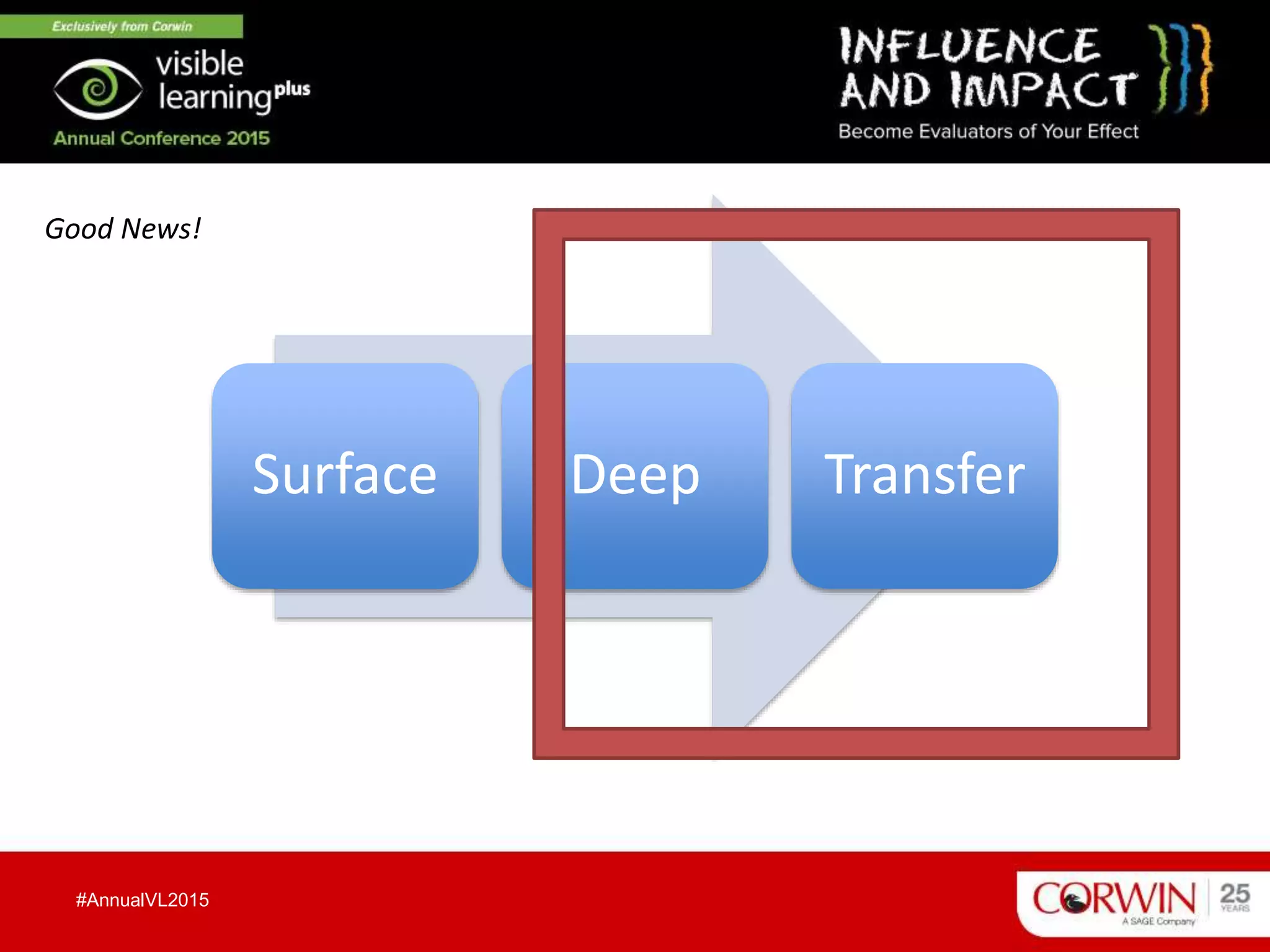
Good News!
Surface Deep Transfer
#AnnualVL2015
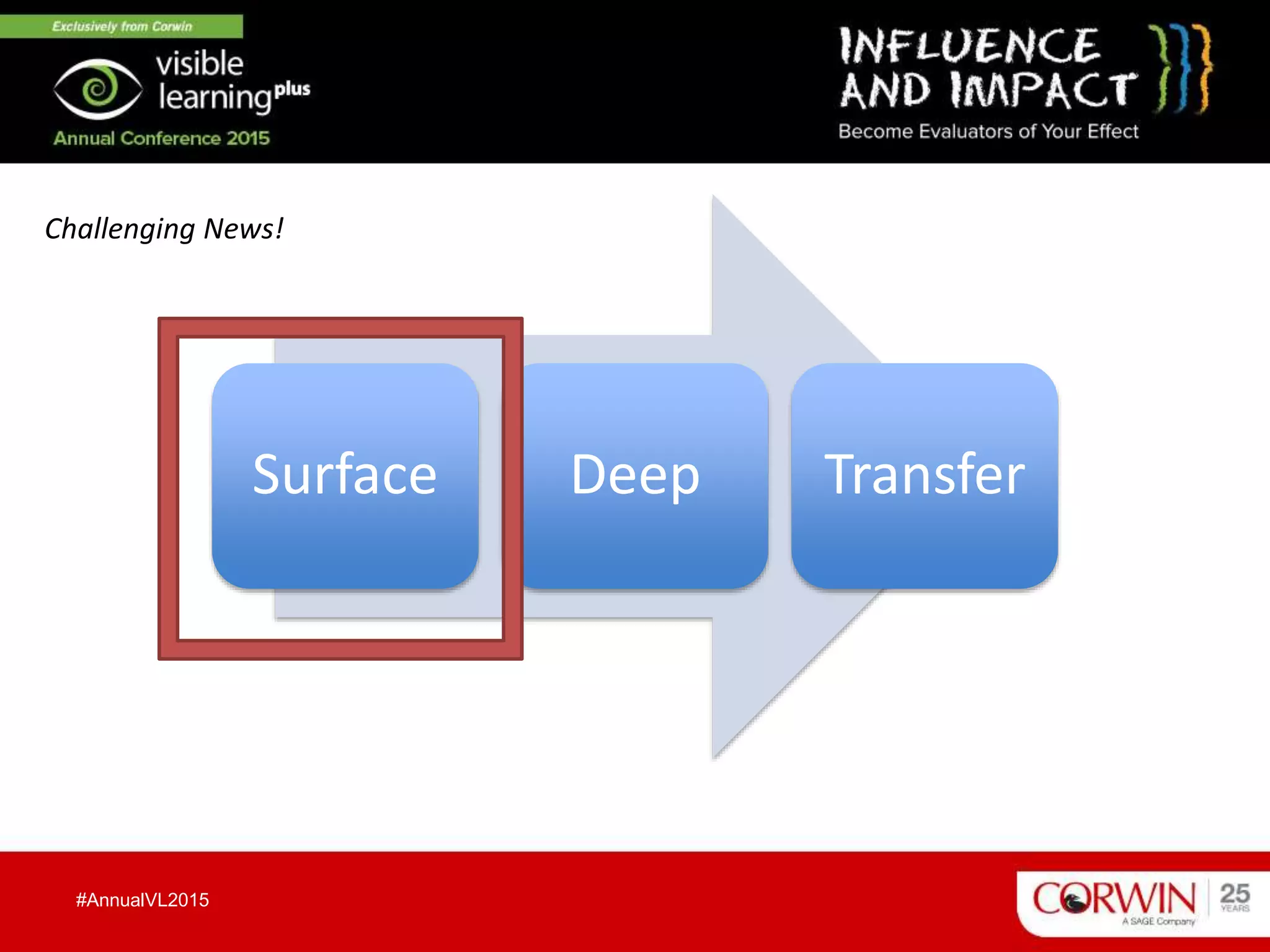
Challenging News!
Surface Deep Transfer
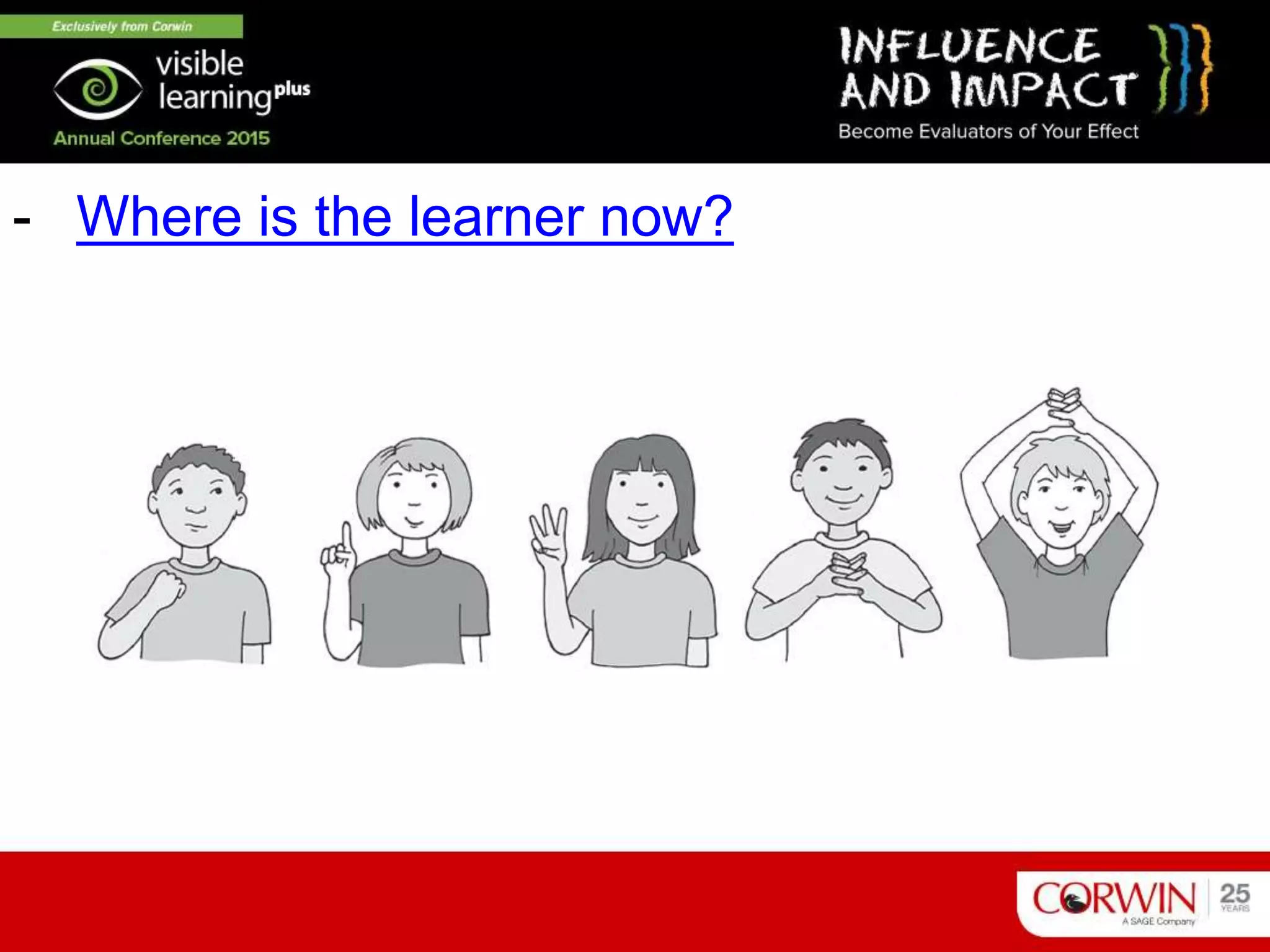
- Where is the learner now?
#AnnualVL2015
Good News!
Surface Deep Transfer
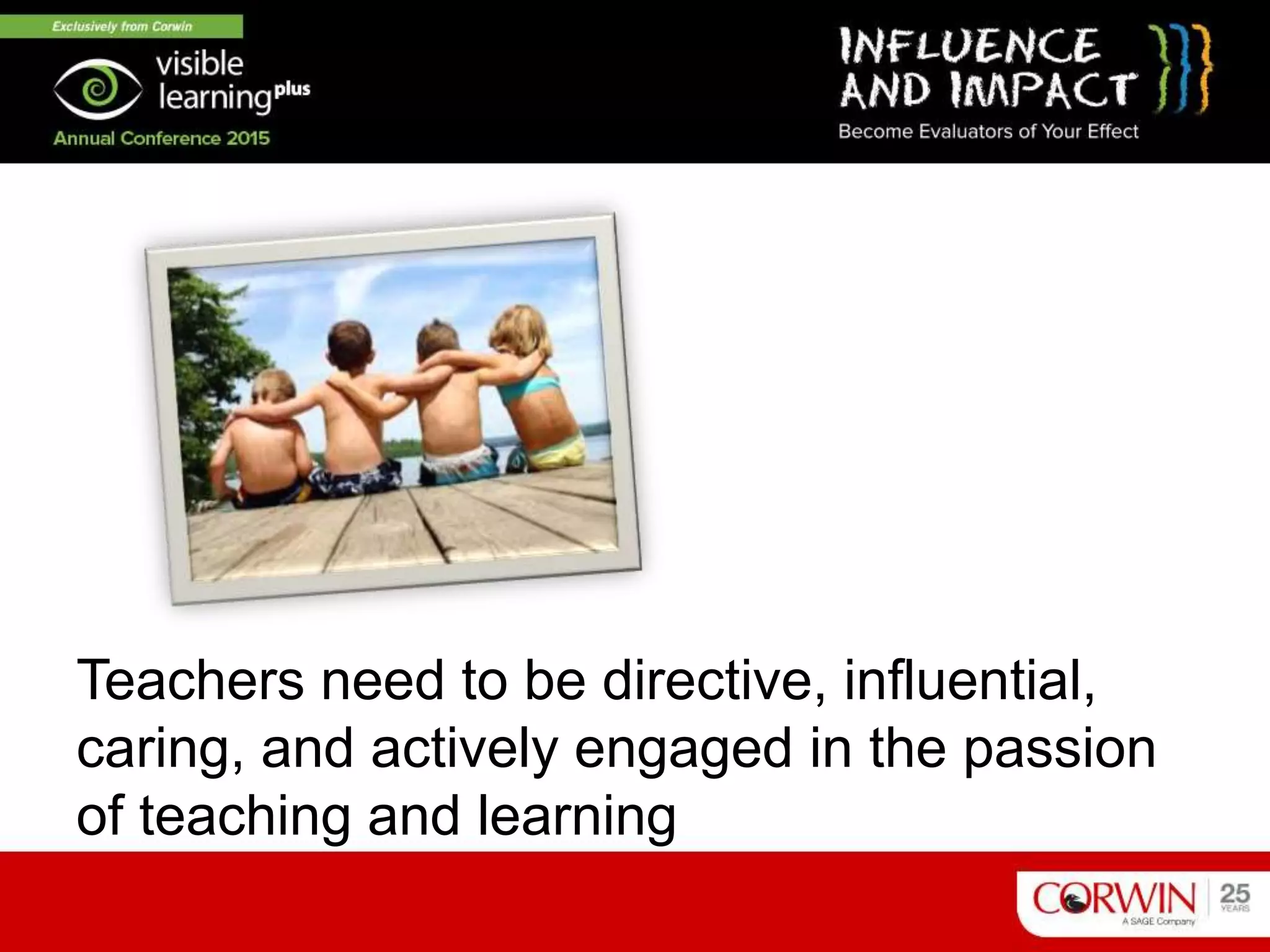
Teachers need to be directive, influential,
caring, and actively engaged in the passion
of teaching and learning
3 Key Ideas for
Implementation
Right Time
Right Intervention
Balanced Approach
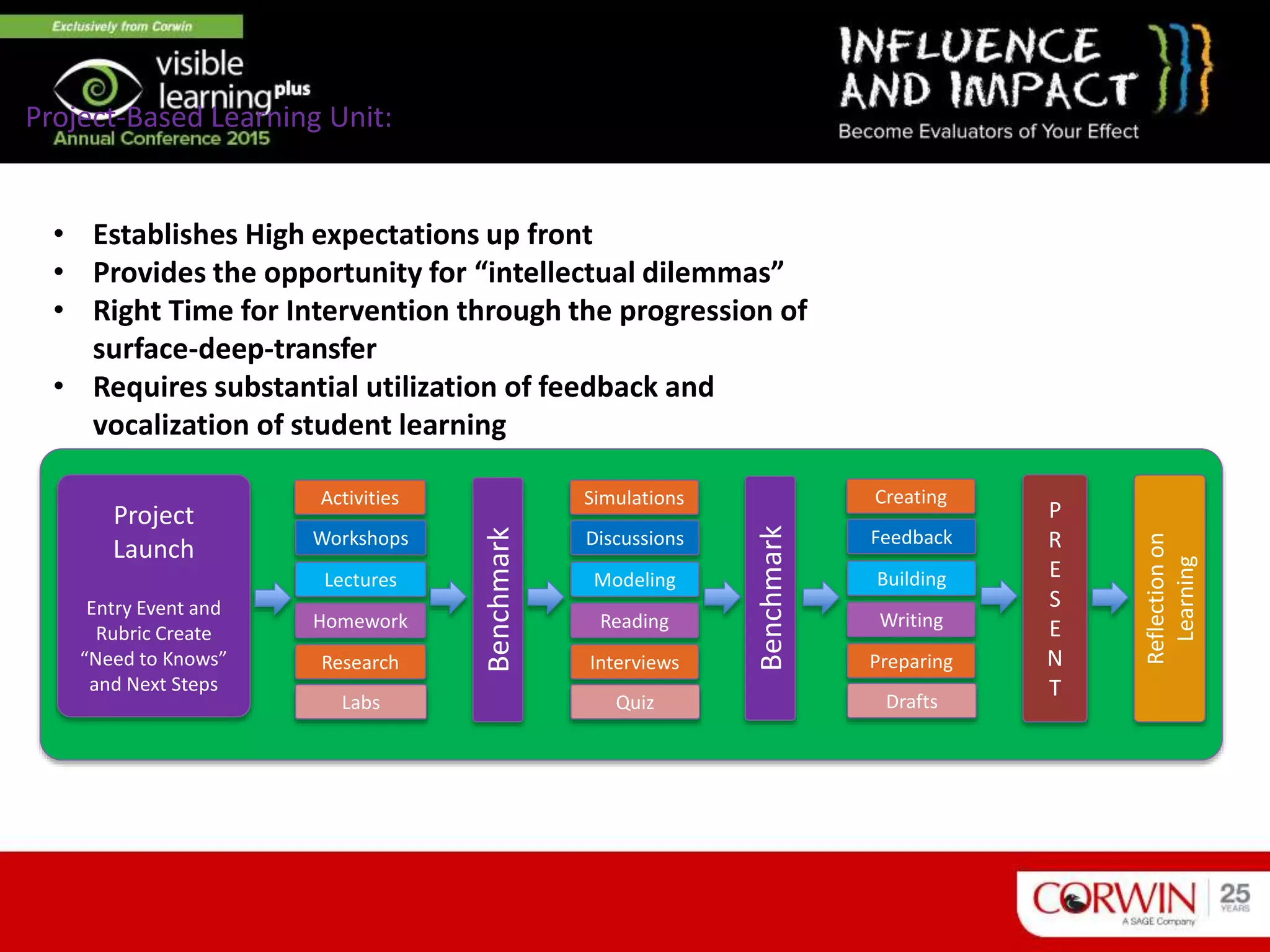
Project-Based Learning Unit:
Project
Launch
Entry Event and
Rubric Create
“Need to Knows”
and Next Steps
Activities
Workshops
Lectures
Homework
Benchmark
Research
Labs
Simulations
Discussions
Modeling
Reading
Benchmark
Interviews
Quiz
Reflectionon
Learning
P
R
E
S
E
N
T
Creating
Feedback
Building
Writing
Preparing
Drafts
Project-Based Learning Unit:
Project
Launch
Entry Event and
Rubric Create
“Need to Knows”
and Next Steps
Activities
Workshops
Lectures
Homework
Benchmark
Research
Labs
Simulations
Discussions
Modeling
Reading
Benchmark
Interviews
Quiz
Reflectionon
Learning
P
R
E
S
E
N
T
Creating
Feedback
Building
Writing
Preparing
Drafts
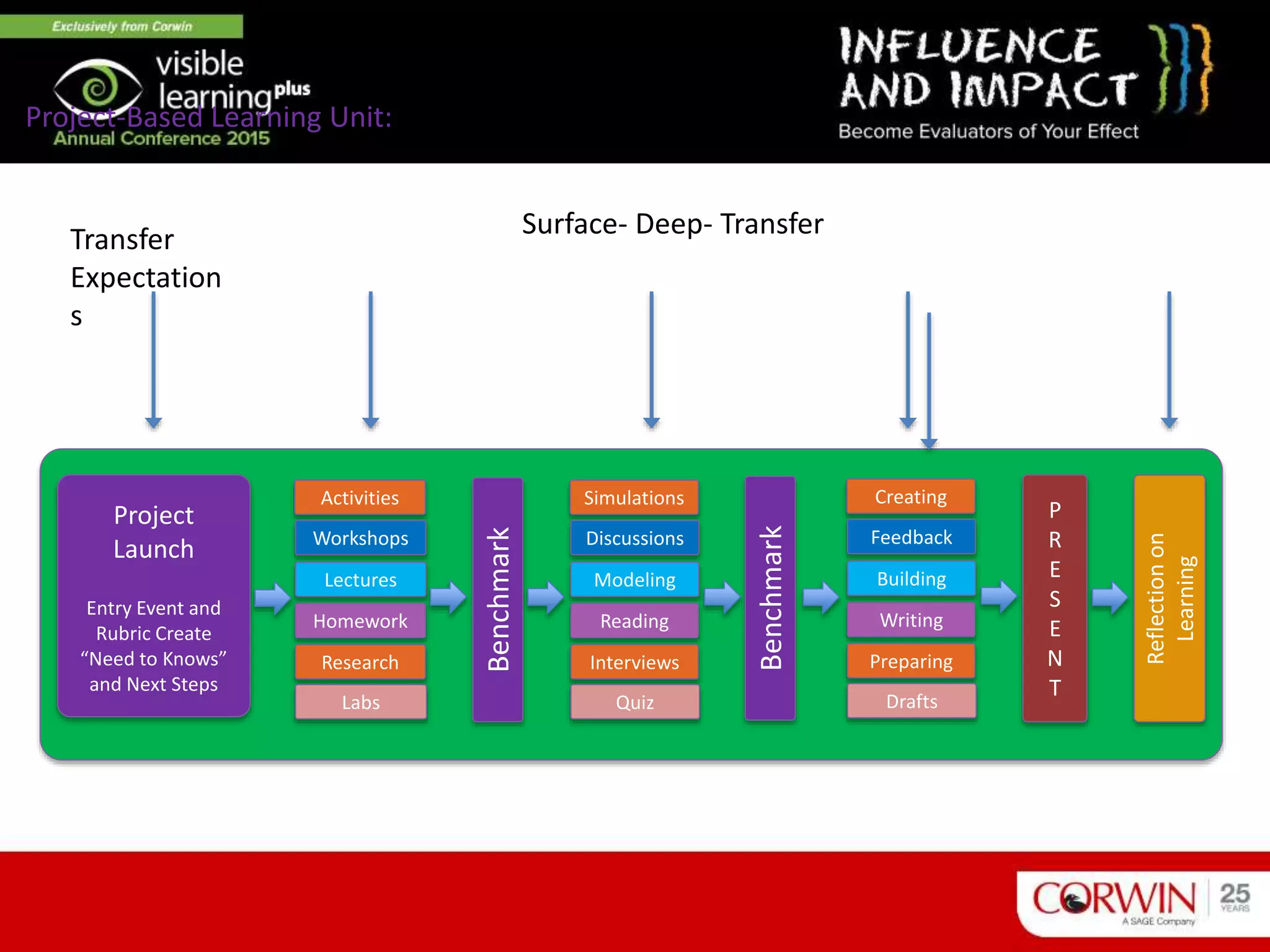
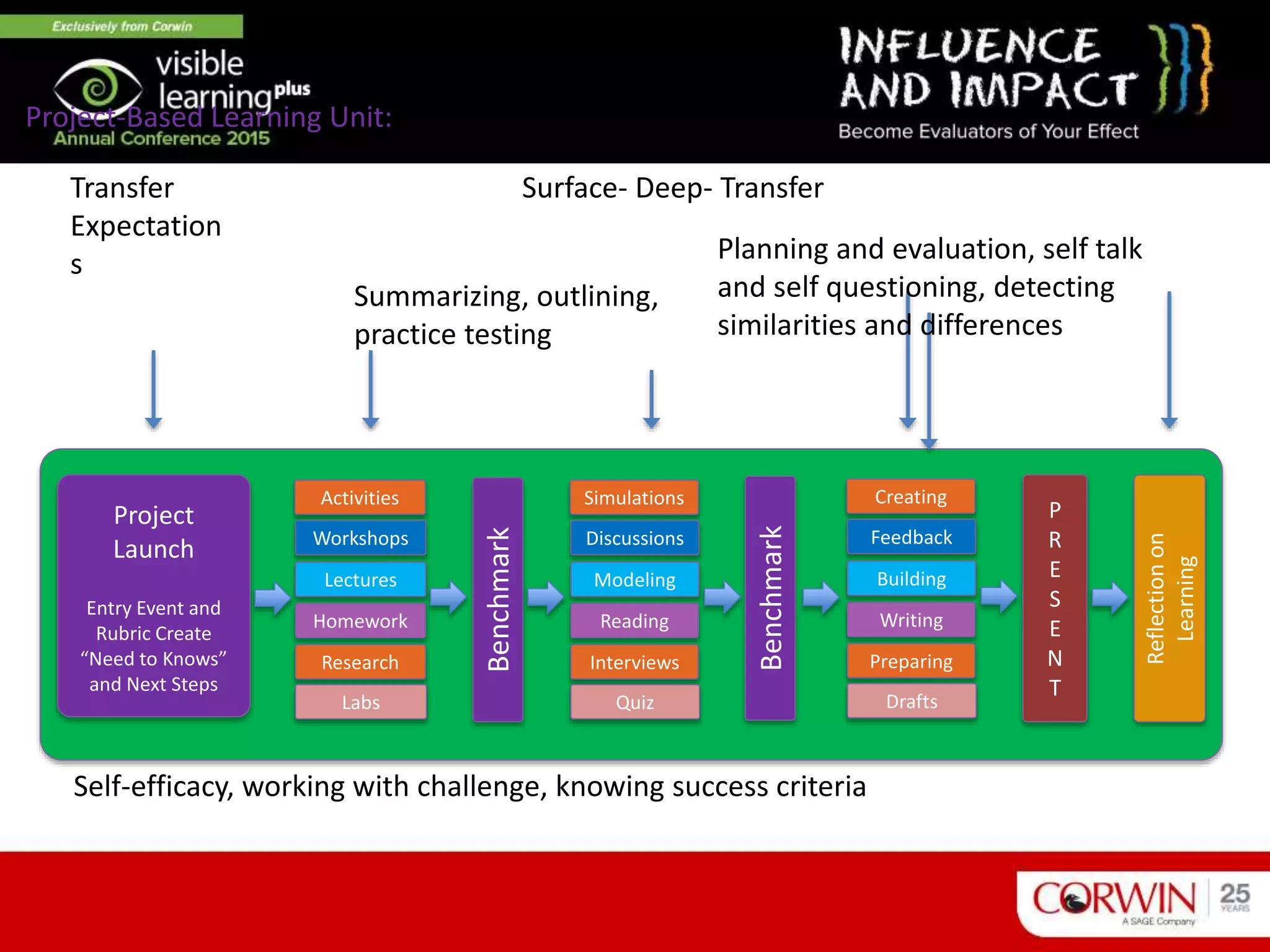
Transfer
Expectation
s
Surface- Deep- Transfer
Project-Based Learning Unit:
Project
Launch
Entry Event and
Rubric Create
“Need to Knows”
and Next Steps
Activities
Workshops
Lectures
Homework
Benchmark
Research
Labs
Simulations
Discussions
Modeling
Reading
Benchmark
Interviews
Quiz
Reflectionon
Learning
P
R
E
S
E
N
T
Creating
Feedback
Building
Writing
Preparing
Drafts
Transfer
Expectation
s
Surface- Deep- Transfer
Self-efficacy, working with challenge, knowing success criteria
Summarizing, outlining,
practice testing
Planning and evaluation, self talk
and self questioning, detecting
similarities and differences
Project-Based Learning Unit:
Project
Launch
Entry Event and
Rubric Create
“Need to Knows”
and Next Steps
Activities
Workshops
Lectures
Homework
Benchmark
Research
Labs
Simulations
Discussions
Modeling
Reading
Benchmark
Interviews
Quiz
Reflectionon
Learning
P
R
E
S
E
N
T
Creating
Feedback
Building
Writing
Preparing
Drafts
Project-Based Learning Unit:
Project
Launch
Entry Event and
Rubric Create
“Need to Knows”
and Next Steps
Activities
Workshops
Lectures
Homework
Benchmark
Research
Labs
Simulations
Discussions
Modeling
Reading
Benchmark
Interviews
Quiz
Reflectionon
Learning
P
R
E
S
E
N
T
Creating
Feedback
Building
Writing
Preparing
Drafts
• Establishes High expectations up front
• Provides the opportunity for “intellectual dilemmas”
• Right Time for Intervention through the progression of
surface-deep-transfer
• Requires substantial utilization of feedback and
vocalization of student learning
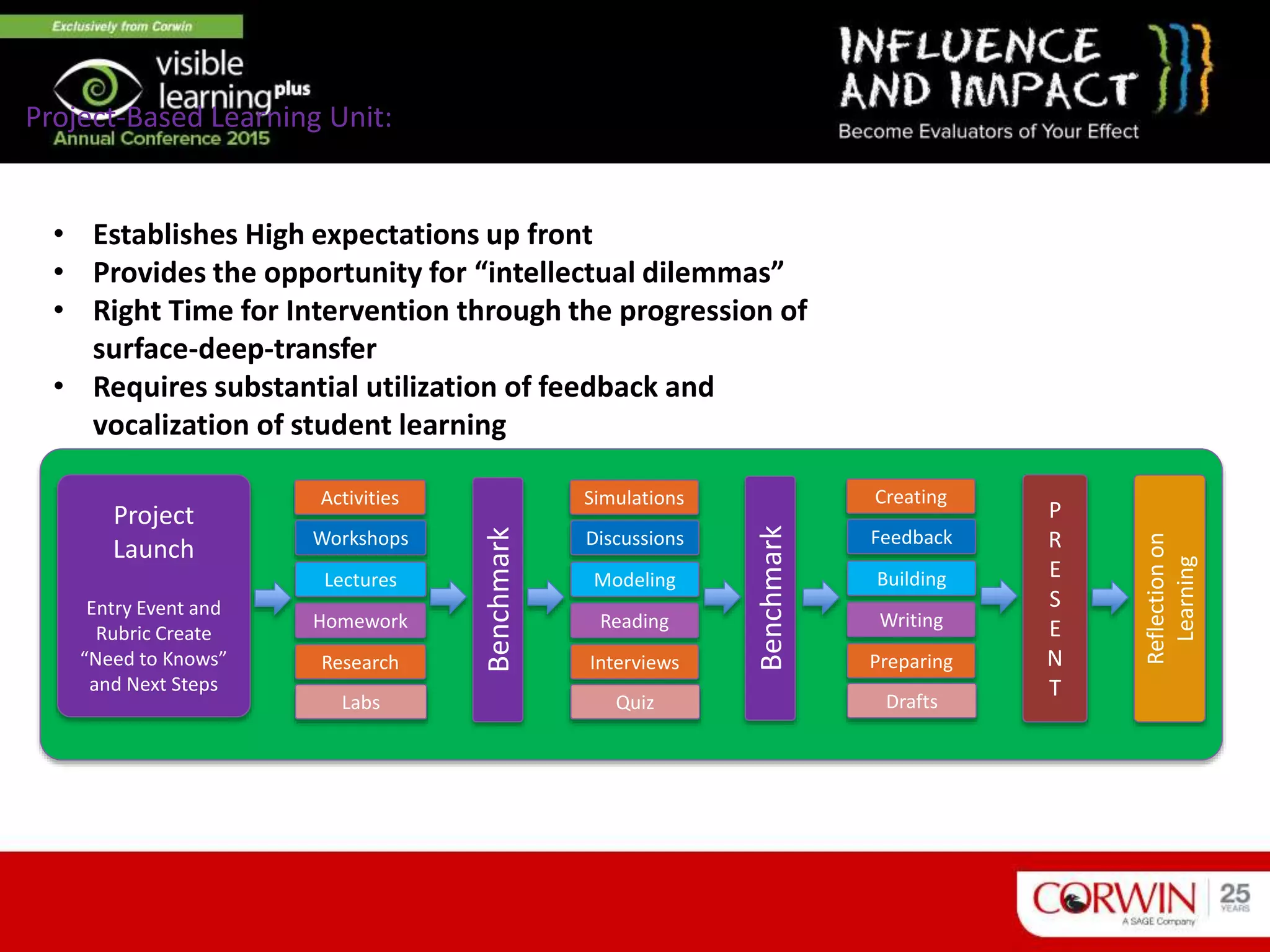
Project-Based Learning Unit:
Project
Launch
Entry Event and
Rubric Create
“Need to Knows”
and Next Steps
Activities
Workshops
Lectures
Homework
Benchmark
Research
Labs
Simulations
Discussions
Modeling
Reading
Benchmark
Interviews
Quiz
Reflectionon
Learning
P
R
E
S
E
N
T
Creating
Feedback
Building
Writing
Preparing
Drafts
• Establishes High expectations up front
• Provides the opportunity for “intellectual dilemmas”
• Right Time for Intervention through the progression of
surface-deep-transfer
• Requires substantial utilization of feedback and
vocalization of student learning
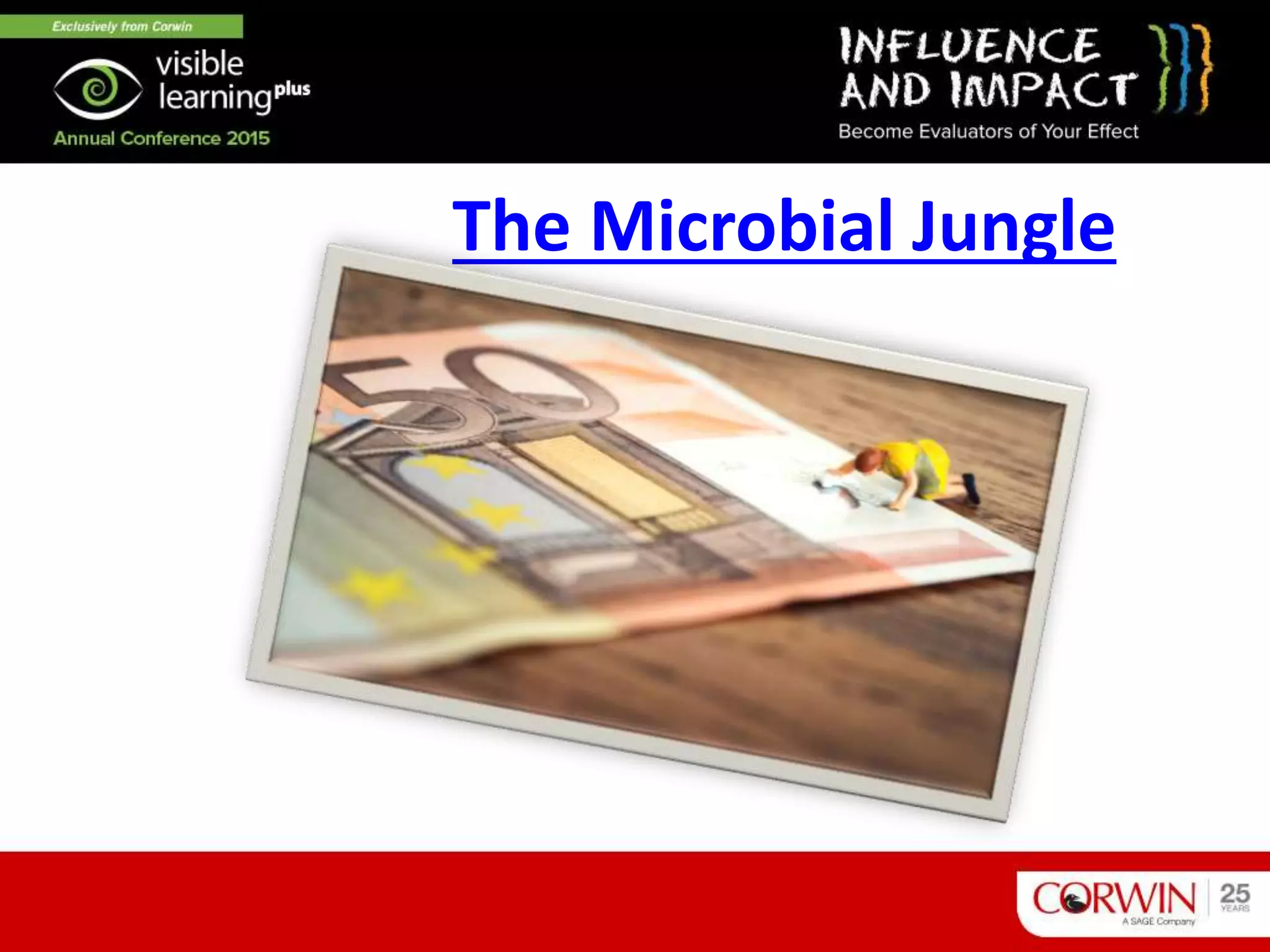
The Microbial Jungle
Program Goal I
• Genetics, Traits and Evolution: Groups of living
organisms change over time. These evolutionary
changes occur at both the molecular/genetic and
organismal levels of organization. Students will
interpret evidence from each level of organization to
explain a specific example of evolutionary change.
Program Goal II
• Levels of Organization: Living organisms
are complex structures with interconnected
levels of organization. Students will analyze
the interactions between the biochemical and
cellular levels of organization in a specific
organism.
Program Goal III
• Chemistry of Life: Living systems are made of
carbon-based molecules and have fundamental
structures. Students will be able to identify and
describe the important structures, properties and
uses of molecules such as proteins,
carbohydrates, lipids and nucleic acids.
What does the student need to
know?• The student:
• Explains the relationship between changes in DNA structure, an
organism’s traits, and evolution.
• Analyzes differences in DNA and protein sequences to infer
evolutionary relationships.
• Analyzes structural differences from both living and extinct
organisms to infer evolutionary relationships.
• Constructs cladograms to represent evolutionary relationships.
Which line would you take and why?
What does the student need to
know?
• The student:
• Describes protein synthesis and its relationship to cellular activity.
• Describes photosynthesis and its relationship to cellular activity.
• Describes cellular respiration and its relationship to cellular activity.
• Demonstrates how cellular organelles and macromolecules work
to accomplish specific functions within a cell.
6 Key Messages to consider
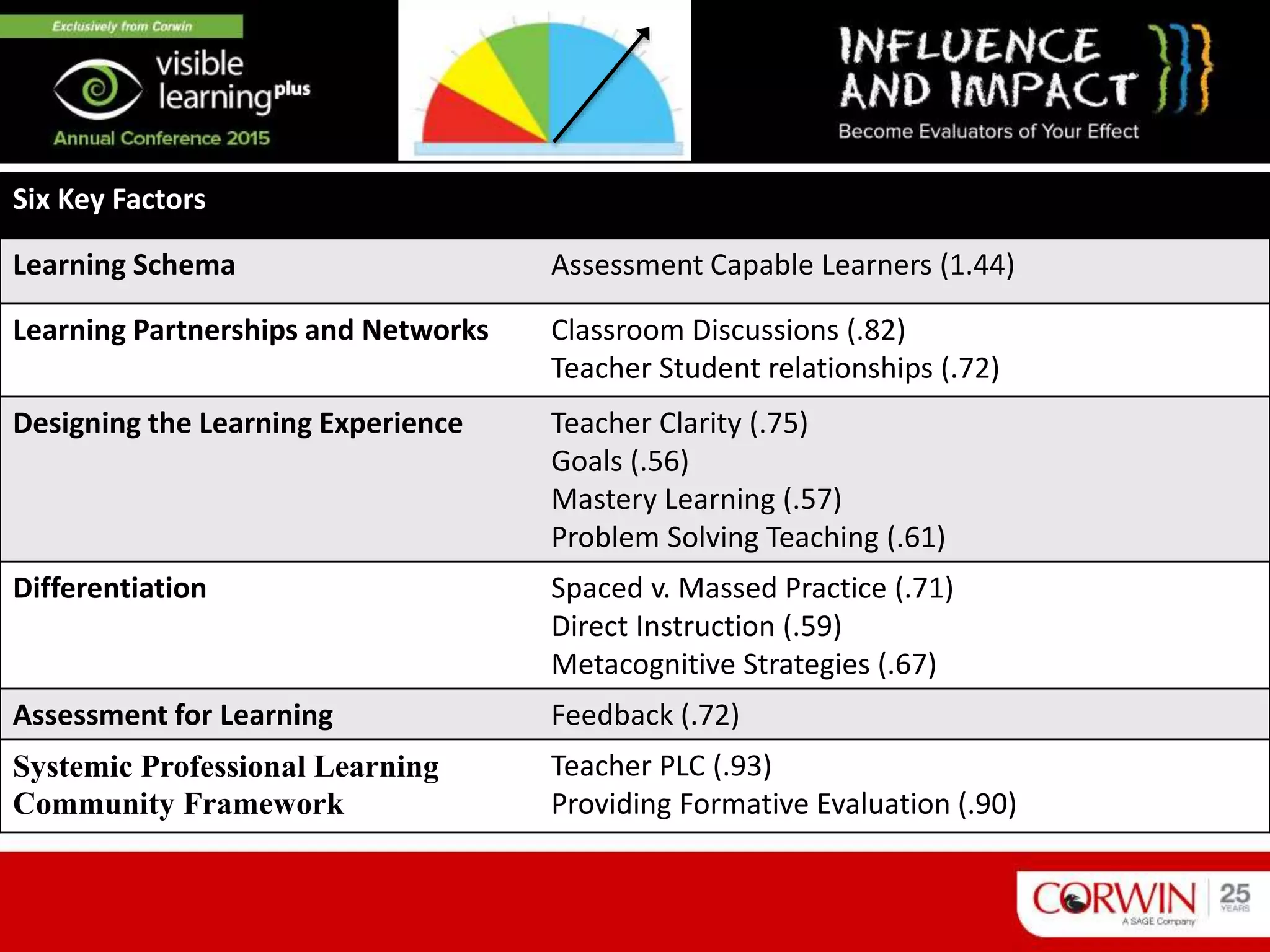
Six Key Factors
Learning Schema Assessment Capable Learners (1.44)
Learning Partnerships and Networks Classroom Discussions (.82)
Teacher Student relationships (.72)
Designing the Learning Experience Teacher Clarity (.75)
Goals (.56)
Mastery Learning (.57)
Problem Solving Teaching (.61)
Differentiation Spaced v. Massed Practice (.71)
Direct Instruction (.59)
Metacognitive Strategies (.67)
Assessment for Learning Feedback (.72)
Systemic Professional Learning
Community Framework
Teacher PLC (.93)
Providing Formative Evaluation (.90)
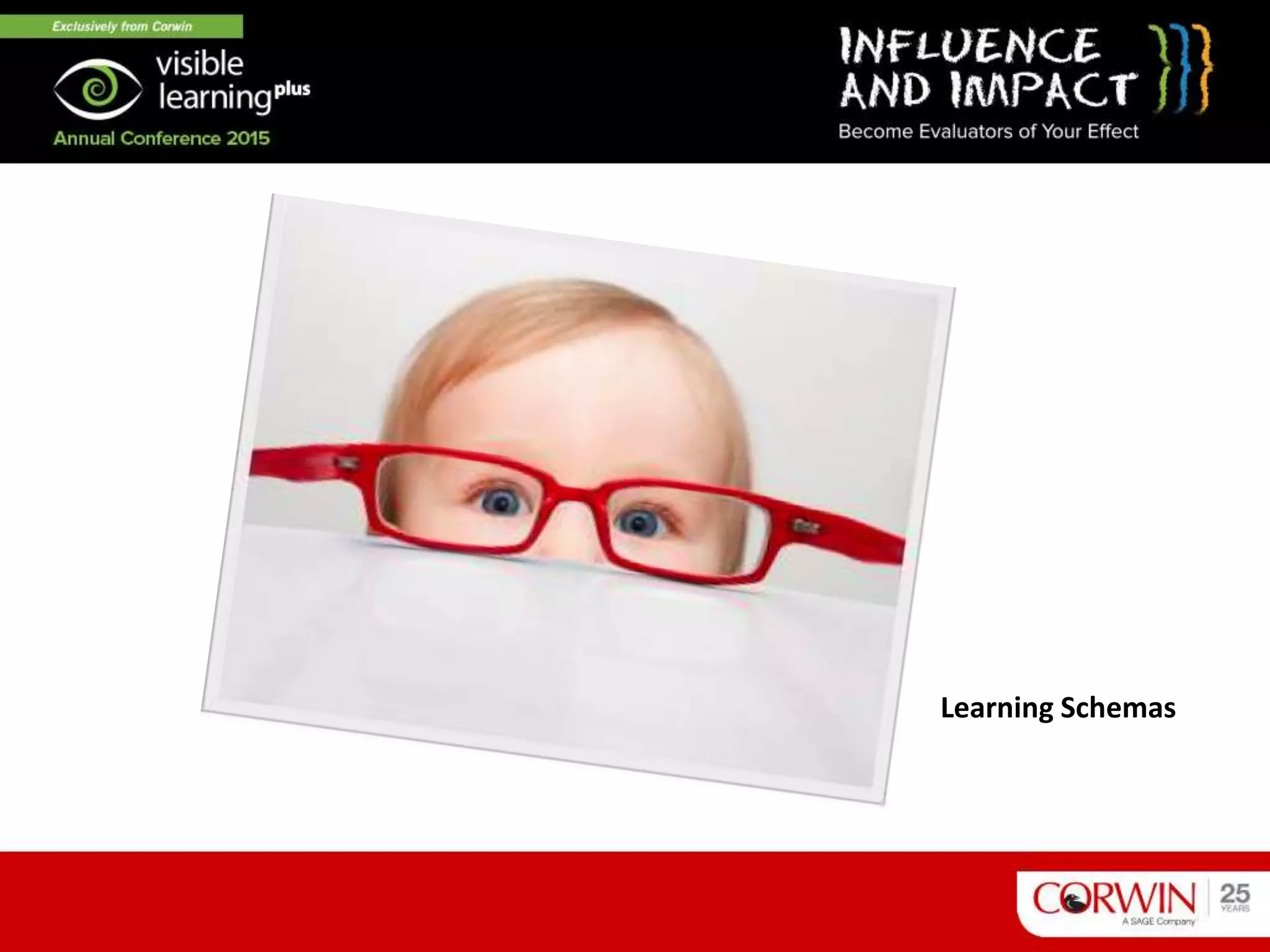
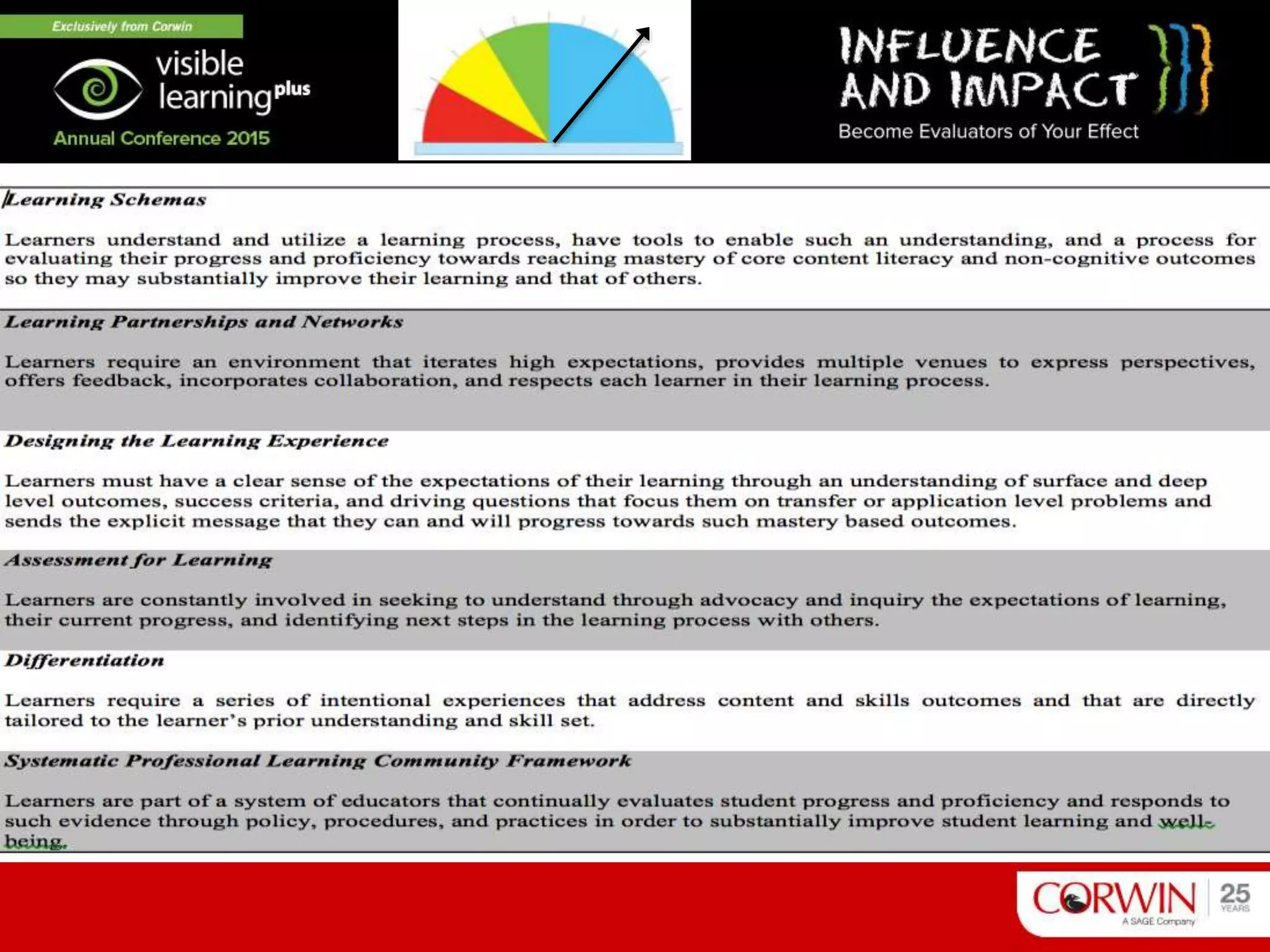
Learning Schemas
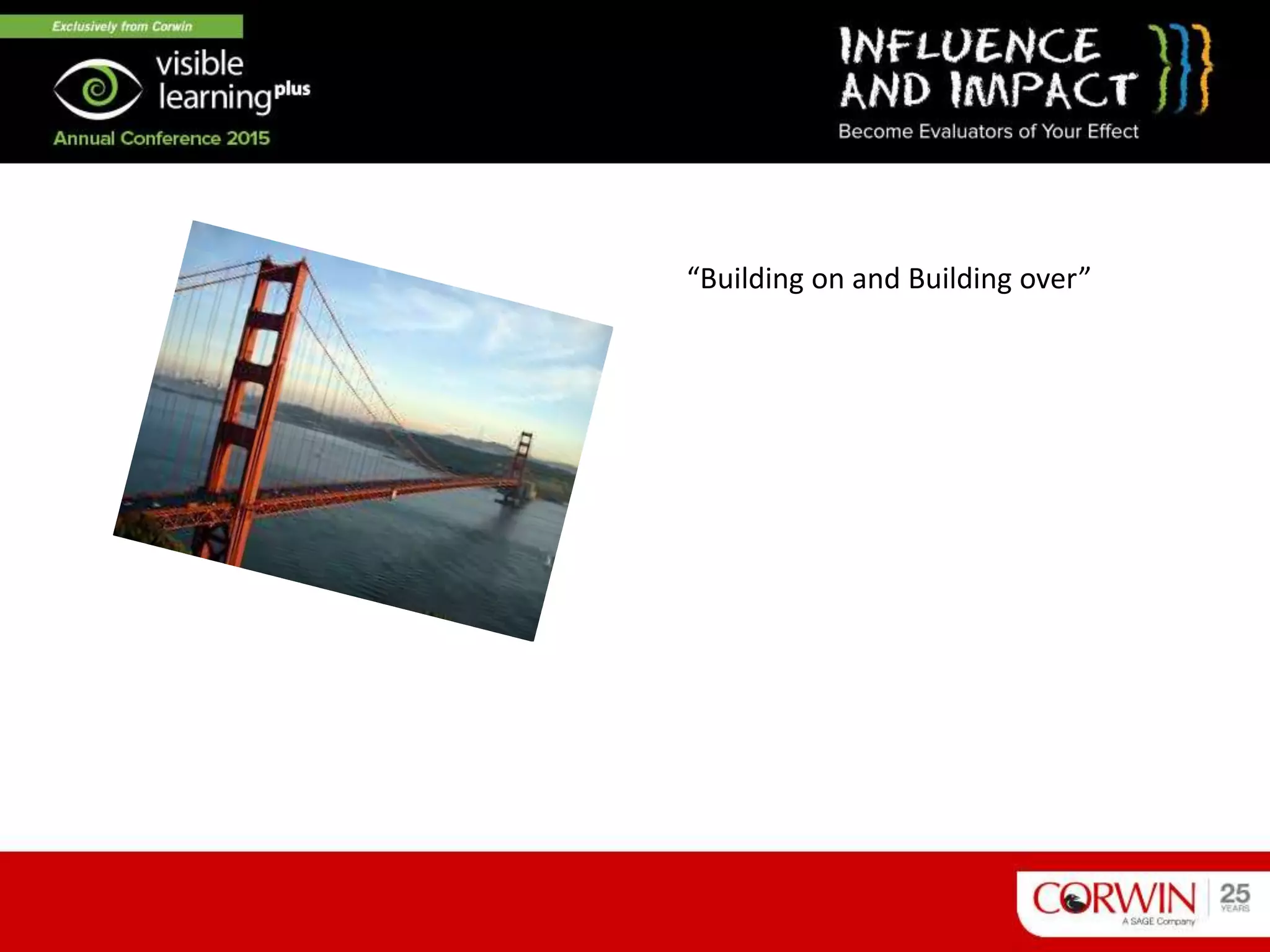
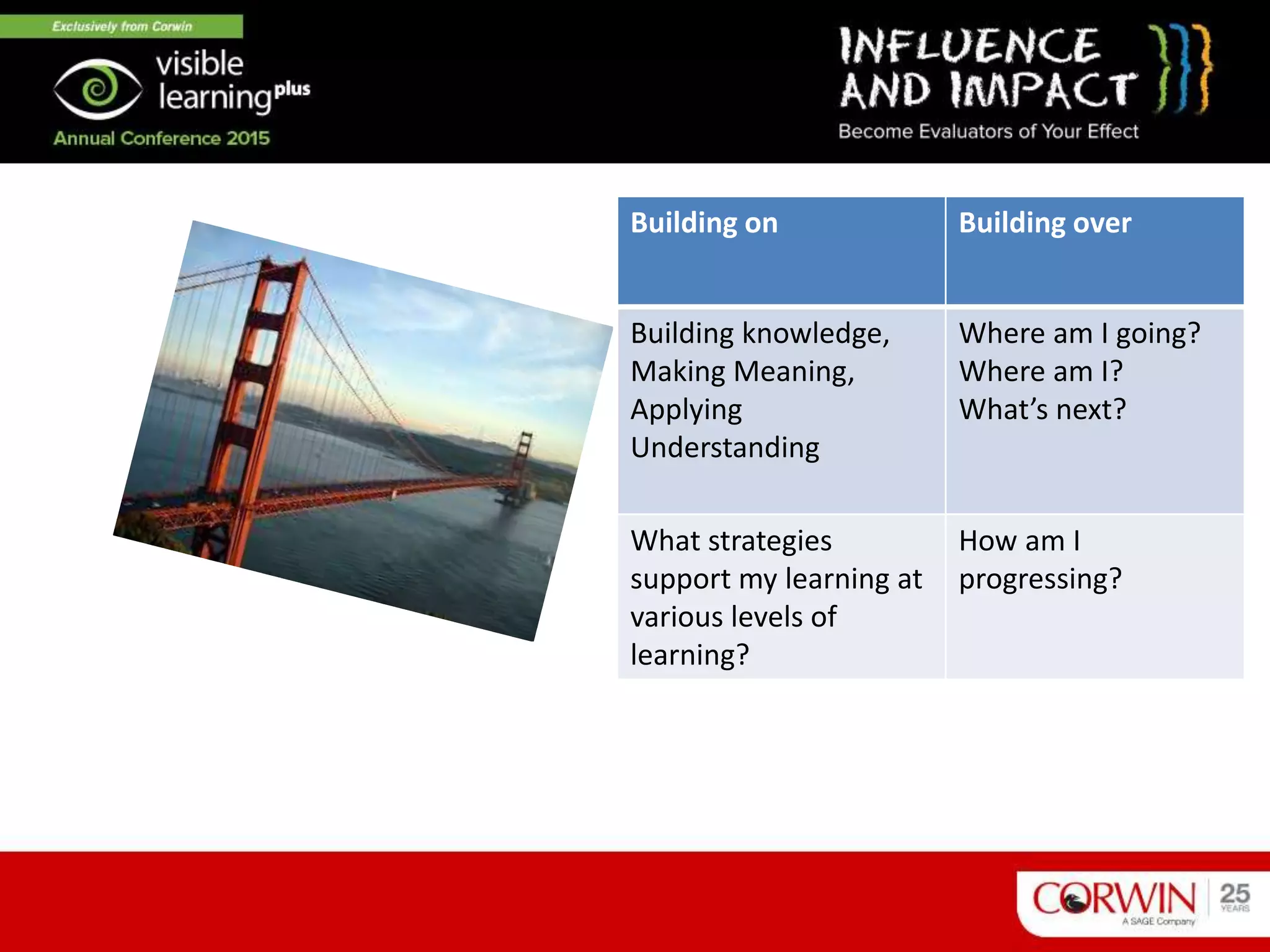
“Building on and Building over”
Building on Building over
Building knowledge,
Making Meaning,
Applying
Understanding
Where am I going?
Where am I?
What’s next?
What strategies
support my learning at
various levels of
learning?
How am I
progressing?
Learning Centered Culture and Climate
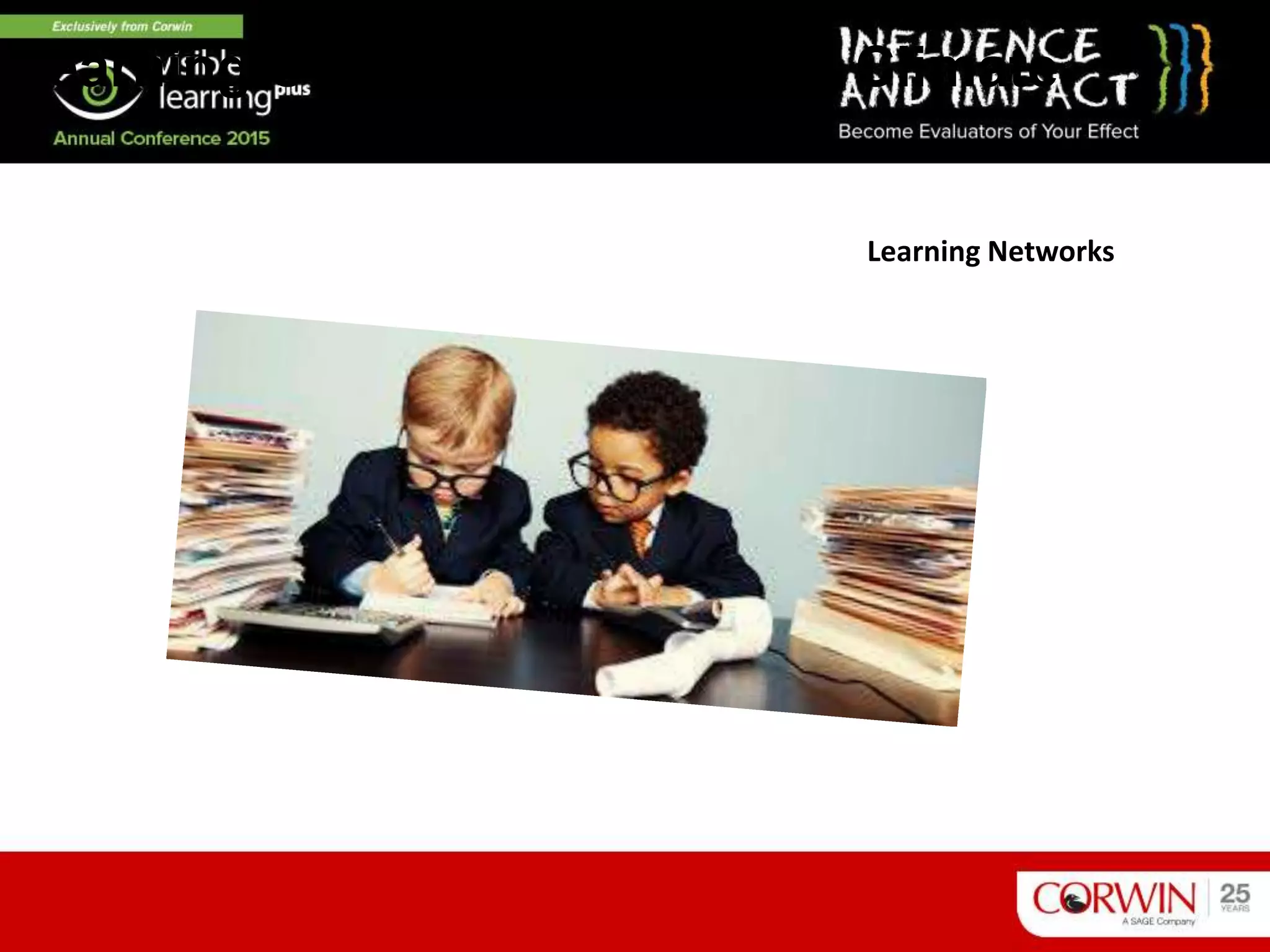
Learning Networks
Enduring Understandings related to
cognition
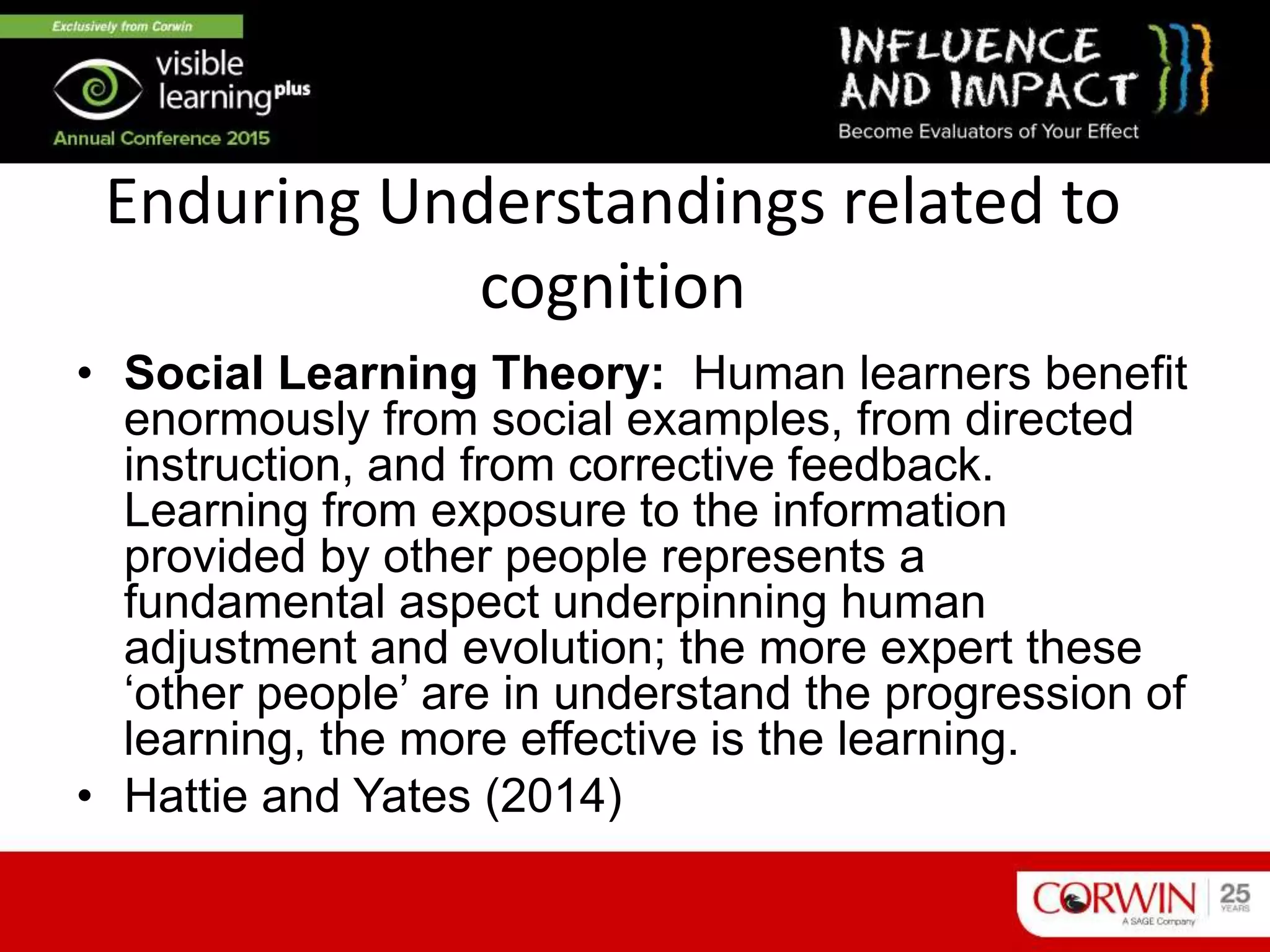
• Social Learning Theory: Human learners benefit
enormously from social examples, from directed
instruction, and from corrective feedback.
Learning from exposure to the information
provided by other people represents a
fundamental aspect underpinning human
adjustment and evolution; the more expert these
‘other people’ are in understand the progression of
learning, the more effective is the learning.
• Hattie and Yates (2014)
Designing the
Learning
experience
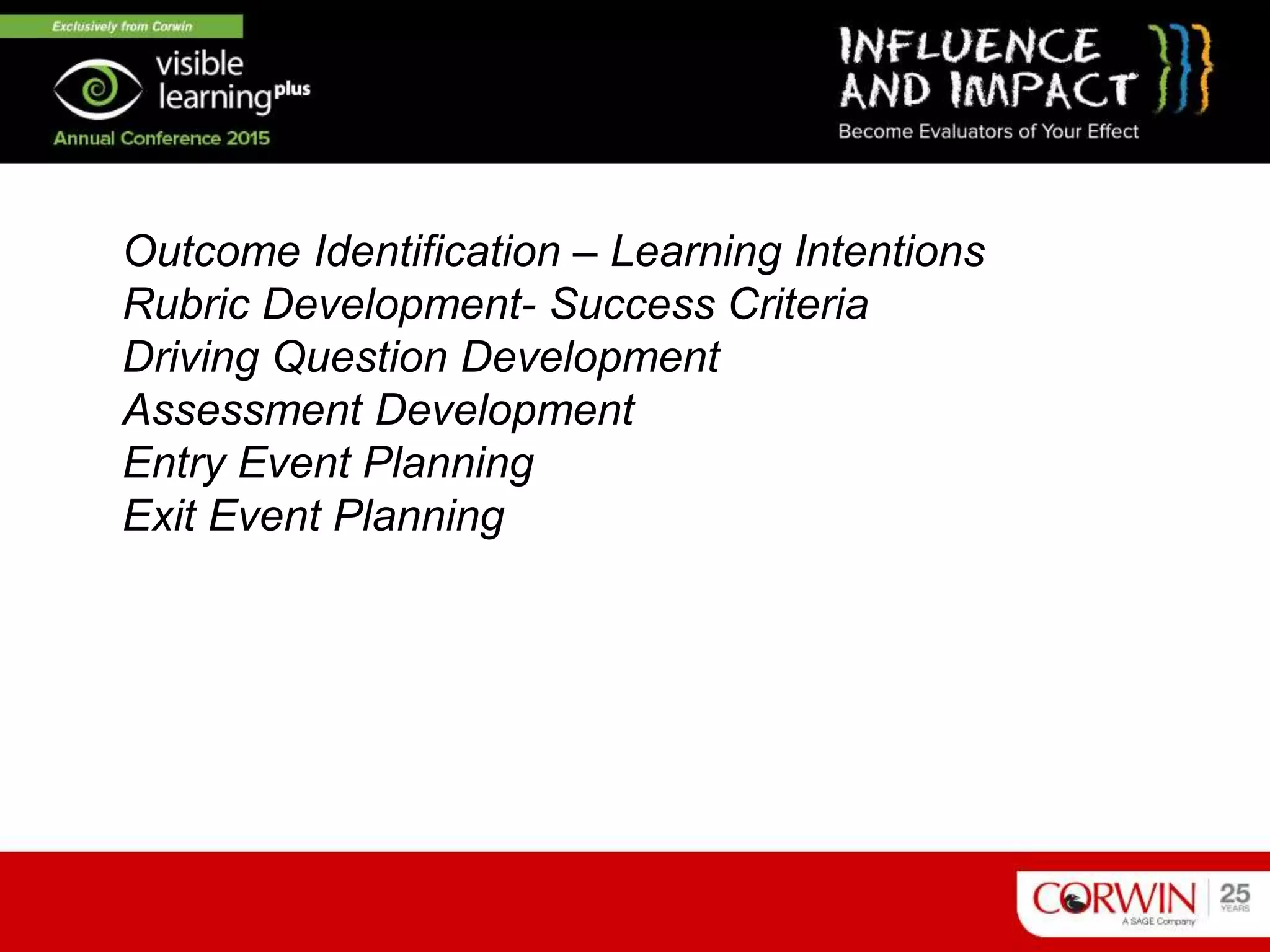
Outcome Identification – Learning Intentions
Rubric Development- Success Criteria
Driving Question Development
Assessment Development
Entry Event Planning
Exit Event Planning
Project-Based Learning Unit:
Project
Launch
Entry Event and
Rubric Create
“Need to Knows”
and Next Steps
Activities
Workshops
Lectures
Homework
Benchmark
Research
Labs
Simulations
Discussions
Modeling
Reading
Benchmark
Interviews
Quiz
Reflectionon
Learning
P
R
E
S
E
N
T
Creating
Feedback
Building
Writing
Preparing
Drafts
Project-Based Learning Unit:
Project
Launch
Entry Event and
Rubric Create
“Need to Knows”
and Next Steps
Activities
Workshops
Lectures
Homework
Benchmark
Research
Labs
Simulations
Discussions
Modeling
Reading
Benchmark
Interviews
Quiz
Reflectionon
Learning
P
R
E
S
E
N
T
Creating
Feedback
Building
Writing
Preparing
Drafts
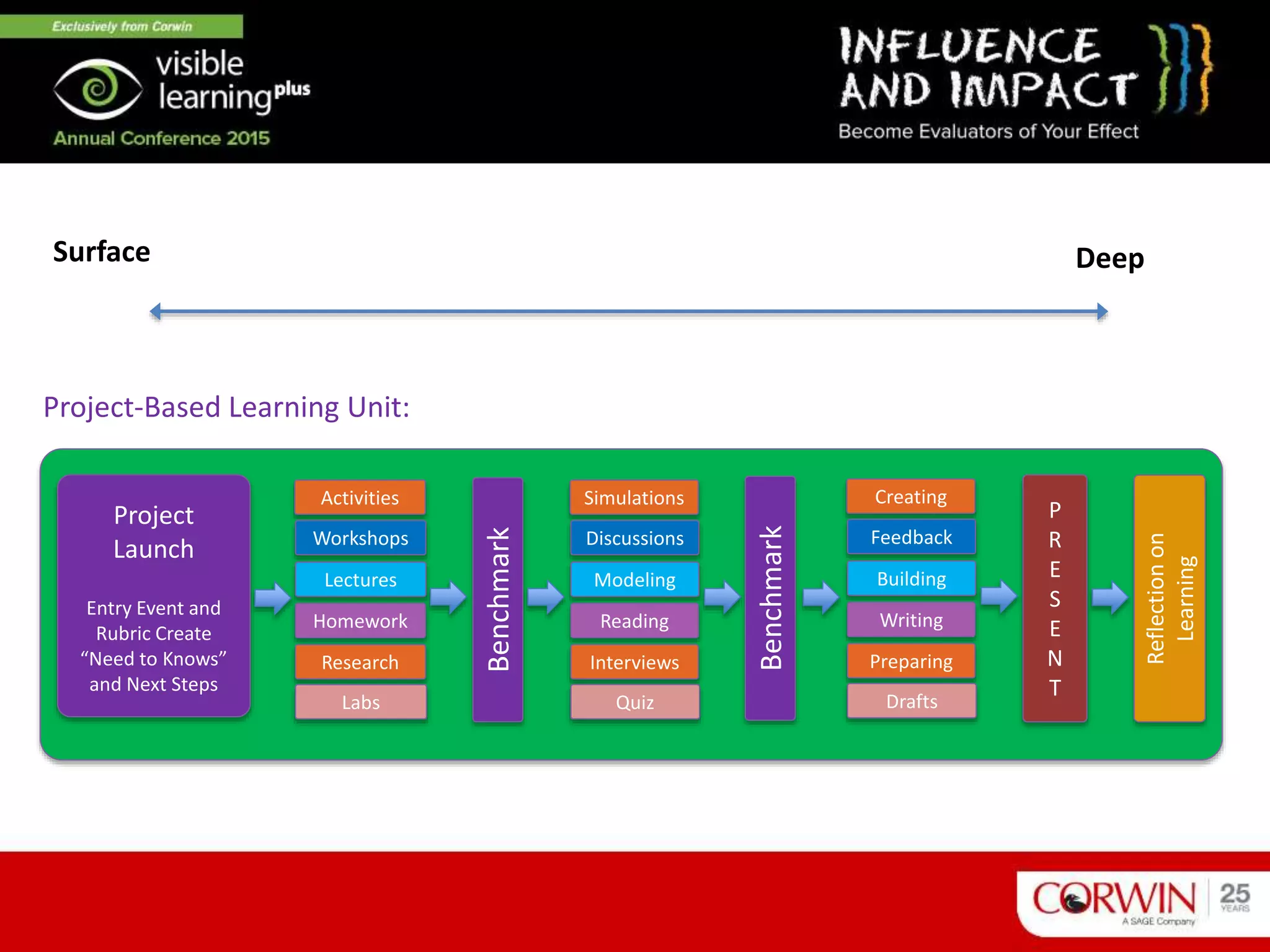
Surface Deep
Project-Based Learning Unit:
Project
Launch
Entry Event and
Rubric Create
“Need to Knows”
and Next Steps
Activities
Workshops
Lectures
Homework
Benchmark
Research
Labs
Simulations
Discussions
Modeling
Reading
Benchmark
Interviews
Quiz
Reflectionon
Learning
P
R
E
S
E
N
T
Creating
Feedback
Building
Writing
Preparing
Drafts
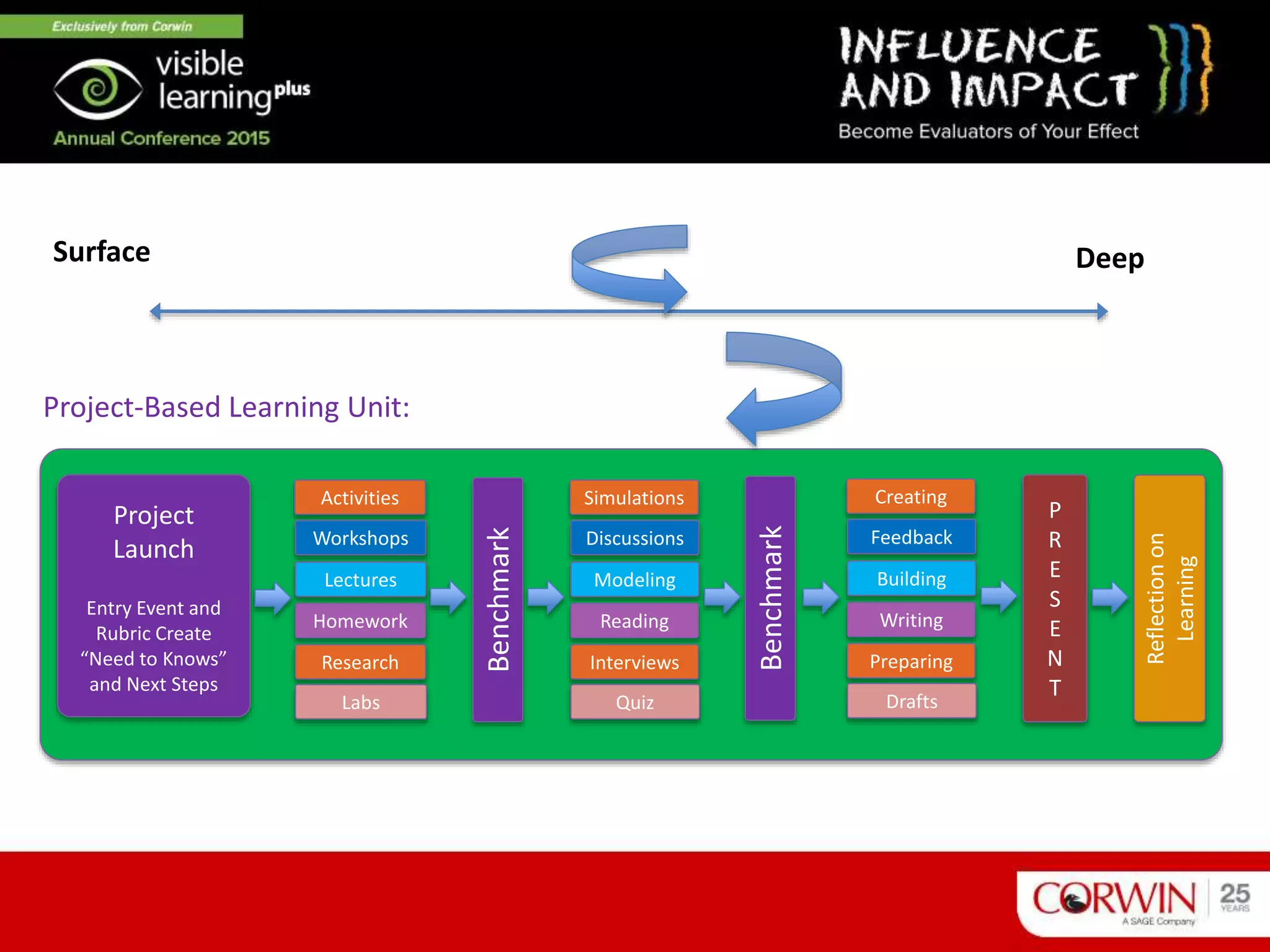
Surface Deep
Project-Based Learning Unit:
Project
Launch
Entry Event and
Rubric Create
“Need to Knows”
and Next Steps
Activities
Workshops
Lectures
Homework
Benchmark
Research
Labs
Simulations
Discussions
Modeling
Reading
Benchmark
Interviews
Quiz
Reflectionon
Learning
P
R
E
S
E
N
T
Creating
Feedback
Building
Writing
Preparing
Drafts
Creating intellectual dilemmas
Score Description
4 Extension
Applying Understanding
3 Relational
Making Meaning
2 Single/Multiple
Building Knowledge
1 Direct Support
DEEP
SURFACE
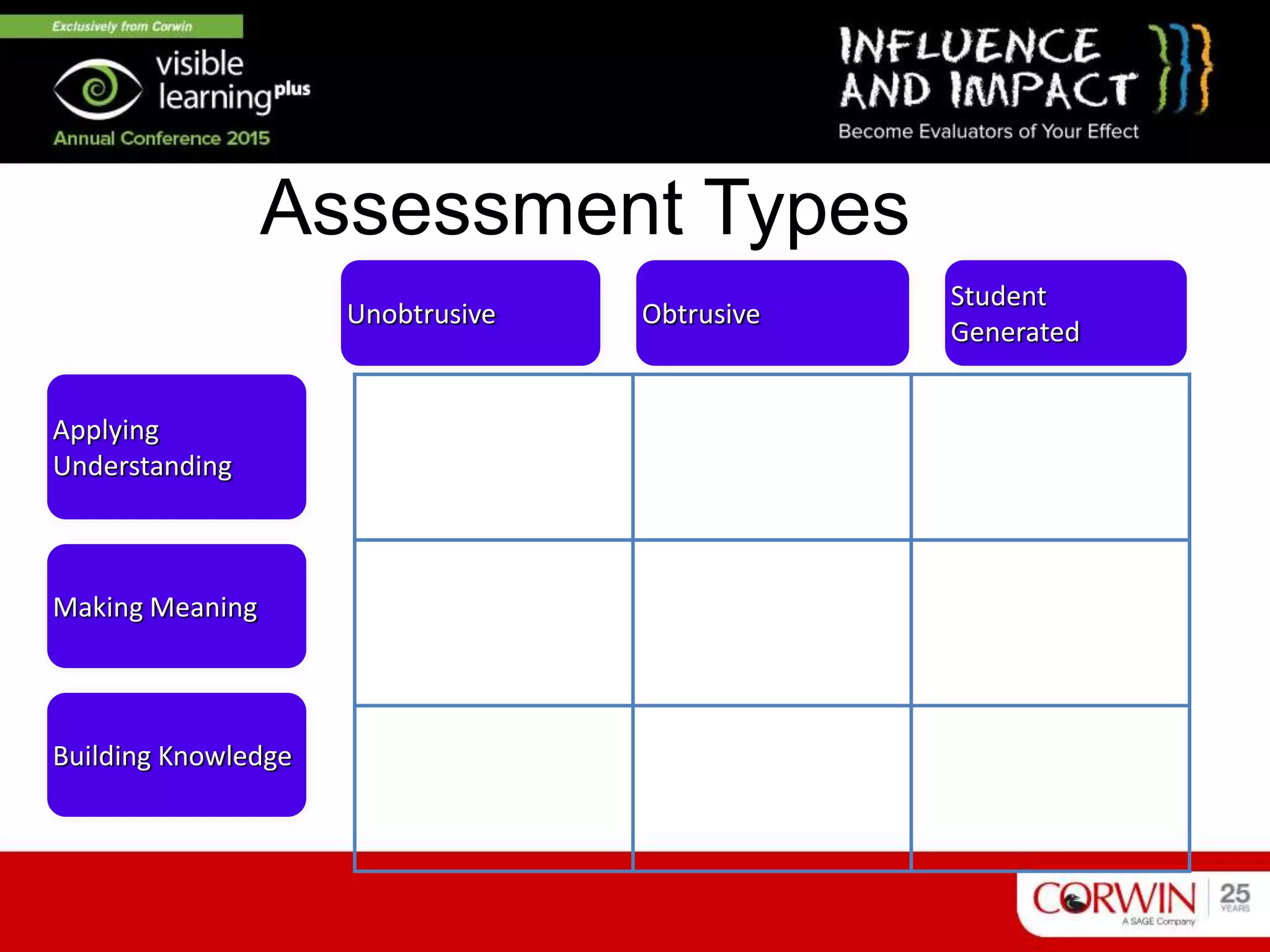
Assessment Types
Unobtrusive Obtrusive
Student
Generated
Applying
Understanding
Making Meaning
Building Knowledge
Differentiation
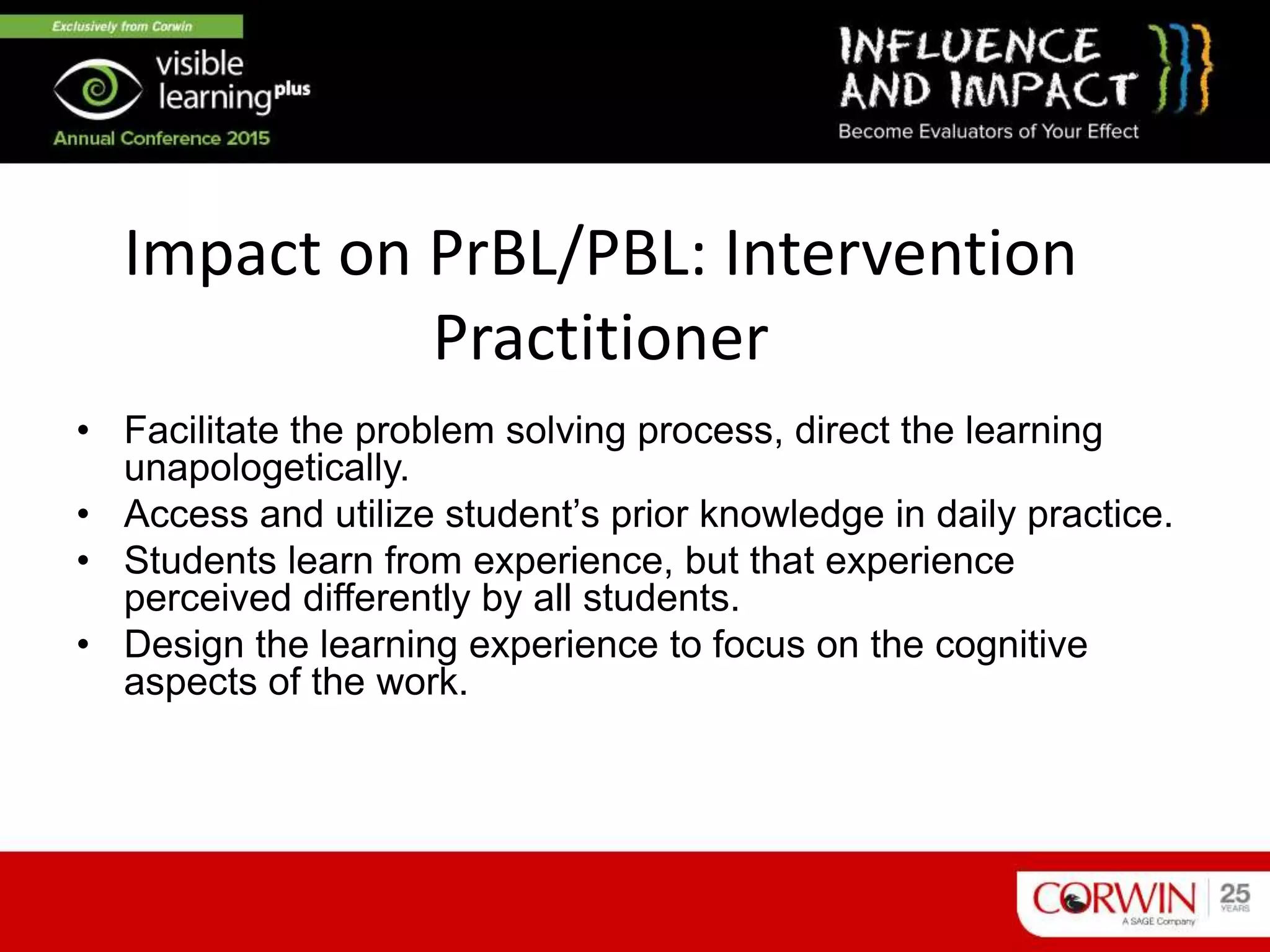
Impact on PrBL/PBL: Intervention
Practitioner
• Facilitate the problem solving process, direct the learning
unapologetically.
• Access and utilize student’s prior knowledge in daily practice.
• Students learn from experience, but that experience
perceived differently by all students.
• Design the learning experience to focus on the cognitive
aspects of the work.
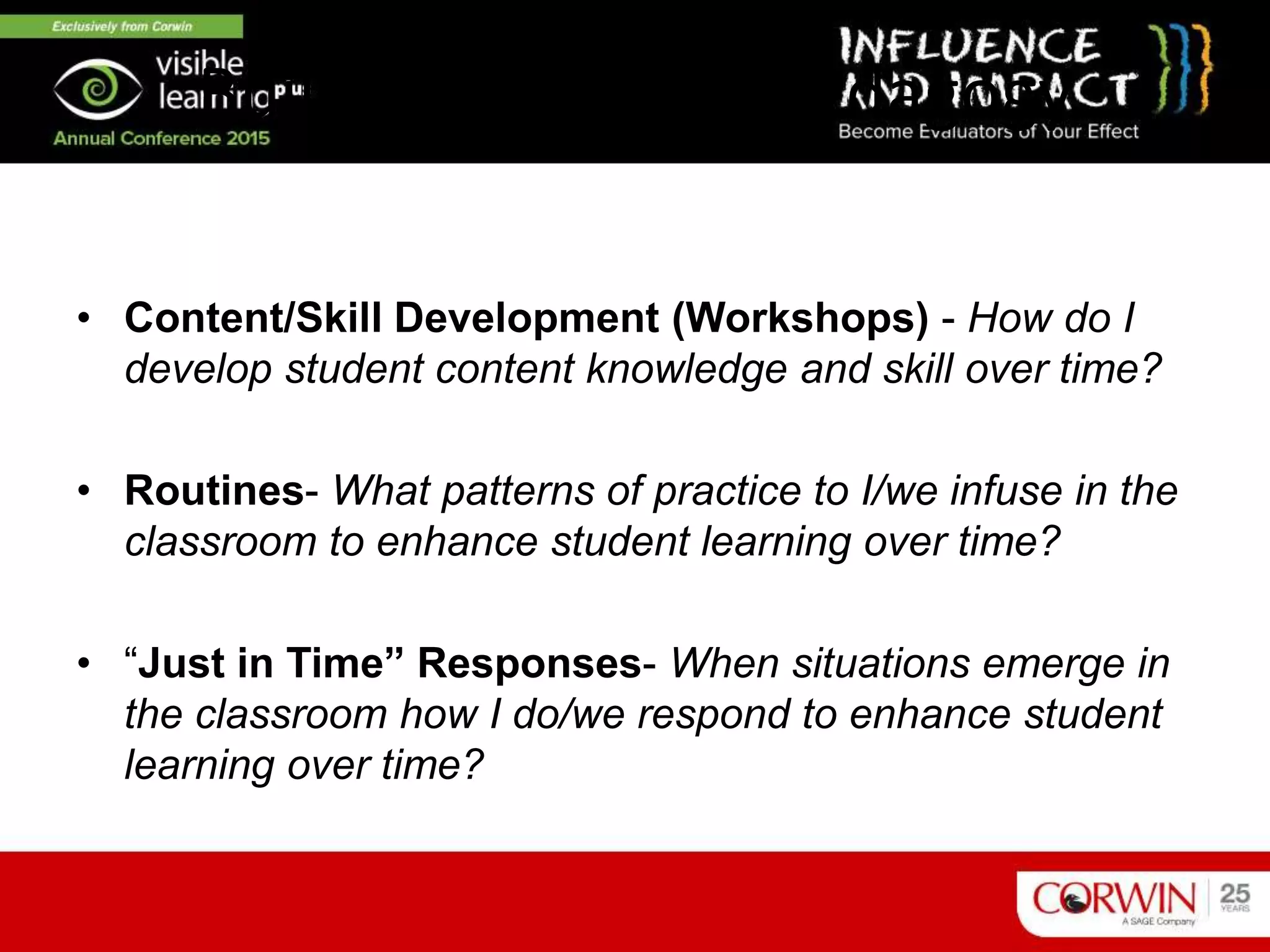
Building Blocks of Pedagogy
• Content/Skill Development (Workshops) - How do I
develop student content knowledge and skill over time?
• Routines- What patterns of practice to I/we infuse in the
classroom to enhance student learning over time?
• “Just in Time” Responses- When situations emerge in
the classroom how I do/we respond to enhance student
learning over time?
Project-Based Learning Unit:
Project
Launch
Entry Event and
Rubric Create
“Need to Knows”
and Next Steps
Activities
Workshops
Lectures
Homework
Benchmark
Research
Labs
Simulations
Discussions
Modeling
Reading
Benchmark
Interviews
Quiz
Reflectionon
Learning
P
R
E
S
E
N
T
Creating
Feedback
Building
Writing
Preparing
Drafts
Surface Deep
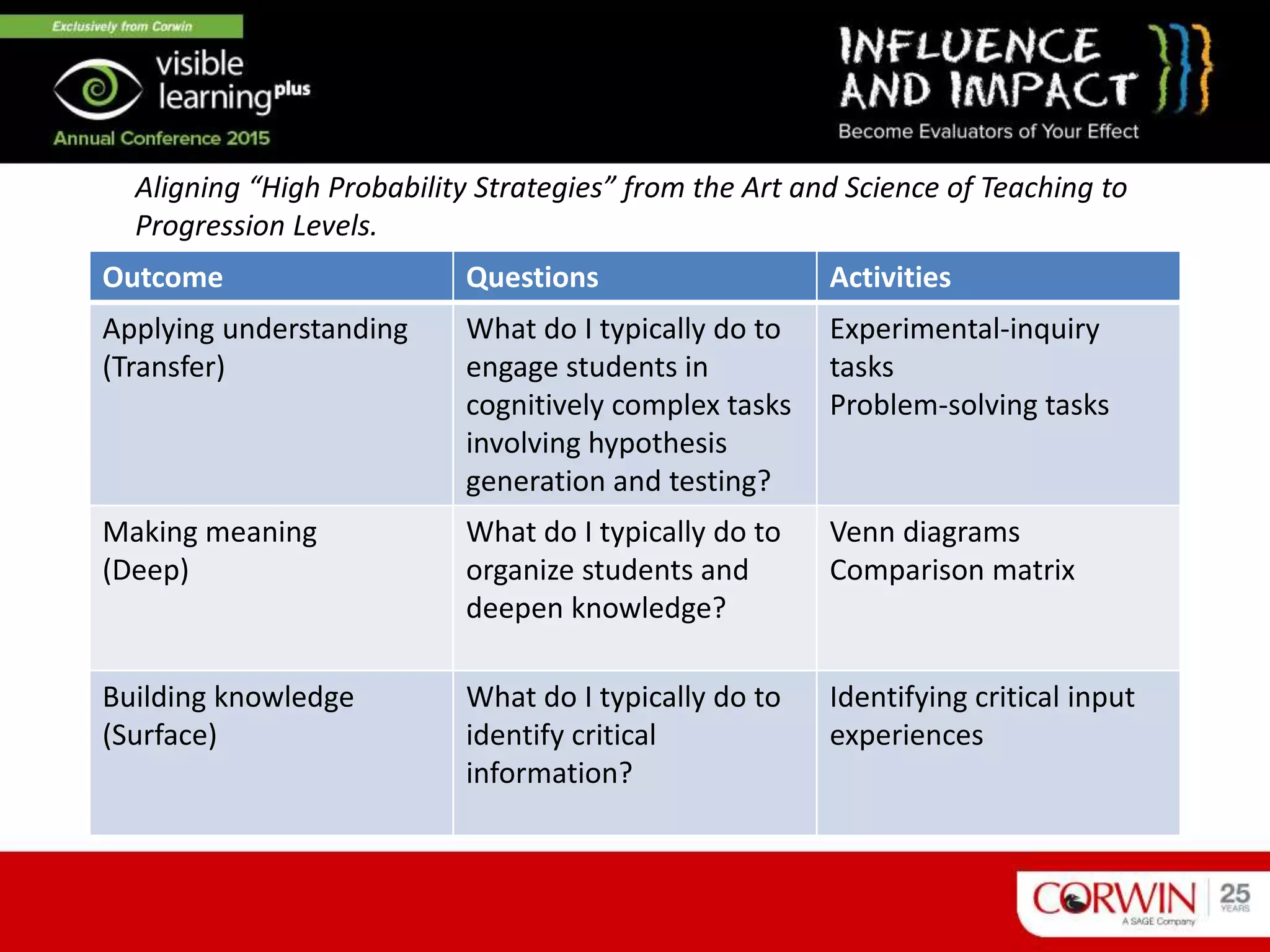
Aligning “High Probability Strategies” from the Art and Science of Teaching to
Progression Levels.
Outcome Questions Activities
Applying understanding
(Transfer)
What do I typically do to
engage students in
cognitively complex tasks
involving hypothesis
generation and testing?
Experimental-inquiry
tasks
Problem-solving tasks
Making meaning
(Deep)
What do I typically do to
organize students and
deepen knowledge?
Venn diagrams
Comparison matrix
Building knowledge
(Surface)
What do I typically do to
identify critical
information?
Identifying critical input
experiences
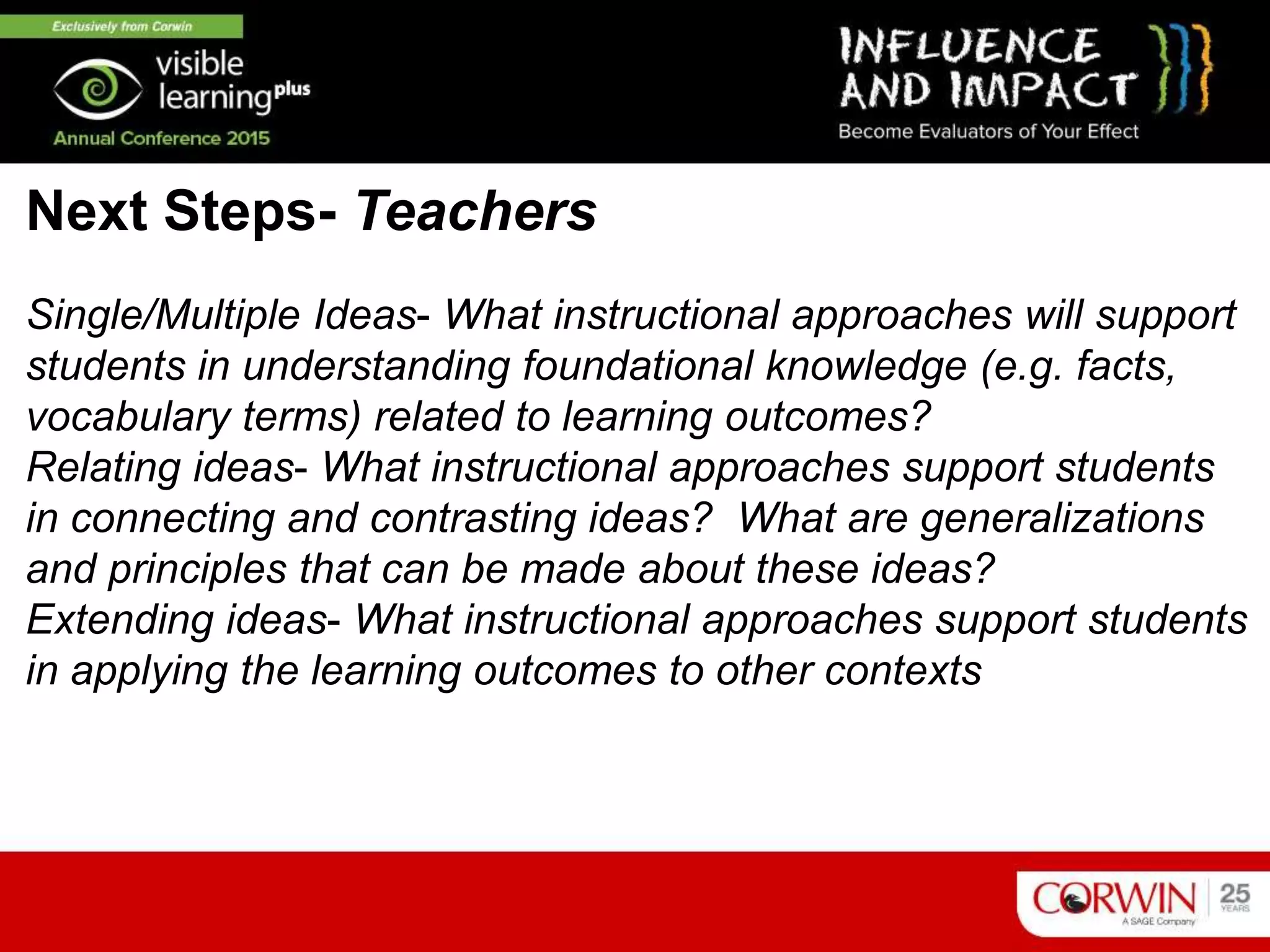
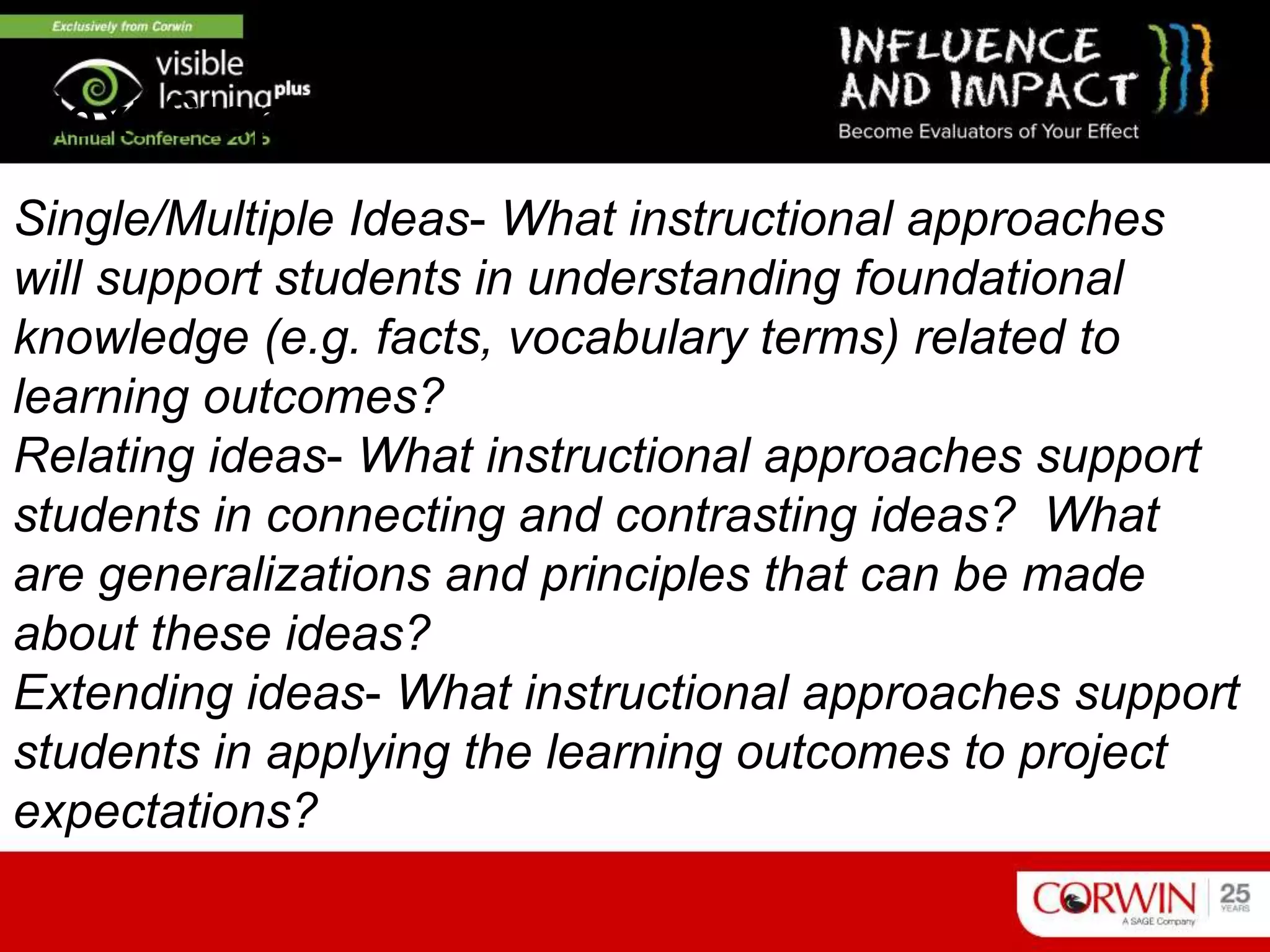
Single/Multiple Ideas- What instructional approaches will support
students in understanding foundational knowledge (e.g. facts,
vocabulary terms) related to learning outcomes?
Relating ideas- What instructional approaches support students
in connecting and contrasting ideas? What are generalizations
and principles that can be made about these ideas?
Extending ideas- What instructional approaches support students
in applying the learning outcomes to other contexts
Next Steps- Teachers
Progression Level
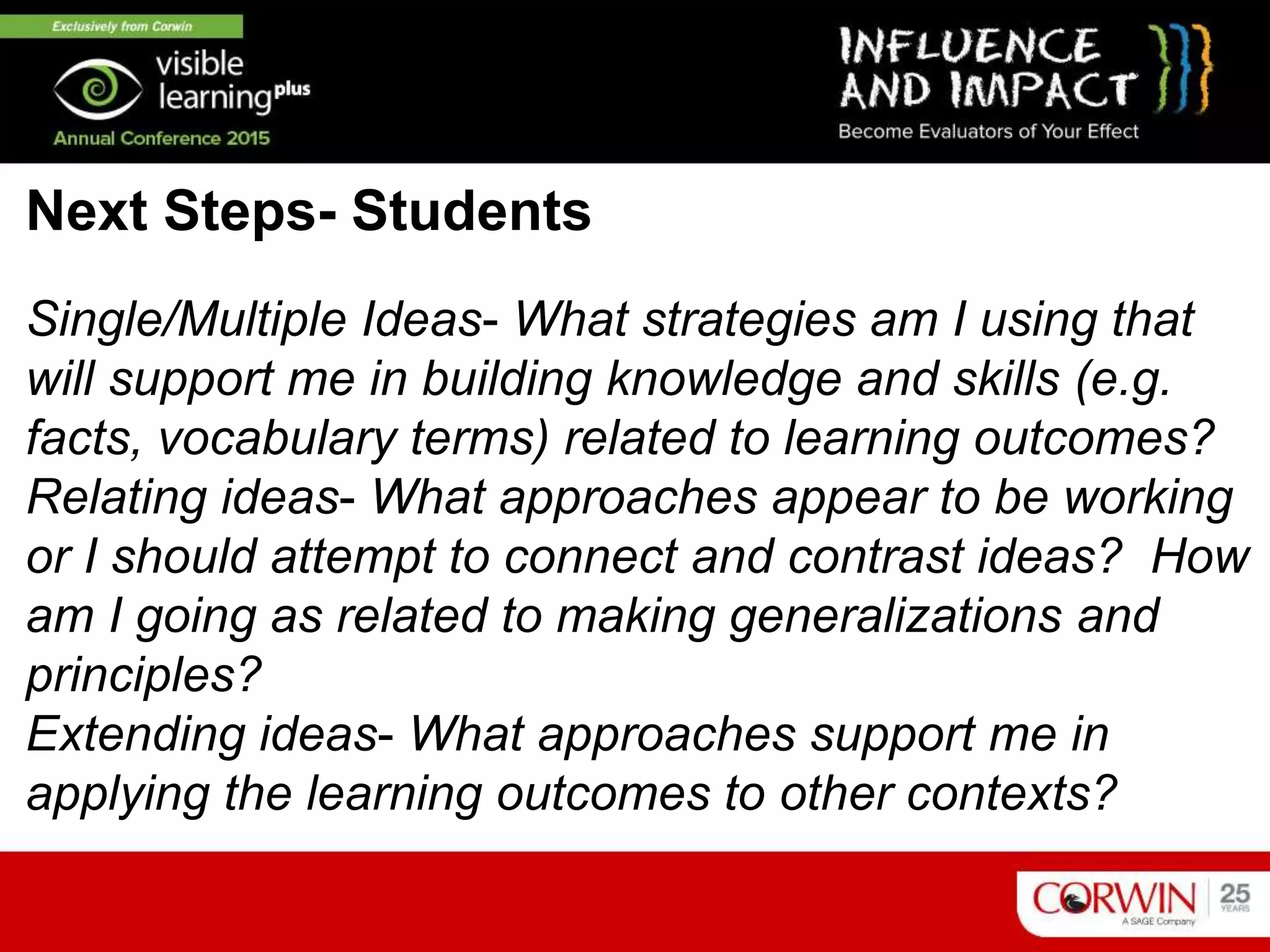
Single/Multiple Ideas- What strategies am I using that
will support me in building knowledge and skills (e.g.
facts, vocabulary terms) related to learning outcomes?
Relating ideas- What approaches appear to be working
or I should attempt to connect and contrast ideas? How
am I going as related to making generalizations and
principles?
Extending ideas- What approaches support me in
applying the learning outcomes to other contexts?
Next Steps- Students
Project Management
Assessment for Learning
Systemic Professional Learning Community
Framework
Progress
Proficiency
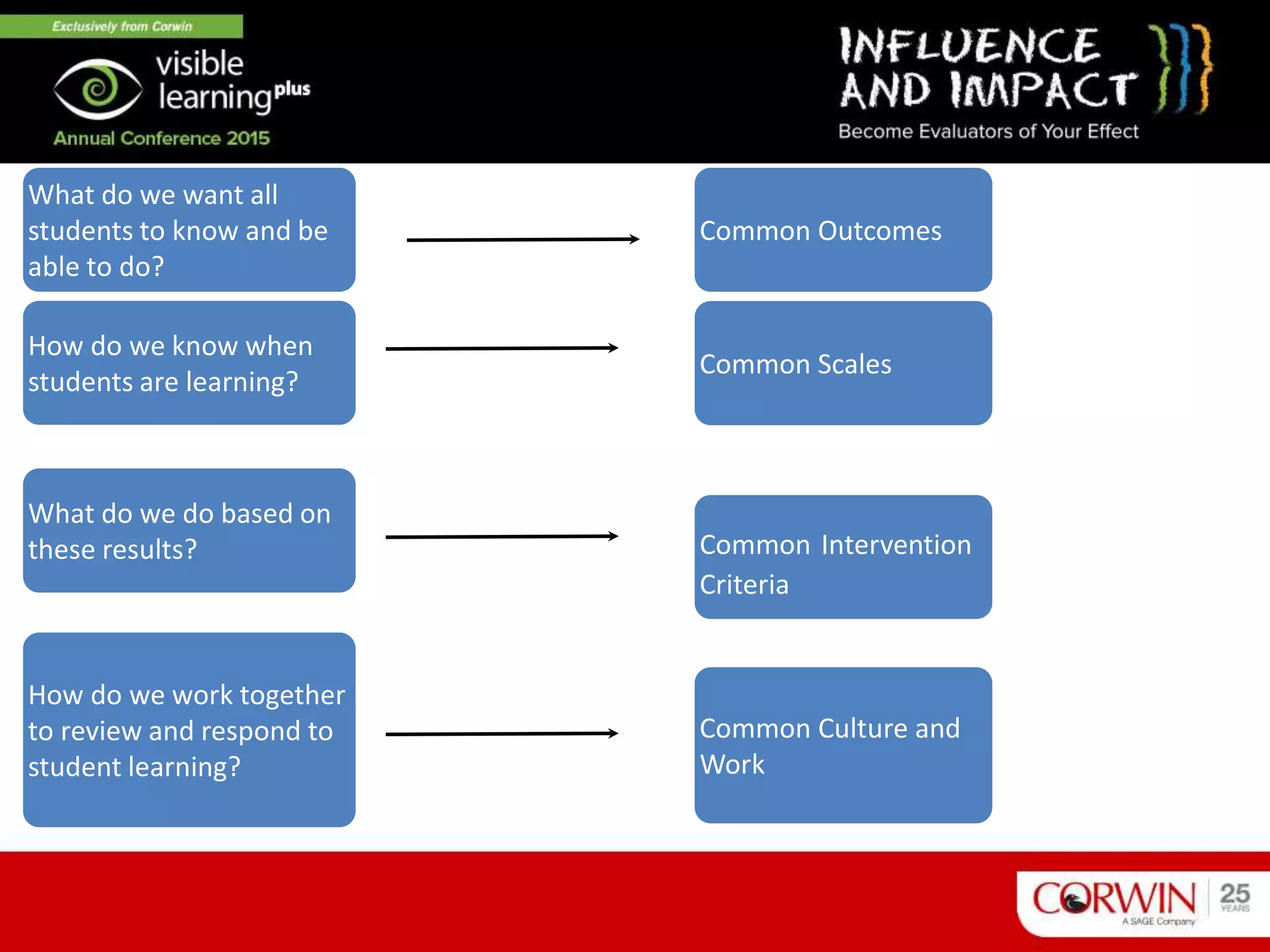
What do we want all
students to know and be
able to do?
How do we know when
students are learning?
What do we do based on
such results?
How do we work together
to review and respond to
student learning?
What do we want all
students to know and be
able to do?
What do we do based on
these results?
How do we work together
to review and respond to
student learning?
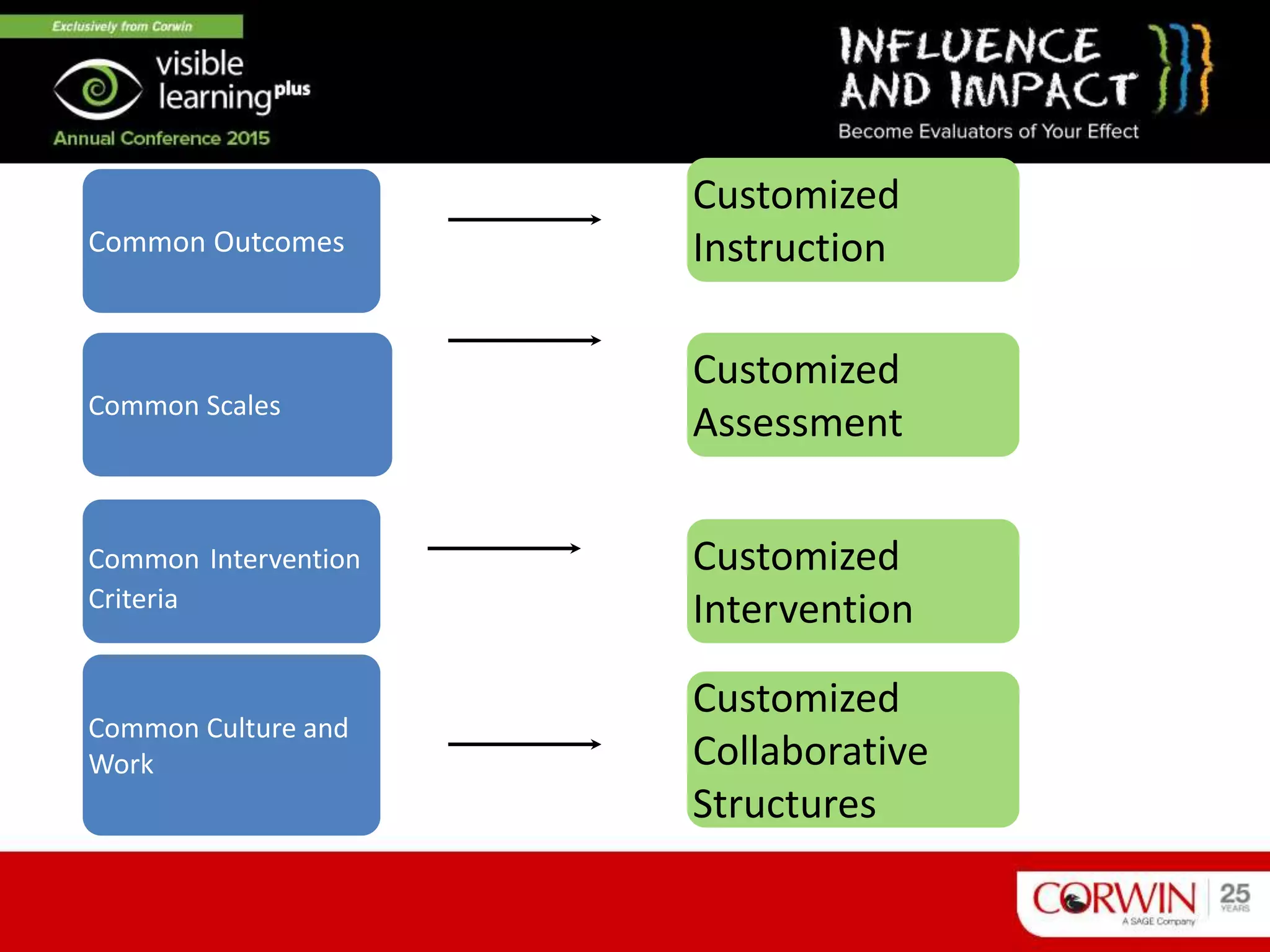
Common Outcomes
Common Scales
Common Intervention
Criteria
Common Culture and
Work
How do we know when
students are learning?
Common Outcomes
Customized
Instruction
Customized
Assessment
Customized
Collaborative
Structures
Customized
Intervention
Common Scales
Common Intervention
Criteria
Common Culture and
Work
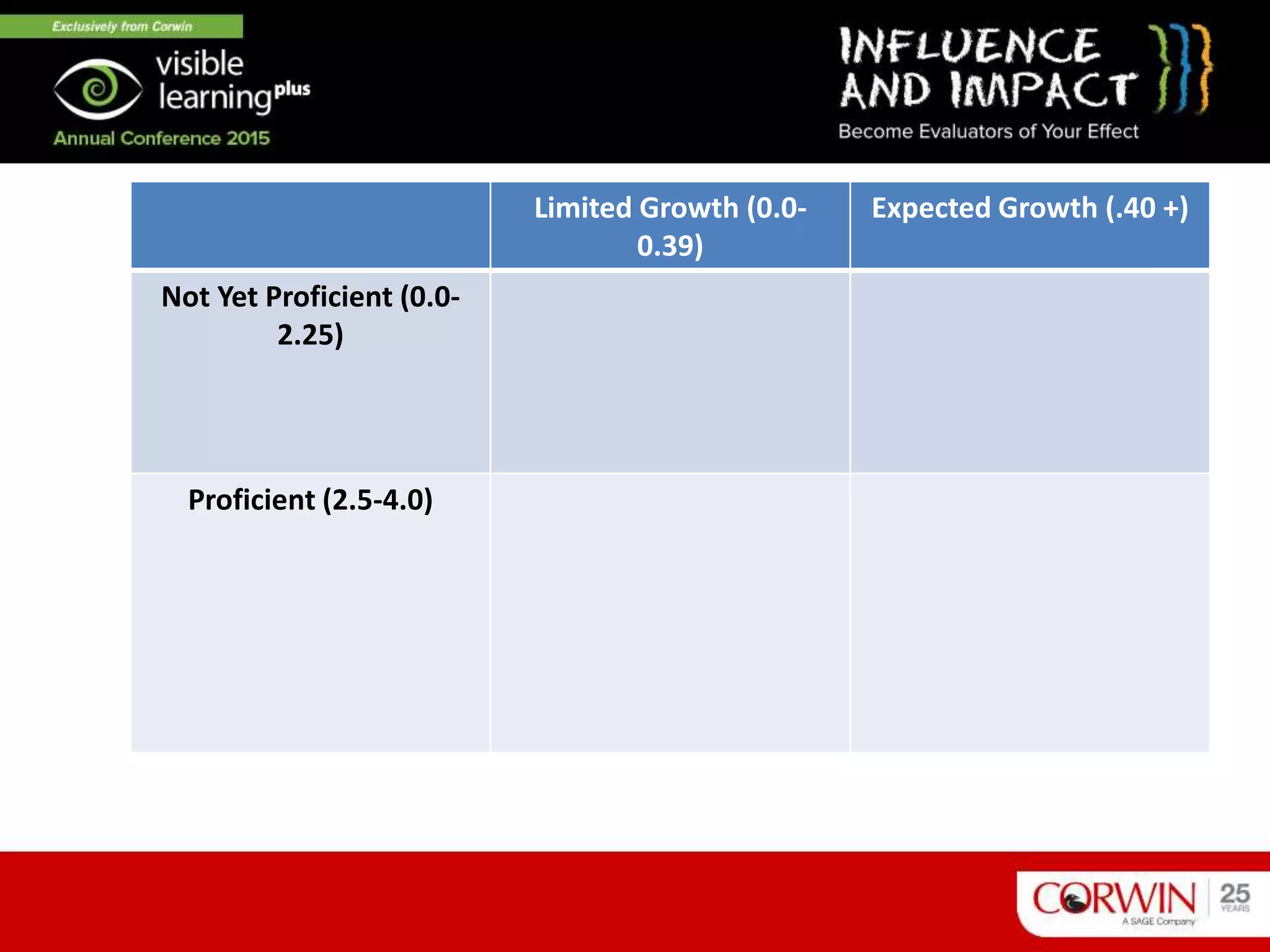
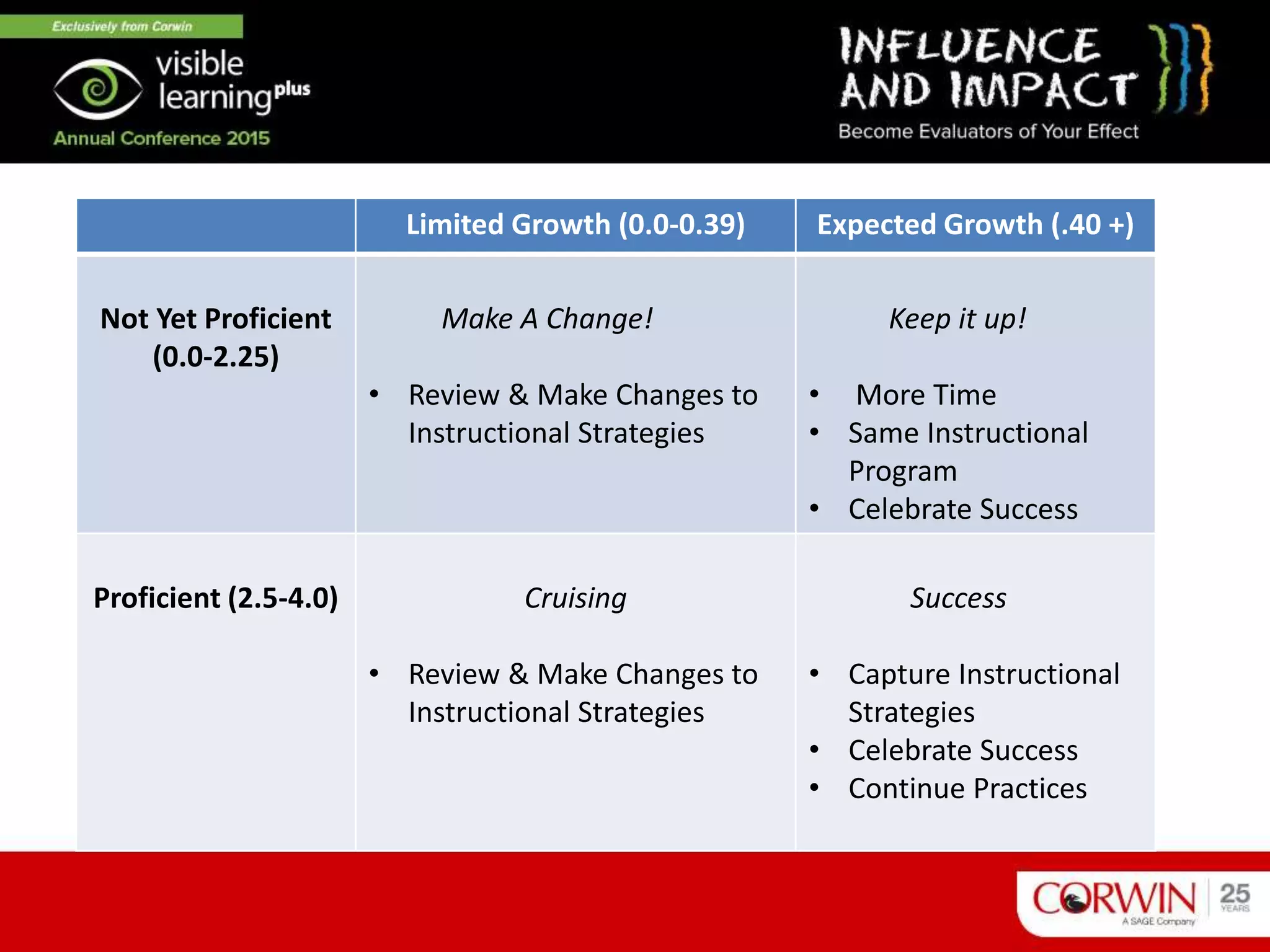
Limited Growth (0.0-
0.39)
Expected Growth (.40 +)
Not Yet Proficient (0.0-
2.25)
Proficient (2.5-4.0)
Limited Growth (0.0-0.39) Expected Growth (.40 +)
Not Yet Proficient
(0.0-2.25)
Make A Change!
• Review & Make Changes to
Instructional Strategies
Keep it up!
• More Time
• Same Instructional
Program
• Celebrate Success
Proficient (2.5-4.0) Cruising
• Review & Make Changes to
Instructional Strategies
Success
• Capture Instructional
Strategies
• Celebrate Success
• Continue Practices
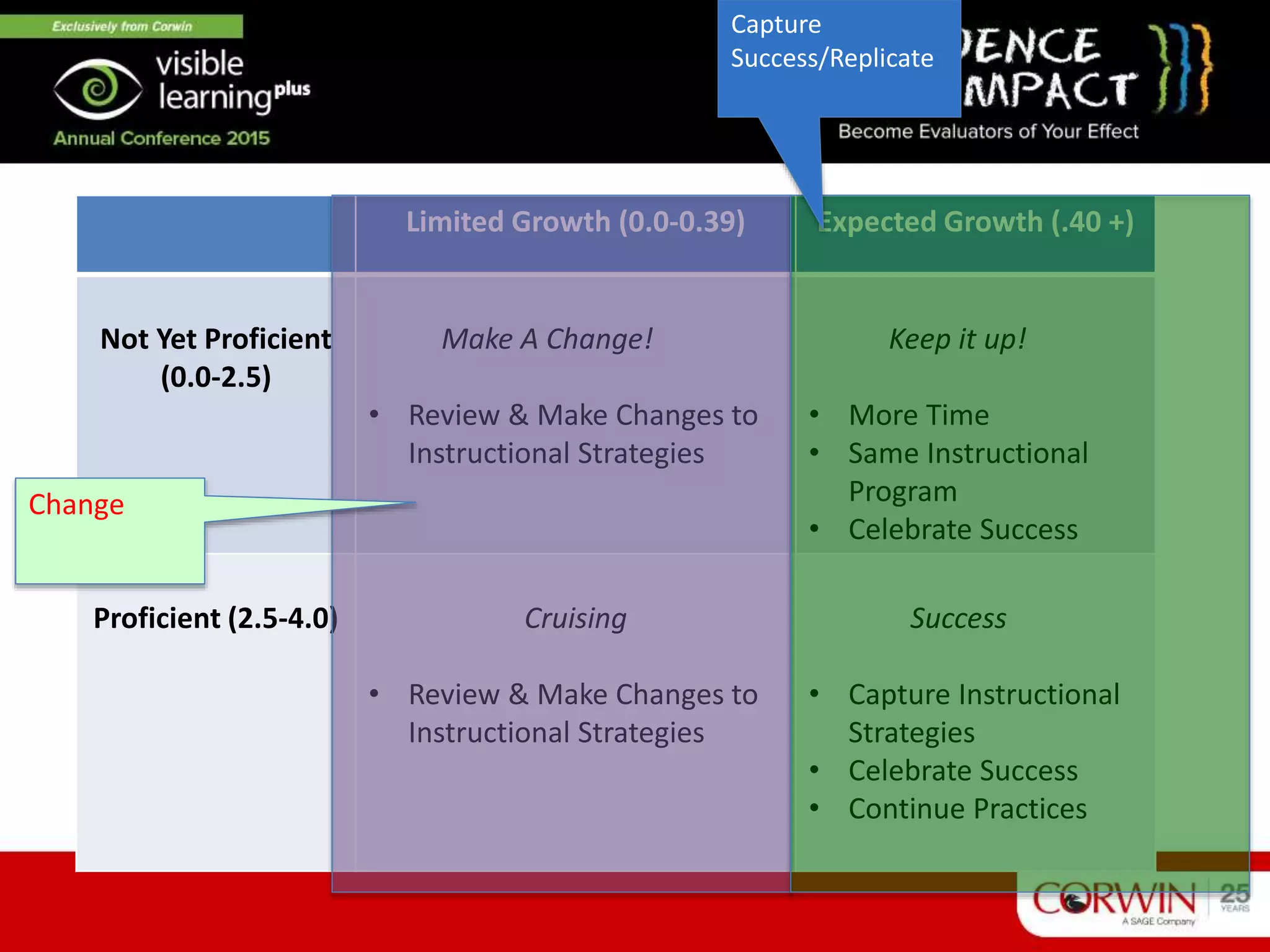
Limited Growth (0.0-0.39) Expected Growth (.40 +)
Not Yet Proficient
(0.0-2.5)
Make A Change!
• Review & Make Changes to
Instructional Strategies
Keep it up!
• More Time
• Same Instructional
Program
• Celebrate Success
Proficient (2.5-4.0) Cruising
• Review & Make Changes to
Instructional Strategies
Success
• Capture Instructional
Strategies
• Celebrate Success
• Continue Practices
Capture
Success/Replicate
Change
What? So What? Now What?
Moving from Data Analysis to Response
Single/Multiple Ideas- What instructional approaches
will support students in understanding foundational
knowledge (e.g. facts, vocabulary terms) related to
learning outcomes?
Relating ideas- What instructional approaches support
students in connecting and contrasting ideas? What
are generalizations and principles that can be made
about these ideas?
Extending ideas- What instructional approaches support
students in applying the learning outcomes to project
expectations?
Next Steps
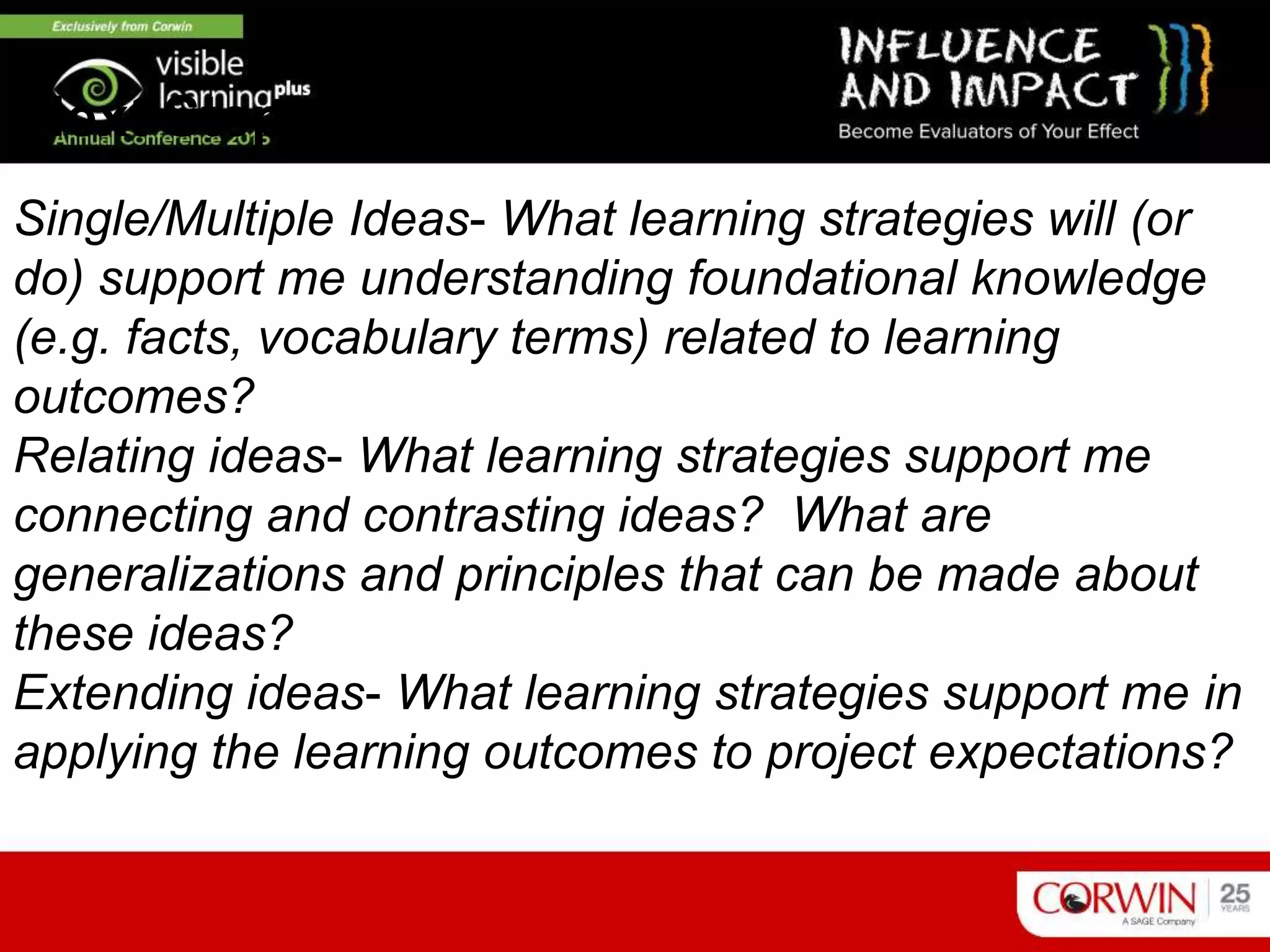
Single/Multiple Ideas- What learning strategies will (or
do) support me understanding foundational knowledge
(e.g. facts, vocabulary terms) related to learning
outcomes?
Relating ideas- What learning strategies support me
connecting and contrasting ideas? What are
generalizations and principles that can be made about
these ideas?
Extending ideas- What learning strategies support me in
applying the learning outcomes to project expectations?
Next Steps
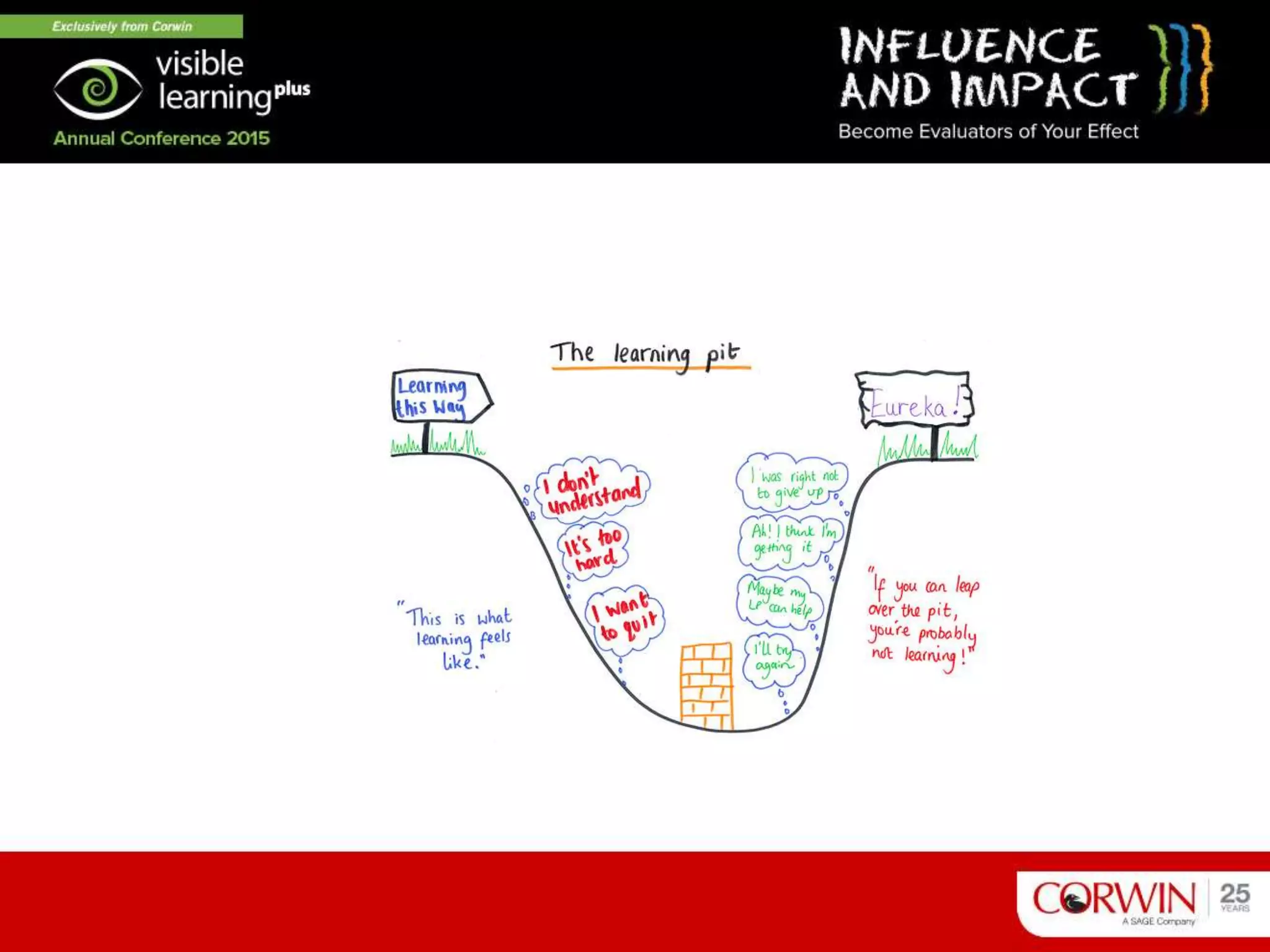
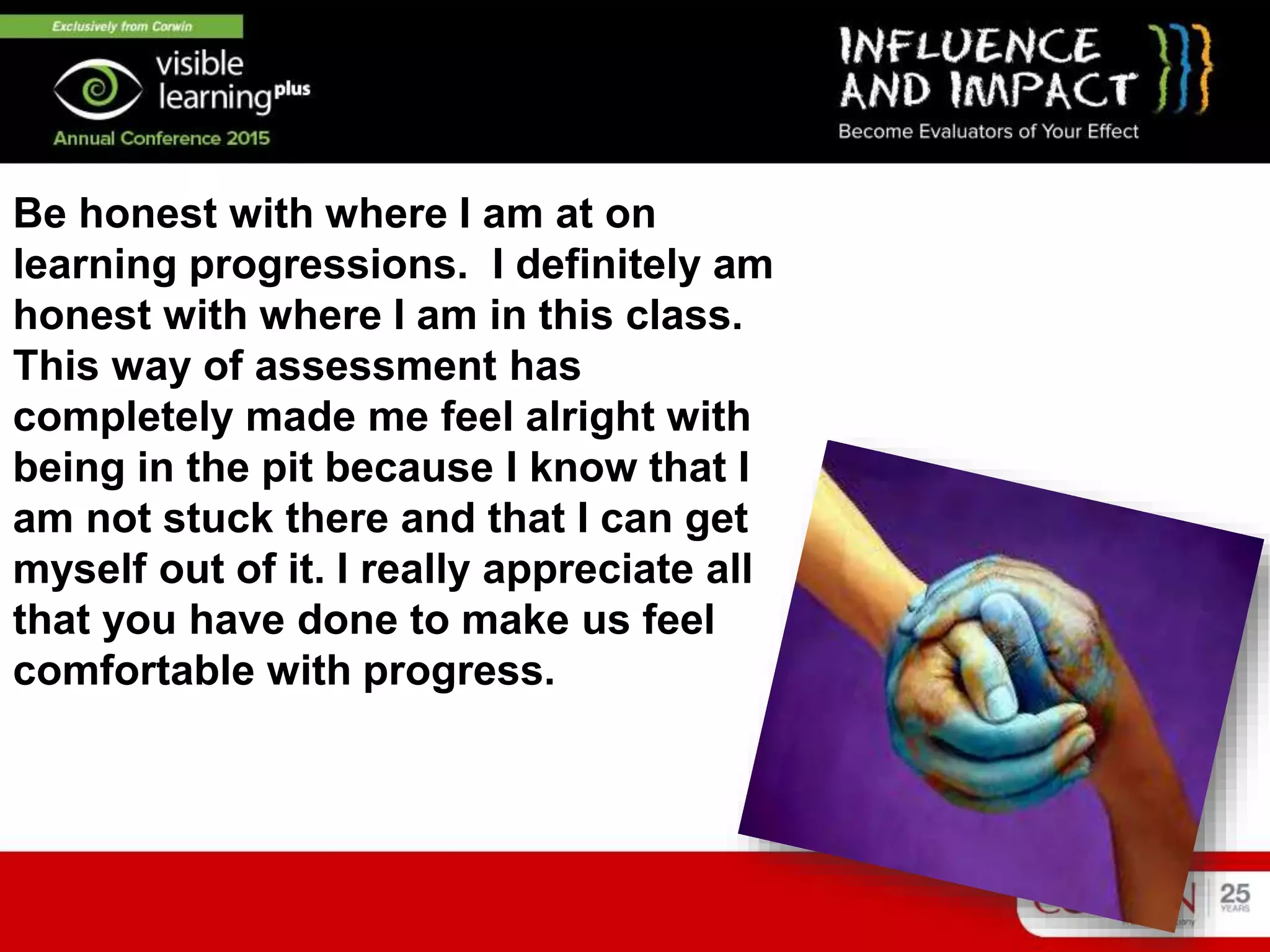
Be honest with where I am at on
learning progressions. I definitely am
honest with where I am in this class.
This way of assessment has
completely made me feel alright with
being in the pit because I know that I
am not stuck there and that I can get
myself out of it. I really appreciate all
that you have done to make us feel
comfortable with progress.
Be open to struggling…Before this class I was not open to
struggling at all, so this took me a while to get used to.
Now I know that I can get myself out of the pit, so I feel
comfortable being in it! I just wish it was this way in the
rest of my classes. ):
My annotations and thoughts on written pieces were at
about a 1 level at the beginning of the semester, but with
guidance in class and a lot of practice I have grown to
getting a four on the last annotation. Next semester I
hope to grow further.
Impact on PrBL/PBL: Intervention
Practitioner
• Facilitate the problem solving process, direct the learning
unapologetically.
• Access and utilize student’s prior knowledge in daily practice.
• Students learn from experience, but that experience is
perceived differently by all students.
• Design the learning experience to focus on the cognitive
aspects of the work.
Research Guidance
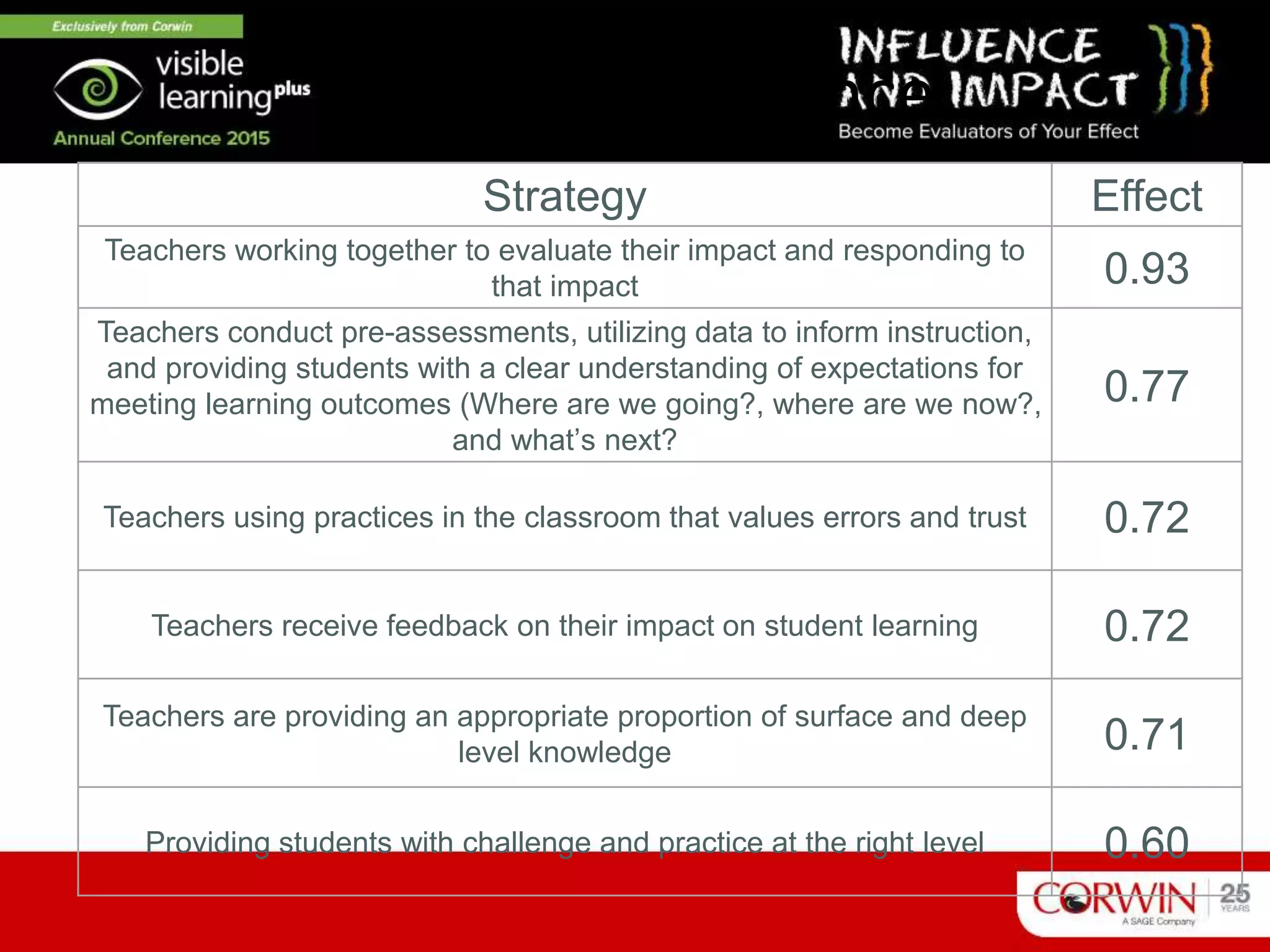
Strategy Effect
Teachers working together to evaluate their impact and responding to
that impact 0.93
Teachers conduct pre-assessments, utilizing data to inform instruction,
and providing students with a clear understanding of expectations for
meeting learning outcomes (Where are we going?, where are we now?,
and what’s next?
0.77
Teachers using practices in the classroom that values errors and trust 0.72
Teachers receive feedback on their impact on student learning 0.72
Teachers are providing an appropriate proportion of surface and deep
level knowledge 0.71
Providing students with challenge and practice at the right level 0.60
What
do you
need to
know?
• michaelmcdowell@icloud.com
• Twitter:mmcdowell13
Learn more about Visible Learningplus at
www.corwin.com/visiblelearning

Final-Developing Surface and Deep Level Knowledge and Skill through Project Based Learning

  • 1.
    Developing Surface andDeep Level Knowledge and Skill through Project Based Learning Michael McDowell, Ed.D.
  • 2.
  • 4.
    Problem Statement How willyou advise the Kenyan national government in finalizing the “Nairobi Proposal”?
  • 5.
    • Task: Presenta solution, including a submitted literature review, to a committee that represents the interests of local communities, business, tourism, and science and technology. • Expectations: The presentation will be held on________ and the government expects the following guidelines are adhered to_________.
  • 6.
  • 8.
    Score Description 4 Extension ApplyingUnderstanding 3 Relational Making Meaning 2 Single/Multiple Building Knowledge 1 Direct Support DEEP SURFACE
  • 9.
    Evaluate or refinea technological solution that reduces impacts of human activities on natural systems.* [Clarification Statement: Examples of data on the impacts of human activities could include the quantities and types of pollutants released, changes to biomass and species diversity, or areal changes in land surface use (such as for urban development, agriculture and livestock, or surface mining). Examples for limiting future impacts could range from local efforts (such as reducing, reusing, and recycling resources) to large-scale geoengineering design solutions (such as altering global temperatures by making large changes to the atmosphere or ocean).]
  • 10.
    Project-Based Learning Unit: Project Launch EntryEvent and Rubric Create “Need to Knows” and Next Steps Activities Workshops Lectures Homework Benchmark Research Labs Simulations Discussions Modeling Reading Benchmark Interviews Quiz Reflectionon Learning P R E S E N T Creating Feedback Building Writing Preparing Drafts
  • 12.
    How do wecodify the most substantial research-based practices to support our learners in substantially progressing towards and reaching mastery in the economic, social, and civic demands of the 21st Century? And, how do we ensure that learners are engaged & motivated in their learning? #AnnualVL2015
  • 13.
  • 14.
    Hypothesis A problem orproject based approach is “the great codifier” combining the beliefs and actions necessary to engage, motivate, and substantially enhance student learning in a breadth of outcomes.
  • 16.
    • Theory ofAction If Problem and Project Based Learning practitioners integrate the key findings of VL into their practice, then students will substantially progress in their learning, and enhance their motivation and engagement?
  • 17.
    Learning Intentions By theend of the session, you will… 1. Understand specific practices that have a high probability for enhancing student learning 2. Understand specific theories that underpin such practices 3. Collect potential means for applying such understanding to your classroom (and site/district) #AnnualVL2015
  • 18.
    Success Criteria By theend of the session, you will… Building Knowledge • identify high impact strategies in PBL. • recognize key factors in project design and implementation that are important to enhancing learning. Making Meaning • relate the VL research to PrBL and PBL practices Applying Understanding • Evaluate tools, processes, or protocols that will (may) enhance your practice #AnnualVL2015
  • 19.
  • 21.
    • “Its unbelievablehow much you don’t know about the game you’ve been playing all your life” - Mantle
  • 22.
    Face the BrutalFacts Face the Brutal Facts
  • 24.
    Effect sizes forteacher as activator and teacher as facilitator Reciprocal Teaching (.74) Feedback (.72) Direct Instruction (.59) Problem Solving teaching (.61) Mastery Learning (.57) Goals-Challenging (.56) Average activator (.63) Simulations and gaming (.32) Inquiry-based teaching (.31) Individualized instruction (.20) PBL (.15) Web-based learning (.09) Whole language-reading (.06) Average facilitator (.17) What are the key difference between these methods? The key is the role of the teacher…We go back to the story
  • 26.
  • 27.
    Effect sizes forteacher as activator and teacher as facilitator Reciprocal Teaching (.74) Feedback (.72) Direct Instruction (.59) Problem Solving teaching (.61) Mastery Learning (.57) Goals-Challenging (.56) Average activator (.63) Simulations and gaming (.32) Inquiry-based teaching (.31) Individualized instruction (.20) PBL (.15) Web-based learning (.09) Whole language-reading (.06) Average facilitator (.17) What about at “deeper levels of learning?
  • 28.
  • 29.
  • 30.
    - Where isthe learner now?
  • 31.
  • 32.
    Teachers need tobe directive, influential, caring, and actively engaged in the passion of teaching and learning
  • 33.
    3 Key Ideasfor Implementation
  • 34.
  • 35.
  • 36.
  • 39.
    Project-Based Learning Unit: Project Launch EntryEvent and Rubric Create “Need to Knows” and Next Steps Activities Workshops Lectures Homework Benchmark Research Labs Simulations Discussions Modeling Reading Benchmark Interviews Quiz Reflectionon Learning P R E S E N T Creating Feedback Building Writing Preparing Drafts
  • 40.
    Project-Based Learning Unit: Project Launch EntryEvent and Rubric Create “Need to Knows” and Next Steps Activities Workshops Lectures Homework Benchmark Research Labs Simulations Discussions Modeling Reading Benchmark Interviews Quiz Reflectionon Learning P R E S E N T Creating Feedback Building Writing Preparing Drafts Transfer Expectation s Surface- Deep- Transfer
  • 41.
    Project-Based Learning Unit: Project Launch EntryEvent and Rubric Create “Need to Knows” and Next Steps Activities Workshops Lectures Homework Benchmark Research Labs Simulations Discussions Modeling Reading Benchmark Interviews Quiz Reflectionon Learning P R E S E N T Creating Feedback Building Writing Preparing Drafts Transfer Expectation s Surface- Deep- Transfer Self-efficacy, working with challenge, knowing success criteria Summarizing, outlining, practice testing Planning and evaluation, self talk and self questioning, detecting similarities and differences
  • 42.
    Project-Based Learning Unit: Project Launch EntryEvent and Rubric Create “Need to Knows” and Next Steps Activities Workshops Lectures Homework Benchmark Research Labs Simulations Discussions Modeling Reading Benchmark Interviews Quiz Reflectionon Learning P R E S E N T Creating Feedback Building Writing Preparing Drafts
  • 43.
    Project-Based Learning Unit: Project Launch EntryEvent and Rubric Create “Need to Knows” and Next Steps Activities Workshops Lectures Homework Benchmark Research Labs Simulations Discussions Modeling Reading Benchmark Interviews Quiz Reflectionon Learning P R E S E N T Creating Feedback Building Writing Preparing Drafts • Establishes High expectations up front • Provides the opportunity for “intellectual dilemmas” • Right Time for Intervention through the progression of surface-deep-transfer • Requires substantial utilization of feedback and vocalization of student learning
  • 44.
    Project-Based Learning Unit: Project Launch EntryEvent and Rubric Create “Need to Knows” and Next Steps Activities Workshops Lectures Homework Benchmark Research Labs Simulations Discussions Modeling Reading Benchmark Interviews Quiz Reflectionon Learning P R E S E N T Creating Feedback Building Writing Preparing Drafts • Establishes High expectations up front • Provides the opportunity for “intellectual dilemmas” • Right Time for Intervention through the progression of surface-deep-transfer • Requires substantial utilization of feedback and vocalization of student learning
  • 45.
  • 46.
    Program Goal I •Genetics, Traits and Evolution: Groups of living organisms change over time. These evolutionary changes occur at both the molecular/genetic and organismal levels of organization. Students will interpret evidence from each level of organization to explain a specific example of evolutionary change.
  • 47.
    Program Goal II •Levels of Organization: Living organisms are complex structures with interconnected levels of organization. Students will analyze the interactions between the biochemical and cellular levels of organization in a specific organism.
  • 48.
    Program Goal III •Chemistry of Life: Living systems are made of carbon-based molecules and have fundamental structures. Students will be able to identify and describe the important structures, properties and uses of molecules such as proteins, carbohydrates, lipids and nucleic acids.
  • 49.
    What does thestudent need to know?• The student: • Explains the relationship between changes in DNA structure, an organism’s traits, and evolution. • Analyzes differences in DNA and protein sequences to infer evolutionary relationships. • Analyzes structural differences from both living and extinct organisms to infer evolutionary relationships. • Constructs cladograms to represent evolutionary relationships.
  • 50.
    Which line wouldyou take and why?
  • 51.
    What does thestudent need to know? • The student: • Describes protein synthesis and its relationship to cellular activity. • Describes photosynthesis and its relationship to cellular activity. • Describes cellular respiration and its relationship to cellular activity. • Demonstrates how cellular organelles and macromolecules work to accomplish specific functions within a cell.
  • 54.
    6 Key Messagesto consider
  • 55.
    Six Key Factors LearningSchema Assessment Capable Learners (1.44) Learning Partnerships and Networks Classroom Discussions (.82) Teacher Student relationships (.72) Designing the Learning Experience Teacher Clarity (.75) Goals (.56) Mastery Learning (.57) Problem Solving Teaching (.61) Differentiation Spaced v. Massed Practice (.71) Direct Instruction (.59) Metacognitive Strategies (.67) Assessment for Learning Feedback (.72) Systemic Professional Learning Community Framework Teacher PLC (.93) Providing Formative Evaluation (.90)
  • 56.
  • 57.
    “Building on andBuilding over”
  • 58.
    Building on Buildingover Building knowledge, Making Meaning, Applying Understanding Where am I going? Where am I? What’s next? What strategies support my learning at various levels of learning? How am I progressing?
  • 59.
    Learning Centered Cultureand Climate Learning Networks
  • 60.
    Enduring Understandings relatedto cognition • Social Learning Theory: Human learners benefit enormously from social examples, from directed instruction, and from corrective feedback. Learning from exposure to the information provided by other people represents a fundamental aspect underpinning human adjustment and evolution; the more expert these ‘other people’ are in understand the progression of learning, the more effective is the learning. • Hattie and Yates (2014)
  • 61.
  • 62.
    Outcome Identification –Learning Intentions Rubric Development- Success Criteria Driving Question Development Assessment Development Entry Event Planning Exit Event Planning
  • 63.
    Project-Based Learning Unit: Project Launch EntryEvent and Rubric Create “Need to Knows” and Next Steps Activities Workshops Lectures Homework Benchmark Research Labs Simulations Discussions Modeling Reading Benchmark Interviews Quiz Reflectionon Learning P R E S E N T Creating Feedback Building Writing Preparing Drafts
  • 64.
    Project-Based Learning Unit: Project Launch EntryEvent and Rubric Create “Need to Knows” and Next Steps Activities Workshops Lectures Homework Benchmark Research Labs Simulations Discussions Modeling Reading Benchmark Interviews Quiz Reflectionon Learning P R E S E N T Creating Feedback Building Writing Preparing Drafts Surface Deep
  • 65.
    Project-Based Learning Unit: Project Launch EntryEvent and Rubric Create “Need to Knows” and Next Steps Activities Workshops Lectures Homework Benchmark Research Labs Simulations Discussions Modeling Reading Benchmark Interviews Quiz Reflectionon Learning P R E S E N T Creating Feedback Building Writing Preparing Drafts Surface Deep
  • 66.
    Project-Based Learning Unit: Project Launch EntryEvent and Rubric Create “Need to Knows” and Next Steps Activities Workshops Lectures Homework Benchmark Research Labs Simulations Discussions Modeling Reading Benchmark Interviews Quiz Reflectionon Learning P R E S E N T Creating Feedback Building Writing Preparing Drafts Creating intellectual dilemmas
  • 67.
    Score Description 4 Extension ApplyingUnderstanding 3 Relational Making Meaning 2 Single/Multiple Building Knowledge 1 Direct Support DEEP SURFACE
  • 68.
  • 69.
  • 70.
    Impact on PrBL/PBL:Intervention Practitioner • Facilitate the problem solving process, direct the learning unapologetically. • Access and utilize student’s prior knowledge in daily practice. • Students learn from experience, but that experience perceived differently by all students. • Design the learning experience to focus on the cognitive aspects of the work.
  • 71.
    Building Blocks ofPedagogy • Content/Skill Development (Workshops) - How do I develop student content knowledge and skill over time? • Routines- What patterns of practice to I/we infuse in the classroom to enhance student learning over time? • “Just in Time” Responses- When situations emerge in the classroom how I do/we respond to enhance student learning over time?
  • 72.
    Project-Based Learning Unit: Project Launch EntryEvent and Rubric Create “Need to Knows” and Next Steps Activities Workshops Lectures Homework Benchmark Research Labs Simulations Discussions Modeling Reading Benchmark Interviews Quiz Reflectionon Learning P R E S E N T Creating Feedback Building Writing Preparing Drafts Surface Deep
  • 73.
    Aligning “High ProbabilityStrategies” from the Art and Science of Teaching to Progression Levels. Outcome Questions Activities Applying understanding (Transfer) What do I typically do to engage students in cognitively complex tasks involving hypothesis generation and testing? Experimental-inquiry tasks Problem-solving tasks Making meaning (Deep) What do I typically do to organize students and deepen knowledge? Venn diagrams Comparison matrix Building knowledge (Surface) What do I typically do to identify critical information? Identifying critical input experiences
  • 74.
    Single/Multiple Ideas- Whatinstructional approaches will support students in understanding foundational knowledge (e.g. facts, vocabulary terms) related to learning outcomes? Relating ideas- What instructional approaches support students in connecting and contrasting ideas? What are generalizations and principles that can be made about these ideas? Extending ideas- What instructional approaches support students in applying the learning outcomes to other contexts Next Steps- Teachers
  • 75.
  • 76.
    Single/Multiple Ideas- Whatstrategies am I using that will support me in building knowledge and skills (e.g. facts, vocabulary terms) related to learning outcomes? Relating ideas- What approaches appear to be working or I should attempt to connect and contrast ideas? How am I going as related to making generalizations and principles? Extending ideas- What approaches support me in applying the learning outcomes to other contexts? Next Steps- Students
  • 77.
  • 79.
  • 81.
    Systemic Professional LearningCommunity Framework
  • 82.
  • 83.
    What do wewant all students to know and be able to do? How do we know when students are learning? What do we do based on such results? How do we work together to review and respond to student learning?
  • 84.
    What do wewant all students to know and be able to do? What do we do based on these results? How do we work together to review and respond to student learning? Common Outcomes Common Scales Common Intervention Criteria Common Culture and Work How do we know when students are learning?
  • 85.
  • 86.
    Limited Growth (0.0- 0.39) ExpectedGrowth (.40 +) Not Yet Proficient (0.0- 2.25) Proficient (2.5-4.0)
  • 87.
    Limited Growth (0.0-0.39)Expected Growth (.40 +) Not Yet Proficient (0.0-2.25) Make A Change! • Review & Make Changes to Instructional Strategies Keep it up! • More Time • Same Instructional Program • Celebrate Success Proficient (2.5-4.0) Cruising • Review & Make Changes to Instructional Strategies Success • Capture Instructional Strategies • Celebrate Success • Continue Practices
  • 90.
    Limited Growth (0.0-0.39)Expected Growth (.40 +) Not Yet Proficient (0.0-2.5) Make A Change! • Review & Make Changes to Instructional Strategies Keep it up! • More Time • Same Instructional Program • Celebrate Success Proficient (2.5-4.0) Cruising • Review & Make Changes to Instructional Strategies Success • Capture Instructional Strategies • Celebrate Success • Continue Practices Capture Success/Replicate Change
  • 91.
    What? So What?Now What? Moving from Data Analysis to Response
  • 92.
    Single/Multiple Ideas- Whatinstructional approaches will support students in understanding foundational knowledge (e.g. facts, vocabulary terms) related to learning outcomes? Relating ideas- What instructional approaches support students in connecting and contrasting ideas? What are generalizations and principles that can be made about these ideas? Extending ideas- What instructional approaches support students in applying the learning outcomes to project expectations? Next Steps
  • 93.
    Single/Multiple Ideas- Whatlearning strategies will (or do) support me understanding foundational knowledge (e.g. facts, vocabulary terms) related to learning outcomes? Relating ideas- What learning strategies support me connecting and contrasting ideas? What are generalizations and principles that can be made about these ideas? Extending ideas- What learning strategies support me in applying the learning outcomes to project expectations? Next Steps
  • 94.
    Be honest withwhere I am at on learning progressions. I definitely am honest with where I am in this class. This way of assessment has completely made me feel alright with being in the pit because I know that I am not stuck there and that I can get myself out of it. I really appreciate all that you have done to make us feel comfortable with progress.
  • 95.
    Be open tostruggling…Before this class I was not open to struggling at all, so this took me a while to get used to. Now I know that I can get myself out of the pit, so I feel comfortable being in it! I just wish it was this way in the rest of my classes. ):
  • 96.
    My annotations andthoughts on written pieces were at about a 1 level at the beginning of the semester, but with guidance in class and a lot of practice I have grown to getting a four on the last annotation. Next semester I hope to grow further.
  • 97.
    Impact on PrBL/PBL:Intervention Practitioner • Facilitate the problem solving process, direct the learning unapologetically. • Access and utilize student’s prior knowledge in daily practice. • Students learn from experience, but that experience is perceived differently by all students. • Design the learning experience to focus on the cognitive aspects of the work.
  • 100.
    Research Guidance Strategy Effect Teachersworking together to evaluate their impact and responding to that impact 0.93 Teachers conduct pre-assessments, utilizing data to inform instruction, and providing students with a clear understanding of expectations for meeting learning outcomes (Where are we going?, where are we now?, and what’s next? 0.77 Teachers using practices in the classroom that values errors and trust 0.72 Teachers receive feedback on their impact on student learning 0.72 Teachers are providing an appropriate proportion of surface and deep level knowledge 0.71 Providing students with challenge and practice at the right level 0.60
  • 102.
  • 103.
  • 104.
    Learn more aboutVisible Learningplus at www.corwin.com/visiblelearning

Editor's Notes

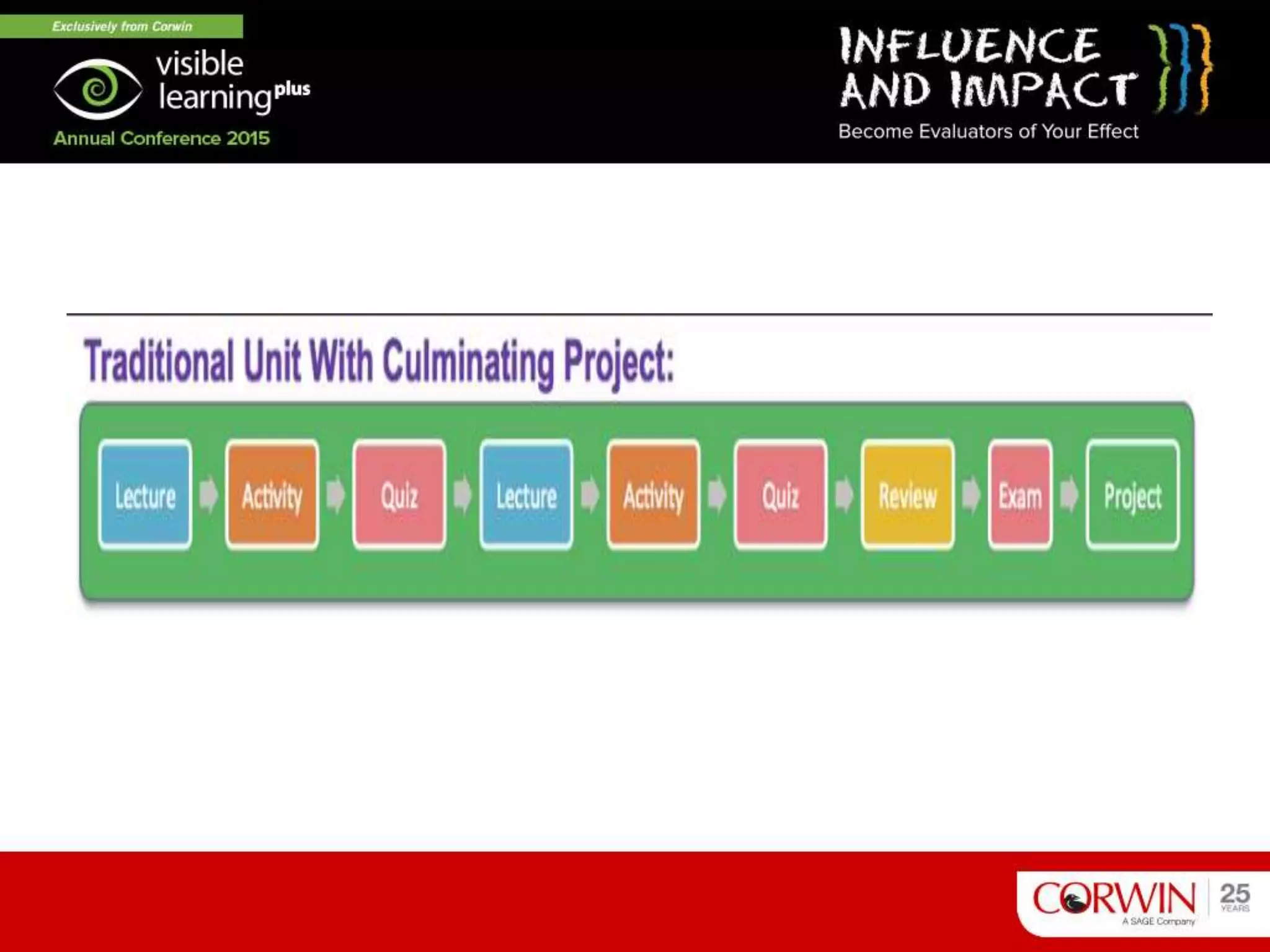
  • #2 The following presentation explores problem and project learning as a potentially high yield instructional approach that enhances students learning in content and cognitive domain areas. The presentation illustrates the potential impact problem and project learning can have on surface and deep level learning when applying the visible learning research to project design, implementation, inspection, and classroom management. The workshop unravels the specific steps teachers can take in the classroom to substantially enhance student learning in the PBL environment.
  • #3 Evaluate or refine a technological solution that reduces impacts of human activities on natural systems.* [Clarification Statement: Examples of data on the impacts of human activities could include the quantities and types of pollutants released, changes to biomass and species diversity, or areal changes in land surface use (such as for urban development, agriculture and livestock, or surface mining). Examples for limiting future impacts could range from local efforts (such as reducing, reusing, and recycling resources) to large-scale geoengineering design solutions (such as altering global temperatures by making large changes to the atmosphere or ocean).]
  • #4 Evaluate or refine a technological solution that reduces impacts of human activities on natural systems.* [Clarification Statement: Examples of data on the impacts of human activities could include the quantities and types of pollutants released, changes to biomass and species diversity, or areal changes in land surface use (such as for urban development, agriculture and livestock, or surface mining). Examples for limiting future impacts could range from local efforts (such as reducing, reusing, and recycling resources) to large-scale geoengineering design solutions (such as altering global temperatures by making large changes to the atmosphere or ocean).]
  • #6 Nex-Gen Standards Evaluate or refine a technological solution that reduces impacts of human activities on natural systems.* [Clarification Statement: Examples of data on the impacts of human activities could include the quantities and types of pollutants released, changes to biomass and species diversity, or areal changes in land surface use (such as for urban development, agriculture and livestock, or surface mining). Examples for limiting future impacts could range from local efforts (such as reducing, reusing, and recycling resources) to large-scale geoengineering design solutions (such as altering global temperatures by making large changes to the atmosphere or ocean).]
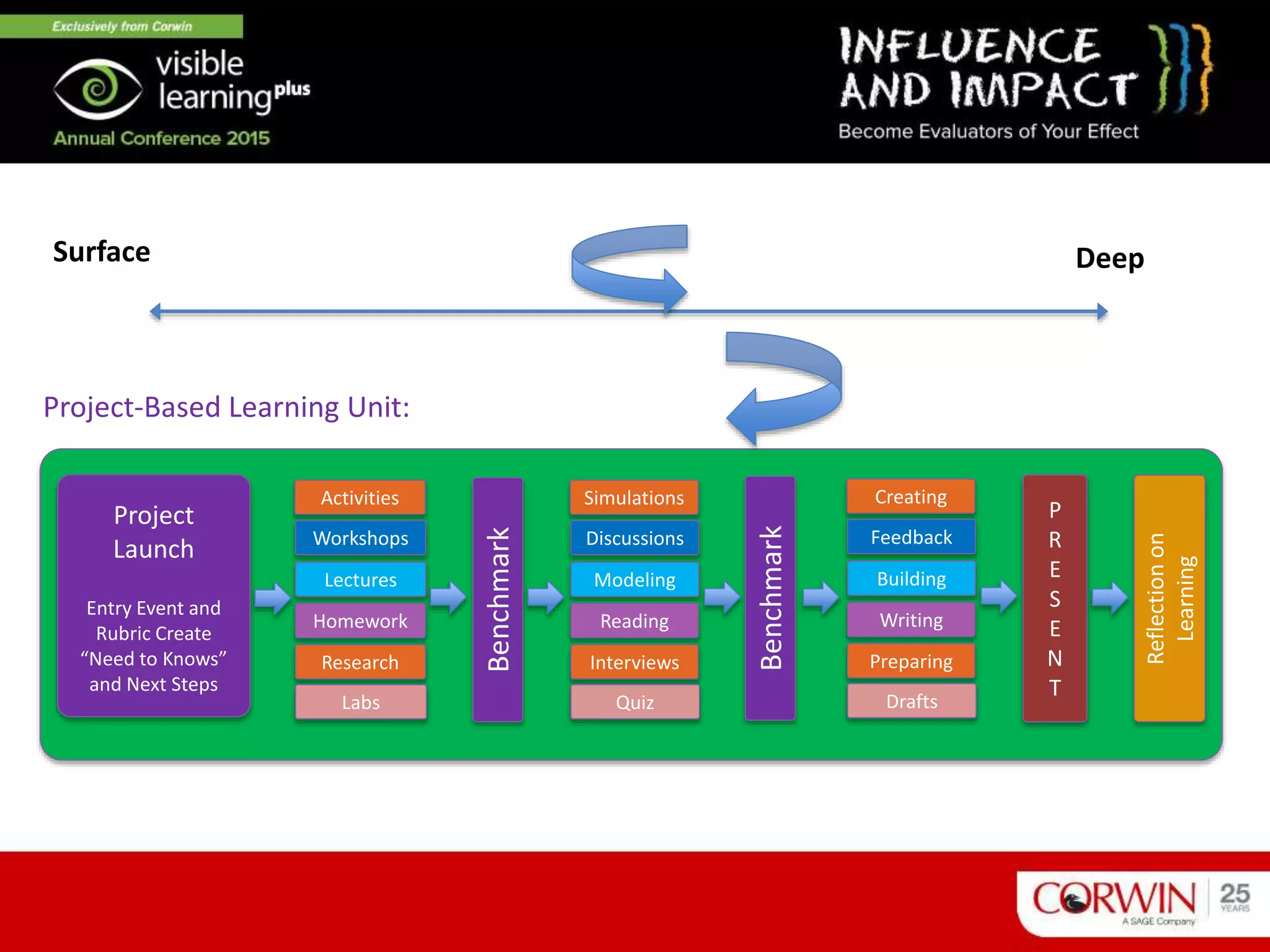
  • #11 Inside a project, there is a process that helps the students be successful. It all starts with the project launch where students are introduced to the challenge with an entry event and told how they will be measured with a rubric. After organizing their group, students will jump into researching the topic. Teachers create a wide variety of activities to guide student learning … it could be a whole group discussion, homework assignment, small differentiated workshops or any of a thousand things that teachers regularly use in their classrooms. The difference is …. Now the students know why they are doing them. The unit is also designed to have specific benchmarks to let the teacher know if a group is falling behind. This could be submitting their research summary, creating a story board, writing a rough draft … any sub-task that feeds into the larger project. Near the end of the unit, the student work moves from information gathering to assimilation and application as they prepare to present. The best PBL units require student to present to an authentic audience … someone who know something about the topic being studied. Lastly, all the research shows that true learning happens when the student reflects on what they learned. So, at the end of project, it is important to spend at least a day in formal reflection activities like asking students what they would do differently next time. Teachers also use this time to gather information on improving the project for next year.
  • #13 Theory of Action If Problem and Project Based Learning practitioners integrate the key findings of VL into their practice, then students will substantially progress in their learning, and enhance their motivation and engagement?
  • #15 Thrill, will, sand skill.
  • #16 PBL is the “great codifier”
  • #21 It turns out its not about who teachers are, its not about what teachers do, its not who the students are, what really matters think about their impact on their students.
  • #25 E.g. Problem Solving Teaching E.S. .61 (221 studies, 15,235 students) Problem-based learning E.S. .15 (285 studies, 38,090) Powerful moderators are found in the literature; these moderators are predicated on the cognitive elements discussed prior.
  • #26 Myriad of expectations- Content, conate, and cognitive Motivation, engagement, “Thrill, Will, and Skill” Inquiry based programs have a low effect at surface level; much higher effect at deeper levels of learning.
  • #28 The story changes E.g. Problem Solving Teaching E.S. .61 (221 studies, 15,235 students) Problem-based learning E.S. .15 (285 studies, 38,090) Powerful moderators are found in the literature; these moderators are predicated on the cognitive elements discussed prior.
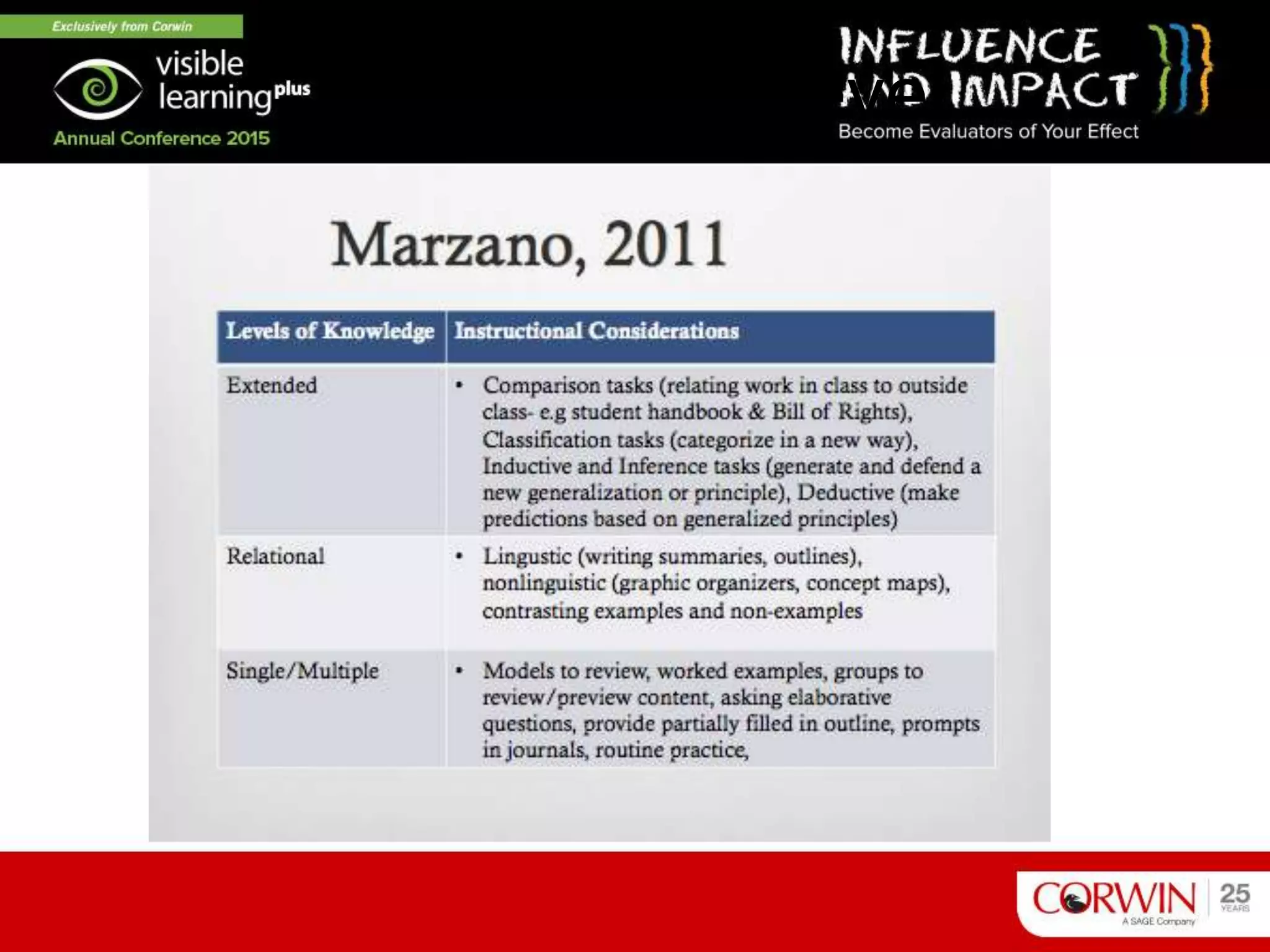
  • #31 Extended- Requires a learner to transfer their understand of single, multiple, and relational content to outside contexts. Relational- Requires a learner to relate single/multiple ideas together to further understand core content Single/Multiple- Requires a learner to understand single or multiple ideas related to the core content standards
  • #35 Right Time for intervention, right intervention tools, balance of surface and deep level knowledge.
  • #36 Right Time for intervention, right intervention tools, balance of surface and deep level knowledge.
  • #41 Inside a project, there is a process that helps the students be successful. It all starts with the project launch where students are introduced to the challenge with an entry event and told how they will be measured with a rubric. After organizing their group, students will jump into researching the topic. Teachers create a wide variety of activities to guide student learning … it could be a whole group discussion, homework assignment, small differentiated workshops or any of a thousand things that teachers regularly use in their classrooms. The difference is …. Now the students know why they are doing them. The unit is also designed to have specific benchmarks to let the teacher know if a group is falling behind. This could be submitting their research summary, creating a story board, writing a rough draft … any sub-task that feeds into the larger project. Near the end of the unit, the student work moves from information gathering to assimilation and application as they prepare to present. The best PBL units require student to present to an authentic audience … someone who know something about the topic being studied. Lastly, all the research shows that true learning happens when the student reflects on what they learned. So, at the end of project, it is important to spend at least a day in formal reflection activities like asking students what they would do differently next time. Teachers also use this time to gather information on improving the project for next year.
  • #42 Inside a project, there is a process that helps the students be successful. It all starts with the project launch where students are introduced to the challenge with an entry event and told how they will be measured with a rubric. After organizing their group, students will jump into researching the topic. Teachers create a wide variety of activities to guide student learning … it could be a whole group discussion, homework assignment, small differentiated workshops or any of a thousand things that teachers regularly use in their classrooms. The difference is …. Now the students know why they are doing them. The unit is also designed to have specific benchmarks to let the teacher know if a group is falling behind. This could be submitting their research summary, creating a story board, writing a rough draft … any sub-task that feeds into the larger project. Near the end of the unit, the student work moves from information gathering to assimilation and application as they prepare to present. The best PBL units require student to present to an authentic audience … someone who know something about the topic being studied. Lastly, all the research shows that true learning happens when the student reflects on what they learned. So, at the end of project, it is important to spend at least a day in formal reflection activities like asking students what they would do differently next time. Teachers also use this time to gather information on improving the project for next year.
  • #43 Inside a project, there is a process that helps the students be successful. It all starts with the project launch where students are introduced to the challenge with an entry event and told how they will be measured with a rubric. After organizing their group, students will jump into researching the topic. Teachers create a wide variety of activities to guide student learning … it could be a whole group discussion, homework assignment, small differentiated workshops or any of a thousand things that teachers regularly use in their classrooms. The difference is …. Now the students know why they are doing them. The unit is also designed to have specific benchmarks to let the teacher know if a group is falling behind. This could be submitting their research summary, creating a story board, writing a rough draft … any sub-task that feeds into the larger project. Near the end of the unit, the student work moves from information gathering to assimilation and application as they prepare to present. The best PBL units require student to present to an authentic audience … someone who know something about the topic being studied. Lastly, all the research shows that true learning happens when the student reflects on what they learned. So, at the end of project, it is important to spend at least a day in formal reflection activities like asking students what they would do differently next time. Teachers also use this time to gather information on improving the project for next year.
  • #44 Inside a project, there is a process that helps the students be successful. It all starts with the project launch where students are introduced to the challenge with an entry event and told how they will be measured with a rubric. After organizing their group, students will jump into researching the topic. Teachers create a wide variety of activities to guide student learning … it could be a whole group discussion, homework assignment, small differentiated workshops or any of a thousand things that teachers regularly use in their classrooms. The difference is …. Now the students know why they are doing them. The unit is also designed to have specific benchmarks to let the teacher know if a group is falling behind. This could be submitting their research summary, creating a story board, writing a rough draft … any sub-task that feeds into the larger project. Near the end of the unit, the student work moves from information gathering to assimilation and application as they prepare to present. The best PBL units require student to present to an authentic audience … someone who know something about the topic being studied. Lastly, all the research shows that true learning happens when the student reflects on what they learned. So, at the end of project, it is important to spend at least a day in formal reflection activities like asking students what they would do differently next time. Teachers also use this time to gather information on improving the project for next year.
  • #45 Inside a project, there is a process that helps the students be successful. It all starts with the project launch where students are introduced to the challenge with an entry event and told how they will be measured with a rubric. After organizing their group, students will jump into researching the topic. Teachers create a wide variety of activities to guide student learning … it could be a whole group discussion, homework assignment, small differentiated workshops or any of a thousand things that teachers regularly use in their classrooms. The difference is …. Now the students know why they are doing them. The unit is also designed to have specific benchmarks to let the teacher know if a group is falling behind. This could be submitting their research summary, creating a story board, writing a rough draft … any sub-task that feeds into the larger project. Near the end of the unit, the student work moves from information gathering to assimilation and application as they prepare to present. The best PBL units require student to present to an authentic audience … someone who know something about the topic being studied. Lastly, all the research shows that true learning happens when the student reflects on what they learned. So, at the end of project, it is important to spend at least a day in formal reflection activities like asking students what they would do differently next time. Teachers also use this time to gather information on improving the project for next year.
  • #46 Inside a project, there is a process that helps the students be successful. It all starts with the project launch where students are introduced to the challenge with an entry event and told how they will be measured with a rubric. After organizing their group, students will jump into researching the topic. Teachers create a wide variety of activities to guide student learning … it could be a whole group discussion, homework assignment, small differentiated workshops or any of a thousand things that teachers regularly use in their classrooms. The difference is …. Now the students know why they are doing them. The unit is also designed to have specific benchmarks to let the teacher know if a group is falling behind. This could be submitting their research summary, creating a story board, writing a rough draft … any sub-task that feeds into the larger project. Near the end of the unit, the student work moves from information gathering to assimilation and application as they prepare to present. The best PBL units require student to present to an authentic audience … someone who know something about the topic being studied. Lastly, all the research shows that true learning happens when the student reflects on what they learned. So, at the end of project, it is important to spend at least a day in formal reflection activities like asking students what they would do differently next time. Teachers also use this time to gather information on improving the project for next year.
  • #58 PBL is the “great codifier”
  • #59 Learners understand and utilize a learning process, have tools to enable such an understanding, and a process for evaluating their progress and proficiency towards reaching mastery of core content literacy and non-cognitive outcomes so they may substantially improve their learning and that of others. Single/Multiple Ideas- What strategies am I using that will support me in building knowledge and skills (e.g. facts, vocabulary terms) related to learning outcomes? Relating ideas- What approaches appear to be working or I should attempt to connect and contrast ideas? How am I going as related to making generalizations and principles? Extending ideas- What approaches support me in applying the learning outcomes to other contexts?
  • #62 Learners require an environment that iterates high expectations, provides multiple venues to express perspectives, offers feedback, incorporates collaboration, and respects each learner in their learning process. to form strong relationships, articulate expectations, identify current progress, and enable learners and teachers to co-construct next steps in the learning process. to actualize the strength in our relationships, to articulate our expectations, identify current progress, and enable learners and teachers to co-construct next steps in the learning process.
  • #63 Hattie and Yates (2014)
  • #64 Learners must have a clear sense of the expectations of their learning through an understanding of surface and deep level outcomes, success criteria, and driving questions that focus them on transfer or application level problems and sends the explicit message that they can and will progress towards such mastery based outcomes.
  • #66 Resource New Tech Network
  • #69 Khan Academy
  • #74 Learners require a series of intentional experiences that address content and skills outcomes and that are directly tailored to the learner’s prior understanding and skill set. Identify ‘lessons’ or activities and products that are anchored in the content Align to the learning process Establish routines that engage learners on the cognitive aspects of a problem or project “Just in Time” and routines are anchored in your cultural agreements Teams are put together to enhance learning through dialogue not for the sole purpose of work flow efficiency
  • #84 Learners are constantly involved in seeking to understand through advocacy and inquiry the expectations of learning, their current progress, and identifying next steps in the learning process with others.
  • #85 Khan Academy
  • #102 Establishes High Expectations up front Provides the opportunity for “intellectual dilemmas” Right Time for Intervention through the progression of surface-deep-transfer Requires substantial utilization of feedback
  • #103 PBL is the “great codifier”
  • #104 PBL is the “great codifier”