pbl pedagogy &
the bc calculus curriculum
carmel schettino, ph.d.
@SchettinoPBL
carmelschettino.org
tcm, january 25, 2014
what is problem-based learning?
• Goals are for students to become better problem solvers
• Four C’s – creativity, communication, collaboration, critical

thinking
• Encourages inquiry and questioning in problem solving

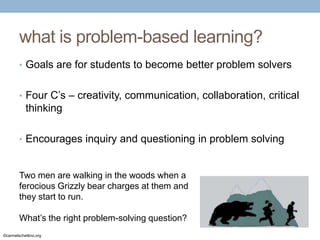
Two men are walking in the woods when a
ferocious Grizzly bear charges at them and
they start to run.
What’s the right problem-solving question?
©carmelschettino.org
directly related to ccss practice standards
make sense of problems and persevere in solving them
reason abstractly and quantitatively
construct viable arguments and critique the reasoning of others
use appropriate tools strategically
look for and express regularity in repeated reasoning

look for and make use of structure
©carmelschettino.org
what is problem-based learning?
• an approach to curriculum and pedagogy where student

learning and content material are co-constructed by students
and teachers through problems that are:

• both contextually-based and abstract
• discussed

and presented by students in a non-

hierarchical environment
• deliberately

knowledge
©carmelschettino.org

scaffolded

based

on

students’

prior
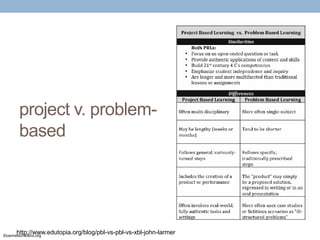
project v. problembased

http://www.edutopia.org/blog/pbl-vs-pbl-vs-xbl-john-larmer

©carmelschettino.org
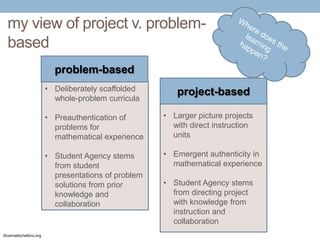
my view of project v. problembased
problem-based
• Deliberately scaffolded
whole-problem curricula

project-based

• Preauthentication of
problems for
mathematical experience
• Student Agency stems
from student
presentations of problem
solutions from prior
knowledge and
collaboration

©carmelschettino.org

• Larger picture projects
with direct instruction
units
• Emergent authenticity in
mathematical experience
• Student Agency stems
from directing project
with knowledge from
instruction and
collaboration
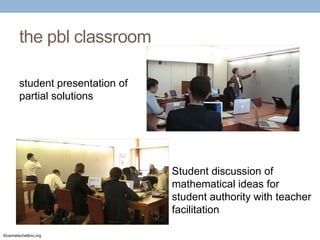
the pbl classroom
student presentation of
partial solutions

Student discussion of
mathematical ideas for
student authority with teacher
facilitation
©carmelschettino.org
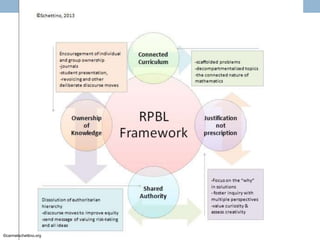
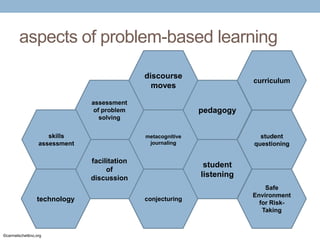
aspects of problem-based learning
discourse
moves
assessment
of problem
solving
skills
assessment

pedagogy

©carmelschettino.org

student
questioning

metacognitive
journaling

facilitation
of
discussion
technology

curriculum

student
listening
conjecturing

Safe
Environment
for RiskTaking
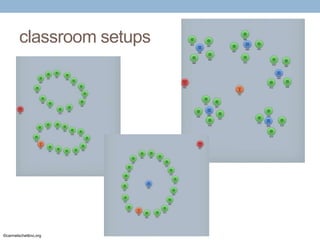
classroom setups

©carmelschettino.org
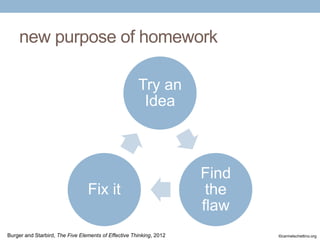
new purpose of homework
Try an
Idea

Fix it
Burger and Starbird, The Five Elements of Effective Thinking, 2012

Find
the
flaw
©carmelschettino.org
challenges with ap bc syllabus
• completion
• test prep
• student motivation
• authentic assessment
©carmelschettino.org
ap bc philosophy
Calculus AB and Calculus BC are primarily concerned with
developing the students’ understanding of the concepts of
calculus and providing experience with its methods and
applications. The courses emphasize a multirepresentational
approach to calculus, with concepts, results, and problems
being expressed graphically, numerically, analytically, and
verbally. The connections among these representations also
are important.
Broad concepts and widely applicable methods are
emphasized. The focus of the courses is neither
manipulation nor memorization of an extensive taxonomy of
functions, curves, theorems, or problem types. Thus,
although facility with manipulation and computational
competence are important outcomes, they are not the core
of these courses
http://apcentral.collegeboard.com/apc/public/repository/ap-calculus-course-description.pdf
focus on connected curriculum
• scaffolded problems
• decompartmentalized topics
• the connected nature of mathematics

©carmelschettino.org
topics for perusal – look for prior
knowledge triggers and scaffolding
• developing understanding of parametric equations
• exploring more advanced polar graphs
• developing understanding of polar area and arc length
• motivating MacLaurin polynomials
• developing chase problems with differential equations

geometrically

©carmelschettino.org
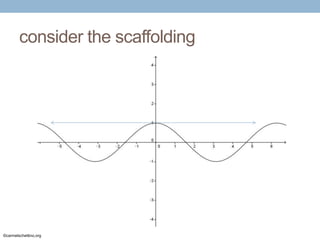
consider the scaffolding

©carmelschettino.org
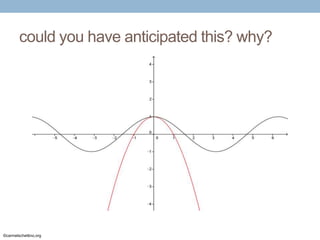
could you have anticipated this? why?

©carmelschettino.org
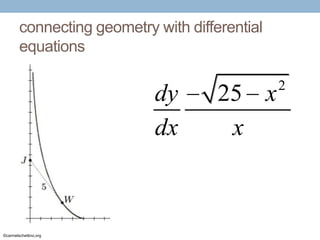
connecting geometry with differential
equations

dy
dx

©carmelschettino.org

25 x
x

2
dog chase problem

©carmelschettino.org
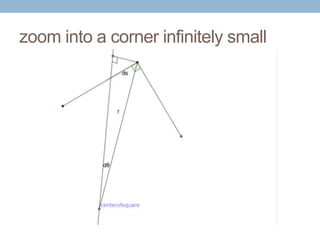
zoom into a corner infinitely small
references
• Burger & Starbird (2012). The 5 Elements of Effective

Thinking, Princeton University Press.
• Larmer, John (2014) Project –Based Learning vs.

Problem Based Learning vs. X-BL, January 2, 2014,
http://www.edutopia.org/blog/pbl-vs-pbl-vs-xbl-john-larmer
• www.carmelschettino.org

©carmelschettino.org
if you would like to learn more about pbl
• Lots of references at my website – links to sites with great

problems
• Follow me on twitter @SchettinoPBL or like me on
Facebook Carmel Schettino, Ph.D
• Take my courses at the Anja S. Greer Math, Science
Technology Conference at Phillips Exeter Academy
• Moving Forward with Problem-Based Learning

• Advanced PBL Instruction – Pedagogy & Development

©carmelschettino.org

PBL Pedagogy & BC Calculus Curriculum

  • 1.
    pbl pedagogy & thebc calculus curriculum carmel schettino, ph.d. @SchettinoPBL carmelschettino.org tcm, january 25, 2014
  • 2.
    what is problem-basedlearning? • Goals are for students to become better problem solvers • Four C’s – creativity, communication, collaboration, critical thinking • Encourages inquiry and questioning in problem solving Two men are walking in the woods when a ferocious Grizzly bear charges at them and they start to run. What’s the right problem-solving question? ©carmelschettino.org
  • 3.
    directly related toccss practice standards make sense of problems and persevere in solving them reason abstractly and quantitatively construct viable arguments and critique the reasoning of others use appropriate tools strategically look for and express regularity in repeated reasoning look for and make use of structure ©carmelschettino.org
  • 4.
    what is problem-basedlearning? • an approach to curriculum and pedagogy where student learning and content material are co-constructed by students and teachers through problems that are: • both contextually-based and abstract • discussed and presented by students in a non- hierarchical environment • deliberately knowledge ©carmelschettino.org scaffolded based on students’ prior
  • 5.
  • 6.
    my view ofproject v. problembased problem-based • Deliberately scaffolded whole-problem curricula project-based • Preauthentication of problems for mathematical experience • Student Agency stems from student presentations of problem solutions from prior knowledge and collaboration ©carmelschettino.org • Larger picture projects with direct instruction units • Emergent authenticity in mathematical experience • Student Agency stems from directing project with knowledge from instruction and collaboration
  • 7.
    the pbl classroom studentpresentation of partial solutions Student discussion of mathematical ideas for student authority with teacher facilitation ©carmelschettino.org
  • 8.
  • 9.
    aspects of problem-basedlearning discourse moves assessment of problem solving skills assessment pedagogy ©carmelschettino.org student questioning metacognitive journaling facilitation of discussion technology curriculum student listening conjecturing Safe Environment for RiskTaking
  • 10.
  • 11.
    new purpose ofhomework Try an Idea Fix it Burger and Starbird, The Five Elements of Effective Thinking, 2012 Find the flaw ©carmelschettino.org
  • 12.
    challenges with apbc syllabus • completion • test prep • student motivation • authentic assessment ©carmelschettino.org
  • 13.
    ap bc philosophy CalculusAB and Calculus BC are primarily concerned with developing the students’ understanding of the concepts of calculus and providing experience with its methods and applications. The courses emphasize a multirepresentational approach to calculus, with concepts, results, and problems being expressed graphically, numerically, analytically, and verbally. The connections among these representations also are important. Broad concepts and widely applicable methods are emphasized. The focus of the courses is neither manipulation nor memorization of an extensive taxonomy of functions, curves, theorems, or problem types. Thus, although facility with manipulation and computational competence are important outcomes, they are not the core of these courses http://apcentral.collegeboard.com/apc/public/repository/ap-calculus-course-description.pdf
  • 14.
    focus on connectedcurriculum • scaffolded problems • decompartmentalized topics • the connected nature of mathematics ©carmelschettino.org
  • 15.
    topics for perusal– look for prior knowledge triggers and scaffolding • developing understanding of parametric equations • exploring more advanced polar graphs • developing understanding of polar area and arc length • motivating MacLaurin polynomials • developing chase problems with differential equations geometrically ©carmelschettino.org
  • 16.
  • 17.
    could you haveanticipated this? why? ©carmelschettino.org
  • 18.
    connecting geometry withdifferential equations dy dx ©carmelschettino.org 25 x x 2
  • 19.
  • 20.
    zoom into acorner infinitely small
  • 21.
    references • Burger &Starbird (2012). The 5 Elements of Effective Thinking, Princeton University Press. • Larmer, John (2014) Project –Based Learning vs. Problem Based Learning vs. X-BL, January 2, 2014, http://www.edutopia.org/blog/pbl-vs-pbl-vs-xbl-john-larmer • www.carmelschettino.org ©carmelschettino.org
  • 22.
    if you wouldlike to learn more about pbl • Lots of references at my website – links to sites with great problems • Follow me on twitter @SchettinoPBL or like me on Facebook Carmel Schettino, Ph.D • Take my courses at the Anja S. Greer Math, Science Technology Conference at Phillips Exeter Academy • Moving Forward with Problem-Based Learning • Advanced PBL Instruction – Pedagogy & Development ©carmelschettino.org