THE EFFECTS OF THE PROBLEM BASED
LEARNING APPROACH ON HIGHER ORDER
THINKING SKILLS IN ELEMENTARY SCIENCE
EDUCATION
Derya Cinar
Selcuk University, TURKEY
Sule Bayraktar
Selcuk University, TURKEY
Prepared By
Eka Sari Monica Barus
4103342004
Introduction
 Problem Based Learning (PBL) aims
specifically at improving problem
solving and comprehension skills.
 Problem based learning has been
shown to improve the
analysis, synthesis and lifelong
learning skills (Harland, 2002).
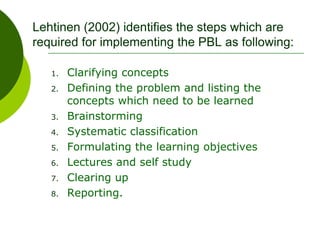
Lehtinen (2002) identifies the steps which are
required for implementing the PBL as following:
1. Clarifying concepts
2. Defining the problem and listing the
concepts which need to be learned
3. Brainstorming
4. Systematic classification
5. Formulating the learning objectives
6. Lectures and self study
7. Clearing up
8. Reporting.
Objectives
 This study was conducted to investigate the effects
of problem-based learning approach in elementary
science education on students’ higher order thinking
skills.
 The study was conducted on 6th grade students
from an elementary school in Konya, Turkey in the
second semester of 2005-2006 educational year.
 The purpose of the present study is to investigate
the effectiveness of PBL in 6th grade students’
higher order thinking skills such as
comprehension, problem solving, and science
process skills.
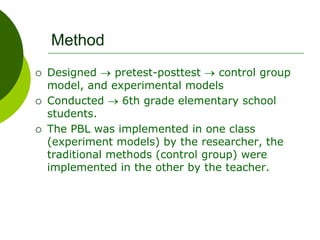
Method
 Designed pretest-posttest control group
model, and experimental models
 Conducted 6th grade elementary school
students.
 The PBL was implemented in one class
(experiment models) by the researcher, the
traditional methods (control group) were
implemented in the other by the teacher.
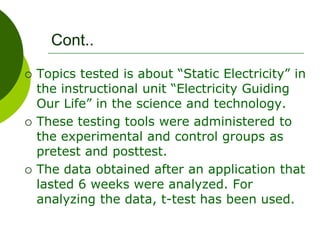
Cont..
 Topics tested is about “Static Electricity” in
the instructional unit “Electricity Guiding
Our Life” in the science and technology.
 These testing tools were administered to
the experimental and control groups as
pretest and posttest.
 The data obtained after an application that
lasted 6 weeks were analyzed. For
analyzing the data, t-test has been used.
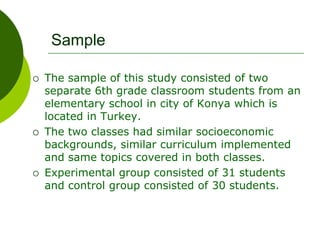
Sample
 The sample of this study consisted of two
separate 6th grade classroom students from an
elementary school in city of Konya which is
located in Turkey.
 The two classes had similar socioeconomic
backgrounds, similar curriculum implemented
and same topics covered in both classes.
 Experimental group consisted of 31 students
and control group consisted of 30 students.
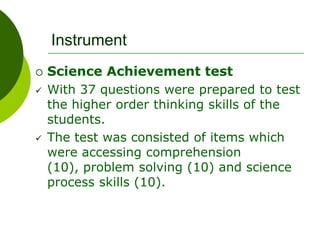
Instrument
 Science Achievement test
 With 37 questions were prepared to test
the higher order thinking skills of the
students.
 The test was consisted of items which
were accessing comprehension
(10), problem solving (10) and science
process skills (10).
Analysis of Data
 The statistical techniques used to
analyze the data were means,
Standard deviations and t-test.
 The Data were analyzed by using
statistical software SPSS.
RESULTS
Based on the analyses of the
data the following findings were
obtained :
1. There was not a
statistically significant
difference in the scores
related to comprehension
level of the learning skills
between the students
taught by traditional and
problem-based learning in
the pre-test. However, the
mean score of the control
group was higher than that
of experimental group.
2. There were no statistical
differences in problem
solving skills and the
science process skills of the
two groups based on the
pre-test results. However,
the mean score on the
science process skills of the
control group was higher
than the experimental
group.
Cont..
 There were significant differences in
comprehension, problem solving and science
process skills of the control and experimental
group.
 The students utilizing problem based learning
method had higher scores on
comprehension, problem solving and science
process skills scores than the control group
students.
 According to the results of the study
problem based learning seems to be
more effective than the traditional
instruction to increase students’
cognitive outcomes.
 A statistically significant difference is
found between the mean scores on
the problem solving ability and
science process skills test of the
control and experimental group
Cont..
Experimental group students learn the
lesson by
 scenarios, made connections with the
real life problems,
 used inquiry and investigative
activities, and
 tried to acquire the objectives of the
lesson by using higher order thinking
skills.
Cont..
 Experimental group students tried to
solve the problem by discussing.
 Based learning to think broadly and
deeply, improved their inquiry skills and
consequently improved their problem
solving ability.
Conclusion
Studies showed that PBL is more effective
in increasing students’ academic
achievement, as well as allowing them to
work in groups and construct their
knowledge through social negotiation
compared to traditional teaching methods.
THANK YOU

Jurnal p pt

  • 1.
    THE EFFECTS OFTHE PROBLEM BASED LEARNING APPROACH ON HIGHER ORDER THINKING SKILLS IN ELEMENTARY SCIENCE EDUCATION Derya Cinar Selcuk University, TURKEY Sule Bayraktar Selcuk University, TURKEY Prepared By Eka Sari Monica Barus 4103342004
  • 2.
    Introduction  Problem BasedLearning (PBL) aims specifically at improving problem solving and comprehension skills.  Problem based learning has been shown to improve the analysis, synthesis and lifelong learning skills (Harland, 2002).
  • 3.
    Lehtinen (2002) identifiesthe steps which are required for implementing the PBL as following: 1. Clarifying concepts 2. Defining the problem and listing the concepts which need to be learned 3. Brainstorming 4. Systematic classification 5. Formulating the learning objectives 6. Lectures and self study 7. Clearing up 8. Reporting.
  • 4.
    Objectives  This studywas conducted to investigate the effects of problem-based learning approach in elementary science education on students’ higher order thinking skills.  The study was conducted on 6th grade students from an elementary school in Konya, Turkey in the second semester of 2005-2006 educational year.  The purpose of the present study is to investigate the effectiveness of PBL in 6th grade students’ higher order thinking skills such as comprehension, problem solving, and science process skills.
  • 5.
    Method  Designed pretest-posttestcontrol group model, and experimental models  Conducted 6th grade elementary school students.  The PBL was implemented in one class (experiment models) by the researcher, the traditional methods (control group) were implemented in the other by the teacher.
  • 6.
    Cont..  Topics testedis about “Static Electricity” in the instructional unit “Electricity Guiding Our Life” in the science and technology.  These testing tools were administered to the experimental and control groups as pretest and posttest.  The data obtained after an application that lasted 6 weeks were analyzed. For analyzing the data, t-test has been used.
  • 7.
    Sample  The sampleof this study consisted of two separate 6th grade classroom students from an elementary school in city of Konya which is located in Turkey.  The two classes had similar socioeconomic backgrounds, similar curriculum implemented and same topics covered in both classes.  Experimental group consisted of 31 students and control group consisted of 30 students.
  • 8.
    Instrument  Science Achievementtest  With 37 questions were prepared to test the higher order thinking skills of the students.  The test was consisted of items which were accessing comprehension (10), problem solving (10) and science process skills (10).
  • 9.
    Analysis of Data The statistical techniques used to analyze the data were means, Standard deviations and t-test.  The Data were analyzed by using statistical software SPSS.
  • 10.
    RESULTS Based on theanalyses of the data the following findings were obtained : 1. There was not a statistically significant difference in the scores related to comprehension level of the learning skills between the students taught by traditional and problem-based learning in the pre-test. However, the mean score of the control group was higher than that of experimental group. 2. There were no statistical differences in problem solving skills and the science process skills of the two groups based on the pre-test results. However, the mean score on the science process skills of the control group was higher than the experimental group.
  • 11.
    Cont..  There weresignificant differences in comprehension, problem solving and science process skills of the control and experimental group.  The students utilizing problem based learning method had higher scores on comprehension, problem solving and science process skills scores than the control group students.
  • 12.
     According tothe results of the study problem based learning seems to be more effective than the traditional instruction to increase students’ cognitive outcomes.  A statistically significant difference is found between the mean scores on the problem solving ability and science process skills test of the control and experimental group
  • 13.
    Cont.. Experimental group studentslearn the lesson by  scenarios, made connections with the real life problems,  used inquiry and investigative activities, and  tried to acquire the objectives of the lesson by using higher order thinking skills.
  • 14.
    Cont..  Experimental groupstudents tried to solve the problem by discussing.  Based learning to think broadly and deeply, improved their inquiry skills and consequently improved their problem solving ability.
  • 15.
    Conclusion Studies showed thatPBL is more effective in increasing students’ academic achievement, as well as allowing them to work in groups and construct their knowledge through social negotiation compared to traditional teaching methods.
  • 16.