PROBLEM – BASED
LEARNING
LEARNING
OUTCOMES
Describe how problem – based
learning and project – based learning
are used as teaching – learning
method
Formulate at least one sample
problem and one sample project for
problem – based and project – based
learning, respectively, based on K to
12 Curriculum guide
Research and critique on an
implemented problem – based
learning and project – based learning
using elements of problem – based
and project – based learning.
INTRODUCTION
• The last thing discussed in Chapter 3 was
inquiry – based learning. Inquiry is an
umbrella term that covers a number of
other approaches to teaching and
learning.
• Teaching practices that utilize a
disposition of inquiry learning and
elements of constructivist teaching
include problems – based learning and
project – based learning. They will be
discussed in this Chapter.
PROBLEM – BASED LEARNING
(PBL)
• Problem – Based Learning uses an
inquiry model or a problem – solving
model.
• In that case, student are given a
problem, pose questions about the
problem, plan on what and how to
gather the necessary information, and
come up with their conclusions
( Schneiderman et al., 1998).
• The driving force is the problem
given and the success is the solution
of the same, and discovery of several
solution.
WHAT ARE THE STEPS IN
PROBLEM – BASED
LEARNING ?
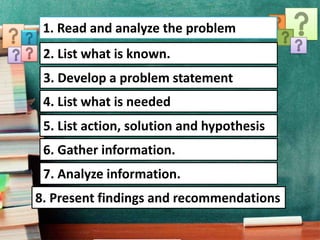
1. Read and analyze the problem
3. Develop a problem statement
4. List what is needed
5. List action, solution and hypothesis
6. Gather information.
2. List what is known.
7. Analyze information.
8. Present findings and recommendations
Key features of
Problem-Based
Learning
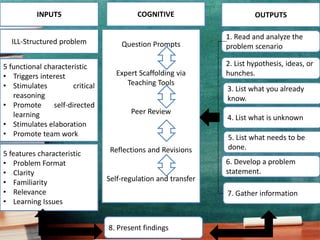
DESIGNING CODNITIVE SCAFFOLDS
FOR WEB – BASED PROBLEM – BASED
LEARNING
INPUTS
ILL-Structured problem
5 functional characteristic
• Triggers interest
• Stimulates critical
reasoning
• Promote self-directed
learning
• Stimulates elaboration
• Promote team work
5 features characteristic
• Problem Format
• Clarity
• Familiarity
• Relevance
• Learning Issues
COGNITIVE
Question Prompts
Expert Scaffolding via
Teaching Tools
Peer Review
Reflections and Revisions
Self-regulation and transfer
OUTPUTS
1. Read and analyze the
problem scenario
2. List hypothesis, ideas, or
hunches.
3. List what you already
know.
4. List what is unknown
5. List what needs to be
done.
6. Develop a problem
statement.
7. Gather information
8. Present findings
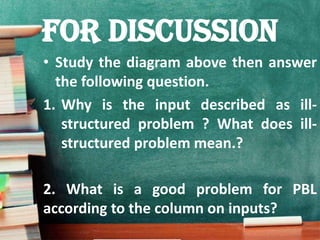
FOR DISCUSSION
• Study the diagram above then answer
the following question.
1. Why is the input described as ill-
structured problem ? What does ill-
structured problem mean.?
2. What is a good problem for PBL
according to the column on inputs?
3. Who is supposed to do steps 1-7
under outputs and #8 under
cognitive support ?
4. Who gives the cognitive support ?
Some Reminders for
PBL to Work
1. The problem must be designed in such a
way that different appropriate
solution/answer may apply. They are not
intended to generate neat answer. In their
struggle to find the answer, the students will
gain essential problem solving and critical
skills.
2. The problem must be a real world scenario.
One way would be by constructing a problem
statement, which contain the following:
a). It casts the student in a particular role.
b). It contains a problem.
c).it gives the students a task.
3. The problem must be relevant to the
students and must be developmentally
appropriate.
4. Guidelines must be set on how the
team/group will work together, expected dates
of completion and group presentation before
the class, procedures in group presentation
5. Teacher gives guidance but does not
give answers to the problem/s.
6. Students must be given reasonable
amount of time to do the work.
7. Teacher makes clear how performance
will be assessed. It is best that the Scoring
Rubric gets presented before work begins.
GRASPS
• GRASPS of Understanding by Design
advocates, Wiggins and Mc Tighe, can
help you formulate a problem.
–What does GRASPS mean? It is an
acronym that guides teachers in the
formulation of an authentic
performance task like the problem
solving.
• G – OAL
• R – OLE
• A – UDIENCE
• S – ITUATION
• P – RODUCT AND
PERFORMANCE
• S - TANDARD
Sample of Performance
Task/Problem
(CREATE AN EXCEL
SPREADSHEET SURVEY)
• G – OAL : Your task is to create an excel
spreadsheet survey by surveying the class as to
which was their favorite lunch food.
• R – OLE : You are a survey taker and you need
to obtain your data by surveying your
classmates on your specific food type.
• A – UDIENCE : You are letting your classmates
and the school cafeteria manager know which
food turned out to be class favorite.
• S – ITUATION : The challenge involves gathering
data and then displaying that data in an excel
spreadsheet.
• P – RODUCT AND PERFORMANCE : You will create
an excel spreadsheet using the data you obtained
and share it in a letter to the cafeteria manager.
• S – TANDARDS FOR SUCCESS : Your product must
meet the following standards : letter is written
correctly and contains correct data displayed in
cells and also displayed into a chart.
Example of
Problems for Use
in basic
Education
• Health Class – You live in a community
which is having a problem of an
increasing number of youth
alcoholics.
• Biology Class – You have learned of
the negative effects of the use of
pesticides in your Biology class.
• Home Economics – the elementary
department of your school has a problem
of widespread pediculosis (head lice)
among children
• Science Class – The Amburayan River is
now polluted. It was discovered that a
mining company has been dumping its
waste into the river.
PROJECT – BASED
LEARNING (PrB/PjBL)
Project – based learning, as the
name implies involves a project which
involves a complex task and some
from of student presentation, and/or
creating an actual product. It focuses
on a production model. The driving
force is the end – product, but the key
to success is the skills acquired during
the process of product production.
In other words, the learning effect is
much more important than the product
itself. Students do project – based
learning by : 1). Defining the purpose of
creating the end – product. 2).
Identifying their audience. 3). Doing
research on the topic. 4). Designing the
product. 5). Implementing the design.
6). Solving the problems that arise.
And finally 6) coming up with the
product. This is followed by a product
presentation and most important of all,
self evaluation and reflection on the
product and the entire production
process (SCHNEIDERMAN et al., 1998).
Problem – based learning starts
with a real world problem or case study
and ends with proposed solutions.
GOD BLESS!!

PROBLEM – BASED LEARNING.pdf

  • 1.
  • 2.
    LEARNING OUTCOMES Describe how problem– based learning and project – based learning are used as teaching – learning method
  • 3.
    Formulate at leastone sample problem and one sample project for problem – based and project – based learning, respectively, based on K to 12 Curriculum guide Research and critique on an implemented problem – based learning and project – based learning using elements of problem – based and project – based learning.
  • 4.
  • 5.
    • The lastthing discussed in Chapter 3 was inquiry – based learning. Inquiry is an umbrella term that covers a number of other approaches to teaching and learning. • Teaching practices that utilize a disposition of inquiry learning and elements of constructivist teaching include problems – based learning and project – based learning. They will be discussed in this Chapter.
  • 6.
    PROBLEM – BASEDLEARNING (PBL) • Problem – Based Learning uses an inquiry model or a problem – solving model. • In that case, student are given a problem, pose questions about the problem, plan on what and how to gather the necessary information, and come up with their conclusions ( Schneiderman et al., 1998).
  • 7.
    • The drivingforce is the problem given and the success is the solution of the same, and discovery of several solution.
  • 8.
    WHAT ARE THESTEPS IN PROBLEM – BASED LEARNING ?
  • 9.
    1. Read andanalyze the problem 3. Develop a problem statement 4. List what is needed 5. List action, solution and hypothesis 6. Gather information. 2. List what is known. 7. Analyze information. 8. Present findings and recommendations
  • 10.
  • 11.
    DESIGNING CODNITIVE SCAFFOLDS FORWEB – BASED PROBLEM – BASED LEARNING
  • 12.
    INPUTS ILL-Structured problem 5 functionalcharacteristic • Triggers interest • Stimulates critical reasoning • Promote self-directed learning • Stimulates elaboration • Promote team work 5 features characteristic • Problem Format • Clarity • Familiarity • Relevance • Learning Issues COGNITIVE Question Prompts Expert Scaffolding via Teaching Tools Peer Review Reflections and Revisions Self-regulation and transfer OUTPUTS 1. Read and analyze the problem scenario 2. List hypothesis, ideas, or hunches. 3. List what you already know. 4. List what is unknown 5. List what needs to be done. 6. Develop a problem statement. 7. Gather information 8. Present findings
  • 13.
    FOR DISCUSSION • Studythe diagram above then answer the following question. 1. Why is the input described as ill- structured problem ? What does ill- structured problem mean.? 2. What is a good problem for PBL according to the column on inputs?
  • 14.
    3. Who issupposed to do steps 1-7 under outputs and #8 under cognitive support ? 4. Who gives the cognitive support ?
  • 15.
    Some Reminders for PBLto Work 1. The problem must be designed in such a way that different appropriate solution/answer may apply. They are not intended to generate neat answer. In their struggle to find the answer, the students will gain essential problem solving and critical skills. 2. The problem must be a real world scenario. One way would be by constructing a problem statement, which contain the following:
  • 16.
    a). It caststhe student in a particular role. b). It contains a problem. c).it gives the students a task. 3. The problem must be relevant to the students and must be developmentally appropriate. 4. Guidelines must be set on how the team/group will work together, expected dates of completion and group presentation before the class, procedures in group presentation
  • 17.
    5. Teacher givesguidance but does not give answers to the problem/s. 6. Students must be given reasonable amount of time to do the work. 7. Teacher makes clear how performance will be assessed. It is best that the Scoring Rubric gets presented before work begins.
  • 18.
  • 19.
    • GRASPS ofUnderstanding by Design advocates, Wiggins and Mc Tighe, can help you formulate a problem. –What does GRASPS mean? It is an acronym that guides teachers in the formulation of an authentic performance task like the problem solving.
  • 20.
    • G –OAL • R – OLE • A – UDIENCE • S – ITUATION • P – RODUCT AND PERFORMANCE • S - TANDARD
  • 21.
    Sample of Performance Task/Problem (CREATEAN EXCEL SPREADSHEET SURVEY)
  • 22.
    • G –OAL : Your task is to create an excel spreadsheet survey by surveying the class as to which was their favorite lunch food. • R – OLE : You are a survey taker and you need to obtain your data by surveying your classmates on your specific food type. • A – UDIENCE : You are letting your classmates and the school cafeteria manager know which food turned out to be class favorite.
  • 23.
    • S –ITUATION : The challenge involves gathering data and then displaying that data in an excel spreadsheet. • P – RODUCT AND PERFORMANCE : You will create an excel spreadsheet using the data you obtained and share it in a letter to the cafeteria manager. • S – TANDARDS FOR SUCCESS : Your product must meet the following standards : letter is written correctly and contains correct data displayed in cells and also displayed into a chart.
  • 24.
    Example of Problems forUse in basic Education
  • 25.
    • Health Class– You live in a community which is having a problem of an increasing number of youth alcoholics. • Biology Class – You have learned of the negative effects of the use of pesticides in your Biology class.
  • 26.
    • Home Economics– the elementary department of your school has a problem of widespread pediculosis (head lice) among children • Science Class – The Amburayan River is now polluted. It was discovered that a mining company has been dumping its waste into the river.
  • 27.
  • 28.
    Project – basedlearning, as the name implies involves a project which involves a complex task and some from of student presentation, and/or creating an actual product. It focuses on a production model. The driving force is the end – product, but the key to success is the skills acquired during the process of product production.
  • 29.
    In other words,the learning effect is much more important than the product itself. Students do project – based learning by : 1). Defining the purpose of creating the end – product. 2). Identifying their audience. 3). Doing research on the topic. 4). Designing the product. 5). Implementing the design. 6). Solving the problems that arise.
  • 30.
    And finally 6)coming up with the product. This is followed by a product presentation and most important of all, self evaluation and reflection on the product and the entire production process (SCHNEIDERMAN et al., 1998). Problem – based learning starts with a real world problem or case study and ends with proposed solutions.
  • 31.