What Does an Inclusive
Mathematics Classroom
Look Like?
C arm e l Sche ttino, Ph.D.
TC M @N C SSM 20 17
1. About M e
2. What is inclusion in the classroom?
3. Why is it important in mathe matics?
4. What are the issue s?
5. Mini-Deep -Dive (a little self -promotion)
6. F ocus on Bias
7. What can y ou do?
INCLUSION?
1. Age
2. Class
3. Gender
4. Ethnicity
5. Sexual
Orientation
6. Race
7. Religion
8. Ability
3
NCTM THEMES
4
Algebra for All
Commitment to access & equity includes
developing socially, emotionally, and
academically safe environments for
mathematics teaching and learning—
environments in which students feel secure
and confident in engaging with one another
and with teachers Principles to Actions, 2014
PROPOSED CHANGES
5
THE REALITY
High-rigor course access is
not a reality across all of our
nation's schools.
2013-2014 Civil Rights Data Collection
Report, US Department of Education,
Office for Civil Rights
ocrdata.ed.gov
6
CONSIDER
7
1995
Claudie Solar - Inclusive
Mathematics Pedagogy
Not “Multiculturalism” in the
Classroom
Stemmed from other
consciousness-raising pedagogies
like radical, critical, feminist
Four Dialectical Aspects:
Silence vs. Speech
Passivity vs. Active Participation
Powerlessness vs. Empowerment
Omission vs. Inclusion
8
WHY MATH?
“Often, inequalities in achievement are perceived as the result
of a hierarchy of competence. When the very students who
have been given more opportunities to learn show higher
achievement than students provided fewer opportunities to
learn, they are perceived as more capable or having more
aptitude. This manner of talking about achievement gaps
without mentioning opportunity gaps that cause them invites a
focus on deficit models to “explain” low performance in terms
of factors such as cultural differences, poverty, low levels of
parental education, and so on.”
NCTM Principles to Action; Access & Equity, 2014
9
Further, research shows:
21% classtime teachers talking to students – demo methods
48% classtime students practicing methods working individually
15% classtime teachers questioning class in whole class format (Boaler)
IRE is method of discourse most commonly found in math classrooms
(Cazden)
WHY MATH?
1 0
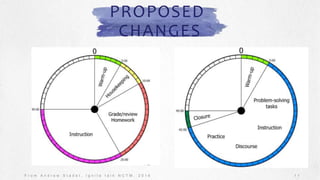
PROPOSED
CHANGES
1 1F r o m A n d r e w S t a d e l , I g n i t e t a l k N C T M , 2 0 1 6
Students’ innate levels of ability cannot be changed by instruction
Equity is the same as equality.
Equity is only an issue for schools with significant racial & ethnic
diversity
ELLs need to be in a separate “track” for math
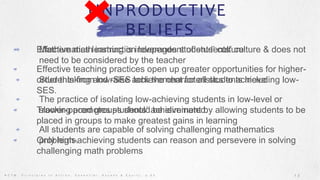
UNPRODUCTIVE
BELIEFS
N C T M , P r i n c i p l e s t o A c t i o n , E s s e n t i a l : A c c e s s & E q u i t y , p . 6 3 1 2
Math Ability is a function of opportunity, experience &
effort
Equity is attained by students receiving differentiated
supports
Equity needs to be addressed in all school settings
ELLs can learn math at grade level or beyond at the
same time that they are learning English.
Mathematics learning is independent of students’ culture & does not
need to be considered by the teacher
Students from low-SES lack the characteristics to achieve
The practice of isolating low-achieving students in low-level or
slower-paced groups should be eliminated.
All students are capable of solving challenging mathematics
problems.
UNPRODUCTIVE
BELIEFS
N C T M , P r i n c i p l e s t o A c t i o n , E s s e n t i a l : A c c e s s & E q u i t y , p . 6 3 1 3
Effective math instruction leverages students’ culture
Effective teaching practices open up greater opportunities for higher-
order thinking and raise achievement for all students including low-
SES.
Tracking promotes students’ achievement by allowing students to be
placed in groups to make greatest gains in learning
Only high-achieving students can reason and persevere in solving
challenging math problems
Establish mathematics goals to focus learning.
Implement tasks that promote reasoning and problem solving.
Use and connect mathematical representations.
Facilitate meaningful mathematical discourse.
Pose purposeful questions.
Build procedural fluency from conceptual understanding.
Support productive struggle in learning mathematics.
Elicit and use evidence of student thinking.
PROPOSED CHANGES
NCTM, Principles to Actions, Mathematical Teaching Practices, 2014
STUDENT VOICE
1 5
http://news.yale.edu/2014/05/15/prizewinners-teaching-yale-students
http://www.matific.com/us/en-us/blog/2015/07/23/interactive-technology-fills-learning-gaps-in-an-intervention-math-
classroom/
http://www.teachthought.com/learning/blended-flipped-learning/10-pros-cons-flipped-
classroom/
STUDENT VOICE
Student voice can be seen as the different ways in which
classroom communication in different media move a
student through growth in their educational process as
well as attending to the multiplicities of identities that
students construct as they move through the process of
belonging to a community of practice.
T a y l o r a n d R o b i n s o n , S c h e t t i n o
1 6
PROBLEMS WITH STUDENT VOICE WORK
Student voice…may not currently have the practical or
theoretical tools…to explain, or to contend with, the
multifarious ways in which power relations work within
school…processes. As a consequence, it may find itself
implicated in reproducing, rather than unsettling or
transforming, the hegemonic-normative practices it
sought to contest. In addition, it may remain bound by
the presumption that…such dialogue is itself a
manifestation of a classed, gendered and ‘raced’ form of
cultural capital (2009, p.169).
T a y l o r & R o b i n s o n , ( 2 0 0 9 ) . S t u d e n t v o i c e : T h e o r i s i n g p o w e r a n d p a r t i c i p a t i o n . P e d a g o g y ,
C u l t u r e a n d S o c i e t y , 1 7 ( 2 ) , 1 6 1 - 1 7 5 .
PROBLEMS WITH STUDENT VOICE WORK
The idea of “giving” students voice, especially when it
refers to students of color, only serves to reify the
dynamic of paternalism that renders Black and Brown
students voiceless until some salvific external force gifts
them with the privilege to speak. Rather than
acknowledge the systemic violences that attempt to
silence the rich voices, cultures, and histories that
students bring into classrooms, this orientation positions
students, and by extension, the communities of students,
as eternally in need of institutional sanctioning.
1 8J a m i l a L y i s c o t t , P o s t d o c t o r a l F e l l o w , T e a c h e r s C o l l e g e , C o l u m b i a U n i v e r s i t y
BELONGING?
• Academics not their strength in general
• Math has never made sense
• It did before Algebra, sense of self worth declined
• Demoralized by a standardized test
• Negative messages from home
• “We’re not math people”
• Combatting stereotypes of math ability
A d a p t e d f r o m B l o g p o s t b y I l a n a H o r n e , P h . D . 5 / 2 0 / 1 6 1 9
Meaning-making process
Systematic, rigorous, disciplined way of
thinking
Needs to happen in community, interaction
with others
Requires attitudes that value personal and
intellectual growth of all
ON REFLECTION
R o g e r s , C . ( 2 0 0 2 ) D e f i n i n g R e f l e c t i o n , T e a c h e r s C o l l e g e R e c o r d 2 0
2 1
PRACTICES THAT
INHIBIT BELONGING
• Emphasizing competition
• Assuming there is “one kind of smartness”
• Devaluing their individuality
• Correcting the inconsequential
• Utilizing only one method of assessment
• Using Cold-Calling as a discipline strategy
S o m e f r o m h t t p s : / / t e a c h i n g m a t h c u l t u r e . w o r d p r e s s . c o m / 2 0 1 6 / 0 5 / 2 0 / w h o - b e l o n g s - i n - o u r - m a t h -
c l a s s r o o m s / 2 2
• Focusing on student ideas & valuing all perspectives
• Describing mathematics with “dynamic subjectivity”
• Letting students create connections
• Helping students create their own mathematical
identity
• Authorship of Ideas/Solutions
• Sharing the Authority of Mathematics
2 3
PRACTICES THAT
FOSTER BELONGING
WHAT DO STUDENTS SAY?
…I’ve been given the opportunity to express myself…my
identity has changed as a person. I feel like this course
is kind of like that. I could be on the side where, I like to
solve it this way and someone else could be on the side
where they like to solve it that way, and the fact that we
both get to express our opinions and even if one of us is
wrong and one of us is right, or even if both of us is right.
It’s changed my identity and given me kind of like a voice
in math. Whereas I didn’t really have one before. It was
a silent voice.
2 5
IMPLICIT BIAS
B l i n d s p o t , B a n a j i & G r e e n w a l d , 2 0 1 4 2 6
1. “the portion of the mind that houses
hidden biases”
2. Gain awareness ->adapt behavior to
outsmart the “machine”
3. Treating people differently to the extent
that there are advantages and
disadvantages that they experience.
WHAT YOU MIGHT NOT KNOW
Your brain operates on two different levels
2 7
Rational Intuitive
Deliberate Automatic
Thinking Slow Thinking Fast
Conscious Unconscious
Explicit Implicit
2 9
Google Image Search
“Teacher Yelling at Student”
“Teacher Angry at Student”
“Teacher disciplining student”
Images where anger is actually
shown – majority of images is
White adult and Student of Color
IMAGES IN THE MEDIA
1. Explicit attitudes & implicit associations are only mildly correlated.
(Cameron 2012)
2. Measure of implicit racial bias can explain teacher, administrator or
parent perpetuate inequalities in even very diverse schools.
(Diamond & Lewis , 2015)
3. Teachers who are high in implicit bias are actually more able to have
successful interracial interactions than less biased peers, but only
when able and willing to devote cognitive resources to regulating
their behavior. (Mendes & Koslov, 2013)
IMPLICATIONS OF IMPLICIT BIAS
FOR THE CLASSROOM
3 0
WHY WORK TOWARDS THIS?
“Inclusive teaching adds to effective teaching - a framework for
understanding why teaching is effective, along with an
intentionality of producing more equitable outcomes for
students. A faculty member may teach effectively without
consciously considering inclusiveness, but by being more
intentional about the desired outcomes of learning and
designing every aspect of the learning to address students’
needs, they could help to create even better results.”
Darryl Yong, Ph.D.
3 1
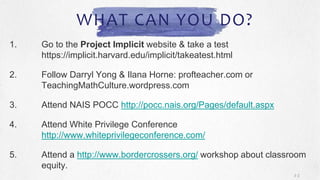
WHAT CAN YOU DO?
1. Go to the Project Implicit website & take a test
https://implicit.harvard.edu/implicit/takeatest.html
2. Follow Darryl Yong & Ilana Horne: profteacher.com or
TeachingMathCulture.wordpress.com
3. Attend NAIS POCC http://pocc.nais.org/Pages/default.aspx
4. Attend White Privilege Conference
http://www.whiteprivilegeconference.com/
5. Attend a http://www.bordercrossers.org/ workshop about classroom
equity.
3 2
FOLLOW ME
@SchettinoPBL
TWITTER
Carmel Schettino, Ph.D.
FACEBOOK
www.slideshare.net/carmelschettino
SLIDESHARE
3 3
BLOG
carmelschettino.org
T O L E A R N M O R E A B O U T P B L , T A K E M Y C O U R S E A T T H E A N J A S . G R E E R
C O N F E R E N C E F O R M A T H , S C I E N C E A N D T E C H N O L O G Y A T E X E T E R , N H
J U N E 2 5 - 3 0 , 2 0 1 7

Inclusive math classroom Schettino 2017

  • 1.
    What Does anInclusive Mathematics Classroom Look Like? C arm e l Sche ttino, Ph.D. TC M @N C SSM 20 17
  • 2.
    1. About Me 2. What is inclusion in the classroom? 3. Why is it important in mathe matics? 4. What are the issue s? 5. Mini-Deep -Dive (a little self -promotion) 6. F ocus on Bias 7. What can y ou do?
  • 3.
    INCLUSION? 1. Age 2. Class 3.Gender 4. Ethnicity 5. Sexual Orientation 6. Race 7. Religion 8. Ability 3
  • 4.
  • 5.
    Commitment to access& equity includes developing socially, emotionally, and academically safe environments for mathematics teaching and learning— environments in which students feel secure and confident in engaging with one another and with teachers Principles to Actions, 2014 PROPOSED CHANGES 5
  • 6.
    THE REALITY High-rigor courseaccess is not a reality across all of our nation's schools. 2013-2014 Civil Rights Data Collection Report, US Department of Education, Office for Civil Rights ocrdata.ed.gov 6
  • 7.
  • 8.
    1995 Claudie Solar -Inclusive Mathematics Pedagogy Not “Multiculturalism” in the Classroom Stemmed from other consciousness-raising pedagogies like radical, critical, feminist Four Dialectical Aspects: Silence vs. Speech Passivity vs. Active Participation Powerlessness vs. Empowerment Omission vs. Inclusion 8
  • 9.
    WHY MATH? “Often, inequalitiesin achievement are perceived as the result of a hierarchy of competence. When the very students who have been given more opportunities to learn show higher achievement than students provided fewer opportunities to learn, they are perceived as more capable or having more aptitude. This manner of talking about achievement gaps without mentioning opportunity gaps that cause them invites a focus on deficit models to “explain” low performance in terms of factors such as cultural differences, poverty, low levels of parental education, and so on.” NCTM Principles to Action; Access & Equity, 2014 9
  • 10.
    Further, research shows: 21%classtime teachers talking to students – demo methods 48% classtime students practicing methods working individually 15% classtime teachers questioning class in whole class format (Boaler) IRE is method of discourse most commonly found in math classrooms (Cazden) WHY MATH? 1 0
  • 11.
    PROPOSED CHANGES 1 1F ro m A n d r e w S t a d e l , I g n i t e t a l k N C T M , 2 0 1 6
  • 12.
    Students’ innate levelsof ability cannot be changed by instruction Equity is the same as equality. Equity is only an issue for schools with significant racial & ethnic diversity ELLs need to be in a separate “track” for math UNPRODUCTIVE BELIEFS N C T M , P r i n c i p l e s t o A c t i o n , E s s e n t i a l : A c c e s s & E q u i t y , p . 6 3 1 2 Math Ability is a function of opportunity, experience & effort Equity is attained by students receiving differentiated supports Equity needs to be addressed in all school settings ELLs can learn math at grade level or beyond at the same time that they are learning English.
  • 13.
    Mathematics learning isindependent of students’ culture & does not need to be considered by the teacher Students from low-SES lack the characteristics to achieve The practice of isolating low-achieving students in low-level or slower-paced groups should be eliminated. All students are capable of solving challenging mathematics problems. UNPRODUCTIVE BELIEFS N C T M , P r i n c i p l e s t o A c t i o n , E s s e n t i a l : A c c e s s & E q u i t y , p . 6 3 1 3 Effective math instruction leverages students’ culture Effective teaching practices open up greater opportunities for higher- order thinking and raise achievement for all students including low- SES. Tracking promotes students’ achievement by allowing students to be placed in groups to make greatest gains in learning Only high-achieving students can reason and persevere in solving challenging math problems
  • 14.
    Establish mathematics goalsto focus learning. Implement tasks that promote reasoning and problem solving. Use and connect mathematical representations. Facilitate meaningful mathematical discourse. Pose purposeful questions. Build procedural fluency from conceptual understanding. Support productive struggle in learning mathematics. Elicit and use evidence of student thinking. PROPOSED CHANGES NCTM, Principles to Actions, Mathematical Teaching Practices, 2014
  • 15.
  • 16.
    STUDENT VOICE Student voicecan be seen as the different ways in which classroom communication in different media move a student through growth in their educational process as well as attending to the multiplicities of identities that students construct as they move through the process of belonging to a community of practice. T a y l o r a n d R o b i n s o n , S c h e t t i n o 1 6
  • 17.
    PROBLEMS WITH STUDENTVOICE WORK Student voice…may not currently have the practical or theoretical tools…to explain, or to contend with, the multifarious ways in which power relations work within school…processes. As a consequence, it may find itself implicated in reproducing, rather than unsettling or transforming, the hegemonic-normative practices it sought to contest. In addition, it may remain bound by the presumption that…such dialogue is itself a manifestation of a classed, gendered and ‘raced’ form of cultural capital (2009, p.169). T a y l o r & R o b i n s o n , ( 2 0 0 9 ) . S t u d e n t v o i c e : T h e o r i s i n g p o w e r a n d p a r t i c i p a t i o n . P e d a g o g y , C u l t u r e a n d S o c i e t y , 1 7 ( 2 ) , 1 6 1 - 1 7 5 .
  • 18.
    PROBLEMS WITH STUDENTVOICE WORK The idea of “giving” students voice, especially when it refers to students of color, only serves to reify the dynamic of paternalism that renders Black and Brown students voiceless until some salvific external force gifts them with the privilege to speak. Rather than acknowledge the systemic violences that attempt to silence the rich voices, cultures, and histories that students bring into classrooms, this orientation positions students, and by extension, the communities of students, as eternally in need of institutional sanctioning. 1 8J a m i l a L y i s c o t t , P o s t d o c t o r a l F e l l o w , T e a c h e r s C o l l e g e , C o l u m b i a U n i v e r s i t y
  • 19.
    BELONGING? • Academics nottheir strength in general • Math has never made sense • It did before Algebra, sense of self worth declined • Demoralized by a standardized test • Negative messages from home • “We’re not math people” • Combatting stereotypes of math ability A d a p t e d f r o m B l o g p o s t b y I l a n a H o r n e , P h . D . 5 / 2 0 / 1 6 1 9
  • 20.
    Meaning-making process Systematic, rigorous,disciplined way of thinking Needs to happen in community, interaction with others Requires attitudes that value personal and intellectual growth of all ON REFLECTION R o g e r s , C . ( 2 0 0 2 ) D e f i n i n g R e f l e c t i o n , T e a c h e r s C o l l e g e R e c o r d 2 0
  • 21.
  • 22.
    PRACTICES THAT INHIBIT BELONGING •Emphasizing competition • Assuming there is “one kind of smartness” • Devaluing their individuality • Correcting the inconsequential • Utilizing only one method of assessment • Using Cold-Calling as a discipline strategy S o m e f r o m h t t p s : / / t e a c h i n g m a t h c u l t u r e . w o r d p r e s s . c o m / 2 0 1 6 / 0 5 / 2 0 / w h o - b e l o n g s - i n - o u r - m a t h - c l a s s r o o m s / 2 2
  • 23.
    • Focusing onstudent ideas & valuing all perspectives • Describing mathematics with “dynamic subjectivity” • Letting students create connections • Helping students create their own mathematical identity • Authorship of Ideas/Solutions • Sharing the Authority of Mathematics 2 3 PRACTICES THAT FOSTER BELONGING
  • 25.
    WHAT DO STUDENTSSAY? …I’ve been given the opportunity to express myself…my identity has changed as a person. I feel like this course is kind of like that. I could be on the side where, I like to solve it this way and someone else could be on the side where they like to solve it that way, and the fact that we both get to express our opinions and even if one of us is wrong and one of us is right, or even if both of us is right. It’s changed my identity and given me kind of like a voice in math. Whereas I didn’t really have one before. It was a silent voice. 2 5
  • 26.
    IMPLICIT BIAS B li n d s p o t , B a n a j i & G r e e n w a l d , 2 0 1 4 2 6 1. “the portion of the mind that houses hidden biases” 2. Gain awareness ->adapt behavior to outsmart the “machine” 3. Treating people differently to the extent that there are advantages and disadvantages that they experience.
  • 27.
    WHAT YOU MIGHTNOT KNOW Your brain operates on two different levels 2 7 Rational Intuitive Deliberate Automatic Thinking Slow Thinking Fast Conscious Unconscious Explicit Implicit
  • 29.
    2 9 Google ImageSearch “Teacher Yelling at Student” “Teacher Angry at Student” “Teacher disciplining student” Images where anger is actually shown – majority of images is White adult and Student of Color IMAGES IN THE MEDIA
  • 30.
    1. Explicit attitudes& implicit associations are only mildly correlated. (Cameron 2012) 2. Measure of implicit racial bias can explain teacher, administrator or parent perpetuate inequalities in even very diverse schools. (Diamond & Lewis , 2015) 3. Teachers who are high in implicit bias are actually more able to have successful interracial interactions than less biased peers, but only when able and willing to devote cognitive resources to regulating their behavior. (Mendes & Koslov, 2013) IMPLICATIONS OF IMPLICIT BIAS FOR THE CLASSROOM 3 0
  • 31.
    WHY WORK TOWARDSTHIS? “Inclusive teaching adds to effective teaching - a framework for understanding why teaching is effective, along with an intentionality of producing more equitable outcomes for students. A faculty member may teach effectively without consciously considering inclusiveness, but by being more intentional about the desired outcomes of learning and designing every aspect of the learning to address students’ needs, they could help to create even better results.” Darryl Yong, Ph.D. 3 1
  • 32.
    WHAT CAN YOUDO? 1. Go to the Project Implicit website & take a test https://implicit.harvard.edu/implicit/takeatest.html 2. Follow Darryl Yong & Ilana Horne: profteacher.com or TeachingMathCulture.wordpress.com 3. Attend NAIS POCC http://pocc.nais.org/Pages/default.aspx 4. Attend White Privilege Conference http://www.whiteprivilegeconference.com/ 5. Attend a http://www.bordercrossers.org/ workshop about classroom equity. 3 2
  • 33.
    FOLLOW ME @SchettinoPBL TWITTER Carmel Schettino,Ph.D. FACEBOOK www.slideshare.net/carmelschettino SLIDESHARE 3 3 BLOG carmelschettino.org T O L E A R N M O R E A B O U T P B L , T A K E M Y C O U R S E A T T H E A N J A S . G R E E R C O N F E R E N C E F O R M A T H , S C I E N C E A N D T E C H N O L O G Y A T E X E T E R , N H J U N E 2 5 - 3 0 , 2 0 1 7

Editor's Notes

  • #27 Is problem-based learning teaching?