Project Based Learning
vs.
Project Based Activities
• Is there a difference between the two?
YES NO
Answer
Yes, there is actually a difference between project
based learning and project based activities.
Project Based Learning
Project Based Learning is an instructional approach built upon
authentic learning activities that engage student interest and
motivation. These activities are designed to answer a question
or solve a problem and generally reflect the types of learning
and work people do in the everyday world outside the
classroom.
http://pbl-online.org/About/whatisPBL.htm
Project Based Activity
If the central activities of the project represent no difficulty to
the student or can be carried out with the application of
already-learned information or skills, the project is an exercise
or activity not PBL
http://www.ri.net/middletown/mef/linksresources/documents/researchreviewPBL_070226.pdf
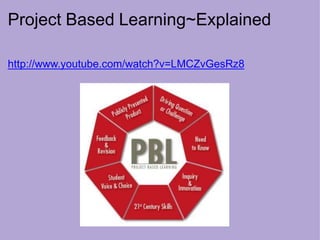
Project Based Learning~Explained
http://www.youtube.com/watch?v=LMCZvGesRz8
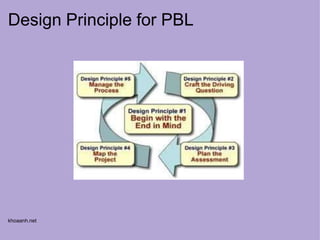
Design Principle for PBL
khoaanh.net
PBL Methods
The methods used in PBL and the specific skills developed,
including
• the ability to think critically,
• analyze and solve complex, real-world problems,
• to find, evaluate, and use appropriate learning resources;
• to work cooperatively,
• to demonstrate effective communication skills, and
• to use content knowledge and intellectual skills to become
continual learners.
• Students must have the responsibility for their own learning
•
This is what makes PBL
constructavist
The characteristics of PBL identify clearly
• the role of the tutor as a facilitator of learning
• the responsibilities of the learners to be self-directed and
selfregulated in their learning, and
• the essential elements in the design of ill-structured
instructional problems as the driving force for inquiry.
The challenge for many instructors when they adopt a PBL
approach is to make the transition from teacher as knowledge
provider to tutor as manager and facilitator of learning and
encouraging students to take full responsibility for their
learning.
Reasons to Use Project -Based Learning
Research shows that students often cannot transfer their
mathematical knowledge to situations outside the
classroom. Projects engage students in applications of
mathematics, which may help them to transfer their
mathematical skills to other disciplines and to real-world
problems. Using significant problems often increases
student motivation, in turn promoting learning.
http://www.glencoe.com/sec/teachingtoday/subject/project_based.phtml
Examples of Project-Based Learning in Math
• There is a wide variety of the type of project that teachers
use in math class projects. Some teachers present a
scenario for the project and have students take the role of a
person in the workplace. Here are some examples of
projects.
• In a middle school or consumer mathematics class, students
take the role of a state official preparing a statistical report
on the state, choosing a topic such as education. The end
product can be a presentation with graphs and written
descriptions of significant findings. Consider collaborating
with a language arts or social studies teacher for this
project.
Getting Started
• Start small. Begin with a project lasting only a few class
periods.
• Define the project and the objectives carefully and clearly.
Have the objectives align with both process and content
standards for your school or state.
• Give students a timeline so that they know exactly what is
expected and when the project is due. Insist on progress
reports, assigning points for the reports.
• Look for projects that are already written. Check newer
textbooks, ancillary materials, or the Internet.
• Design your assessment plan in advance. Share the rubric
you will use with the students before they begin the project.
If possible, show students samples of what you expect,
including project documentation and the end product itself.
• Consider teaming-up with teachers in other subject areas.
Intervention and Facilitation
• If students need a particular skill for the project, such as
graphing data, teach mini-lessons along the way.
• Have appropriate resources for the students: Web sites,
books, people available to answer questions, computer
software, including various programs for helping students
present their project.
• Give students class time to complete some of the steps
necessary, such as brainstorming, writing an outline,
drafting a report, and having others edit and revise the
report. Be sure to provide specific feedback regarding their
ideas and plans to execute the project prior to their
beginning.
http://www.glencoe.com/sec/teachingtoday/subject/project_based.phtml
Resources
http://pbl-online.org/About/whatisPBL.htm
http://www.ri.net/middletown/mef/linksresources/documents/researchreviewPBL_070226.pdf
http://www.youtube.com/watch?v=LMCZvGesRz8
khoaanh.net
http://www.glencoe.com/sec/teachingtoday/subject/project_based.phtml

Project Based Learning detai description

  • 1.
  • 2.
    Project Based Learning vs. ProjectBased Activities • Is there a difference between the two? YES NO
  • 3.
    Answer Yes, there isactually a difference between project based learning and project based activities.
  • 4.
    Project Based Learning ProjectBased Learning is an instructional approach built upon authentic learning activities that engage student interest and motivation. These activities are designed to answer a question or solve a problem and generally reflect the types of learning and work people do in the everyday world outside the classroom. http://pbl-online.org/About/whatisPBL.htm
  • 5.
    Project Based Activity Ifthe central activities of the project represent no difficulty to the student or can be carried out with the application of already-learned information or skills, the project is an exercise or activity not PBL http://www.ri.net/middletown/mef/linksresources/documents/researchreviewPBL_070226.pdf
  • 6.
  • 7.
    Design Principle forPBL khoaanh.net
  • 8.
    PBL Methods The methodsused in PBL and the specific skills developed, including • the ability to think critically, • analyze and solve complex, real-world problems, • to find, evaluate, and use appropriate learning resources; • to work cooperatively, • to demonstrate effective communication skills, and • to use content knowledge and intellectual skills to become continual learners. • Students must have the responsibility for their own learning •
  • 9.
    This is whatmakes PBL constructavist The characteristics of PBL identify clearly • the role of the tutor as a facilitator of learning • the responsibilities of the learners to be self-directed and selfregulated in their learning, and • the essential elements in the design of ill-structured instructional problems as the driving force for inquiry. The challenge for many instructors when they adopt a PBL approach is to make the transition from teacher as knowledge provider to tutor as manager and facilitator of learning and encouraging students to take full responsibility for their learning.
  • 10.
    Reasons to UseProject -Based Learning Research shows that students often cannot transfer their mathematical knowledge to situations outside the classroom. Projects engage students in applications of mathematics, which may help them to transfer their mathematical skills to other disciplines and to real-world problems. Using significant problems often increases student motivation, in turn promoting learning. http://www.glencoe.com/sec/teachingtoday/subject/project_based.phtml
  • 11.
    Examples of Project-BasedLearning in Math • There is a wide variety of the type of project that teachers use in math class projects. Some teachers present a scenario for the project and have students take the role of a person in the workplace. Here are some examples of projects. • In a middle school or consumer mathematics class, students take the role of a state official preparing a statistical report on the state, choosing a topic such as education. The end product can be a presentation with graphs and written descriptions of significant findings. Consider collaborating with a language arts or social studies teacher for this project.
  • 12.
    Getting Started • Startsmall. Begin with a project lasting only a few class periods. • Define the project and the objectives carefully and clearly. Have the objectives align with both process and content standards for your school or state. • Give students a timeline so that they know exactly what is expected and when the project is due. Insist on progress reports, assigning points for the reports. • Look for projects that are already written. Check newer textbooks, ancillary materials, or the Internet. • Design your assessment plan in advance. Share the rubric you will use with the students before they begin the project. If possible, show students samples of what you expect, including project documentation and the end product itself. • Consider teaming-up with teachers in other subject areas.
  • 13.
    Intervention and Facilitation •If students need a particular skill for the project, such as graphing data, teach mini-lessons along the way. • Have appropriate resources for the students: Web sites, books, people available to answer questions, computer software, including various programs for helping students present their project. • Give students class time to complete some of the steps necessary, such as brainstorming, writing an outline, drafting a report, and having others edit and revise the report. Be sure to provide specific feedback regarding their ideas and plans to execute the project prior to their beginning. http://www.glencoe.com/sec/teachingtoday/subject/project_based.phtml
  • 14.