PROBLEM BASED LEARNING (PBL)By: Christine Lim AminaKiluwashaMeysamMoradi
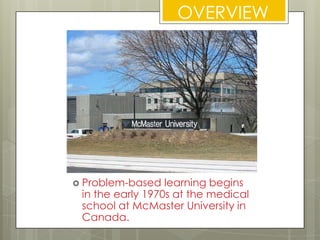
OVERVIEWProblem-based learning begins in the early 1970s at the medical school at McMaster University in Canada.
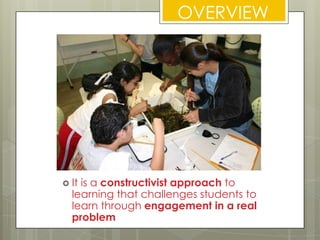
OVERVIEWIt is a constructivistapproach to learning that challenges students to learn through engagement in a real problem
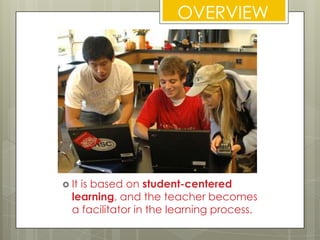
OVERVIEWIt is based on student-centered learning, and the teacher becomes a facilitator in the learning process.
What is PBLThe learning that results from the process of working towards the understanding of a resolution of a problem                   (Barrows, Tamblyn, 1980)
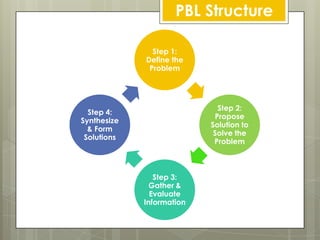
PBL Structure
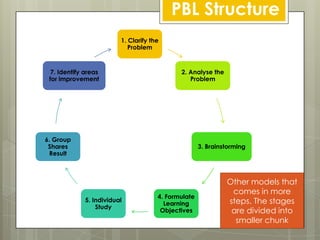
PBL StructureOther models that comes in more steps. The stages are divided into smaller chunk
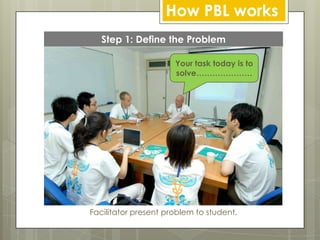
How PBL worksStep 1: Define the ProblemYour task today is to solve…………………Facilitator present problem to student.
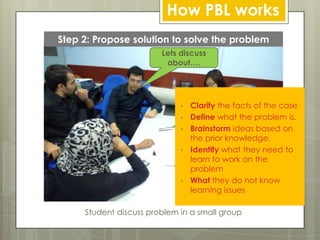
How PBL worksStep 2: Propose solution to solve the problemLets discuss about….Clarifythe facts of the case
Define what the problem is.
Brainstorm ideas based on the prior knowledge.
Identifywhat they need to learn to work on the problem
What they do not know learning issuesStudent discuss problem in a small group
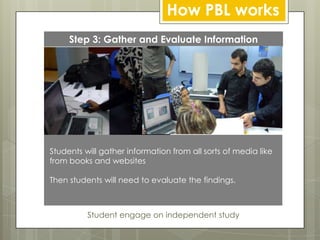
How PBL worksStep 3: Gather and Evaluate InformationStudents will gather information from all sorts of media like from books and websitesThen students will need to evaluate the findings.Student engage on independent study
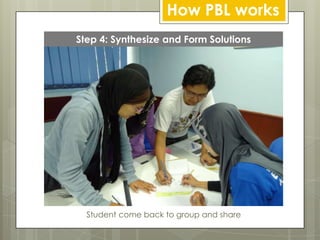
How PBL worksStep 4: Synthesize and Form SolutionsStudent come back to group and share
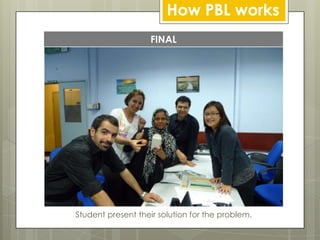
How PBL worksFINALStudent present their solution for the problem.
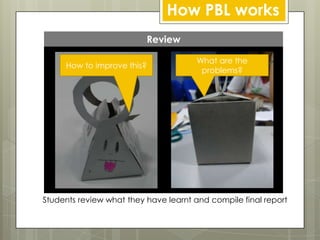
How PBL worksReviewHow to improve this?What are the problems?Students review what they have learnt and compile final report
CharacteristicsProblem drives the learning. Using tutorials students define their own learning issues.Learning is student-centered, and the teacher becomes a facilitator in the learning process.Emphasis on the process of students solving a real world problem.
Purpose Developed of high fidelity competencyIdentification of self-analysisClear clinical decision-makingProblem solve in abnormal circumstancesCultivating an ability Adaptation to work effectively in a team

Problem based learning

  • 1.
    PROBLEM BASED LEARNING(PBL)By: Christine Lim AminaKiluwashaMeysamMoradi
  • 2.
    OVERVIEWProblem-based learning beginsin the early 1970s at the medical school at McMaster University in Canada.
  • 3.
    OVERVIEWIt is aconstructivistapproach to learning that challenges students to learn through engagement in a real problem
  • 4.
    OVERVIEWIt is basedon student-centered learning, and the teacher becomes a facilitator in the learning process.
  • 5.
    What is PBLThelearning that results from the process of working towards the understanding of a resolution of a problem    (Barrows, Tamblyn, 1980)
  • 6.
  • 7.
    PBL StructureOther modelsthat comes in more steps. The stages are divided into smaller chunk
  • 8.
    How PBL worksStep1: Define the ProblemYour task today is to solve…………………Facilitator present problem to student.
  • 9.
    How PBL worksStep2: Propose solution to solve the problemLets discuss about….Clarifythe facts of the case
  • 10.
    Define what theproblem is.
  • 11.
    Brainstorm ideas basedon the prior knowledge.
  • 12.
    Identifywhat they needto learn to work on the problem
  • 13.
    What they donot know learning issuesStudent discuss problem in a small group
  • 14.
    How PBL worksStep3: Gather and Evaluate InformationStudents will gather information from all sorts of media like from books and websitesThen students will need to evaluate the findings.Student engage on independent study
  • 15.
    How PBL worksStep4: Synthesize and Form SolutionsStudent come back to group and share
  • 16.
    How PBL worksFINALStudentpresent their solution for the problem.
  • 17.
    How PBL worksReviewHowto improve this?What are the problems?Students review what they have learnt and compile final report
  • 18.
    CharacteristicsProblem drives thelearning. Using tutorials students define their own learning issues.Learning is student-centered, and the teacher becomes a facilitator in the learning process.Emphasis on the process of students solving a real world problem.
  • 19.
    Purpose Developed ofhigh fidelity competencyIdentification of self-analysisClear clinical decision-makingProblem solve in abnormal circumstancesCultivating an ability Adaptation to work effectively in a team

Editor's Notes

  • #3 Constructivism: Learners create their own learning, active learning and construct knowledge themselves, learners discover the basic principles for themselves
  • #4 Constructivism: Learners create their own learning, active learning and construct knowledge themselves, learners discover the basic principles for themselves
  • #5 Constructivism: Learners create their own learning, active learning and construct knowledge themselves, learners discover the basic principles for themselves