Presentation
On
Project Entitled
“Manufacturing of Paver Blocks using Construction and
Demolition Wastes”
Guided by- Presented by-
Prof. XYZ Nirmal ( XYZ)
Prof.(Civil Engg. Dept.) PRN : 170101161007
B. TECH CIVIL ENGG.
DEPARTMENT OF CIVIL ENGINEERING
SCHOOL OF ENGINEERING AND TECHNOLOGY
SANDIP UNIVERSITY
At Post Mahiravani, Trimbak Road, Tal. & Dist. Nashik - 422213
1
2
CONTENT
• Introduction
• Objectives
• Problem Identification
• Literature Review
• Methodology
• References
3
INTRODUCTION
• Construction and demolition waste is the waste which is
generated from various activities like residential
construction work, road work, renovation work
demolition, etc.
• Recycled coarse aggregates are obtained by crushing of
concrete waste from demolition of structural components
in many structures such as old buildings, bridges, concrete
pavements etc.
• The rapid industrialization and urbanization resulted in
large quantity of waste generation and in turn,
environmental degradation.
• Recycling of solid waste into a sustainable construction
material with optimum mix proportion is the global need
to reduce its adverse environmental impacts
4
OBJECTIVES
1. To make an attempt to use construction and
demolition waste in manufacturing so as to minimize
that waste from the society.
2. To minimize the burden of construction and
demolished waste on environment and dumping
issue.
3. To increase the density of the block thereby
achieving a good compressive strength.
4. Identifying the uses and applications of these paver
blocks with respect to their strength.
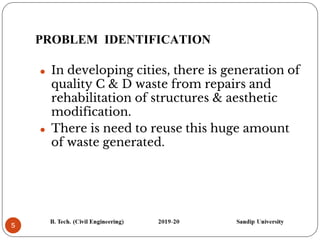
PROBLEM IDENTIFICATION
5
⚫ In developing cities, there is generation of
quality C & D waste from repairs and
rehabilitation of structures & aesthetic
modification.
⚫ There is need to reuse this huge amount
of waste generated.
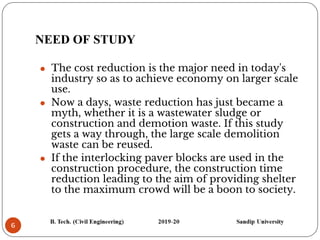
NEED OF STUDY
6
⚫ The cost reduction is the major need in today's
industry so as to achieve economy on larger scale
use.
⚫ Now a days, waste reduction has just became a
myth, whether it is a wastewater sludge or
construction and demotion waste. If this study
gets a way through, the large scale demolition
waste can be reused.
⚫ If the interlocking paver blocks are used in the
construction procedure, the construction time
reduction leading to the aim of providing shelter
to the maximum crowd will be a boon to society.
LITERATURE REVIEW
7
SR.
NO.
AUTHOR OF
PAPER
TITLE DESCRIPTION
1
(Pattnaik Truptimala [et
al.,
2018)
Manufacture of
interlocking concrete
paving blocks with flyash
and glass powder
• In the paper, concrete paving blocks may be
produced with locally available cement,
aggregates, fly ash and waste glass powder as the
mineral admixture.
•The study indicated that fly ash and waste glass
powder can effectively be used as cement
replacement without substantial change in strength
2.
(Gencel Osman [et al.].,
2012)
Properties of concrete
paving blocks made with
waste marble
• This paper shows the use of materials like
Portland Cement, Dry and clean natural
river sand, crushed sand and crushed stone
whereas Crushed waste marble and dust
used were obtained from marble processing
plants in Turkey.
• This paper concluded that their method of
incorporating marble waste is only limited
by incidental costs
3.
(Wang Xinyi, Chin Chee
Seong and Xia jun, 2019)
Material
Characterization for
Sustainable Concrete
Paving Blocks
• This Paper aims to study the property
variations of sustainable concrete paving
block using different contents of
construction wastes.
• Mixing crushed glass in the concrete paving
blocks as a type of coarse aggregates can
improve the blocks’ strength and decrease
the blocks’ water absorption
LITERATURE REVIEW
8
SR.
NO.
AUTHOR OF
PAPER
TITLE DESCRIPTION
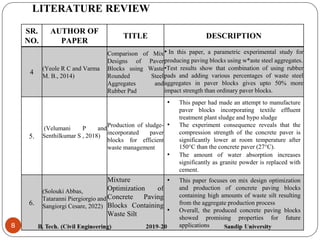
4
(Yeole R C and Varma
M. B., 2014)
Comparison of Mix
Designs of Paver
Blocks using Waste
Rounded Steel
Aggregates and
Rubber Pad
• In this paper, a parametric experimental study for
producing paving blocks using w*aste steel aggregates.
•Test results show that combination of using rubber
pads and adding various percentages of waste steel
aggregates in paver blocks gives upto 50% more
impact strength than ordinary paver blocks.
5.
(Velumani P and
Senthilkumar S , 2018)
Production of sludge-
incorporated paver
blocks for efficient
waste management
• This paper had made an attempt to manufacture
paver blocks incorporating textile effluent
treatment plant sludge and hypo sludge
• The experiment consequence reveals that the
compression strength of the concrete paver is
significantly lower at room temperature after
150°C than the concrete paver (27°C).
• The amount of water absorption increases
significantly as granite powder is replaced with
cement.
6.
(Solouki Abbas,
Tataranni Piergiorgio and
Sangiorgi Cesare, 2022)
Mixture
Optimization of
Concrete Paving
Blocks Containing
Waste Silt
• This paper focuses on mix design optimization
and production of concrete paving blocks
containing high amounts of waste silt resulting
from the aggregate production process
• Overall, the produced concrete paving blocks
showed promising properties for future
applications
LITERATURE REVIEW
9
SR.
NO
.
AUTHOR OF
PAPER
TITLE DESCRIPTION
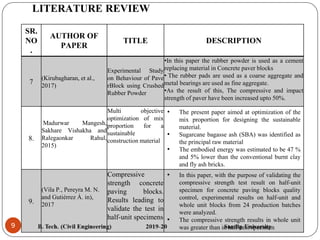
7
(Kirubagharan, et al.,
2017)
Experimental Study
on Behaviour of Pave
rBlock using Crushed
Rubber Powder
•In this paper the rubber powder is used as a cement
replacing material in Concrete paver blocks
• The rubber pads are used as a coarse aggregate and
metal bearings are used as fine aggregate.
•As the result of this, The compressive and impact
strength of paver have been increased upto 50%.
8.
Madurwar Mangesh,
Sakhare Vishakha and
Ralegaonkar Rahul,
2015)
Multi objective
optimization of mix
proportion for a
sustainable
construction material
• The present paper aimed at optimization of the
mix proportion for designing the sustainable
material.
• Sugarcane bagasse ash (SBA) was identified as
the principal raw material
• The embodied energy was estimated to be 47 %
and 5% lower than the conventional burnt clay
and fly ash bricks.
9.
(Vila P., Pereyra M. N.
and Gutiérrez Á. in),
2017
Compressive
strength concrete
paving blocks.
Results leading to
validate the test in
half-unit specimens
• In this paper, with the purpose of validating the
compressive strength test result on half-unit
specimen for concrete paving blocks quality
control, experimental results on half-unit and
whole unit blocks from 24 production batches
were analyzed.
• The compressive strength results in whole unit
was greater than in half-unit specimen
10
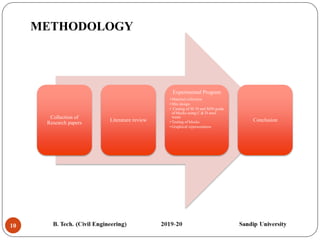
METHODOLOGY
Collection of
Research papers
Literature review
Experimental Program
• Material collection
• Mix design
• Casting of M 30 and M50 grade
of blocks using C & D steel
waste
• Testing of blocks
• Graphical representation
Conclusion
11
REFERENCES
1. A. Panimayam [et al.] Utilisation of Waste Plastics as a Replacement of Coarse Aggregate in Paver Blocks [Journal] //
International Journal of ChemTech Research. - Coimbatore, India : Sai Scientific Communications
Research, 2017. - 8 : Vol. 10. - pp. 211-218. - ISSN: 0974-4290.
2. Aamar Danish, Mohammad Ali Mosaberpanah and Muhammad Usama Salim Past and present
techniques of self-healing in cementitious materials: A critical review on efficiency of implemented
treatments [Journal] // Journal of Materials Research and Technology. - North Cyprus, Turkey : Elsevier,
2020. - 9 : Vol. 3. - pp. 6883–6899.
3. Agrawal Nikhil S [et al.] Review Paper on Sustainable Use of Debris in Paver Blocks [Journal] // Indian
Journal of Applied Research. - Pune : [s.n.], December 2015. - 12 : Vol. 5. - pp. 243-245. - ISSN - 2249-
555X.
4. Albayrak Gulcag and Albayrak Ugur Investigation of Ready Mixed Concrete Transportation Problem
Using Linear Programming and Genetic Algorithm [Journal] // Civil Engineering Journal. - Turkey : [s.n.],
October 2016. - 10 : Vol. 2. - pp. 491-496.
5. Anastasiou E K, Liapis A and Papachristoforou M Life Cycle Assessment of Concrete Products for
Special Applications Containing EAF Slag [Journal] // Procedia Environmental Sciences. - Thessaloniki,
Greece : Elsevier, 2017. - pp. 469-476.
6. G Anusha [et al.] Experimental Study on Properties of Concrete Paver Blocks by Partially Replacing
Cement with Granite Powder [Conference] // IOP Conf. Series: Materials Science and Engineering. - [s.l.] :
IOP Publishing, 2021.
7. Gautam Pradeep Kumar [et al.] Sustainable use of waste in flexible pavement: A review [Journal] //
Construction and Building Materials. - Jaipur : Elsevier, 2018. - Vol. 180. - pp. 239-253.
8. Gawatre Dinesh W [et al.] To Improve Mechanical Properties of Concrete Paver Blocks [Journal] // IOSR
Journal of Mechanical and Civil Engineering. - June 2017. - 3 : Vol. 14. - pp. 147-151. - ISSN: 2320-334X.
12
REFERENCES
8. Gencel Osman [et al.] Properties of concrete paving blocks made with waste marble [Journal] // Journal of Cleaner Production. -
Turkey : Elsevier, 2012. - pp. 62-70.
9. Hallale Shivkumar, Swami Suraj and Londhe Vikas Utilization of demolished bulding waste in paving block with coir fibre
[Journal]. - Akurdi, Maharashtra, India : [s.n.], 2017. - 3 : Vol. 3. - pp. 2395-4396.
10.Iheanyichukwu Chigozirim G., Umar Sadiq A. and Prince C. Ekwueme A REVIEW ON SELF-HEALING CONCRETE USING
BACTERIA [Journal] // Sustainable Structure and Materials. - 2018. - 2 : Vol. 1. - pp. 12-20.
11.Indian Sandard of Precast Concrete Blocks for Paving - Specification (IS15658) [Report] = IS 15658 / Bureau of Indian Standards ;
Flooring, Wall Finishing and Roofing Sectional Committee, CED 5. - New Delhi : [s.n.], 2006. - pp. 1 - 27.
12.Indra Jaya and Rambe Andy Putra Analysis Comparison of Cost and Time of Concrete and Paving Block Jobs in the
Implementation of Village Road Development using Village fund Project [Conference] // In Proceedings of the International
Conference of Science, Technology, Engineering, Environmental and Ramification Researches. - Indonesia : Science and Technology
Publications. - pp. 368-374. - ISBN: 978-989-758-449-7.
13.Janani R and Bharani Priya A Study of Paver Blocks from Construction wastes [Journal] // Journal of Applied Science and
Computations. - Tamilnadu, India : [s.n.], December 2018. - 12 : Vol. 5. - pp. 1186-1190. - ISSN NO: 1076-5131.
14.Jaya Indra and Rambe Andy Putra Analysis Comparison of Cost and Time of Concrete and Paving Block Jobs in the
Implementation of Village Road Development using Village Fund Budget [Conference] // International Conference of Science,
Technology, Engineering, Environmental and Ramification Researches (ICOSTEERR 2018). - Indonesia : SCITEPRESS – Science
and Technology Publications Ltd, 2018. - pp. 368-374. - ISBN: 978-989-758-449-7.
15.Kirubagharan P. [et al.] Experimental Study on Behaviour of Pave rBlock using Crushed Rubber Powder [Journal] // International
Journal of Civil Engineering and Technology (IJCIET). - [s.l.] : IAEME, Scopus Indexed, March 2017. - 3 : Vol. 8. - pp. 582-589. -
ISSN Print: 0976-6308.
16.Lavanya Ganesan and Chippymol James Strength characteristics of Concrete Paver Blocks embedded with PET Fibres [Journal] //
International Journal of Engineering Research And Management (IJERM). - September 2019. - 9 : Vol. 6. - pp. 62-64. - ISSN: 2349-
2058.
THANK YOU !
13

Paver blocks.pptx

  • 1.
    Presentation On Project Entitled “Manufacturing ofPaver Blocks using Construction and Demolition Wastes” Guided by- Presented by- Prof. XYZ Nirmal ( XYZ) Prof.(Civil Engg. Dept.) PRN : 170101161007 B. TECH CIVIL ENGG. DEPARTMENT OF CIVIL ENGINEERING SCHOOL OF ENGINEERING AND TECHNOLOGY SANDIP UNIVERSITY At Post Mahiravani, Trimbak Road, Tal. & Dist. Nashik - 422213 1
  • 2.
    2 CONTENT • Introduction • Objectives •Problem Identification • Literature Review • Methodology • References
  • 3.
    3 INTRODUCTION • Construction anddemolition waste is the waste which is generated from various activities like residential construction work, road work, renovation work demolition, etc. • Recycled coarse aggregates are obtained by crushing of concrete waste from demolition of structural components in many structures such as old buildings, bridges, concrete pavements etc. • The rapid industrialization and urbanization resulted in large quantity of waste generation and in turn, environmental degradation. • Recycling of solid waste into a sustainable construction material with optimum mix proportion is the global need to reduce its adverse environmental impacts
  • 4.
    4 OBJECTIVES 1. To makean attempt to use construction and demolition waste in manufacturing so as to minimize that waste from the society. 2. To minimize the burden of construction and demolished waste on environment and dumping issue. 3. To increase the density of the block thereby achieving a good compressive strength. 4. Identifying the uses and applications of these paver blocks with respect to their strength.
  • 5.
    PROBLEM IDENTIFICATION 5 ⚫ Indeveloping cities, there is generation of quality C & D waste from repairs and rehabilitation of structures & aesthetic modification. ⚫ There is need to reuse this huge amount of waste generated.
  • 6.
    NEED OF STUDY 6 ⚫The cost reduction is the major need in today's industry so as to achieve economy on larger scale use. ⚫ Now a days, waste reduction has just became a myth, whether it is a wastewater sludge or construction and demotion waste. If this study gets a way through, the large scale demolition waste can be reused. ⚫ If the interlocking paver blocks are used in the construction procedure, the construction time reduction leading to the aim of providing shelter to the maximum crowd will be a boon to society.
  • 7.
    LITERATURE REVIEW 7 SR. NO. AUTHOR OF PAPER TITLEDESCRIPTION 1 (Pattnaik Truptimala [et al., 2018) Manufacture of interlocking concrete paving blocks with flyash and glass powder • In the paper, concrete paving blocks may be produced with locally available cement, aggregates, fly ash and waste glass powder as the mineral admixture. •The study indicated that fly ash and waste glass powder can effectively be used as cement replacement without substantial change in strength 2. (Gencel Osman [et al.]., 2012) Properties of concrete paving blocks made with waste marble • This paper shows the use of materials like Portland Cement, Dry and clean natural river sand, crushed sand and crushed stone whereas Crushed waste marble and dust used were obtained from marble processing plants in Turkey. • This paper concluded that their method of incorporating marble waste is only limited by incidental costs 3. (Wang Xinyi, Chin Chee Seong and Xia jun, 2019) Material Characterization for Sustainable Concrete Paving Blocks • This Paper aims to study the property variations of sustainable concrete paving block using different contents of construction wastes. • Mixing crushed glass in the concrete paving blocks as a type of coarse aggregates can improve the blocks’ strength and decrease the blocks’ water absorption
  • 8.
    LITERATURE REVIEW 8 SR. NO. AUTHOR OF PAPER TITLEDESCRIPTION 4 (Yeole R C and Varma M. B., 2014) Comparison of Mix Designs of Paver Blocks using Waste Rounded Steel Aggregates and Rubber Pad • In this paper, a parametric experimental study for producing paving blocks using w*aste steel aggregates. •Test results show that combination of using rubber pads and adding various percentages of waste steel aggregates in paver blocks gives upto 50% more impact strength than ordinary paver blocks. 5. (Velumani P and Senthilkumar S , 2018) Production of sludge- incorporated paver blocks for efficient waste management • This paper had made an attempt to manufacture paver blocks incorporating textile effluent treatment plant sludge and hypo sludge • The experiment consequence reveals that the compression strength of the concrete paver is significantly lower at room temperature after 150°C than the concrete paver (27°C). • The amount of water absorption increases significantly as granite powder is replaced with cement. 6. (Solouki Abbas, Tataranni Piergiorgio and Sangiorgi Cesare, 2022) Mixture Optimization of Concrete Paving Blocks Containing Waste Silt • This paper focuses on mix design optimization and production of concrete paving blocks containing high amounts of waste silt resulting from the aggregate production process • Overall, the produced concrete paving blocks showed promising properties for future applications
  • 9.
    LITERATURE REVIEW 9 SR. NO . AUTHOR OF PAPER TITLEDESCRIPTION 7 (Kirubagharan, et al., 2017) Experimental Study on Behaviour of Pave rBlock using Crushed Rubber Powder •In this paper the rubber powder is used as a cement replacing material in Concrete paver blocks • The rubber pads are used as a coarse aggregate and metal bearings are used as fine aggregate. •As the result of this, The compressive and impact strength of paver have been increased upto 50%. 8. Madurwar Mangesh, Sakhare Vishakha and Ralegaonkar Rahul, 2015) Multi objective optimization of mix proportion for a sustainable construction material • The present paper aimed at optimization of the mix proportion for designing the sustainable material. • Sugarcane bagasse ash (SBA) was identified as the principal raw material • The embodied energy was estimated to be 47 % and 5% lower than the conventional burnt clay and fly ash bricks. 9. (Vila P., Pereyra M. N. and Gutiérrez Á. in), 2017 Compressive strength concrete paving blocks. Results leading to validate the test in half-unit specimens • In this paper, with the purpose of validating the compressive strength test result on half-unit specimen for concrete paving blocks quality control, experimental results on half-unit and whole unit blocks from 24 production batches were analyzed. • The compressive strength results in whole unit was greater than in half-unit specimen
  • 10.
    10 METHODOLOGY Collection of Research papers Literaturereview Experimental Program • Material collection • Mix design • Casting of M 30 and M50 grade of blocks using C & D steel waste • Testing of blocks • Graphical representation Conclusion
  • 11.
    11 REFERENCES 1. A. Panimayam[et al.] Utilisation of Waste Plastics as a Replacement of Coarse Aggregate in Paver Blocks [Journal] // International Journal of ChemTech Research. - Coimbatore, India : Sai Scientific Communications Research, 2017. - 8 : Vol. 10. - pp. 211-218. - ISSN: 0974-4290. 2. Aamar Danish, Mohammad Ali Mosaberpanah and Muhammad Usama Salim Past and present techniques of self-healing in cementitious materials: A critical review on efficiency of implemented treatments [Journal] // Journal of Materials Research and Technology. - North Cyprus, Turkey : Elsevier, 2020. - 9 : Vol. 3. - pp. 6883–6899. 3. Agrawal Nikhil S [et al.] Review Paper on Sustainable Use of Debris in Paver Blocks [Journal] // Indian Journal of Applied Research. - Pune : [s.n.], December 2015. - 12 : Vol. 5. - pp. 243-245. - ISSN - 2249- 555X. 4. Albayrak Gulcag and Albayrak Ugur Investigation of Ready Mixed Concrete Transportation Problem Using Linear Programming and Genetic Algorithm [Journal] // Civil Engineering Journal. - Turkey : [s.n.], October 2016. - 10 : Vol. 2. - pp. 491-496. 5. Anastasiou E K, Liapis A and Papachristoforou M Life Cycle Assessment of Concrete Products for Special Applications Containing EAF Slag [Journal] // Procedia Environmental Sciences. - Thessaloniki, Greece : Elsevier, 2017. - pp. 469-476. 6. G Anusha [et al.] Experimental Study on Properties of Concrete Paver Blocks by Partially Replacing Cement with Granite Powder [Conference] // IOP Conf. Series: Materials Science and Engineering. - [s.l.] : IOP Publishing, 2021. 7. Gautam Pradeep Kumar [et al.] Sustainable use of waste in flexible pavement: A review [Journal] // Construction and Building Materials. - Jaipur : Elsevier, 2018. - Vol. 180. - pp. 239-253. 8. Gawatre Dinesh W [et al.] To Improve Mechanical Properties of Concrete Paver Blocks [Journal] // IOSR Journal of Mechanical and Civil Engineering. - June 2017. - 3 : Vol. 14. - pp. 147-151. - ISSN: 2320-334X.
  • 12.
    12 REFERENCES 8. Gencel Osman[et al.] Properties of concrete paving blocks made with waste marble [Journal] // Journal of Cleaner Production. - Turkey : Elsevier, 2012. - pp. 62-70. 9. Hallale Shivkumar, Swami Suraj and Londhe Vikas Utilization of demolished bulding waste in paving block with coir fibre [Journal]. - Akurdi, Maharashtra, India : [s.n.], 2017. - 3 : Vol. 3. - pp. 2395-4396. 10.Iheanyichukwu Chigozirim G., Umar Sadiq A. and Prince C. Ekwueme A REVIEW ON SELF-HEALING CONCRETE USING BACTERIA [Journal] // Sustainable Structure and Materials. - 2018. - 2 : Vol. 1. - pp. 12-20. 11.Indian Sandard of Precast Concrete Blocks for Paving - Specification (IS15658) [Report] = IS 15658 / Bureau of Indian Standards ; Flooring, Wall Finishing and Roofing Sectional Committee, CED 5. - New Delhi : [s.n.], 2006. - pp. 1 - 27. 12.Indra Jaya and Rambe Andy Putra Analysis Comparison of Cost and Time of Concrete and Paving Block Jobs in the Implementation of Village Road Development using Village fund Project [Conference] // In Proceedings of the International Conference of Science, Technology, Engineering, Environmental and Ramification Researches. - Indonesia : Science and Technology Publications. - pp. 368-374. - ISBN: 978-989-758-449-7. 13.Janani R and Bharani Priya A Study of Paver Blocks from Construction wastes [Journal] // Journal of Applied Science and Computations. - Tamilnadu, India : [s.n.], December 2018. - 12 : Vol. 5. - pp. 1186-1190. - ISSN NO: 1076-5131. 14.Jaya Indra and Rambe Andy Putra Analysis Comparison of Cost and Time of Concrete and Paving Block Jobs in the Implementation of Village Road Development using Village Fund Budget [Conference] // International Conference of Science, Technology, Engineering, Environmental and Ramification Researches (ICOSTEERR 2018). - Indonesia : SCITEPRESS – Science and Technology Publications Ltd, 2018. - pp. 368-374. - ISBN: 978-989-758-449-7. 15.Kirubagharan P. [et al.] Experimental Study on Behaviour of Pave rBlock using Crushed Rubber Powder [Journal] // International Journal of Civil Engineering and Technology (IJCIET). - [s.l.] : IAEME, Scopus Indexed, March 2017. - 3 : Vol. 8. - pp. 582-589. - ISSN Print: 0976-6308. 16.Lavanya Ganesan and Chippymol James Strength characteristics of Concrete Paver Blocks embedded with PET Fibres [Journal] // International Journal of Engineering Research And Management (IJERM). - September 2019. - 9 : Vol. 6. - pp. 62-64. - ISSN: 2349- 2058.
  • 13.