STUDIES ON SELF HEALING SUSTAINABLE
CONCRETE USING BACTERIAL CARBONATE
PRECIPITATE
Batch No 7 Guided by
Project Team Members Dr.S.Jayakumar
G.Bharanedharan-14TA0207 Prof. & Head(Civil
Department)
S.Logesh -14TA0225 SMVEC.
A.V.K.Nishok -14TA0232
R.Rajkumar -14TA0239
B.Tech IV year.
1
Contents
 Introduction
 Need for study
 Objective
 Scope
 Critical Summary
 Work methodology
 Results
 Conclusion
 Reference slide
2
INTRODUCTION
Concrete is the most essential material used in Construction.
But it is weak in tension so it cracks due to sustained loads and also
due to various other reasons.
Therefore Bacterial induced Calcium Carbonate precipitation is
proposed as a environment friendly crack remediation and also
increases the compressive strength of the material.
3
NEED FOR STUDY
• Nowadays the most important technique used to seal cracks is
Epoxy injection, Dry packing, Stitching etc.
• But these methods especially Epoxy injection turned out to be
expensive and harmful to Environment.
• And these methods don’t work well on wet surfaces either.
• Hence using microorganisms may lead a path for efficient and
ecofriendly treatment of cracks.
4
OBJECTIVE
• To study the effectiveness of the bio deposition treatment on
Concrete using various microorganisms.
• To study the effects of microorganisms on compressive
strength of Concrete.
• To gain knowledge on efficiency of bacterial treatments.
5
SCOPE
6
• Since this method proved out to be Eco-friendly, it can bring a
wide revolution in the future.
• It prevents the cracks in concrete at early stage so this can be
used in large scale construction projects with increased
durability.
• Reduces the corrosion of steel and thus improves the
durability of steel reinforced concrete.
Critical Summary
 Compressive strength increases and water absorption decreases
with increase in concentration of bacteria.
 Thus durability of the concrete may increase.
 This method is proved to be Eco-Friendly because the oxygen
is consumed by the bacteria to convert Calcium to
limestone,which prevent corrosion of steel due to cracks.
 Geopolymer coating produced from metakoalin is required to
protect the encapsuled bacteria.
7
 It also reduces the chloride transmission in concrete.
 Light weight aggregate technique is efficient then other carrier
techniques at later stages.
 Maximum compressive strength is attained at 10^5/ml
concentration of bacteria.
 Decrease in permeability in case of autoclave bacteria.
 Using carrier for protection of bacteria is efficient then direct
application of bacteria.
 Flexural strength is increased by 1% incase of LWA technique.
8
9
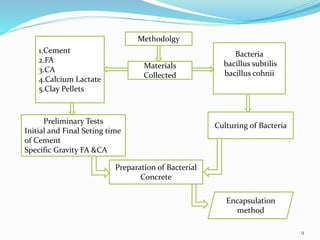
Methodolgy
Materials
Collected
Bacteria
bacillus subtilis
bacillus cohnii
1.Cement
2.FA
3.CA
4.Calcium Lactate
5.Clay Pellets
Preliminary Tests
Initial and Final Seting time
of Cement
Specific Gravity FA &CA
Culturing of Bacteria
Preparation of Bacterial
Concrete
Encapsulation
method
10
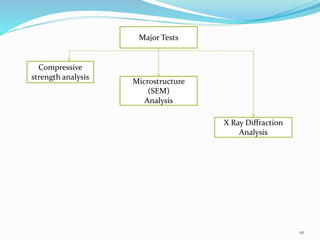
Compressive
strength analysis
Microstructure
(SEM)
Analysis
Major Tests
X Ray Diffraction
Analysis
Working Progress
Selection of Bacteria
There are various types of Bacteria can be used in concrete such as
B.subtilis,B.pasteurii,B.cohnii,B.licheniformis,etc.
Here in India we came across the availabity of B.subtilis,B.cohnii.
So we have selected B.subtilis and B.cohnii.
We have seleceted B.subtilis since this bacteria produces Calcium Carbonate.
This is formally known as Hay bacillus or grass bacillus and it is a gram positive
and catalane positive bacterium.
B.subtilis is a rod shaped bacteria and this form a tough, protective endo-spores,
allowing it to tollerate extreme environmental conditions.
11
Encapsulation method
By encapsulation method the bacteria and its food i.e. calcium lactate, are placed
inside treated clay pellets and concrete is prepared.
About 6% of the clay pellets are added for making bacterial concrete.
When concrete structures are made with bacterial concrete, when the crack
occurs in the structure and clay pellets are broken.
The bacteria germinate and eat down the calcium lactate and produce limestone,
which hardens and thus sealing the crack.
Minor cracks about 0.5mm width can be treated by using bacterial concrete.
12
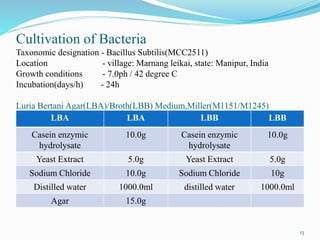
Cultivation of Bacteria
Taxonomic designation - Bacillus Subtilis(MCC2511)
Location - village: Marnang leikai, state: Manipur, India
Growth conditions - 7.0ph / 42 degree C
Incubation(days/h) - 24h
Luria Bertani Agar(LBA)/Broth(LBB) Medium,Miller(M1151/M1245)
13
LBA LBA LBB LBB
Casein enzymic
hydrolysate
10.0g Casein enzymic
hydrolysate
10.0g
Yeast Extract 5.0g Yeast Extract 5.0g
Sodium Chloride 10.0g Sodium Chloride 10g
Distilled water 1000.0ml distilled water 1000.0ml
Agar 15.0g
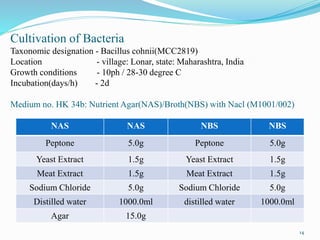
Cultivation of Bacteria
Taxonomic designation - Bacillus cohnii(MCC2819)
Location - village: Lonar, state: Maharashtra, India
Growth conditions - 10ph / 28-30 degree C
Incubation(days/h) - 2d
Medium no. HK 34b: Nutrient Agar(NAS)/Broth(NBS) with Nacl (M1001/002)
14
NAS NAS NBS NBS
Peptone 5.0g Peptone 5.0g
Yeast Extract 1.5g Yeast Extract 1.5g
Meat Extract 1.5g Meat Extract 1.5g
Sodium Chloride 5.0g Sodium Chloride 5.0g
Distilled water 1000.0ml distilled water 1000.0ml
Agar 15.0g
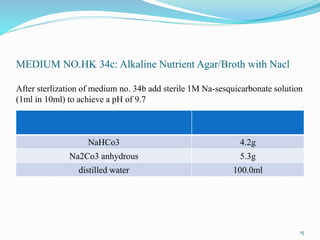
MEDIUM NO.HK 34c: Alkaline Nutrient Agar/Broth with Nacl
After sterlization of medium no. 34b add sterile 1M Na-sesquicarbonate solution
(1ml in 10ml) to achieve a pH of 9.7
15
NaHCo3 4.2g
Na2Co3 anhydrous 5.3g
distilled water 100.0ml
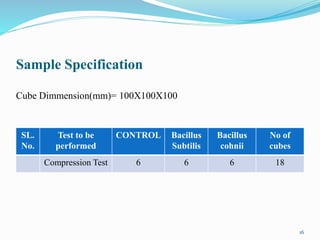
Sample Specification
Cube Dimmension(mm)= 100X100X100
16
SL.
No.
Test to be
performed
CONTROL Bacillus
Subtilis
Bacillus
cohnii
No of
cubes
Compression Test 6 6 6 18
RESULTS
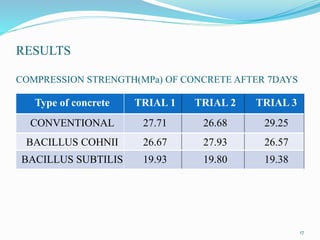
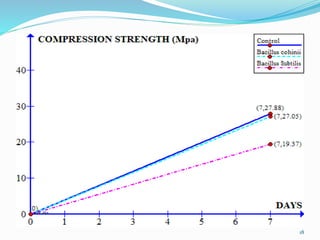
COMPRESSION STRENGTH(MPa) OF CONCRETE AFTER 7DAYS
17
COMPRESSIVE STRENGTH(MPa) OF CONCRETE AFTER 7 DAYS
Type of concrete TRIAL 1 TRIAL 2 TRIAL 3
CONVENTIONAL 27.71 26.68 29.25
BACILLUS COHNII 26.67 27.93 26.57
BACILLUS SUBTILIS 19.93 19.80 19.38
18
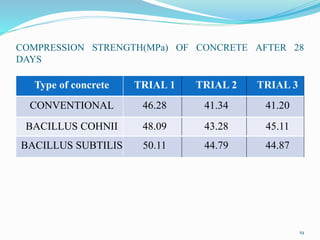
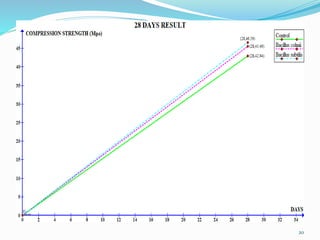
COMPRESSION STRENGTH(MPa) OF CONCRETE AFTER 28
DAYS
19
Type of concrete TRIAL 1 TRIAL 2 TRIAL 3
CONVENTIONAL 46.28 41.34 41.20
BACILLUS COHNII 48.09 43.28 45.11
BACILLUS SUBTILIS 50.11 44.79 44.87
20
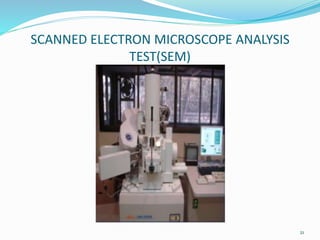
SCANNED ELECTRON MICROSCOPE ANALYSIS
TEST(SEM)
21
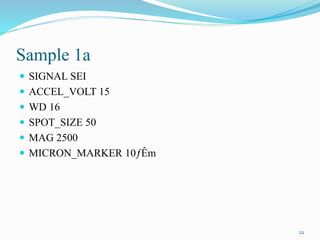
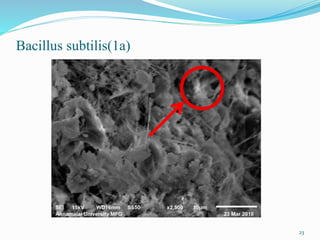
Sample 1a
 SIGNAL SEI
 ACCEL_VOLT 15
 WD 16
 SPOT_SIZE 50
 MAG 2500
 MICRON_MARKER 10ƒÊm
22
Bacillus subtilis(1a)
23
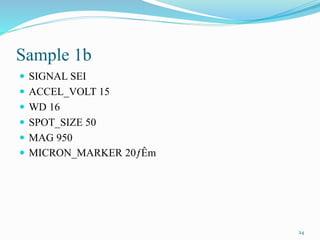
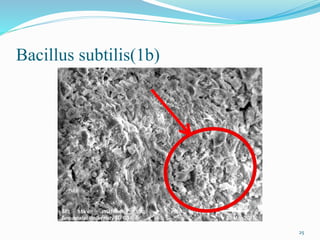
Sample 1b
 SIGNAL SEI
 ACCEL_VOLT 15
 WD 16
 SPOT_SIZE 50
 MAG 950
 MICRON_MARKER 20ƒÊm
24
Bacillus subtilis(1b)
25
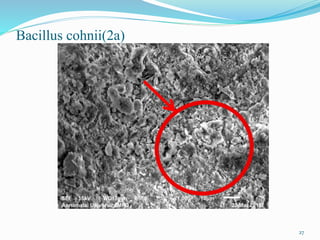
Sample 2a
 SIGNAL SEI
 ACCEL_VOLT 15
 WD 17mm
 SPOT_SIZE 50
 MAG 1000
 MICRON_MARKER 10ƒÊm
26
Bacillus cohnii(2a)
27
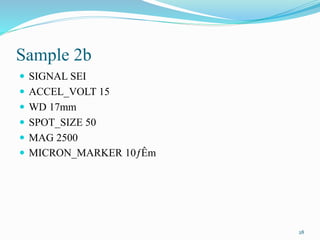
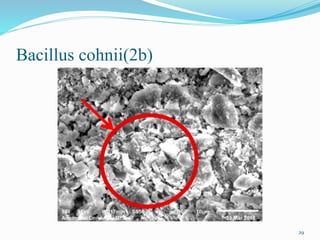
Sample 2b
 SIGNAL SEI
 ACCEL_VOLT 15
 WD 17mm
 SPOT_SIZE 50
 MAG 2500
 MICRON_MARKER 10ƒÊm
28
Bacillus cohnii(2b)
29
Conclusion
 Specimens incorporated with bacteria resulted in lower compressive strength at
early age of 7 days.
 But at age of 28 days, the microbial induced bacteria showed a significant increase
in compressive strength then controlled specimens.
 Concrete incorporated with bacillus subtilis results in higher compressive strength
then bacillus cohnii.
 Specimens with bacillus subtilis showed 11℅ increase in compressive strength then
control.
 Although both the bacteria resulted in self healing of cracks after 28 days of curing.
 Thus bacillus subtilis turned out to be efficient then bacillus cohnii on all the
considered properties.
30
Reference
[1] Wasim Khaliq, Muhammad Basit Ehsan, Crack healin in concrete using
various bio influenced self-healing techniques, Construction and Building
Materials 102 (2016) 349–357
[2] Henk M. Jonkers, Arjan Thijssen, Gerard Muyzer, Oguzhan Copuroglu,
Erik Schlangen, Application of bacteria as self-healing agent for the
development of sustainable concrete, Ecological Engineering 36 (2010)
230–235.
[3] Mian Luo, Chun-xiang Qian, Rui-yang Li, Factors affecting crack
repairing capacity of bacteria-based self-healing concrete, Construction
and Building Materials 87 (2015) 1–7
31
[4]S. A. L. de Koster, R. M. Mors, H. W. Nugteren, H.M. Jonkers,G.M.H.
Meestersa, J. R. van Ommena, Geopolymer coating of bacteria-
containing granules for use in self- healing concrete, Procedia
Engineering 102 ( 2015 ) 475 – 484.
[5]S.A. Abo-El-Enein , A.H. Ali b, Fatma N. Talkhan , H.A. Abdel- Gawwad ,
Application of microbial biocementation to improve the physico-mechanical
properties of cement mortar, HBRC Journal (2013)9,36–40.
[6]Navneet Chahal, Rafat Siddique, Anita Rajor , Influence of bacteria on the
compressive strength, water absorption and rapid chloride permeability of
fly ash concrete, Construction and Building Materials 28 (2012) 351-356
32
[7]Mayur Shantilal Vekariya1, Prof. Jayeshkumar Pitroda, Bacterial Concrete: New
Era For Construction Industry, International Journal of Engineering Trends and
Technology (IJETT) – Volume 4 Issue 9- Sep 2013.
[8]P. Ghosh, S. Mandal, B.D. Chattopadhyay, S. Pal, Use of microorganism to
improve the strength of cement mortar, Cement and Concrete Research 35
(2005) 1980 – 1983.
[9]S.W. Tang, Y. Yao, C. Andrade,Recent durability studies on concrete
structure, Cement and Concrete Research(2015).
[10]Y. C. Guo, X. Wang, Z. Yan & H. Zhong, Current progress on biological self-
healing concrete, ISSN: 1432-8917 (Print) 1433- 075X.
33
[11] N. De Belie & J. Wang, Bacteria-based repair and self-healing o
concrete, ISSN: 2165-0373 (Print) 2165-0381.
[12] Jing Xu, Wu Ya, Multiscale mechanical quantification of self-healing
concrete incorporating non-ureolytic bacteria-based healing agent,
Cement and Concrete Research 64 (2014) 1–10
[13] J.Y. Wang a,b, H. Soens c, W. Verstraete b, N. De Belie, Self-healing
concrete by use of microencapsulated bacterial spores, Cement and
Concrete Research 56 (2014) 139–152.
[14] Peter Duxson, John L. Provis, Grant C. Lukey, Jannie S.J. van
Deventer, The role of inorganic polymer technology in the
developmentof ‘green concrete’, Cement and Concrete Research 37
(2007) 1590–1597.
[15] H.K. Kim, S.J. Park, J.I. Han, H.K. Lee, Microbially mediated
calcium carbonate precipitation on normal and lightweight concrete,
Construction and Building Materials 38 (2013) 1073–1082.
34
...Thank You...
35

Self healing concrete

  • 1.
    STUDIES ON SELFHEALING SUSTAINABLE CONCRETE USING BACTERIAL CARBONATE PRECIPITATE Batch No 7 Guided by Project Team Members Dr.S.Jayakumar G.Bharanedharan-14TA0207 Prof. & Head(Civil Department) S.Logesh -14TA0225 SMVEC. A.V.K.Nishok -14TA0232 R.Rajkumar -14TA0239 B.Tech IV year. 1
  • 2.
    Contents  Introduction  Needfor study  Objective  Scope  Critical Summary  Work methodology  Results  Conclusion  Reference slide 2
  • 3.
    INTRODUCTION Concrete is themost essential material used in Construction. But it is weak in tension so it cracks due to sustained loads and also due to various other reasons. Therefore Bacterial induced Calcium Carbonate precipitation is proposed as a environment friendly crack remediation and also increases the compressive strength of the material. 3
  • 4.
    NEED FOR STUDY •Nowadays the most important technique used to seal cracks is Epoxy injection, Dry packing, Stitching etc. • But these methods especially Epoxy injection turned out to be expensive and harmful to Environment. • And these methods don’t work well on wet surfaces either. • Hence using microorganisms may lead a path for efficient and ecofriendly treatment of cracks. 4
  • 5.
    OBJECTIVE • To studythe effectiveness of the bio deposition treatment on Concrete using various microorganisms. • To study the effects of microorganisms on compressive strength of Concrete. • To gain knowledge on efficiency of bacterial treatments. 5
  • 6.
    SCOPE 6 • Since thismethod proved out to be Eco-friendly, it can bring a wide revolution in the future. • It prevents the cracks in concrete at early stage so this can be used in large scale construction projects with increased durability. • Reduces the corrosion of steel and thus improves the durability of steel reinforced concrete.
  • 7.
    Critical Summary  Compressivestrength increases and water absorption decreases with increase in concentration of bacteria.  Thus durability of the concrete may increase.  This method is proved to be Eco-Friendly because the oxygen is consumed by the bacteria to convert Calcium to limestone,which prevent corrosion of steel due to cracks.  Geopolymer coating produced from metakoalin is required to protect the encapsuled bacteria. 7
  • 8.
     It alsoreduces the chloride transmission in concrete.  Light weight aggregate technique is efficient then other carrier techniques at later stages.  Maximum compressive strength is attained at 10^5/ml concentration of bacteria.  Decrease in permeability in case of autoclave bacteria.  Using carrier for protection of bacteria is efficient then direct application of bacteria.  Flexural strength is increased by 1% incase of LWA technique. 8
  • 9.
    9 Methodolgy Materials Collected Bacteria bacillus subtilis bacillus cohnii 1.Cement 2.FA 3.CA 4.CalciumLactate 5.Clay Pellets Preliminary Tests Initial and Final Seting time of Cement Specific Gravity FA &CA Culturing of Bacteria Preparation of Bacterial Concrete Encapsulation method
  • 10.
  • 11.
    Working Progress Selection ofBacteria There are various types of Bacteria can be used in concrete such as B.subtilis,B.pasteurii,B.cohnii,B.licheniformis,etc. Here in India we came across the availabity of B.subtilis,B.cohnii. So we have selected B.subtilis and B.cohnii. We have seleceted B.subtilis since this bacteria produces Calcium Carbonate. This is formally known as Hay bacillus or grass bacillus and it is a gram positive and catalane positive bacterium. B.subtilis is a rod shaped bacteria and this form a tough, protective endo-spores, allowing it to tollerate extreme environmental conditions. 11
  • 12.
    Encapsulation method By encapsulationmethod the bacteria and its food i.e. calcium lactate, are placed inside treated clay pellets and concrete is prepared. About 6% of the clay pellets are added for making bacterial concrete. When concrete structures are made with bacterial concrete, when the crack occurs in the structure and clay pellets are broken. The bacteria germinate and eat down the calcium lactate and produce limestone, which hardens and thus sealing the crack. Minor cracks about 0.5mm width can be treated by using bacterial concrete. 12
  • 13.
    Cultivation of Bacteria Taxonomicdesignation - Bacillus Subtilis(MCC2511) Location - village: Marnang leikai, state: Manipur, India Growth conditions - 7.0ph / 42 degree C Incubation(days/h) - 24h Luria Bertani Agar(LBA)/Broth(LBB) Medium,Miller(M1151/M1245) 13 LBA LBA LBB LBB Casein enzymic hydrolysate 10.0g Casein enzymic hydrolysate 10.0g Yeast Extract 5.0g Yeast Extract 5.0g Sodium Chloride 10.0g Sodium Chloride 10g Distilled water 1000.0ml distilled water 1000.0ml Agar 15.0g
  • 14.
    Cultivation of Bacteria Taxonomicdesignation - Bacillus cohnii(MCC2819) Location - village: Lonar, state: Maharashtra, India Growth conditions - 10ph / 28-30 degree C Incubation(days/h) - 2d Medium no. HK 34b: Nutrient Agar(NAS)/Broth(NBS) with Nacl (M1001/002) 14 NAS NAS NBS NBS Peptone 5.0g Peptone 5.0g Yeast Extract 1.5g Yeast Extract 1.5g Meat Extract 1.5g Meat Extract 1.5g Sodium Chloride 5.0g Sodium Chloride 5.0g Distilled water 1000.0ml distilled water 1000.0ml Agar 15.0g
  • 15.
    MEDIUM NO.HK 34c:Alkaline Nutrient Agar/Broth with Nacl After sterlization of medium no. 34b add sterile 1M Na-sesquicarbonate solution (1ml in 10ml) to achieve a pH of 9.7 15 NaHCo3 4.2g Na2Co3 anhydrous 5.3g distilled water 100.0ml
  • 16.
    Sample Specification Cube Dimmension(mm)=100X100X100 16 SL. No. Test to be performed CONTROL Bacillus Subtilis Bacillus cohnii No of cubes Compression Test 6 6 6 18
  • 17.
    RESULTS COMPRESSION STRENGTH(MPa) OFCONCRETE AFTER 7DAYS 17 COMPRESSIVE STRENGTH(MPa) OF CONCRETE AFTER 7 DAYS Type of concrete TRIAL 1 TRIAL 2 TRIAL 3 CONVENTIONAL 27.71 26.68 29.25 BACILLUS COHNII 26.67 27.93 26.57 BACILLUS SUBTILIS 19.93 19.80 19.38
  • 18.
  • 19.
    COMPRESSION STRENGTH(MPa) OFCONCRETE AFTER 28 DAYS 19 Type of concrete TRIAL 1 TRIAL 2 TRIAL 3 CONVENTIONAL 46.28 41.34 41.20 BACILLUS COHNII 48.09 43.28 45.11 BACILLUS SUBTILIS 50.11 44.79 44.87
  • 20.
  • 21.
    SCANNED ELECTRON MICROSCOPEANALYSIS TEST(SEM) 21
  • 22.
    Sample 1a  SIGNALSEI  ACCEL_VOLT 15  WD 16  SPOT_SIZE 50  MAG 2500  MICRON_MARKER 10ƒÊm 22
  • 23.
  • 24.
    Sample 1b  SIGNALSEI  ACCEL_VOLT 15  WD 16  SPOT_SIZE 50  MAG 950  MICRON_MARKER 20ƒÊm 24
  • 25.
  • 26.
    Sample 2a  SIGNALSEI  ACCEL_VOLT 15  WD 17mm  SPOT_SIZE 50  MAG 1000  MICRON_MARKER 10ƒÊm 26
  • 27.
  • 28.
    Sample 2b  SIGNALSEI  ACCEL_VOLT 15  WD 17mm  SPOT_SIZE 50  MAG 2500  MICRON_MARKER 10ƒÊm 28
  • 29.
  • 30.
    Conclusion  Specimens incorporatedwith bacteria resulted in lower compressive strength at early age of 7 days.  But at age of 28 days, the microbial induced bacteria showed a significant increase in compressive strength then controlled specimens.  Concrete incorporated with bacillus subtilis results in higher compressive strength then bacillus cohnii.  Specimens with bacillus subtilis showed 11℅ increase in compressive strength then control.  Although both the bacteria resulted in self healing of cracks after 28 days of curing.  Thus bacillus subtilis turned out to be efficient then bacillus cohnii on all the considered properties. 30
  • 31.
    Reference [1] Wasim Khaliq,Muhammad Basit Ehsan, Crack healin in concrete using various bio influenced self-healing techniques, Construction and Building Materials 102 (2016) 349–357 [2] Henk M. Jonkers, Arjan Thijssen, Gerard Muyzer, Oguzhan Copuroglu, Erik Schlangen, Application of bacteria as self-healing agent for the development of sustainable concrete, Ecological Engineering 36 (2010) 230–235. [3] Mian Luo, Chun-xiang Qian, Rui-yang Li, Factors affecting crack repairing capacity of bacteria-based self-healing concrete, Construction and Building Materials 87 (2015) 1–7 31
  • 32.
    [4]S. A. L.de Koster, R. M. Mors, H. W. Nugteren, H.M. Jonkers,G.M.H. Meestersa, J. R. van Ommena, Geopolymer coating of bacteria- containing granules for use in self- healing concrete, Procedia Engineering 102 ( 2015 ) 475 – 484. [5]S.A. Abo-El-Enein , A.H. Ali b, Fatma N. Talkhan , H.A. Abdel- Gawwad , Application of microbial biocementation to improve the physico-mechanical properties of cement mortar, HBRC Journal (2013)9,36–40. [6]Navneet Chahal, Rafat Siddique, Anita Rajor , Influence of bacteria on the compressive strength, water absorption and rapid chloride permeability of fly ash concrete, Construction and Building Materials 28 (2012) 351-356 32
  • 33.
    [7]Mayur Shantilal Vekariya1,Prof. Jayeshkumar Pitroda, Bacterial Concrete: New Era For Construction Industry, International Journal of Engineering Trends and Technology (IJETT) – Volume 4 Issue 9- Sep 2013. [8]P. Ghosh, S. Mandal, B.D. Chattopadhyay, S. Pal, Use of microorganism to improve the strength of cement mortar, Cement and Concrete Research 35 (2005) 1980 – 1983. [9]S.W. Tang, Y. Yao, C. Andrade,Recent durability studies on concrete structure, Cement and Concrete Research(2015). [10]Y. C. Guo, X. Wang, Z. Yan & H. Zhong, Current progress on biological self- healing concrete, ISSN: 1432-8917 (Print) 1433- 075X. 33
  • 34.
    [11] N. DeBelie & J. Wang, Bacteria-based repair and self-healing o concrete, ISSN: 2165-0373 (Print) 2165-0381. [12] Jing Xu, Wu Ya, Multiscale mechanical quantification of self-healing concrete incorporating non-ureolytic bacteria-based healing agent, Cement and Concrete Research 64 (2014) 1–10 [13] J.Y. Wang a,b, H. Soens c, W. Verstraete b, N. De Belie, Self-healing concrete by use of microencapsulated bacterial spores, Cement and Concrete Research 56 (2014) 139–152. [14] Peter Duxson, John L. Provis, Grant C. Lukey, Jannie S.J. van Deventer, The role of inorganic polymer technology in the developmentof ‘green concrete’, Cement and Concrete Research 37 (2007) 1590–1597. [15] H.K. Kim, S.J. Park, J.I. Han, H.K. Lee, Microbially mediated calcium carbonate precipitation on normal and lightweight concrete, Construction and Building Materials 38 (2013) 1073–1082. 34
  • 35.