Soil Stabilisation
Presented by
M.Vijay Bhaskar Reddy
Reg. No: 11610579
Roll No: 1612-A01
Definition:
• It is the process of treating a soil
in such a manner as to
maintain ,alter or improve the
performance of the soil as a
constructing material.
• The changes in soil properties
are brought by either mixing
additives or by mechanical
blending.
Purpose of soil stabilisation:
• To improve the strength of sub-bases, base and in
case of low cost roads, as a surface courses.
• To make use of locally available soil and other
materials.
• To eliminate or improve certain undesirable
properties.
• To control dust.
• To increase load bearing capacity of soil.
• To reduce compressibility and thereby settlement.
Types of soil stabilisation
• Mechanical Stabilization
• Soil Cement Stabilization
• Soil Lime Stabilization
• Soil Bitumen Stabilization
• Stabilization by Geo-textiles
Mechanical Stabilization
• Two or more types of soils are mixed to attain a desired
property to suit a particular construction and soils are
grouped into two categories (aggregates and binders).
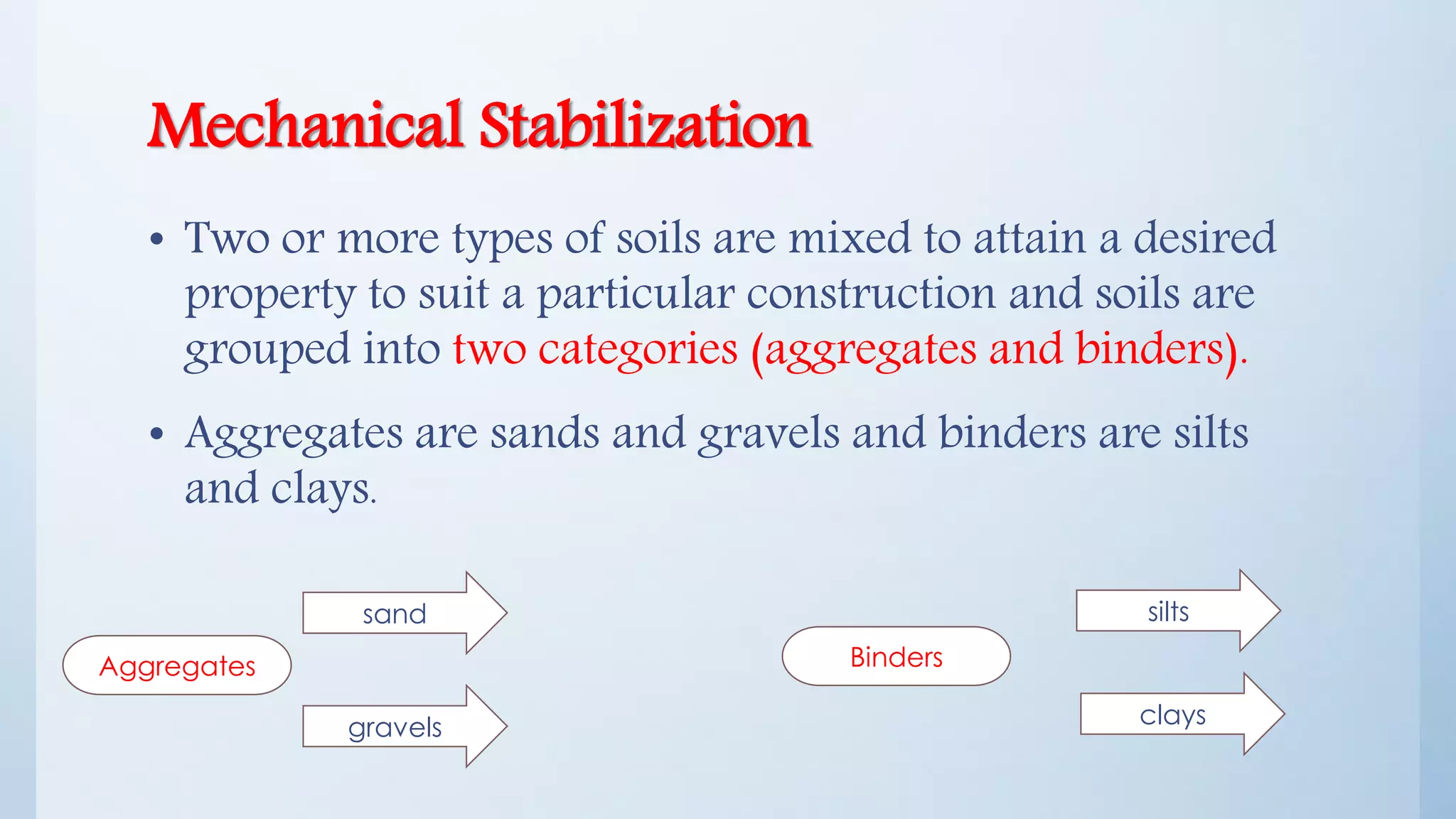
• Aggregates are sands and gravels and binders are silts
and clays.
BindersAggregates
sand
gravels
silts
clays
• When mixed together in a definite proportion, a soil
possessing required internal friction and cohesion is
obtained. When properly placed and compacted, the
material becomes mechanically stable.
Soil Cement Stabilization
• In cement stabilization pulverized soils
and cement in suitable proportion are
mixed with water and the resulting
mixture is compacted by compacting
equipment such as rollers.
• When cement hydrates and develops
strength the soil cement becomes a
hard and durable structural material.
FactorsaffectingSoilcement
• Type of Soil :Granularmaterialswithsufficientfines.Suchmaterialrequiresless
cementanddeficiencyinfinesrequiremorecementbuttheyarealsofallundersuitable
materials.
• Quality of cement :Thecementrequirementdependsuponthegradationofthesoil.
wellgradedsoilrequiresabout5%cement,whereasapoorlygraded,uniformsoilmay
requireabout9%cement.
• Quantity of water :Waterrequirementshouldbesufficientforcementhydration.
Potablewaterismostdesirable.
SoilLimeStabilization
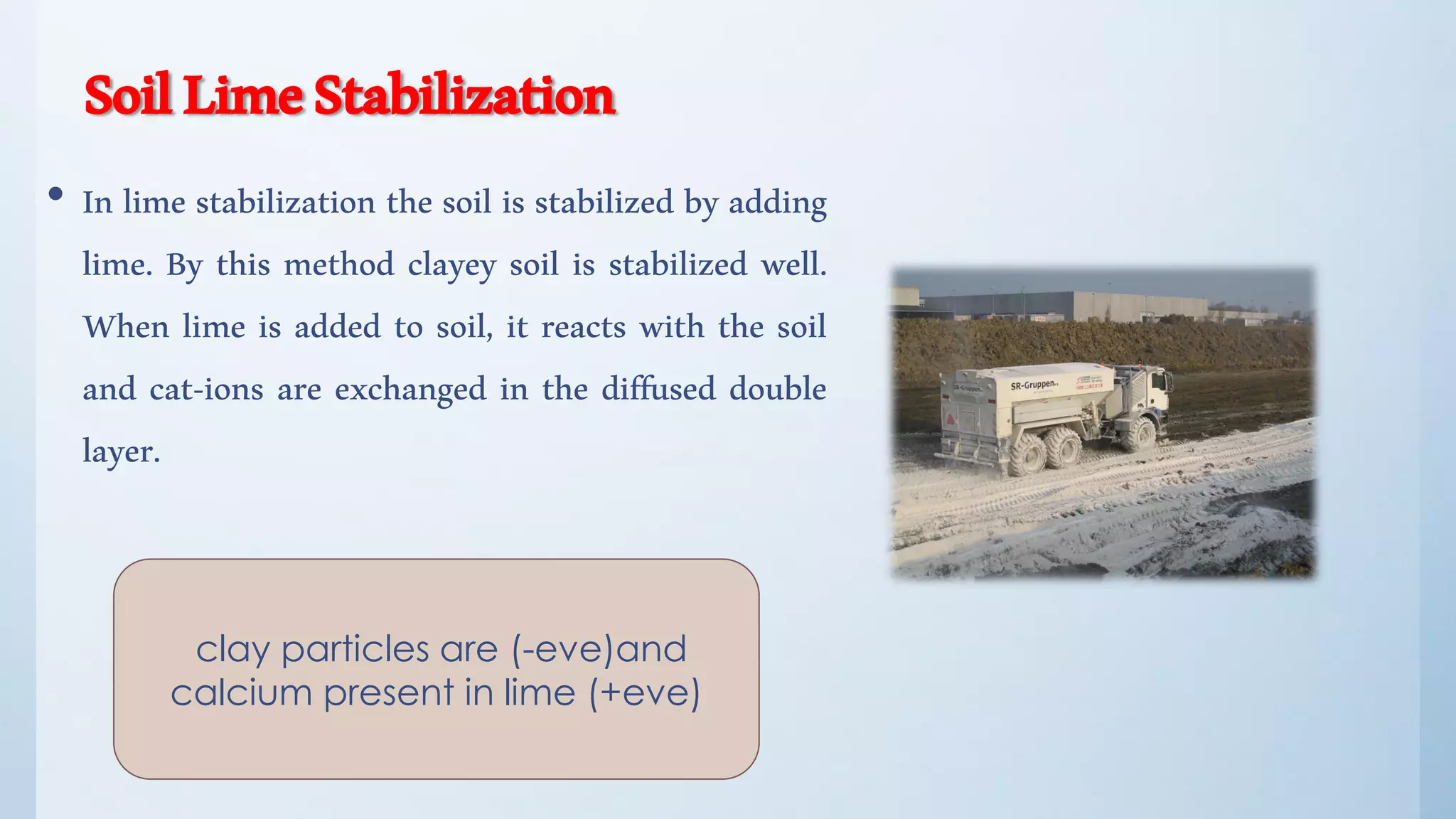
• In lime stabilization the soil is stabilized by adding
lime. By this method clayey soil is stabilized well.
When lime is added to soil, it reacts with the soil
and cat-ions are exchanged in the diffused double
layer.
clay particles are (-eve)and
calcium present in lime (+eve)
• FIRST:-Calcium(lime)replacestheweakerionsofsodium,
magnesium,potassiumwhichresultsinformationof positively
chargedcalciumonthesurfaceofclayparticles.Thisinturnreduces
plasticityofsoil.
• SECOND:-Aluminousandsiliceous(clay)reactswithlimein
presenceofwatertoformcementitiousgels,whichincreasesthesoil
strengthfurther.
• Thesepozzolanicreactionsareslowandextendedforlong periodof
time.Theamountoflimerequiredforstabilizationvariesbetween
2to10%.
Lime
Quantityoflime
• Shouldbe3to10%byweightofdrysoilisnormallyrequired.
Hydratedlime[Ca(OH)2 ]inpowderedformispreferable
comparedtoQuicklime[CaO]asitdangerfromburnsthatcan
becausedtounprotectedworkmen
Properties:
• Reducesplasticity.
• Shrinkageandswellingcanbedecreased.
• Strengthcanbeimproved
• Normalsoilcompressivestrength-0.18to0.7MN/m²,whereas
strengthafter28daysbytreatingwithlime,compressivestrength
0.7to1.7MN/m².
Soil stabilization
Soil stabilization

Soil stabilization