2013 American Transactions on Engineering & Applied Sciences.

American Transactions on
Engineering & Applied Sciences
http://TuEngr.com/ATEAS

Recycling Dumped Concrete for Making Concrete
Paving Blocks
Boonsap Witchayangkoon

a*

b

, Monsinee Pattanasuwan ,

b

Pawarut Nakarin , and Panprapa Jampatong

b

a

Department of Civil Engineering, Faculty of Engineering, Thammasat University, THAILAND
Engineering and Business Management Program, Faculty of Engineering, Thammasat University,
THAILAND
b

ARTICLEINFO

ABSTRACT

Article history:
Received 03 April 2013
Received in revised form
23 May 2013
Accepted 14 June 2013
Available online
07 July 2013

This study applies recycled concrete as a replacement of
coarse aggregate to produce concrete paving blocks. The
experiment is conducted to observe concrete strength of the
specimen samples. The Thai Industrial Standard for concrete
paving blocks (TIS 827-2531) has specified concrete samples at 28
days to have compressive strength surplus 350ksc. This study,
recycled concrete has been used at various proportions, 50%, 70%,
and 100% replacement of coarse aggregate. The mix concrete
uses water-cement ratio 0.47 with design slump 10±2.5cm.
Average concrete strengths at 28days are 665 ksc, 456 ksc and 350
ksc. Thus, this work shows possibility that dumped concrete can
be recycled with full 100% replacement of coarse aggregate in
making concrete paving blocks.

Keywords:
Recycled concrete;
Coarse aggregate
replacement;
Thai Industrial Standard.

2013 Am. Trans. Eng. Appl. Sci.

1. Introduction
Demolition concretes are found as waste material from various monolithic concrete
construction and destruction processes as well as from experimental laboratories.
*Corresponding author (B.Witchayangkoon). Tel/Fax: +66-2-5643001 Ext.3101. E-mail
addresses: drboonsap@gmail.com.
2013. American Transactions on Engineering &
Applied Sciences. Volume 2 No. 3 ISSN 2229-1652 eISSN 2229-1660 Online Available
at http://TuEngr.com/ATEAS/V02/247-252.pdf

These

247
demolition concretes are normally taken to dumped sites. The problem is that number of dumped
sites is greatly reduced. Also, the dumping cost is getting higher. Importantly, this dumping
process is not quite environmentally friendly. Therefore, this work tries to find an experimental
solution by applying recycled concrete to be used in non-critical non-structural parts.

We

contemplate and test in using recycled concrete as coarse aggregate for making concrete paving
blocks.

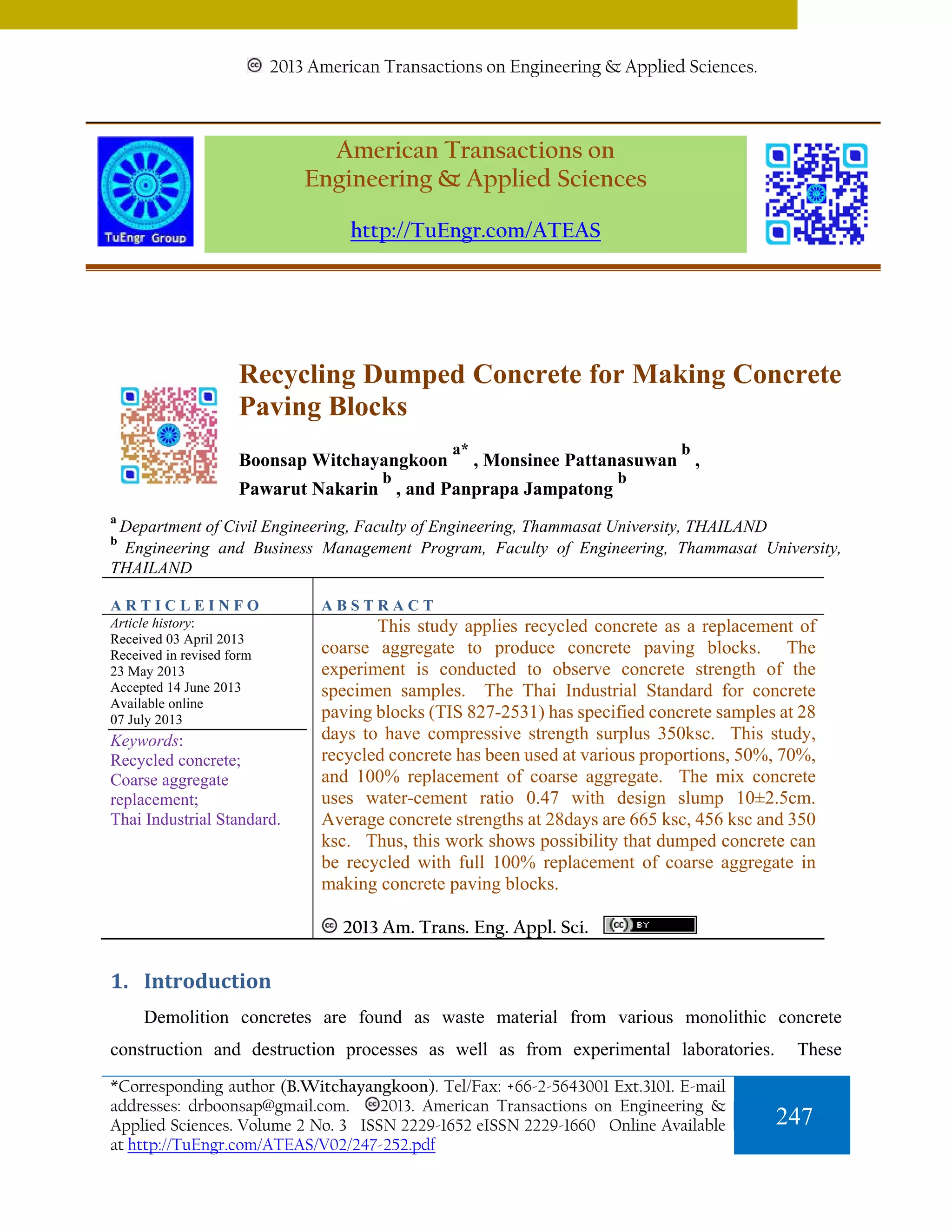
Figure 1: Concrete at dump site.

2. Literature Review
Utilization of waste concrete for new construction has long been proposed (Ravindrarajah,
1987). Attempts have been long made to recycle demolished concrete and masonry (Hansen,
1992). Shrinkage of concrete with replacement of aggregate with recycled concrete aggregate
(RCA) has been studied (Gómez, 2002). To promote the recycling of concrete, Shima et al.,
(2005) have developed a technology to produce high-quality recycled aggregate. As a technology
to recycle the waste concrete has been improved, it was possible to evaluate the fundamental
characteristics of concrete using RCA for structural concrete members, such as pavement
structures (Park and Sim, 2006). More research on Compound Performance of Waste Concrete
Pulverized Admixture and Slag Powder has also been experimented (Li and Da-xing, 2009).
Seangatith (2001) gave cost evaluation guideline of using crushed concrete as coarse aggregate for
concrete. Only cost of the material, cost of installation, and maintenance cost were considered.
Seangatith (2001) also emphasized that recycled concrete with good gradation can be used in
concrete while proper mechanical properties can be maintained in terms of compressive strength,
modulus of elasticity, and creep. This RCA concrete is equivalent to normal concrete, but having
even less shrinkage.
248
B. Witchayangkoon, M. Pattanasuwan, P. Nakarin a , and P. Jampatong
3. Methodology
Detail of this study is as followed.

3.1 Crushing Dumped Concrete
Dumped concrete is randomly taken from experimental laboratory dump site, see Figure 1.
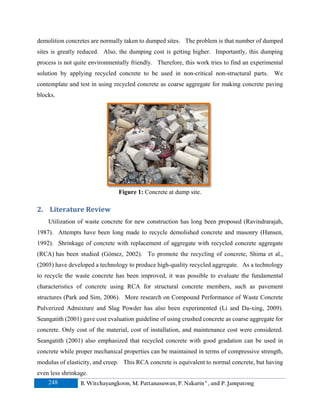
Concrete is then crushed to have smaller varied sizes, with dimensions about one inch or smaller,
as shown in Figure 2.

Figure 2: Crushed concrete, during the crushing process.

3.2 Sieve Analysis
Crushed concrete is put into the vertical vibrating sieving machine. The sieving result is
shown in Table 1. The test follows ASTM-C136 (2006).
Seive Size

¾”
½”
3/8”
No.4
No.8
Pan
Total.

Table 1: Sieve analysis of crushed concrete.
Weight
Percentage
Percentage
recycled
Weight
Greater
Concrete (Kg)
0.061
2.77
2.77
0.454
20.61
23.38
0.485
22.02
45.4
1.058
48.02
93.42
0.122
5.54
98.96
0.023
1.04
100
2.203

3.3 Mix Concrete
There are nine moulds available for producing concrete paving block specimens. Each
mould’s dimensions are 10cm x 10cm x 6cm. Each mix batch for nine specimens is 0.006m3,
*Corresponding author (B.Witchayangkoon). Tel/Fax: +66-2-5643001 Ext.3101. E-mail
addresses: drboonsap@gmail.com.
2013. American Transactions on Engineering &
Applied Sciences. Volume 2 No. 3 ISSN 2229-1652 eISSN 2229-1660 Online Available
at http://TuEngr.com/ATEAS/V02/247-252.pdf

249
including 10% spare (see Table 2). Water cement ratio is 0.47, with design slump 10±2.5cm for
easily flow of mix concrete into the block moulds.
Table 2: Mix Concrete Design.
Trial Batch Mix for volume 0.006 cu.m.
Material
50%
70%
100%
(kg)
Replacement
Replacement
Replacement
2.52Kg
Cement Type 1
1.20Kg
Water
5.18Kg
Dry Fine Agg
1.98Kg
0Kg
Dry Coarse Agg
3.30Kg
4.62Kg
6.60Kg
Recycled Concrete
3.30Kg

3.4 Specimen Curing
After hardened, concrete paving block specimens are cured by covering with plastic sheet to
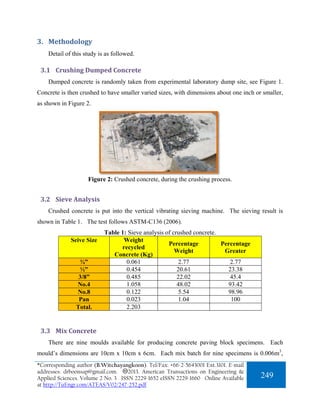
maintain continued hydration process in concrete. The curing lasts 28 days. Sample specimens
after curing are shown in Figure 3.

Figure 3: Concrete paving block specimens after curing.

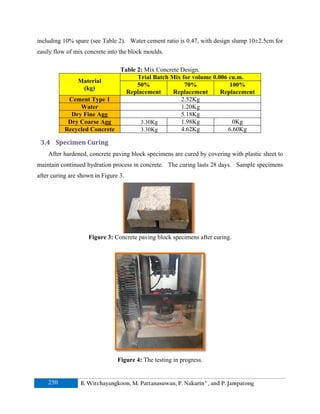
Figure 4: The testing in progress.

250

B. Witchayangkoon, M. Pattanasuwan, P. Nakarin a , and P. Jampatong
3.1 Compression Test
The Universal Testing Machine (UTM) is used for compression test of all concrete paving
block specimens. The test follows ASTM C 31 and C39. Figure 4 shows the testing in progress.

4. Result and Discussion
Average test results of specimens for each batch of different replacement are given in Table 3
together with standard deviation. It is found that for 100% replacement of coarse aggregate the
average test result gives 350 kg/cm2 (ksc). This test result is equal the suggested TIS827-2531
value of 350ksc.
Table 3: Average test result with standard deviation for varied replacement of coarse aggregates.
Compression
50%
70%
100%
test
Replacement
Replacement
Replacement
mean

665.1+13.3 ksc 474.7+14.3 ksc

350.1+9.9 ksc

5. Conclusion
We experiment recycled concrete as a replacement of coarse aggregate to produce concrete
paving blocks.

The observed concrete strength of the specimen samples, with various

proportions, 50%, 70%, and 100% replacement of coarse aggregate. The Thai Industrial Standard
for concrete paving blocks (TIS 827-2531) has specified concrete samples at 28 days to have
compressive strength surplus 350ksc. Average concrete strengths at 28days are 665 ksc, 456 ksc
and 350 ksc, are all higher than the specified standard. Thus, this work shows possibility that
dumped concrete can be recycled with full 100% replacement of coarse aggregate in making
concrete paving blocks.

6. References
Gómez Soberón, J. M. V. (2002, January). Shrinkage of concrete with replacement of aggregate
with recycled concrete aggregate. In SP-209: ACI Fifth Int Conf on Innovation in Design
with Emphasis on Seismic, Wind and Environmental Loading, Quality Control, and
Innovation in Materials/Hot Weather Concreting. VM Malhotra.
Hansen, T. C. (Ed.). (1992). Recycling of demolished concrete and masonry (Vol. 6). Taylor &
*Corresponding author (B.Witchayangkoon). Tel/Fax: +66-2-5643001 Ext.3101. E-mail
addresses: drboonsap@gmail.com.
2013. American Transactions on Engineering &
Applied Sciences. Volume 2 No. 3 ISSN 2229-1652 eISSN 2229-1660 Online Available
at http://TuEngr.com/ATEAS/V02/247-252.pdf

251
Francis.
Li, S. U. N., and Da-xing, Q. I. A. N. (2009). Research on Compound Performance of Waste
Concrete Pulverized Admixture and Slag Powder [J]. Journal of Luoyang Institute of
Science and Technology (Natural Science Edition), 2, 004.
Park, C., & Sim, J. (2006). Fundamental properties of concrete using recycled concrete aggregate
produced through advanced recycling process. In Transportation Research Board 85th
Annual Meeting (No. 06-0810).
Ravindrarajah, R. S. (1987). Utilization of waste concrete for new construction. CONSERV.
RECYCLING., 10(2), 69-74.
Seangatith, S. (2001). Cost Evaluation Guideline of Using Crushed Concrete as Coarse Aggregate
for Concrete. Suranaree J. Sci Technol. 8:50-54.
Shima, H., Tateyashiki, H., Matsuhashi, R., & Yoshida, Y. (2005). An advanced concrete recycling
technology and its applicability assessment through input-output analysis. Journal of
Advanced Concrete Technology, 3(1), 53-67.

Dr. B. Witchayangkoon is an Associate Professor of Department of Civil Engineering at Thammasat
University. He received his B.Eng. from King Mongkut’s University of Technology Thonburi with
Honors. He continued his PhD study at University of Maine, USA, where he obtained his PhD in
Spatial Information Science & Engineering. Dr. Witchayangkoon current interests involve
applications of emerging technologies to engineering.
Monsinee Pattanasuwan is a student in the Engineering and Business Management Program,
Department of Civil Engineering, Faculty of Engineering, Thammasat University, THAILAND. She is
interested in applications of technology in construction and management.

Panprapa Jampatong is a student in the Engineering and Business Management Program, Department
of Civil Engineering, Faculty of Engineering, Thammasat University, THAILAND. Her interests
involve the areas of technology applied to construction and management.

Pawarut Nakarin is a student in the Engineering and Business Management Program, Department of
Civil Engineering, Faculty of Engineering, Thammasat University, THAILAND. His interests are in
the areas of construction technology and management.

Peer Review: This article has been internationally peer-reviewed and accepted for publication
according to the guidelines given at the journal’s website.

252

B. Witchayangkoon, M. Pattanasuwan, P. Nakarin a , and P. Jampatong

Recycling Dumped Concrete for Making Concrete Paving Blocks

  • 1.
    2013 American Transactionson Engineering & Applied Sciences. American Transactions on Engineering & Applied Sciences http://TuEngr.com/ATEAS Recycling Dumped Concrete for Making Concrete Paving Blocks Boonsap Witchayangkoon a* b , Monsinee Pattanasuwan , b Pawarut Nakarin , and Panprapa Jampatong b a Department of Civil Engineering, Faculty of Engineering, Thammasat University, THAILAND Engineering and Business Management Program, Faculty of Engineering, Thammasat University, THAILAND b ARTICLEINFO ABSTRACT Article history: Received 03 April 2013 Received in revised form 23 May 2013 Accepted 14 June 2013 Available online 07 July 2013 This study applies recycled concrete as a replacement of coarse aggregate to produce concrete paving blocks. The experiment is conducted to observe concrete strength of the specimen samples. The Thai Industrial Standard for concrete paving blocks (TIS 827-2531) has specified concrete samples at 28 days to have compressive strength surplus 350ksc. This study, recycled concrete has been used at various proportions, 50%, 70%, and 100% replacement of coarse aggregate. The mix concrete uses water-cement ratio 0.47 with design slump 10±2.5cm. Average concrete strengths at 28days are 665 ksc, 456 ksc and 350 ksc. Thus, this work shows possibility that dumped concrete can be recycled with full 100% replacement of coarse aggregate in making concrete paving blocks. Keywords: Recycled concrete; Coarse aggregate replacement; Thai Industrial Standard. 2013 Am. Trans. Eng. Appl. Sci. 1. Introduction Demolition concretes are found as waste material from various monolithic concrete construction and destruction processes as well as from experimental laboratories. *Corresponding author (B.Witchayangkoon). Tel/Fax: +66-2-5643001 Ext.3101. E-mail addresses: drboonsap@gmail.com. 2013. American Transactions on Engineering & Applied Sciences. Volume 2 No. 3 ISSN 2229-1652 eISSN 2229-1660 Online Available at http://TuEngr.com/ATEAS/V02/247-252.pdf These 247
  • 2.
    demolition concretes arenormally taken to dumped sites. The problem is that number of dumped sites is greatly reduced. Also, the dumping cost is getting higher. Importantly, this dumping process is not quite environmentally friendly. Therefore, this work tries to find an experimental solution by applying recycled concrete to be used in non-critical non-structural parts. We contemplate and test in using recycled concrete as coarse aggregate for making concrete paving blocks. Figure 1: Concrete at dump site. 2. Literature Review Utilization of waste concrete for new construction has long been proposed (Ravindrarajah, 1987). Attempts have been long made to recycle demolished concrete and masonry (Hansen, 1992). Shrinkage of concrete with replacement of aggregate with recycled concrete aggregate (RCA) has been studied (Gómez, 2002). To promote the recycling of concrete, Shima et al., (2005) have developed a technology to produce high-quality recycled aggregate. As a technology to recycle the waste concrete has been improved, it was possible to evaluate the fundamental characteristics of concrete using RCA for structural concrete members, such as pavement structures (Park and Sim, 2006). More research on Compound Performance of Waste Concrete Pulverized Admixture and Slag Powder has also been experimented (Li and Da-xing, 2009). Seangatith (2001) gave cost evaluation guideline of using crushed concrete as coarse aggregate for concrete. Only cost of the material, cost of installation, and maintenance cost were considered. Seangatith (2001) also emphasized that recycled concrete with good gradation can be used in concrete while proper mechanical properties can be maintained in terms of compressive strength, modulus of elasticity, and creep. This RCA concrete is equivalent to normal concrete, but having even less shrinkage. 248 B. Witchayangkoon, M. Pattanasuwan, P. Nakarin a , and P. Jampatong
  • 3.
    3. Methodology Detail ofthis study is as followed. 3.1 Crushing Dumped Concrete Dumped concrete is randomly taken from experimental laboratory dump site, see Figure 1. Concrete is then crushed to have smaller varied sizes, with dimensions about one inch or smaller, as shown in Figure 2. Figure 2: Crushed concrete, during the crushing process. 3.2 Sieve Analysis Crushed concrete is put into the vertical vibrating sieving machine. The sieving result is shown in Table 1. The test follows ASTM-C136 (2006). Seive Size ¾” ½” 3/8” No.4 No.8 Pan Total. Table 1: Sieve analysis of crushed concrete. Weight Percentage Percentage recycled Weight Greater Concrete (Kg) 0.061 2.77 2.77 0.454 20.61 23.38 0.485 22.02 45.4 1.058 48.02 93.42 0.122 5.54 98.96 0.023 1.04 100 2.203 3.3 Mix Concrete There are nine moulds available for producing concrete paving block specimens. Each mould’s dimensions are 10cm x 10cm x 6cm. Each mix batch for nine specimens is 0.006m3, *Corresponding author (B.Witchayangkoon). Tel/Fax: +66-2-5643001 Ext.3101. E-mail addresses: drboonsap@gmail.com. 2013. American Transactions on Engineering & Applied Sciences. Volume 2 No. 3 ISSN 2229-1652 eISSN 2229-1660 Online Available at http://TuEngr.com/ATEAS/V02/247-252.pdf 249
  • 4.
    including 10% spare(see Table 2). Water cement ratio is 0.47, with design slump 10±2.5cm for easily flow of mix concrete into the block moulds. Table 2: Mix Concrete Design. Trial Batch Mix for volume 0.006 cu.m. Material 50% 70% 100% (kg) Replacement Replacement Replacement 2.52Kg Cement Type 1 1.20Kg Water 5.18Kg Dry Fine Agg 1.98Kg 0Kg Dry Coarse Agg 3.30Kg 4.62Kg 6.60Kg Recycled Concrete 3.30Kg 3.4 Specimen Curing After hardened, concrete paving block specimens are cured by covering with plastic sheet to maintain continued hydration process in concrete. The curing lasts 28 days. Sample specimens after curing are shown in Figure 3. Figure 3: Concrete paving block specimens after curing. Figure 4: The testing in progress. 250 B. Witchayangkoon, M. Pattanasuwan, P. Nakarin a , and P. Jampatong
  • 5.
    3.1 Compression Test TheUniversal Testing Machine (UTM) is used for compression test of all concrete paving block specimens. The test follows ASTM C 31 and C39. Figure 4 shows the testing in progress. 4. Result and Discussion Average test results of specimens for each batch of different replacement are given in Table 3 together with standard deviation. It is found that for 100% replacement of coarse aggregate the average test result gives 350 kg/cm2 (ksc). This test result is equal the suggested TIS827-2531 value of 350ksc. Table 3: Average test result with standard deviation for varied replacement of coarse aggregates. Compression 50% 70% 100% test Replacement Replacement Replacement mean 665.1+13.3 ksc 474.7+14.3 ksc 350.1+9.9 ksc 5. Conclusion We experiment recycled concrete as a replacement of coarse aggregate to produce concrete paving blocks. The observed concrete strength of the specimen samples, with various proportions, 50%, 70%, and 100% replacement of coarse aggregate. The Thai Industrial Standard for concrete paving blocks (TIS 827-2531) has specified concrete samples at 28 days to have compressive strength surplus 350ksc. Average concrete strengths at 28days are 665 ksc, 456 ksc and 350 ksc, are all higher than the specified standard. Thus, this work shows possibility that dumped concrete can be recycled with full 100% replacement of coarse aggregate in making concrete paving blocks. 6. References Gómez Soberón, J. M. V. (2002, January). Shrinkage of concrete with replacement of aggregate with recycled concrete aggregate. In SP-209: ACI Fifth Int Conf on Innovation in Design with Emphasis on Seismic, Wind and Environmental Loading, Quality Control, and Innovation in Materials/Hot Weather Concreting. VM Malhotra. Hansen, T. C. (Ed.). (1992). Recycling of demolished concrete and masonry (Vol. 6). Taylor & *Corresponding author (B.Witchayangkoon). Tel/Fax: +66-2-5643001 Ext.3101. E-mail addresses: drboonsap@gmail.com. 2013. American Transactions on Engineering & Applied Sciences. Volume 2 No. 3 ISSN 2229-1652 eISSN 2229-1660 Online Available at http://TuEngr.com/ATEAS/V02/247-252.pdf 251
  • 6.
    Francis. Li, S. U.N., and Da-xing, Q. I. A. N. (2009). Research on Compound Performance of Waste Concrete Pulverized Admixture and Slag Powder [J]. Journal of Luoyang Institute of Science and Technology (Natural Science Edition), 2, 004. Park, C., & Sim, J. (2006). Fundamental properties of concrete using recycled concrete aggregate produced through advanced recycling process. In Transportation Research Board 85th Annual Meeting (No. 06-0810). Ravindrarajah, R. S. (1987). Utilization of waste concrete for new construction. CONSERV. RECYCLING., 10(2), 69-74. Seangatith, S. (2001). Cost Evaluation Guideline of Using Crushed Concrete as Coarse Aggregate for Concrete. Suranaree J. Sci Technol. 8:50-54. Shima, H., Tateyashiki, H., Matsuhashi, R., & Yoshida, Y. (2005). An advanced concrete recycling technology and its applicability assessment through input-output analysis. Journal of Advanced Concrete Technology, 3(1), 53-67. Dr. B. Witchayangkoon is an Associate Professor of Department of Civil Engineering at Thammasat University. He received his B.Eng. from King Mongkut’s University of Technology Thonburi with Honors. He continued his PhD study at University of Maine, USA, where he obtained his PhD in Spatial Information Science & Engineering. Dr. Witchayangkoon current interests involve applications of emerging technologies to engineering. Monsinee Pattanasuwan is a student in the Engineering and Business Management Program, Department of Civil Engineering, Faculty of Engineering, Thammasat University, THAILAND. She is interested in applications of technology in construction and management. Panprapa Jampatong is a student in the Engineering and Business Management Program, Department of Civil Engineering, Faculty of Engineering, Thammasat University, THAILAND. Her interests involve the areas of technology applied to construction and management. Pawarut Nakarin is a student in the Engineering and Business Management Program, Department of Civil Engineering, Faculty of Engineering, Thammasat University, THAILAND. His interests are in the areas of construction technology and management. Peer Review: This article has been internationally peer-reviewed and accepted for publication according to the guidelines given at the journal’s website. 252 B. Witchayangkoon, M. Pattanasuwan, P. Nakarin a , and P. Jampatong