Submitted To:
Engr. Fahmida Siddiqa
Lecturer
Department of Textile Engineering
Daffodil International University
Submitted By:
Md. Robiul Islam
ID NO : 153-23-4464
Section : B
Department of Textile Engineering
Daffodil International University
Satin / Sateen
Introduction
 Satin weave , although more complicated, is a flexible type of
weave than the plain weave.
 It is called ‘Satin’ when filament fibers such as silk or nylon
are used and is called ‘Sateen’ when short-staple yarn like
cotton is used to make it.
Features of satin/sateen
 The fabric surface is very smooth and lustrous.
 By using low twisted yarn and by increasing EPI, smoothness can be increased.
 Only one interlacement between warp and weft.
 The interlacement point is covered with adjacent long float yarn.
 No. of cross mark or base mark is equal to the no. of threads in repeat.
 Loose structure compare to plain and twill.
 No visible twill line.
 Widely used in case of jacquard design.
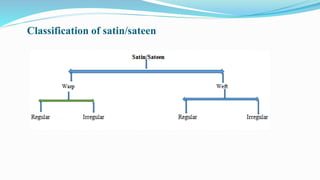
Classification of satin/sateen
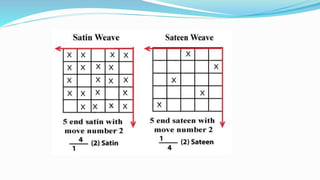
WARP SATIN
 If the prominence of warp floating are seen on the fabric surface, this
satin are called warp satin.
 Warp satin is expressed by A/1(B)
 Where, A=warp face and B=move no.(step value)
WEFT SATIN
 If the prominence of weft floating are seen on the surface of the fabric, it
is called weft satin/sateen
 Weft satin is expressed by 1/A(B)
 Where A=weft face and B=move no (step value).
Move number
 In case of satin weave, the distance between two adjacent interlacing
points is known as move number/step value.
Advantages and disadvantages of satin weave
These constructions produce smooth, lustrous, rich looking fabrics that give
reasonably good service if they are not subjected to excessive hard wear.
Satin weave usually requires more shafts in the weaving than do the plain or
twill weaves there by increasing the cost of production.
Uses of Satin weave
 Widely used to produce lace.
 Desks wear, curtain and decorative garments and upholstery.
 Widely used to produce coat and suiting.
 Used to produce multiply fabric.
 Used to produce very costly fabric because of its smoothness.
 Widely used incase of jacquard design in basic weave.
 Used as ladies dress.
THANK YOU
FOR
YOUR ATTENTION

SATIN / SATEEN WEAVE

  • 1.
    Submitted To: Engr. FahmidaSiddiqa Lecturer Department of Textile Engineering Daffodil International University Submitted By: Md. Robiul Islam ID NO : 153-23-4464 Section : B Department of Textile Engineering Daffodil International University
  • 2.
  • 3.
    Introduction  Satin weave, although more complicated, is a flexible type of weave than the plain weave.  It is called ‘Satin’ when filament fibers such as silk or nylon are used and is called ‘Sateen’ when short-staple yarn like cotton is used to make it.
  • 4.
    Features of satin/sateen The fabric surface is very smooth and lustrous.  By using low twisted yarn and by increasing EPI, smoothness can be increased.  Only one interlacement between warp and weft.  The interlacement point is covered with adjacent long float yarn.  No. of cross mark or base mark is equal to the no. of threads in repeat.  Loose structure compare to plain and twill.  No visible twill line.  Widely used in case of jacquard design.
  • 5.
  • 6.
    WARP SATIN  Ifthe prominence of warp floating are seen on the fabric surface, this satin are called warp satin.  Warp satin is expressed by A/1(B)  Where, A=warp face and B=move no.(step value)
  • 7.
    WEFT SATIN  Ifthe prominence of weft floating are seen on the surface of the fabric, it is called weft satin/sateen  Weft satin is expressed by 1/A(B)  Where A=weft face and B=move no (step value).
  • 8.
    Move number  Incase of satin weave, the distance between two adjacent interlacing points is known as move number/step value.
  • 10.
    Advantages and disadvantagesof satin weave These constructions produce smooth, lustrous, rich looking fabrics that give reasonably good service if they are not subjected to excessive hard wear. Satin weave usually requires more shafts in the weaving than do the plain or twill weaves there by increasing the cost of production.
  • 11.
    Uses of Satinweave  Widely used to produce lace.  Desks wear, curtain and decorative garments and upholstery.  Widely used to produce coat and suiting.  Used to produce multiply fabric.  Used to produce very costly fabric because of its smoothness.  Widely used incase of jacquard design in basic weave.  Used as ladies dress.
  • 12.

Editor's Notes