

PREPARED BY: JEGAN
INFERTILITY
❖ Infertility is the inability of a couple to achieve pregnancy over an average
period of one year despite adequate, regular (3-4 times per
week),unprotected sexual intercourse
❖ Infertility may also be referred to as the inability to carry a pregnancy to
the delivery of a live baby.
❖ The couple conceived and delivered a live baby in 1st pregnancy but unable
to conceive for the 2nd time is also termed as infertility
Jegan Nadar
 Infertility can be due to the
❖ Woman (60-70%)
❖ Man (40-50%)
❖ Both
Male
Infertility
MALE INFERTILITY
• Male infertility refers to the
inability of a male to achieve
pregnancy in a fertile female
• Male factors accounts for 40-50%
of infertility in human
Jegan Nadar
RISK FACTORS AND CAUSES OF INFERTILITY IN MALE
1. Spermatozoa and Infertility
2. Structural Obstruction and Infertility
3. Environmental Factors
4. Urinary Tract Infection and Infertility
5. Life Style and Infertility
6. Sexually Transmitted Disease (Std) and Infertility
Jegan Nadar
1. SPERMATOZOA AND INFERTILITY
❖ Low sperm counts
❖ Abnormal spermatozoa morphology (shape) and low sperm motility
❖ These conditions are usually asymptomatic to most males but of great
etiological importance
❖ The quality of the spermatozoa (count, vitality, motility and
morphology) and the composition of seminal fluid are also important
index of sperm function
❖ Improper sperm function can lead to infertility
Jegan Nadar
❖ Aspermia - complete lack of semen
❖ Hypospermia - reduced seminal volume
❖ Oligozoospermia - decreased number of spermatozoa in semen
❖ Azoospermia - absence of sperm cells in semen
❖ Teratospermia - increase in sperm with abnormal morphology
❖ Asthenozoospermia - reduced sperm motility
❖ These condition can lead to infertility
Jegan Nadar
2. STRUCTURAL OBSTRUCTION AND INFERTILITY
❖ Vas deferens and ejaculatory duct obstruction
could be an important cause of infertility
as they affect ejaculation.
❖ Obstructive azoospermia may result from
previous vasectomy; epididymal, or
ejaculatory duct pathology
Jegan Nadar
3. ENVIRONMENTAL FACTORS
❖ It has been established that environmental factors can lead to infertility
❖ Toxins such as glues, volatile organic solvents, silicones, physical agents, chemical dusts and
pesticides are found to produce damaging effects in testis and affecting sperm quality
and quantity
❖ Radiations and excessive heat to the genitalia have damaging effect on the testicles.
❖ Hence individuals having direct contact
with or exposure to such chemicals
have high chances of having primary or
secondary infertility
Jegan Nadar
4. URINARY TRACT INFECTION AND INFERTILITY
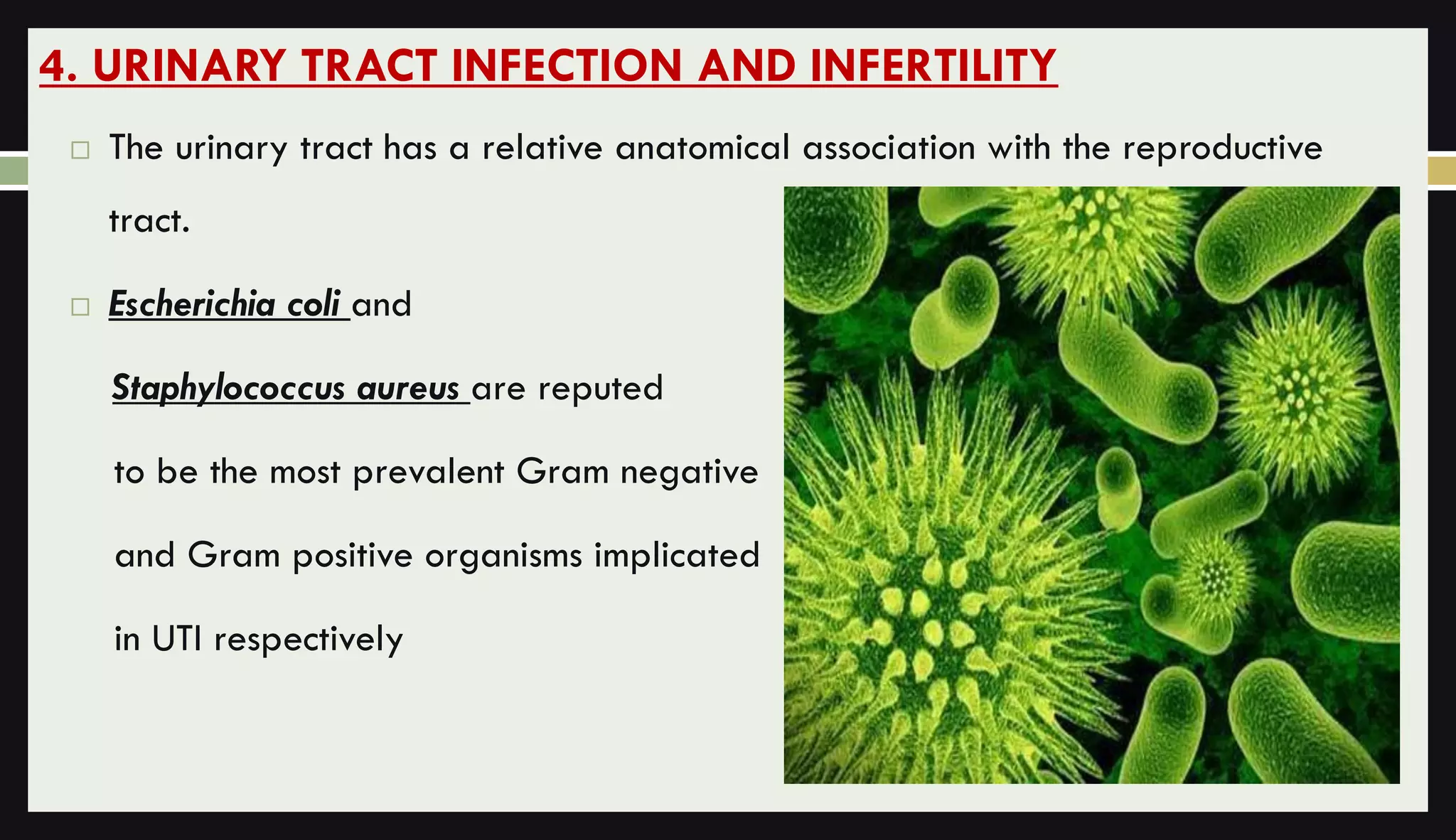
 The urinary tract has a relative anatomical association with the reproductive
tract.
 Escherichia coli and
Staphylococcus aureus are reputed
to be the most prevalent Gram negative
and Gram positive organisms implicated
in UTI respectively
5. LIFE STYLE AND INFERTILITY
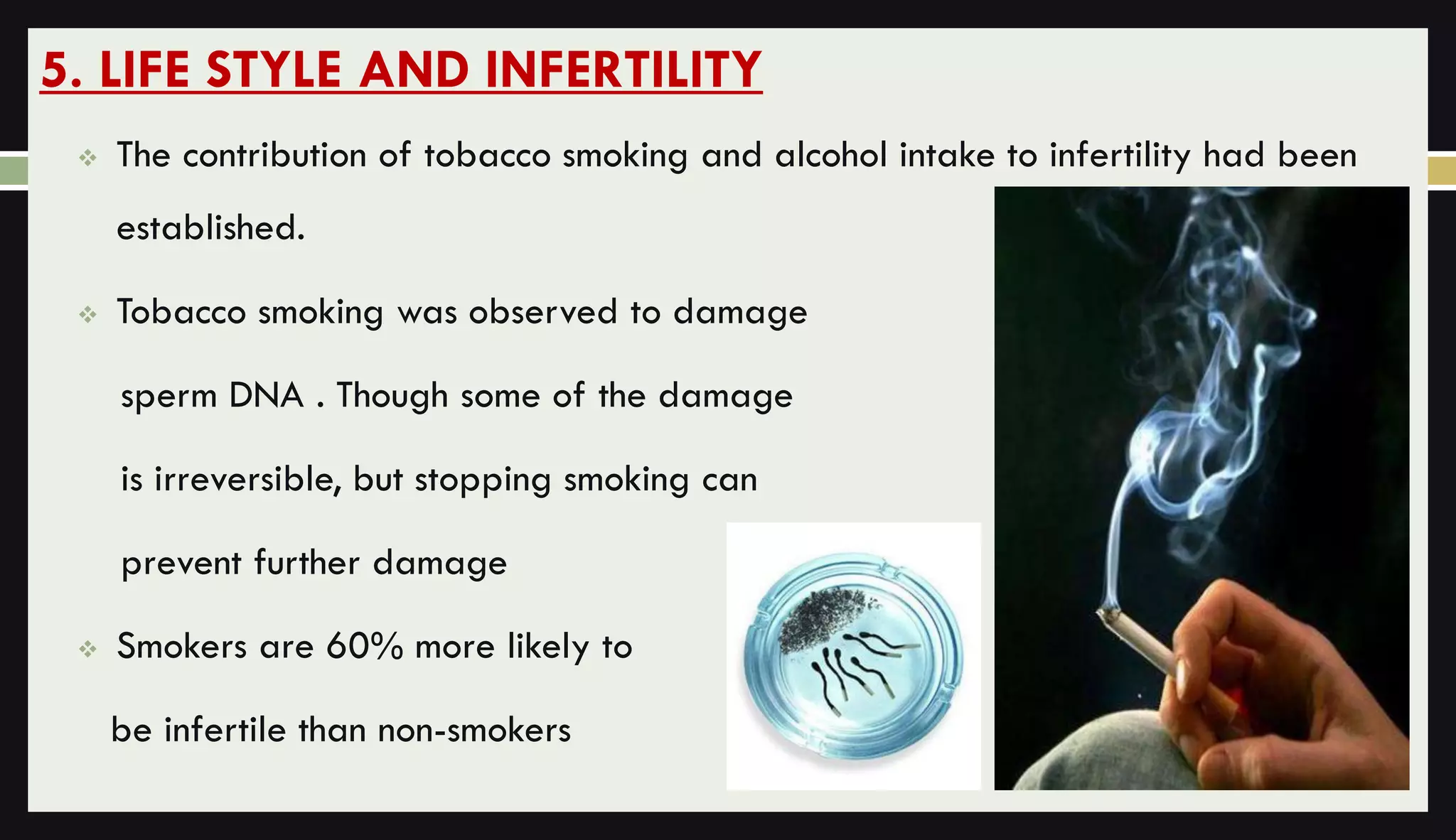
❖ The contribution of tobacco smoking and alcohol intake to infertility had been
established.
❖ Tobacco smoking was observed to damage
sperm DNA . Though some of the damage
is irreversible, but stopping smoking can
prevent further damage
❖ Smokers are 60% more likely to
be infertile than non-smokers
6. SEXUALLY TRANSMITTED DISEASE (STD) AND INFERTILITY
❖ STDs are diseases transmitted through sexual activity with an infected partner
caused by viruses, bacteria, or parasitic microorganisms.
❖ STDs are a leading cause of infertility.
❖ They are often asymptomatic but may
display few symptoms, with the risk of
failing to seek proper treatment in time
to prevent decreased fertility
Female Infertility
FEMALE INFERTILITY
❖ A woman of reproductive age who has not conceived after 1 year of unprotected
vaginal sexual intercourse is known as female infertility
❖ It is estimated that female infertility accounts for 50-70%
RISK FACTORS AND CAUSES OF INFERTILITY IN FEMALE
❖ Infertility may be caused by an underlying medical condition that may damage
the fallopian tubes, interferes with ovulation, or causes hormonal complications.
❖ Other causes of infertility in females include
➢ Ovulation problems,
➢ Tubal blockage,
➢ Age-related factors,
➢ Uterine problems, and
➢ Hormone imbalance
1. OVARIAN FUNCTIONAL PROBLEM AND INFERTILITY
❖ Infertility resulting from ovarian dysfunction may be due to absence of eggs in the
ovaries or due to a complete blockage of the ovaries.
❖ The other cause can be
1.Ovarian dystrophy (physical damage to the ovaries, or ovaries with multiple cysts)
2.luteinized unruptured follicle syndrome (LUFS), in which case the egg may have
matured properly but the follicle failed to burst or even burst without releasing the
egg may occur and cause anovulatory cycle
3.In PCOS the ovaries produce high amounts of androgens, particularly testosterone
and thus amenorrhea or oligomenorrhea is quite common. Jegan Nadar
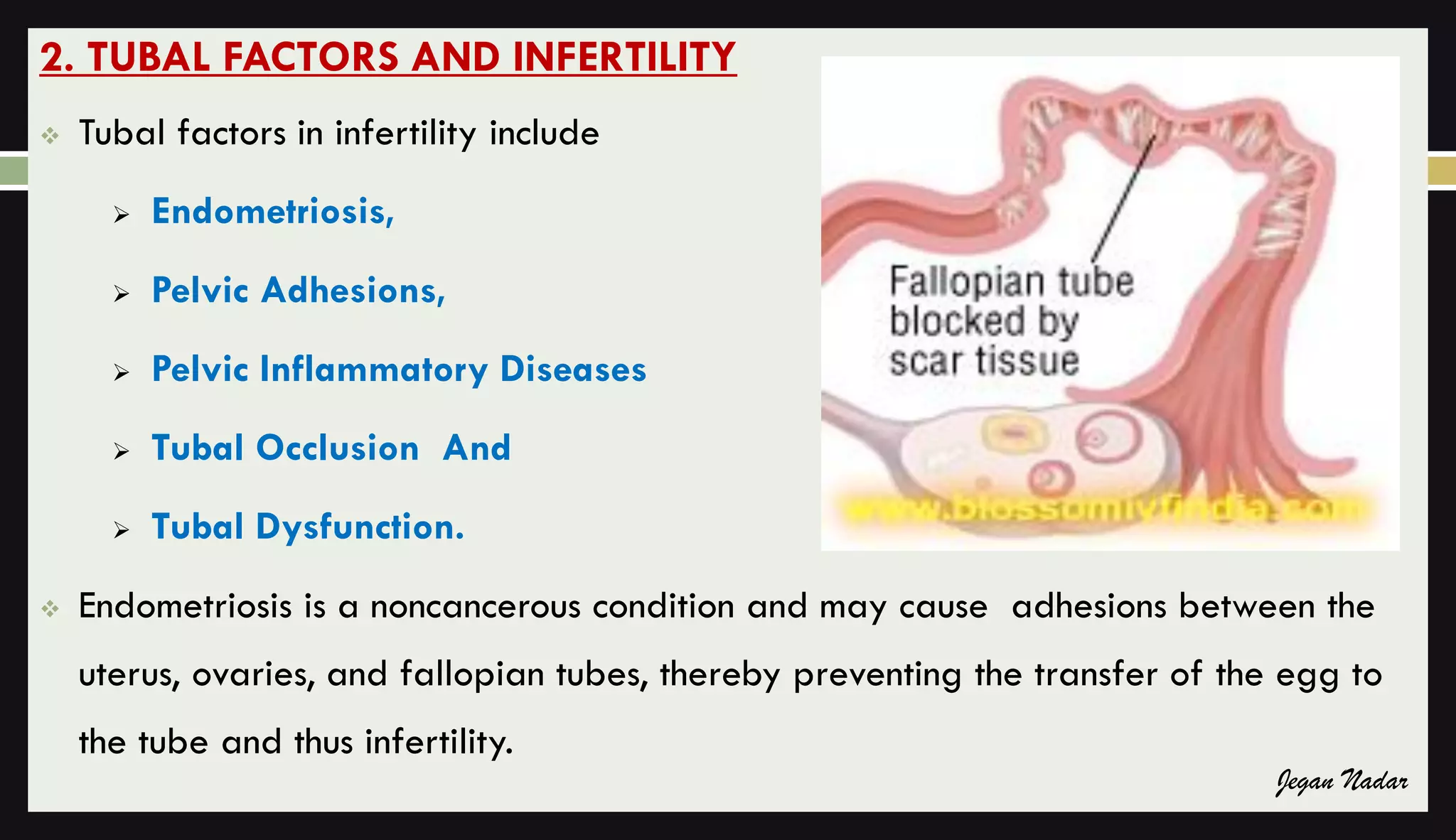
2. TUBAL FACTORS AND INFERTILITY
❖ Tubal factors in infertility include
➢ Endometriosis,
➢ Pelvic Adhesions,
➢ Pelvic Inflammatory Diseases
➢ Tubal Occlusion And
➢ Tubal Dysfunction.
❖ Endometriosis is a noncancerous condition and may cause adhesions between the
uterus, ovaries, and fallopian tubes, thereby preventing the transfer of the egg to
the tube and thus infertility.
Jegan Nadar
3. UTERINE FACTORS AND INFERTILITY
❖ Notable amongst uterine factors are uterine malformation such as
➢ Abnormal Uterine Shape and Intrauterine Septum
➢ Polyps,
➢ Leiomyoma, and
➢ Asherman’s Syndrome .
❖ Benign fibroid in the uterus are extremely common in women in their 30s.
❖ Large fibroids may cause infertility by impairing the uterine lining, blocking the
fallopian tube, distorting the shape of the uterine cavity or altering the position of
the cervix.
Jegan Nadar
4. HORMONAL IMBALANCE AND INFERTILITY
❖ The hypothalamus, through the release of gonadotrophin releasing hormones,
controls the pituitary gland which directly or indirectly controls most other
hormonal glands in the human body.
❖ Thus, alterations in the chemical signals from the hypothalamus can affect the
pituitary gland, ovaries, thyroid, mammary gland and hence, hormonal
abnormalities.
❖ Women with hormonal imbalance will not produce enough follicles to ensure the
development of an ovule.
Jegan Nadar
Pathophysiology of Infertility

Pathophysiology of Infertility

  • 1.
  • 2.
    INFERTILITY ❖ Infertility isthe inability of a couple to achieve pregnancy over an average period of one year despite adequate, regular (3-4 times per week),unprotected sexual intercourse ❖ Infertility may also be referred to as the inability to carry a pregnancy to the delivery of a live baby. ❖ The couple conceived and delivered a live baby in 1st pregnancy but unable to conceive for the 2nd time is also termed as infertility Jegan Nadar
  • 4.
     Infertility canbe due to the ❖ Woman (60-70%) ❖ Man (40-50%) ❖ Both
  • 5.
  • 6.
    MALE INFERTILITY • Maleinfertility refers to the inability of a male to achieve pregnancy in a fertile female • Male factors accounts for 40-50% of infertility in human Jegan Nadar
  • 7.
    RISK FACTORS ANDCAUSES OF INFERTILITY IN MALE 1. Spermatozoa and Infertility 2. Structural Obstruction and Infertility 3. Environmental Factors 4. Urinary Tract Infection and Infertility 5. Life Style and Infertility 6. Sexually Transmitted Disease (Std) and Infertility Jegan Nadar
  • 8.
    1. SPERMATOZOA ANDINFERTILITY ❖ Low sperm counts ❖ Abnormal spermatozoa morphology (shape) and low sperm motility ❖ These conditions are usually asymptomatic to most males but of great etiological importance ❖ The quality of the spermatozoa (count, vitality, motility and morphology) and the composition of seminal fluid are also important index of sperm function ❖ Improper sperm function can lead to infertility Jegan Nadar
  • 11.
    ❖ Aspermia -complete lack of semen ❖ Hypospermia - reduced seminal volume ❖ Oligozoospermia - decreased number of spermatozoa in semen ❖ Azoospermia - absence of sperm cells in semen ❖ Teratospermia - increase in sperm with abnormal morphology ❖ Asthenozoospermia - reduced sperm motility ❖ These condition can lead to infertility Jegan Nadar
  • 12.
    2. STRUCTURAL OBSTRUCTIONAND INFERTILITY ❖ Vas deferens and ejaculatory duct obstruction could be an important cause of infertility as they affect ejaculation. ❖ Obstructive azoospermia may result from previous vasectomy; epididymal, or ejaculatory duct pathology Jegan Nadar
  • 13.
    3. ENVIRONMENTAL FACTORS ❖It has been established that environmental factors can lead to infertility ❖ Toxins such as glues, volatile organic solvents, silicones, physical agents, chemical dusts and pesticides are found to produce damaging effects in testis and affecting sperm quality and quantity ❖ Radiations and excessive heat to the genitalia have damaging effect on the testicles. ❖ Hence individuals having direct contact with or exposure to such chemicals have high chances of having primary or secondary infertility Jegan Nadar
  • 14.
    4. URINARY TRACTINFECTION AND INFERTILITY  The urinary tract has a relative anatomical association with the reproductive tract.  Escherichia coli and Staphylococcus aureus are reputed to be the most prevalent Gram negative and Gram positive organisms implicated in UTI respectively
  • 15.
    5. LIFE STYLEAND INFERTILITY ❖ The contribution of tobacco smoking and alcohol intake to infertility had been established. ❖ Tobacco smoking was observed to damage sperm DNA . Though some of the damage is irreversible, but stopping smoking can prevent further damage ❖ Smokers are 60% more likely to be infertile than non-smokers
  • 16.
    6. SEXUALLY TRANSMITTEDDISEASE (STD) AND INFERTILITY ❖ STDs are diseases transmitted through sexual activity with an infected partner caused by viruses, bacteria, or parasitic microorganisms. ❖ STDs are a leading cause of infertility. ❖ They are often asymptomatic but may display few symptoms, with the risk of failing to seek proper treatment in time to prevent decreased fertility
  • 17.
  • 18.
    FEMALE INFERTILITY ❖ Awoman of reproductive age who has not conceived after 1 year of unprotected vaginal sexual intercourse is known as female infertility ❖ It is estimated that female infertility accounts for 50-70%
  • 19.
    RISK FACTORS ANDCAUSES OF INFERTILITY IN FEMALE ❖ Infertility may be caused by an underlying medical condition that may damage the fallopian tubes, interferes with ovulation, or causes hormonal complications. ❖ Other causes of infertility in females include ➢ Ovulation problems, ➢ Tubal blockage, ➢ Age-related factors, ➢ Uterine problems, and ➢ Hormone imbalance
  • 20.
    1. OVARIAN FUNCTIONALPROBLEM AND INFERTILITY ❖ Infertility resulting from ovarian dysfunction may be due to absence of eggs in the ovaries or due to a complete blockage of the ovaries. ❖ The other cause can be 1.Ovarian dystrophy (physical damage to the ovaries, or ovaries with multiple cysts) 2.luteinized unruptured follicle syndrome (LUFS), in which case the egg may have matured properly but the follicle failed to burst or even burst without releasing the egg may occur and cause anovulatory cycle 3.In PCOS the ovaries produce high amounts of androgens, particularly testosterone and thus amenorrhea or oligomenorrhea is quite common. Jegan Nadar
  • 21.
    2. TUBAL FACTORSAND INFERTILITY ❖ Tubal factors in infertility include ➢ Endometriosis, ➢ Pelvic Adhesions, ➢ Pelvic Inflammatory Diseases ➢ Tubal Occlusion And ➢ Tubal Dysfunction. ❖ Endometriosis is a noncancerous condition and may cause adhesions between the uterus, ovaries, and fallopian tubes, thereby preventing the transfer of the egg to the tube and thus infertility. Jegan Nadar
  • 22.
    3. UTERINE FACTORSAND INFERTILITY ❖ Notable amongst uterine factors are uterine malformation such as ➢ Abnormal Uterine Shape and Intrauterine Septum ➢ Polyps, ➢ Leiomyoma, and ➢ Asherman’s Syndrome . ❖ Benign fibroid in the uterus are extremely common in women in their 30s. ❖ Large fibroids may cause infertility by impairing the uterine lining, blocking the fallopian tube, distorting the shape of the uterine cavity or altering the position of the cervix. Jegan Nadar
  • 24.
    4. HORMONAL IMBALANCEAND INFERTILITY ❖ The hypothalamus, through the release of gonadotrophin releasing hormones, controls the pituitary gland which directly or indirectly controls most other hormonal glands in the human body. ❖ Thus, alterations in the chemical signals from the hypothalamus can affect the pituitary gland, ovaries, thyroid, mammary gland and hence, hormonal abnormalities. ❖ Women with hormonal imbalance will not produce enough follicles to ensure the development of an ovule. Jegan Nadar