INTRODUCTION
PATHOLOGY
1. It is the study of nature & cause of disease which
involves changes in structure and function
2. The aspects of a disease process that form the core
of pathology include:
3. its cause, the pathogenesis that is the
sequence of events which give rise to the
manifestations of the disease), and
4. the morphologic changes (structural alterations
induced in cells & tissues by the disease
What is Pathology?
 Pathology is the study of patterns, causes,
mechanisms and effects of illness
(disease)
 To interpret symptoms and signs it is
important to know the range of
abnormalities possible in an organ system
 Basis of differential diagnosis
Pathology clinical disciplines
 Histopathology
 Haematology
 Clinical chemistry
 Immunology
 Microbiology
 Genetics
Pathology - diagnostic tools
 Structural examination
◦ Fluid and tissue cytology
◦ Biopsy
◦ Autopsy
Pathology encompasses all
aspects of disease
 Genetic function
 Physiological/ biochemical function
 Structural abnormalities
◦ Cells
◦ Tissues
◦ Organs
Aetiology
 The root cause of a disease process
• Genetic
• Environmental agent
• Immune
• Infective
• Neoplastic
• Primary inflammatory
• Vascular
• Iatrogenic
Pathogenesis
 The molecular, physiological and cellular
mechanisms that occur after the first
injury and which lead to the expression of
a disease
 Understanding pathogenesis is important
in choosing, or developing, an appropriate
therapy
Natural history
 The course of a disease process
◦ Untreated
◦ Modified by therapy
 Prognosis*
◦ Disability
◦ Disease-free survival
◦ Survival
* With its prefix pro-, meaning "before", prognosis means basically "knowledge
beforehand" of how a situation is likely to turn out. Prognosis was originally a strictly
medical term, but it soon broadened to include predictions made by experts of all
kinds. Thus, for example, economists are constantly offering prognoses (notice the
irregular plural form) about where the economy is going, and climate scientists
regularly prognosticate about how quickly the earth's atmosphere is warming.
Diagnosis: the process of determining by examination the nature and
circumstances of a diseased condition i.e. the decision reached from such examination.
Abbreviation: Dx.
Sequelae
 The clinical and pathological
consequences of a disease process
(A sequela (UK: /sᵻˈkwiːlə/, US: /sᵻˈkwɛlə/;
usually used in the plural, sequelae) is a
pathological condition resulting from a disease,
injury, therapy, or other trauma. Typically,
a sequela is a chronic condition that is a
complication which follows a more acute
condition)
Studying Pathology
 This is a GOOD thing…
 Pathology enters all disciplines of
medicine
 Pathology is the bedrock of good clinical
medicine
◦ General Pathology
◦ Systems Pathology
Pathological Manifestations
 Adaptation of cells to environmental
changes
 What happens to cells when they cannot
adapt and how they die
 Disorders due to abnormal cell growth, for
example cancer
 Tissue responses to injury and how
tissues heal
 Atheroma* and disease of blood vessels
 Thrombosis and infarction
 Tumour pathology
◦ Classification and nomenclature
◦ Behaviour and diagnosis
◦ Causation and cell biology
 Revision genetics
* Atheroma :degeneration of the walls of the arteries caused by
accumulated fatty deposits and scar tissue, and leading to
restriction of the circulation and a risk of thrombosis.
As well, the fatty material which forms deposits in the arteries.
 Systems pathology continues through
the whole of the clinical course
 Pathology tutorial system with guided
reading
 Probably 40% of the content of all
examinations in clinical course consist
of Pathology
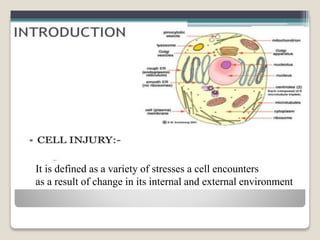
It is defined as a variety of stresses a cell encounters
as a result of change in its internal and external environment
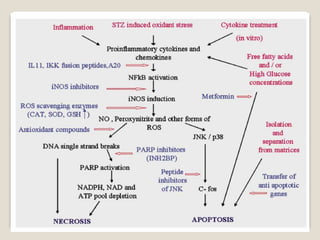
Flow chart (last page) depicts apoptotic and necrotic beta cell death
cascades along with possible modes of intervention. Causes/agents
of beta cell death are indicated in red while agents/strategies for
prevention of beta cell damage are indicated in blue. Red arrows
stand for possible sites of intervention. IL-11: Interleukin 11, IKK:
Inhibitor of kappa kinase, iNOS: inducible nitric oxide synthase,
NO, Nitric oxide, STZ: Streptozotocin, ROS: Reactive oxygen
species, PARP: Poly (ADP-Ribose) Polymerase, CAT: Catalase:
SOD, superoxide dismutase; GSH: glutathione peroxidase, NF-kB:
Nuclear Factor kappa B.
Mechanisms of (islet) cell death.
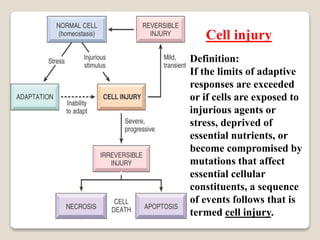
Definition:
If the limits of adaptive
responses are exceeded
or if cells are exposed to
injurious agents or
stress, deprived of
essential nutrients, or
become compromised by
mutations that affect
essential cellular
constituents, a sequence
of events follows that is
termed cell injury.
Cell injury
Overview of Cell Injury •
Cells actively control the composition of their
immediate environment and intracellular milieu
within a narrow range of physiological parameters
(“homeostasis ”) • Under physiological stresses or
pathological stimuli (“injury”), cells can undergo
adaptation to achieve a new steady state that would
be compatible with their viability in the new
environment. • If the injury is too severe
(“irreversible injury”), the affected cells die.
Causes of Cell Injury
•Hypoxia and ischemia
• Chemical” agents
•“Physical” agents
•Infections
•Immunological reactions
•Genetic defects
•Nutritional defects
•Aging
Apoptosis
A natural process of self-
destruction by degradative enzymes in certain cells, such as
epithelial cells and erythrocytes,
that are genetically programmed to have a limited lifespan or
are damaged, as by irradiation or toxic drugs.
Also called programmed cell death.
Necrosis
Pathologic death of one or more cells, or of a portion of tissue or
organ, resulting from irreversible damage; earliest irreversible
changes are mitochondrial, consisting of swelling and granular
calcium deposits seen by electron microscopy; most frequent
visible alterations are nuclear: pyknosis, shrunken and abnormally
dark basophilic staining; karyolysis, swollen and abnormally pale
basophilic staining; or karyorrhexis, rupture, and fragmentation of
the nucleus.
After such changes, the outlines of individual cells are indistinct
& affected cells may merge, sometimes forming focus
of coarsely granular, amorphous, or hyaline material.
Necrosis – phenomenon continued
( referred as Death of some or all cells in an organ or tissue).
The process involves swelling of the nucleus (pyknosis),
fragmentation
of nucleus (karyorrhexis) and complete dissolution of the
nuclear chromatin (karyolysis). Necrosis is caused by disease,
Trauma* or interference with blood supply.
There are many sequelae to ocular necrosis (e.g. inflammation,
reduction in aqueous humour production following ciliary
epithelium necrosis, corneal opacity following necrosis of
corneal epithelial cells, and visual loss and floaters following
retinal necrosis).
*Trauma is often the result of an overwhelming amount of stress that exceeds
one's ability to cope, or integrate the emotions involved with that experience.
Types Of Necrosis
There are six types of Necrosis:
•Coagulative necrosis
•Liquefactive necrosis
•Caseous necrosis
•Fat necrosis
•Fibroid necrosis
•Gangrenous necrosis
The type of necrosis can often be categorized based on how the
cells look after death. Sometimes the entire cell loses its
structure, and sometimes the outer architecture remains the same
and only the inside is affected.
More Common Types
Aseptic necrosis necrosis without infection or inflammation.
Caseous necrosis in which the tissue is soft, dry and cheesy, occurring typical
ly in tuberculosis.
Central necrosis affecting the central portion of an affected bone, cell or
lobule of the liver.
cheesy necrosis in which the tissue resembles cottage cheese; most often seen
in tuberculosis.
coagulation necrosisdeath of cells, the protoplasm of the cells becoming fixed
and opaque by coagulation of the protein elements, the
cellular outline persisting for a long time.
colliquative necrosis see liquefactive necrosis (below).
liquefactive necrosis when necrotic material becomes softened and liquefied.
moist necrosis here the dead tissue is wet and soft.
Zenker's necrosis wherein occurs the
hyaline degeneration and necrosis of striated muscle; also called Zenker's
degeneration.
Apoptosis & Necrosis
In General, there are two steps that occur when a cell dies:
1. Proteins inside the cell break down
2. The body releases enzymes that digest these dead cells
The apoptosis process is a natural part of the cell's life cycle, and the body is
ready to carry the dead cell materials away. In necrosis, however, the body isn't
prepared to remove the dead cells, and as a result, causes an inflammatory
response.
Cells need blood to live, and any interruption to blood flow results in necrosis.
Injury, infection, disease, toxins, and many other factors can block blood from
getting to a cell and cause unnatural death. Sometimes a dead cell releases
chemicals that can affect the nearby cells, spreading necrosis to wide areas in a
condition called gangrene, which occurs when tissues in certain areas, usually
the hands and feet, die. Again, a dead cell can't turn back into a living one, so
the only cure for gangrene is to amputate the area.
Sub cellular Responses: Autophagy is a common phenomenon involved in the
removal of damaged organelles during cell injury and the cellular remodeling of
differentiation, and it is particularly pronounced in cells undergoing atrophy
induced by nutrient deprivation or hormonal involution.

Pathology & micro biology intro

  • 1.
    INTRODUCTION PATHOLOGY 1. It isthe study of nature & cause of disease which involves changes in structure and function 2. The aspects of a disease process that form the core of pathology include: 3. its cause, the pathogenesis that is the sequence of events which give rise to the manifestations of the disease), and 4. the morphologic changes (structural alterations induced in cells & tissues by the disease
  • 2.
    What is Pathology? Pathology is the study of patterns, causes, mechanisms and effects of illness (disease)  To interpret symptoms and signs it is important to know the range of abnormalities possible in an organ system  Basis of differential diagnosis
  • 3.
    Pathology clinical disciplines Histopathology  Haematology  Clinical chemistry  Immunology  Microbiology  Genetics
  • 4.
    Pathology - diagnostictools  Structural examination ◦ Fluid and tissue cytology ◦ Biopsy ◦ Autopsy
  • 5.
    Pathology encompasses all aspectsof disease  Genetic function  Physiological/ biochemical function  Structural abnormalities ◦ Cells ◦ Tissues ◦ Organs
  • 6.
    Aetiology  The rootcause of a disease process • Genetic • Environmental agent • Immune • Infective • Neoplastic • Primary inflammatory • Vascular • Iatrogenic
  • 7.
    Pathogenesis  The molecular,physiological and cellular mechanisms that occur after the first injury and which lead to the expression of a disease  Understanding pathogenesis is important in choosing, or developing, an appropriate therapy
  • 8.
    Natural history  Thecourse of a disease process ◦ Untreated ◦ Modified by therapy  Prognosis* ◦ Disability ◦ Disease-free survival ◦ Survival * With its prefix pro-, meaning "before", prognosis means basically "knowledge beforehand" of how a situation is likely to turn out. Prognosis was originally a strictly medical term, but it soon broadened to include predictions made by experts of all kinds. Thus, for example, economists are constantly offering prognoses (notice the irregular plural form) about where the economy is going, and climate scientists regularly prognosticate about how quickly the earth's atmosphere is warming. Diagnosis: the process of determining by examination the nature and circumstances of a diseased condition i.e. the decision reached from such examination. Abbreviation: Dx.
  • 9.
    Sequelae  The clinicaland pathological consequences of a disease process (A sequela (UK: /sᵻˈkwiːlə/, US: /sᵻˈkwɛlə/; usually used in the plural, sequelae) is a pathological condition resulting from a disease, injury, therapy, or other trauma. Typically, a sequela is a chronic condition that is a complication which follows a more acute condition)
  • 10.
    Studying Pathology  Thisis a GOOD thing…  Pathology enters all disciplines of medicine  Pathology is the bedrock of good clinical medicine ◦ General Pathology ◦ Systems Pathology
  • 11.
    Pathological Manifestations  Adaptationof cells to environmental changes  What happens to cells when they cannot adapt and how they die  Disorders due to abnormal cell growth, for example cancer  Tissue responses to injury and how tissues heal
  • 12.
     Atheroma* anddisease of blood vessels  Thrombosis and infarction  Tumour pathology ◦ Classification and nomenclature ◦ Behaviour and diagnosis ◦ Causation and cell biology  Revision genetics * Atheroma :degeneration of the walls of the arteries caused by accumulated fatty deposits and scar tissue, and leading to restriction of the circulation and a risk of thrombosis. As well, the fatty material which forms deposits in the arteries.
  • 13.
     Systems pathologycontinues through the whole of the clinical course  Pathology tutorial system with guided reading  Probably 40% of the content of all examinations in clinical course consist of Pathology
  • 14.
    It is definedas a variety of stresses a cell encounters as a result of change in its internal and external environment
  • 16.
    Flow chart (lastpage) depicts apoptotic and necrotic beta cell death cascades along with possible modes of intervention. Causes/agents of beta cell death are indicated in red while agents/strategies for prevention of beta cell damage are indicated in blue. Red arrows stand for possible sites of intervention. IL-11: Interleukin 11, IKK: Inhibitor of kappa kinase, iNOS: inducible nitric oxide synthase, NO, Nitric oxide, STZ: Streptozotocin, ROS: Reactive oxygen species, PARP: Poly (ADP-Ribose) Polymerase, CAT: Catalase: SOD, superoxide dismutase; GSH: glutathione peroxidase, NF-kB: Nuclear Factor kappa B. Mechanisms of (islet) cell death.
  • 17.
    Definition: If the limitsof adaptive responses are exceeded or if cells are exposed to injurious agents or stress, deprived of essential nutrients, or become compromised by mutations that affect essential cellular constituents, a sequence of events follows that is termed cell injury. Cell injury
  • 18.
    Overview of CellInjury • Cells actively control the composition of their immediate environment and intracellular milieu within a narrow range of physiological parameters (“homeostasis ”) • Under physiological stresses or pathological stimuli (“injury”), cells can undergo adaptation to achieve a new steady state that would be compatible with their viability in the new environment. • If the injury is too severe (“irreversible injury”), the affected cells die.
  • 19.
    Causes of CellInjury •Hypoxia and ischemia • Chemical” agents •“Physical” agents •Infections •Immunological reactions •Genetic defects •Nutritional defects •Aging
  • 20.
    Apoptosis A natural processof self- destruction by degradative enzymes in certain cells, such as epithelial cells and erythrocytes, that are genetically programmed to have a limited lifespan or are damaged, as by irradiation or toxic drugs. Also called programmed cell death.
  • 21.
    Necrosis Pathologic death ofone or more cells, or of a portion of tissue or organ, resulting from irreversible damage; earliest irreversible changes are mitochondrial, consisting of swelling and granular calcium deposits seen by electron microscopy; most frequent visible alterations are nuclear: pyknosis, shrunken and abnormally dark basophilic staining; karyolysis, swollen and abnormally pale basophilic staining; or karyorrhexis, rupture, and fragmentation of the nucleus. After such changes, the outlines of individual cells are indistinct & affected cells may merge, sometimes forming focus of coarsely granular, amorphous, or hyaline material.
  • 22.
    Necrosis – phenomenoncontinued ( referred as Death of some or all cells in an organ or tissue). The process involves swelling of the nucleus (pyknosis), fragmentation of nucleus (karyorrhexis) and complete dissolution of the nuclear chromatin (karyolysis). Necrosis is caused by disease, Trauma* or interference with blood supply. There are many sequelae to ocular necrosis (e.g. inflammation, reduction in aqueous humour production following ciliary epithelium necrosis, corneal opacity following necrosis of corneal epithelial cells, and visual loss and floaters following retinal necrosis). *Trauma is often the result of an overwhelming amount of stress that exceeds one's ability to cope, or integrate the emotions involved with that experience.
  • 23.
    Types Of Necrosis Thereare six types of Necrosis: •Coagulative necrosis •Liquefactive necrosis •Caseous necrosis •Fat necrosis •Fibroid necrosis •Gangrenous necrosis The type of necrosis can often be categorized based on how the cells look after death. Sometimes the entire cell loses its structure, and sometimes the outer architecture remains the same and only the inside is affected.
  • 24.
    More Common Types Asepticnecrosis necrosis without infection or inflammation. Caseous necrosis in which the tissue is soft, dry and cheesy, occurring typical ly in tuberculosis. Central necrosis affecting the central portion of an affected bone, cell or lobule of the liver. cheesy necrosis in which the tissue resembles cottage cheese; most often seen in tuberculosis. coagulation necrosisdeath of cells, the protoplasm of the cells becoming fixed and opaque by coagulation of the protein elements, the cellular outline persisting for a long time. colliquative necrosis see liquefactive necrosis (below). liquefactive necrosis when necrotic material becomes softened and liquefied. moist necrosis here the dead tissue is wet and soft. Zenker's necrosis wherein occurs the hyaline degeneration and necrosis of striated muscle; also called Zenker's degeneration.
  • 25.
    Apoptosis & Necrosis InGeneral, there are two steps that occur when a cell dies: 1. Proteins inside the cell break down 2. The body releases enzymes that digest these dead cells The apoptosis process is a natural part of the cell's life cycle, and the body is ready to carry the dead cell materials away. In necrosis, however, the body isn't prepared to remove the dead cells, and as a result, causes an inflammatory response. Cells need blood to live, and any interruption to blood flow results in necrosis. Injury, infection, disease, toxins, and many other factors can block blood from getting to a cell and cause unnatural death. Sometimes a dead cell releases chemicals that can affect the nearby cells, spreading necrosis to wide areas in a condition called gangrene, which occurs when tissues in certain areas, usually the hands and feet, die. Again, a dead cell can't turn back into a living one, so the only cure for gangrene is to amputate the area. Sub cellular Responses: Autophagy is a common phenomenon involved in the removal of damaged organelles during cell injury and the cellular remodeling of differentiation, and it is particularly pronounced in cells undergoing atrophy induced by nutrient deprivation or hormonal involution.