metastasis

ali hatami
ehsan arabi

1
What is cancer metastasis?
 Cancer defines as a population of cells that
have lost their normal controls of growth and
differentiation and are proliferating without
check
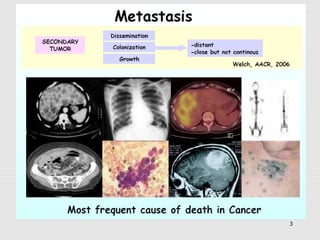
 Metastasis is the process by which a tumor
cell leaves the primary tumor, travels to a
distant site via the circulatory system, and
establishes a secondary tumor
2
3
5 major steps in metastasis
1. Invasion and infiltration of surrounding normal
host tissue
2. Release of neoplastic cells
3. Survival in the circulation
4. Arrest in the capillary beds of distant organs
5. Penetration of the lymphatic or blood vessel
walls followed by growth of the disseminated
tumor cells

4
5
6
Metastatic Growth in the Liver

7
Routes of Metastasis
 Through the circulatory (blood) system
(hematogenous)
 Through the lymphatic system
 Through the body wall into the
abdominal and chest cavities
(transcoelomic)
8
Cell movement

9
a) Matrix degrading enzymes
 Required for a controlled degradation
of components of the extracellular
matrix (ECM)
 The proteases involved in this process
are classified into serine-, cysteine-,
aspartyl-, and metalloproteinase.

10
Matrix metalloproteinases (MMP)
 16 members, subdivided into 4 groups, based
on their structural characteristics and
substrate specificities
 Soluble and secreted groups; collagenase,
gelatinase and stromelysins
 Membrane type (MT-MMP) group are
anchored in the plasma membrane
 A zinc ion in the active centre of the protease
is required for their catalytic activities.
11
MMP family

12
Serine proteases
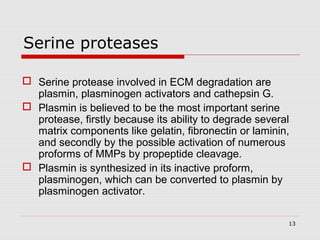
 Serine protease involved in ECM degradation are
plasmin, plasminogen activators and cathepsin G.
 Plasmin is believed to be the most important serine
protease, firstly because its ability to degrade several
matrix components like gelatin, fibronectin or laminin,
and secondly by the possible activation of numerous
proforms of MMPs by propeptide cleavage.
 Plasmin is synthesized in its inactive proform,
plasminogen, which can be converted to plasmin by
plasminogen activator.
13
Migrating cancer cells can die from a
variety of causes
 Detachment from the surface of other cells can
lead to cell death (called anoikis 'an-oh-e-kus')
 When Cancer cells travel through the vessels
they can get damaged or stuck, leading to cell
death
 Cancer cells can be recognized and destroyed
by cells of the immune system
 The cells may exist at locations far from the
original tumor without multiplying enough to
cause any problems
14
Reason for organ selectivity
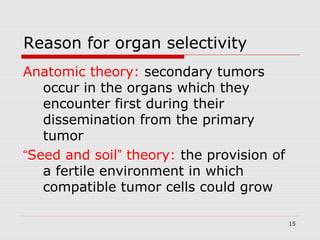
Anatomic theory: secondary tumors
occur in the organs which they
encounter first during their
dissemination from the primary
tumor
“Seed and soil” theory: the provision of
a fertile environment in which
compatible tumor cells could grow
15
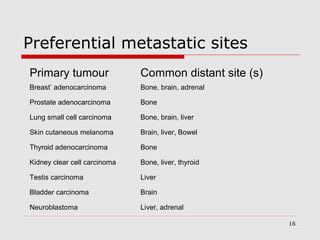
Preferential metastatic sites
Primary tumour

Common distant site (s)

Breast’ adenocarcinoma

Bone, brain, adrenal

Prostate adenocarcinoma

Bone

Lung small cell carcinoma

Bone, brain, liver

Skin cutaneous melanoma

Brain, liver, Bowel

Thyroid adenocarcinoma

Bone

Kidney clear cell carcinoma

Bone, liver, thyroid

Testis carcinoma

Liver

Bladder carcinoma

Brain

Neuroblastoma

Liver, adrenal
16
17

Metastasis

  • 1.
  • 2.
    What is cancermetastasis?  Cancer defines as a population of cells that have lost their normal controls of growth and differentiation and are proliferating without check  Metastasis is the process by which a tumor cell leaves the primary tumor, travels to a distant site via the circulatory system, and establishes a secondary tumor 2
  • 3.
  • 4.
    5 major stepsin metastasis 1. Invasion and infiltration of surrounding normal host tissue 2. Release of neoplastic cells 3. Survival in the circulation 4. Arrest in the capillary beds of distant organs 5. Penetration of the lymphatic or blood vessel walls followed by growth of the disseminated tumor cells 4
  • 5.
  • 6.
  • 7.
  • 8.
    Routes of Metastasis Through the circulatory (blood) system (hematogenous)  Through the lymphatic system  Through the body wall into the abdominal and chest cavities (transcoelomic) 8
  • 9.
  • 10.
    a) Matrix degradingenzymes  Required for a controlled degradation of components of the extracellular matrix (ECM)  The proteases involved in this process are classified into serine-, cysteine-, aspartyl-, and metalloproteinase. 10
  • 11.
    Matrix metalloproteinases (MMP) 16 members, subdivided into 4 groups, based on their structural characteristics and substrate specificities  Soluble and secreted groups; collagenase, gelatinase and stromelysins  Membrane type (MT-MMP) group are anchored in the plasma membrane  A zinc ion in the active centre of the protease is required for their catalytic activities. 11
  • 12.
  • 13.
    Serine proteases  Serineprotease involved in ECM degradation are plasmin, plasminogen activators and cathepsin G.  Plasmin is believed to be the most important serine protease, firstly because its ability to degrade several matrix components like gelatin, fibronectin or laminin, and secondly by the possible activation of numerous proforms of MMPs by propeptide cleavage.  Plasmin is synthesized in its inactive proform, plasminogen, which can be converted to plasmin by plasminogen activator. 13
  • 14.
    Migrating cancer cellscan die from a variety of causes  Detachment from the surface of other cells can lead to cell death (called anoikis 'an-oh-e-kus')  When Cancer cells travel through the vessels they can get damaged or stuck, leading to cell death  Cancer cells can be recognized and destroyed by cells of the immune system  The cells may exist at locations far from the original tumor without multiplying enough to cause any problems 14
  • 15.
    Reason for organselectivity Anatomic theory: secondary tumors occur in the organs which they encounter first during their dissemination from the primary tumor “Seed and soil” theory: the provision of a fertile environment in which compatible tumor cells could grow 15
  • 16.
    Preferential metastatic sites Primarytumour Common distant site (s) Breast’ adenocarcinoma Bone, brain, adrenal Prostate adenocarcinoma Bone Lung small cell carcinoma Bone, brain, liver Skin cutaneous melanoma Brain, liver, Bowel Thyroid adenocarcinoma Bone Kidney clear cell carcinoma Bone, liver, thyroid Testis carcinoma Liver Bladder carcinoma Brain Neuroblastoma Liver, adrenal 16
  • 17.