Wound Healing
1
Overview
 Wounds
 Wound Healing Process (WHP)
 Chronic Wounds
 Wound Care
10/27/2017
2
Overview
 Wounds
 Wound Healing Process (WHP)
 Chronic Wounds
 Wound Care
10/27/2017
3
Wound
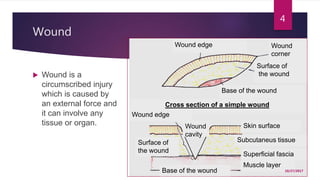
 Wound is a
circumscribed injury
which is caused by
an external force and
it can involve any
tissue or organ.
Wound edge Wound
corner
Surface of
the wound
Base of the wound
Cross section of a simple wound
Skin surface
Subcutaneus tissue
Superficial fascia
Muscle layer
Base of the wound
Wound edge
Surface of
the wound
Wound
cavity
10/27/2017
4
DEFINITION OF A WOUND
A wound is a break in the skin, which may result from physical, mechanical or thermal
damage, or develop as a result of the presence of an underlying medical or
physiological disorder. For example:
 Physical damage: pressure ulcers
 Mechanical damage: abrasions, grazes, lacerations, knife wounds (surgery), or
bullet wounds and bites etc.
 Thermal damage: burns caused by flames, chemicals, radiation, friction or
electricity and frostbite.
 Medical or physiological disorder: arterial or venous ulcers, autoimmune,
endocrine, dermatology and haematological disorders, wounds associated with
certain systemic infections, malignant diseases or neuropathy.
10/27/2017
5
Wounds
 Intentional Wounds: result from planned treatment
 Unintentional Wounds: result from unexpected trauma…accident/ burns/ shooting
 Open Wounds: skin broken, portal of entry
 Closed Wounds: trauma from force, skin intact, soft tissue damage, internal injury, possible
bleeding
 Acute Wounds: go through normal/timely healing process
 Chronic Wounds: fail to go through normal stages of healing; no timely progress in
healing
10/27/2017
6
Wound Classification
 Accidental Wounds
 Based on the bacterial contamination
 Based on the depth of wounds
10/27/2017
7
Accidental Wounds
Classification based on origin
Wounds caused by
 Mechanical forces
 Chemicals
 Radiation
 Thermal forces
 Special
10/27/2017
8
Accidental Wounds
Classification based on origin
10/27/2017
9
 Mechanical
 Abraded wound (vulnus abrasum)
 Puncured wound (v. punctum)
 Incised wound (v. scissum)
 Cut wound (v. caesum)
 Crush wound (v. contusum)
 Torn wound (v. lacerum)
 Bite wound (v. morsum)
 Shot wound (v. sclopetarium)
 Chemical
 Acid
 Base
 Wounds caused by radiation
 Wounds caused by thermal forces
 Burning
 Freezing
 Special
 Toxic, venoms
10/27/2017
Classification of wounds
Based on bacterial contamination
 Clean wound
 Clean-contaminated wound
 Contaminated wound
 Heavily contaminated or dirty wound
10/27/2017
10
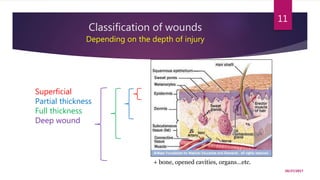
Classification of wounds
Depending on the depth of injury
Superficial
Partial thickness
Full thickness
Deep wound
+ bone, opened cavities, organs…etc.
10/27/2017
11
Acute and Chronic Wounds
 Acute wounds in normal, healthy individuals heal through an
orderly sequence of physiological events that include
hemostasis, inflammation, epithelialization, fibroplasia, and
maturation.
 When this process is altered, a chronic wound may develop
and is more likely to occur in patients with underlying
disorders such as peripheral artery disease, diabetes, venous
insufficiency, nutritional deficiencies, and other disease states.
10/27/2017
12
Overview
 Wounds
 Wound Healing Process (WHP)
 Chronic Wounds
 Wound Care
10/27/2017
13
Wound Healing
The purpose of acute inflammation is to eliminate the pathogenic insult and
remove injured tissue.
 Healing is the restoration of integrity to an injured tissue.
 Regeneration is the renewal of a lost tissue or part in which the lost cells are
replaced by identical ones through proliferation.
 Repair is the orderly process by which a wound is eventually replaced by a scar.
10/27/2017
14
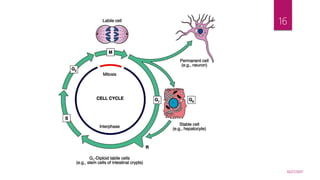
Classification of cells by proliferative
potential
 Labile cells are found in tissues that are in a constant state of renewal (skin).
 Stable cells are found in tissues that normally are renewed very slowly (liver).
 Permanent cells are terminally differentiated and have lost all capacity for
regeneration (neurons).
10/27/2017
15
10/27/2017
16
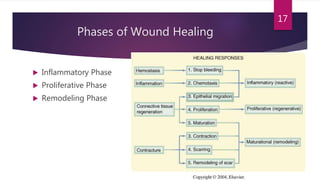
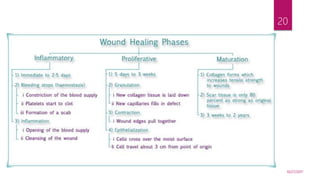
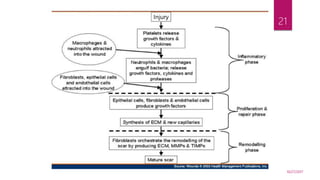
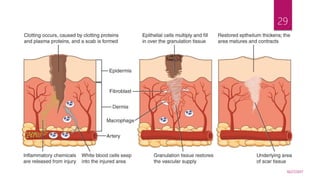
Phases of Wound Healing
 Inflammatory Phase
 Proliferative Phase
 Remodeling Phase
10/27/2017
17
10/27/2017
18
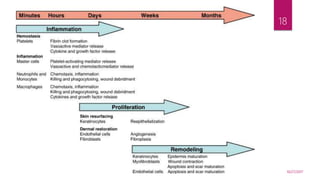
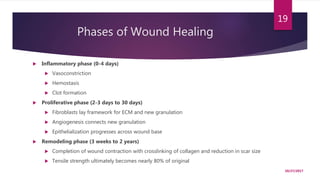
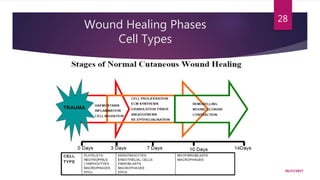
Phases of Wound Healing
 Inflammatory phase (0-4 days)
 Vasoconstriction
 Hemostasis
 Clot formation
 Proliferative phase (2-3 days to 30 days)
 Fibroblasts lay framework for ECM and new granulation
 Angiogenesis connects new granulation
 Epithelialization progresses across wound base
 Remodeling phase (3 weeks to 2 years)
 Completion of wound contraction with crosslinking of collagen and reduction in scar size
 Tensile strength ultimately becomes nearly 80% of original
10/27/2017
19
10/27/2017
20
10/27/2017
21
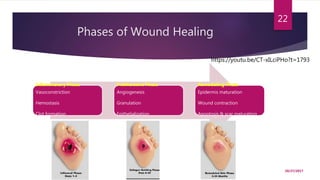
Phases of Wound Healing
Inflammatory Phase
Vasoconstriction
Hemostasis
Clot formation
Proliferative Phase
Angiogenesis
Granulation
Epithelialization
Remodeling Phase
Epidermis maturation
Wound contraction
Apoptosis & scar maturation
10/27/2017
22
https://youtu.be/CT-xILciPHo?t=1793
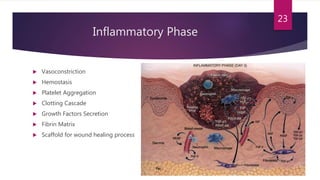
Inflammatory Phase
 Vasoconstriction
 Hemostasis
 Platelet Aggregation
 Clotting Cascade
 Growth Factors Secretion
 Fibrin Matrix
 Scaffold for wound healing process
10/27/2017
23
Selected growth factors important to
wound healing
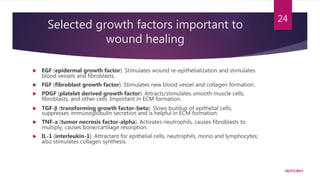
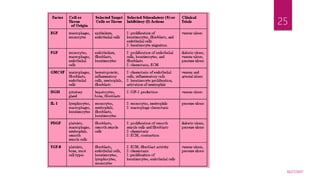
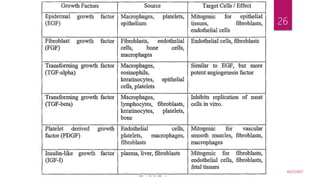
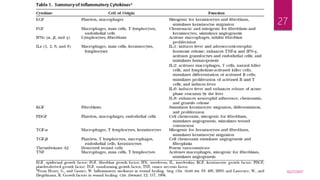
 EGF (epidermal growth factor). Stimulates wound re-epithelialization and stimulates
blood vessels and fibroblasts.
 FGF (fibroblast growth factor). Stimulates new blood vessel and collagen formation.
 PDGF (platelet derived growth factor). Attracts/stimulates smooth muscle cells,
fibroblasts, and other cells. Important in ECM formation.
 TGF-β (transforming growth factor-beta). Slows buildup of epithelial cells,
suppresses immunoglobulin secretion and is helpful in ECM formation.
 TNF-a (tumor necrosis factor-alpha). Activates neutrophils, causes fibroblasts to
multiply, causes bone/cartilage resorption.
 IL-1 (interleukin-1). Attractant for epithelial cells, neutrophils, mono and lymphocytes;
also stimulates collagen synthesis.
10/27/2017
24
10/27/2017
25
10/27/2017
26
10/27/2017
27
Wound Healing Phases
Cell Types
10/27/2017
28
10/27/2017
29
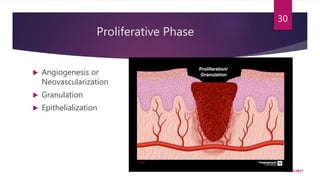
Proliferative Phase
 Angiogenesis or
Neovascularization
 Granulation
 Epithelialization
10/27/2017
30
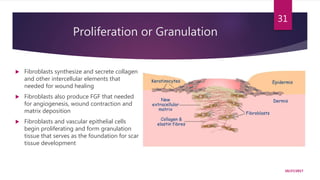
Proliferation or Granulation
10/27/2017
31
 Fibroblasts synthesize and secrete collagen
and other intercellular elements that
needed for wound healing
 Fibroblasts also produce FGF that needed
for angiogenesis, wound contraction and
matrix deposition
 Fibroblasts and vascular epithelial cells
begin proliferating and form granulation
tissue that serves as the foundation for scar
tissue development
Remodeling Phase
 The principle cell involved in this process is the fibroblast. When the levels of
collagen production and degradation equalize, the maturation phase of tissue
repair is said to have begun] During maturation, type III collagen, which is
prevalent during proliferation, is replaced by type I collagen. Originally
disorganized collagen fibers are rearranged, cross-linked, and aligned along
tension lines.
 Remodeling can take up to 2 years after wounding.
10/27/2017
32
Overview
 Wounds
 Wound Healing Process (WHP)
 Chronic Wounds
 Wound Care
10/27/2017
33
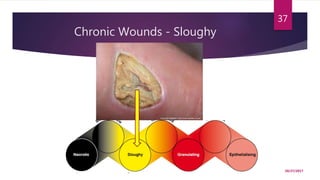
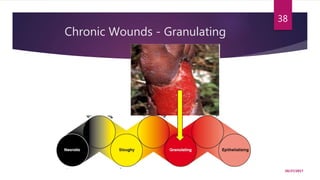
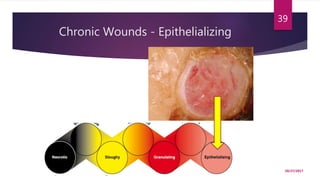
Chronic Wounds
 Acute wounds in normal, healthy individuals heal through an orderly
sequence of physiological events that include hemostasis, inflammation,
epithelialization, fibroplasia, and maturation.
 Chronic wounds are arrested in one of these stages, usually the
inflammatory stage, and cannot progress further.
 Chronic wounds are generally associated with physiological impairments
that slow or prevent wound healing. When this process is altered, a chronic
wound may develop and is more likely to occur in patients with underlying
disorders such as peripheral artery disease, diabetes, venous insufficiency,
nutritional deficiencies, and other disease states.
10/27/2017
34
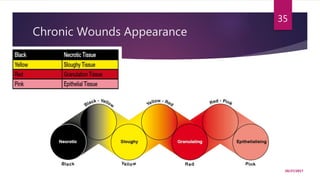
Chronic Wounds Appearance
10/27/2017
35
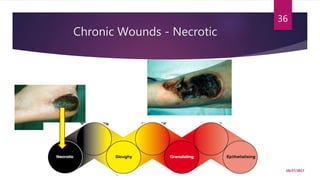
Chronic Wounds - Necrotic
10/27/2017
36
Chronic Wounds - Sloughy
10/27/2017
37
Chronic Wounds - Granulating
10/27/2017
38
Chronic Wounds - Epithelializing
10/27/2017
39
Impaired Wound Healing
Local Factors
 Inadequate blood supply
 Increased skin tension
 Poor surgical apposition
 Wound dehiscence
 Poor venous drainage
 Presence of foreign body and foreign body
reactions
 Continued presence of micro-organisms &
Infection
 Excess local mobility, such as over a joint
Systemic Factors
 Advancing age and general immobility
 Obesity
 Smoking
 Malnutrition
 Deficiency of vitamins and trace elements
 Systemic malignancy and terminal illness Shock of
any cause
 Chemotherapy and radiotherapy
 Immunosuppressant drugs, corticosteroids,
anticoagulants
 Inherited neutrophil disorders, such as leucocyte
adhesion deficiency
 Diabetes and CRF
10/27/2017
40
Overview
 Wounds
 Wound Healing Process (WHP)
 Chronic Wounds
 Wound Care
10/27/2017
41
Factors Affecting Wound Healing
An individual's ability to heal and the time required can vary greatly, and are influenced by the following factors, which
should be taken into consideration during assessment:
 General physical and psychological health and type and level of concurrent illnesses
 Treatment: systemically and locally
 Nutritional and hydration status
 Type of wound, location, depth and extent of damage and type of tissue in wound
 Wound temperature, moisture level and pH balance
 Levels of bacterial colonisation and infection
 Blood supply to the wound and surrounding area & oedema of surrounding tissues
 Disruption to normal sleep pattern
 History of smoking and alcohol consumption
 Medications such as steroids, immune-suppressants and chemotherapy.
 environment
10/27/2017
42
Wound Management
 Wound Bed Preparation (WBP)
 Wound Debridement
 Infection Prevention & Control
 Effective Exudate Management
10/27/2017
43
Wound Management
 Wound Debridement: Debridement is the removal of necrotic, devitalised, sloughy or infected tissue,
or foreign bodies from a wound. The body can debride itself by a natural process called autolysis;
however, this may take time if large amounts of slough are present. Slough can provide an environment
for bacteria to thrive, increasing the risk of infection. Debridement is recommended as a principle of
wound management
 Autolytic debridement: where the body gradually sheds itself of devitalised tissue. This process can be
augmented by the use of dressings such as hydrogels, hydrocolloids or capillary action dressings, alginates,
foams, antiseptic dressings.
 Bio-surgery: sterile larvae (maggots)
 Sharp debridement: using a sterile blade, scalpel or scissors. This should only be undertaken by a healthcare
professional with specific training and competence.
 Surgical debridement: used when there is an urgent clinical need to remove or drain devitalised tissue and when
fast debridement would speed patient recovery. If this is required the patient should be referred to a surgeon.
10/27/2017
44
Wound Management
 Effective Exudate Management: PRINCIPLE OF MOISTURE BALANCE
 Drier wounds, (except those with poor circulation), should be moistened with
dressings that hydrate tissue, e.g. hydrogels, hydrocolloid sheets and pastes.
 Wounds with excess exudate require dressings that absorb or control fluid, e.g.
alginates, hydrofibres, capillary action, foams, Negative Pressure Wound
Therapy (NPWT) and compression bandages and hosiery.
 Surrounding intact skin should be protected from exudate with barrier films,
creams and absorbent dressings as it can cause excoriation.
10/27/2017
45
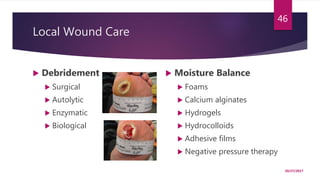
Local Wound Care
 Debridement
 Surgical
 Autolytic
 Enzymatic
 Biological
 Moisture Balance
 Foams
 Calcium alginates
 Hydrogels
 Hydrocolloids
 Adhesive films
 Negative pressure therapy
10/27/2017
46
10/27/2017
47
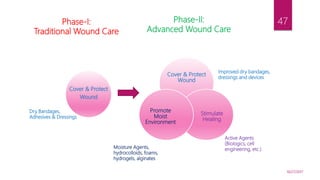
Cover & Protect
Wound
Stimulate
Healing
Promote
Moist
Environment
Cover & Protect
Wound
Phase-I:
Traditional Wound Care
Phase-II:
Advanced Wound Care
Dry Bandages,
Adhesives & Dressings
Moisture Agents,
hydrocolloids, foams,
hydrogels, alginates
Improved dry bandages,
dressings and devices
Active Agents
(Biologics, cell
engineering, etc.)
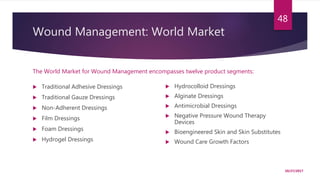
Wound Management: World Market
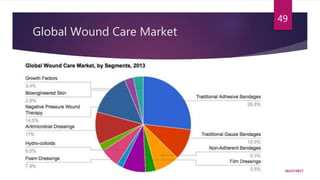
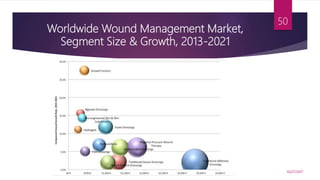
The World Market for Wound Management encompasses twelve product segments:
 Traditional Adhesive Dressings
 Traditional Gauze Dressings
 Non-Adherent Dressings
 Film Dressings
 Foam Dressings
 Hydrogel Dressings
 Hydrocolloid Dressings
 Alginate Dressings
 Antimicrobial Dressings
 Negative Pressure Wound Therapy
Devices
 Bioengineered Skin and Skin Substitutes
 Wound Care Growth Factors
10/27/2017
48
Global Wound Care Market
10/27/2017
49
Worldwide Wound Management Market,
Segment Size & Growth, 2013-2021
10/27/2017
50
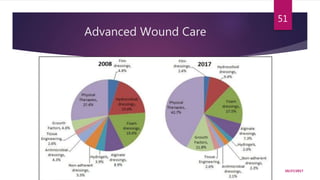
Advanced Wound Care
10/27/2017
51
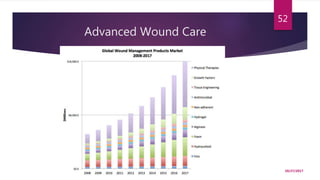
Advanced Wound Care
10/27/2017
52

Wound healing

  • 1.
  • 2.
    Overview  Wounds  WoundHealing Process (WHP)  Chronic Wounds  Wound Care 10/27/2017 2
  • 3.
    Overview  Wounds  WoundHealing Process (WHP)  Chronic Wounds  Wound Care 10/27/2017 3
  • 4.
    Wound  Wound isa circumscribed injury which is caused by an external force and it can involve any tissue or organ. Wound edge Wound corner Surface of the wound Base of the wound Cross section of a simple wound Skin surface Subcutaneus tissue Superficial fascia Muscle layer Base of the wound Wound edge Surface of the wound Wound cavity 10/27/2017 4
  • 5.
    DEFINITION OF AWOUND A wound is a break in the skin, which may result from physical, mechanical or thermal damage, or develop as a result of the presence of an underlying medical or physiological disorder. For example:  Physical damage: pressure ulcers  Mechanical damage: abrasions, grazes, lacerations, knife wounds (surgery), or bullet wounds and bites etc.  Thermal damage: burns caused by flames, chemicals, radiation, friction or electricity and frostbite.  Medical or physiological disorder: arterial or venous ulcers, autoimmune, endocrine, dermatology and haematological disorders, wounds associated with certain systemic infections, malignant diseases or neuropathy. 10/27/2017 5
  • 6.
    Wounds  Intentional Wounds:result from planned treatment  Unintentional Wounds: result from unexpected trauma…accident/ burns/ shooting  Open Wounds: skin broken, portal of entry  Closed Wounds: trauma from force, skin intact, soft tissue damage, internal injury, possible bleeding  Acute Wounds: go through normal/timely healing process  Chronic Wounds: fail to go through normal stages of healing; no timely progress in healing 10/27/2017 6
  • 7.
    Wound Classification  AccidentalWounds  Based on the bacterial contamination  Based on the depth of wounds 10/27/2017 7
  • 8.
    Accidental Wounds Classification basedon origin Wounds caused by  Mechanical forces  Chemicals  Radiation  Thermal forces  Special 10/27/2017 8
  • 9.
    Accidental Wounds Classification basedon origin 10/27/2017 9  Mechanical  Abraded wound (vulnus abrasum)  Puncured wound (v. punctum)  Incised wound (v. scissum)  Cut wound (v. caesum)  Crush wound (v. contusum)  Torn wound (v. lacerum)  Bite wound (v. morsum)  Shot wound (v. sclopetarium)  Chemical  Acid  Base  Wounds caused by radiation  Wounds caused by thermal forces  Burning  Freezing  Special  Toxic, venoms 10/27/2017
  • 10.
    Classification of wounds Basedon bacterial contamination  Clean wound  Clean-contaminated wound  Contaminated wound  Heavily contaminated or dirty wound 10/27/2017 10
  • 11.
    Classification of wounds Dependingon the depth of injury Superficial Partial thickness Full thickness Deep wound + bone, opened cavities, organs…etc. 10/27/2017 11
  • 12.
    Acute and ChronicWounds  Acute wounds in normal, healthy individuals heal through an orderly sequence of physiological events that include hemostasis, inflammation, epithelialization, fibroplasia, and maturation.  When this process is altered, a chronic wound may develop and is more likely to occur in patients with underlying disorders such as peripheral artery disease, diabetes, venous insufficiency, nutritional deficiencies, and other disease states. 10/27/2017 12
  • 13.
    Overview  Wounds  WoundHealing Process (WHP)  Chronic Wounds  Wound Care 10/27/2017 13
  • 14.
    Wound Healing The purposeof acute inflammation is to eliminate the pathogenic insult and remove injured tissue.  Healing is the restoration of integrity to an injured tissue.  Regeneration is the renewal of a lost tissue or part in which the lost cells are replaced by identical ones through proliferation.  Repair is the orderly process by which a wound is eventually replaced by a scar. 10/27/2017 14
  • 15.
    Classification of cellsby proliferative potential  Labile cells are found in tissues that are in a constant state of renewal (skin).  Stable cells are found in tissues that normally are renewed very slowly (liver).  Permanent cells are terminally differentiated and have lost all capacity for regeneration (neurons). 10/27/2017 15
  • 16.
  • 17.
    Phases of WoundHealing  Inflammatory Phase  Proliferative Phase  Remodeling Phase 10/27/2017 17
  • 18.
  • 19.
    Phases of WoundHealing  Inflammatory phase (0-4 days)  Vasoconstriction  Hemostasis  Clot formation  Proliferative phase (2-3 days to 30 days)  Fibroblasts lay framework for ECM and new granulation  Angiogenesis connects new granulation  Epithelialization progresses across wound base  Remodeling phase (3 weeks to 2 years)  Completion of wound contraction with crosslinking of collagen and reduction in scar size  Tensile strength ultimately becomes nearly 80% of original 10/27/2017 19
  • 20.
  • 21.
  • 22.
    Phases of WoundHealing Inflammatory Phase Vasoconstriction Hemostasis Clot formation Proliferative Phase Angiogenesis Granulation Epithelialization Remodeling Phase Epidermis maturation Wound contraction Apoptosis & scar maturation 10/27/2017 22 https://youtu.be/CT-xILciPHo?t=1793
  • 23.
    Inflammatory Phase  Vasoconstriction Hemostasis  Platelet Aggregation  Clotting Cascade  Growth Factors Secretion  Fibrin Matrix  Scaffold for wound healing process 10/27/2017 23
  • 24.
    Selected growth factorsimportant to wound healing  EGF (epidermal growth factor). Stimulates wound re-epithelialization and stimulates blood vessels and fibroblasts.  FGF (fibroblast growth factor). Stimulates new blood vessel and collagen formation.  PDGF (platelet derived growth factor). Attracts/stimulates smooth muscle cells, fibroblasts, and other cells. Important in ECM formation.  TGF-β (transforming growth factor-beta). Slows buildup of epithelial cells, suppresses immunoglobulin secretion and is helpful in ECM formation.  TNF-a (tumor necrosis factor-alpha). Activates neutrophils, causes fibroblasts to multiply, causes bone/cartilage resorption.  IL-1 (interleukin-1). Attractant for epithelial cells, neutrophils, mono and lymphocytes; also stimulates collagen synthesis. 10/27/2017 24
  • 25.
  • 26.
  • 27.
  • 28.
    Wound Healing Phases CellTypes 10/27/2017 28
  • 29.
  • 30.
    Proliferative Phase  Angiogenesisor Neovascularization  Granulation  Epithelialization 10/27/2017 30
  • 31.
    Proliferation or Granulation 10/27/2017 31 Fibroblasts synthesize and secrete collagen and other intercellular elements that needed for wound healing  Fibroblasts also produce FGF that needed for angiogenesis, wound contraction and matrix deposition  Fibroblasts and vascular epithelial cells begin proliferating and form granulation tissue that serves as the foundation for scar tissue development
  • 32.
    Remodeling Phase  Theprinciple cell involved in this process is the fibroblast. When the levels of collagen production and degradation equalize, the maturation phase of tissue repair is said to have begun] During maturation, type III collagen, which is prevalent during proliferation, is replaced by type I collagen. Originally disorganized collagen fibers are rearranged, cross-linked, and aligned along tension lines.  Remodeling can take up to 2 years after wounding. 10/27/2017 32
  • 33.
    Overview  Wounds  WoundHealing Process (WHP)  Chronic Wounds  Wound Care 10/27/2017 33
  • 34.
    Chronic Wounds  Acutewounds in normal, healthy individuals heal through an orderly sequence of physiological events that include hemostasis, inflammation, epithelialization, fibroplasia, and maturation.  Chronic wounds are arrested in one of these stages, usually the inflammatory stage, and cannot progress further.  Chronic wounds are generally associated with physiological impairments that slow or prevent wound healing. When this process is altered, a chronic wound may develop and is more likely to occur in patients with underlying disorders such as peripheral artery disease, diabetes, venous insufficiency, nutritional deficiencies, and other disease states. 10/27/2017 34
  • 35.
  • 36.
    Chronic Wounds -Necrotic 10/27/2017 36
  • 37.
    Chronic Wounds -Sloughy 10/27/2017 37
  • 38.
    Chronic Wounds -Granulating 10/27/2017 38
  • 39.
    Chronic Wounds -Epithelializing 10/27/2017 39
  • 40.
    Impaired Wound Healing LocalFactors  Inadequate blood supply  Increased skin tension  Poor surgical apposition  Wound dehiscence  Poor venous drainage  Presence of foreign body and foreign body reactions  Continued presence of micro-organisms & Infection  Excess local mobility, such as over a joint Systemic Factors  Advancing age and general immobility  Obesity  Smoking  Malnutrition  Deficiency of vitamins and trace elements  Systemic malignancy and terminal illness Shock of any cause  Chemotherapy and radiotherapy  Immunosuppressant drugs, corticosteroids, anticoagulants  Inherited neutrophil disorders, such as leucocyte adhesion deficiency  Diabetes and CRF 10/27/2017 40
  • 41.
    Overview  Wounds  WoundHealing Process (WHP)  Chronic Wounds  Wound Care 10/27/2017 41
  • 42.
    Factors Affecting WoundHealing An individual's ability to heal and the time required can vary greatly, and are influenced by the following factors, which should be taken into consideration during assessment:  General physical and psychological health and type and level of concurrent illnesses  Treatment: systemically and locally  Nutritional and hydration status  Type of wound, location, depth and extent of damage and type of tissue in wound  Wound temperature, moisture level and pH balance  Levels of bacterial colonisation and infection  Blood supply to the wound and surrounding area & oedema of surrounding tissues  Disruption to normal sleep pattern  History of smoking and alcohol consumption  Medications such as steroids, immune-suppressants and chemotherapy.  environment 10/27/2017 42
  • 43.
    Wound Management  WoundBed Preparation (WBP)  Wound Debridement  Infection Prevention & Control  Effective Exudate Management 10/27/2017 43
  • 44.
    Wound Management  WoundDebridement: Debridement is the removal of necrotic, devitalised, sloughy or infected tissue, or foreign bodies from a wound. The body can debride itself by a natural process called autolysis; however, this may take time if large amounts of slough are present. Slough can provide an environment for bacteria to thrive, increasing the risk of infection. Debridement is recommended as a principle of wound management  Autolytic debridement: where the body gradually sheds itself of devitalised tissue. This process can be augmented by the use of dressings such as hydrogels, hydrocolloids or capillary action dressings, alginates, foams, antiseptic dressings.  Bio-surgery: sterile larvae (maggots)  Sharp debridement: using a sterile blade, scalpel or scissors. This should only be undertaken by a healthcare professional with specific training and competence.  Surgical debridement: used when there is an urgent clinical need to remove or drain devitalised tissue and when fast debridement would speed patient recovery. If this is required the patient should be referred to a surgeon. 10/27/2017 44
  • 45.
    Wound Management  EffectiveExudate Management: PRINCIPLE OF MOISTURE BALANCE  Drier wounds, (except those with poor circulation), should be moistened with dressings that hydrate tissue, e.g. hydrogels, hydrocolloid sheets and pastes.  Wounds with excess exudate require dressings that absorb or control fluid, e.g. alginates, hydrofibres, capillary action, foams, Negative Pressure Wound Therapy (NPWT) and compression bandages and hosiery.  Surrounding intact skin should be protected from exudate with barrier films, creams and absorbent dressings as it can cause excoriation. 10/27/2017 45
  • 46.
    Local Wound Care Debridement  Surgical  Autolytic  Enzymatic  Biological  Moisture Balance  Foams  Calcium alginates  Hydrogels  Hydrocolloids  Adhesive films  Negative pressure therapy 10/27/2017 46
  • 47.
    10/27/2017 47 Cover & Protect Wound Stimulate Healing Promote Moist Environment Cover& Protect Wound Phase-I: Traditional Wound Care Phase-II: Advanced Wound Care Dry Bandages, Adhesives & Dressings Moisture Agents, hydrocolloids, foams, hydrogels, alginates Improved dry bandages, dressings and devices Active Agents (Biologics, cell engineering, etc.)
  • 48.
    Wound Management: WorldMarket The World Market for Wound Management encompasses twelve product segments:  Traditional Adhesive Dressings  Traditional Gauze Dressings  Non-Adherent Dressings  Film Dressings  Foam Dressings  Hydrogel Dressings  Hydrocolloid Dressings  Alginate Dressings  Antimicrobial Dressings  Negative Pressure Wound Therapy Devices  Bioengineered Skin and Skin Substitutes  Wound Care Growth Factors 10/27/2017 48
  • 49.
    Global Wound CareMarket 10/27/2017 49
  • 50.
    Worldwide Wound ManagementMarket, Segment Size & Growth, 2013-2021 10/27/2017 50
  • 51.
  • 52.