
Non-contagious Skin 
Disorders/Neoplastic Skin 
Disorders/Skin Injuries
Acne Vulgaris 
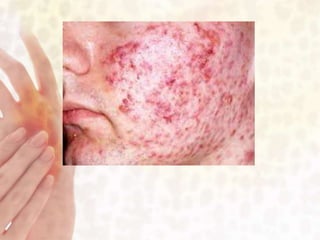
Acne vulgaris is a common chronic 
skin disease involving blockage and/or 
inflammation of pilosebaceous units (hair 
follicles and their accompanying 
sebaceous gland). Acne can present as 
non inflammatory lesions, inflammatory 
lesions, or a mixture of both, affecting 
mostly the face but also the back and 
chest
Atopic Dermatitis 
Atopic dermatitis (eczema) is a 
condition that makes your skin red and 
itchy. It's common in children but can 
occur at any age. Atopic dermatitis is long 
lasting (chronic) and tends to flare 
periodically and then subside. It may be 
accompanied by asthma or hay fever.
Contact Dermatitis 
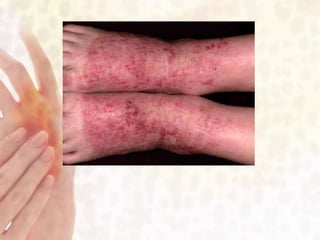
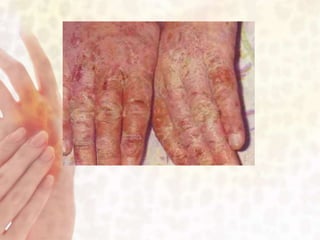
• Contact dermatitis is a red, itchy rash 
caused by a substance that comes into 
contact with your skin. The rash isn't 
contagious or life-threatening, but it can be 
very uncomfortable. 
• Possible causes include soaps, cosmetics, 
fragrances, jewelry, and plants, such as 
poison ivy or poison oak. Some people are 
exposed to substances at work that may 
cause contact dermatitis.
Contact Dermatitis 
• To treat contact dermatitis successfully, 
you need to identify and avoid the cause of 
your reaction. If you can avoid the 
offending substance, the rash usually 
clears up in two to four weeks. You can try 
soothing your skin with cool, wet 
compresses, anti-itch creams and other 
self-care steps.
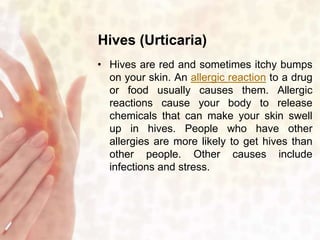
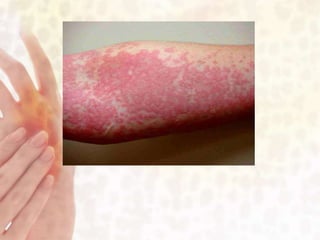
Hives (Urticaria) 
• Hives are red and sometimes itchy bumps 
on your skin. An allergic reaction to a drug 
or food usually causes them. Allergic 
reactions cause your body to release 
chemicals that can make your skin swell 
up in hives. People who have other 
allergies are more likely to get hives than 
other people. Other causes include 
infections and stress.
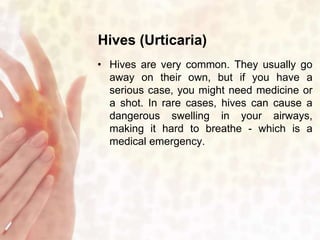
Hives (Urticaria) 
• Hives are very common. They usually go 
away on their own, but if you have a 
serious case, you might need medicine or 
a shot. In rare cases, hives can cause a 
dangerous swelling in your airways, 
making it hard to breathe - which is a 
medical emergency.
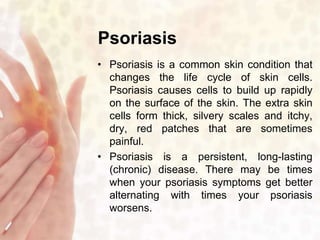
Psoriasis 
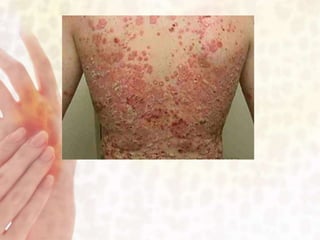
• Psoriasis is a common skin condition that 
changes the life cycle of skin cells. 
Psoriasis causes cells to build up rapidly 
on the surface of the skin. The extra skin 
cells form thick, silvery scales and itchy, 
dry, red patches that are sometimes 
painful. 
• Psoriasis is a persistent, long-lasting 
(chronic) disease. There may be times 
when your psoriasis symptoms get better 
alternating with times your psoriasis 
worsens.
Psoriasis 
• The primary goal of treatment is to stop 
the skin cells from growing so quickly. 
While there isn't a cure, psoriasis 
treatments may offer significant relief. 
Lifestyle measures, such as using a 
nonprescription cortisone cream and 
exposing your skin to small amounts of 
natural sunlight, also may improve your 
psoriasis symptoms.
Skin Cancer 
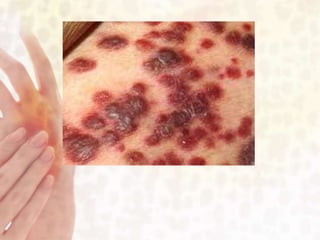
• Skin cancer — the abnormal growth of 
skin cells — most often develops on skin 
exposed to the sun. But this common form 
of cancer can also occur on areas of your 
skin not ordinarily exposed to sunlight. 
• There are three major types of skin cancer 
— basal cell carcinoma, squamous cell 
carcinoma and melanoma.
Skin Cancer 
• You can reduce your risk of skin cancer by 
limiting or avoiding exposure to ultraviolet 
(UV) radiation. Checking your skin for 
suspicious changes can help detect skin 
cancer at its earliest stages. Early 
detection of skin cancer gives you the 
greatest chance for successful skin cancer 
treatment.
Actinic Keratosis 
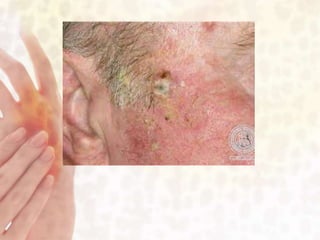
• An actinic keratosis (ak-TIN-ik ker-uh- 
TOE-sis) is a rough, scaly patch on your 
skin that develops from years of exposure 
to the sun. It's most commonly found on 
your face, lips, ears, back of your hands, 
forearms, scalp or neck. 
• Also known as solar keratosis, an actinic 
keratosis enlarges slowly and usually 
causes no signs or symptoms other than a 
patch or small spot on your skin. These 
lesions take years to develop, usually first 
appearing in older adults.
Actinic Keratosis 
• A small percentage of actinic keratosis 
lesions can eventually become skin 
cancer. You can reduce your risk of actinic 
keratosis by minimizing your sun exposure 
and protecting your skin from ultraviolet 
(UV) rays.
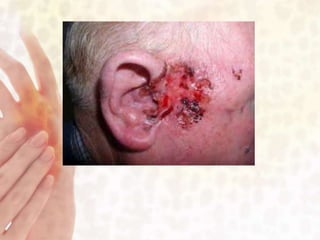
Basal Cell Carcinoma 
• Basal cell carcinoma is a type of skin 
cancer. Basal cell carcinoma begins in the 
basal cells — a type of cell within the skin 
that produces new skin cells as old ones 
die off. 
• Basal cell carcinoma often appears as a 
waxy bump, though it can take other 
forms. Basal cell carcinoma occurs most 
often on areas of the skin that are often 
exposed to the sun, such as your face and 
neck. 
•
Basal Cell Carcinoma 
• Most basal cell carcinomas are thought to 
be caused by long-term exposure to 
ultraviolet (UV) radiation from sunlight. 
Avoiding the sun and using sunscreen 
may help protect against basal cell 
carcinoma.
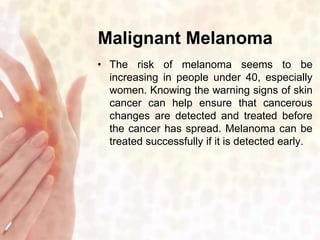
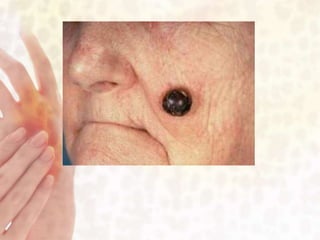
Malignant Melanoma 
• Melanoma, the most serious type of skin 
cancer, develops in the cells 
(melanocytes) that produce melanin the 
pigment that gives your skin its color. 
Melanoma can also form in your eyes and, 
rarely, in internal organs, such as your 
intestines. 
• The exact cause of all melanomas isn't 
clear, but exposure to ultraviolet (UV) 
radiation from sunlight or tanning lamps 
and beds increases your risk of developing 
melanoma. Limiting your exposure to UV 
radiation can help reduce your risk of 
melanoma.
Malignant Melanoma 
• The risk of melanoma seems to be 
increasing in people under 40, especially 
women. Knowing the warning signs of skin 
cancer can help ensure that cancerous 
changes are detected and treated before 
the cancer has spread. Melanoma can be 
treated successfully if it is detected early.
Bedsores(Pressure 
Sores) 
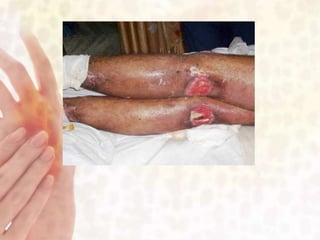
• Bedsores — also called pressure sores or 
pressure ulcers — are injuries to skin and 
underlying tissue resulting from prolonged 
pressure on the skin. Bedsores most often 
develop on skin that covers bony areas of 
the body, such as the heels, ankles, hips 
and tailbone. 
• People most at risk of bedsores are those 
with a medical condition that limits their 
ability to change positions, requires them 
to use a wheelchair or confines them to a 
bed for a long time.
Bedsores(Pressure 
Sores) 
• Bedsores can develop quickly and are 
often difficult to treat. Several things can 
help prevent some bedsores and help with 
healing.
Scar 
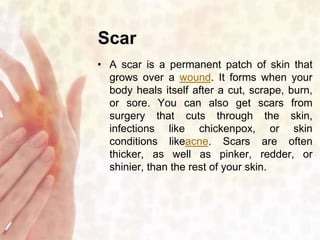
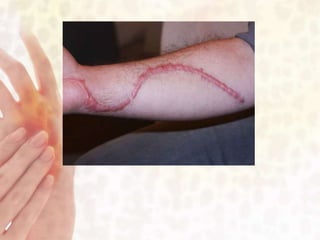
• A scar is a permanent patch of skin that 
grows over a wound. It forms when your 
body heals itself after a cut, scrape, burn, 
or sore. You can also get scars from 
surgery that cuts through the skin, 
infections like chickenpox, or skin 
conditions likeacne. Scars are often 
thicker, as well as pinker, redder, or 
shinier, than the rest of your skin.
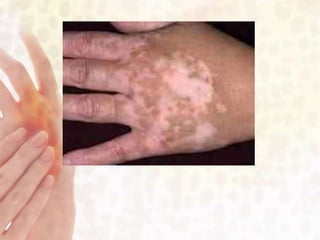
Vitiligo 
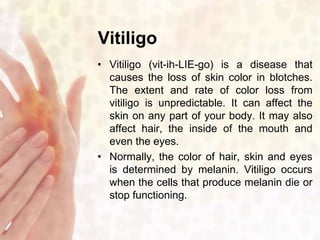
• Vitiligo (vit-ih-LIE-go) is a disease that 
causes the loss of skin color in blotches. 
The extent and rate of color loss from 
vitiligo is unpredictable. It can affect the 
skin on any part of your body. It may also 
affect hair, the inside of the mouth and 
even the eyes. 
• Normally, the color of hair, skin and eyes 
is determined by melanin. Vitiligo occurs 
when the cells that produce melanin die or 
stop functioning.
Vitiligo 
• Vitiligo affects people of all skin types, but 
it may be more noticeable in people with 
darker skin. The condition is not life-threatening 
or contagious. It can be 
stressful or make you feel bad about 
yourself. Treatment for vitiligo may 
improve the appearance of the affected 
skin but does not cure the disease.
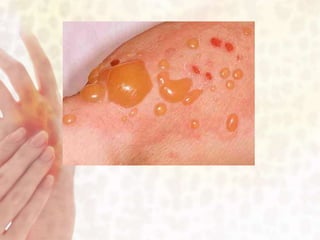
Bullous Pemphigoid 
• Bullous pemphigoid (BUL-us PEM-fih-goid) 
is a rare skin condition that causes 
large, fluid-filled blisters on areas of skin 
that often flex — such as the lower 
abdomen, upper thighs or armpits. Bullous 
pemphigoid is most common in people 
older than age 60. 
• Bullous pemphigoid occurs when your 
immune system attacks a thin layer of 
tissue below your outer layer of skin. The 
reason for this abnormal immune response 
is unknown, although it sometimes can be 
triggered by taking certain medications.
Bullous Pemphigoid 
• Treatment usually includes corticosteroids, 
such as prednisone, and other drugs that 
suppress the immune system. Bullous 
pemphigoid can be life-threatening, 
especially for older people who are 
already in poor health.
THE END

Non contagious skin disorders

  • 1.
    Non-contagious Skin Disorders/NeoplasticSkin Disorders/Skin Injuries
  • 2.
    Acne Vulgaris Acnevulgaris is a common chronic skin disease involving blockage and/or inflammation of pilosebaceous units (hair follicles and their accompanying sebaceous gland). Acne can present as non inflammatory lesions, inflammatory lesions, or a mixture of both, affecting mostly the face but also the back and chest
  • 4.
    Atopic Dermatitis Atopicdermatitis (eczema) is a condition that makes your skin red and itchy. It's common in children but can occur at any age. Atopic dermatitis is long lasting (chronic) and tends to flare periodically and then subside. It may be accompanied by asthma or hay fever.
  • 6.
    Contact Dermatitis •Contact dermatitis is a red, itchy rash caused by a substance that comes into contact with your skin. The rash isn't contagious or life-threatening, but it can be very uncomfortable. • Possible causes include soaps, cosmetics, fragrances, jewelry, and plants, such as poison ivy or poison oak. Some people are exposed to substances at work that may cause contact dermatitis.
  • 7.
    Contact Dermatitis •To treat contact dermatitis successfully, you need to identify and avoid the cause of your reaction. If you can avoid the offending substance, the rash usually clears up in two to four weeks. You can try soothing your skin with cool, wet compresses, anti-itch creams and other self-care steps.
  • 9.
    Hives (Urticaria) •Hives are red and sometimes itchy bumps on your skin. An allergic reaction to a drug or food usually causes them. Allergic reactions cause your body to release chemicals that can make your skin swell up in hives. People who have other allergies are more likely to get hives than other people. Other causes include infections and stress.
  • 10.
    Hives (Urticaria) •Hives are very common. They usually go away on their own, but if you have a serious case, you might need medicine or a shot. In rare cases, hives can cause a dangerous swelling in your airways, making it hard to breathe - which is a medical emergency.
  • 12.
    Psoriasis • Psoriasisis a common skin condition that changes the life cycle of skin cells. Psoriasis causes cells to build up rapidly on the surface of the skin. The extra skin cells form thick, silvery scales and itchy, dry, red patches that are sometimes painful. • Psoriasis is a persistent, long-lasting (chronic) disease. There may be times when your psoriasis symptoms get better alternating with times your psoriasis worsens.
  • 13.
    Psoriasis • Theprimary goal of treatment is to stop the skin cells from growing so quickly. While there isn't a cure, psoriasis treatments may offer significant relief. Lifestyle measures, such as using a nonprescription cortisone cream and exposing your skin to small amounts of natural sunlight, also may improve your psoriasis symptoms.
  • 15.
    Skin Cancer •Skin cancer — the abnormal growth of skin cells — most often develops on skin exposed to the sun. But this common form of cancer can also occur on areas of your skin not ordinarily exposed to sunlight. • There are three major types of skin cancer — basal cell carcinoma, squamous cell carcinoma and melanoma.
  • 16.
    Skin Cancer •You can reduce your risk of skin cancer by limiting or avoiding exposure to ultraviolet (UV) radiation. Checking your skin for suspicious changes can help detect skin cancer at its earliest stages. Early detection of skin cancer gives you the greatest chance for successful skin cancer treatment.
  • 18.
    Actinic Keratosis •An actinic keratosis (ak-TIN-ik ker-uh- TOE-sis) is a rough, scaly patch on your skin that develops from years of exposure to the sun. It's most commonly found on your face, lips, ears, back of your hands, forearms, scalp or neck. • Also known as solar keratosis, an actinic keratosis enlarges slowly and usually causes no signs or symptoms other than a patch or small spot on your skin. These lesions take years to develop, usually first appearing in older adults.
  • 19.
    Actinic Keratosis •A small percentage of actinic keratosis lesions can eventually become skin cancer. You can reduce your risk of actinic keratosis by minimizing your sun exposure and protecting your skin from ultraviolet (UV) rays.
  • 21.
    Basal Cell Carcinoma • Basal cell carcinoma is a type of skin cancer. Basal cell carcinoma begins in the basal cells — a type of cell within the skin that produces new skin cells as old ones die off. • Basal cell carcinoma often appears as a waxy bump, though it can take other forms. Basal cell carcinoma occurs most often on areas of the skin that are often exposed to the sun, such as your face and neck. •
  • 22.
    Basal Cell Carcinoma • Most basal cell carcinomas are thought to be caused by long-term exposure to ultraviolet (UV) radiation from sunlight. Avoiding the sun and using sunscreen may help protect against basal cell carcinoma.
  • 24.
    Malignant Melanoma •Melanoma, the most serious type of skin cancer, develops in the cells (melanocytes) that produce melanin the pigment that gives your skin its color. Melanoma can also form in your eyes and, rarely, in internal organs, such as your intestines. • The exact cause of all melanomas isn't clear, but exposure to ultraviolet (UV) radiation from sunlight or tanning lamps and beds increases your risk of developing melanoma. Limiting your exposure to UV radiation can help reduce your risk of melanoma.
  • 25.
    Malignant Melanoma •The risk of melanoma seems to be increasing in people under 40, especially women. Knowing the warning signs of skin cancer can help ensure that cancerous changes are detected and treated before the cancer has spread. Melanoma can be treated successfully if it is detected early.
  • 27.
    Bedsores(Pressure Sores) •Bedsores — also called pressure sores or pressure ulcers — are injuries to skin and underlying tissue resulting from prolonged pressure on the skin. Bedsores most often develop on skin that covers bony areas of the body, such as the heels, ankles, hips and tailbone. • People most at risk of bedsores are those with a medical condition that limits their ability to change positions, requires them to use a wheelchair or confines them to a bed for a long time.
  • 28.
    Bedsores(Pressure Sores) •Bedsores can develop quickly and are often difficult to treat. Several things can help prevent some bedsores and help with healing.
  • 30.
    Scar • Ascar is a permanent patch of skin that grows over a wound. It forms when your body heals itself after a cut, scrape, burn, or sore. You can also get scars from surgery that cuts through the skin, infections like chickenpox, or skin conditions likeacne. Scars are often thicker, as well as pinker, redder, or shinier, than the rest of your skin.
  • 32.
    Vitiligo • Vitiligo(vit-ih-LIE-go) is a disease that causes the loss of skin color in blotches. The extent and rate of color loss from vitiligo is unpredictable. It can affect the skin on any part of your body. It may also affect hair, the inside of the mouth and even the eyes. • Normally, the color of hair, skin and eyes is determined by melanin. Vitiligo occurs when the cells that produce melanin die or stop functioning.
  • 33.
    Vitiligo • Vitiligoaffects people of all skin types, but it may be more noticeable in people with darker skin. The condition is not life-threatening or contagious. It can be stressful or make you feel bad about yourself. Treatment for vitiligo may improve the appearance of the affected skin but does not cure the disease.
  • 35.
    Bullous Pemphigoid •Bullous pemphigoid (BUL-us PEM-fih-goid) is a rare skin condition that causes large, fluid-filled blisters on areas of skin that often flex — such as the lower abdomen, upper thighs or armpits. Bullous pemphigoid is most common in people older than age 60. • Bullous pemphigoid occurs when your immune system attacks a thin layer of tissue below your outer layer of skin. The reason for this abnormal immune response is unknown, although it sometimes can be triggered by taking certain medications.
  • 36.
    Bullous Pemphigoid •Treatment usually includes corticosteroids, such as prednisone, and other drugs that suppress the immune system. Bullous pemphigoid can be life-threatening, especially for older people who are already in poor health.
  • 38.