Mr.L. Mugala
Lesson 5
©2024
Pathogen Associated Molecular
Patterns (PAMPs)
Pathogen Associated Molecular Patterns (PAMPs)
 These are molecules associated with groups of
pathogens that are recognized by cells of the
innate immune system.
 These molecular patterns are conserved in
microorganisms.
 These molecular patterns are unlikely to mutate.
 These however are not expressed by host tissues.
PAMPs
 The absence of PAMPs on host tissues enables the host
cells to distinguish self from non- self.
 A typical PAMP is bacterial DNA.
 This DNA shows unmethylaated pairs of cytosine and
guanosine (CpG).
 LPS is the major component of the cell wall of gram
negative bacteria.
 Peptidoglycans are major components of the cell wall of
gram +ve bacteria.
Pattern recognition receptors(PRRs
 PRRs recognize PAMPs.
 PPRs are expressed mostly on phagocytes.
 A typical example of PRRs are Toll-like receptors(TLRs).
 TLRs are homologous to drosophila protein called Toll.
 This protein(Toll) protects insects against infection.
PRRs
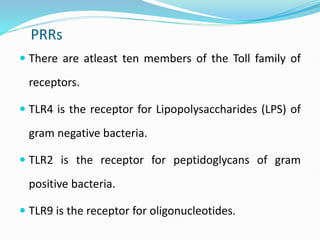
 There are atleast ten members of the Toll family of
receptors.
 TLR4 is the receptor for Lipopolysaccharides (LPS) of
gram negative bacteria.
 TLR2 is the receptor for peptidoglycans of gram
positive bacteria.
 TLR9 is the receptor for oligonucleotides.
Types of PRRs
 Three types or groups;
(i) Secreted PRRs
(ii) Endocytic PRRs
(ii) Signaling PRRs
 Secreted PRRs
 Are opsonins that bind to microbial cell wall.
 This binding tags the bacterial cell wall for
degradation by phagocytosis or complement system.
 Best known receptor for this class is Mannose binding
lectin.
PRRs
 Mannose binding lectin is secreted in the liver as
an ‘acute phase’ protein.
 It recognizes carbohydrates on;
bacteria
Yeast
parasites
viruses.
PRRs
 MBL2 gene produces mannose-binding lectin.
 Mutation in MBL2 gene leads to mannose-binding
lectin deficiency.
 Mutation may be due to some diseases.
 Mannose-binding lectin deficiency may be inherited.
 Mannose –binding lectin deficiency leads to serious
infections like pneumonia,mengitis etc.
 Endocytic PRRs
 Expressed on the surface of the phagocytes.
 Mediate the uptake and transport of a pathogen to
lysosomes.
 Examples.
Mannose receptor
Scavenger receptor
 Signaling PRRs
 These include the members of the Toll-like family.
 These transmit signals that initiate the
transcription process.
 Transcription process may result in the secretion
of proinflammatory cytokines chemokines.
Summary
PAMPs are conserved on bacteria but not in human
host tissues.
PAMPs are recognized by PRRs.
PRRs are expressed on phagocytes.
3 Classes of PRRs
Secreted PRRs
 Secreted by the liver and remain in blood circulation e.g.
MBL
 MBL binds onto mannose on microbes
 MBL is an opsonin that opsonizes bacteria.
3 classes of PRRs- Secreted PPRs
 Oposonization is the process of tagging or coating
bacteria by opsonins such as MBL, antibody and
complements
 Oposonization facilitated bacterial destruction by
phagocytosis
3 classes of PRRs
Endocytic PRRs
These are expressed on the surfaces of phagocytes
They facilitate the uptake of microbes into the cell by
endocytosis
Example mannose receptors that bind onto the mannose
residue on microbes
3 classes of PRRs
Signaling PRRs
These include all members of Toll-Like Receptors (TLRs).
Found on the surfaces of phagocytes
Bind onto the microbes and send signals into the cell’s
nucleus
This initiates the genes responsible for producing
proinflammatory cytokines to undergo gene expression
Gene expression yields chemical mediators of
inflammation such as histamine.
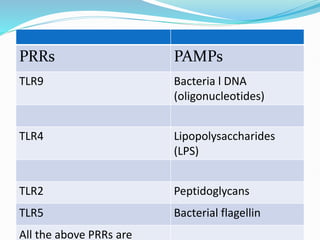
PRRs PAMPs
TLR9 Bacteria l DNA
(oligonucleotides)
TLR4 Lipopolysaccharides
(LPS)
TLR2 Peptidoglycans
TLR5 Bacterial flagellin
All the above PRRs are

PATHOGEN ASSOCIATED MOLECULAR PATTERNS (PAMPs) - 2024 NOTES.pptx

  • 1.
    Mr.L. Mugala Lesson 5 ©2024 PathogenAssociated Molecular Patterns (PAMPs)
  • 2.
    Pathogen Associated MolecularPatterns (PAMPs)  These are molecules associated with groups of pathogens that are recognized by cells of the innate immune system.  These molecular patterns are conserved in microorganisms.  These molecular patterns are unlikely to mutate.  These however are not expressed by host tissues.
  • 3.
    PAMPs  The absenceof PAMPs on host tissues enables the host cells to distinguish self from non- self.  A typical PAMP is bacterial DNA.  This DNA shows unmethylaated pairs of cytosine and guanosine (CpG).  LPS is the major component of the cell wall of gram negative bacteria.  Peptidoglycans are major components of the cell wall of gram +ve bacteria.
  • 4.
    Pattern recognition receptors(PRRs PRRs recognize PAMPs.  PPRs are expressed mostly on phagocytes.  A typical example of PRRs are Toll-like receptors(TLRs).  TLRs are homologous to drosophila protein called Toll.  This protein(Toll) protects insects against infection.
  • 5.
    PRRs  There areatleast ten members of the Toll family of receptors.  TLR4 is the receptor for Lipopolysaccharides (LPS) of gram negative bacteria.  TLR2 is the receptor for peptidoglycans of gram positive bacteria.  TLR9 is the receptor for oligonucleotides.
  • 6.
    Types of PRRs Three types or groups; (i) Secreted PRRs (ii) Endocytic PRRs (ii) Signaling PRRs
  • 7.
     Secreted PRRs Are opsonins that bind to microbial cell wall.  This binding tags the bacterial cell wall for degradation by phagocytosis or complement system.  Best known receptor for this class is Mannose binding lectin.
  • 8.
    PRRs  Mannose bindinglectin is secreted in the liver as an ‘acute phase’ protein.  It recognizes carbohydrates on; bacteria Yeast parasites viruses.
  • 9.
    PRRs  MBL2 geneproduces mannose-binding lectin.  Mutation in MBL2 gene leads to mannose-binding lectin deficiency.  Mutation may be due to some diseases.  Mannose-binding lectin deficiency may be inherited.  Mannose –binding lectin deficiency leads to serious infections like pneumonia,mengitis etc.
  • 10.
     Endocytic PRRs Expressed on the surface of the phagocytes.  Mediate the uptake and transport of a pathogen to lysosomes.  Examples. Mannose receptor Scavenger receptor
  • 11.
     Signaling PRRs These include the members of the Toll-like family.  These transmit signals that initiate the transcription process.  Transcription process may result in the secretion of proinflammatory cytokines chemokines.
  • 12.
    Summary PAMPs are conservedon bacteria but not in human host tissues. PAMPs are recognized by PRRs. PRRs are expressed on phagocytes.
  • 13.
    3 Classes ofPRRs Secreted PRRs  Secreted by the liver and remain in blood circulation e.g. MBL  MBL binds onto mannose on microbes  MBL is an opsonin that opsonizes bacteria.
  • 14.
    3 classes ofPRRs- Secreted PPRs  Oposonization is the process of tagging or coating bacteria by opsonins such as MBL, antibody and complements  Oposonization facilitated bacterial destruction by phagocytosis
  • 15.
    3 classes ofPRRs Endocytic PRRs These are expressed on the surfaces of phagocytes They facilitate the uptake of microbes into the cell by endocytosis Example mannose receptors that bind onto the mannose residue on microbes
  • 16.
    3 classes ofPRRs Signaling PRRs These include all members of Toll-Like Receptors (TLRs). Found on the surfaces of phagocytes Bind onto the microbes and send signals into the cell’s nucleus This initiates the genes responsible for producing proinflammatory cytokines to undergo gene expression Gene expression yields chemical mediators of inflammation such as histamine.
  • 17.
    PRRs PAMPs TLR9 Bacterial DNA (oligonucleotides) TLR4 Lipopolysaccharides (LPS) TLR2 Peptidoglycans TLR5 Bacterial flagellin All the above PRRs are