Dr Robin Thomas
Resident in Pediatrics
JJMMC, Davangere
By Dr Robin Thomas
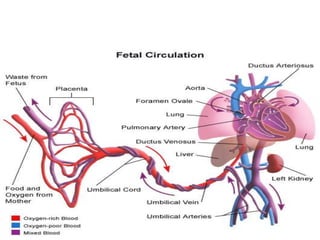
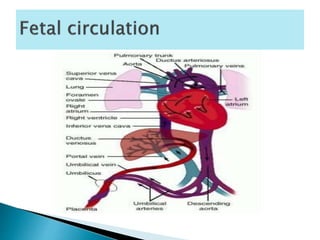
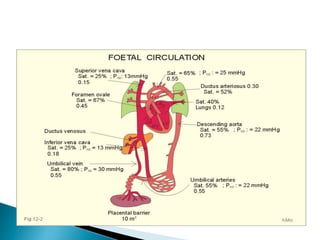
 Before birth-blood from placenta -80%
saturated with O2 –returns to fetus –umbilical
vein. PO2 30-35 mmHg
 Liver-most of this blood flows through
Ductus venosus directly into inferior vena
cava (IVC) , short-circuiting liver.
 Smaller amount enters liver sinusoids &
mixes with blood from portal circulation.
 Sphincter mechanism in ductus venosus –
regulates flow of umbilical blood tru liver
sinusoids.
 IVC-placental blood mixes with
deoxygenated blood returning from lower
limbs- enters right atrium.PO2 26-28mmHg
 Guided towards Foramen ovale by valve of
IVC & blood passes directly into left atrium.
 Small amount of blood remains in right
atrium-lower edge of septum secundum –
crista dividens- mixes with desaturated blood
returning from head & arms-superior vena
cava.
 Left atrium-mixing of desaturated blood
returning from lungs tru pulmonary vein-
blood enters left ventricle ejected -Ascending
aorta.
 Some Oxygen rich blood –coronary & carotid
arteries –supplies heart musculature & brain.
 Desaturated blood from superior vena cava
(SVC) –( PO2 12-14 mmHg ) right atrium-
right ventricle ejected -Pulmonary trunk.
 Fetal pulmonary arterial circulation is
vasoconstricted-10% right ventricular outflow
enters lungs.
 Fetal life-resistance in pulmonary vessels
high-blood passes directly through Ductus
arteriosus ( PO2 18-22mmHg) into
Descending aorta- mixes with blood from
proximal aorta-lower part of fetal body.
 Descending aorta-2 umbilical arteries-
placenta.
 O2 saturation umbilical arteries -58%
 During course from placenta –organs of fetus
–blood in umbilical vein (PO2 30-35 mmHg)
loses its high oxygen content, as it mixes
with desaturated blood.
 Theoretically ,mixing of blood occurs in 5
places.
 1.Liver-mixes with blood from portal
circulation.
 2.IVC-mixes with deoxygenated blood
returning from lower extremities,pelvis,
kidneys.
 3.Right atrium-mixes with desaturated blood
returning from head & arms via SVC.(PO2 12-
14 mmHg)
 4.Left atrium-mixes with desaturated blood
returning from lungs-pulmonary vein.
 5.Entrance of Ductus arteriosus (PO2 18-
22mmHg) into descending aorta-mixes with
blood from proximal aorta.
 Changes in vascular system at birth-caused
by cessation of placental blood flow &
beginning of respiration.
 Closure of Umbilical arteries –contraction of
smooth musculature of wall-thermal &
mechanical stimuli & change in O2 tension.
 Functionally umbilical arteries close a few
minutes after birth.
 Actual obliteration by fibrous proliferation –
takes 2-3 months.
 Distal part of umbilical arteries form median-
umbilical ligaments, proximal portion remain
open as superior vesical arteries.
 Closure of umbilical vein & ductus venosus
occurs shortly after that of umbilical arteries.
 Blood from placenta may enter newborn for
sometime after birth.
 Umbilical vein form ligamentum teres -
hepatis, in lower margin of falciform-
ligament.
 Ductus venosus forms ligamentum venosum.
 Closure of ductus arteriosus occurs by
contraction of muscular wall-immediately
after birth-mediated by bradykinin-substance
released from lungs during initial inflation.
 Functional closure-10-15 hr.
 Complete anatomical obliteration –
proliferation of intima-takes 1-3 months.
 Ductus arteriosus forms ligamentum
arteriosum.
 Closure of foramen ovale –caused by increased
pressure in left atrium combined with decrease in
pressure on right atrium.
flap valve of foramen ovale close against edge of
crista dividens.
functional closure-3rd month of life.
 Closure of ductus arteriosus –amount of blood
flowing tru lung vessels increases rapidly-raises
pressure in left atrium.
 Pressure in right atrium decreases –result of
interruption of placental blood flow.
 First breath presses septum primum against
septum secundum-functionally foramen-
ovale closes.
 First days of life-closure is reversible.
 Crying by baby creates shunt from right to
left-cyanotic periods in newborn.
 Constant apposition leads to fusion of 2
septa by 1year.
 20% -perfect anatomical closure never
obtained- Probe patent foramen ovale.
 At birth, fetal circulation must immediately
adapt extrauterine life –gas exchange is
transferred from placenta to lung.
 Soon after onset of spontaneous respiration-
placenta is removed from circulation –by
clamping umbilical cord or constriction of
umbilical arteries –increases Systemic -
vascular resistance.
 Onset of spontaneous respiration expands
the lung & brings O2 to pulmonary alveoli.
 Heart rate slowes as a result of baroreceptor
response to increase in systemic vascular
resistance –when placental circulation is
eliminated.
 Average central aortic pressure in term
neonate-75/50 mmHg.
 Sudden increase in systemic vascular
resistance & drop in pulmonary vascular
resistance –cause reversal of flow through
ductus arteriosus & increase in pulmonary
blood flow.
 Before birth pulmonary & systemic
resistances cause 90% blood to go through
ductus arteriosus into descending aorta.
 After birth, 90% blood goes to pulmonary
arteries with pulmonary blood flow increasing
from 35 ml/kg/min to 160-200 ml/kg/min.
 Normal neonate-closure of ductus arteriosus
& fall in PVR results in decrease in pulmonary
arterial & right ventricular pressure.
 Major decline in PVR occurs within 1st 2-3
days –may be prolonged for 7 days.
 1st weeks of life-remodeling of pulmonary
vasculature-thinning of vascular smooth
muscle & recruitment of new vessels.
 Decrease in PVR influences the timing of
clinical appearance of many congenital heart
lesions.
 Left to right shunt through a VSD may be
minimal in 1st week after birth, when PVR is
still high.
 Differences between neonatal circulation &
that of older infants.
 1.R-L or L-R to shunt may persist across
foramen ovale.
 2.Cardiopulmonary disease-patency of
ductus arteriosus allow L-R ,R-L or
bidirectional shunting.
 3.Neonatal pulmonary vasculature constricts
more vigorously in response to hypoxemia,
hypercapnea & acidosis.
 4.Wall thickness & muscle mass of neonatal
left & right ventricles are almost equal.
 5.New born infants at rest have high O2
consumption assoc. with high cardiac output.
 New born cardiac output 350 ml/kg/min falls
in 1st two month of life to 150 ml/kg/min &
more gradually to normal adult cardiac
output of 75 ml/kg/min.
 Foramen ovale is functionally closed by 3rd
month of life.
 Functional closure of ductus arteriosus is by
10-15 hr in normal neonate. Remains patent
in congenital heart disease.
 Premature new born infant with evanescent
systolic murmur or continuous murmur –PDA
should be suspected.
 Fetal life-patency of ductus arteriosus
maintained by low O2 tension &
endogenously produced prostaglandins PGE2.
 Full term neonate-O2 major factor controlling
ductal closure.
 PO2 of blood passing through ductus reaches
50 mmHg –ductal wall constricts.
 Gestational age play a important role.
 Ductus of a premature infant –less responsive
to O2 , eventhough its musculature is
developed.
 Fetus-placenta provides for gas & metabolite
exchange.
 3 cardiovascular structures unique to fetus for
maintaining parallel circulation: ductus venosus,
foramen ovale, ductus arteriosus.
 After birth –mechanical expansion of lungs
causes increase in PO2, decrease in PVR &
increase in systemic vascular resistance.
 Closure of umbilical arteries,umbilical vein,
ductus venosus, ductus arteriosus.
 Umbilical arteries-median umbilical ligament.
Left umbilical vein-ligamentum teres of liver.
Ductus venosus-ligamentum venosum.
Ductus arteriosus-ligamentum arteriosum.
 Functional closure of foramen ovale by 3 rd
month of life & ductus arteriosus by 10-15 hr
in a normal neonate.
 1.Kliegman, Stanton, Geme ST, Schor, Behrman. Nelson
Textbook of Pediatrics 19th edition 2012 :1529-1530.
 2.Sadler WT. Langmans Medical Embryology 10th edition
2012 :189-194.
 3.John FK, James EK, Donald CF . Nadas Pediatric
Cardiology 2nd edition 2006 :14-25
 4.Myung PK .Pediatric cardiology for Practitioners 2012 5th
edition :119-123
 5.Inderbir singh, Pal PK. Human Embryology 8th edition
2012 :231-235
Fetal circulation

Fetal circulation

  • 1.
    Dr Robin Thomas Residentin Pediatrics JJMMC, Davangere
  • 2.
  • 5.
     Before birth-bloodfrom placenta -80% saturated with O2 –returns to fetus –umbilical vein. PO2 30-35 mmHg  Liver-most of this blood flows through Ductus venosus directly into inferior vena cava (IVC) , short-circuiting liver.  Smaller amount enters liver sinusoids & mixes with blood from portal circulation.  Sphincter mechanism in ductus venosus – regulates flow of umbilical blood tru liver sinusoids.
  • 6.
     IVC-placental bloodmixes with deoxygenated blood returning from lower limbs- enters right atrium.PO2 26-28mmHg  Guided towards Foramen ovale by valve of IVC & blood passes directly into left atrium.  Small amount of blood remains in right atrium-lower edge of septum secundum – crista dividens- mixes with desaturated blood returning from head & arms-superior vena cava.
  • 7.
     Left atrium-mixingof desaturated blood returning from lungs tru pulmonary vein- blood enters left ventricle ejected -Ascending aorta.  Some Oxygen rich blood –coronary & carotid arteries –supplies heart musculature & brain.  Desaturated blood from superior vena cava (SVC) –( PO2 12-14 mmHg ) right atrium- right ventricle ejected -Pulmonary trunk.
  • 8.
     Fetal pulmonaryarterial circulation is vasoconstricted-10% right ventricular outflow enters lungs.  Fetal life-resistance in pulmonary vessels high-blood passes directly through Ductus arteriosus ( PO2 18-22mmHg) into Descending aorta- mixes with blood from proximal aorta-lower part of fetal body.  Descending aorta-2 umbilical arteries- placenta.  O2 saturation umbilical arteries -58%
  • 9.
     During coursefrom placenta –organs of fetus –blood in umbilical vein (PO2 30-35 mmHg) loses its high oxygen content, as it mixes with desaturated blood.  Theoretically ,mixing of blood occurs in 5 places.  1.Liver-mixes with blood from portal circulation.  2.IVC-mixes with deoxygenated blood returning from lower extremities,pelvis, kidneys.
  • 10.
     3.Right atrium-mixeswith desaturated blood returning from head & arms via SVC.(PO2 12- 14 mmHg)  4.Left atrium-mixes with desaturated blood returning from lungs-pulmonary vein.  5.Entrance of Ductus arteriosus (PO2 18- 22mmHg) into descending aorta-mixes with blood from proximal aorta.
  • 12.
     Changes invascular system at birth-caused by cessation of placental blood flow & beginning of respiration.  Closure of Umbilical arteries –contraction of smooth musculature of wall-thermal & mechanical stimuli & change in O2 tension.  Functionally umbilical arteries close a few minutes after birth.  Actual obliteration by fibrous proliferation – takes 2-3 months.
  • 13.
     Distal partof umbilical arteries form median- umbilical ligaments, proximal portion remain open as superior vesical arteries.  Closure of umbilical vein & ductus venosus occurs shortly after that of umbilical arteries.  Blood from placenta may enter newborn for sometime after birth.  Umbilical vein form ligamentum teres - hepatis, in lower margin of falciform- ligament.
  • 14.
     Ductus venosusforms ligamentum venosum.  Closure of ductus arteriosus occurs by contraction of muscular wall-immediately after birth-mediated by bradykinin-substance released from lungs during initial inflation.  Functional closure-10-15 hr.  Complete anatomical obliteration – proliferation of intima-takes 1-3 months.  Ductus arteriosus forms ligamentum arteriosum.
  • 15.
     Closure offoramen ovale –caused by increased pressure in left atrium combined with decrease in pressure on right atrium. flap valve of foramen ovale close against edge of crista dividens. functional closure-3rd month of life.  Closure of ductus arteriosus –amount of blood flowing tru lung vessels increases rapidly-raises pressure in left atrium.  Pressure in right atrium decreases –result of interruption of placental blood flow.
  • 16.
     First breathpresses septum primum against septum secundum-functionally foramen- ovale closes.  First days of life-closure is reversible.  Crying by baby creates shunt from right to left-cyanotic periods in newborn.  Constant apposition leads to fusion of 2 septa by 1year.
  • 17.
     20% -perfectanatomical closure never obtained- Probe patent foramen ovale.
  • 18.
     At birth,fetal circulation must immediately adapt extrauterine life –gas exchange is transferred from placenta to lung.  Soon after onset of spontaneous respiration- placenta is removed from circulation –by clamping umbilical cord or constriction of umbilical arteries –increases Systemic - vascular resistance.
  • 19.
     Onset ofspontaneous respiration expands the lung & brings O2 to pulmonary alveoli.  Heart rate slowes as a result of baroreceptor response to increase in systemic vascular resistance –when placental circulation is eliminated.  Average central aortic pressure in term neonate-75/50 mmHg.
  • 20.
     Sudden increasein systemic vascular resistance & drop in pulmonary vascular resistance –cause reversal of flow through ductus arteriosus & increase in pulmonary blood flow.  Before birth pulmonary & systemic resistances cause 90% blood to go through ductus arteriosus into descending aorta.
  • 21.
     After birth,90% blood goes to pulmonary arteries with pulmonary blood flow increasing from 35 ml/kg/min to 160-200 ml/kg/min.  Normal neonate-closure of ductus arteriosus & fall in PVR results in decrease in pulmonary arterial & right ventricular pressure.  Major decline in PVR occurs within 1st 2-3 days –may be prolonged for 7 days.
  • 22.
     1st weeksof life-remodeling of pulmonary vasculature-thinning of vascular smooth muscle & recruitment of new vessels.  Decrease in PVR influences the timing of clinical appearance of many congenital heart lesions.  Left to right shunt through a VSD may be minimal in 1st week after birth, when PVR is still high.
  • 23.
     Differences betweenneonatal circulation & that of older infants.  1.R-L or L-R to shunt may persist across foramen ovale.  2.Cardiopulmonary disease-patency of ductus arteriosus allow L-R ,R-L or bidirectional shunting.  3.Neonatal pulmonary vasculature constricts more vigorously in response to hypoxemia, hypercapnea & acidosis.
  • 24.
     4.Wall thickness& muscle mass of neonatal left & right ventricles are almost equal.  5.New born infants at rest have high O2 consumption assoc. with high cardiac output.  New born cardiac output 350 ml/kg/min falls in 1st two month of life to 150 ml/kg/min & more gradually to normal adult cardiac output of 75 ml/kg/min.
  • 25.
     Foramen ovaleis functionally closed by 3rd month of life.  Functional closure of ductus arteriosus is by 10-15 hr in normal neonate. Remains patent in congenital heart disease.  Premature new born infant with evanescent systolic murmur or continuous murmur –PDA should be suspected.
  • 26.
     Fetal life-patencyof ductus arteriosus maintained by low O2 tension & endogenously produced prostaglandins PGE2.  Full term neonate-O2 major factor controlling ductal closure.  PO2 of blood passing through ductus reaches 50 mmHg –ductal wall constricts.
  • 27.
     Gestational ageplay a important role.  Ductus of a premature infant –less responsive to O2 , eventhough its musculature is developed.
  • 28.
     Fetus-placenta providesfor gas & metabolite exchange.  3 cardiovascular structures unique to fetus for maintaining parallel circulation: ductus venosus, foramen ovale, ductus arteriosus.  After birth –mechanical expansion of lungs causes increase in PO2, decrease in PVR & increase in systemic vascular resistance.  Closure of umbilical arteries,umbilical vein, ductus venosus, ductus arteriosus.
  • 29.
     Umbilical arteries-medianumbilical ligament. Left umbilical vein-ligamentum teres of liver. Ductus venosus-ligamentum venosum. Ductus arteriosus-ligamentum arteriosum.  Functional closure of foramen ovale by 3 rd month of life & ductus arteriosus by 10-15 hr in a normal neonate.
  • 30.
     1.Kliegman, Stanton,Geme ST, Schor, Behrman. Nelson Textbook of Pediatrics 19th edition 2012 :1529-1530.  2.Sadler WT. Langmans Medical Embryology 10th edition 2012 :189-194.  3.John FK, James EK, Donald CF . Nadas Pediatric Cardiology 2nd edition 2006 :14-25  4.Myung PK .Pediatric cardiology for Practitioners 2012 5th edition :119-123  5.Inderbir singh, Pal PK. Human Embryology 8th edition 2012 :231-235