Past Time

   Monica Caruntu
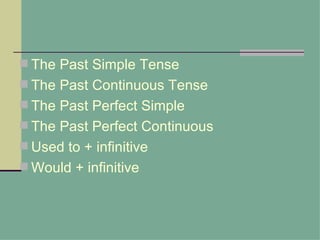
 The Past Simple Tense
 The Past Continuous Tense
 The Past Perfect Simple
 The Past Perfect Continuous
 Used to + infinitive
 Would + infinitive
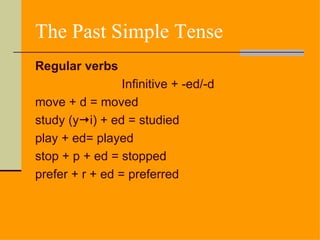
The Past Simple Tense
Regular verbs
                 Infinitive + -ed/-d
move + d = moved
study (yi) + ed = studied
play + ed= played
stop + p + ed = stopped
prefer + r + ed = preferred
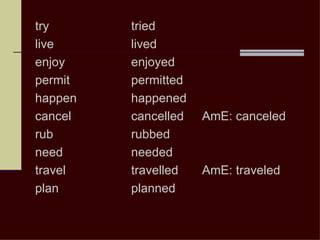
try      tried
live     lived
enjoy    enjoyed
permit   permitted
happen   happened
cancel   cancelled   AmE: canceled
rub      rubbed
need     needed
travel   travelled   AmE: traveled
plan     planned
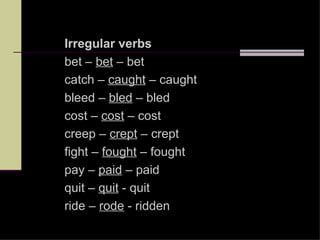
Irregular verbs
bet – bet – bet
catch – caught – caught
bleed – bled – bled
cost – cost – cost
creep – crept – crept
fight – fought – fought
pay – paid – paid
quit – quit - quit
ride – rode - ridden
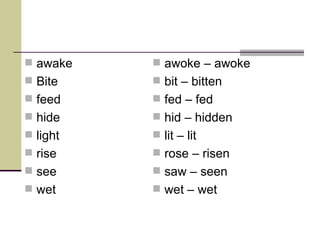
 awake    awoke – awoke
 Bite     bit – bitten
 feed     fed – fed
 hide     hid – hidden
 light    lit – lit
 rise     rose – risen
 see      saw – seen
 wet      wet – wet
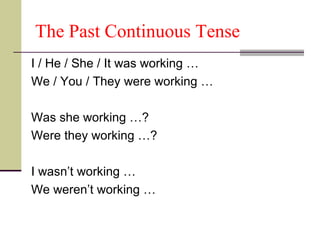
The Past Continuous Tense
I / He / She / It was working …
We / You / They were working …

Was she working …?
Were they working …?

I wasn’t working …
We weren’t working …
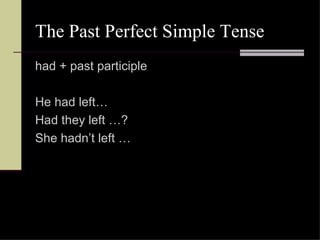
The Past Perfect Simple Tense
had + past participle

He had left…
Had they left …?
She hadn’t left …
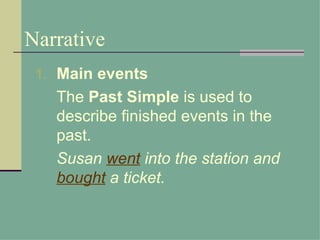
Narrative
 1. Main events
   The Past Simple is used to
   describe finished events in the
   past.
   Susan went into the station and
   bought a ticket.
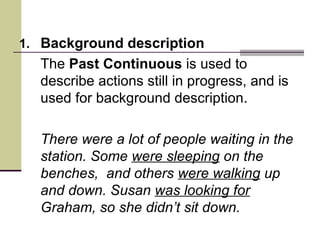
1. Background description
  The Past Continuous is used to
  describe actions still in progress, and is
  used for background description.

  There were a lot of people waiting in the
  station. Some were sleeping on the
  benches, and others were walking up
  and down. Susan was looking for
  Graham, so she didn’t sit down.
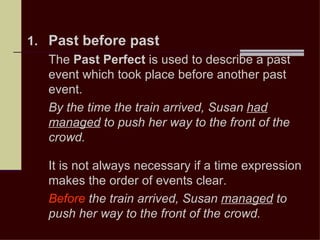
1. Past before past
   The Past Perfect is used to describe a past
   event which took place before another past
   event.
   By the time the train arrived, Susan had
   managed to push her way to the front of the
   crowd.

   It is not always necessary if a time expression
   makes the order of events clear.
   Before the train arrived, Susan managed to
   push her way to the front of the crowd.
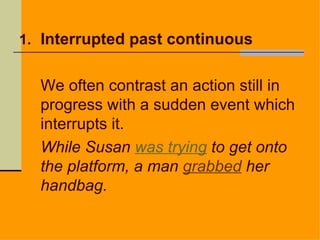
1. Interrupted past continuous


  We often contrast an action still in
  progress with a sudden event which
  interrupts it.
  While Susan was trying to get onto
  the platform, a man grabbed her
  handbag.
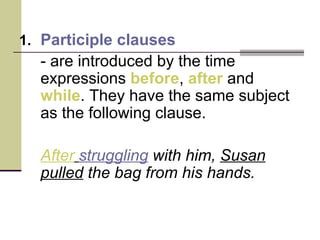
1. Participle clauses
  - are introduced by the time
  expressions before, after and
  while. They have the same subject
  as the following clause.

  After struggling with him, Susan
  pulled the bag from his hands.
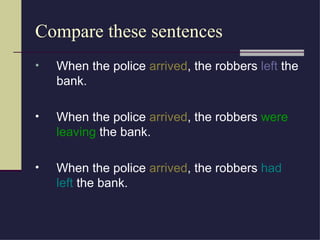
Compare these sentences
•   When the police arrived, the robbers left the
    bank.

•   When the police arrived, the robbers were
    leaving the bank.

•   When the police arrived, the robbers had
    left the bank.
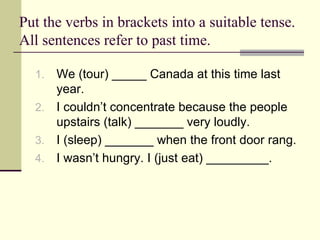
Put the verbs in brackets into a suitable tense.
All sentences refer to past time.

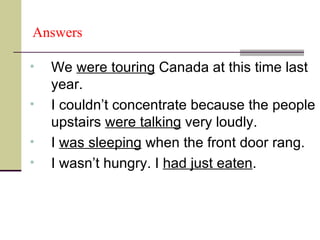
  1. We (tour) _____ Canada at this time last
     year.
  2. I couldn’t concentrate because the people
     upstairs (talk) _______ very loudly.
  3. I (sleep) _______ when the front door rang.
  4. I wasn’t hungry. I (just eat) _________.
Answers

•   We were touring Canada at this time last
    year.
•   I couldn’t concentrate because the people
    upstairs were talking very loudly.
•   I was sleeping when the front door rang.
•   I wasn’t hungry. I had just eaten.
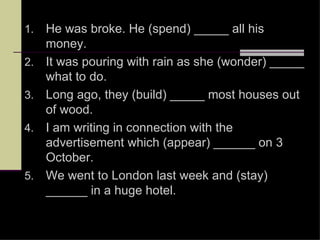
1.   He was broke. He (spend) _____ all his
     money.
2.   It was pouring with rain as she (wonder) _____
     what to do.
3.   Long ago, they (build) _____ most houses out
     of wood.
4.   I am writing in connection with the
     advertisement which (appear) ______ on 3
     October.
5.   We went to London last week and (stay)
     ______ in a huge hotel.
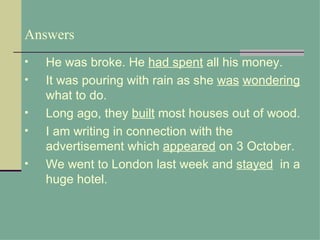
Answers
•   He was broke. He had spent all his money.
•   It was pouring with rain as she was wondering
    what to do.
•   Long ago, they built most houses out of wood.
•   I am writing in connection with the
    advertisement which appeared on 3 October.
•   We went to London last week and stayed in a
    huge hotel.
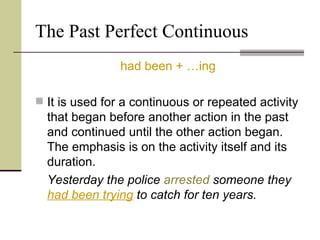
The Past Perfect Continuous
                had been + …ing

 It is used for a continuous or repeated activity
  that began before another action in the past
  and continued until the other action began.
  The emphasis is on the activity itself and its
  duration.
  Yesterday the police arrested someone they
  had been trying to catch for ten years.
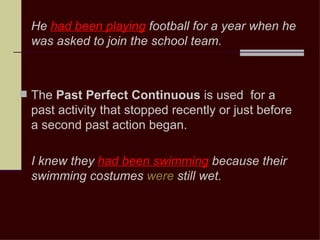
He had been playing football for a year when he
  was asked to join the school team.


 The Past Perfect Continuous is used for a
  past activity that stopped recently or just before
  a second past action began.

  I knew they had been swimming because their
  swimming costumes were still wet.
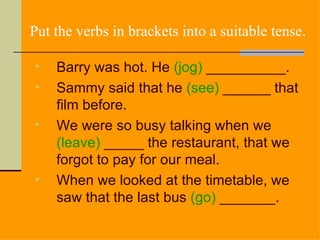
Put the verbs in brackets into a suitable tense.

•   Barry was hot. He (jog) __________.
•   Sammy said that he (see) ______ that
    film before.
•   We were so busy talking when we
    (leave) _____ the restaurant, that we
    forgot to pay for our meal.
•   When we looked at the timetable, we
    saw that the last bus (go) _______.
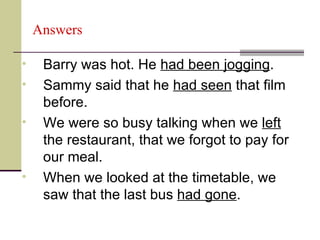
Answers

•    Barry was hot. He had been jogging.
•    Sammy said that he had seen that film
     before.
•    We were so busy talking when we left
     the restaurant, that we forgot to pay for
     our meal.
•    When we looked at the timetable, we
     saw that the last bus had gone.
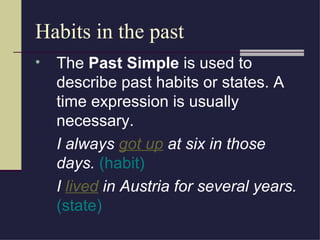
Habits in the past
•   The Past Simple is used to
    describe past habits or states. A
    time expression is usually
    necessary.
    I always got up at six in those
    days. (habit)
    I lived in Austria for several years.
    (state)
•  Used to is used to describe past habits,
   usually in contrast with the present.
   A time expression is not necessary.
   I used to get up at six, but now I get up
   at eight.
   Used to can also describe past states.
   I used to own a horse. (I owned a horse
   once.)
Note these forms:
   I didn’t use to like beer.
   Did you use to swim every day?
•   Would is used to describe a
    person’s typical activities in the past.
    It can only be used to describe
    repeated actions.

    Every evening was the same. Jack
    would turn on the radio, light his
    pipe and fall asleep.
•   The Past Continuous can be used
    to describe a repeated action in the
    past, often an annoying habit. A
    frequency adverb is necessary.

    When Peter was younger, he was
    always getting into trouble.
Politeness and uncertainty
 The Past Continuous with the verb
 wonder has a polite meaning.
 I was wondering if you could help me.

 With the verb think the Past
 Continuous suggests uncertainty.
 I was thinking of having a party next
 week.
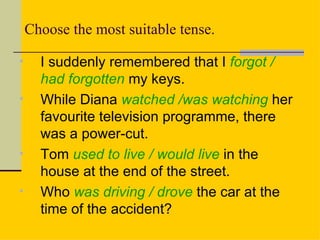
Choose the most suitable tense.

•     I suddenly remembered that I forgot /
      had forgotten my keys.
•     While Diana watched /was watching her
      favourite television programme, there
      was a power-cut.
•     Tom used to live / would live in the
      house at the end of the street.
•     Who was driving / drove the car at the
      time of the accident?
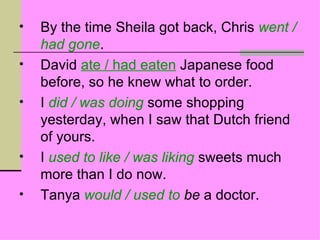
•   By the time Sheila got back, Chris went /
    had gone.
•   David ate / had eaten Japanese food
    before, so he knew what to order.
•   I did / was doing some shopping
    yesterday, when I saw that Dutch friend
    of yours.
•   I used to like / was liking sweets much
    more than I do now.
•   Tanya would / used to be a doctor.
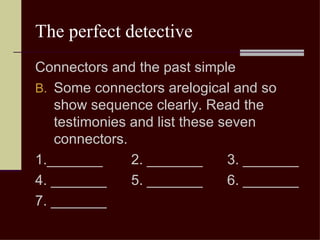
The perfect detective
Connectors and the past simple
B. Some connectors arelogical and so
   show sequence clearly. Read the
   testimonies and list these seven
   connectors.
1._______      2. _______      3. _______
4. _______     5. _______      6. _______
7. _______
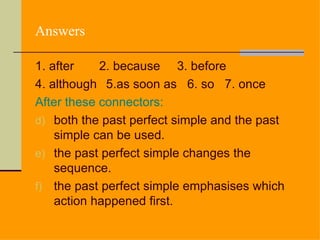
Answers

1. after    2. because 3. before
4. although 5.as soon as 6. so 7. once
After these connectors:
d) both the past perfect simple and the past
    simple can be used.
e) the past perfect simple changes the
    sequence.
f) the past perfect simple emphasises which
    action happened first.
A. Some connectors do not show sequence
   clearly. Read the testimonies and list these
   connectors.
2. ________ 2. ________ 3. ________
1.when         2. but       3. and
After these connectors:
e) both the past perfect simple and the past
   simple can be used
f) the past perfect simple changes the
   sequence

Pasttime

  • 1.
    Past Time Monica Caruntu
  • 2.
     The PastSimple Tense  The Past Continuous Tense  The Past Perfect Simple  The Past Perfect Continuous  Used to + infinitive  Would + infinitive
  • 3.
    The Past SimpleTense Regular verbs Infinitive + -ed/-d move + d = moved study (yi) + ed = studied play + ed= played stop + p + ed = stopped prefer + r + ed = preferred
  • 4.
    try tried live lived enjoy enjoyed permit permitted happen happened cancel cancelled AmE: canceled rub rubbed need needed travel travelled AmE: traveled plan planned
  • 5.
    Irregular verbs bet –bet – bet catch – caught – caught bleed – bled – bled cost – cost – cost creep – crept – crept fight – fought – fought pay – paid – paid quit – quit - quit ride – rode - ridden
  • 6.
     awake  awoke – awoke  Bite  bit – bitten  feed  fed – fed  hide  hid – hidden  light  lit – lit  rise  rose – risen  see  saw – seen  wet  wet – wet
  • 7.
    The Past ContinuousTense I / He / She / It was working … We / You / They were working … Was she working …? Were they working …? I wasn’t working … We weren’t working …
  • 8.
    The Past PerfectSimple Tense had + past participle He had left… Had they left …? She hadn’t left …
  • 9.
    Narrative 1. Mainevents The Past Simple is used to describe finished events in the past. Susan went into the station and bought a ticket.
  • 10.
    1. Background description The Past Continuous is used to describe actions still in progress, and is used for background description. There were a lot of people waiting in the station. Some were sleeping on the benches, and others were walking up and down. Susan was looking for Graham, so she didn’t sit down.
  • 11.
    1. Past beforepast The Past Perfect is used to describe a past event which took place before another past event. By the time the train arrived, Susan had managed to push her way to the front of the crowd. It is not always necessary if a time expression makes the order of events clear. Before the train arrived, Susan managed to push her way to the front of the crowd.
  • 12.
    1. Interrupted pastcontinuous We often contrast an action still in progress with a sudden event which interrupts it. While Susan was trying to get onto the platform, a man grabbed her handbag.
  • 13.
    1. Participle clauses - are introduced by the time expressions before, after and while. They have the same subject as the following clause. After struggling with him, Susan pulled the bag from his hands.
  • 14.
    Compare these sentences • When the police arrived, the robbers left the bank. • When the police arrived, the robbers were leaving the bank. • When the police arrived, the robbers had left the bank.
  • 15.
    Put the verbsin brackets into a suitable tense. All sentences refer to past time. 1. We (tour) _____ Canada at this time last year. 2. I couldn’t concentrate because the people upstairs (talk) _______ very loudly. 3. I (sleep) _______ when the front door rang. 4. I wasn’t hungry. I (just eat) _________.
  • 16.
    Answers • We were touring Canada at this time last year. • I couldn’t concentrate because the people upstairs were talking very loudly. • I was sleeping when the front door rang. • I wasn’t hungry. I had just eaten.
  • 17.
    1. He was broke. He (spend) _____ all his money. 2. It was pouring with rain as she (wonder) _____ what to do. 3. Long ago, they (build) _____ most houses out of wood. 4. I am writing in connection with the advertisement which (appear) ______ on 3 October. 5. We went to London last week and (stay) ______ in a huge hotel.
  • 18.
    Answers • He was broke. He had spent all his money. • It was pouring with rain as she was wondering what to do. • Long ago, they built most houses out of wood. • I am writing in connection with the advertisement which appeared on 3 October. • We went to London last week and stayed in a huge hotel.
  • 19.
    The Past PerfectContinuous had been + …ing  It is used for a continuous or repeated activity that began before another action in the past and continued until the other action began. The emphasis is on the activity itself and its duration. Yesterday the police arrested someone they had been trying to catch for ten years.
  • 20.
    He had beenplaying football for a year when he was asked to join the school team.  The Past Perfect Continuous is used for a past activity that stopped recently or just before a second past action began. I knew they had been swimming because their swimming costumes were still wet.
  • 21.
    Put the verbsin brackets into a suitable tense. • Barry was hot. He (jog) __________. • Sammy said that he (see) ______ that film before. • We were so busy talking when we (leave) _____ the restaurant, that we forgot to pay for our meal. • When we looked at the timetable, we saw that the last bus (go) _______.
  • 22.
    Answers • Barry was hot. He had been jogging. • Sammy said that he had seen that film before. • We were so busy talking when we left the restaurant, that we forgot to pay for our meal. • When we looked at the timetable, we saw that the last bus had gone.
  • 23.
    Habits in thepast • The Past Simple is used to describe past habits or states. A time expression is usually necessary. I always got up at six in those days. (habit) I lived in Austria for several years. (state)
  • 24.
    • Usedto is used to describe past habits, usually in contrast with the present. A time expression is not necessary. I used to get up at six, but now I get up at eight. Used to can also describe past states. I used to own a horse. (I owned a horse once.) Note these forms: I didn’t use to like beer. Did you use to swim every day?
  • 25.
    Would is used to describe a person’s typical activities in the past. It can only be used to describe repeated actions. Every evening was the same. Jack would turn on the radio, light his pipe and fall asleep.
  • 26.
    The Past Continuous can be used to describe a repeated action in the past, often an annoying habit. A frequency adverb is necessary. When Peter was younger, he was always getting into trouble.
  • 27.
    Politeness and uncertainty The Past Continuous with the verb wonder has a polite meaning. I was wondering if you could help me.  With the verb think the Past Continuous suggests uncertainty. I was thinking of having a party next week.
  • 28.
    Choose the mostsuitable tense. • I suddenly remembered that I forgot / had forgotten my keys. • While Diana watched /was watching her favourite television programme, there was a power-cut. • Tom used to live / would live in the house at the end of the street. • Who was driving / drove the car at the time of the accident?
  • 29.
    By the time Sheila got back, Chris went / had gone. • David ate / had eaten Japanese food before, so he knew what to order. • I did / was doing some shopping yesterday, when I saw that Dutch friend of yours. • I used to like / was liking sweets much more than I do now. • Tanya would / used to be a doctor.
  • 30.
    The perfect detective Connectorsand the past simple B. Some connectors arelogical and so show sequence clearly. Read the testimonies and list these seven connectors. 1._______ 2. _______ 3. _______ 4. _______ 5. _______ 6. _______ 7. _______
  • 31.
    Answers 1. after 2. because 3. before 4. although 5.as soon as 6. so 7. once After these connectors: d) both the past perfect simple and the past simple can be used. e) the past perfect simple changes the sequence. f) the past perfect simple emphasises which action happened first.
  • 32.
    A. Some connectorsdo not show sequence clearly. Read the testimonies and list these connectors. 2. ________ 2. ________ 3. ________ 1.when 2. but 3. and After these connectors: e) both the past perfect simple and the past simple can be used f) the past perfect simple changes the sequence