PRESENT SIMPLE
TENSE
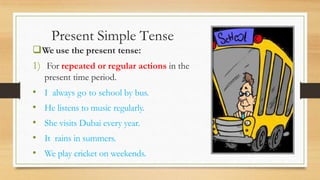
Present Simple Tense
We use the present tense:
1) For repeated or regular actions in the
present time period.
• I always go to school by bus.
• He listens to music regularly.
• She visits Dubai every year.
• It rains in summers.
• We play cricket on weekends.
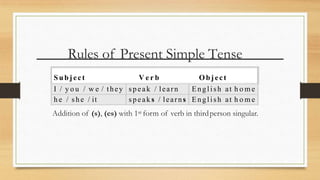
Rules of Present Simple Tense
Addition of (s), (es) with 1st form of verb in thirdperson singular.
Subject V e r b Object
I / y o u / w e / they speak / learn English at h o m e
h e / she / it speak s / learns English at h o m e
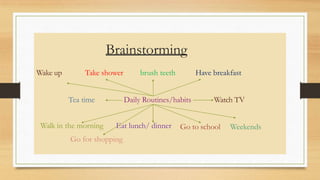
Brainstorming
Wake up Take shower brush teeth Have breakfast
Tea time Daily Routines/habits Watch TV
Go to school WeekendsWalk in the morning Eat lunch/ dinner
Go for shopping
2) For
3) For habits and hobbies
 I get up early in the morning .
 She bites her nails.
 He smokes.
 She reads novels.
 He collects coins.
 I keep pets.
4. For things that are always /
generally true.
 He lives in Karachi.
 They speak English at work.
 We work in BSS.
 Some birds fly south in winter.
• For feelings and thoughts.
 He feels hungry
 She feels nausea
 I think it’s a good idea.
5. To refer future time, fixed future
events on timetables or calendars.
• The train leaves at 5:00.
• Flight PK 77 takes off at 1100
hours.
• The tournament starts from
January.
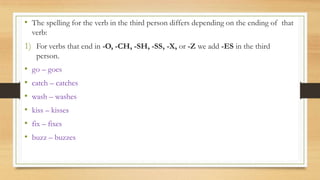
• The spelling for the verb in the third person differs depending on the ending of that
verb:
1) For verbs that end in -O, -CH, -SH, -SS, -X, or -Z we add -ES in the third
person.
• go – goes
• catch – catches
• wash – washes
• kiss – kisses
• fix – fixes
• buzz – buzzes
2) For verbs that end in a consonant + Y, we remove the Y and add -IES.
• marry – marries.
• study – studies.
• carry – carries.
• worry – worries.
NOTE: For verbs that end in a vowel + Y, we just add -S.
• play – plays.
• enjoy – enjoys.
• say – says.
Use of DO andDOES.
Negative Sentence:
• To make a negative sentence we add don't between the subject andthe verb first form. We use Don't
when thesubject is I, you, we orthey.
Example: is I/ you/ we/ they don't speak French.
• When the subject is he, she or it, we add doesn't between the subject and the verb to make a negative
sentence.
Example: he/ she/ it doesn'tspeak German.
• The following is the word order to construct a basic negative sentence in English in the Present Tense
using Don't or Doesn't:
• Subject+ don't/doesn't+ Verb1st form+ Object
Examples: I don’t like cats.
• He doesn’t live here.
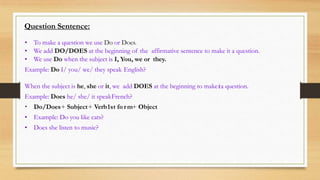
Question Sentence:
• To make a question we use Do or Does.
• We add DO/DOES at the beginning of the affirmative sentence to make it a question.
• We use Do when the subject is I, You, we or they.
Example: Do I/ you/ we/ they speak English?
When the subject is he, she or it, we add DOES at the beginning to makeita question.
Example: Does he/ she/ it speakFrench?
• Do/Does+ Subject+ Verb1st form+ Object
• Example: Do you like cats?
• Does she listen to music?
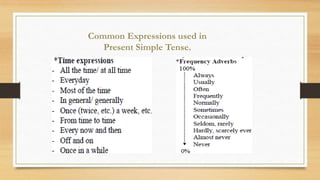
Common Expressions used in
Present Simple Tense.
We also use Present Simple for;
6) Broadcast Communications: (News Headlines/ Commentary)
• Pakistan beats Srilanka in ODI series.
• Dengue claims two more lives.
• Messi scores a hat trick.
7) Story Telling: (Vivid Narration)
Used to show that the past action seems to still happen vividly, instead of Past Simple
• There is a loud explosion behind us, and then I see the man coming out from the building. The tall lady
sits down at her desk, reaches for the gun and shoots herself.
8) Exclamatory Sentences:
Used to show sudden feeling and it’s usually used with there and here, ended by exclamation mark.
• Here comes teacher!
• What a good day it is!
• How nice it is!
• There goes the ball!
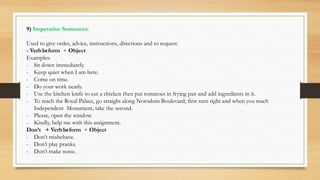
9) Imperative Sentences:
Used to give order, advice, instructions, directions and to request.
- Verb1stform + Object
Examples:
- Sit down immediately.
- Keep quiet when I am here.
- Come on time.
- Do your work neatly.
- Use the kitchen knife to cut a chicken then put tomatoes in frying pan and add ingredients in it.
- To reach the Royal Palace, go straight along Norodom Boulevard; first turn right and when you reach
Independent Monument, take the second.
- Please, open the window.
- Kindly, help me with this assignment.
Don’t + Verb1stform + Object
- Don’t misbehave.
- Don’t play pranks.
- Don’t make noise.
Practice Time!
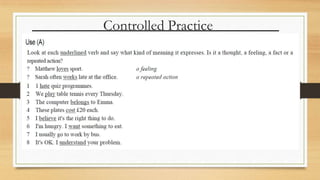
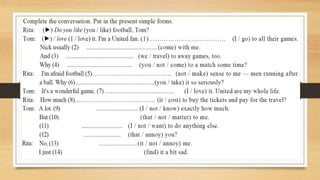
Controlled Practice
FREE WRITING
Write about your friend’s daily routine.

Present Simple Tense

  • 1.
  • 2.
    Present Simple Tense Weuse the present tense: 1) For repeated or regular actions in the present time period. • I always go to school by bus. • He listens to music regularly. • She visits Dubai every year. • It rains in summers. • We play cricket on weekends.
  • 3.
    Rules of PresentSimple Tense Addition of (s), (es) with 1st form of verb in thirdperson singular. Subject V e r b Object I / y o u / w e / they speak / learn English at h o m e h e / she / it speak s / learns English at h o m e
  • 4.
    Brainstorming Wake up Takeshower brush teeth Have breakfast Tea time Daily Routines/habits Watch TV Go to school WeekendsWalk in the morning Eat lunch/ dinner Go for shopping
  • 5.
  • 6.
    3) For habitsand hobbies  I get up early in the morning .  She bites her nails.  He smokes.  She reads novels.  He collects coins.  I keep pets.
  • 7.
    4. For thingsthat are always / generally true.  He lives in Karachi.  They speak English at work.  We work in BSS.  Some birds fly south in winter. • For feelings and thoughts.  He feels hungry  She feels nausea  I think it’s a good idea.
  • 8.
    5. To referfuture time, fixed future events on timetables or calendars. • The train leaves at 5:00. • Flight PK 77 takes off at 1100 hours. • The tournament starts from January.
  • 9.
    • The spellingfor the verb in the third person differs depending on the ending of that verb: 1) For verbs that end in -O, -CH, -SH, -SS, -X, or -Z we add -ES in the third person. • go – goes • catch – catches • wash – washes • kiss – kisses • fix – fixes • buzz – buzzes
  • 10.
    2) For verbsthat end in a consonant + Y, we remove the Y and add -IES. • marry – marries. • study – studies. • carry – carries. • worry – worries. NOTE: For verbs that end in a vowel + Y, we just add -S. • play – plays. • enjoy – enjoys. • say – says. Use of DO andDOES.
  • 11.
    Negative Sentence: • Tomake a negative sentence we add don't between the subject andthe verb first form. We use Don't when thesubject is I, you, we orthey. Example: is I/ you/ we/ they don't speak French. • When the subject is he, she or it, we add doesn't between the subject and the verb to make a negative sentence. Example: he/ she/ it doesn'tspeak German. • The following is the word order to construct a basic negative sentence in English in the Present Tense using Don't or Doesn't: • Subject+ don't/doesn't+ Verb1st form+ Object Examples: I don’t like cats. • He doesn’t live here.
  • 12.
    Question Sentence: • Tomake a question we use Do or Does. • We add DO/DOES at the beginning of the affirmative sentence to make it a question. • We use Do when the subject is I, You, we or they. Example: Do I/ you/ we/ they speak English? When the subject is he, she or it, we add DOES at the beginning to makeita question. Example: Does he/ she/ it speakFrench? • Do/Does+ Subject+ Verb1st form+ Object • Example: Do you like cats? • Does she listen to music?
  • 13.
    Common Expressions usedin Present Simple Tense.
  • 14.
    We also usePresent Simple for; 6) Broadcast Communications: (News Headlines/ Commentary) • Pakistan beats Srilanka in ODI series. • Dengue claims two more lives. • Messi scores a hat trick. 7) Story Telling: (Vivid Narration) Used to show that the past action seems to still happen vividly, instead of Past Simple • There is a loud explosion behind us, and then I see the man coming out from the building. The tall lady sits down at her desk, reaches for the gun and shoots herself. 8) Exclamatory Sentences: Used to show sudden feeling and it’s usually used with there and here, ended by exclamation mark. • Here comes teacher! • What a good day it is! • How nice it is! • There goes the ball!
  • 15.
    9) Imperative Sentences: Usedto give order, advice, instructions, directions and to request. - Verb1stform + Object Examples: - Sit down immediately. - Keep quiet when I am here. - Come on time. - Do your work neatly. - Use the kitchen knife to cut a chicken then put tomatoes in frying pan and add ingredients in it. - To reach the Royal Palace, go straight along Norodom Boulevard; first turn right and when you reach Independent Monument, take the second. - Please, open the window. - Kindly, help me with this assignment. Don’t + Verb1stform + Object - Don’t misbehave. - Don’t play pranks. - Don’t make noise.
  • 16.
  • 17.
  • 20.
    FREE WRITING Write aboutyour friend’s daily routine.