Past Time RVA
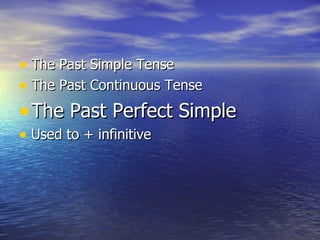
The Past Simple Tense The Past Continuous Tense The Past Perfect Simple Used to + infinitive
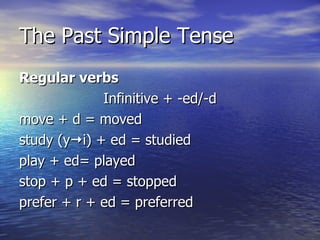
The Past Simple Tense Regular verbs Infinitive + -ed/-d move + d = moved study (y  i) + ed = studied play + ed= played stop + p + ed = stopped prefer + r + ed = preferred
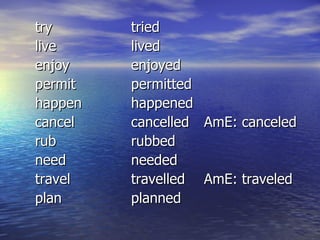
try  live enjoy permit happen cancel rub need travel plan tried  lived enjoyed permitted happened cancelled   AmE: canceled rubbed needed travelled    AmE: traveled planned
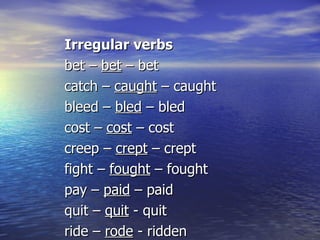
Irregular verbs bet –  bet  – bet catch –  caught  – caught bleed –  bled  – bled cost –  cost  – cost creep –  crept  – crept fight –  fought  – fought pay –  paid  – paid quit –  quit  - quit ride –  rode  - ridden
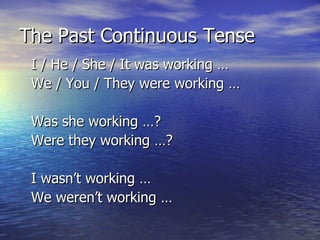
The Past Continuous Tense I / He / She / It was working … We / You / They were working … Was she working …? Were they working …? I wasn’t working … We weren’t working …
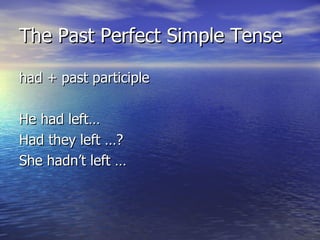
The Past Perfect Simple Tense had + past participle He had left…  Had they left …? She hadn’t left …
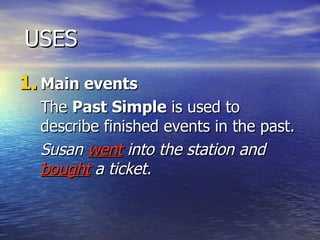
USES Main events The  Past Simple  is used to describe finished events in the past. Susan  went  into the station and  bought   a ticket.
Background description The  Past Continuous  is used to describe actions still in progress, and is used for background description. There were a lot of people waiting in the station. Some  were sleeping  on the benches,  and others  were walking   up and down. Susan  was looking for  Graham, so she didn’t sit down.
Past Perfect (Past before past) The  Past Perfect  is used to describe a past event which took place before another past event. By the time the train arrived, Susan  had bought  the ticket (Para cuando llegó el tren, Susan había comprado el billete).
Interrupted past continuous We often contrast an action still in progress with a sudden event which interrupts it. While Susan  was trying  to get onto the platform, a man  grabbed   her handbag.
Put the verbs in brackets into a suitable tense. All sentences refer to past time. We (tour) _____ Canada at this time last year. I couldn’t concentrate because the people upstairs (talk) _______ very loudly. I (sleep) _______ when the front door rang. I wasn’t hungry. I (just eat) _________.
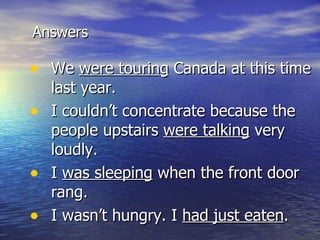
Answers We  were touring  Canada at this time last year. I couldn’t concentrate because the people upstairs  were talking  very loudly. I  was sleeping  when the front door rang. I wasn’t hungry. I  had just eaten .
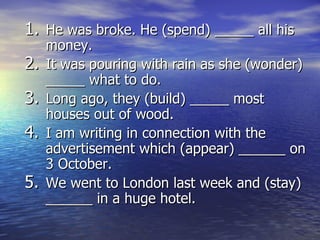
He was broke. He (spend) _____ all his money. It was pouring with rain as she (wonder) _____ what to do. Long ago, they (build) _____ most houses out of wood.  I am writing in connection with the advertisement which (appear) ______ on 3 October. We went to London last week and (stay) ______ in a huge hotel.
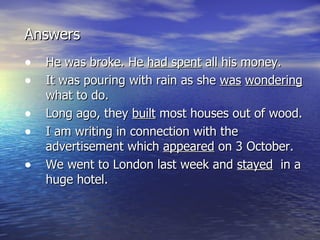
Answers He was broke. He  had spent  all his money. It was pouring with rain as she  was   wondering  what to do. Long ago, they  built  most houses out of wood.  I am writing in connection with the advertisement which  appeared  on 3 October. We went to London last week and  stayed   in a huge hotel.
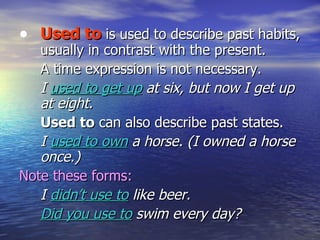
Used to  is used to describe past habits, usually in contrast with the present.  A time expression is not necessary. I  used to get up  at six, but now I get up at eight. Used to  can also describe past states. I  used to own  a horse. (I owned a horse once.) Note these forms: I  didn’t use to  like beer. Did you use to  swim every day?
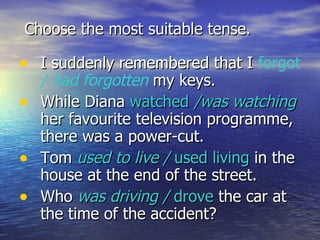
Choose the most suitable tense. I suddenly remembered that I  forgot  /   had forgotten  my keys. While Diana  watched  /was watching  her favourite television programme, there was a power-cut. Tom  used to live /  used living  in the house at the end of the street. Who  was driving /  drove  the car at the time of the accident?
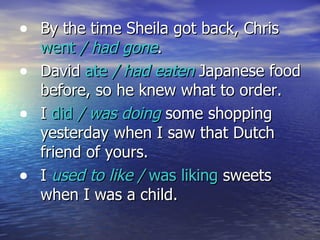
By the time Sheila got back, Chris  went  / had gone . David  ate  / had eaten  Japanese food before, so he knew what to order. I  did  / was doing  some shopping yesterday when I saw that Dutch friend of yours. I  used to like /  was liking  sweets when I was a child.

Past tenses

  • 1.
  • 2.
    The Past SimpleTense The Past Continuous Tense The Past Perfect Simple Used to + infinitive
  • 3.
    The Past SimpleTense Regular verbs Infinitive + -ed/-d move + d = moved study (y  i) + ed = studied play + ed= played stop + p + ed = stopped prefer + r + ed = preferred
  • 4.
    try liveenjoy permit happen cancel rub need travel plan tried lived enjoyed permitted happened cancelled AmE: canceled rubbed needed travelled AmE: traveled planned
  • 5.
    Irregular verbs bet– bet – bet catch – caught – caught bleed – bled – bled cost – cost – cost creep – crept – crept fight – fought – fought pay – paid – paid quit – quit - quit ride – rode - ridden
  • 6.
    The Past ContinuousTense I / He / She / It was working … We / You / They were working … Was she working …? Were they working …? I wasn’t working … We weren’t working …
  • 7.
    The Past PerfectSimple Tense had + past participle He had left… Had they left …? She hadn’t left …
  • 8.
    USES Main eventsThe Past Simple is used to describe finished events in the past. Susan went into the station and bought a ticket.
  • 9.
    Background description The Past Continuous is used to describe actions still in progress, and is used for background description. There were a lot of people waiting in the station. Some were sleeping on the benches, and others were walking up and down. Susan was looking for Graham, so she didn’t sit down.
  • 10.
    Past Perfect (Pastbefore past) The Past Perfect is used to describe a past event which took place before another past event. By the time the train arrived, Susan had bought the ticket (Para cuando llegó el tren, Susan había comprado el billete).
  • 11.
    Interrupted past continuousWe often contrast an action still in progress with a sudden event which interrupts it. While Susan was trying to get onto the platform, a man grabbed her handbag.
  • 12.
    Put the verbsin brackets into a suitable tense. All sentences refer to past time. We (tour) _____ Canada at this time last year. I couldn’t concentrate because the people upstairs (talk) _______ very loudly. I (sleep) _______ when the front door rang. I wasn’t hungry. I (just eat) _________.
  • 13.
    Answers We were touring Canada at this time last year. I couldn’t concentrate because the people upstairs were talking very loudly. I was sleeping when the front door rang. I wasn’t hungry. I had just eaten .
  • 14.
    He was broke.He (spend) _____ all his money. It was pouring with rain as she (wonder) _____ what to do. Long ago, they (build) _____ most houses out of wood. I am writing in connection with the advertisement which (appear) ______ on 3 October. We went to London last week and (stay) ______ in a huge hotel.
  • 15.
    Answers He wasbroke. He had spent all his money. It was pouring with rain as she was wondering what to do. Long ago, they built most houses out of wood. I am writing in connection with the advertisement which appeared on 3 October. We went to London last week and stayed in a huge hotel.
  • 16.
    Used to is used to describe past habits, usually in contrast with the present. A time expression is not necessary. I used to get up at six, but now I get up at eight. Used to can also describe past states. I used to own a horse. (I owned a horse once.) Note these forms: I didn’t use to like beer. Did you use to swim every day?
  • 17.
    Choose the mostsuitable tense. I suddenly remembered that I forgot / had forgotten my keys. While Diana watched /was watching her favourite television programme, there was a power-cut. Tom used to live / used living in the house at the end of the street. Who was driving / drove the car at the time of the accident?
  • 18.
    By the timeSheila got back, Chris went / had gone . David ate / had eaten Japanese food before, so he knew what to order. I did / was doing some shopping yesterday when I saw that Dutch friend of yours. I used to like / was liking sweets when I was a child.