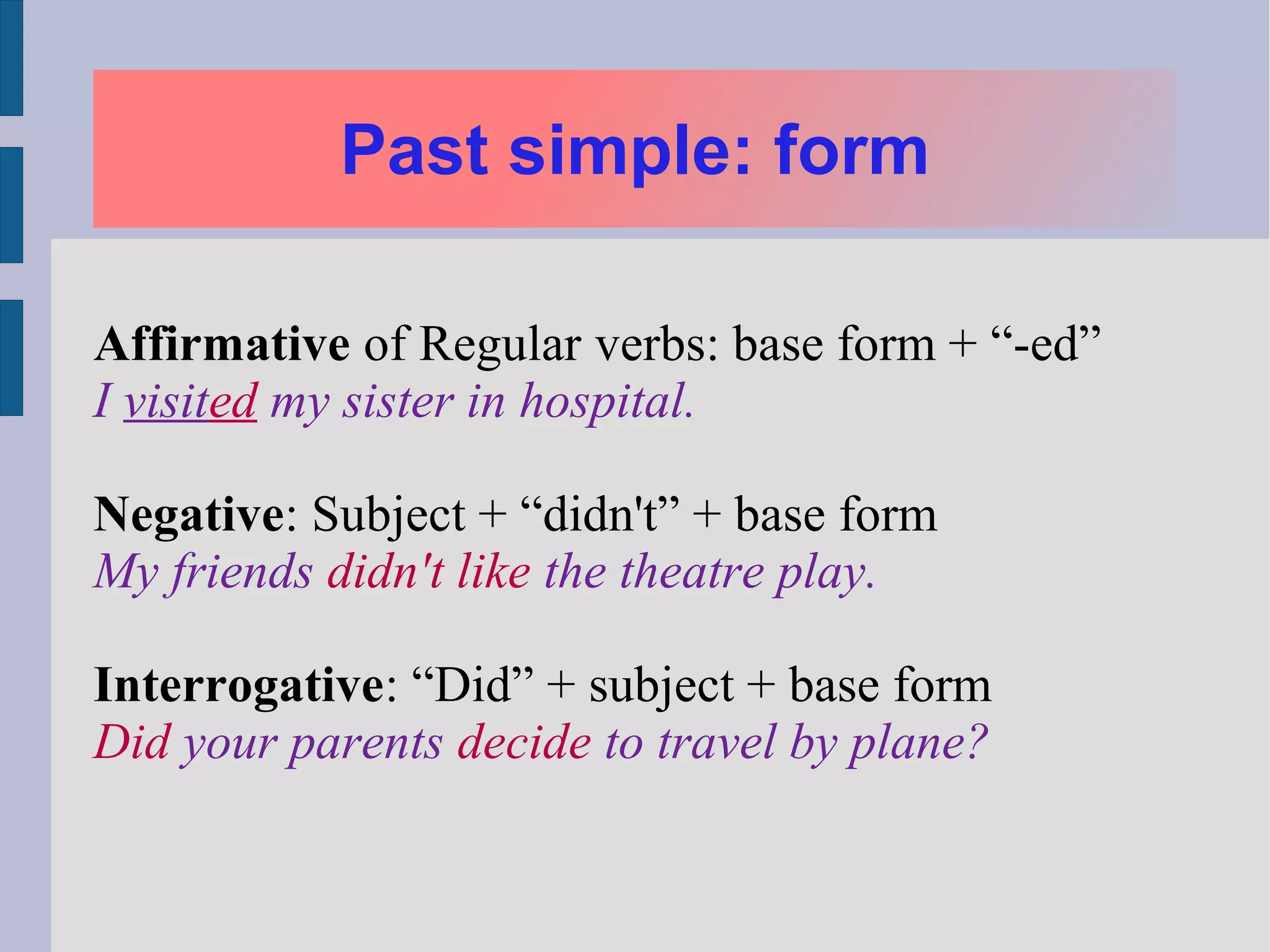
Past simple: form

Affirmative of Regular verbs: base form + “-ed”
I visited my sister in hospital.

Negative: Subject + “didn't” + base form
My friends didn't like the theatre play.

Interrogative: “Did” + subject + base form
Did your parents decide to travel by plane?
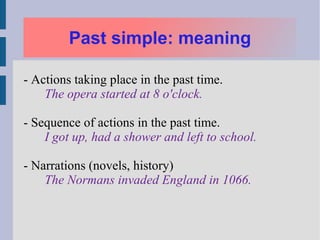
Past simple: meaning

- Actions taking place in the past time.
    The opera started at 8 o'clock.

- Sequence of actions in the past time.
    I got up, had a shower and left to school.

- Narrations (novels, history)
    The Normans invaded England in 1066.
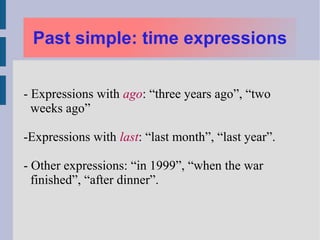
Past simple: time expressions


- Expressions with ago: “three years ago”, “two
  weeks ago”

-Expressions with last: “last month”, “last year”.

- Other expressions: “in 1999”, “when the war
  finished”, “after dinner”.
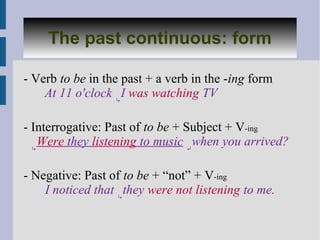
The past continuous: form

- Verb to be in the past + a verb in the -ing form
    At 11 o'clock ↳I was watching TV

- Interrogative: Past of to be + Subject + V-ing
  ↳
    Were they listening to music ↵when you arrived?

- Negative: Past of to be + “not” + V-ing
    I noticed that ↳they were not listening to me.
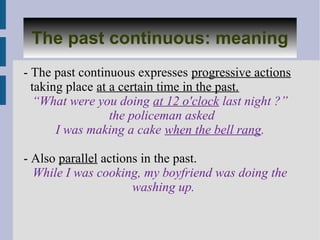
The past continuous: meaning
   Past continuous: meaning
- The past continuous expresses progressive actions
  taking place at a certain time in the past.
   “What were you doing at 12 o'clock last night ?”
                  the policeman asked
       I was making a cake when the bell rang.

- Also parallel actions in the past.
  While I was cooking, my boyfriend was doing the
                      washing up.
The past continuous:
    Past continuous: meaning
        time expressions
- The past continuous often appears with while time
                  expressions as in
    There was an accident while I was having
 dinner.

- Also with time expressions indicating the moment
  when the action happened as in
    At twelve o'clock I was still [aún] studying.
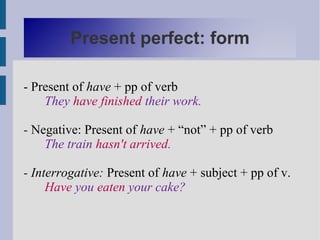
Present perfect: form

- Present of have + pp of verb
    They have finished their work.

- Negative: Present of have + “not” + pp of verb
    The train hasn't arrived.

- Interrogative: Present of have + subject + pp of v.
     Have you eaten your cake?
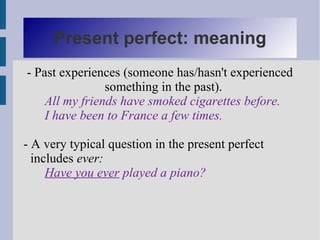
Present perfect: meaning
- Past experiences (someone has/hasn't experienced
                something in the past).
    All my friends have smoked cigarettes before.
    I have been to France a few times.

- A very typical question in the present perfect
  includes ever:
     Have you ever played a piano?
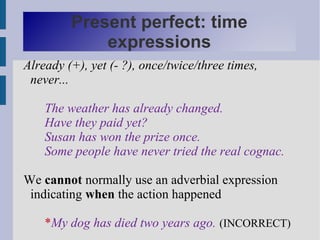
Present perfect: time
             expressions
Already (+), yet (- ?), once/twice/three times,
 never...

    The weather has already changed.
    Have they paid yet?
    Susan has won the prize once.
    Some people have never tried the real cognac.

We cannot normally use an adverbial expression
 indicating when the action happened

    *My dog has died two years ago. (INCORRECT)
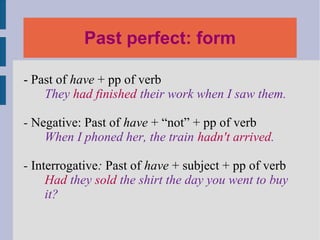
Past perfect: form

- Past of have + pp of verb
    They had finished their work when I saw them.

- Negative: Past of have + “not” + pp of verb
    When I phoned her, the train hadn't arrived.

- Interrogative: Past of have + subject + pp of verb
     Had they sold the shirt the day you went to buy
     it?
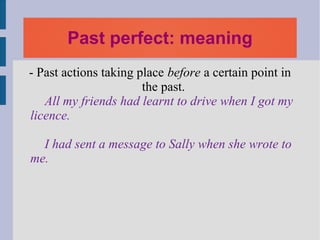
Past perfect: meaning
- Past actions taking place before a certain point in
                       the past.
   All my friends had learnt to drive when I got my
licence.

  I had sent a message to Sally when she wrote to
me.
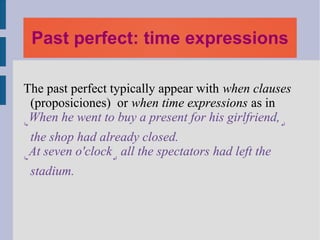
Past perfect: time expressions

The past perfect typically appear with when clauses
  (proposiciones) or when time expressions as in
↳
 When he went to buy a present for his girlfriend, ↵
  the shop had already closed.
↳
 At seven o'clock↵ all the spectators had left the
 stadium.

Past tenses

  • 1.
    Past simple: form Affirmativeof Regular verbs: base form + “-ed” I visited my sister in hospital. Negative: Subject + “didn't” + base form My friends didn't like the theatre play. Interrogative: “Did” + subject + base form Did your parents decide to travel by plane?
  • 2.
    Past simple: meaning -Actions taking place in the past time. The opera started at 8 o'clock. - Sequence of actions in the past time. I got up, had a shower and left to school. - Narrations (novels, history) The Normans invaded England in 1066.
  • 3.
    Past simple: timeexpressions - Expressions with ago: “three years ago”, “two weeks ago” -Expressions with last: “last month”, “last year”. - Other expressions: “in 1999”, “when the war finished”, “after dinner”.
  • 4.
    The past continuous:form - Verb to be in the past + a verb in the -ing form At 11 o'clock ↳I was watching TV - Interrogative: Past of to be + Subject + V-ing ↳ Were they listening to music ↵when you arrived? - Negative: Past of to be + “not” + V-ing I noticed that ↳they were not listening to me.
  • 5.
    The past continuous:meaning Past continuous: meaning - The past continuous expresses progressive actions taking place at a certain time in the past. “What were you doing at 12 o'clock last night ?” the policeman asked I was making a cake when the bell rang. - Also parallel actions in the past. While I was cooking, my boyfriend was doing the washing up.
  • 6.
    The past continuous: Past continuous: meaning time expressions - The past continuous often appears with while time expressions as in There was an accident while I was having dinner. - Also with time expressions indicating the moment when the action happened as in At twelve o'clock I was still [aún] studying.
  • 7.
    Present perfect: form -Present of have + pp of verb They have finished their work. - Negative: Present of have + “not” + pp of verb The train hasn't arrived. - Interrogative: Present of have + subject + pp of v. Have you eaten your cake?
  • 8.
    Present perfect: meaning -Past experiences (someone has/hasn't experienced something in the past). All my friends have smoked cigarettes before. I have been to France a few times. - A very typical question in the present perfect includes ever: Have you ever played a piano?
  • 9.
    Present perfect: time expressions Already (+), yet (- ?), once/twice/three times, never... The weather has already changed. Have they paid yet? Susan has won the prize once. Some people have never tried the real cognac. We cannot normally use an adverbial expression indicating when the action happened *My dog has died two years ago. (INCORRECT)
  • 10.
    Past perfect: form -Past of have + pp of verb They had finished their work when I saw them. - Negative: Past of have + “not” + pp of verb When I phoned her, the train hadn't arrived. - Interrogative: Past of have + subject + pp of verb Had they sold the shirt the day you went to buy it?
  • 11.
    Past perfect: meaning -Past actions taking place before a certain point in the past. All my friends had learnt to drive when I got my licence. I had sent a message to Sally when she wrote to me.
  • 12.
    Past perfect: timeexpressions The past perfect typically appear with when clauses (proposiciones) or when time expressions as in ↳ When he went to buy a present for his girlfriend, ↵ the shop had already closed. ↳ At seven o'clock↵ all the spectators had left the stadium.