PRESENT
SIMPLE
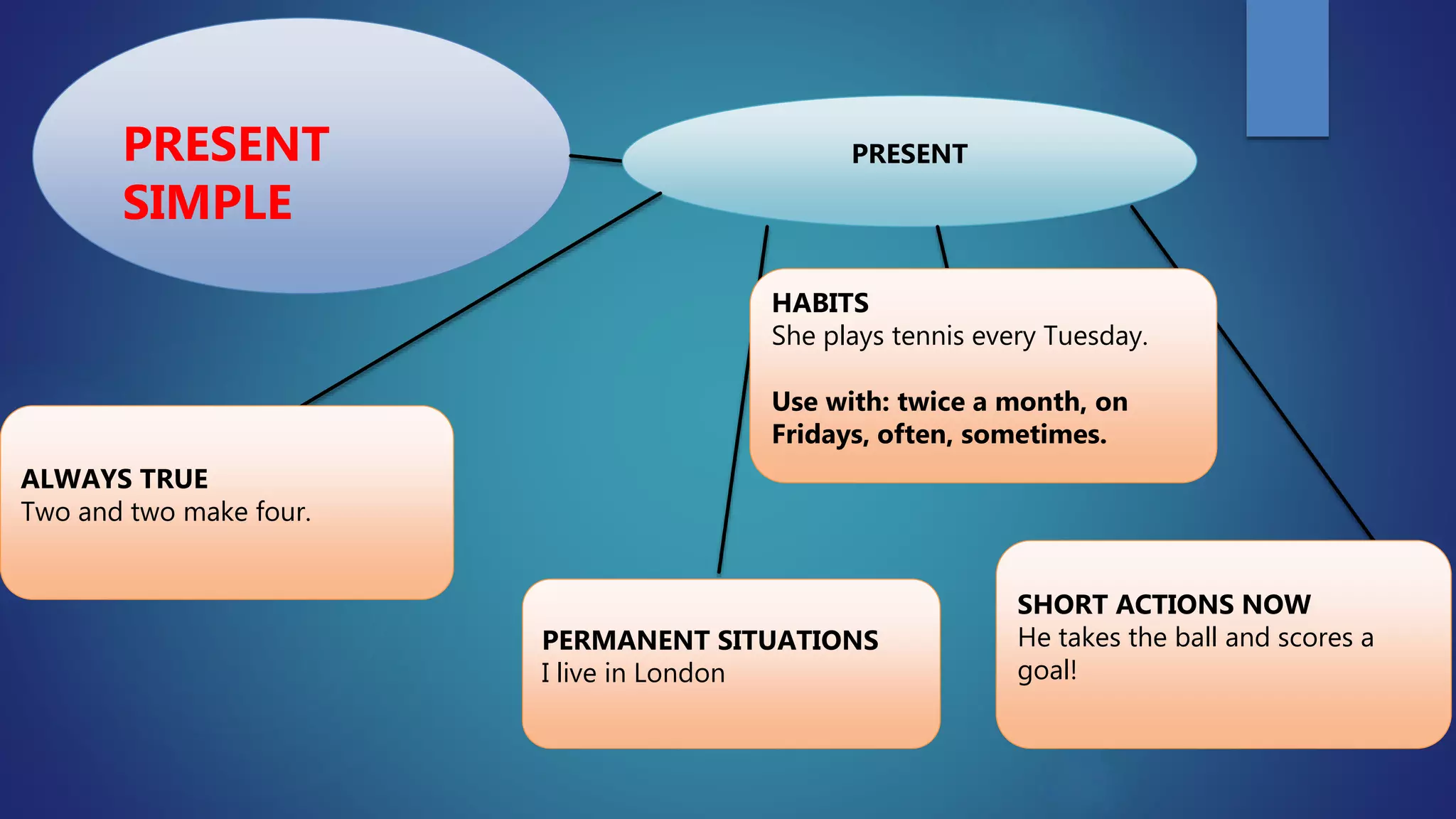
PRESENT
HABITS
She plays tennis every Tuesday.
Use with: twice a month, on
Fridays, often, sometimes.
SHORT ACTIONS NOW
He takes the ball and scores a
goal!
PERMANENT SITUATIONS
I live in London
ALWAYS TRUE
Two and two make four.
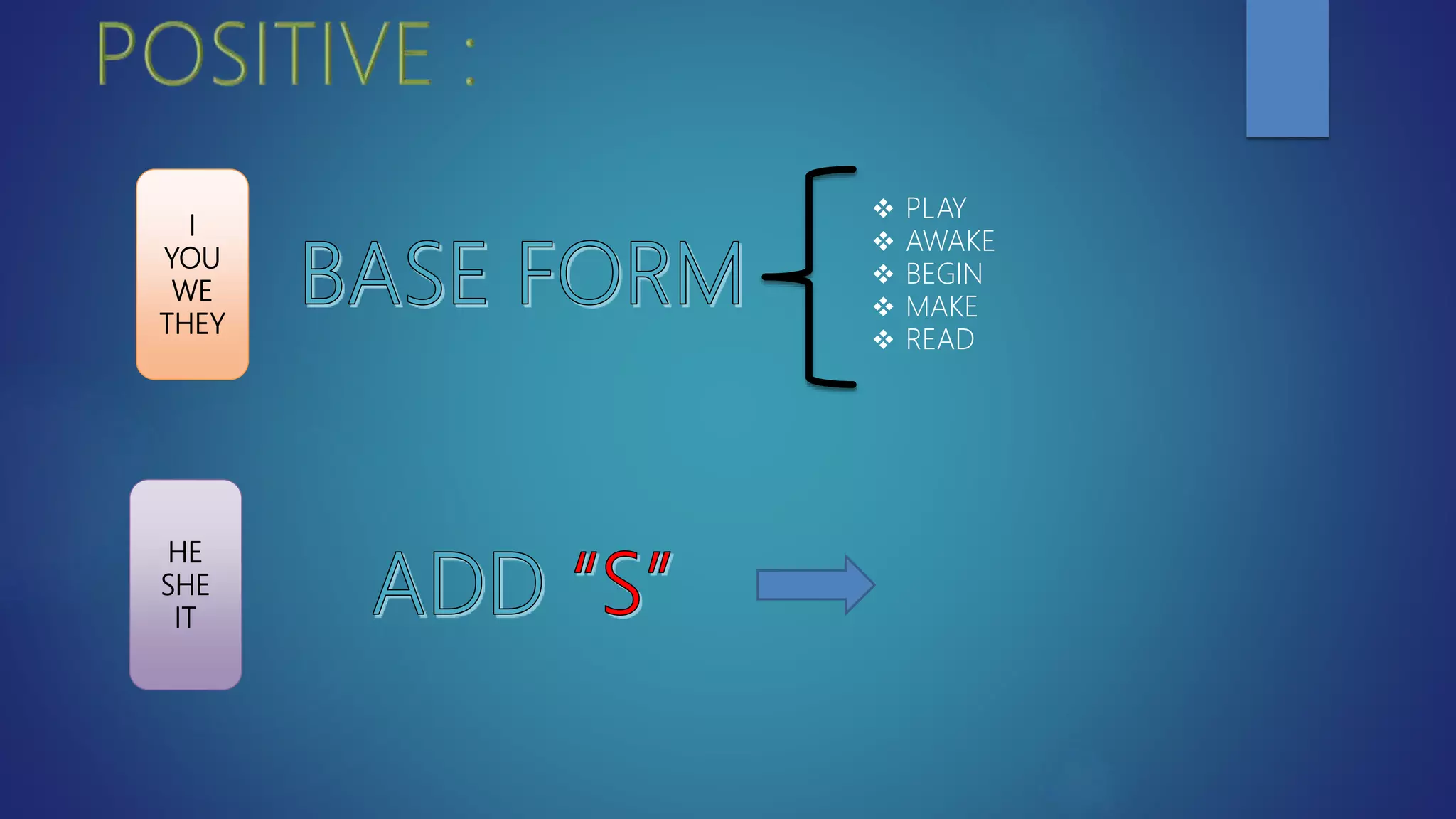
I
YOU
WE
THEY
HE
SHE
IT
 PLAY
 AWAKE
 BEGIN
 MAKE
 READ
She has seldom written books
He had always dug holes.
You often dance in the club
Does she usually wear black?
I don’t always arrive on time.
SOME RULES:
Verbs that end in 'y':
Verbs that end in 's', 'sh', 'ch', or 'x':
Verbs that end in 'y' often change 'y' to 'ie' before 's':
•study becomes studies
•try becomes tries
•marry becomes marries
•fly becomes flies
•cry becomes cries
(Be careful! 'y' doesn't change to 'ie' if the
ending is 'ay', 'ey', 'oy', 'uy'. So, play
becomes plays, say becomes says, buy
becomes buys, enjoy becomes enjoys,
stay becomes stays)
Verbs that end in 's', 'sh', 'ch', or 'x':
Verbs that end in 's', 'sh', 'ch' or 'x' often add 'e' before 's':
•pass becomes passes
•wash becomes washes
•teach becomes teaches
I
YOU
WE
THEY
HE
SHE
IT
NEGATIVE( PLAY) NEGATIVE SHORT FORM
I
YOU
DO NOT PLAY
WE
THEY
I DON’T PLAY
YOU DON’T PLAY
WE DON’T PLAY
THEY DON’T PLAY
HE
SHE DOES NOT PLAY
IT
HE DOESN’T PLAY
SHE DOESN’T PLAY
IT DOESN’T PLAY
I
YOU
WE
THEY
HE
SHE
IT
 PLAY
 AWAKE
 BEGIN
 MAKE
 READ

Present simple

  • 2.
    PRESENT SIMPLE PRESENT HABITS She plays tennisevery Tuesday. Use with: twice a month, on Fridays, often, sometimes. SHORT ACTIONS NOW He takes the ball and scores a goal! PERMANENT SITUATIONS I live in London ALWAYS TRUE Two and two make four.
  • 3.
  • 4.
    She has seldomwritten books He had always dug holes. You often dance in the club Does she usually wear black? I don’t always arrive on time.
  • 5.
    SOME RULES: Verbs thatend in 'y': Verbs that end in 's', 'sh', 'ch', or 'x':
  • 6.
    Verbs that endin 'y' often change 'y' to 'ie' before 's': •study becomes studies •try becomes tries •marry becomes marries •fly becomes flies •cry becomes cries (Be careful! 'y' doesn't change to 'ie' if the ending is 'ay', 'ey', 'oy', 'uy'. So, play becomes plays, say becomes says, buy becomes buys, enjoy becomes enjoys, stay becomes stays)
  • 7.
    Verbs that endin 's', 'sh', 'ch', or 'x': Verbs that end in 's', 'sh', 'ch' or 'x' often add 'e' before 's': •pass becomes passes •wash becomes washes •teach becomes teaches
  • 8.
  • 9.
    NEGATIVE( PLAY) NEGATIVESHORT FORM I YOU DO NOT PLAY WE THEY I DON’T PLAY YOU DON’T PLAY WE DON’T PLAY THEY DON’T PLAY HE SHE DOES NOT PLAY IT HE DOESN’T PLAY SHE DOESN’T PLAY IT DOESN’T PLAY
  • 10.