What is Tense
TENSE :-
Tense is a verb-based method used to
indicate the time, and sometimes the continuation
or completeness, of an action or state in relation to
the time of speaking.
The word TENSE is Originated by a
Latin word called tempus which means “time”
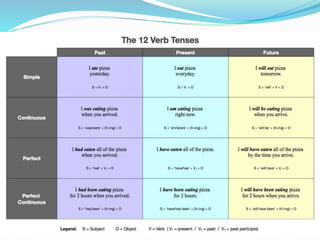
 Types of Tenses
Past tense
Present tense
Future tense
PAST TENSE:-
The past tense is a grammatical
tense whose principal function is to place an
action or situation in past time
In languages which have a past
tense, it thus provides a grammatical means
of indicating that the event being referred to
took place in the past.
Examples of verbs in the past tense
include the English verbs Sang, went and
was.
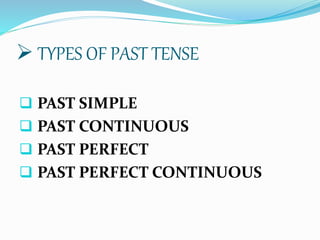
 TYPES OF PAST TENSE
 PAST SIMPLE
 PAST CONTINUOUS
 PAST PERFECT
 PAST PERFECT CONTINUOUS
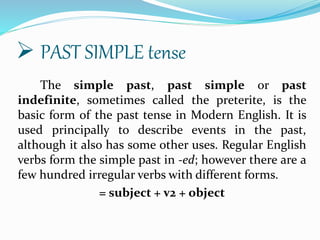
 PAST SIMPLE tense
The simple past, past simple or past
indefinite, sometimes called the preterite, is the
basic form of the past tense in Modern English. It is
used principally to describe events in the past,
although it also has some other uses. Regular English
verbs form the simple past in -ed; however there are a
few hundred irregular verbs with different forms.
= subject + v2 + object
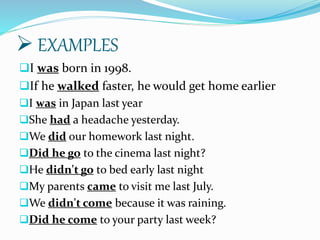
 EXAMPLES
I was born in 1998.
If he walked faster, he would get home earlier
I was in Japan last year
She had a headache yesterday.
We did our homework last night.
Did he go to the cinema last night?
He didn't go to bed early last night
My parents came to visit me last July.
We didn't come because it was raining.
Did he come to your party last week?
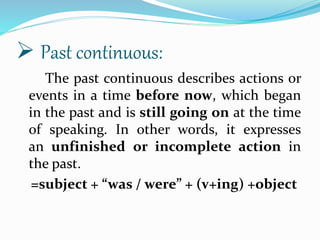
The past continuous describes actions or
events in a time before now, which began
in the past and is still going on at the time
of speaking. In other words, it expresses
an unfinished or incomplete action in
the past.
=subject + “was / were” + (v+ing) +object
 Past continuous:
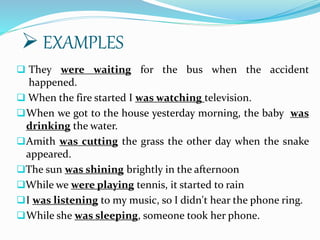
 They were waiting for the bus when the accident
happened.
 When the fire started I was watching television.
When we got to the house yesterday morning, the baby was
drinking the water.
Amith was cutting the grass the other day when the snake
appeared.
The sun was shining brightly in the afternoon
While we were playing tennis, it started to rain
I was listening to my music, so I didn't hear the phone ring.
While she was sleeping, someone took her phone.
 EXAMPLES
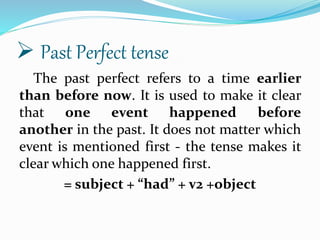
The past perfect refers to a time earlier
than before now. It is used to make it clear
that one event happened before
another in the past. It does not matter which
event is mentioned first - the tense makes it
clear which one happened first.
= subject + “had” + v2 +object
 Past Perfect tense
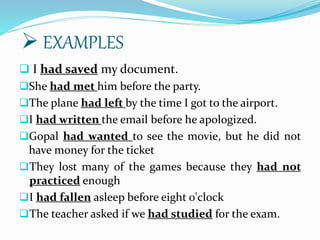
 I had saved my document.
She had met him before the party.
The plane had left by the time I got to the airport.
I had written the email before he apologized.
Gopal had wanted to see the movie, but he did not
have money for the ticket
They lost many of the games because they had not
practiced enough
I had fallen asleep before eight o'clock
The teacher asked if we had studied for the exam.
 EXAMPLES
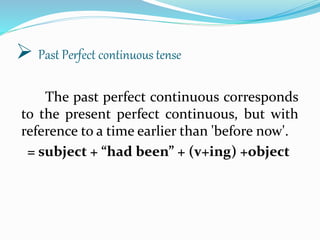
The past perfect continuous corresponds
to the present perfect continuous, but with
reference to a time earlier than 'before now'.
= subject + “had been” + (v+ing) +object
 Past Perfect continuous tense
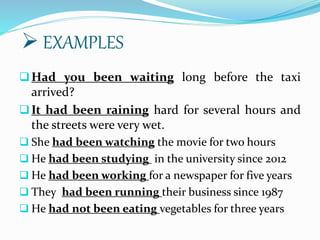
Had you been waiting long before the taxi
arrived?
It had been raining hard for several hours and
the streets were very wet.
 She had been watching the movie for two hours
 He had been studying in the university since 2012
 He had been working for a newspaper for five years
 They had been running their business since 1987
 He had not been eating vegetables for three years
 EXAMPLES
Tenses
Tenses
Tenses

Tenses

  • 3.
  • 4.
    TENSE :- Tense isa verb-based method used to indicate the time, and sometimes the continuation or completeness, of an action or state in relation to the time of speaking. The word TENSE is Originated by a Latin word called tempus which means “time”
  • 5.
     Types ofTenses Past tense Present tense Future tense
  • 7.
    PAST TENSE:- The pasttense is a grammatical tense whose principal function is to place an action or situation in past time In languages which have a past tense, it thus provides a grammatical means of indicating that the event being referred to took place in the past. Examples of verbs in the past tense include the English verbs Sang, went and was.
  • 8.
     TYPES OFPAST TENSE  PAST SIMPLE  PAST CONTINUOUS  PAST PERFECT  PAST PERFECT CONTINUOUS
  • 9.
     PAST SIMPLEtense The simple past, past simple or past indefinite, sometimes called the preterite, is the basic form of the past tense in Modern English. It is used principally to describe events in the past, although it also has some other uses. Regular English verbs form the simple past in -ed; however there are a few hundred irregular verbs with different forms. = subject + v2 + object
  • 10.
     EXAMPLES I wasborn in 1998. If he walked faster, he would get home earlier I was in Japan last year She had a headache yesterday. We did our homework last night. Did he go to the cinema last night? He didn't go to bed early last night My parents came to visit me last July. We didn't come because it was raining. Did he come to your party last week?
  • 11.
    The past continuousdescribes actions or events in a time before now, which began in the past and is still going on at the time of speaking. In other words, it expresses an unfinished or incomplete action in the past. =subject + “was / were” + (v+ing) +object  Past continuous:
  • 12.
     They werewaiting for the bus when the accident happened.  When the fire started I was watching television. When we got to the house yesterday morning, the baby was drinking the water. Amith was cutting the grass the other day when the snake appeared. The sun was shining brightly in the afternoon While we were playing tennis, it started to rain I was listening to my music, so I didn't hear the phone ring. While she was sleeping, someone took her phone.  EXAMPLES
  • 13.
    The past perfectrefers to a time earlier than before now. It is used to make it clear that one event happened before another in the past. It does not matter which event is mentioned first - the tense makes it clear which one happened first. = subject + “had” + v2 +object  Past Perfect tense
  • 14.
     I hadsaved my document. She had met him before the party. The plane had left by the time I got to the airport. I had written the email before he apologized. Gopal had wanted to see the movie, but he did not have money for the ticket They lost many of the games because they had not practiced enough I had fallen asleep before eight o'clock The teacher asked if we had studied for the exam.  EXAMPLES
  • 15.
    The past perfectcontinuous corresponds to the present perfect continuous, but with reference to a time earlier than 'before now'. = subject + “had been” + (v+ing) +object  Past Perfect continuous tense
  • 16.
    Had you beenwaiting long before the taxi arrived? It had been raining hard for several hours and the streets were very wet.  She had been watching the movie for two hours  He had been studying in the university since 2012  He had been working for a newspaper for five years  They had been running their business since 1987  He had not been eating vegetables for three years  EXAMPLES