PHRASAL VERBS
PHRASAL VERBS The phrasal verbs or "verbs compounds" are a very particular aspect of English and often causes confusion among people who are learning the language.  The phrasal verbs are idiomatic expressions that are formed by combining verbs with prepositions or adverbs. This results in new phrasal verbs with a meaning very different from what the dictionary gives for individual verbs.  The compound verbs are widely used in both written English and the spoken. There always new phrasal verbs as grammatical structure of these is a very flexible to create new verbs and expressions. Moreover, the same phrasal verb can have several meanings.
EXAMPLES
EXAMPLES VERB  +  PREPOSITION  +  OBJECT Verb + preposition + object  (transitive verb takes an object)  The preposition is placed between the basic verb and object. Blowing up the balloons for the party was easy Adverbial particle + VERB + OBJECT  (transitive verb takes an object)  1) If the object is a noun, adverbial particle can be placed after the verb or after the object base. The old man gave away his houses. The old man gave his houses away. 2) If the object is a pronoun, the adverbial particle is placed at the end.    The oldman gave them away.
EXAMPLES Verb + adverbial particle + preposition + object  (transitive verb takes an object)  Adverbial particle is the first and the second is a preposition. It is not possible to insert another word between two particles.    Helen ran out without saying goodbye.  (Elena ran out without saying goodbye) Verb + adverbial particle  (intransitive verb is not object)  The adverbial particle is placed immediately after the basic verb. Our car broke down yesterday morning.
PREPOSITIONAL VERBS
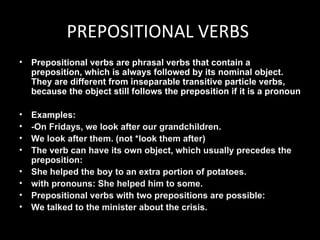
PREPOSITIONAL VERBS  Prepositional verbs are phrasal verbs that contain a preposition, which is always followed by its nominal object. They are different from inseparable transitive particle verbs, because the object still follows the preposition if it is a pronoun Examples: -On Fridays, we look after our grandchildren.  We look after them. (not *look them after)  The verb can have its own object, which usually precedes the preposition: She helped the boy to an extra portion of potatoes.  with pronouns: She helped him to some.  Prepositional verbs with two prepositions are possible: We talked to the minister about the crisis.
Elaboró: María del Carmen  Calva Minero Especialidad:English Profra: Diana Castañón

Phrasal Verbs

  • 1.
  • 2.
    PHRASAL VERBS Thephrasal verbs or "verbs compounds" are a very particular aspect of English and often causes confusion among people who are learning the language. The phrasal verbs are idiomatic expressions that are formed by combining verbs with prepositions or adverbs. This results in new phrasal verbs with a meaning very different from what the dictionary gives for individual verbs. The compound verbs are widely used in both written English and the spoken. There always new phrasal verbs as grammatical structure of these is a very flexible to create new verbs and expressions. Moreover, the same phrasal verb can have several meanings.
  • 3.
  • 4.
    EXAMPLES VERB  + PREPOSITION  +  OBJECT Verb + preposition + object (transitive verb takes an object) The preposition is placed between the basic verb and object. Blowing up the balloons for the party was easy Adverbial particle + VERB + OBJECT (transitive verb takes an object) 1) If the object is a noun, adverbial particle can be placed after the verb or after the object base. The old man gave away his houses. The old man gave his houses away. 2) If the object is a pronoun, the adverbial particle is placed at the end.   The oldman gave them away.
  • 5.
    EXAMPLES Verb +adverbial particle + preposition + object (transitive verb takes an object) Adverbial particle is the first and the second is a preposition. It is not possible to insert another word between two particles.   Helen ran out without saying goodbye. (Elena ran out without saying goodbye) Verb + adverbial particle (intransitive verb is not object) The adverbial particle is placed immediately after the basic verb. Our car broke down yesterday morning.
  • 6.
  • 7.
    PREPOSITIONAL VERBS Prepositional verbs are phrasal verbs that contain a preposition, which is always followed by its nominal object. They are different from inseparable transitive particle verbs, because the object still follows the preposition if it is a pronoun Examples: -On Fridays, we look after our grandchildren. We look after them. (not *look them after) The verb can have its own object, which usually precedes the preposition: She helped the boy to an extra portion of potatoes. with pronouns: She helped him to some. Prepositional verbs with two prepositions are possible: We talked to the minister about the crisis.
  • 8.
    Elaboró: María delCarmen Calva Minero Especialidad:English Profra: Diana Castañón