Writing in the Discipline
Reported by: Richelle R. Capin
Course: I- BS in Information Technology
Cause and Effect
Cause and Effect
Nothing happens without a reason or
without some kind of consequence.
When you explain why things happen and
what occurs when they do, the technique
you use is called cause and effect.
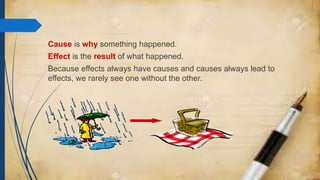
Cause is why something happened.
Effect is the result of what happened.
Because effects always have causes and causes always lead to
effects, we rarely see one without the other.
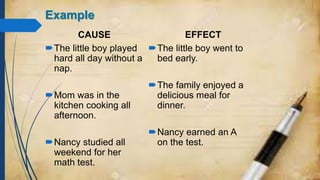
Example
CAUSE
The little boy played
hard all day without a
nap.
Mom was in the
kitchen cooking all
afternoon.
Nancy studied all
weekend for her
math test.
EFFECT
The little boy went to
bed early.
The family enjoyed a
delicious meal for
dinner.
Nancy earned an A
on the test.
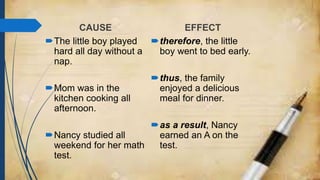
CAUSE
The little boy played
hard all day without a
nap.
Mom was in the
kitchen cooking all
afternoon.
Nancy studied all
weekend for her math
test.
EFFECT
therefore, the little
boy went to bed early.
thus, the family
enjoyed a delicious
meal for dinner.
as a result, Nancy
earned an A on the
test.
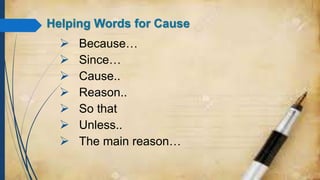
Helping Words for Cause
 Because…
 Since…
 Cause..
 Reason..
 So that
 Unless..
 The main reason…
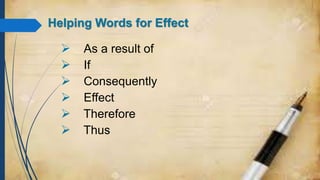
Helping Words for Effect
 As a result of
 If
 Consequently
 Effect
 Therefore
 Thus
Notes!
Conjunctions such as therefore, consequently, as a
result, and for this reason are usually followed by a
comma.
 The weather was cold; therefore, Sally closed the
window.
 The weather was cold. Consequently, Sally put on her
scarf.
 A blizzard hit the town. As a result, the schools were
closed.
Notes!
The adverbial clause conjunctions since and because are
exceptions.
These are attached directly at the beginning of CAUSE-
sentence without a comma.
 Because the weather outside was cold, Sally closed the
window.
 Since it was so chilly outside, Benjamin built up a big fire
in his fireplace.
Notes!
The coordinating conjunction so is also different the one
above.
 The weather was warm, so Jim turned on the air
conditioner.
 The weather was warm. So Jim turned on the air
conditioner.
Other Example
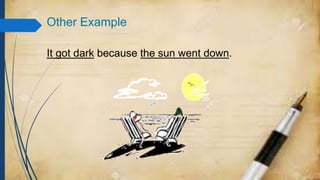
It got dark because the sun went down.
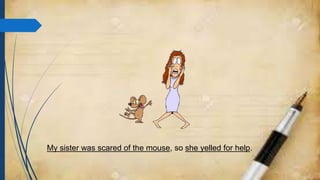
My sister was scared of the mouse, so she yelled for help.
Comparison and Contrast
Compare and contrast pertaining to a
written exercise about the similarities and
differences between two or more people,
places, or things.
Example: Time in Philippines is similar
to time in Beijing China.
Helping Words for Comparison and Contrast
 and
 Although
 even though
 though
 while
 whereas
 however
 on the other hand
 But
 yet
Example
Coordinators can join sentences and begin sentences.
 Kim likes heavy metal, but Tom prefers classical music.
 Kim likes heavy metal. But Tom prefers classical music.
Subordinators join dependent clauses to sentences.
 While Kim likes prime rib, Tom prefers rice and vegetables.
 Kim likes prime rib while Tom prefers rice and vegetables.
Transition words do not join sentences;
Kim and Tom have different tastes in music and
food; however, they both like to dance.
Kim and Tom have different tastes in music and
food. However, they both like to dance.
Analogy
Analogy
An analogy is a kind of comparison that explains
the unknown in terms of the known, the unfamiliar
in terms of the familiar.
Analogy can be used with other methods of
development to explain a process, define a
concept, narrate an event, or describe a person or
place.
Example
My love is as vast as an ocean.
Life is like a race. The one who keeps running
wins the race and the one who stops to catch
a breath loses.
Just a sword is the weapon of a
warrior; a pen is the weapon of a writer.
Writing in the discipine

Writing in the discipine

  • 1.
    Writing in theDiscipline Reported by: Richelle R. Capin Course: I- BS in Information Technology
  • 2.
  • 3.
    Cause and Effect Nothinghappens without a reason or without some kind of consequence. When you explain why things happen and what occurs when they do, the technique you use is called cause and effect.
  • 4.
    Cause is whysomething happened. Effect is the result of what happened. Because effects always have causes and causes always lead to effects, we rarely see one without the other.
  • 5.
    Example CAUSE The little boyplayed hard all day without a nap. Mom was in the kitchen cooking all afternoon. Nancy studied all weekend for her math test. EFFECT The little boy went to bed early. The family enjoyed a delicious meal for dinner. Nancy earned an A on the test.
  • 6.
    CAUSE The little boyplayed hard all day without a nap. Mom was in the kitchen cooking all afternoon. Nancy studied all weekend for her math test. EFFECT therefore, the little boy went to bed early. thus, the family enjoyed a delicious meal for dinner. as a result, Nancy earned an A on the test.
  • 7.
    Helping Words forCause  Because…  Since…  Cause..  Reason..  So that  Unless..  The main reason…
  • 8.
    Helping Words forEffect  As a result of  If  Consequently  Effect  Therefore  Thus
  • 9.
    Notes! Conjunctions such astherefore, consequently, as a result, and for this reason are usually followed by a comma.  The weather was cold; therefore, Sally closed the window.  The weather was cold. Consequently, Sally put on her scarf.  A blizzard hit the town. As a result, the schools were closed.
  • 10.
    Notes! The adverbial clauseconjunctions since and because are exceptions. These are attached directly at the beginning of CAUSE- sentence without a comma.  Because the weather outside was cold, Sally closed the window.  Since it was so chilly outside, Benjamin built up a big fire in his fireplace.
  • 11.
    Notes! The coordinating conjunctionso is also different the one above.  The weather was warm, so Jim turned on the air conditioner.  The weather was warm. So Jim turned on the air conditioner.
  • 12.
    Other Example It gotdark because the sun went down.
  • 13.
    My sister wasscared of the mouse, so she yelled for help.
  • 14.
  • 15.
    Comparison and Contrast Compareand contrast pertaining to a written exercise about the similarities and differences between two or more people, places, or things. Example: Time in Philippines is similar to time in Beijing China.
  • 16.
    Helping Words forComparison and Contrast  and  Although  even though  though  while  whereas  however  on the other hand  But  yet
  • 17.
    Example Coordinators can joinsentences and begin sentences.  Kim likes heavy metal, but Tom prefers classical music.  Kim likes heavy metal. But Tom prefers classical music. Subordinators join dependent clauses to sentences.  While Kim likes prime rib, Tom prefers rice and vegetables.  Kim likes prime rib while Tom prefers rice and vegetables.
  • 18.
    Transition words donot join sentences; Kim and Tom have different tastes in music and food; however, they both like to dance. Kim and Tom have different tastes in music and food. However, they both like to dance.
  • 19.
  • 20.
    Analogy An analogy isa kind of comparison that explains the unknown in terms of the known, the unfamiliar in terms of the familiar. Analogy can be used with other methods of development to explain a process, define a concept, narrate an event, or describe a person or place.
  • 21.
    Example My love isas vast as an ocean. Life is like a race. The one who keeps running wins the race and the one who stops to catch a breath loses. Just a sword is the weapon of a warrior; a pen is the weapon of a writer.