PassiveVoice
Part2
1
https://pixabay.com/photos/books-bookstore-book-reading-shop-1204038/ shared under CC0
2
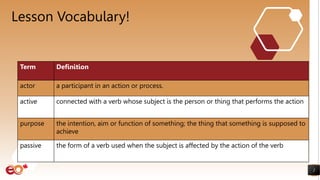
Lesson Vocabulary!
Term Definition
actor a participant in an action or process.
active connected with a verb whose subject is the person or thing that performs the action
purpose the intention, aim or function of something; the thing that something is supposed to
achieve
passive the form of a verb used when the subject is affected by the action of the verb
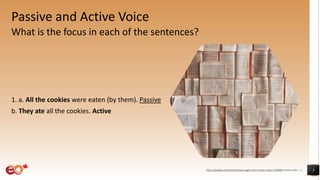
Passive and Active Voice
What is the focus in each of the sentences?
1. a. All the cookies were eaten (by them). Passive
b. They ate all the cookies. Active
3
https://pixabay.com/photos/books-pages-story-stories-notes-1245690/ shared under CC0
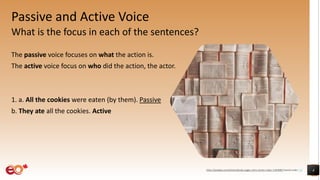
Passive and Active Voice
What is the focus in each of the sentences?
The passive voice focuses on what the action is.
The active voice focus on who did the action, the actor.
1. a. All the cookies were eaten (by them). Passive
b. They ate all the cookies. Active
4
https://pixabay.com/photos/books-pages-story-stories-notes-1245690/ shared under CC0
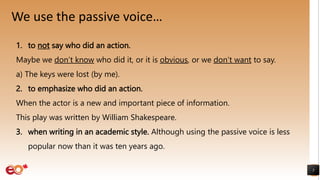
We use the passive voice…
5
1. to not say who did an action.
Maybe we don’t know who did it, or it is obvious, or we don’t want to say.
a) The keys were lost (by me).
2. to emphasize who did an action.
When the actor is a new and important piece of information.
This play was written by William Shakespeare.
3. when writing in an academic style. Although using the passive voice is less
popular now than it was ten years ago.
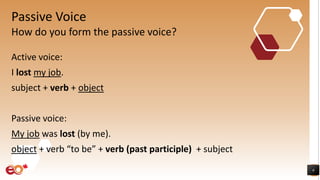
Passive Voice
Active voice:
I lost my job.
subject + verb + object
Passive voice:
My job was lost (by me).
object + verb “to be” + verb (past participle) + subject
6
How do you form the passive voice?
Passive Voice
Active voice:
Jim waits for his sister.
subject + verb + object
Passive voice:
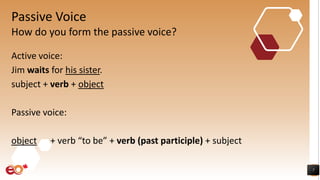
object + verb “to be” + verb (past participle) + subject
7
How do you form the passive voice?
Passive Voice
Active voice:
Jim waits for his sister.
subject + verb + object
Passive voice:
His sister is waited for by Jim.
object + verb “to be” + verb (past participle) + subject
8
How do you form the passive voice?
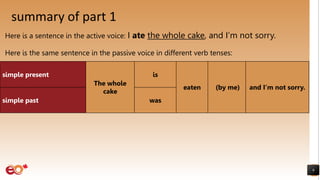
summary of part 1
Here is a sentence in the active voice: I ate the whole cake, and I’m not sorry.
Here is the same sentence in the passive voice in different verb tenses:
9
simple present
The whole
cake
is
eaten (by me) and I’m not sorry.
simple past was
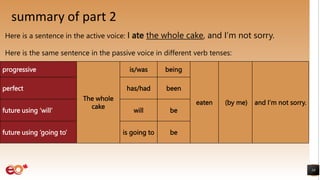
summary of part 2
10
progressive
The whole
cake
is/was being
eaten (by me) and I’m not sorry.
perfect has/had been
future using ‘will’ will be
future using ‘going to’ is going to be
Here is a sentence in the active voice: I ate the whole cake, and I’m not sorry.
Here is the same sentence in the passive voice in different verb tenses:
Image shared under CC0
present&past
progressive
https://pixabay.com/photos/books-bookstore-book-reading-shop-1204038/ shared under CC0
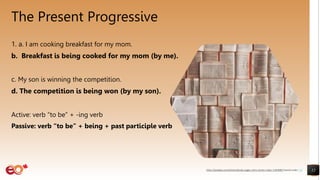
The Present Progressive
1. a. I am cooking breakfast for my mom.
b. Breakfast is being cooked for my mom (by me).
c. My son is winning the competition.
d. The competition is being won (by my son).
Active: verb “to be” + -ing verb
Passive: verb “to be” + being + past participle verb
12
https://pixabay.com/photos/books-pages-story-stories-notes-1245690/ shared under CC0
The Present Progressive
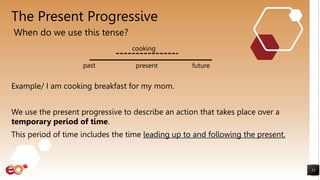
Example/ I am cooking breakfast for my mom.
We use the present progressive to describe an action that takes place over a
temporary period of time.
This period of time includes the time leading up to and following the present.
13
When do we use this tense?
present
past future
cooking
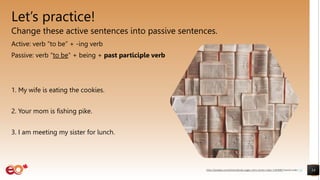
Let’s practice!
Change these active sentences into passive sentences.
Active: verb “to be” + -ing verb
Passive: verb “to be” + being + past participle verb
1. My wife is eating the cookies.
2. Your mom is fishing pike.
3. I am meeting my sister for lunch.
14
https://pixabay.com/photos/books-pages-story-stories-notes-1245690/ shared under CC0
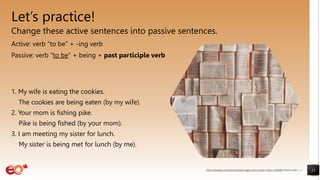
Let’s practice!
Change these active sentences into passive sentences.
Active: verb “to be” + -ing verb
Passive: verb “to be” + being + past participle verb
1. My wife is eating the cookies.
The cookies are being eaten (by my wife).
2. Your mom is fishing pike.
Pike is being fished (by your mom).
3. I am meeting my sister for lunch.
My sister is being met for lunch (by me).
15
https://pixabay.com/photos/books-pages-story-stories-notes-1245690/ shared under CC0
Let’s practice!
Please write three active - passive sentence pairs.
Active: verb “to be” + -ing verb
Passive: verb “to be” + being + past participle verb
16
https://pixabay.com/photos/books-pages-story-stories-notes-1245690/ shared under CC0
The Past Progressive
1. a. She was reading storybooks.
b. Storybooks were being read (by her).
c. They were playing football after school.
d. Football was being played after school
(by them).
Active: verb “to be” + -ing verb
Passive: verb “to be” + being + past participle verb
17
https://pixabay.com/photos/books-pages-story-stories-notes-1245690/ shared under CC0
The Past Progressive
Example/ She was reading storybooks.
We use the past progressive to describe an action that takes place over a
temporary period of time.
This period of time is in the past and doesn’t include the present.
18
When do we use this tense?
present
past future
reading
Let’s practice!
Change these active sentences into passive sentences.
Active: verb “to be” + -ing verb
Passive: verb “to be” + being + past participle verb
1. Thomas was cooking a delicious dish.
2. We were celebrating Christmas last year.
3. Mayra was writing a novel.
19
https://pixabay.com/photos/books-pages-story-stories-notes-1245690/ shared under CC0
Let’s practice!
Change these active sentences into passive sentences.
Active: verb “to be” + -ing verb
Passive: verb “to be” + being + past participle verb
1. Thomas was cooking a delicious dish.
A delicious dish was being cooked
(by Thomas).
2. We were celebrating Christmas last year.
Christmas was being celebrated last year (by us).
3. Mayra was writing a novel.
A novel was being written (by Mayra).
20
https://pixabay.com/photos/books-pages-story-stories-notes-1245690/ shared under CC0
Let’s practice!
Please write three active - passive sentence pairs.
Active: verb “to be” + -ing verb
Passive: verb “to be” + being + past participle verb
21
https://pixabay.com/photos/books-pages-story-stories-notes-1245690/ shared under CC0
Image shared under CC0
present&past
perfect
https://pixabay.com/photos/books-bookstore-book-reading-shop-1204038/ shared under CC0
The Present Perfect
1. a. She has designed beautiful clothing.
b. Beautiful clothing has been designed (by her).
c. I have cooked a meal for my family last night.
d. A meal has been cooked for my family last
night (by me).
Active: verb “to have” + past participle
Passive: verb “to have” + been + past participle
23
https://pixabay.com/photos/books-pages-story-stories-notes-1245690/ shared under CC0
The Present Perfect
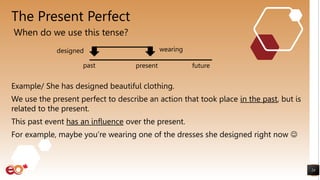
Example/ She has designed beautiful clothing.
We use the present perfect to describe an action that took place in the past, but is
related to the present.
This past event has an influence over the present.
For example, maybe you’re wearing one of the dresses she designed right now 
24
When do we use this tense?
wearing
present
past future
designed
Let’s practice!
Change these active sentences into passive sentences.
Active: verb “to have” + past participle
Passive: verb “to have” + been + past participle verb
1. I have fixed my computer.
2. The dog has broken my sunglasses.
3. He has received a letter each Monday.
25
https://pixabay.com/photos/books-pages-story-stories-notes-1245690/ shared under CC0
Let’s practice!
Change these active sentences into passive sentences.
Active: verb “to have” + past participle
Passive: verb “to have” + been + past participle verb
1. I have fixed my computer.
My computer has been fixed (by me).
2. The dog has broken my sunglasses.
My sunglasses have been broken (by the dog).
3. He has received a letter each Monday.
A letter has been received each Monday (by him).
26
https://pixabay.com/photos/books-pages-story-stories-notes-1245690/ shared under CC0
Let’s practice!
Please write three active - passive sentence pairs.
Active: verb “to have” + past participle
Passive: verb “to have” + been + past participle verb
27
https://pixabay.com/photos/books-pages-story-stories-notes-1245690/ shared under CC0
The Past Perfect
1. a. Thomas had slept six hours before the exam.
b. Six hours had been slept (by Thomas) before the exam.
c. Ihor had collected money for the charity
after the party.
d. Money had been collected for the
charity (by Ihor) after the party.
Active: verb “to have” + past participle
Passive: verb “to have” + been + past participle
28
https://pixabay.com/photos/books-pages-story-stories-notes-1245690/ shared under CC0
The Past Perfect
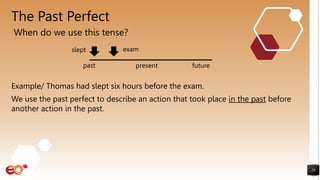
Example/ Thomas had slept six hours before the exam.
We use the past perfect to describe an action that took place in the past before
another action in the past.
29
When do we use this tense?
present
past future
slept exam
Let’s practice!
Change these active sentences into passive sentences.
Active: verb “to have” + past participle
Passive: verb “to have” + been + past participle verb
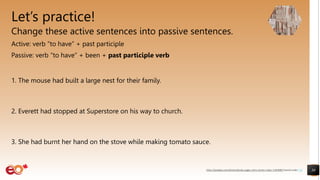
1. The mouse had built a large nest for their family.
2. Everett had stopped at Superstore on his way to church.
3. She had burnt her hand on the stove while making tomato sauce.
30
https://pixabay.com/photos/books-pages-story-stories-notes-1245690/ shared under CC0
Let’s practice!
Change these active sentences into passive sentences.
Active: verb “to have” + past participle
Passive: verb “to have” + been + past participle verb
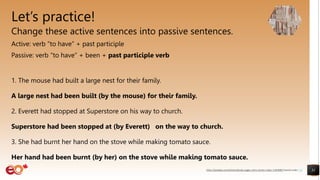
1. The mouse had built a large nest for their family.
A large nest had been built (by the mouse) for their family.
2. Everett had stopped at Superstore on his way to church.
Superstore had been stopped at (by Everett) on the way to church.
3. She had burnt her hand on the stove while making tomato sauce.
Her hand had been burnt (by her) on the stove while making tomato sauce.
31
https://pixabay.com/photos/books-pages-story-stories-notes-1245690/ shared under CC0
Let’s practice!
Please write three active - passive sentence pairs.
Active: verb “to have” + past participle
Passive: verb “to have” + been + past participle verb
32
https://pixabay.com/photos/books-pages-story-stories-notes-1245690/ shared under CC0
Image shared under CC0
futurewith“will”
&“begoingto”
https://pixabay.com/photos/books-bookstore-book-reading-shop-1204038/ shared under CC0
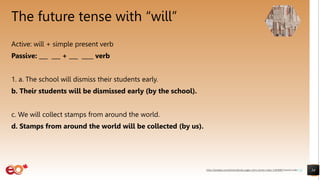
The future tense with “will”
Active: will + simple present verb
Passive: ___ ___ + ___ ____ verb
1. a. The school will dismiss their students early.
b. Their students will be dismissed early (by the school).
c. We will collect stamps from around the world.
d. Stamps from around the world will be collected (by us).
34
https://pixabay.com/photos/books-pages-story-stories-notes-1245690/ shared under CC0
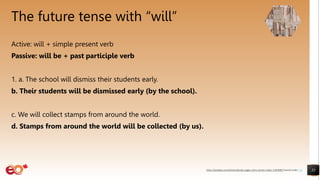
The future tense with “will”
Active: will + simple present verb
Passive: will be + past participle verb
1. a. The school will dismiss their students early.
b. Their students will be dismissed early (by the school).
c. We will collect stamps from around the world.
d. Stamps from around the world will be collected (by us).
35
https://pixabay.com/photos/books-pages-story-stories-notes-1245690/ shared under CC0
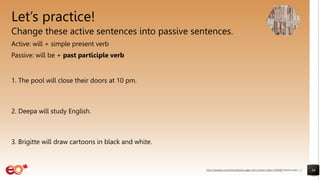
Let’s practice!
Change these active sentences into passive sentences.
Active: will + simple present verb
Passive: will be + past participle verb
1. The pool will close their doors at 10 pm.
2. Deepa will study English.
3. Brigitte will draw cartoons in black and white.
36
https://pixabay.com/photos/books-pages-story-stories-notes-1245690/ shared under CC0
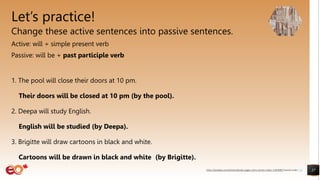
Let’s practice!
Change these active sentences into passive sentences.
Active: will + simple present verb
Passive: will be + past participle verb
1. The pool will close their doors at 10 pm.
Their doors will be closed at 10 pm (by the pool).
2. Deepa will study English.
English will be studied (by Deepa).
3. Brigitte will draw cartoons in black and white.
Cartoons will be drawn in black and white (by Brigitte).
37
https://pixabay.com/photos/books-pages-story-stories-notes-1245690/ shared under CC0
Let’s practice!
Please write three active - passive sentence pairs.
Active: will + simple present verb
Passive: will be + past participle verb
38
https://pixabay.com/photos/books-pages-story-stories-notes-1245690/ shared under CC0
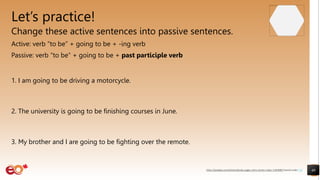
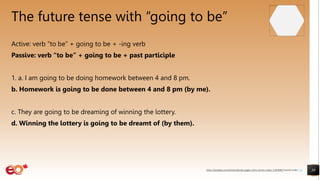
The future tense with “going to be”
Active: verb “to be” + going to be + -ing verb
Passive: verb “to be” + going to be + past participle
1. a. I am going to be doing homework between 4 and 8 pm.
b. Homework is going to be done between 4 and 8 pm (by me).
c. They are going to be dreaming of winning the lottery.
d. Winning the lottery is going to be dreamt of (by them).
39
https://pixabay.com/photos/books-pages-story-stories-notes-1245690/ shared under CC0
Let’s practice!
Change these active sentences into passive sentences.
Active: verb “to be” + going to be + -ing verb
Passive: verb “to be” + going to be + past participle verb
1. I am going to be driving a motorcycle.
2. The university is going to be finishing courses in June.
3. My brother and I are going to be fighting over the remote.
40
https://pixabay.com/photos/books-pages-story-stories-notes-1245690/ shared under CC0
Let’s practice!
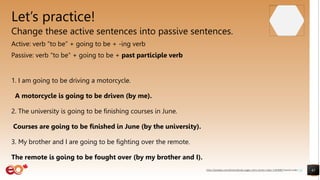
Change these active sentences into passive sentences.
Active: verb “to be” + going to be + -ing verb
Passive: verb “to be” + going to be + past participle verb
1. I am going to be driving a motorcycle.
A motorcycle is going to be driven (by me).
2. The university is going to be finishing courses in June.
Courses are going to be finished in June (by the university).
3. My brother and I are going to be fighting over the remote.
The remote is going to be fought over (by my brother and I).
41
https://pixabay.com/photos/books-pages-story-stories-notes-1245690/ shared under CC0
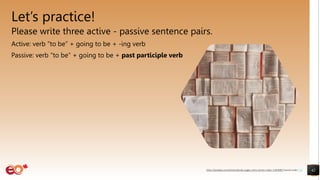
Let’s practice!
Please write three active - passive sentence pairs.
Active: verb “to be” + going to be + -ing verb
Passive: verb “to be” + going to be + past participle verb
42
https://pixabay.com/photos/books-pages-story-stories-notes-1245690/ shared under CC0
Image shared under CC0
Let’spractice!
https://pixabay.com/photos/books-bookstore-book-reading-shop-1204038/ shared under CC0
44
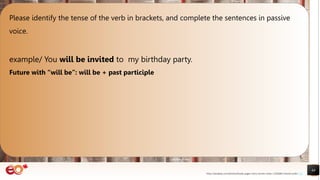
Please identify the tense of the verb in brackets, and complete the sentences in passive
voice.
example/ You will be invited to my birthday party.
Future with “will be”: will be + past participle
https://pixabay.com/photos/books-pages-story-stories-notes-1245690/ shared under CC0
45
Please identify the tense of the verb in brackets, and complete the sentences in passive
voice.
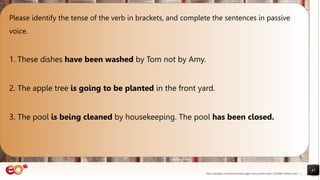
1. These dishes have been washed by Tom not by Amy.
2. The apple tree is going to be planted in the front yard.
3. The pool is being cleaned by housekeeping. The pool has been closed.
https://pixabay.com/photos/books-pages-story-stories-notes-1245690/ shared under CC0
46
Please identify the tense of the verb in brackets, and complete the sentences in passive
voice.
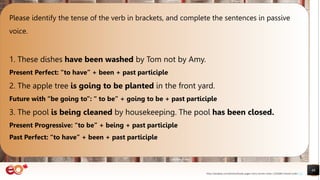
1. These dishes have been washed by Tom not by Amy.
Present Perfect: “to have” + been + past participle
2. The apple tree is going to be planted in the front yard.
Future with “be going to”: “ to be” + going to be + past participle
3. The pool is being cleaned by housekeeping. The pool has been closed.
Present Progressive: “to be” + being + past participle
Past Perfect: “to have” + been + past participle
https://pixabay.com/photos/books-pages-story-stories-notes-1245690/ shared under CC0
47
Please identify the tense of the verb in brackets, and complete the sentences in passive
voice.
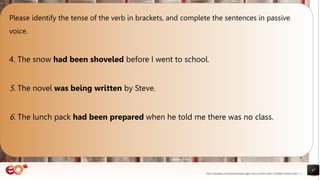
4. The snow had been shoveled before I went to school.
5. The novel was being written by Steve.
6. The lunch pack had been prepared when he told me there was no class.
https://pixabay.com/photos/books-pages-story-stories-notes-1245690/ shared under CC0
48
Please identify the tense of the verb in brackets, and complete the sentences in passive
voice.
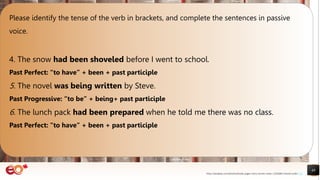
4. The snow had been shoveled before I went to school.
Past Perfect: “to have” + been + past participle
5. The novel was being written by Steve.
Past Progressive: “to be” + being+ past participle
6. The lunch pack had been prepared when he told me there was no class.
Past Perfect: “to have” + been + past participle
https://pixabay.com/photos/books-pages-story-stories-notes-1245690/ shared under CC0
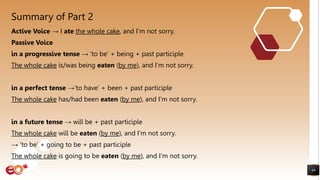
Summary of Part 2
Active Voice → I ate the whole cake, and I’m not sorry.
Passive Voice
in a progressive tense → ‘to be’ + being + past participle
The whole cake is/was being eaten (by me), and I’m not sorry.
in a perfect tense →‘to have’ + been + past participle
The whole cake has/had been eaten (by me), and I’m not sorry.
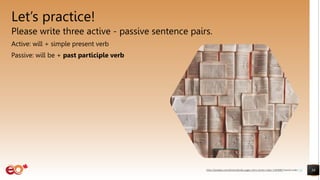
in a future tense → will be + past participle
The whole cake will be eaten (by me), and I’m not sorry.
→ ‘to be’ + going to be + past participle
The whole cake is going to be eaten (by me), and I’m not sorry.
49
Questions?
50
https://pixabay.com/photos/cup-of-coffee-laptop-office-macbook-1280537/ shared under CC0
Thankyou!
Nastashya Wall
204-946-5140 ex. 201
nwall@myenglishonline.ca
livelearn.ca

Passive Voice Part2-2NW.pptx

  • 1.
  • 2.
    2 Lesson Vocabulary! Term Definition actora participant in an action or process. active connected with a verb whose subject is the person or thing that performs the action purpose the intention, aim or function of something; the thing that something is supposed to achieve passive the form of a verb used when the subject is affected by the action of the verb
  • 3.
    Passive and ActiveVoice What is the focus in each of the sentences? 1. a. All the cookies were eaten (by them). Passive b. They ate all the cookies. Active 3 https://pixabay.com/photos/books-pages-story-stories-notes-1245690/ shared under CC0
  • 4.
    Passive and ActiveVoice What is the focus in each of the sentences? The passive voice focuses on what the action is. The active voice focus on who did the action, the actor. 1. a. All the cookies were eaten (by them). Passive b. They ate all the cookies. Active 4 https://pixabay.com/photos/books-pages-story-stories-notes-1245690/ shared under CC0
  • 5.
    We use thepassive voice… 5 1. to not say who did an action. Maybe we don’t know who did it, or it is obvious, or we don’t want to say. a) The keys were lost (by me). 2. to emphasize who did an action. When the actor is a new and important piece of information. This play was written by William Shakespeare. 3. when writing in an academic style. Although using the passive voice is less popular now than it was ten years ago.
  • 6.
    Passive Voice Active voice: Ilost my job. subject + verb + object Passive voice: My job was lost (by me). object + verb “to be” + verb (past participle) + subject 6 How do you form the passive voice?
  • 7.
    Passive Voice Active voice: Jimwaits for his sister. subject + verb + object Passive voice: object + verb “to be” + verb (past participle) + subject 7 How do you form the passive voice?
  • 8.
    Passive Voice Active voice: Jimwaits for his sister. subject + verb + object Passive voice: His sister is waited for by Jim. object + verb “to be” + verb (past participle) + subject 8 How do you form the passive voice?
  • 9.
    summary of part1 Here is a sentence in the active voice: I ate the whole cake, and I’m not sorry. Here is the same sentence in the passive voice in different verb tenses: 9 simple present The whole cake is eaten (by me) and I’m not sorry. simple past was
  • 10.
    summary of part2 10 progressive The whole cake is/was being eaten (by me) and I’m not sorry. perfect has/had been future using ‘will’ will be future using ‘going to’ is going to be Here is a sentence in the active voice: I ate the whole cake, and I’m not sorry. Here is the same sentence in the passive voice in different verb tenses:
  • 11.
    Image shared underCC0 present&past progressive https://pixabay.com/photos/books-bookstore-book-reading-shop-1204038/ shared under CC0
  • 12.
    The Present Progressive 1.a. I am cooking breakfast for my mom. b. Breakfast is being cooked for my mom (by me). c. My son is winning the competition. d. The competition is being won (by my son). Active: verb “to be” + -ing verb Passive: verb “to be” + being + past participle verb 12 https://pixabay.com/photos/books-pages-story-stories-notes-1245690/ shared under CC0
  • 13.
    The Present Progressive Example/I am cooking breakfast for my mom. We use the present progressive to describe an action that takes place over a temporary period of time. This period of time includes the time leading up to and following the present. 13 When do we use this tense? present past future cooking
  • 14.
    Let’s practice! Change theseactive sentences into passive sentences. Active: verb “to be” + -ing verb Passive: verb “to be” + being + past participle verb 1. My wife is eating the cookies. 2. Your mom is fishing pike. 3. I am meeting my sister for lunch. 14 https://pixabay.com/photos/books-pages-story-stories-notes-1245690/ shared under CC0
  • 15.
    Let’s practice! Change theseactive sentences into passive sentences. Active: verb “to be” + -ing verb Passive: verb “to be” + being + past participle verb 1. My wife is eating the cookies. The cookies are being eaten (by my wife). 2. Your mom is fishing pike. Pike is being fished (by your mom). 3. I am meeting my sister for lunch. My sister is being met for lunch (by me). 15 https://pixabay.com/photos/books-pages-story-stories-notes-1245690/ shared under CC0
  • 16.
    Let’s practice! Please writethree active - passive sentence pairs. Active: verb “to be” + -ing verb Passive: verb “to be” + being + past participle verb 16 https://pixabay.com/photos/books-pages-story-stories-notes-1245690/ shared under CC0
  • 17.
    The Past Progressive 1.a. She was reading storybooks. b. Storybooks were being read (by her). c. They were playing football after school. d. Football was being played after school (by them). Active: verb “to be” + -ing verb Passive: verb “to be” + being + past participle verb 17 https://pixabay.com/photos/books-pages-story-stories-notes-1245690/ shared under CC0
  • 18.
    The Past Progressive Example/She was reading storybooks. We use the past progressive to describe an action that takes place over a temporary period of time. This period of time is in the past and doesn’t include the present. 18 When do we use this tense? present past future reading
  • 19.
    Let’s practice! Change theseactive sentences into passive sentences. Active: verb “to be” + -ing verb Passive: verb “to be” + being + past participle verb 1. Thomas was cooking a delicious dish. 2. We were celebrating Christmas last year. 3. Mayra was writing a novel. 19 https://pixabay.com/photos/books-pages-story-stories-notes-1245690/ shared under CC0
  • 20.
    Let’s practice! Change theseactive sentences into passive sentences. Active: verb “to be” + -ing verb Passive: verb “to be” + being + past participle verb 1. Thomas was cooking a delicious dish. A delicious dish was being cooked (by Thomas). 2. We were celebrating Christmas last year. Christmas was being celebrated last year (by us). 3. Mayra was writing a novel. A novel was being written (by Mayra). 20 https://pixabay.com/photos/books-pages-story-stories-notes-1245690/ shared under CC0
  • 21.
    Let’s practice! Please writethree active - passive sentence pairs. Active: verb “to be” + -ing verb Passive: verb “to be” + being + past participle verb 21 https://pixabay.com/photos/books-pages-story-stories-notes-1245690/ shared under CC0
  • 22.
    Image shared underCC0 present&past perfect https://pixabay.com/photos/books-bookstore-book-reading-shop-1204038/ shared under CC0
  • 23.
    The Present Perfect 1.a. She has designed beautiful clothing. b. Beautiful clothing has been designed (by her). c. I have cooked a meal for my family last night. d. A meal has been cooked for my family last night (by me). Active: verb “to have” + past participle Passive: verb “to have” + been + past participle 23 https://pixabay.com/photos/books-pages-story-stories-notes-1245690/ shared under CC0
  • 24.
    The Present Perfect Example/She has designed beautiful clothing. We use the present perfect to describe an action that took place in the past, but is related to the present. This past event has an influence over the present. For example, maybe you’re wearing one of the dresses she designed right now  24 When do we use this tense? wearing present past future designed
  • 25.
    Let’s practice! Change theseactive sentences into passive sentences. Active: verb “to have” + past participle Passive: verb “to have” + been + past participle verb 1. I have fixed my computer. 2. The dog has broken my sunglasses. 3. He has received a letter each Monday. 25 https://pixabay.com/photos/books-pages-story-stories-notes-1245690/ shared under CC0
  • 26.
    Let’s practice! Change theseactive sentences into passive sentences. Active: verb “to have” + past participle Passive: verb “to have” + been + past participle verb 1. I have fixed my computer. My computer has been fixed (by me). 2. The dog has broken my sunglasses. My sunglasses have been broken (by the dog). 3. He has received a letter each Monday. A letter has been received each Monday (by him). 26 https://pixabay.com/photos/books-pages-story-stories-notes-1245690/ shared under CC0
  • 27.
    Let’s practice! Please writethree active - passive sentence pairs. Active: verb “to have” + past participle Passive: verb “to have” + been + past participle verb 27 https://pixabay.com/photos/books-pages-story-stories-notes-1245690/ shared under CC0
  • 28.
    The Past Perfect 1.a. Thomas had slept six hours before the exam. b. Six hours had been slept (by Thomas) before the exam. c. Ihor had collected money for the charity after the party. d. Money had been collected for the charity (by Ihor) after the party. Active: verb “to have” + past participle Passive: verb “to have” + been + past participle 28 https://pixabay.com/photos/books-pages-story-stories-notes-1245690/ shared under CC0
  • 29.
    The Past Perfect Example/Thomas had slept six hours before the exam. We use the past perfect to describe an action that took place in the past before another action in the past. 29 When do we use this tense? present past future slept exam
  • 30.
    Let’s practice! Change theseactive sentences into passive sentences. Active: verb “to have” + past participle Passive: verb “to have” + been + past participle verb 1. The mouse had built a large nest for their family. 2. Everett had stopped at Superstore on his way to church. 3. She had burnt her hand on the stove while making tomato sauce. 30 https://pixabay.com/photos/books-pages-story-stories-notes-1245690/ shared under CC0
  • 31.
    Let’s practice! Change theseactive sentences into passive sentences. Active: verb “to have” + past participle Passive: verb “to have” + been + past participle verb 1. The mouse had built a large nest for their family. A large nest had been built (by the mouse) for their family. 2. Everett had stopped at Superstore on his way to church. Superstore had been stopped at (by Everett) on the way to church. 3. She had burnt her hand on the stove while making tomato sauce. Her hand had been burnt (by her) on the stove while making tomato sauce. 31 https://pixabay.com/photos/books-pages-story-stories-notes-1245690/ shared under CC0
  • 32.
    Let’s practice! Please writethree active - passive sentence pairs. Active: verb “to have” + past participle Passive: verb “to have” + been + past participle verb 32 https://pixabay.com/photos/books-pages-story-stories-notes-1245690/ shared under CC0
  • 33.
    Image shared underCC0 futurewith“will” &“begoingto” https://pixabay.com/photos/books-bookstore-book-reading-shop-1204038/ shared under CC0
  • 34.
    The future tensewith “will” Active: will + simple present verb Passive: ___ ___ + ___ ____ verb 1. a. The school will dismiss their students early. b. Their students will be dismissed early (by the school). c. We will collect stamps from around the world. d. Stamps from around the world will be collected (by us). 34 https://pixabay.com/photos/books-pages-story-stories-notes-1245690/ shared under CC0
  • 35.
    The future tensewith “will” Active: will + simple present verb Passive: will be + past participle verb 1. a. The school will dismiss their students early. b. Their students will be dismissed early (by the school). c. We will collect stamps from around the world. d. Stamps from around the world will be collected (by us). 35 https://pixabay.com/photos/books-pages-story-stories-notes-1245690/ shared under CC0
  • 36.
    Let’s practice! Change theseactive sentences into passive sentences. Active: will + simple present verb Passive: will be + past participle verb 1. The pool will close their doors at 10 pm. 2. Deepa will study English. 3. Brigitte will draw cartoons in black and white. 36 https://pixabay.com/photos/books-pages-story-stories-notes-1245690/ shared under CC0
  • 37.
    Let’s practice! Change theseactive sentences into passive sentences. Active: will + simple present verb Passive: will be + past participle verb 1. The pool will close their doors at 10 pm. Their doors will be closed at 10 pm (by the pool). 2. Deepa will study English. English will be studied (by Deepa). 3. Brigitte will draw cartoons in black and white. Cartoons will be drawn in black and white (by Brigitte). 37 https://pixabay.com/photos/books-pages-story-stories-notes-1245690/ shared under CC0
  • 38.
    Let’s practice! Please writethree active - passive sentence pairs. Active: will + simple present verb Passive: will be + past participle verb 38 https://pixabay.com/photos/books-pages-story-stories-notes-1245690/ shared under CC0
  • 39.
    The future tensewith “going to be” Active: verb “to be” + going to be + -ing verb Passive: verb “to be” + going to be + past participle 1. a. I am going to be doing homework between 4 and 8 pm. b. Homework is going to be done between 4 and 8 pm (by me). c. They are going to be dreaming of winning the lottery. d. Winning the lottery is going to be dreamt of (by them). 39 https://pixabay.com/photos/books-pages-story-stories-notes-1245690/ shared under CC0
  • 40.
    Let’s practice! Change theseactive sentences into passive sentences. Active: verb “to be” + going to be + -ing verb Passive: verb “to be” + going to be + past participle verb 1. I am going to be driving a motorcycle. 2. The university is going to be finishing courses in June. 3. My brother and I are going to be fighting over the remote. 40 https://pixabay.com/photos/books-pages-story-stories-notes-1245690/ shared under CC0
  • 41.
    Let’s practice! Change theseactive sentences into passive sentences. Active: verb “to be” + going to be + -ing verb Passive: verb “to be” + going to be + past participle verb 1. I am going to be driving a motorcycle. A motorcycle is going to be driven (by me). 2. The university is going to be finishing courses in June. Courses are going to be finished in June (by the university). 3. My brother and I are going to be fighting over the remote. The remote is going to be fought over (by my brother and I). 41 https://pixabay.com/photos/books-pages-story-stories-notes-1245690/ shared under CC0
  • 42.
    Let’s practice! Please writethree active - passive sentence pairs. Active: verb “to be” + going to be + -ing verb Passive: verb “to be” + going to be + past participle verb 42 https://pixabay.com/photos/books-pages-story-stories-notes-1245690/ shared under CC0
  • 43.
    Image shared underCC0 Let’spractice! https://pixabay.com/photos/books-bookstore-book-reading-shop-1204038/ shared under CC0
  • 44.
    44 Please identify thetense of the verb in brackets, and complete the sentences in passive voice. example/ You will be invited to my birthday party. Future with “will be”: will be + past participle https://pixabay.com/photos/books-pages-story-stories-notes-1245690/ shared under CC0
  • 45.
    45 Please identify thetense of the verb in brackets, and complete the sentences in passive voice. 1. These dishes have been washed by Tom not by Amy. 2. The apple tree is going to be planted in the front yard. 3. The pool is being cleaned by housekeeping. The pool has been closed. https://pixabay.com/photos/books-pages-story-stories-notes-1245690/ shared under CC0
  • 46.
    46 Please identify thetense of the verb in brackets, and complete the sentences in passive voice. 1. These dishes have been washed by Tom not by Amy. Present Perfect: “to have” + been + past participle 2. The apple tree is going to be planted in the front yard. Future with “be going to”: “ to be” + going to be + past participle 3. The pool is being cleaned by housekeeping. The pool has been closed. Present Progressive: “to be” + being + past participle Past Perfect: “to have” + been + past participle https://pixabay.com/photos/books-pages-story-stories-notes-1245690/ shared under CC0
  • 47.
    47 Please identify thetense of the verb in brackets, and complete the sentences in passive voice. 4. The snow had been shoveled before I went to school. 5. The novel was being written by Steve. 6. The lunch pack had been prepared when he told me there was no class. https://pixabay.com/photos/books-pages-story-stories-notes-1245690/ shared under CC0
  • 48.
    48 Please identify thetense of the verb in brackets, and complete the sentences in passive voice. 4. The snow had been shoveled before I went to school. Past Perfect: “to have” + been + past participle 5. The novel was being written by Steve. Past Progressive: “to be” + being+ past participle 6. The lunch pack had been prepared when he told me there was no class. Past Perfect: “to have” + been + past participle https://pixabay.com/photos/books-pages-story-stories-notes-1245690/ shared under CC0
  • 49.
    Summary of Part2 Active Voice → I ate the whole cake, and I’m not sorry. Passive Voice in a progressive tense → ‘to be’ + being + past participle The whole cake is/was being eaten (by me), and I’m not sorry. in a perfect tense →‘to have’ + been + past participle The whole cake has/had been eaten (by me), and I’m not sorry. in a future tense → will be + past participle The whole cake will be eaten (by me), and I’m not sorry. → ‘to be’ + going to be + past participle The whole cake is going to be eaten (by me), and I’m not sorry. 49
  • 50.
  • 51.
    Thankyou! Nastashya Wall 204-946-5140 ex.201 nwall@myenglishonline.ca livelearn.ca