
HIC university of south
Asia
• Mamoona Jabeen
• Bcs 4th
semester
• Presentation Name: Active&Passive
• Teacher Name: Miss Mehvish
• Subject: Functional English
3-07-2015 BCK 1
3-7-2015 Active passive 2
Active & PassiveActive & Passive
Active Voice Form
• When we want to say that the subject of a
sentence is doing the action, we use the verb of
that sentence in its Active form:
• e.g. A man is cutting down a tree.
‘A man’ = subject -- doing the action -- cutting -
Active
3-7-2015 BCK 3
Active & PassiveActive & Passive
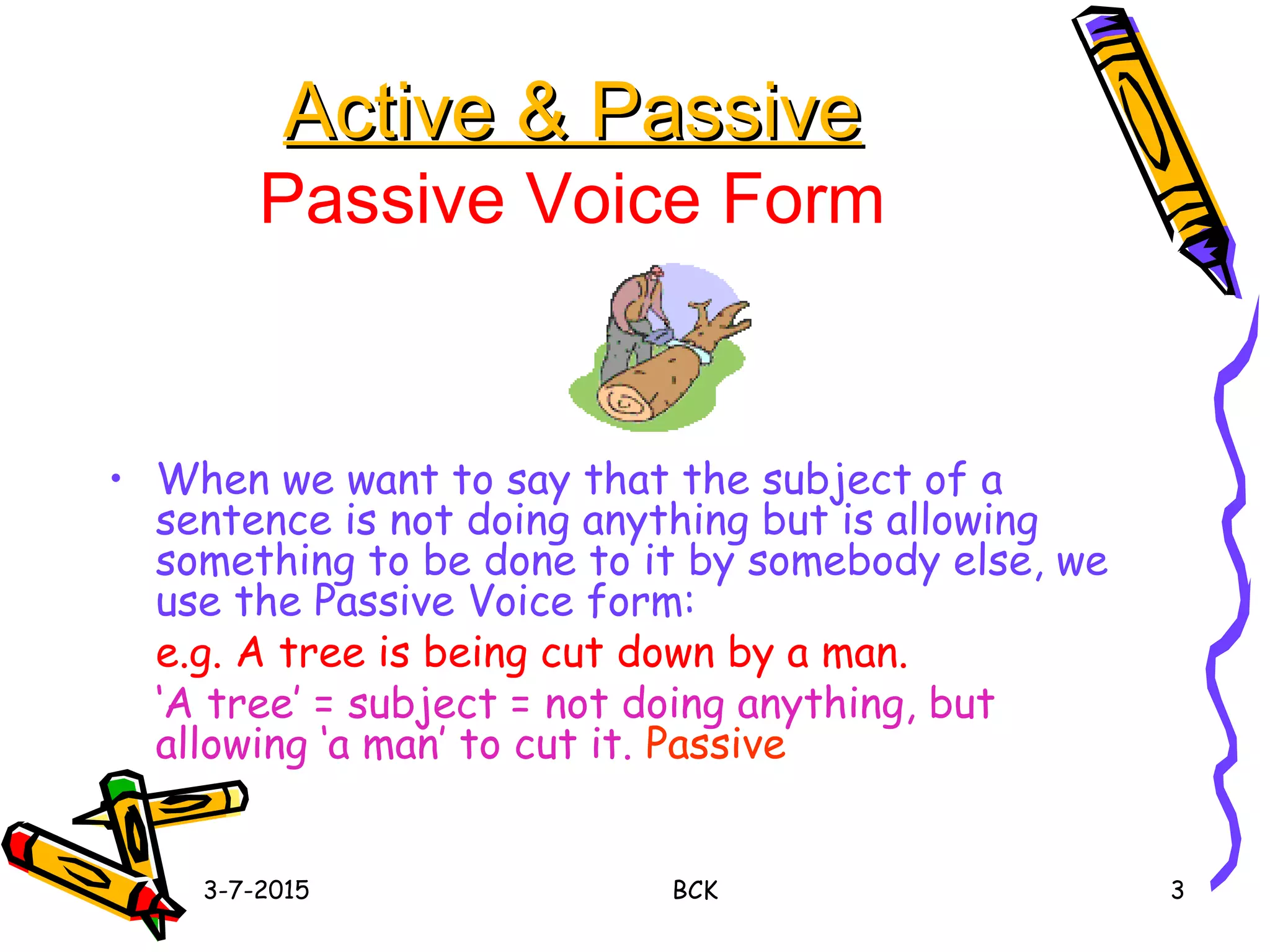
Passive Voice Form
• When we want to say that the subject of a
sentence is not doing anything but is allowing
something to be done to it by somebody else, we
use the Passive Voice form:
e.g. A tree is being cut down by a man.
‘A tree’ = subject = not doing anything, but
allowing ‘a man’ to cut it. Passive
BCK 4
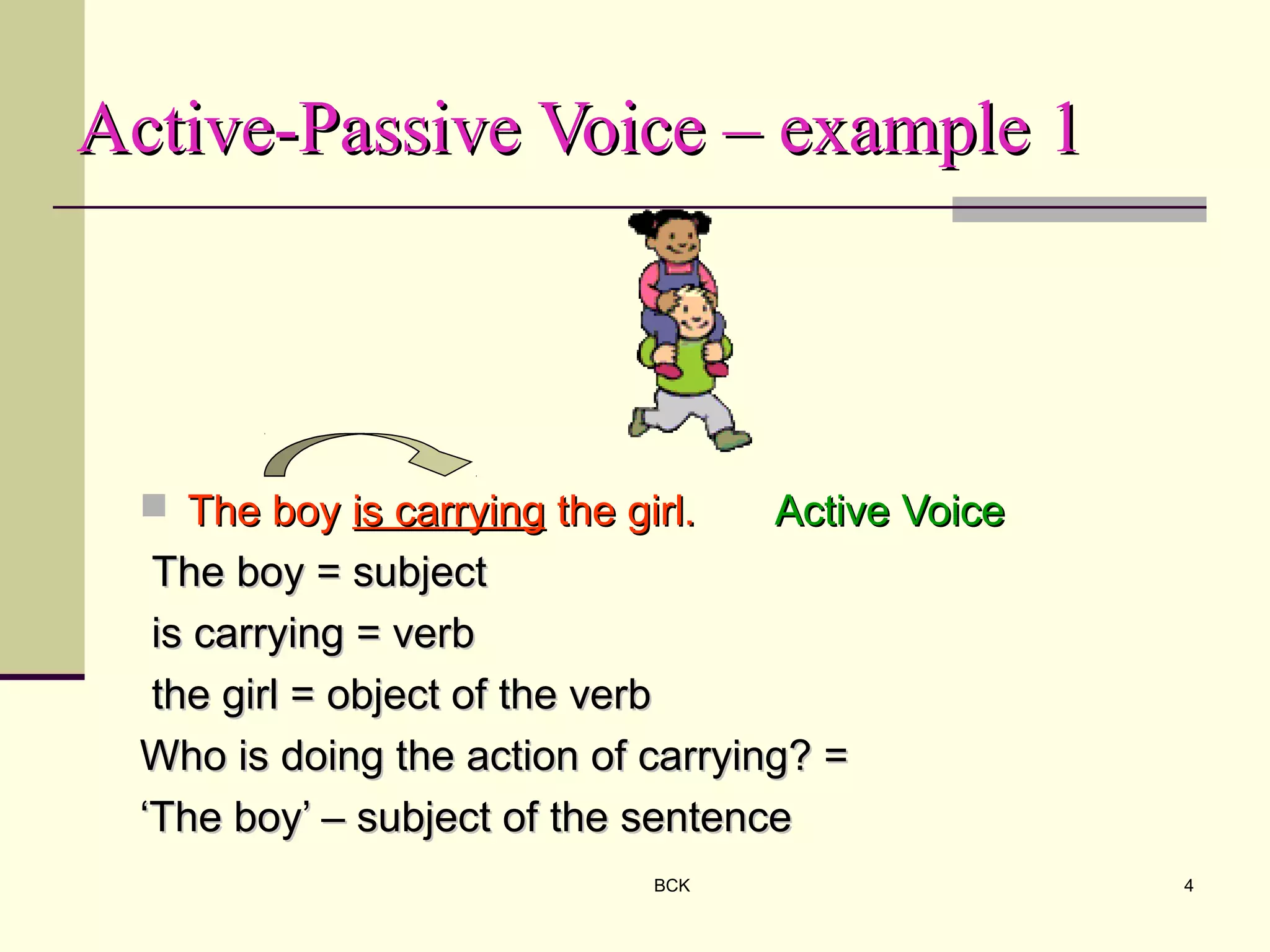
Active-Passive Voice – example 1Active-Passive Voice – example 1
 The boyThe boy is carryingis carrying the girl.the girl. Active VoiceActive Voice
The boy = subjectThe boy = subject
is carrying = verbis carrying = verb
the girl = object of the verbthe girl = object of the verb
Who is doing the action of carrying? =Who is doing the action of carrying? =
‘‘The boy’ – subject of the sentenceThe boy’ – subject of the sentence
3-7-20153-7-2015
BCKBCK 55
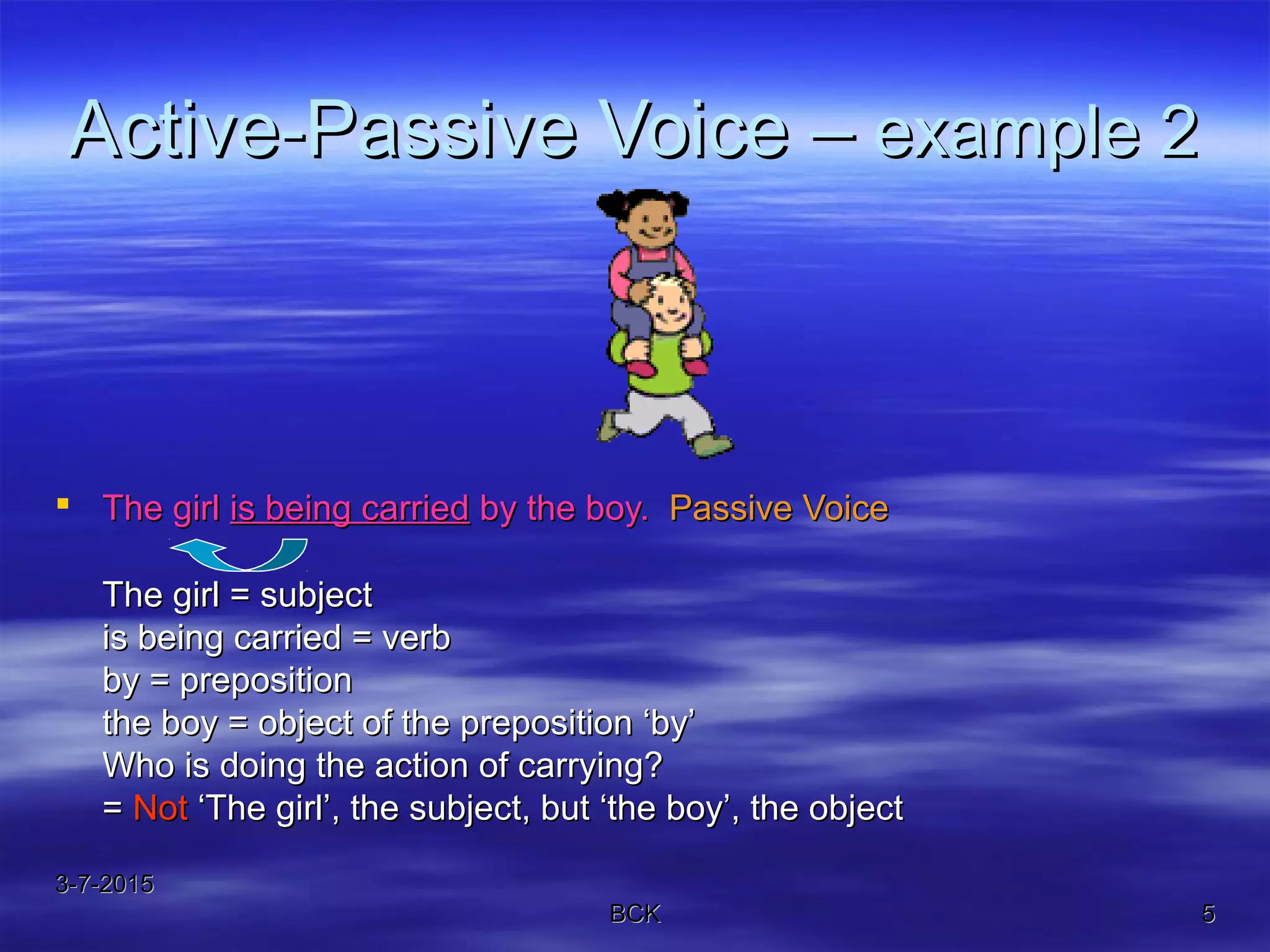
Active-Passive Voice –Active-Passive Voice – example 2example 2
 The girlThe girl is being carriedis being carried by the boy.by the boy. Passive VoicePassive Voice
The girl = subjectThe girl = subject
is being carried = verbis being carried = verb
by = prepositionby = preposition
the boy = object of the preposition ‘by’the boy = object of the preposition ‘by’
Who is doing the action of carrying?Who is doing the action of carrying?
== NotNot ‘The girl’, the subject, but ‘the boy’, the object‘The girl’, the subject, but ‘the boy’, the object
3-7-20153-7-2015 BCKBCK 66
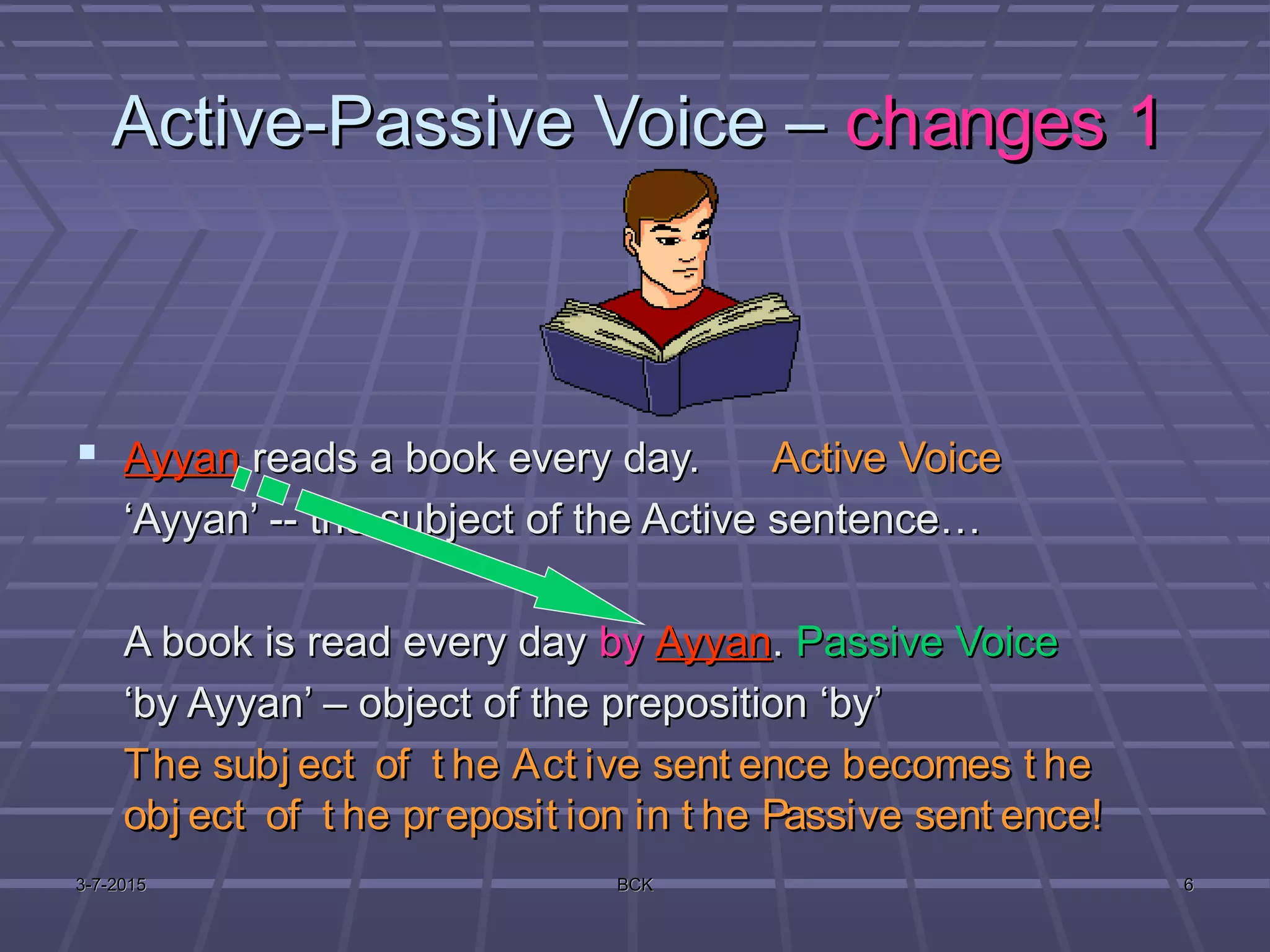
Active-Passive Voice –Active-Passive Voice – changes 1changes 1
 AyyanAyyan reads a book every day.reads a book every day. Active VoiceActive Voice
‘‘Ayyan’ -- the subject of the Active sentence…Ayyan’ -- the subject of the Active sentence…
A book is read every dayA book is read every day byby AyyanAyyan.. Passive VoicePassive Voice
‘‘by Ayyan’ – object of the preposition ‘by’by Ayyan’ – object of the preposition ‘by’
The subj ect of t he Act ive sent ence becomes t heThe subj ect of t he Act ive sent ence becomes t he
obj ect of t he preposit ion in t he Passive sent ence!obj ect of t he preposit ion in t he Passive sent ence!
3-7-2015
BCK 7
Active-Passive Voice – changes 2Active-Passive Voice – changes 2
 AyyanAyyan readsreads a book every day. Active Voicea book every day. Active Voice
‘‘reads’ – verb of the Active sentencereads’ – verb of the Active sentence
A bookA book is readis read every day by Ayyan.every day by Ayyan. PassivePassive voicevoice
The Active form of the verb in Active sentence isThe Active form of the verb in Active sentence is
changed into the Passive form in Passive sentence.changed into the Passive form in Passive sentence.
‘‘readsreads’ becomes “’ becomes “is readis read”!”!
3-7-2015 BCK 8
Active-Passive Voice – changes 3Active-Passive Voice – changes 3
 Ayyan readsAyyan reads a booka book every day.every day. Active VoiceActive Voice
‘‘a book’ -- object of the verba book’ -- object of the verb
A bookA book is read every day by Ayyan.is read every day by Ayyan. Passive voicePassive voice
‘‘A book’ -- subject of the passive sentence…A book’ -- subject of the passive sentence…
The object of the verb in the Active sentence
becomes the subject of the Passive sentence.
3-7-20153-7-2015 BCKBCK 99
Active-Passive Voice –Active-Passive Voice – note 1note 1
 He cooksHe cooks foodfood. Active Voice. Active Voice
‘‘food’ – object of the verb –food’ – object of the verb –
singularsingular
FoodFood isis cooked by him. Passive Voicecooked by him. Passive Voice
‘‘Food’ – subject of the passiveFood’ – subject of the passive
sentence – singular, so ‘sentence – singular, so ‘isis cooked’ --cooked’ --
verbverb singularsingular
When thesubject of asentenceisWhen thesubject of asentenceis
singular, theverb must also beinsingular, theverb must also bein
singularsingular
3-7-2015
BCK 10
Active-Passive Voice – not e 2
 When the subject of a sentence is Plural, the verb of that
sentence must be Plural:
 He carried some books. Active Voice
‘some books’ -- object of the verb in Active – Plural
Some books were carried by him. Passive Voice
‘were carried’ – verb – ‘were’ plural / ‘books’ plural
3-7-2015 BCK 11
Active-Passive Voice -- not e 3
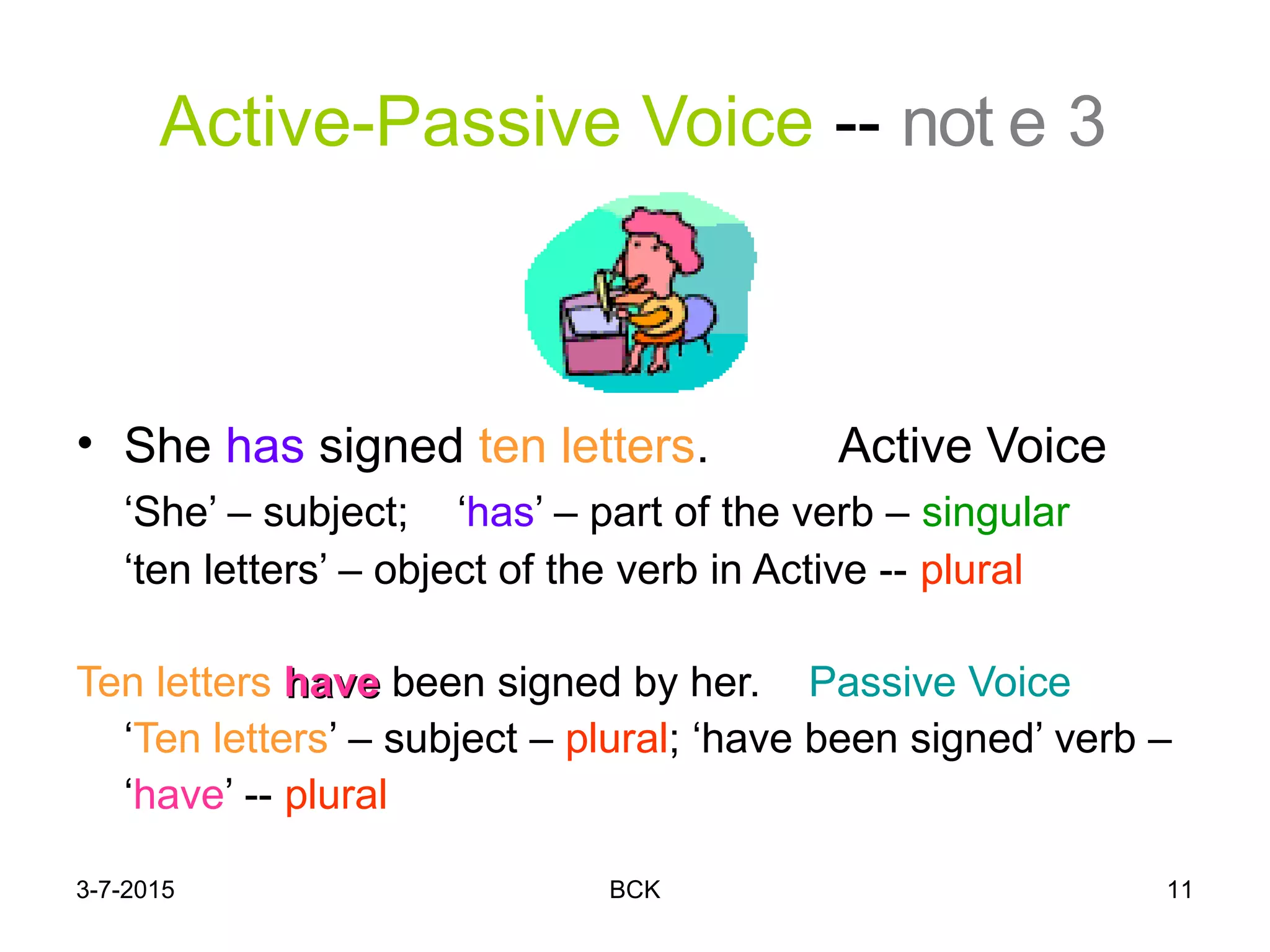
• She has signed ten letters. Active Voice
‘She’ – subject; ‘has’ – part of the verb – singular
‘ten letters’ – object of the verb in Active -- plural
Ten letters havehave been signed by her. Passive Voice
‘Ten letters’ – subject – plural; ‘have been signed’ verb –
‘have’ -- plural
3-7-20153-7-2015
BCKBCK 1212
Active-Passive Voice –Active-Passive Voice – Tense ChangeTense Change 11
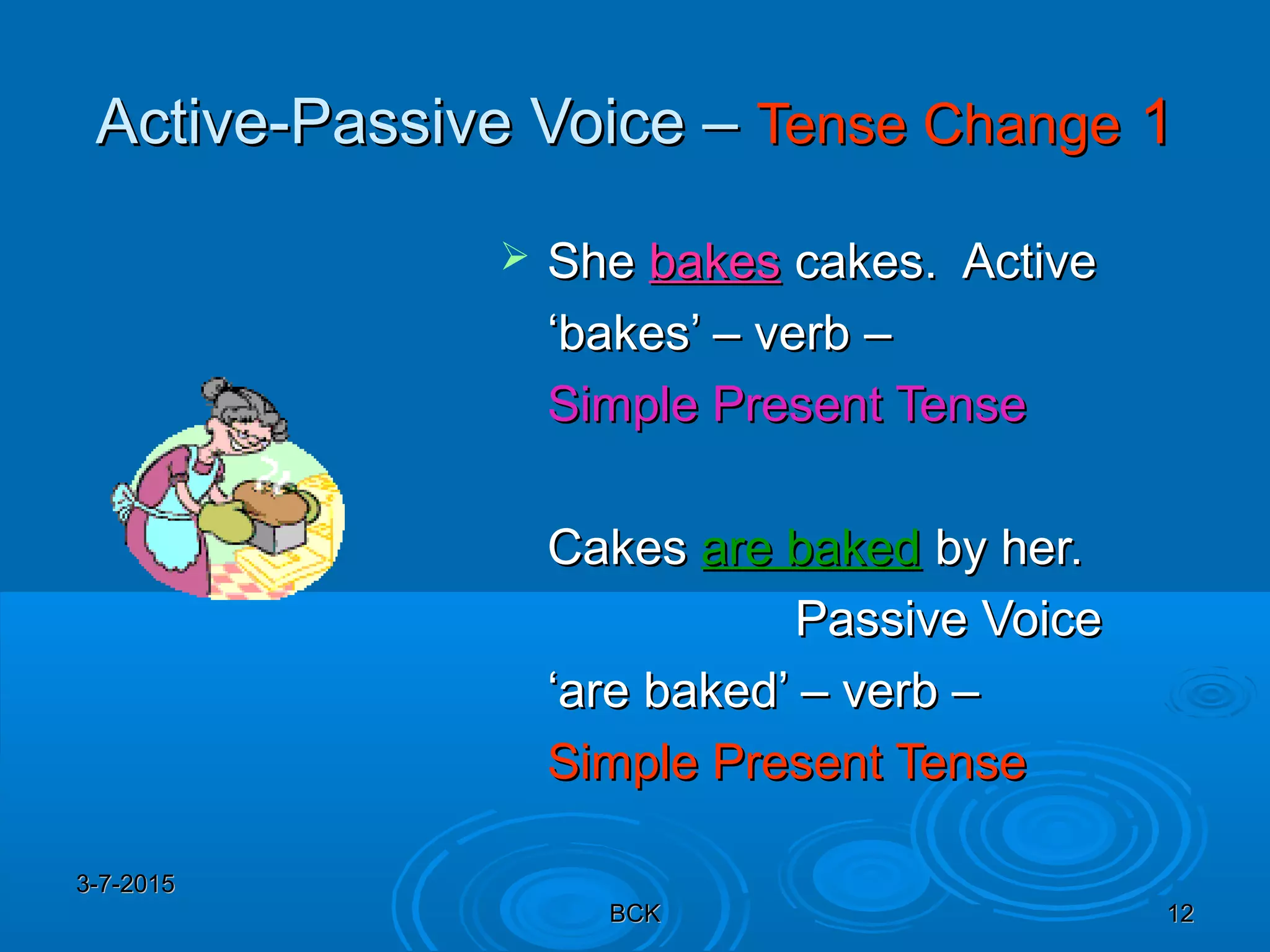
 SheShe bakesbakes cakes. Activecakes. Active
‘‘bakes’ – verb –bakes’ – verb –
Simple Present TenseSimple Present Tense
CakesCakes are bakedare baked by her.by her.
Passive VoicePassive Voice
‘‘are baked’ – verb –are baked’ – verb –
Simple Present TenseSimple Present Tense
3-7-20153-7-2015
BCKBCK 1313
Active-Passive – Tense Change 2Active-Passive – Tense Change 2
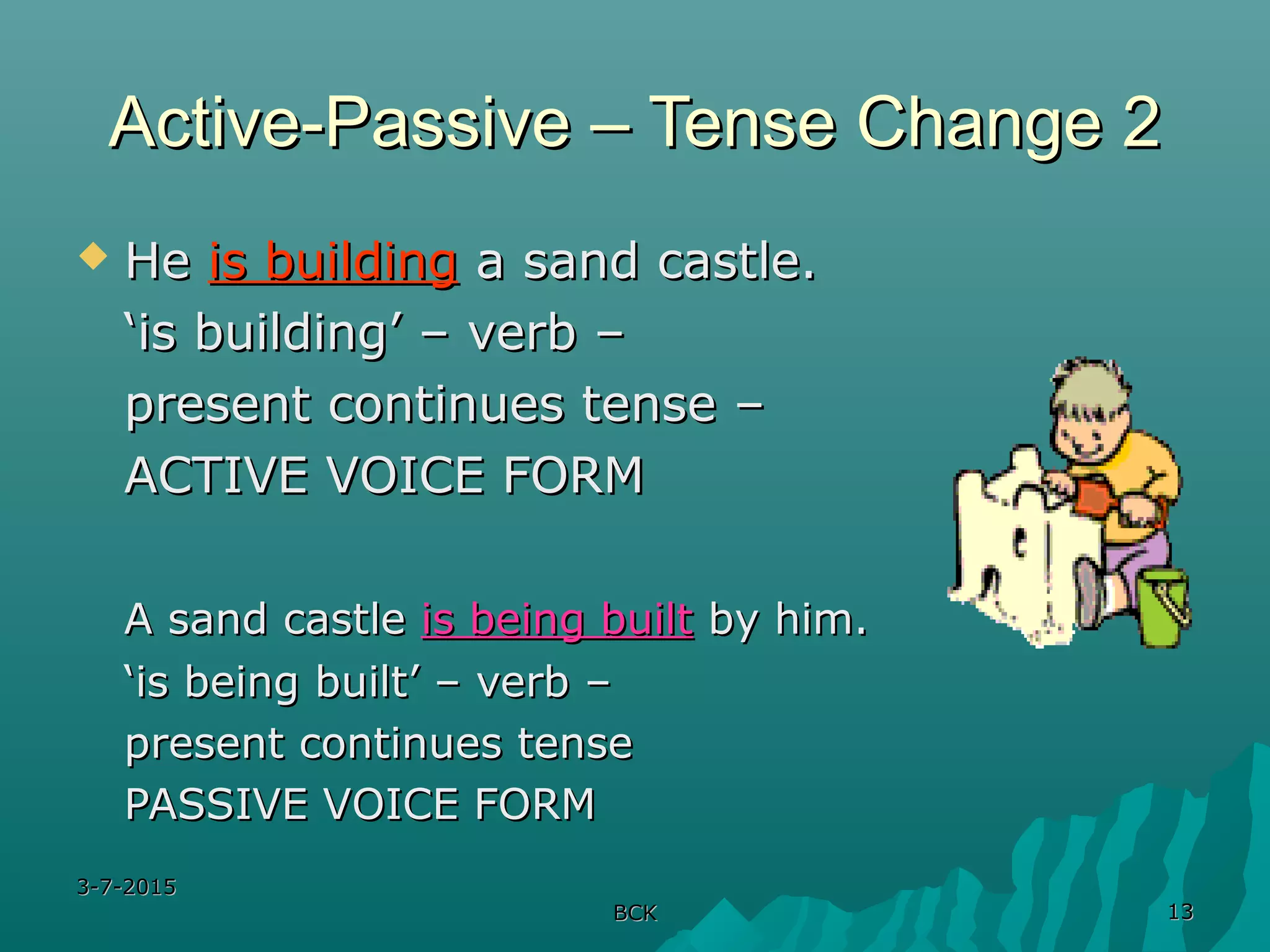
 HeHe is buildingis building a sand castle.a sand castle.
‘‘is building’ – verb –is building’ – verb –
present continues tense –present continues tense –
ACTIVE VOICE FORMACTIVE VOICE FORM
A sand castleA sand castle is being builtis being built by him.by him.
‘‘is being built’ – verb –is being built’ – verb –
present continues tensepresent continues tense
PASSIVE VOICE FORMPASSIVE VOICE FORM
3-7-20153-7-2015 BCKBCK 1414
Active-Passive -- Tense Change 3Active-Passive -- Tense Change 3
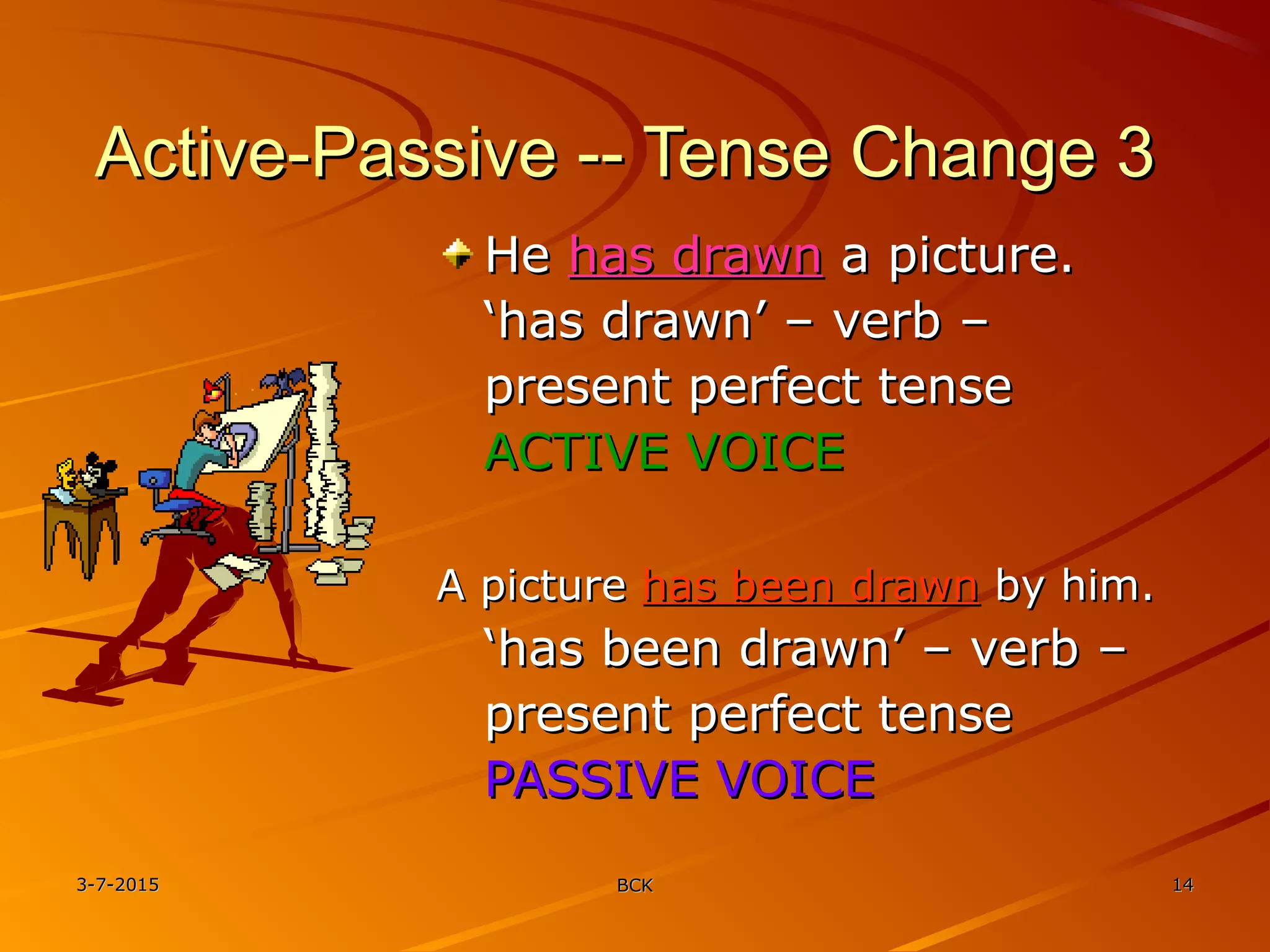
HeHe has drawnhas drawn a picture.a picture.
‘‘has drawn’ – verb –has drawn’ – verb –
present perfect tensepresent perfect tense
ACTIVE VOICEACTIVE VOICE
A pictureA picture has been drawnhas been drawn by him.by him.
‘‘has been drawn’ – verb –has been drawn’ – verb –
present perfect tensepresent perfect tense
PASSIVE VOICEPASSIVE VOICE
3-7-2015 BCK 15
Active-Passive – Tense Change 4
According to the traditional grammar rules, the
present perfect continues tense is not used in
PASSIVE VOICE FORM; however, in the
contemporary English, there are occasions where
the present perfect continues tense is used in the
Passive Voice:
e.g. He has been mowing the lawn. Active Voice
The lawn has been being mowed by him.
Passive Voice
3-7-2015 BCK 16
Active-Passive Voice –Active-Passive Voice –
Tense Change 5Tense Change 5
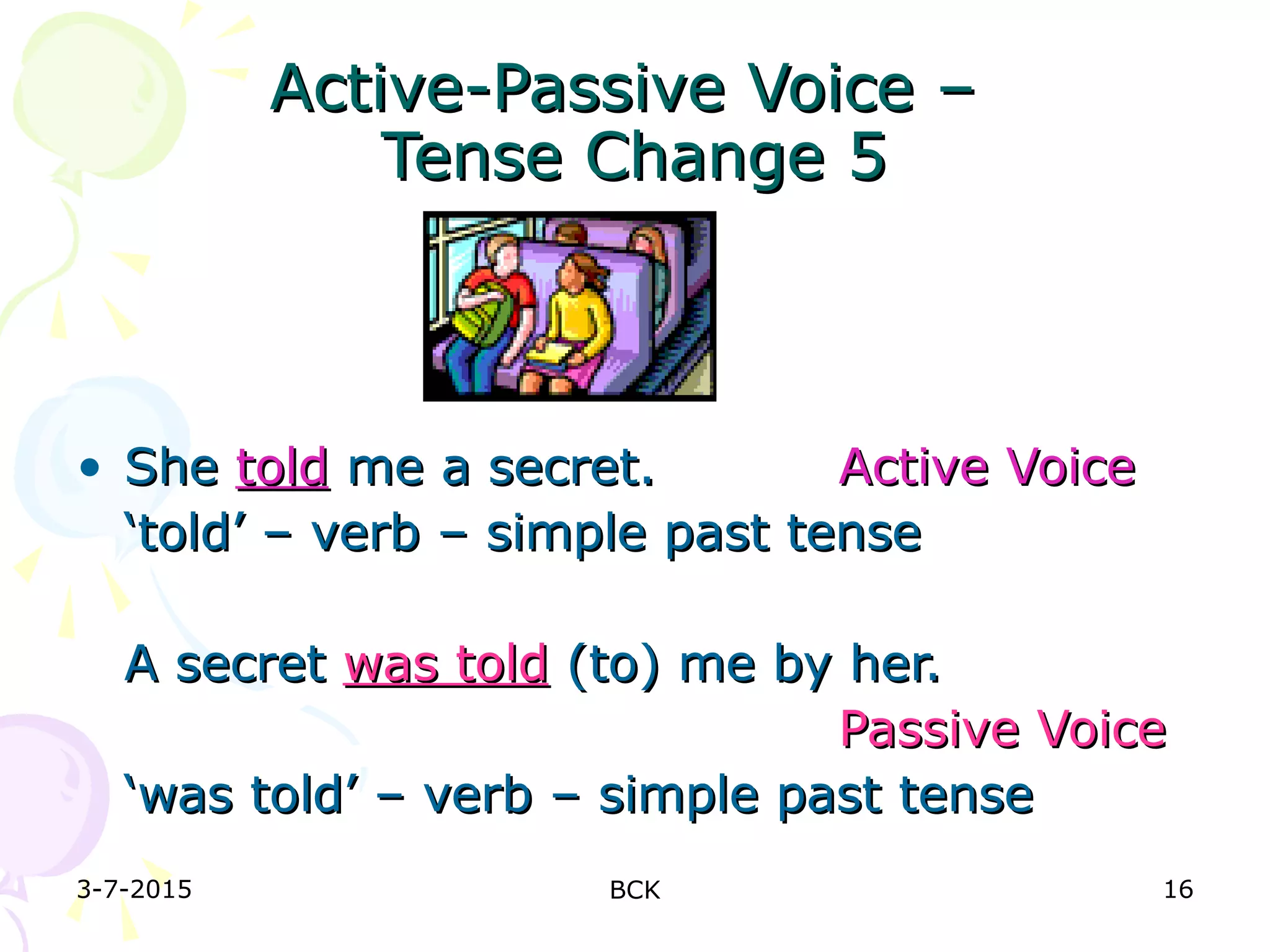
• SheShe toldtold me a secret.me a secret. Active VoiceActive Voice
‘‘told’ – verb – simple past tensetold’ – verb – simple past tense
A secretA secret was toldwas told (to) me by her.(to) me by her.
Passive VoicePassive Voice
‘‘was told’ – verb – simple past tensewas told’ – verb – simple past tense
3-7-20153-7-2015 BCKBCK 1717
Active-Passive Voice –Active-Passive Voice –
Tense Change 6Tense Change 6
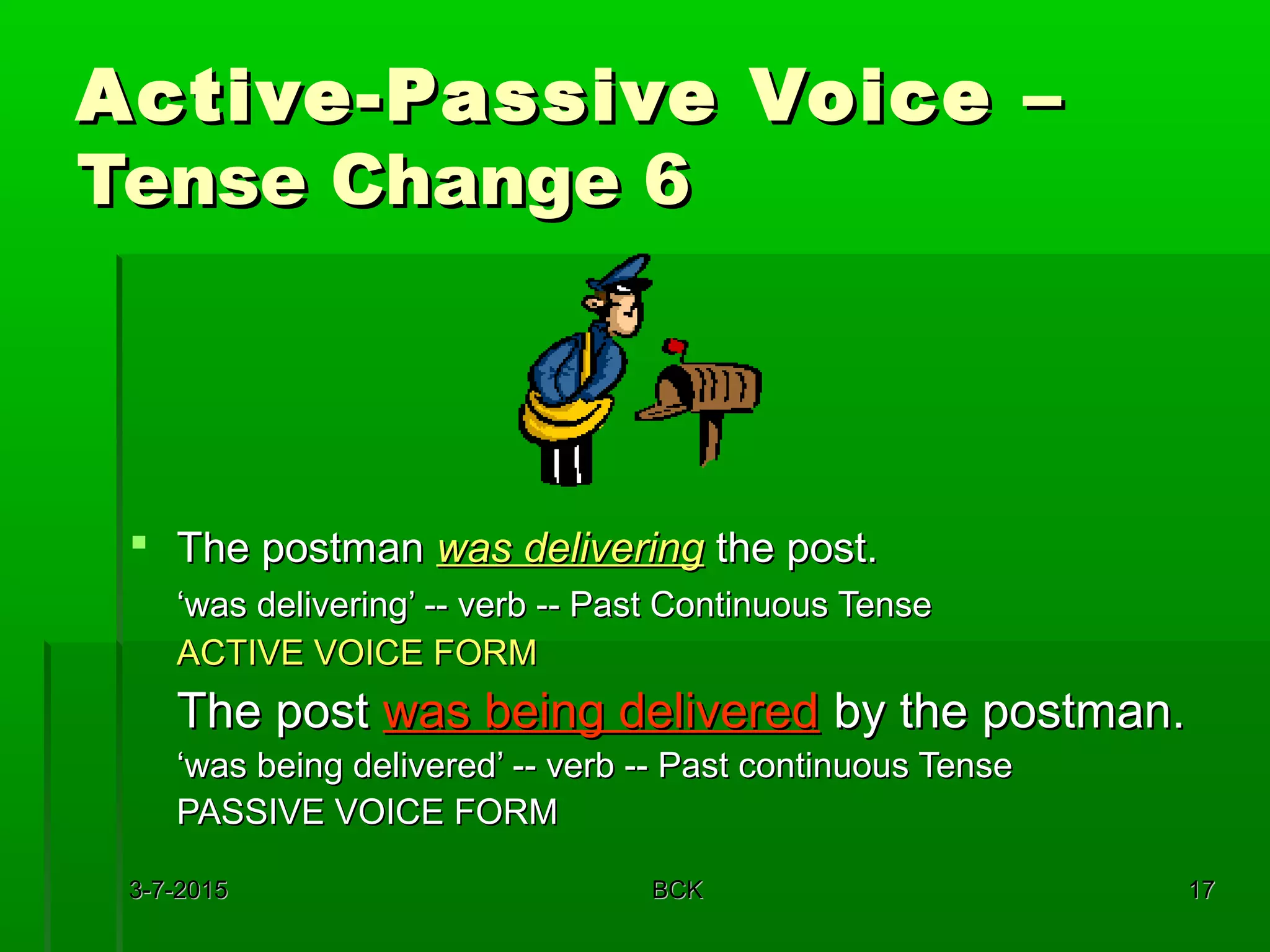
 The postmanThe postman was deliveringwas delivering the post.the post.
‘‘was delivering’ -- verb -- Past Continuous Tensewas delivering’ -- verb -- Past Continuous Tense
ACTIVE VOICE FORMACTIVE VOICE FORM
The postThe post was being deliveredwas being delivered by the postman.by the postman.
‘‘was being delivered’ -- verb -- Past continuous Tensewas being delivered’ -- verb -- Past continuous Tense
PASSIVE VOICE FORMPASSIVE VOICE FORM
3-7-20153-7-2015
BCKBCK 1818
Active-Passive Voice -- Tense Change 7Active-Passive Voice -- Tense Change 7
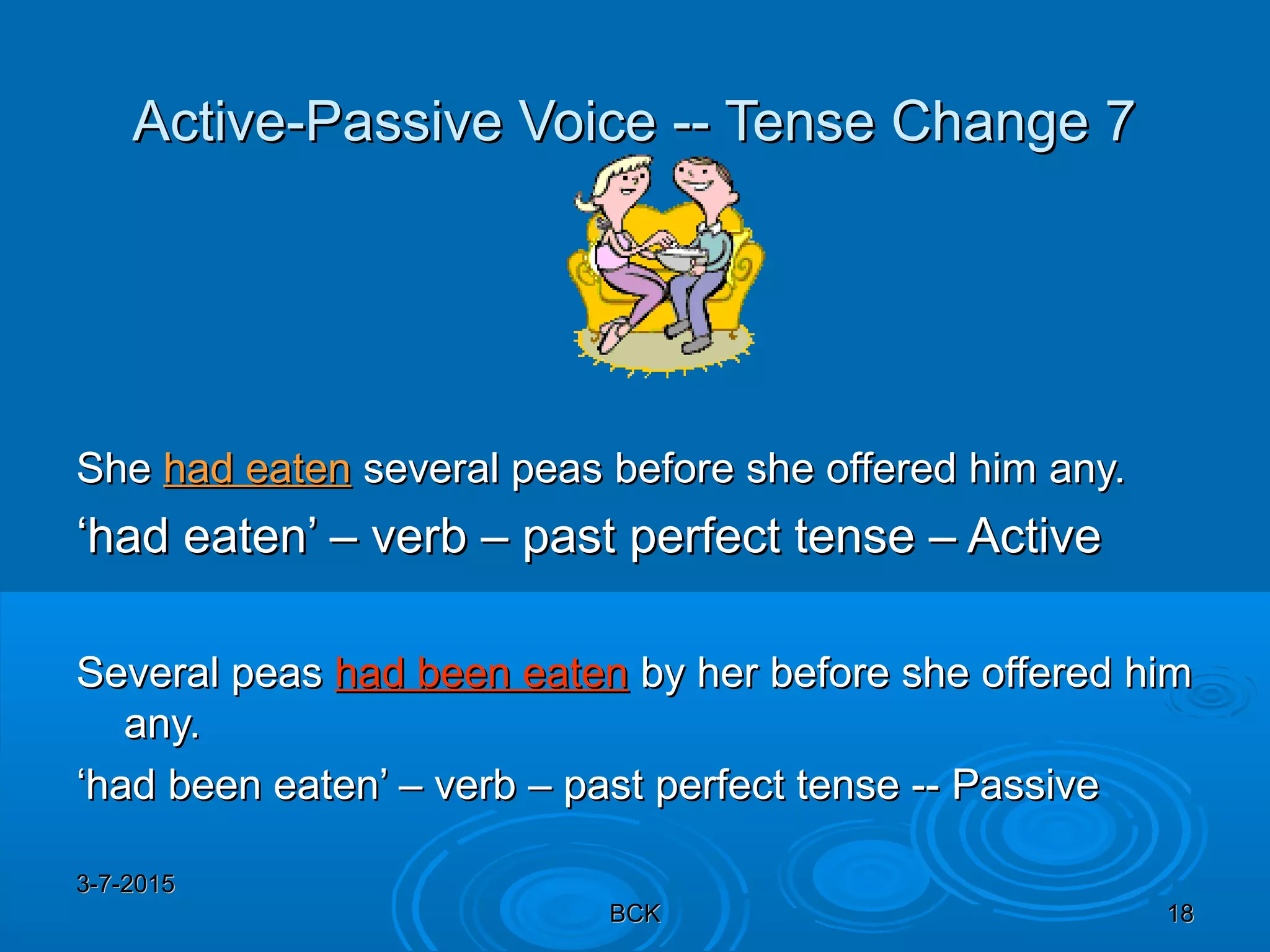
SheShe had eatenhad eaten several peas before she offered him any.several peas before she offered him any.
‘‘had eaten’ – verb – past perfect tense – Activehad eaten’ – verb – past perfect tense – Active
Several peasSeveral peas had been eatenhad been eaten by her before she offered himby her before she offered him
any.any.
‘‘had been eaten’ – verb – past perfect tense -- Passivehad been eaten’ – verb – past perfect tense -- Passive
3-7-20153-7-2015
BCKBCK 1919
Active-Passive Voice – Tense Change 8Active-Passive Voice – Tense Change 8
 According to the traditional grammar rules, theAccording to the traditional grammar rules, the
past perfect continuous tense is not used inpast perfect continuous tense is not used in
Passive form; however, in the contemporaryPassive form; however, in the contemporary
English, there are occasions where the pastEnglish, there are occasions where the past
perfect tense is used in the Passive Form, too!perfect tense is used in the Passive Form, too!
 HeHe had been writing lettershad been writing letters for half an hourfor half an hour
before somebody called him out.before somebody called him out.
 LettersLetters had been being writtenhad been being written for half an hourfor half an hour (by(by
him)him) before somebody called him out.before somebody called him out.
3-7-2015 BCK 20
Active-Passive Voice – Tense Change 9
They will give the beggar some money.
‘will give’ -- verb -- simple future tense -- Active
The beggar will be given some money by them.
‘will be given’ -- verb -- simple future tense -- Passive
3-7-2015 BCK 21
Active-Passive -- Tense Change10
• According to the traditional grammar
rules, the future continuous tense in the
Active is not used in Passive Voice Form.
• e.g. They will be playing with fireworks by
the time their father reaches home. Active
‘will be playing’ – verb – future continuous
-------- NO PASSIVE --------
3-7-2015 BCK 22
Active-Passive Voice – Tense ChangeActive-Passive Voice – Tense Change
1111
► SueSue will have sewnwill have sewn two dresses by 12 O’ clock.two dresses by 12 O’ clock.
‘‘will have sewn’ – verb – future perfect tense –will have sewn’ – verb – future perfect tense – ActiveActive
Two dressesTwo dresses will have been sewnwill have been sewn by 12 O’ clock by Sue.by 12 O’ clock by Sue.
‘‘will have been sewn’ – verb – future perfect tense --will have been sewn’ – verb – future perfect tense --
PassivePassive
3-7-20153-7-2015
BCKBCK 2323
Active-Passive Voice – Tense Change 12Active-Passive Voice – Tense Change 12
 According to the traditional grammar rules, theAccording to the traditional grammar rules, the
future perfect continuous tense is not used in thefuture perfect continuous tense is not used in the
Passive Voice Form:Passive Voice Form:
e.g. Youe.g. You will have been workingwill have been working on the courseon the course
material for 2 hours by 6 in the evening.material for 2 hours by 6 in the evening.
‘‘will have been working’ – verb –will have been working’ – verb –
Future Perfect Continuous Tense – ActiveFuture Perfect Continuous Tense – Active
---------- NO CHANGE -------------------- NO CHANGE ----------
3-7-2015 BCK 24
Active-Passive Voice – Tense Change 13
The Modal Auxiliary (helping) Verbs in
Passive Voice Form take ‘be’:
e.g. He will give you a book. Active Voice
You will be given a book by him. Passive
e.g. They can pick a number. Active Voice
A number can be picked by them.
Passive
e.g. We must finish this job. Active Voice
This job must be finished by us. Passive
3-7-20153-7-2015
BCKBCK 2525
Active-Passive Voice –Active-Passive Voice – not e 1not e 1
 The Subject of the active voice sentence becomes the object of theThe Subject of the active voice sentence becomes the object of the
preposition in the Passive Voice sentence. The preposition ispreposition in the Passive Voice sentence. The preposition is
usually ‘by’ when the object is a person, and ‘with’ when the objectusually ‘by’ when the object is a person, and ‘with’ when the object
is a thing, such as a knife, gun, arrow, etc.is a thing, such as a knife, gun, arrow, etc.
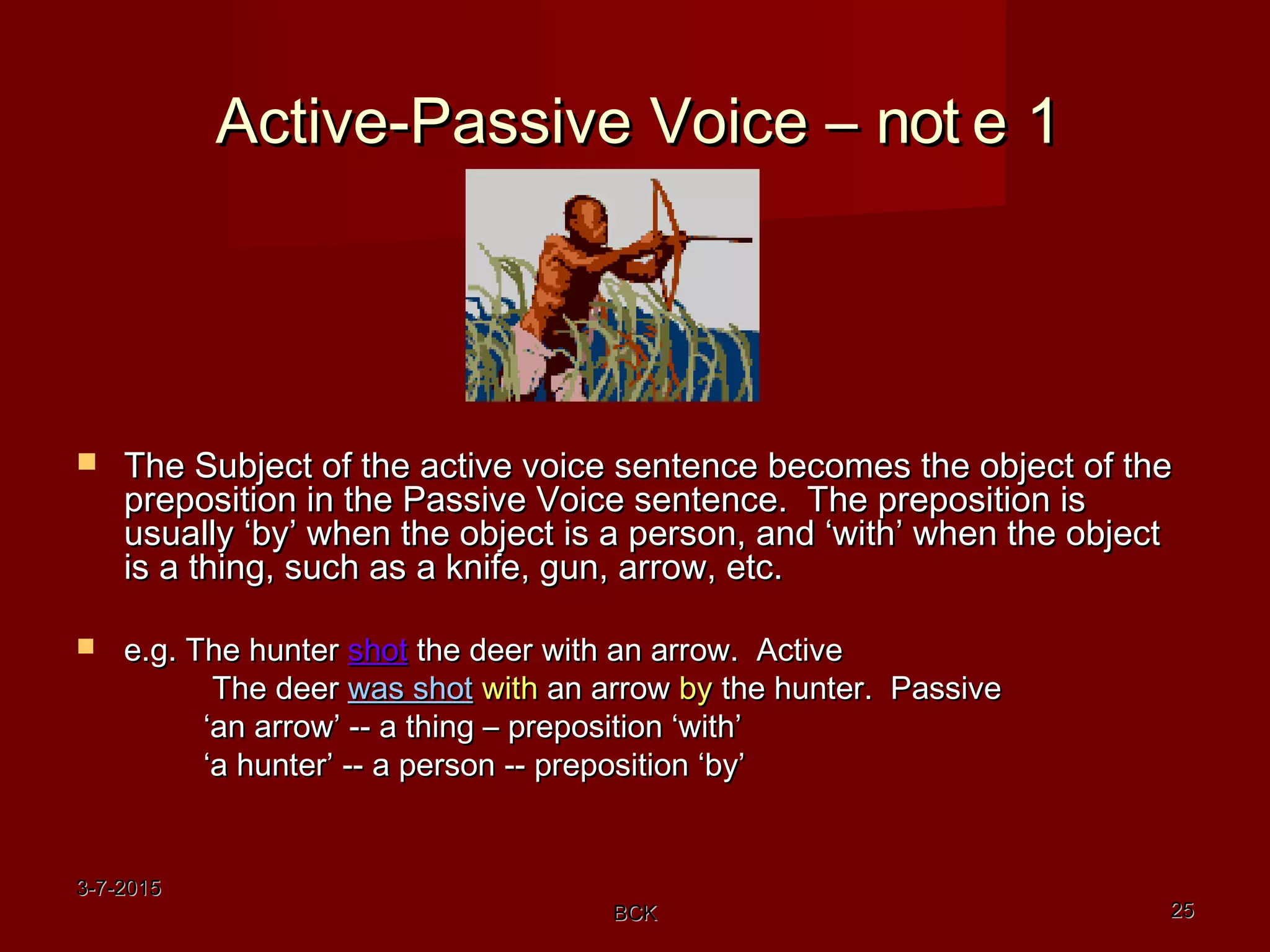
 e.g. The huntere.g. The hunter shotshot the deer with an arrow. Activethe deer with an arrow. Active
The deerThe deer was shotwas shot withwith an arrowan arrow byby the hunter. Passivethe hunter. Passive
‘‘an arrow’ -- a thing – preposition ‘with’an arrow’ -- a thing – preposition ‘with’
‘‘a hunter’ -- a person -- preposition ‘by’a hunter’ -- a person -- preposition ‘by’
3-7-2015
BCK26
Active-Passive Voice – not e 2
 When there are two objects of the verb in the active
voice sentence, we can change that active sentence
into passive in two way: using the first object in one
sentence and the second object in the other.
3-7-2015
BCK27
Active-Passive Voice –Active-Passive Voice – not e 2not e 2
(cont inued)(cont inued)
 e.g. The teacher teachese.g. The teacher teaches youyou a lessona lesson. Active. Active
‘‘you’ – object of the verb / ‘a lesson’ – object of the verbyou’ – object of the verb / ‘a lesson’ – object of the verb
(A)(A) YouYou are taught a lesson by the teacher. Passiveare taught a lesson by the teacher. Passive
(B)(B) A lessonA lesson is taught to you by the teacher. Passiveis taught to you by the teacher. Passive
3-7-2015 BCK 28
Active-Passive Voice -- not e 3
• In writing the Passive Voice, in most cases, the
preposition – ‘by’ or ‘with’ – and its object are not used,
because they are understood:
• e.g. The cook made me an omelette. Active Voice
An omelette was made for me
by the cook.
.
Passive Voice

Voice of verbs active and passive

  • 1.
    HIC university ofsouth Asia • Mamoona Jabeen • Bcs 4th semester • Presentation Name: Active&Passive • Teacher Name: Miss Mehvish • Subject: Functional English 3-07-2015 BCK 1
  • 2.
    3-7-2015 Active passive2 Active & PassiveActive & Passive Active Voice Form • When we want to say that the subject of a sentence is doing the action, we use the verb of that sentence in its Active form: • e.g. A man is cutting down a tree. ‘A man’ = subject -- doing the action -- cutting - Active
  • 3.
    3-7-2015 BCK 3 Active& PassiveActive & Passive Passive Voice Form • When we want to say that the subject of a sentence is not doing anything but is allowing something to be done to it by somebody else, we use the Passive Voice form: e.g. A tree is being cut down by a man. ‘A tree’ = subject = not doing anything, but allowing ‘a man’ to cut it. Passive
  • 4.
    BCK 4 Active-Passive Voice– example 1Active-Passive Voice – example 1  The boyThe boy is carryingis carrying the girl.the girl. Active VoiceActive Voice The boy = subjectThe boy = subject is carrying = verbis carrying = verb the girl = object of the verbthe girl = object of the verb Who is doing the action of carrying? =Who is doing the action of carrying? = ‘‘The boy’ – subject of the sentenceThe boy’ – subject of the sentence
  • 5.
    3-7-20153-7-2015 BCKBCK 55 Active-Passive Voice–Active-Passive Voice – example 2example 2  The girlThe girl is being carriedis being carried by the boy.by the boy. Passive VoicePassive Voice The girl = subjectThe girl = subject is being carried = verbis being carried = verb by = prepositionby = preposition the boy = object of the preposition ‘by’the boy = object of the preposition ‘by’ Who is doing the action of carrying?Who is doing the action of carrying? == NotNot ‘The girl’, the subject, but ‘the boy’, the object‘The girl’, the subject, but ‘the boy’, the object
  • 6.
    3-7-20153-7-2015 BCKBCK 66 Active-PassiveVoice –Active-Passive Voice – changes 1changes 1  AyyanAyyan reads a book every day.reads a book every day. Active VoiceActive Voice ‘‘Ayyan’ -- the subject of the Active sentence…Ayyan’ -- the subject of the Active sentence… A book is read every dayA book is read every day byby AyyanAyyan.. Passive VoicePassive Voice ‘‘by Ayyan’ – object of the preposition ‘by’by Ayyan’ – object of the preposition ‘by’ The subj ect of t he Act ive sent ence becomes t heThe subj ect of t he Act ive sent ence becomes t he obj ect of t he preposit ion in t he Passive sent ence!obj ect of t he preposit ion in t he Passive sent ence!
  • 7.
    3-7-2015 BCK 7 Active-Passive Voice– changes 2Active-Passive Voice – changes 2  AyyanAyyan readsreads a book every day. Active Voicea book every day. Active Voice ‘‘reads’ – verb of the Active sentencereads’ – verb of the Active sentence A bookA book is readis read every day by Ayyan.every day by Ayyan. PassivePassive voicevoice The Active form of the verb in Active sentence isThe Active form of the verb in Active sentence is changed into the Passive form in Passive sentence.changed into the Passive form in Passive sentence. ‘‘readsreads’ becomes “’ becomes “is readis read”!”!
  • 8.
    3-7-2015 BCK 8 Active-PassiveVoice – changes 3Active-Passive Voice – changes 3  Ayyan readsAyyan reads a booka book every day.every day. Active VoiceActive Voice ‘‘a book’ -- object of the verba book’ -- object of the verb A bookA book is read every day by Ayyan.is read every day by Ayyan. Passive voicePassive voice ‘‘A book’ -- subject of the passive sentence…A book’ -- subject of the passive sentence… The object of the verb in the Active sentence becomes the subject of the Passive sentence.
  • 9.
    3-7-20153-7-2015 BCKBCK 99 Active-PassiveVoice –Active-Passive Voice – note 1note 1  He cooksHe cooks foodfood. Active Voice. Active Voice ‘‘food’ – object of the verb –food’ – object of the verb – singularsingular FoodFood isis cooked by him. Passive Voicecooked by him. Passive Voice ‘‘Food’ – subject of the passiveFood’ – subject of the passive sentence – singular, so ‘sentence – singular, so ‘isis cooked’ --cooked’ -- verbverb singularsingular When thesubject of asentenceisWhen thesubject of asentenceis singular, theverb must also beinsingular, theverb must also bein singularsingular
  • 10.
    3-7-2015 BCK 10 Active-Passive Voice– not e 2  When the subject of a sentence is Plural, the verb of that sentence must be Plural:  He carried some books. Active Voice ‘some books’ -- object of the verb in Active – Plural Some books were carried by him. Passive Voice ‘were carried’ – verb – ‘were’ plural / ‘books’ plural
  • 11.
    3-7-2015 BCK 11 Active-PassiveVoice -- not e 3 • She has signed ten letters. Active Voice ‘She’ – subject; ‘has’ – part of the verb – singular ‘ten letters’ – object of the verb in Active -- plural Ten letters havehave been signed by her. Passive Voice ‘Ten letters’ – subject – plural; ‘have been signed’ verb – ‘have’ -- plural
  • 12.
    3-7-20153-7-2015 BCKBCK 1212 Active-Passive Voice–Active-Passive Voice – Tense ChangeTense Change 11  SheShe bakesbakes cakes. Activecakes. Active ‘‘bakes’ – verb –bakes’ – verb – Simple Present TenseSimple Present Tense CakesCakes are bakedare baked by her.by her. Passive VoicePassive Voice ‘‘are baked’ – verb –are baked’ – verb – Simple Present TenseSimple Present Tense
  • 13.
    3-7-20153-7-2015 BCKBCK 1313 Active-Passive –Tense Change 2Active-Passive – Tense Change 2  HeHe is buildingis building a sand castle.a sand castle. ‘‘is building’ – verb –is building’ – verb – present continues tense –present continues tense – ACTIVE VOICE FORMACTIVE VOICE FORM A sand castleA sand castle is being builtis being built by him.by him. ‘‘is being built’ – verb –is being built’ – verb – present continues tensepresent continues tense PASSIVE VOICE FORMPASSIVE VOICE FORM
  • 14.
    3-7-20153-7-2015 BCKBCK 1414 Active-Passive-- Tense Change 3Active-Passive -- Tense Change 3 HeHe has drawnhas drawn a picture.a picture. ‘‘has drawn’ – verb –has drawn’ – verb – present perfect tensepresent perfect tense ACTIVE VOICEACTIVE VOICE A pictureA picture has been drawnhas been drawn by him.by him. ‘‘has been drawn’ – verb –has been drawn’ – verb – present perfect tensepresent perfect tense PASSIVE VOICEPASSIVE VOICE
  • 15.
    3-7-2015 BCK 15 Active-Passive– Tense Change 4 According to the traditional grammar rules, the present perfect continues tense is not used in PASSIVE VOICE FORM; however, in the contemporary English, there are occasions where the present perfect continues tense is used in the Passive Voice: e.g. He has been mowing the lawn. Active Voice The lawn has been being mowed by him. Passive Voice
  • 16.
    3-7-2015 BCK 16 Active-PassiveVoice –Active-Passive Voice – Tense Change 5Tense Change 5 • SheShe toldtold me a secret.me a secret. Active VoiceActive Voice ‘‘told’ – verb – simple past tensetold’ – verb – simple past tense A secretA secret was toldwas told (to) me by her.(to) me by her. Passive VoicePassive Voice ‘‘was told’ – verb – simple past tensewas told’ – verb – simple past tense
  • 17.
    3-7-20153-7-2015 BCKBCK 1717 Active-PassiveVoice –Active-Passive Voice – Tense Change 6Tense Change 6  The postmanThe postman was deliveringwas delivering the post.the post. ‘‘was delivering’ -- verb -- Past Continuous Tensewas delivering’ -- verb -- Past Continuous Tense ACTIVE VOICE FORMACTIVE VOICE FORM The postThe post was being deliveredwas being delivered by the postman.by the postman. ‘‘was being delivered’ -- verb -- Past continuous Tensewas being delivered’ -- verb -- Past continuous Tense PASSIVE VOICE FORMPASSIVE VOICE FORM
  • 18.
    3-7-20153-7-2015 BCKBCK 1818 Active-Passive Voice-- Tense Change 7Active-Passive Voice -- Tense Change 7 SheShe had eatenhad eaten several peas before she offered him any.several peas before she offered him any. ‘‘had eaten’ – verb – past perfect tense – Activehad eaten’ – verb – past perfect tense – Active Several peasSeveral peas had been eatenhad been eaten by her before she offered himby her before she offered him any.any. ‘‘had been eaten’ – verb – past perfect tense -- Passivehad been eaten’ – verb – past perfect tense -- Passive
  • 19.
    3-7-20153-7-2015 BCKBCK 1919 Active-Passive Voice– Tense Change 8Active-Passive Voice – Tense Change 8  According to the traditional grammar rules, theAccording to the traditional grammar rules, the past perfect continuous tense is not used inpast perfect continuous tense is not used in Passive form; however, in the contemporaryPassive form; however, in the contemporary English, there are occasions where the pastEnglish, there are occasions where the past perfect tense is used in the Passive Form, too!perfect tense is used in the Passive Form, too!  HeHe had been writing lettershad been writing letters for half an hourfor half an hour before somebody called him out.before somebody called him out.  LettersLetters had been being writtenhad been being written for half an hourfor half an hour (by(by him)him) before somebody called him out.before somebody called him out.
  • 20.
    3-7-2015 BCK 20 Active-PassiveVoice – Tense Change 9 They will give the beggar some money. ‘will give’ -- verb -- simple future tense -- Active The beggar will be given some money by them. ‘will be given’ -- verb -- simple future tense -- Passive
  • 21.
    3-7-2015 BCK 21 Active-Passive-- Tense Change10 • According to the traditional grammar rules, the future continuous tense in the Active is not used in Passive Voice Form. • e.g. They will be playing with fireworks by the time their father reaches home. Active ‘will be playing’ – verb – future continuous -------- NO PASSIVE --------
  • 22.
    3-7-2015 BCK 22 Active-PassiveVoice – Tense ChangeActive-Passive Voice – Tense Change 1111 ► SueSue will have sewnwill have sewn two dresses by 12 O’ clock.two dresses by 12 O’ clock. ‘‘will have sewn’ – verb – future perfect tense –will have sewn’ – verb – future perfect tense – ActiveActive Two dressesTwo dresses will have been sewnwill have been sewn by 12 O’ clock by Sue.by 12 O’ clock by Sue. ‘‘will have been sewn’ – verb – future perfect tense --will have been sewn’ – verb – future perfect tense -- PassivePassive
  • 23.
    3-7-20153-7-2015 BCKBCK 2323 Active-Passive Voice– Tense Change 12Active-Passive Voice – Tense Change 12  According to the traditional grammar rules, theAccording to the traditional grammar rules, the future perfect continuous tense is not used in thefuture perfect continuous tense is not used in the Passive Voice Form:Passive Voice Form: e.g. Youe.g. You will have been workingwill have been working on the courseon the course material for 2 hours by 6 in the evening.material for 2 hours by 6 in the evening. ‘‘will have been working’ – verb –will have been working’ – verb – Future Perfect Continuous Tense – ActiveFuture Perfect Continuous Tense – Active ---------- NO CHANGE -------------------- NO CHANGE ----------
  • 24.
    3-7-2015 BCK 24 Active-PassiveVoice – Tense Change 13 The Modal Auxiliary (helping) Verbs in Passive Voice Form take ‘be’: e.g. He will give you a book. Active Voice You will be given a book by him. Passive e.g. They can pick a number. Active Voice A number can be picked by them. Passive e.g. We must finish this job. Active Voice This job must be finished by us. Passive
  • 25.
    3-7-20153-7-2015 BCKBCK 2525 Active-Passive Voice–Active-Passive Voice – not e 1not e 1  The Subject of the active voice sentence becomes the object of theThe Subject of the active voice sentence becomes the object of the preposition in the Passive Voice sentence. The preposition ispreposition in the Passive Voice sentence. The preposition is usually ‘by’ when the object is a person, and ‘with’ when the objectusually ‘by’ when the object is a person, and ‘with’ when the object is a thing, such as a knife, gun, arrow, etc.is a thing, such as a knife, gun, arrow, etc.  e.g. The huntere.g. The hunter shotshot the deer with an arrow. Activethe deer with an arrow. Active The deerThe deer was shotwas shot withwith an arrowan arrow byby the hunter. Passivethe hunter. Passive ‘‘an arrow’ -- a thing – preposition ‘with’an arrow’ -- a thing – preposition ‘with’ ‘‘a hunter’ -- a person -- preposition ‘by’a hunter’ -- a person -- preposition ‘by’
  • 26.
    3-7-2015 BCK26 Active-Passive Voice –not e 2  When there are two objects of the verb in the active voice sentence, we can change that active sentence into passive in two way: using the first object in one sentence and the second object in the other.
  • 27.
    3-7-2015 BCK27 Active-Passive Voice –Active-PassiveVoice – not e 2not e 2 (cont inued)(cont inued)  e.g. The teacher teachese.g. The teacher teaches youyou a lessona lesson. Active. Active ‘‘you’ – object of the verb / ‘a lesson’ – object of the verbyou’ – object of the verb / ‘a lesson’ – object of the verb (A)(A) YouYou are taught a lesson by the teacher. Passiveare taught a lesson by the teacher. Passive (B)(B) A lessonA lesson is taught to you by the teacher. Passiveis taught to you by the teacher. Passive
  • 28.
    3-7-2015 BCK 28 Active-PassiveVoice -- not e 3 • In writing the Passive Voice, in most cases, the preposition – ‘by’ or ‘with’ – and its object are not used, because they are understood: • e.g. The cook made me an omelette. Active Voice An omelette was made for me by the cook. . Passive Voice