https://pixabay.com/photos/books-bookstore-book-reading-1204029/shared under CC0
1
Passive Voice 2
CLBlevel3-4
https://pixabay.com/photos/books-bookstore-book-reading-1204029/shared under CC0
2
Welcome to the English Online community!
Our Equity, Diversity, and Inclusion Acknowledgment
This community welcomes, appreciates, and respects everyone – it doesn’t matter
what country you’re from or who you are!
We are here today to become better at English, so let’s focus on learning!
Please remember that English Online has ZERO tolerance for discrimination of any
kind, including:
(political, religious, nationality, or gender-based).
If anyone feels uncomfortable attending the class, they are free to leave and email us
at info@myenglishonline.ca
AGENDA
1. Welcome!
2. Active and Passive Voice
3. Passive Verb Tenses – Simple Present and Simple Past
4. Examples
5. Practice
6. Homework
3
https://pixabay.com/illustrations/artificial-intelligence-brain-think-4389372/ shared under CC0
Active and Passive Voices
What is the difference…?
All sentences in English are either active or passive.
In an active sentence, a person or thing does the
action, and this comes first.
4
Active Voice
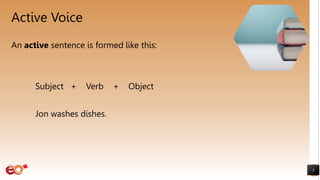
An active sentence is formed like this:
Subject + Verb + Object
Jon washes dishes.
5
Passive Voice
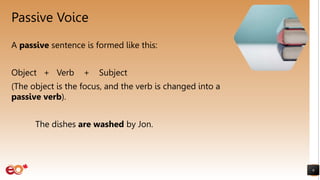
A passive sentence is formed like this:
Object + Verb + Subject
(The object is the focus, and the verb is changed into a
passive verb).
The dishes are washed by Jon.
6
Active and Passive Voices
This person or thing doing the action is called the actor
of the sentence.
EXAMPLE:
We offer online English classes.
“We” is the actor.
7
Active and Passive Voices
In a passive sentence, the person or object that
receives the action is placed at the beginning of the
sentence, and the actor is placed at the end, often
introduced with “by”.
Example:
English classes are offered by us.
8
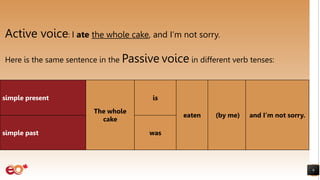
Active voice: I ate the whole cake, and I’m not sorry.
Here is the same sentence in the Passive voice in different verb tenses:
9
simple present
The whole
cake
is
eaten (by me) and I’m not sorry.
simple past was
Passive and Active Voice
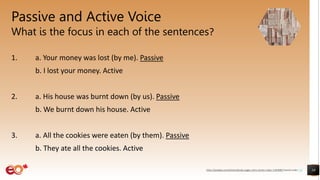
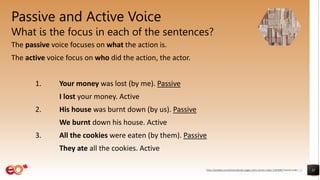
What is the focus in each of the sentences?
1. a. Your money was lost (by me). Passive
b. I lost your money. Active
2. a. His house was burnt down (by us). Passive
b. We burnt down his house. Active
3. a. All the cookies were eaten (by them). Passive
b. They ate all the cookies. Active
10
https://pixabay.com/photos/books-pages-story-stories-notes-1245690/ shared under CC0
Passive and Active Voice
What is the focus in each of the sentences?
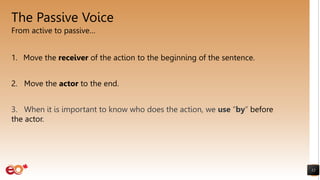
The passive voice focuses on what the action is.
The active voice focus on who did the action, the actor.
1. Your money was lost (by me). Passive
I lost your money. Active
2. His house was burnt down (by us). Passive
We burnt down his house. Active
3. All the cookies were eaten (by them). Passive
They ate all the cookies. Active
11
https://pixabay.com/photos/books-pages-story-stories-notes-1245690/ shared under CC0
The Passive Voice
From active to passive…
12
1. Move the receiver of the action to the beginning of the sentence.
2. Move the actor to the end.
3. When it is important to know who does the action, we use ”by” before
the actor.
The Passive Voice
From active to passive…
13
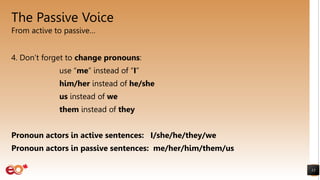
4. Don’t forget to change pronouns:
use “me” instead of “I”
him/her instead of he/she
us instead of we
them instead of they
Pronoun actors in active sentences: I/she/he/they/we
Pronoun actors in passive sentences: me/her/him/them/us
The Passive Voice
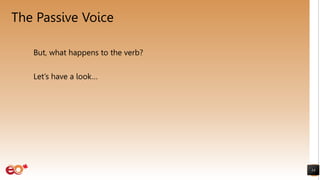
But, what happens to the verb?
Let’s have a look…
14
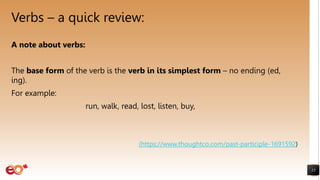
Verbs – a quick review:
15
A note about verbs:
The base form of the verb is the verb in its simplest form – no ending (ed,
ing).
For example:
run, walk, read, lost, listen, buy,
(https://www.thoughtco.com/past-participle-1691592)
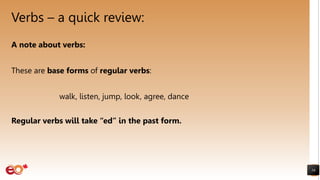
Verbs – a quick review:
16
A note about verbs:
These are base forms of regular verbs:
walk, listen, jump, look, agree, dance
Regular verbs will take “ed” in the past form.
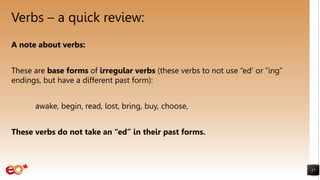
Verbs – a quick review:
17
A note about verbs:
These are base forms of irregular verbs (these verbs to not use “ed’ or “ing”
endings, but have a different past form):
awake, begin, read, lost, bring, buy, choose,
These verbs do not take an “ed” in their past forms.
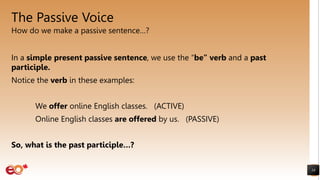
The Passive Voice
How do we make a passive sentence…?
18
In a simple present passive sentence, we use the “be” verb and a past
participle.
Notice the verb in these examples:
We offer online English classes. (ACTIVE)
Online English classes are offered by us. (PASSIVE)
So, what is the past participle…?
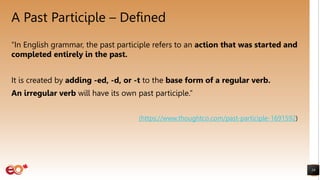
A Past Participle – Defined
19
“In English grammar, the past participle refers to an action that was started and
completed entirely in the past.
It is created by adding -ed, -d, or -t to the base form of a regular verb.
An irregular verb will have its own past participle.”
(https://www.thoughtco.com/past-participle-1691592)
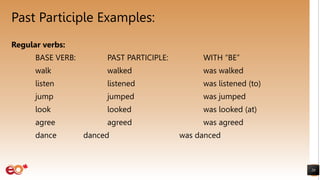
Past Participle Examples:
20
Regular verbs:
BASE VERB: PAST PARTICIPLE: WITH “BE”
walk walked was walked
listen listened was listened (to)
jump jumped was jumped
look looked was looked (at)
agree agreed was agreed
dance danced was danced
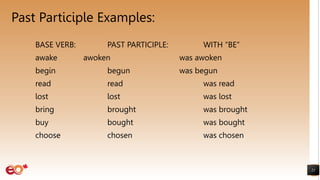
Past Participle Examples:
21
BASE VERB: PAST PARTICIPLE: WITH “BE”
awake awoken was awoken
begin begun was begun
read read was read
lost lost was lost
bring brought was brought
buy bought was bought
choose chosen was chosen
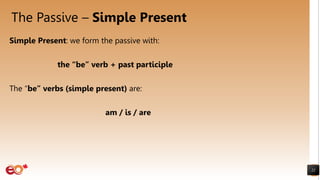
The Passive – Simple Present
Simple Present: we form the passive with:
the “be” verb + past participle
The “be” verbs (simple present) are:
am / is / are
22
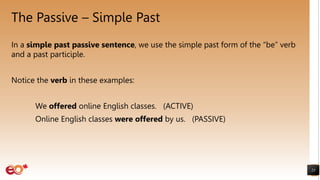
The Passive – Simple Past
23
In a simple past passive sentence, we use the simple past form of the “be” verb
and a past participle.
Notice the verb in these examples:
We offered online English classes. (ACTIVE)
Online English classes were offered by us. (PASSIVE)
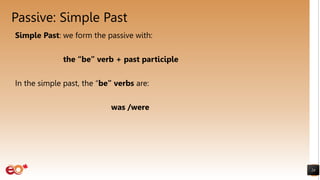
Passive: Simple Past
Simple Past: we form the passive with:
the “be” verb + past participle
In the simple past, the “be” verbs are:
was /were
24
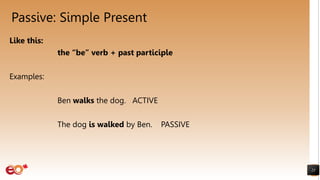
Passive: Simple Present
Like this:
the “be” verb + past participle
Examples:
Ben walks the dog. ACTIVE
The dog is walked by Ben. PASSIVE
25
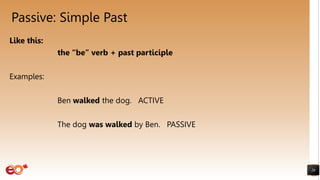
Passive: Simple Past
Like this:
the “be” verb + past participle
Examples:
Ben walked the dog. ACTIVE
The dog was walked by Ben. PASSIVE
26
Passive: Simple Present
Like this:
the “be” verb + past participle
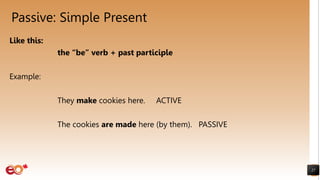
Example:
They make cookies here. ACTIVE
The cookies are made here (by them). PASSIVE
27
Passive: Simple Past
Like this:
the “be” verb + past participle
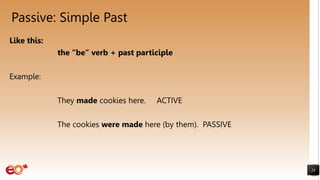
Example:
They made cookies here. ACTIVE
The cookies were made here (by them). PASSIVE
28
Passive: Simple Present
29
Like this:
the “be” verb + past participle
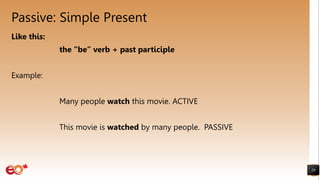
Example:
Many people watch this movie. ACTIVE
This movie is watched by many people. PASSIVE
Passive: Simple Past
30
Like this:
the “be” verb + past participle
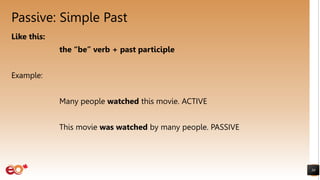
Example:
Many people watched this movie. ACTIVE
This movie was watched by many people. PASSIVE
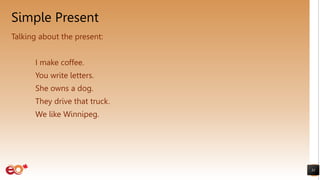
Simple Present
31
Talking about the present:
I make coffee.
You write letters.
She owns a dog.
They drive that truck.
We like Winnipeg.
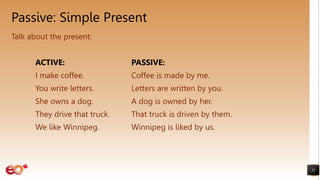
Passive: Simple Present
32
Talk about the present:
ACTIVE: PASSIVE:
I make coffee. Coffee is made by me.
You write letters. Letters are written by you.
She owns a dog. A dog is owned by her.
They drive that truck. That truck is driven by them.
We like Winnipeg. Winnipeg is liked by us.
Simple Past:
33
Talk about the past.
I made coffee.
You wrote letters.
She had a dog.
They drove that truck.
We liked Winnipeg.
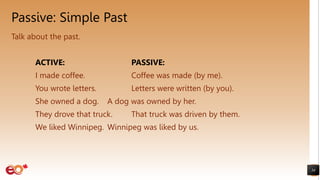
Passive: Simple Past
34
Talk about the past.
ACTIVE: PASSIVE:
I made coffee. Coffee was made (by me).
You wrote letters. Letters were written (by you).
She owned a dog. A dog was owned by her.
They drove that truck. That truck was driven by them.
We liked Winnipeg. Winnipeg was liked by us.
Image shared under CC0
simple present
https://pixabay.com/photos/books-bookstore-book-reading-shop-1204038/ shared under CC0
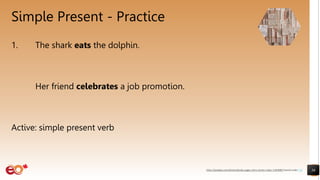
Simple Present - Practice
1. The shark eats the dolphin.
Her friend celebrates a job promotion.
Active: simple present verb
36
https://pixabay.com/photos/books-pages-story-stories-notes-1245690/ shared under CC0
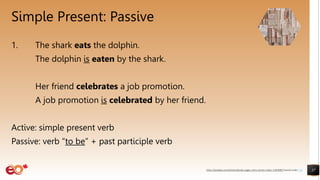
Simple Present: Passive
1. The shark eats the dolphin.
The dolphin is eaten by the shark.
Her friend celebrates a job promotion.
A job promotion is celebrated by her friend.
Active: simple present verb
Passive: verb “to be” + past participle verb
37
https://pixabay.com/photos/books-pages-story-stories-notes-1245690/ shared under CC0
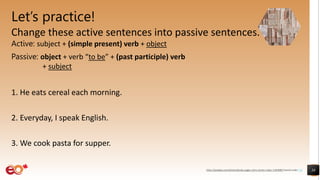
Let’s practice!
Change these active sentences into passive sentences.
Active: subject + (simple present) verb + object
Passive: object + verb “to be” + (past participle) verb
+ subject
1. He eats cereal each morning.
2. Everyday, I speak English.
3. We cook pasta for supper.
38
https://pixabay.com/photos/books-pages-story-stories-notes-1245690/ shared under CC0
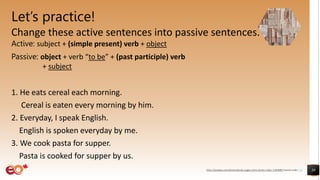
Let’s practice!
Change these active sentences into passive sentences.
Active: subject + (simple present) verb + object
Passive: object + verb “to be” + (past participle) verb
+ subject
1. He eats cereal each morning.
Cereal is eaten every morning by him.
2. Everyday, I speak English.
English is spoken everyday by me.
3. We cook pasta for supper.
Pasta is cooked for supper by us.
39
https://pixabay.com/photos/books-pages-story-stories-notes-1245690/ shared under CC0
Image shared under CC0
simplepast
https://pixabay.com/photos/books-bookstore-book-reading-shop-1204038/ shared under CC0
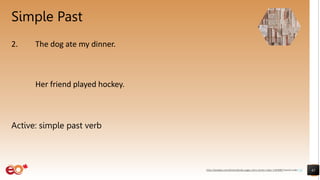
Simple Past
2. The dog ate my dinner.
Her friend played hockey.
Active: simple past verb
41
https://pixabay.com/photos/books-pages-story-stories-notes-1245690/ shared under CC0
Simple Past
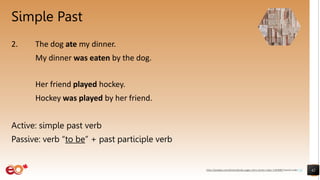
2. The dog ate my dinner.
My dinner was eaten by the dog.
Her friend played hockey.
Hockey was played by her friend.
Active: simple past verb
Passive: verb “to be” + past participle verb
42
https://pixabay.com/photos/books-pages-story-stories-notes-1245690/ shared under CC0
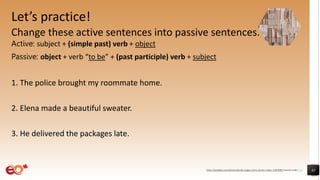
Let’s practice!
Change these active sentences into passive sentences.
Active: subject + (simple past) verb + object
Passive: object + verb “to be” + (past participle) verb + subject
1. The police brought my roommate home.
2. Elena made a beautiful sweater.
3. He delivered the packages late.
43
https://pixabay.com/photos/books-pages-story-stories-notes-1245690/ shared under CC0
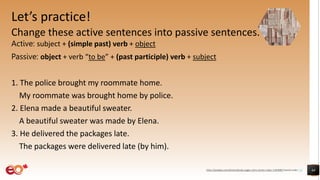
Let’s practice!
Change these active sentences into passive sentences.
Active: subject + (simple past) verb + object
Passive: object + verb “to be” + (past participle) verb + subject
1. The police brought my roommate home.
My roommate was brought home by police.
2. Elena made a beautiful sweater.
A beautiful sweater was made by Elena.
3. He delivered the packages late.
The packages were delivered late (by him).
44
https://pixabay.com/photos/books-pages-story-stories-notes-1245690/ shared under CC0
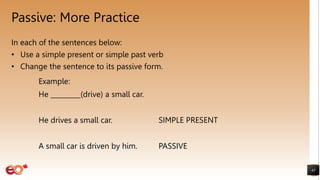
Passive: More Practice
In each of the sentences below:
• Use a simple present or simple past verb
• Change the sentence to its passive form.
45
Example:
He _________(drive) a small car.
He drives a small car. SIMPLE PRESENT
A small car is driven by him. PASSIVE
Passive Practice
In each of the sentences below:
• Use a simple present or simple past verb
• Change the sentence to its passive form.
46
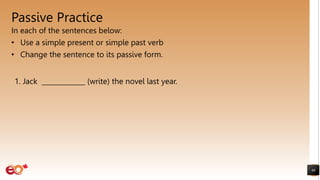
1. Jack _____________ (write) the novel last year.
Passive Practice
In each of the sentences below:
• Use a simple present or simple past verb
• Change the sentence to its passive form.
47
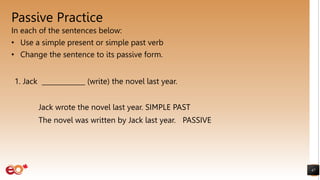
1. Jack _____________ (write) the novel last year.
Jack wrote the novel last year. SIMPLE PAST
The novel was written by Jack last year. PASSIVE
Passive Practice
In each of the sentences below:
• Use a simple present or simple past verb
• Change the sentence to its passive form.
48
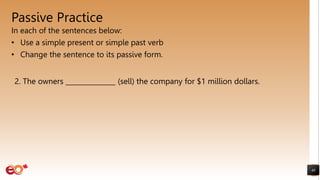
2. The owners _______________ (sell) the company for $1 million dollars.
Passive Practice
In each of the sentences below:
• Use a simple present or simple past verb
• Change the sentence to its passive form.
49
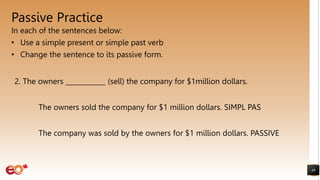
2. The owners ____________ (sell) the company for $1million dollars.
The owners sold the company for $1 million dollars. SIMPL PAS
The company was sold by the owners for $1 million dollars. PASSIVE
Passive Practice
In each of the sentences below:
• Use a simple present or simple past verb
• Change the sentence to its passive form.
50
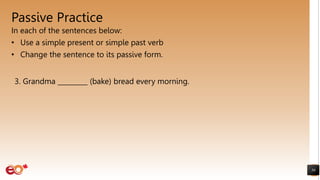
3. Grandma _________ (bake) bread every morning.
Passive Practice
In each of the sentences below:
• Use a simple present or simple past verb
• Change the sentence to its passive form.
51
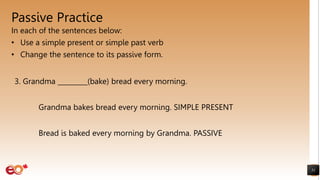
3. Grandma _________(bake) bread every morning.
Grandma bakes bread every morning. SIMPLE PRESENT
Bread is baked every morning by Grandma. PASSIVE
Passive Practice
In each of the sentences below:
• Use a simple present or simple past verb
• Change the sentence to its passive form.
52
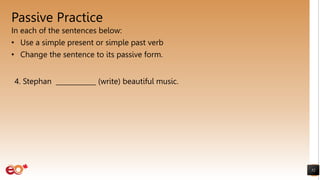
4. Stephan ____________ (write) beautiful music.
Passive Practice
In each of the sentences below:
• Use a simple present or simple past verb
• Change the sentence to its passive form.
53
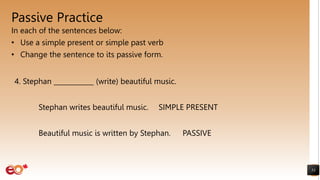
4. Stephan ____________ (write) beautiful music.
Stephan writes beautiful music. SIMPLE PRESENT
Beautiful music is written by Stephan. PASSIVE
Passive Practice
In each of the sentences below:
• Use a simple present or simple past verb
• Change the sentence to its passive form.
54
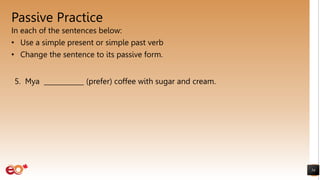
5. Mya ____________ (prefer) coffee with sugar and cream.
Passive Practice
In each of the sentences below:
• Use a simple present or simple past verb
• Change the sentence to its passive form.
55
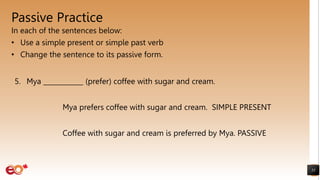
5. Mya ____________ (prefer) coffee with sugar and cream.
Mya prefers coffee with sugar and cream. SIMPLE PRESENT
Coffee with sugar and cream is preferred by Mya. PASSIVE
Passive Practice
In each of the sentences below:
• Use a simple present or simple past verb
• Change the sentence to its passive form.
56
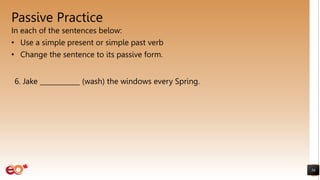
6. Jake ____________ (wash) the windows every Spring.
Passive Practice
In each of the sentences below:
• Use a simple present or simple past verb
• Change the sentence to its passive form.
57
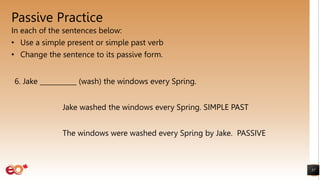
6. Jake ___________ (wash) the windows every Spring.
Jake washed the windows every Spring. SIMPLE PAST
The windows were washed every Spring by Jake. PASSIVE
Passive Practice
In each of the sentences below:
• Use a simple present or simple past verb
• Change the sentence to its passive form.
58
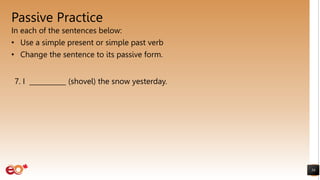
7. I ___________ (shovel) the snow yesterday.
Passive Practice
In each of the sentences below:
• Use a simple present or simple past verb
• Change the sentence to its passive form.
59
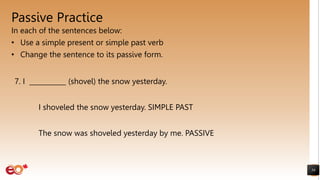
7. I ___________ (shovel) the snow yesterday.
I shoveled the snow yesterday. SIMPLE PAST
The snow was shoveled yesterday by me. PASSIVE
Use of the Passive
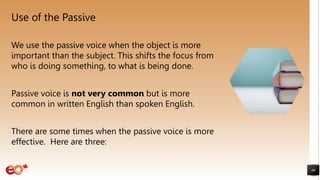
We use the passive voice when the object is more
important than the subject. This shifts the focus from
who is doing something, to what is being done.
Passive voice is not very common but is more
common in written English than spoken English.
There are some times when the passive voice is more
effective. Here are three:
60
We use the passive voice…
61
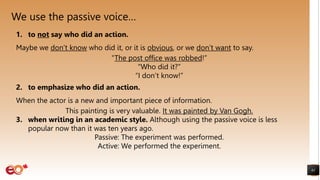
1. to not say who did an action.
Maybe we don’t know who did it, or it is obvious, or we don’t want to say.
“The post office was robbed!”
“Who did it?”
“I don’t know!”
2. to emphasize who did an action.
When the actor is a new and important piece of information.
This painting is very valuable. It was painted by Van Gogh.
3. when writing in an academic style. Although using the passive voice is less
popular now than it was ten years ago.
Passive: The experiment was performed.
Active: We performed the experiment.
The Passive Voice – When to Use It:
62
https://pixabay.com/photos/books-pages-story-stories-notes-1245690/ shared under CC0
1. When we want to change the focus of the sentence:
Example: This book was written by Steve.
(We are more interested in the book than the writer.)
The Passive Voice – When to Use It:
63
https://pixabay.com/photos/books-pages-story-stories-notes-1245690/ shared under CC0
2. When the actor is unknown or unimportant or obvious or “people in
general”:
Example: The kitchen was cleaned.
(The people who did the cleaning are unknown or unimportant.)
*In this case, we can leave out the actor and “by”.
The Passive Voice – When to Use It:
64
https://pixabay.com/photos/books-pages-story-stories-notes-1245690/ shared under CC0
3. In factual (like news reports) or scientific/academic writing:
Example: In this study, a new model is used.
*In this case, also, we can leave out the actor, and “by”.
Homework:
Change each sentence from active to passive voice.
1. My naughty dog ate the Thanksgiving turkey.
2. I stop for coffee every morning.
3. Michael repaired the fence last Spring.
4. Elsa loves English grammar.
65
https://pixabay.com/photos/books-pages-story-stories-notes-1245690/ shared under CC0
https://pixabay.com/photos/books-study-literature-learn-stack-2158737/ shared under CC0
https://pixabay.com/illustrations/artificial-intelligence-brain-think-4389372/ shared under CC0
HOMEWORK – The Details:
1. Submit your homework to Lori on Skype. live: loramoren.
2. After class, you have until the 11:59 pm the same day to complete the assignment.
3. I will correct your homework and provide feedback!
Sources:
Beare, Kenneth. "Passive Voice Usage and Examples for ESL/EFL."
ThoughtCo, Apr. 5, 2023
https://www.thoughtco.com/passive-voice-in-english-grammar-
1211144
https://ellii.com/video/the-passive-voice
https://ell.brainpop.com/level3/unit1/lesson1/summary/#:~:text=In
%20the%20present%20simple%2C%20the,the%20form%20of%20be
%20changes.
Powerpoint (N. Wall): Passive Voice
67
https://pixabay.com/photos/books-pages-story-stories-notes-1245690/ shared under CC0
https://pixabay.com/photos/books-study-literature-learn-stack-2158737/ shared under CC0
https://pixabay.com/illustrations/artificial-intelligence-brain-think-4389372/ shared under CC0
Language Contest
Want to learn more expressions, Canadian cultural
references and idioms?
Check English Online’s Facebook and Instagram
pages and take the challenge
of our Language Contest every
other Thursday!
You can win EO personalized
prizes and improve your English
skills one idiom at a time!
Thankyou!
Lori Morency
Skype: live:loramoren
livelearn.ca
Thankyou!
Blaine
broberts@myenglishonline.ca
livelearn.ca
1-204-946-5140
Website:
livelearn.ca
Email:
info@myenglishonline.ca

PassiveVoice2CLB3-4.pptx

  • 1.
    https://pixabay.com/photos/books-bookstore-book-reading-1204029/shared under CC0 1 PassiveVoice 2 CLBlevel3-4 https://pixabay.com/photos/books-bookstore-book-reading-1204029/shared under CC0
  • 2.
    2 Welcome to theEnglish Online community! Our Equity, Diversity, and Inclusion Acknowledgment This community welcomes, appreciates, and respects everyone – it doesn’t matter what country you’re from or who you are! We are here today to become better at English, so let’s focus on learning! Please remember that English Online has ZERO tolerance for discrimination of any kind, including: (political, religious, nationality, or gender-based). If anyone feels uncomfortable attending the class, they are free to leave and email us at info@myenglishonline.ca
  • 3.
    AGENDA 1. Welcome! 2. Activeand Passive Voice 3. Passive Verb Tenses – Simple Present and Simple Past 4. Examples 5. Practice 6. Homework 3 https://pixabay.com/illustrations/artificial-intelligence-brain-think-4389372/ shared under CC0
  • 4.
    Active and PassiveVoices What is the difference…? All sentences in English are either active or passive. In an active sentence, a person or thing does the action, and this comes first. 4
  • 5.
    Active Voice An activesentence is formed like this: Subject + Verb + Object Jon washes dishes. 5
  • 6.
    Passive Voice A passivesentence is formed like this: Object + Verb + Subject (The object is the focus, and the verb is changed into a passive verb). The dishes are washed by Jon. 6
  • 7.
    Active and PassiveVoices This person or thing doing the action is called the actor of the sentence. EXAMPLE: We offer online English classes. “We” is the actor. 7
  • 8.
    Active and PassiveVoices In a passive sentence, the person or object that receives the action is placed at the beginning of the sentence, and the actor is placed at the end, often introduced with “by”. Example: English classes are offered by us. 8
  • 9.
    Active voice: Iate the whole cake, and I’m not sorry. Here is the same sentence in the Passive voice in different verb tenses: 9 simple present The whole cake is eaten (by me) and I’m not sorry. simple past was
  • 10.
    Passive and ActiveVoice What is the focus in each of the sentences? 1. a. Your money was lost (by me). Passive b. I lost your money. Active 2. a. His house was burnt down (by us). Passive b. We burnt down his house. Active 3. a. All the cookies were eaten (by them). Passive b. They ate all the cookies. Active 10 https://pixabay.com/photos/books-pages-story-stories-notes-1245690/ shared under CC0
  • 11.
    Passive and ActiveVoice What is the focus in each of the sentences? The passive voice focuses on what the action is. The active voice focus on who did the action, the actor. 1. Your money was lost (by me). Passive I lost your money. Active 2. His house was burnt down (by us). Passive We burnt down his house. Active 3. All the cookies were eaten (by them). Passive They ate all the cookies. Active 11 https://pixabay.com/photos/books-pages-story-stories-notes-1245690/ shared under CC0
  • 12.
    The Passive Voice Fromactive to passive… 12 1. Move the receiver of the action to the beginning of the sentence. 2. Move the actor to the end. 3. When it is important to know who does the action, we use ”by” before the actor.
  • 13.
    The Passive Voice Fromactive to passive… 13 4. Don’t forget to change pronouns: use “me” instead of “I” him/her instead of he/she us instead of we them instead of they Pronoun actors in active sentences: I/she/he/they/we Pronoun actors in passive sentences: me/her/him/them/us
  • 14.
    The Passive Voice But,what happens to the verb? Let’s have a look… 14
  • 15.
    Verbs – aquick review: 15 A note about verbs: The base form of the verb is the verb in its simplest form – no ending (ed, ing). For example: run, walk, read, lost, listen, buy, (https://www.thoughtco.com/past-participle-1691592)
  • 16.
    Verbs – aquick review: 16 A note about verbs: These are base forms of regular verbs: walk, listen, jump, look, agree, dance Regular verbs will take “ed” in the past form.
  • 17.
    Verbs – aquick review: 17 A note about verbs: These are base forms of irregular verbs (these verbs to not use “ed’ or “ing” endings, but have a different past form): awake, begin, read, lost, bring, buy, choose, These verbs do not take an “ed” in their past forms.
  • 18.
    The Passive Voice Howdo we make a passive sentence…? 18 In a simple present passive sentence, we use the “be” verb and a past participle. Notice the verb in these examples: We offer online English classes. (ACTIVE) Online English classes are offered by us. (PASSIVE) So, what is the past participle…?
  • 19.
    A Past Participle– Defined 19 “In English grammar, the past participle refers to an action that was started and completed entirely in the past. It is created by adding -ed, -d, or -t to the base form of a regular verb. An irregular verb will have its own past participle.” (https://www.thoughtco.com/past-participle-1691592)
  • 20.
    Past Participle Examples: 20 Regularverbs: BASE VERB: PAST PARTICIPLE: WITH “BE” walk walked was walked listen listened was listened (to) jump jumped was jumped look looked was looked (at) agree agreed was agreed dance danced was danced
  • 21.
    Past Participle Examples: 21 BASEVERB: PAST PARTICIPLE: WITH “BE” awake awoken was awoken begin begun was begun read read was read lost lost was lost bring brought was brought buy bought was bought choose chosen was chosen
  • 22.
    The Passive –Simple Present Simple Present: we form the passive with: the “be” verb + past participle The “be” verbs (simple present) are: am / is / are 22
  • 23.
    The Passive –Simple Past 23 In a simple past passive sentence, we use the simple past form of the “be” verb and a past participle. Notice the verb in these examples: We offered online English classes. (ACTIVE) Online English classes were offered by us. (PASSIVE)
  • 24.
    Passive: Simple Past SimplePast: we form the passive with: the “be” verb + past participle In the simple past, the “be” verbs are: was /were 24
  • 25.
    Passive: Simple Present Likethis: the “be” verb + past participle Examples: Ben walks the dog. ACTIVE The dog is walked by Ben. PASSIVE 25
  • 26.
    Passive: Simple Past Likethis: the “be” verb + past participle Examples: Ben walked the dog. ACTIVE The dog was walked by Ben. PASSIVE 26
  • 27.
    Passive: Simple Present Likethis: the “be” verb + past participle Example: They make cookies here. ACTIVE The cookies are made here (by them). PASSIVE 27
  • 28.
    Passive: Simple Past Likethis: the “be” verb + past participle Example: They made cookies here. ACTIVE The cookies were made here (by them). PASSIVE 28
  • 29.
    Passive: Simple Present 29 Likethis: the “be” verb + past participle Example: Many people watch this movie. ACTIVE This movie is watched by many people. PASSIVE
  • 30.
    Passive: Simple Past 30 Likethis: the “be” verb + past participle Example: Many people watched this movie. ACTIVE This movie was watched by many people. PASSIVE
  • 31.
    Simple Present 31 Talking aboutthe present: I make coffee. You write letters. She owns a dog. They drive that truck. We like Winnipeg.
  • 32.
    Passive: Simple Present 32 Talkabout the present: ACTIVE: PASSIVE: I make coffee. Coffee is made by me. You write letters. Letters are written by you. She owns a dog. A dog is owned by her. They drive that truck. That truck is driven by them. We like Winnipeg. Winnipeg is liked by us.
  • 33.
    Simple Past: 33 Talk aboutthe past. I made coffee. You wrote letters. She had a dog. They drove that truck. We liked Winnipeg.
  • 34.
    Passive: Simple Past 34 Talkabout the past. ACTIVE: PASSIVE: I made coffee. Coffee was made (by me). You wrote letters. Letters were written (by you). She owned a dog. A dog was owned by her. They drove that truck. That truck was driven by them. We liked Winnipeg. Winnipeg was liked by us.
  • 35.
    Image shared underCC0 simple present https://pixabay.com/photos/books-bookstore-book-reading-shop-1204038/ shared under CC0
  • 36.
    Simple Present -Practice 1. The shark eats the dolphin. Her friend celebrates a job promotion. Active: simple present verb 36 https://pixabay.com/photos/books-pages-story-stories-notes-1245690/ shared under CC0
  • 37.
    Simple Present: Passive 1.The shark eats the dolphin. The dolphin is eaten by the shark. Her friend celebrates a job promotion. A job promotion is celebrated by her friend. Active: simple present verb Passive: verb “to be” + past participle verb 37 https://pixabay.com/photos/books-pages-story-stories-notes-1245690/ shared under CC0
  • 38.
    Let’s practice! Change theseactive sentences into passive sentences. Active: subject + (simple present) verb + object Passive: object + verb “to be” + (past participle) verb + subject 1. He eats cereal each morning. 2. Everyday, I speak English. 3. We cook pasta for supper. 38 https://pixabay.com/photos/books-pages-story-stories-notes-1245690/ shared under CC0
  • 39.
    Let’s practice! Change theseactive sentences into passive sentences. Active: subject + (simple present) verb + object Passive: object + verb “to be” + (past participle) verb + subject 1. He eats cereal each morning. Cereal is eaten every morning by him. 2. Everyday, I speak English. English is spoken everyday by me. 3. We cook pasta for supper. Pasta is cooked for supper by us. 39 https://pixabay.com/photos/books-pages-story-stories-notes-1245690/ shared under CC0
  • 40.
    Image shared underCC0 simplepast https://pixabay.com/photos/books-bookstore-book-reading-shop-1204038/ shared under CC0
  • 41.
    Simple Past 2. Thedog ate my dinner. Her friend played hockey. Active: simple past verb 41 https://pixabay.com/photos/books-pages-story-stories-notes-1245690/ shared under CC0
  • 42.
    Simple Past 2. Thedog ate my dinner. My dinner was eaten by the dog. Her friend played hockey. Hockey was played by her friend. Active: simple past verb Passive: verb “to be” + past participle verb 42 https://pixabay.com/photos/books-pages-story-stories-notes-1245690/ shared under CC0
  • 43.
    Let’s practice! Change theseactive sentences into passive sentences. Active: subject + (simple past) verb + object Passive: object + verb “to be” + (past participle) verb + subject 1. The police brought my roommate home. 2. Elena made a beautiful sweater. 3. He delivered the packages late. 43 https://pixabay.com/photos/books-pages-story-stories-notes-1245690/ shared under CC0
  • 44.
    Let’s practice! Change theseactive sentences into passive sentences. Active: subject + (simple past) verb + object Passive: object + verb “to be” + (past participle) verb + subject 1. The police brought my roommate home. My roommate was brought home by police. 2. Elena made a beautiful sweater. A beautiful sweater was made by Elena. 3. He delivered the packages late. The packages were delivered late (by him). 44 https://pixabay.com/photos/books-pages-story-stories-notes-1245690/ shared under CC0
  • 45.
    Passive: More Practice Ineach of the sentences below: • Use a simple present or simple past verb • Change the sentence to its passive form. 45 Example: He _________(drive) a small car. He drives a small car. SIMPLE PRESENT A small car is driven by him. PASSIVE
  • 46.
    Passive Practice In eachof the sentences below: • Use a simple present or simple past verb • Change the sentence to its passive form. 46 1. Jack _____________ (write) the novel last year.
  • 47.
    Passive Practice In eachof the sentences below: • Use a simple present or simple past verb • Change the sentence to its passive form. 47 1. Jack _____________ (write) the novel last year. Jack wrote the novel last year. SIMPLE PAST The novel was written by Jack last year. PASSIVE
  • 48.
    Passive Practice In eachof the sentences below: • Use a simple present or simple past verb • Change the sentence to its passive form. 48 2. The owners _______________ (sell) the company for $1 million dollars.
  • 49.
    Passive Practice In eachof the sentences below: • Use a simple present or simple past verb • Change the sentence to its passive form. 49 2. The owners ____________ (sell) the company for $1million dollars. The owners sold the company for $1 million dollars. SIMPL PAS The company was sold by the owners for $1 million dollars. PASSIVE
  • 50.
    Passive Practice In eachof the sentences below: • Use a simple present or simple past verb • Change the sentence to its passive form. 50 3. Grandma _________ (bake) bread every morning.
  • 51.
    Passive Practice In eachof the sentences below: • Use a simple present or simple past verb • Change the sentence to its passive form. 51 3. Grandma _________(bake) bread every morning. Grandma bakes bread every morning. SIMPLE PRESENT Bread is baked every morning by Grandma. PASSIVE
  • 52.
    Passive Practice In eachof the sentences below: • Use a simple present or simple past verb • Change the sentence to its passive form. 52 4. Stephan ____________ (write) beautiful music.
  • 53.
    Passive Practice In eachof the sentences below: • Use a simple present or simple past verb • Change the sentence to its passive form. 53 4. Stephan ____________ (write) beautiful music. Stephan writes beautiful music. SIMPLE PRESENT Beautiful music is written by Stephan. PASSIVE
  • 54.
    Passive Practice In eachof the sentences below: • Use a simple present or simple past verb • Change the sentence to its passive form. 54 5. Mya ____________ (prefer) coffee with sugar and cream.
  • 55.
    Passive Practice In eachof the sentences below: • Use a simple present or simple past verb • Change the sentence to its passive form. 55 5. Mya ____________ (prefer) coffee with sugar and cream. Mya prefers coffee with sugar and cream. SIMPLE PRESENT Coffee with sugar and cream is preferred by Mya. PASSIVE
  • 56.
    Passive Practice In eachof the sentences below: • Use a simple present or simple past verb • Change the sentence to its passive form. 56 6. Jake ____________ (wash) the windows every Spring.
  • 57.
    Passive Practice In eachof the sentences below: • Use a simple present or simple past verb • Change the sentence to its passive form. 57 6. Jake ___________ (wash) the windows every Spring. Jake washed the windows every Spring. SIMPLE PAST The windows were washed every Spring by Jake. PASSIVE
  • 58.
    Passive Practice In eachof the sentences below: • Use a simple present or simple past verb • Change the sentence to its passive form. 58 7. I ___________ (shovel) the snow yesterday.
  • 59.
    Passive Practice In eachof the sentences below: • Use a simple present or simple past verb • Change the sentence to its passive form. 59 7. I ___________ (shovel) the snow yesterday. I shoveled the snow yesterday. SIMPLE PAST The snow was shoveled yesterday by me. PASSIVE
  • 60.
    Use of thePassive We use the passive voice when the object is more important than the subject. This shifts the focus from who is doing something, to what is being done. Passive voice is not very common but is more common in written English than spoken English. There are some times when the passive voice is more effective. Here are three: 60
  • 61.
    We use thepassive voice… 61 1. to not say who did an action. Maybe we don’t know who did it, or it is obvious, or we don’t want to say. “The post office was robbed!” “Who did it?” “I don’t know!” 2. to emphasize who did an action. When the actor is a new and important piece of information. This painting is very valuable. It was painted by Van Gogh. 3. when writing in an academic style. Although using the passive voice is less popular now than it was ten years ago. Passive: The experiment was performed. Active: We performed the experiment.
  • 62.
    The Passive Voice– When to Use It: 62 https://pixabay.com/photos/books-pages-story-stories-notes-1245690/ shared under CC0 1. When we want to change the focus of the sentence: Example: This book was written by Steve. (We are more interested in the book than the writer.)
  • 63.
    The Passive Voice– When to Use It: 63 https://pixabay.com/photos/books-pages-story-stories-notes-1245690/ shared under CC0 2. When the actor is unknown or unimportant or obvious or “people in general”: Example: The kitchen was cleaned. (The people who did the cleaning are unknown or unimportant.) *In this case, we can leave out the actor and “by”.
  • 64.
    The Passive Voice– When to Use It: 64 https://pixabay.com/photos/books-pages-story-stories-notes-1245690/ shared under CC0 3. In factual (like news reports) or scientific/academic writing: Example: In this study, a new model is used. *In this case, also, we can leave out the actor, and “by”.
  • 65.
    Homework: Change each sentencefrom active to passive voice. 1. My naughty dog ate the Thanksgiving turkey. 2. I stop for coffee every morning. 3. Michael repaired the fence last Spring. 4. Elsa loves English grammar. 65 https://pixabay.com/photos/books-pages-story-stories-notes-1245690/ shared under CC0 https://pixabay.com/photos/books-study-literature-learn-stack-2158737/ shared under CC0 https://pixabay.com/illustrations/artificial-intelligence-brain-think-4389372/ shared under CC0
  • 66.
    HOMEWORK – TheDetails: 1. Submit your homework to Lori on Skype. live: loramoren. 2. After class, you have until the 11:59 pm the same day to complete the assignment. 3. I will correct your homework and provide feedback!
  • 67.
    Sources: Beare, Kenneth. "PassiveVoice Usage and Examples for ESL/EFL." ThoughtCo, Apr. 5, 2023 https://www.thoughtco.com/passive-voice-in-english-grammar- 1211144 https://ellii.com/video/the-passive-voice https://ell.brainpop.com/level3/unit1/lesson1/summary/#:~:text=In %20the%20present%20simple%2C%20the,the%20form%20of%20be %20changes. Powerpoint (N. Wall): Passive Voice 67 https://pixabay.com/photos/books-pages-story-stories-notes-1245690/ shared under CC0 https://pixabay.com/photos/books-study-literature-learn-stack-2158737/ shared under CC0 https://pixabay.com/illustrations/artificial-intelligence-brain-think-4389372/ shared under CC0
  • 68.
    Language Contest Want tolearn more expressions, Canadian cultural references and idioms? Check English Online’s Facebook and Instagram pages and take the challenge of our Language Contest every other Thursday! You can win EO personalized prizes and improve your English skills one idiom at a time!
  • 69.
  • 70.