Cellular Transport
An introduction
HL Biology
Cells & Biomolecules
Mr Goodwin
Passive transport
 The movement of molecules across the plasma
membrane from an area of high concentration
to an area of low concentration.
 A process requiring no energy
 Made up of three processes:
– Diffusion
– Facilitated Transport
– Osmosis
Diffusion
 The movement of molecules from an area of high
concentration to an area of low concentration
 A natural process requiring no energy
 Some molecules enter and leave cells through the
plasma membrane by diffusion.
 Such molecules are:
1. Small noncharged molecules like urea
2. Water
3. Gases like oxygen and carbon dioxide.
Osmosis
 The movement of water molecules across a semi-
permeable membrane, from an area of high water
concentration to an area of low water concentration
 A natural process requiring no energy
 An area of high water concentration has low solute
concentration, while an area of low water concentration
has high solute concentration
 Solution tonicity (how relatively concentrated)
1. Isotonic: No water movement
2. Hypertonic: Water moves in.
3. Hypotonic: Water moves out
Facilitated transport
 The movement of molecules from an area of high
concentration to an area of low concentration
 A natural process requiring no energy
 Unlike diffusion, a carrier or channel protein is required.
 Such molecules are:
1. Some sugars
2. Water
3. Some amino acids
Note that these molecules are generally too big to simply diffuse on their own
Active Transport
 The movement of molecules across the plasma
membrane from an area of low concentration
to an area of high concentration.
 A process that requires energy
 Made up of three processes:
– Active transport
– Endocytosis
– Exocytosis
Active Transport
 The movement of molecules from an area of low
concentration to an area of high concentration. This is
also known as going against the concentration
gradient.
 A process that requires energy
 A protein carrier is also required.
 Such molecules are:
1. Ions like Na+, K+ and Cl-
2. Some sugars
3. Some amino acids
Exocytosis
A process where very large molecules
(macromolecules) leave the cell by the formation
of vesicles from the plasma membrane. Molecules
like:
 Digestive enzymes: Ex, Produced in the pancreas
and released in the small intestine.
 Hormones: Ex, Insulin, produed in the pancreas,
released into the blood to regulate sugar levels.
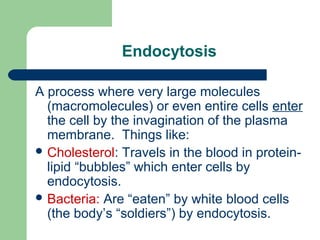
Endocytosis
A process where very large molecules
(macromolecules) or even entire cells enter
the cell by the invagination of the plasma
membrane. Things like:
 Cholesterol: Travels in the blood in protein-
lipid “bubbles” which enter cells by
endocytosis.
 Bacteria: Are “eaten” by white blood cells
(the body’s “soldiers”) by endocytosis.
Endocytosis
A process where very large molecules
(macromolecules) or even entire cells enter
the cell by the invagination of the plasma
membrane. Things like:
 Cholesterol: Travels in the blood in protein-
lipid “bubbles” which enter cells by
endocytosis.
 Bacteria: Are “eaten” by white blood cells
(the body’s “soldiers”) by endocytosis.

Cellular transport

  • 1.
    Cellular Transport An introduction HLBiology Cells & Biomolecules Mr Goodwin
  • 2.
    Passive transport  Themovement of molecules across the plasma membrane from an area of high concentration to an area of low concentration.  A process requiring no energy  Made up of three processes: – Diffusion – Facilitated Transport – Osmosis
  • 3.
    Diffusion  The movementof molecules from an area of high concentration to an area of low concentration  A natural process requiring no energy  Some molecules enter and leave cells through the plasma membrane by diffusion.  Such molecules are: 1. Small noncharged molecules like urea 2. Water 3. Gases like oxygen and carbon dioxide.
  • 4.
    Osmosis  The movementof water molecules across a semi- permeable membrane, from an area of high water concentration to an area of low water concentration  A natural process requiring no energy  An area of high water concentration has low solute concentration, while an area of low water concentration has high solute concentration  Solution tonicity (how relatively concentrated) 1. Isotonic: No water movement 2. Hypertonic: Water moves in. 3. Hypotonic: Water moves out
  • 5.
    Facilitated transport  Themovement of molecules from an area of high concentration to an area of low concentration  A natural process requiring no energy  Unlike diffusion, a carrier or channel protein is required.  Such molecules are: 1. Some sugars 2. Water 3. Some amino acids Note that these molecules are generally too big to simply diffuse on their own
  • 6.
    Active Transport  Themovement of molecules across the plasma membrane from an area of low concentration to an area of high concentration.  A process that requires energy  Made up of three processes: – Active transport – Endocytosis – Exocytosis
  • 7.
    Active Transport  Themovement of molecules from an area of low concentration to an area of high concentration. This is also known as going against the concentration gradient.  A process that requires energy  A protein carrier is also required.  Such molecules are: 1. Ions like Na+, K+ and Cl- 2. Some sugars 3. Some amino acids
  • 8.
    Exocytosis A process wherevery large molecules (macromolecules) leave the cell by the formation of vesicles from the plasma membrane. Molecules like:  Digestive enzymes: Ex, Produced in the pancreas and released in the small intestine.  Hormones: Ex, Insulin, produed in the pancreas, released into the blood to regulate sugar levels.
  • 9.
    Endocytosis A process wherevery large molecules (macromolecules) or even entire cells enter the cell by the invagination of the plasma membrane. Things like:  Cholesterol: Travels in the blood in protein- lipid “bubbles” which enter cells by endocytosis.  Bacteria: Are “eaten” by white blood cells (the body’s “soldiers”) by endocytosis.
  • 10.
    Endocytosis A process wherevery large molecules (macromolecules) or even entire cells enter the cell by the invagination of the plasma membrane. Things like:  Cholesterol: Travels in the blood in protein- lipid “bubbles” which enter cells by endocytosis.  Bacteria: Are “eaten” by white blood cells (the body’s “soldiers”) by endocytosis.