A materials system composed of two or more physically distinct
phases whose combination produces aggregate properties that
are different from those of its constituents
Generally, one material forms a continuous matrix while the
other provides the reinforcement
Examples:
Concrete reinforced with steel
Epoxy reinforced with graphite fibers.
Plastic molding compounds containing fillers
Rubber mixed with carbon black
Can you think of
any other
examples of where
composites are
used?
-The aerospace industry (structural components as well as
engines and motors)
-Automotive parts (panels, frames, dashboards, body repairs)
-Sinks, bathtubs, hot tubs, swimming pools
-Cement buildings, bridges
-Surfboards, snowboards, skis
-Golf clubs, fishing poles, hockey sticks
-Trees are technically composite materials, plywood
-Electrical boxes, circuit boards, contacts
-Everywhere
Classification
Nearly all composite materials consist of two phases:
Primary phase (matrix) - forms the matrix within which the
secondary phase is imbedded
Secondary phase (reinforcement) - imbedded phase
sometimes referred to as a reinforcing agent, because it
usually serves to strengthen the composite
The reinforcing phase may be in the form of fibers, particles, or
various other geometries
Protect phases from environment
Transfer stresses to phases
Holds the imbedded phase in place, usually enclosing and often
concealing it
When a load is applied, the matrix shares the load with the secondary
phase, in some cases deforming so that the stress is essentially born by
the reinforcing agent
Fiber materials in fiber-reinforced composites:
Glass – most widely used filament
Carbon – high elastic modulus
Boron – very high elastic modulus
Polymers - Kevlar
Ceramics – SiC and Al2O3
Metals - steel
The most important commercial use of fibers is in polymer
composites
Continuous fibers - very long; in theory, they offer a
continuous path by which a load can be carried by the
composite part
Discontinuous fibers (chopped sections of continuous
fibers) - short lengths (L/D = roughly 100)
Important type of discontinuous fiber are
whiskers - hair-like single crystals with diameters
down to about 0.001 mm (0.00004 in.) with very high
strength
A second common shape of imbedded phase is particulate,
ranging in size from microscopic to macroscopic
Flakes are basically two-dimensional particles - small flat
platelets
The distribution of particles in the composite matrix is random,
and therefore strength and other properties of the composite
material are usually isotropic
Strengthening mechanism depends on particle size
Traditional or natural composites – composite materials that
occur in nature or have been produced by civilizations for many
years
Examples: wood, concrete, asphalt.
Synthetic composites - modern material systems normally
associated with the manufacturing industries, in which the
components are first produced separately and then combined in
a controlled way to achieve the desired structure, properties,
and part geometry
Wood
Cellulose Fibers
Lignin Matrix
Bones
Collagen Fibers
Mineral Matrix
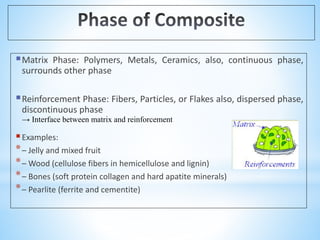
Matrix Phase: Polymers, Metals, Ceramics, also, continuous phase,
surrounds other phase
Reinforcement Phase: Fibers, Particles, or Flakes also, dispersed phase,
discontinuous phase
Examples:
*– Jelly and mixed fruit
*– Wood (cellulose fibers in hemicellulose and lignin)
*– Bones (soft protein collagen and hard apatite minerals)
*– Pearlite (ferrite and cementite)
→ Interface between matrix and reinforcement
In selecting a composite material, an optimum
combination of properties is usually sought, rather than
one particular property
Example: fuselage and wings of an aircraft must be
lightweight and be strong, stiff, and tough
-Several fiber-reinforced polymers possess this
combination of properties
Example: natural rubber alone is relatively weak
-Adding significant amounts of carbon black to NR
increases its strength dramatically
The materials used as component phases in the
composite
The geometric shapes of the constituents and resulting
structure of the composite system
The manner in which the phases interact with one
another
Most materials have tensile strengths several times greater as
fibers than in bulk
By imbedding the fibers in a polymer matrix, a composite
material is obtained that avoids the problems of fibers but
utilizes their strengths
The matrix provides the bulk shape to protect the fiber
surfaces and resist buckling
When a load is applied, the low-strength matrix deforms and
distributes the stress to the high-strength fibers
Laminar composite structure – conventional
Sandwich structure
Honeycomb sandwich structure
*Automotive tires - consists of multiple layers bonded together
*FRPs - multi-layered fiber-reinforced plastic panels for aircraft,
automobile body panels, boat hulls
*Printed circuit boards - layers of reinforced plastic and copper for
electrical conductivity and insulation
*Snow skis - composite structures consisting of layers of metals,
particle board, and phenolic plastic
*Windshield glass - two layers of glass on either side of a sheet of
tough plastic
Composites can be classified by their matrix material
which include:
-Metal matrix composites (MMC’s)
-Ceramic matrix composites (CMC’s)
-Polymer matrix composites (PMC’s)
A metal matrix reinforced by a second phase
The matrix is relatively soft and flexible.
The reinforcement must have high strength and stiffness
Since the load must be transferred from the matrix to the
reinforcement, the reinforcement-matrix bond must be
strong.
Reinforcing phases:
Particles of ceramic (these MMCs are commonly called
cermets)
Fibers of various materials: other metals, ceramics,
carbon, and boron
Common Metal Matrices:
-Metal martices include aluminum, magnesium, copper, nickel,
and intermetallic compound alloys
-MMCs are better at higher temperatures than PMCs although
production is much more difficult and expensive
-MMCs can have applications such as fan blades in engines, clutch
and brake linings, engine cylinder liners, etc.
-Dispersion strengthened alloys can be considered as composites because
there is little or no interaction between the two components and the
reinforcement is not soluble in the metal matrix.
-The dispersoids are usually 10-250 nm diameter oxide particles and are
introduced by physical means rather than chemical precipitation.
-They are located within the grains and at grain boundaries but are not
coherent with the matrix as in precipitation hardening
-The dispersed particles are sufficiently small in size to impede dislocation
movement and thus improve yield strength as well as stiffness.
-Dispersion strengthened alloys are somewhat weaker than precipitation
hardened alloys at room temperature but since overaging, tempering, grain
growth or particle coarsening do not occur on heating, they are stronger and
more creep resistant at high temperatures.
-SAPs have an aluminum matrix with aluminum oxide (Al2O3)
particulate
-The matrix can be strengthened by 14%
SAPs are produced using different methods, two examples are as
follows:
-Al and Al2O3 powders are blended then compacted at high
pressure then sintered like a ceramic.
-Al powder is heated in air to form a thick film of Al2O3 on each
particle, when the powder is compacted the Al2O3 film fractures
into tiny particles and becomes surrounded by the Al during
sintering.
 -Cemented carbides are an example of regular particulate MMC’s (as
opposed to dispersion strengthened MMC’s)
 -Carbides such as WC (tungsten-carbide) are used for cutting tool
inserts but this hard ceramic is very brittle so it cracks or chips under
impact loads, to remedy this cobalt is used as a matrix
 -Co-WC (cobalt tungsten-carbide) cermets are produced by pressing
Co and W powders into compacts, which are heated above the
melting point of Co
 -On cooling the carbide particles become embedded in the solidified
Co, which act as a tough matrix for the WC particles
 -In addition to its strength and toughness, Co is also selected because
it wets the carbide particles to give a strong bond
 -Cemented carbides are commonly used as inserts for cutting
tools
Figure (from left to right):
Cutting tool inserts, a
milling tool and a lathe tool
Photomicrograph (about 1500X) of cemented carbide with 85% WC and 15% Co
Tungsten carbide cermets (Co binder) - cutting tools are most
common; other: wire drawing dies, rock drilling bits and other
mining tools, dies for powder metallurgy, indenters for hardness
testers
Titanium carbide cermets (Ni binder) - high temperature
applications such as gas-turbine nozzle vanes, valve seats,
thermocouple protection tubes, torch tips, cutting tools for
steels
Chromium carbides cermets (Ni binder) - gage blocks, valve
liners, spray nozzles, bearing seal rings
A ceramic primary phase imbedded with a secondary
phase, which usually consists of fibers
Attractive properties of ceramics: high stiffness,
hardness, hot hardness, and compressive strength; and
relatively low density
Weaknesses of ceramics: low toughness and bulk
tensile strength, susceptibility to thermal cracking
CMCs represent an attempt to retain the desirable
properties of ceramics while compensating for their
weaknesses
*A polymer primary phase in which a secondary phase is
imbedded as fibers, particles, or flakes
*Examples: most plastic molding compounds, rubber
reinforced with carbon black, and fiber-reinforced
polymers (FRPs)
*FRPs are most closely identified with the term
composite
-There are two basic categories of polymer matrices:
-Thermoplastics
-Thermoset plastics
-Roughly 95% of the composite market uses thermosetting plastics
-Thermoseting plastics are polymerized in two ways:
-By adding a catalyst to the resin causing the resin to ‘cure’,
basically one must measure and mix two parts of the resin and
apply it before the resin cures
-By heating the resin to it’s cure temperature
Common thermosetting plastics:
-Phenolics: good electrical properties, often used in circuit board
applications
-Epoxies: low solvent emission (fumes) upon curing, low shrink
rate upon polymerization which produces a relatively residual
stress-free bond with the reinforcement, it is the matrix material
that produces the highest strength and stiffness, often used in
aerospace applications
-Polyester: most commonly used resin, slightly weaker than epoxy
but about half the price, produces emission when curing.
 -Fiber reinforced composites provide improved strength, fatigue
resistance, Young’s modulus and strength to weight ratio over
the constituent materials.
 -This is achieved by incorporating strong, stiff, yet brittle fibers
into a more ductile matrix.
 -Generally speaking the fiber supplies the strength and stiffness
while the matrix binds the fibers together and provides a means
of transferring the load between fibers
 -The matrix also provides protection for the fibers
Most widely used form of FRP is a laminar structure, made by
stacking and bonding thin layers of fiber and polymer until
desired thickness is obtained
By varying fiber orientation among layers, a specified level of
anisotropy (direction dependence of the physical properties) in
properties can be achieved in the laminate
Applications: parts of thin cross-section, such as aircraft wing
and fuselage sections, automobile and truck body panels, and
boat hulls
 -Many factors must be considered when designing a fiber-
reinforced composite including the length, diameter,
orientation, amount and properties of the constituents, and the
bonding between them.
 -The method used to produce the final product is also very
important as it dictates the type of properties just mentioned as
well as the quality of the product.
 Fiber length and diameter: Fiber dimensions are characterized
by their aspect ratio l/d where l is the fiber length and d is the
diameter.
 The strength improves when the aspect ratio is large.
 Typical fiber diameters are from 10 mm to 150 mm.
 Fibers often fracture because of surface imperfections. Making
the diameter small reduces its surface area, which has fewer
flaws.
 Long fibers are preferred because the ends of the fiber carry
less of the load. Thus the longer the fiber, the fewer the ends
and the higher the load carrying capacity of the fibers.
-As can be seen
from this plot, the
strength of the
composite increases
as the fiber length
increases (this is a
chopped E-glass-
epoxy composite)
-Maximum strength is obtained
when long fibers are oriented
parallel to the applied load
-The effect of fiber orientation
and strength can be seen in the
plot
-The properties of fiber
composites can be tailored
to meet different loading
requirements
-By using combinations of
different fiber orientation
quasi-isotropic materials
may be produced
Figure (a) shows a unidirectional arrangement
Figure (b) shows a quasi-isotropic arrangement
Some commonly used fibers for polymer matrix composites:
-Glass fibers
-Carbon fibers
-Aramid fibers
Some commonly used fibers for metal matrix composites:
-Boron fibers
-Carbon fibers
-Oxide ceramic and non-oxide ceramic fibers
-Due to the relatively inexpensive cost glass fibers are the most commonly used
reinforcement
-There are a variety of types of glass, they are all compounds of silica with a variety
of metallic oxides
-The most commonly used glass is E-glass, this is the most popular because of it’s
cost
Designation: Property or Characteristic:
E, electrical low electrical conductivity
S, strength high strength
C, chemical high chemical durability
M, modulus high stiffness
A, alkali high alkali or soda lime glass
D, dielectric low dielectric constant
 -Carbon fibers have gained a lot of popularity in the last two decades due to
the price reduction
 “Carbon fiber composites are five times stronger than 1020 steel yet five
times lighter. In comparison to 6061 aluminum, carbon fiber composites are
seven times stronger and two times stiffer yet still 1.5 times lighter”
 -Initially used exclusively by the aerospace industry they are becoming more
and more common in fields such as automotive, civil infrastructure, and
paper production
▪ -Aramid fibers are also becoming more and more common
▪ -They have the highest level of specific strength of all the
common fibers
▪ -They are commonly used when a degree of impact resistance is
required such as in ballistic armour
▪ -The most common type of aramid is Kevlar
 Filament: a single thread like fiber
 -Roving: a bundle of filaments wound to form a large strand
 -Chopped strand mat: assembled from chopped filaments
bound with a binder
 -Continuous filament random mat: assembled from continuous
filaments bound with a binder
 -Many varieties of woven fabrics: woven from rovings
Above Left: Roving
Above Right: Filaments
Right: Close up of a roving
Random mat and woven fabric
(glass fibers)
Carbon fiber woven fabric
*High strength-to-weight and modulus-to-weight ratios
*Low specific gravity - a typical FRP weighs only about 1/5 as
much as steel; yet, strength and modulus are comparable in fiber
direction
*Good fatigue strength
*Good corrosion resistance, although polymers are soluble in
various chemicals
*Low thermal expansion - for many FRPs, leading to good
dimensional stability
*Significant anisotropy in properties
*Aerospace – much of the structural weight of todays airplanes
and helicopters consist of advanced FRPs
*Automotive – somebody panels for cars and truck cabs
*Continued use of low-carbon sheet steel in cars is evidence of
its low cost and ease of processing
*Sports and recreation
*Fiberglass reinforced plastic has been used for boat hulls since
the 1940s
*Fishing rods, tennis rackets, golf club shafts, helmets, skis,
bows and arrows
In addition to FRPs, other PMCs contain particles, flakes, and
short fibers as the secondary phase
Called fillers when used in molding compounds
Two categories:
Reinforcing fillers – used to strengthen or otherwise improve
mechanical properties
Examples: wood flour in phenolic and amino resins; and
carbon black in rubber
Extenders – used to increase bulk and reduce cost per unit
weight, but little or no effect on mechanical properties
The two phases are typically produced separately
before being combined into the composite part
Processing techniques to fabricate MMC and CMC
components are similar to those used for powdered
metals and ceramics
Molding processes are commonly used for PMCs with
particles and chopped fibers
Specialized processes have been developed for FRPs
Composites can be very strong and stiff, yet very light in weight,
so ratios of strength-to-weight and stiffness-to-weight are
several times greater than steel or aluminum
Fatigue properties are generally better than for common
engineering metals
Toughness is often greater too
Composites can be designed that do not corrode like steel
Possible to achieve combinations of properties not attainable
with metals, ceramics, or polymers alone
Properties of many important composites are anisotropic - the
properties differ depending on the direction in which they are
measured – this may be an advantage or a disadvantage
Many of the polymer-based composites are subject to attack by
chemicals or solvents, just as the polymers themselves are
susceptible to attack
Composite materials are generally expensive
Manufacturing methods for shaping composite materials are
often slow and costly

Composits material. Engineering material and scinece.pptx

  • 2.
    A materials systemcomposed of two or more physically distinct phases whose combination produces aggregate properties that are different from those of its constituents Generally, one material forms a continuous matrix while the other provides the reinforcement Examples: Concrete reinforced with steel Epoxy reinforced with graphite fibers. Plastic molding compounds containing fillers Rubber mixed with carbon black
  • 3.
    Can you thinkof any other examples of where composites are used?
  • 4.
    -The aerospace industry(structural components as well as engines and motors) -Automotive parts (panels, frames, dashboards, body repairs) -Sinks, bathtubs, hot tubs, swimming pools -Cement buildings, bridges -Surfboards, snowboards, skis -Golf clubs, fishing poles, hockey sticks -Trees are technically composite materials, plywood -Electrical boxes, circuit boards, contacts -Everywhere
  • 6.
  • 7.
    Nearly all compositematerials consist of two phases: Primary phase (matrix) - forms the matrix within which the secondary phase is imbedded Secondary phase (reinforcement) - imbedded phase sometimes referred to as a reinforcing agent, because it usually serves to strengthen the composite The reinforcing phase may be in the form of fibers, particles, or various other geometries
  • 8.
    Protect phases fromenvironment Transfer stresses to phases Holds the imbedded phase in place, usually enclosing and often concealing it When a load is applied, the matrix shares the load with the secondary phase, in some cases deforming so that the stress is essentially born by the reinforcing agent
  • 9.
    Fiber materials infiber-reinforced composites: Glass – most widely used filament Carbon – high elastic modulus Boron – very high elastic modulus Polymers - Kevlar Ceramics – SiC and Al2O3 Metals - steel The most important commercial use of fibers is in polymer composites
  • 10.
    Continuous fibers -very long; in theory, they offer a continuous path by which a load can be carried by the composite part Discontinuous fibers (chopped sections of continuous fibers) - short lengths (L/D = roughly 100) Important type of discontinuous fiber are whiskers - hair-like single crystals with diameters down to about 0.001 mm (0.00004 in.) with very high strength
  • 11.
    A second commonshape of imbedded phase is particulate, ranging in size from microscopic to macroscopic Flakes are basically two-dimensional particles - small flat platelets The distribution of particles in the composite matrix is random, and therefore strength and other properties of the composite material are usually isotropic Strengthening mechanism depends on particle size
  • 12.
    Traditional or naturalcomposites – composite materials that occur in nature or have been produced by civilizations for many years Examples: wood, concrete, asphalt. Synthetic composites - modern material systems normally associated with the manufacturing industries, in which the components are first produced separately and then combined in a controlled way to achieve the desired structure, properties, and part geometry
  • 13.
  • 14.
    Matrix Phase: Polymers,Metals, Ceramics, also, continuous phase, surrounds other phase Reinforcement Phase: Fibers, Particles, or Flakes also, dispersed phase, discontinuous phase Examples: *– Jelly and mixed fruit *– Wood (cellulose fibers in hemicellulose and lignin) *– Bones (soft protein collagen and hard apatite minerals) *– Pearlite (ferrite and cementite) → Interface between matrix and reinforcement
  • 15.
    In selecting acomposite material, an optimum combination of properties is usually sought, rather than one particular property Example: fuselage and wings of an aircraft must be lightweight and be strong, stiff, and tough -Several fiber-reinforced polymers possess this combination of properties Example: natural rubber alone is relatively weak -Adding significant amounts of carbon black to NR increases its strength dramatically
  • 16.
    The materials usedas component phases in the composite The geometric shapes of the constituents and resulting structure of the composite system The manner in which the phases interact with one another
  • 17.
    Most materials havetensile strengths several times greater as fibers than in bulk By imbedding the fibers in a polymer matrix, a composite material is obtained that avoids the problems of fibers but utilizes their strengths The matrix provides the bulk shape to protect the fiber surfaces and resist buckling When a load is applied, the low-strength matrix deforms and distributes the stress to the high-strength fibers
  • 18.
    Laminar composite structure– conventional Sandwich structure Honeycomb sandwich structure
  • 19.
    *Automotive tires -consists of multiple layers bonded together *FRPs - multi-layered fiber-reinforced plastic panels for aircraft, automobile body panels, boat hulls *Printed circuit boards - layers of reinforced plastic and copper for electrical conductivity and insulation *Snow skis - composite structures consisting of layers of metals, particle board, and phenolic plastic *Windshield glass - two layers of glass on either side of a sheet of tough plastic
  • 20.
    Composites can beclassified by their matrix material which include: -Metal matrix composites (MMC’s) -Ceramic matrix composites (CMC’s) -Polymer matrix composites (PMC’s)
  • 21.
    A metal matrixreinforced by a second phase The matrix is relatively soft and flexible. The reinforcement must have high strength and stiffness Since the load must be transferred from the matrix to the reinforcement, the reinforcement-matrix bond must be strong. Reinforcing phases: Particles of ceramic (these MMCs are commonly called cermets) Fibers of various materials: other metals, ceramics, carbon, and boron
  • 22.
    Common Metal Matrices: -Metalmartices include aluminum, magnesium, copper, nickel, and intermetallic compound alloys -MMCs are better at higher temperatures than PMCs although production is much more difficult and expensive -MMCs can have applications such as fan blades in engines, clutch and brake linings, engine cylinder liners, etc.
  • 23.
    -Dispersion strengthened alloyscan be considered as composites because there is little or no interaction between the two components and the reinforcement is not soluble in the metal matrix. -The dispersoids are usually 10-250 nm diameter oxide particles and are introduced by physical means rather than chemical precipitation. -They are located within the grains and at grain boundaries but are not coherent with the matrix as in precipitation hardening -The dispersed particles are sufficiently small in size to impede dislocation movement and thus improve yield strength as well as stiffness. -Dispersion strengthened alloys are somewhat weaker than precipitation hardened alloys at room temperature but since overaging, tempering, grain growth or particle coarsening do not occur on heating, they are stronger and more creep resistant at high temperatures.
  • 24.
    -SAPs have analuminum matrix with aluminum oxide (Al2O3) particulate -The matrix can be strengthened by 14% SAPs are produced using different methods, two examples are as follows: -Al and Al2O3 powders are blended then compacted at high pressure then sintered like a ceramic. -Al powder is heated in air to form a thick film of Al2O3 on each particle, when the powder is compacted the Al2O3 film fractures into tiny particles and becomes surrounded by the Al during sintering.
  • 25.
     -Cemented carbidesare an example of regular particulate MMC’s (as opposed to dispersion strengthened MMC’s)  -Carbides such as WC (tungsten-carbide) are used for cutting tool inserts but this hard ceramic is very brittle so it cracks or chips under impact loads, to remedy this cobalt is used as a matrix  -Co-WC (cobalt tungsten-carbide) cermets are produced by pressing Co and W powders into compacts, which are heated above the melting point of Co  -On cooling the carbide particles become embedded in the solidified Co, which act as a tough matrix for the WC particles  -In addition to its strength and toughness, Co is also selected because it wets the carbide particles to give a strong bond
  • 26.
     -Cemented carbidesare commonly used as inserts for cutting tools Figure (from left to right): Cutting tool inserts, a milling tool and a lathe tool
  • 27.
    Photomicrograph (about 1500X)of cemented carbide with 85% WC and 15% Co
  • 28.
    Tungsten carbide cermets(Co binder) - cutting tools are most common; other: wire drawing dies, rock drilling bits and other mining tools, dies for powder metallurgy, indenters for hardness testers Titanium carbide cermets (Ni binder) - high temperature applications such as gas-turbine nozzle vanes, valve seats, thermocouple protection tubes, torch tips, cutting tools for steels Chromium carbides cermets (Ni binder) - gage blocks, valve liners, spray nozzles, bearing seal rings
  • 29.
    A ceramic primaryphase imbedded with a secondary phase, which usually consists of fibers Attractive properties of ceramics: high stiffness, hardness, hot hardness, and compressive strength; and relatively low density Weaknesses of ceramics: low toughness and bulk tensile strength, susceptibility to thermal cracking CMCs represent an attempt to retain the desirable properties of ceramics while compensating for their weaknesses
  • 30.
    *A polymer primaryphase in which a secondary phase is imbedded as fibers, particles, or flakes *Examples: most plastic molding compounds, rubber reinforced with carbon black, and fiber-reinforced polymers (FRPs) *FRPs are most closely identified with the term composite
  • 31.
    -There are twobasic categories of polymer matrices: -Thermoplastics -Thermoset plastics -Roughly 95% of the composite market uses thermosetting plastics -Thermoseting plastics are polymerized in two ways: -By adding a catalyst to the resin causing the resin to ‘cure’, basically one must measure and mix two parts of the resin and apply it before the resin cures -By heating the resin to it’s cure temperature
  • 32.
    Common thermosetting plastics: -Phenolics:good electrical properties, often used in circuit board applications -Epoxies: low solvent emission (fumes) upon curing, low shrink rate upon polymerization which produces a relatively residual stress-free bond with the reinforcement, it is the matrix material that produces the highest strength and stiffness, often used in aerospace applications -Polyester: most commonly used resin, slightly weaker than epoxy but about half the price, produces emission when curing.
  • 33.
     -Fiber reinforcedcomposites provide improved strength, fatigue resistance, Young’s modulus and strength to weight ratio over the constituent materials.  -This is achieved by incorporating strong, stiff, yet brittle fibers into a more ductile matrix.  -Generally speaking the fiber supplies the strength and stiffness while the matrix binds the fibers together and provides a means of transferring the load between fibers  -The matrix also provides protection for the fibers
  • 34.
    Most widely usedform of FRP is a laminar structure, made by stacking and bonding thin layers of fiber and polymer until desired thickness is obtained By varying fiber orientation among layers, a specified level of anisotropy (direction dependence of the physical properties) in properties can be achieved in the laminate Applications: parts of thin cross-section, such as aircraft wing and fuselage sections, automobile and truck body panels, and boat hulls
  • 35.
     -Many factorsmust be considered when designing a fiber- reinforced composite including the length, diameter, orientation, amount and properties of the constituents, and the bonding between them.  -The method used to produce the final product is also very important as it dictates the type of properties just mentioned as well as the quality of the product.
  • 36.
     Fiber lengthand diameter: Fiber dimensions are characterized by their aspect ratio l/d where l is the fiber length and d is the diameter.  The strength improves when the aspect ratio is large.  Typical fiber diameters are from 10 mm to 150 mm.  Fibers often fracture because of surface imperfections. Making the diameter small reduces its surface area, which has fewer flaws.  Long fibers are preferred because the ends of the fiber carry less of the load. Thus the longer the fiber, the fewer the ends and the higher the load carrying capacity of the fibers.
  • 37.
    -As can beseen from this plot, the strength of the composite increases as the fiber length increases (this is a chopped E-glass- epoxy composite)
  • 38.
    -Maximum strength isobtained when long fibers are oriented parallel to the applied load -The effect of fiber orientation and strength can be seen in the plot
  • 39.
    -The properties offiber composites can be tailored to meet different loading requirements -By using combinations of different fiber orientation quasi-isotropic materials may be produced Figure (a) shows a unidirectional arrangement Figure (b) shows a quasi-isotropic arrangement
  • 40.
    Some commonly usedfibers for polymer matrix composites: -Glass fibers -Carbon fibers -Aramid fibers Some commonly used fibers for metal matrix composites: -Boron fibers -Carbon fibers -Oxide ceramic and non-oxide ceramic fibers
  • 41.
    -Due to therelatively inexpensive cost glass fibers are the most commonly used reinforcement -There are a variety of types of glass, they are all compounds of silica with a variety of metallic oxides -The most commonly used glass is E-glass, this is the most popular because of it’s cost Designation: Property or Characteristic: E, electrical low electrical conductivity S, strength high strength C, chemical high chemical durability M, modulus high stiffness A, alkali high alkali or soda lime glass D, dielectric low dielectric constant
  • 42.
     -Carbon fibershave gained a lot of popularity in the last two decades due to the price reduction  “Carbon fiber composites are five times stronger than 1020 steel yet five times lighter. In comparison to 6061 aluminum, carbon fiber composites are seven times stronger and two times stiffer yet still 1.5 times lighter”  -Initially used exclusively by the aerospace industry they are becoming more and more common in fields such as automotive, civil infrastructure, and paper production
  • 43.
    ▪ -Aramid fibersare also becoming more and more common ▪ -They have the highest level of specific strength of all the common fibers ▪ -They are commonly used when a degree of impact resistance is required such as in ballistic armour ▪ -The most common type of aramid is Kevlar
  • 45.
     Filament: asingle thread like fiber  -Roving: a bundle of filaments wound to form a large strand  -Chopped strand mat: assembled from chopped filaments bound with a binder  -Continuous filament random mat: assembled from continuous filaments bound with a binder  -Many varieties of woven fabrics: woven from rovings
  • 46.
    Above Left: Roving AboveRight: Filaments Right: Close up of a roving
  • 47.
    Random mat andwoven fabric (glass fibers)
  • 48.
  • 49.
    *High strength-to-weight andmodulus-to-weight ratios *Low specific gravity - a typical FRP weighs only about 1/5 as much as steel; yet, strength and modulus are comparable in fiber direction *Good fatigue strength *Good corrosion resistance, although polymers are soluble in various chemicals *Low thermal expansion - for many FRPs, leading to good dimensional stability *Significant anisotropy in properties
  • 50.
    *Aerospace – muchof the structural weight of todays airplanes and helicopters consist of advanced FRPs *Automotive – somebody panels for cars and truck cabs *Continued use of low-carbon sheet steel in cars is evidence of its low cost and ease of processing *Sports and recreation *Fiberglass reinforced plastic has been used for boat hulls since the 1940s *Fishing rods, tennis rackets, golf club shafts, helmets, skis, bows and arrows
  • 51.
    In addition toFRPs, other PMCs contain particles, flakes, and short fibers as the secondary phase Called fillers when used in molding compounds Two categories: Reinforcing fillers – used to strengthen or otherwise improve mechanical properties Examples: wood flour in phenolic and amino resins; and carbon black in rubber Extenders – used to increase bulk and reduce cost per unit weight, but little or no effect on mechanical properties
  • 52.
    The two phasesare typically produced separately before being combined into the composite part Processing techniques to fabricate MMC and CMC components are similar to those used for powdered metals and ceramics Molding processes are commonly used for PMCs with particles and chopped fibers Specialized processes have been developed for FRPs
  • 53.
    Composites can bevery strong and stiff, yet very light in weight, so ratios of strength-to-weight and stiffness-to-weight are several times greater than steel or aluminum Fatigue properties are generally better than for common engineering metals Toughness is often greater too Composites can be designed that do not corrode like steel Possible to achieve combinations of properties not attainable with metals, ceramics, or polymers alone
  • 54.
    Properties of manyimportant composites are anisotropic - the properties differ depending on the direction in which they are measured – this may be an advantage or a disadvantage Many of the polymer-based composites are subject to attack by chemicals or solvents, just as the polymers themselves are susceptible to attack Composite materials are generally expensive Manufacturing methods for shaping composite materials are often slow and costly

Editor's Notes

  • #40  "Quasi-isotropic" refers to a material or structure that exhibits isotropic-like properties in multiple directions, though it may not be perfectly isotropic. Isotropic materials have uniform properties in all directions, meaning their mechanical and thermal properties are the same regardless of the direction in which they are measured.