From First Principles
PART II – MODERN PHYSICS
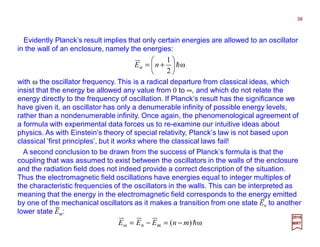
May 2017 – R2.1
Maurice R. TREMBLAY
http://atlas.ch
Candidate Higgs
Decay to four
muons recorded by
ATLAS in 2012.
Chapter 3
Contents
PART II – MODERN PHYSICS
Charge and Current Densities
Electromagnetic Induction
Electromagnetic Potentials
Gauge Invariance
Maxwell’s Equations
Foundations of Special Relativity
Tensors of Rank One
4D Formulation of Electromagnetism
Plane Wave Solutions of the Wave
Equation
Special Relativity and
Electromagnetism
The Special Lorentz Transformations
Relativistic Kinematics
Tensors in General
The Metric Tensor
The Problem of Radiation in
Enclosures
Thermodynamic Considerations
2017
MRT
The Wien Displacement Law
The Rayleigh-Jeans Law
Planck’s Resolution of the Problem
Photons and Electrons
Scattering Problems
The Rutherford Cross-Section
Bohr’s Model
Fundamental Properties of Waves
The Hypothesis of de Broglie and Einstein
Appendix: The General Theory of
Relativity
References
2
The second of the major revolutions in modern physics arose from the attempt to
analyze, on the basis of classical theory, the thermodynamic properties of electromag-
netic radiation confined to the isothermal enclosure (i.e., isothermal being a process that
takes place at constant temperature). Profound discrepancies between predictions
based upon fundamental classical law on the one hand, and experimental observations
of the other, induced Max Planck to put forward a remarkable hypothesis which
effectively resolved the difficulty. This hypothesis became the cornerstone of a whole
new interpretation of basic physical phenomena; the interpretation is known as quantum
theory, or quantum mechanics, which is the subject of PART III – QUANTUM
MECHANICS.
3
2017
MRT
Here we shall analyze the radiation contained in an isothermal cavity, with a view
toward finding the temperature dependence of the energy density of components of the
radiation with different frequencies. This dependence can be checked by experiments,
and therefore the analysis provides a valuable experimental check on the classical
theory of electromagnetic radiation.
An important property of radiation within an isothermal enclosure is that the radiation
is isotropic everywhere within the enclosure (i.e., there is just as much electromagnetic
radiative momentum being carried in one direction as in any other direction). Since the
pressure on the walls of the enclosure is just the momentum per unit area delivered by
the radiation per unit time, the isotropicity of radiation means that the radiation
pressure on the walls must be uniform.
The Problem of Radiation in Enclosures
Consider a train of waves moving in the direction k/|k|, and let them be incident on a
small element of area, ∆S, of the enclosure wall. Now generate a cylinder with sides
parallel to k/|k| and having base ∆S (see Figure); the slant height of the cylinder is ∆l,
and it has volume ∆V=∆S•∆llll, where ∆S=n∆S, n being the normal to the surface ∆S,
and ∆llll=∆l(k/|k|). Then the amount of radiative momentum carried by the waves we are
considering in this cylinder is (momentum density is P =(1/c)(k/|k|)E given P=∆P/∆V):
4
2017
MRT
k
S
c
S
c
S
cc
V
c
k
kk
k
kn
k
k
kn
k
k
S
k
k
P θcos
ˆˆˆ
)( 22
llll
r
∆∆=
•
∆∆=
•
∆∆=∆•∆=∆=∆
EEEEE
where k=|k| and cosθ =n•k with k= k/|k|, and all of it is delivered to the element of area
∆S in time ∆t=∆l/c.
ˆ ˆ
ˆ ˆ ˆ
Cylinder generated by a plane surface of area ∆S being displaced along k =k/|k| at an angle θ from the
normal to the surface.
ˆ
∆l
∆S x
y
z
nˆ k = k/|k|ˆθ
If ∆S is an element of area on a perfectly smooth, reflecting wall, the change in
momentum for radiation moving in direction k during time ∆t=∆l/c is:
5
2017
MRT
where θ and ϕ are the polar angles of k/k as measured in terms of a z-axis along n and
x- and y-axes in the plane of ∆S.
θ2
2
2
cos2
)ˆ(
2ˆ2 ll ∆∆=∆∆
•
=ƥ SS
ck
E
Ekn
Pn
because only the normal component of momentum suffers a change, and the direction
of that component is reversed, so that the change in the normal component is twice the
normal component. Thus the force on ∆S arising from radiation moving along k/k is:
nn
Pn
F ˆcos2ˆ
ˆ2 2
θS
t
∆=
∆
ƥ
= E
and the resulting pressure is:
θϕθ 2
ˆ cos2
ˆ
),( E=
∆
•
=Π=Π
S
Fn
k
ˆ
To find the total pressure, we must add together the pressures coming from all
possible directions on one side of the surface ∆S. The quantity Πk is actually the
pressure arising from waves traveling along direction k≡k/k and coming from a small
element of solid angle, dΩ, on a hemisphere covered by ∆S (see Figure). We must add
together the pressures arising from waves that come from all such elements of solid
angle. Since, from solid analytic geometry and calculus, we know that an element of
solid angle is given by dΩ=sinθ dθ dϕ, where θ is the polar angle and ϕ is the azimuthal
angle, we find that the total pressure is:
6
2017
MRT
E
EE
E
3
π4
π4sincosπ4
sin)cos2(
1
0
2
2π
0
2
π2
0
2π
0
2
ˆ
=
==
=ΩΠ=Π
∫∫
∫ ∫∫
xdxd
ddd
θθθ
θθθϕ
Hemisphere k
Radiation arising from solid angle dΩ strikes the surface ∆S at an angle θ from the normal n.
∆S x
y
z
nˆ
kθ
dΩ
ϕ
ˆ
ˆ
ˆ
The energy density in the same hemisphere is the sum of the energy densities arising
from all waves moving along k/k and from all waves moving against k/k (i.e., along −k/k),
and these must be summed over all directions k/k for the hemisphere. Since the
radiation is isotropic, E is independent of θ and ϕ, and we get:
7
2017
MRT
as the energy of all the radiation contributing to the pressure Π; more generally, Ψ is
simply the energy density at any interior point of the enclosure since the latter is given
by:
EEE π4sin22
π2
0
2π
0
==Ω=Ψ ∫ ∫∫ θθϕ ddd
Hemisphere
EE π4=Ω∫Sphere
d
The equation for Π and Ψ above together tell us that the pressure on the walls of the
enclosure is just one-third the energy density within the enclosure:
Ψ=Π
3
1
Now we may calculate also the flux of energy at the surface of the isothermal
enclosure (i.e., we may find the energy brought up to a surface element of area ∆S in
time interval ∆t). This energy is just:
8
2017
MRT
tScddtcSd
k
VU ∆∆=∆∆=Ω∆=∆ ∫ ∫∫ EEE πsincos)(
π2
0
2π
0
θθθϕ
Hemisphere
k
where by ∆V(k/k) we mean the volume of a cylinder with base ∆s and sides having
length c∆t parallel to k/k (i.e., ∆V(k/k) is the volume swept out by the waves passing
through ∆S in direction k/k during time interval ∆t). Thus the desired energy flux is:
Ψ==
∆∆
∆
=Φ
4
π
c
c
tS
U
E
It can be shown that a perfectly reflecting enclosure is thermodynamically equivalent to a
totally absorbing body, or black body. Hence the emissive power, or radiant emittance of
a block body is the same as that for an enclosure such as the one we are analyzing. For
such systems, the emissive power e is equal to the absorptive power, a; e and a
represent the energy flux given off, and absorbed, respectively, by the system. A black
body, by definition, would absorb all the radiation brought up to its surface in a unit of
time, and would re-emit exactly the same amount of radiative energy in a unit time.
Hence the energy emitted (or absorbed) per unit area per unit time is given by Ψ above:
9
2017
MRT
Ψ=
4
c
e
where e is the radiative emittance of a black body having exactly the same temperature
as our isothermal enclosure.
Thermodynamic Considerations
Now the confined radiation is a thermodynamic system in that it can be described in
terms of the thermodynamic variables Π, V, and T (i.e., pressure, volume, and absolute
temperature). Therefore, we may utilize the well-known energy equation of
thermodynamics:
10
2017
MRT
Π−





∂
Π∂
=





∂
∂
VT
T
T
V
U
where U is the internal energy of the system, U=ΠV, and the subscripts on partial
derivatives mean that the variable represented by the subscript is held constant when
the derivative is calculated. We have found that Π=⅓Ψ, the energy density Ψ on the
right-hand side being independent of volume; hence:
Td
d
TTV
U
VVT
Ψ
=





∂
Ψ∂
=





∂
Π∂
Ψ=





∂
∂
3
1
3
1
and
Substitution of these into the above equation yields:
Ψ−
Ψ
=Ψ
3
1
3 Td
dT
or:
Ψ
Ψ
=
d
T
Td
4
Integration of this last equation gives us:
11
2017
MRT
4
Tb=Ψ
where b is a constant. Insertion of this last result into e=(c/4)Ψ above then yields the
temperature dependence of the emissive power for a black body as:
4
4
T
cb
e =
Usually the constant bc/4 is designated σ and is called the Stephan-Boltzmann constant,
so that:
4
Te σ=
where the experimentally determined numerical value of the constant is:
43411
KskgorKcmsecerg −−−−−−−
××= 105.67010670.5 85
σ
This law relating e and T was discovered experimentally by Stephan is 1879, and the
thermodynamic analysis was carried out later by Boltzmann; it is known as the Stephan-
Boltzmann law.
Now we may use the first law of thermodynamics to obtain a relationship between
temperature and volume. The differential form for the first law of thermodynamics is:
12
2017
MRT
UdUdQd +=
where dQ is the heat gained by a thermodynamic system, dU is the increase in internal
energy, and dW is the amount of work done by the system. We assume that our cavity
full of radiation is an isolated system and that no exchange of heat between it and the
remainder of the universe is possible. Therefore we take dQ=0; the processes we may
consider are adiabatic processes (i.e., without transfer of heat between a thermodyna-
mic system and its surroundings; energy is transferred only as work). Also, the internal
energy of the system is U=ΠV, and the work done by the system must be dW =ΠdV,
where dV is the change in volume that occurs as the process is carried out. Therefore
we have:
VdVdVdVd )()(0 Π+Ψ+Ψ=Π+Ψ=
or using Π=⅓Ψ in this equation:
V
Vdd
3
4
−=
Ψ
Ψ
The solutions to this equation have the form:
34
22
34
11
34
)constant( VVV Ψ=Ψ=Ψ −
or
where Ψ1 is the energy density of the system when the volume is V1, and Ψ2 is the
energy density of the system when the volume has become V2.
Our earlier results can be used to convert this last equation (i.e., Ψ1V1
4/3=Ψ2V2
4/3) to
several different forms. For example if we write Ψ=bT 4 as:
13
2017
MRT
4
2
2
4
1
1
TT
Ψ
=
Ψ
and use this in Π=⅓Ψ, we have:
431
22
431
11 )()( VTVT =
or since both T and V are real, positive quantities:
31
22
31
11 VTVT =
the temperature is proportional to the inverse of the cube root of the volume. Another
useful expression of Ψ1V1
4/3=Ψ2V2
4/3 is obtained by using U=ΠV, so that:
31
22
31
11 VUVU =
the internal energy also is proportional to the inverse of the cube root of the volume. The
Ψ1/T1=Ψ2/T2 and U1V1
1/3 =U2V2
1/3 equations above taken together yield:
2
1
2
1
T
T
U
U
=
which pretty much says that the internal energy is proportional to the temperature! Duh!
The energy contained within the enclosure is contributed by many components with
different wave numbers; thus, if Ψk is the energy density of all waves having wave
number k (i.e., k=2π/λ) then Ψ=ΣkΨk. But, if k is allowed to take on all possible real
values (which, according to km =(π/Lm)nm for nm =0,1,2,… and m=1,2,3, is possible only if
L1,L2,L3 →∞), then the Ψ=ΣkΨk sum is not appropriate, and instead we must write:
14
2017
MRT
∫
∞
=Ψ
0
)( kdkI
where I(k) is the energy density, per unit wave number, of waves having wave numbers
between k and k+dk; that is, if we define:
)()()(
0
∞Ψ=Ψ=Ψ ∫ and
k
kdkIk
then it follows that:
kd
kd
k
)(
)(
Ψ
=ψ
In any case, if the cavity is large, Ψ(k)= ∫0 to k I(k)dk can be used as a good
approximation.
The Wien Displacement Law
Similarly, let us write the spectral decomposition of the emissive power as:
15
2017
MRT
Then, according to e=(c/4)Ψ:
∫
∞
=
0
)( kdke ε
0)()(
44 0
=





−=−Ψ ∫
∞
kdkkI
c
e
c
ε
This suggests that:
)(
4
)( kI
c
k =ε
though it does not prove that the relationship of e=(c/4)Ψ can be extended to spectral
components but for the purpose of our exposé we shall accept it without further
elaboration.
Now let us consider the temperature dependence of I(k). In order to do this, we must
recall λ = 2L/√(n1
2 +n2
2+n3
2), which can be rewritten as:
16
2017
MRT
31
22
31
11 VkVk =
since k=2π/λ. Using T1V1
1/3 =T2V2
1/3 in this equation, we have the result:
2
1
2
1
T
T
k
k
=
This result holds for the spectral components k1 +dk1 and k2 +dk2; thus:
2
2
2
1
2
1
2
2
2
1
2
1
22
11
2
1
2
1
11
k
kd
k
kd
T
T
k
kd
k
kd
k
k
kdk
kdk
T
T
k
k
+
+
=
+
+
=
+
+
==
or:
2
1
2
1
2
2
2
1
1
k
kd
T
T
k
kd
T
T
+=





+
and hence:
2
2
1
1 kd
T
T
kd =
This allows us to utilize the relation Ψ1/Ψ2=T1
4/T2
4 in finding the temperature
dependence of I(k), for we have:
17
2017
MRT
4
2
1
222
111
2
1
)(
)(






==
Ψ
Ψ
∫
∫
T
T
kdkI
kdkI
which, if we use dk1 =(T1/T2)dk2 above, becomes:
0
)()(
0
)()(
23
2
22
3
1
11
24
2
22
2
1
4
1
11
=








−=








− ∫∫ kd
T
kI
T
kI
kd
T
kI
T
T
T
kI
or
By the same kind of plausibility argument that let to ε (k) = (c/4)I(k) above, then, we get:
So, I(k) is proportional to the cube of the temperature. If follows from ε (k) = (c/4)I(k),
then, that:
3
2
1
22
11
)(
)(






=
T
T
kI
kI
3
2
2
3
1
1 )()(
T
k
T
k εε
=
also. This is the form of the result that is most valuable to the experimenter because
the emissivity per unit wave number, ε (k), is an experimentally observable quantity,
as is T.
Wilhelm Wien (1864-1928) observed that, because of k1/k2 =T1/T2, our last equation
could be written in the form:
18
2017
MRT






==
T
k
g
T
k
T
k
3
2
2
3
1
1 )()( εε
where g(k/T) does not depend independently on either k or T, but rather depends upon
the ratio k/T. Wien’s guess for g(k/T) was that is should have the form:
3
e 





=




 −
T
k
a
T
k
g Tk β
where a and β are constants. From this, Wien’s law:
33
3
e
4
e
4
)(
4
)( k
c
a
T
T
k
c
a
k
c
kI TkTk ββ
ε −−
=





==
follows. This formula has been found to fit experimental data well at high frequencies
(small wavelengths), but it fails for low frequencies (high wavelengths), namely for k<3×
104 cm−1. Rayleigh and Jeans found another form for g(k/T) that works well at very low
frequencies, but that fails badly at high frequencies, say k>2.5×103 cm−1. No theory
based upon classical physics has been found, that will fit experimental data in the region
of frequencies between where the Wien law and the Rayleigh-Jeans law fit the data
adequately.
∼
∼
Because it serves as an introduction to methods we shall use later, and because it
completes the classical picture of radiation in a cavity, the Rayleigh-Jeans analysis
deserves our consideration.
19
2017
MRT
∑∑∑∑ ∂∂===
kkk
k kkk
λ
λ
λ
)()(
µ
)( 0
0
o
0
0 AA
V
VTUU
A well-known result from classical statistical mechanics is that each independent
dynamical coordinate that appears quadratically in the expression for the energy of the
system, contributes a mean energy of ½kBT to the system, kB being Boltzmann’s
constant. Since for the electromagnetic field we have:
where the sum is extended over all values of the wave vector k. It is clear that the
‘coordinate’ ∂0Aλ(k) appears quadratically in the energy. Hence it would seem
reasonable to associate with each of the ∂0Aλ(k) a mean energy of ½kBT. However, we
can impose the constraints:
00 0
==• AandAk
in some frame of reference, thanks to the freedom allowed us by gauge transformations
of the second kind. Therefore only two of the four components of ∂0Aλ(k) are indepen-
dent, so that the mean energy contributed by a wave with wave vector k might be
expected to be 2⋅½kBT =kBT.
But this argument is incorrect since we have used the rules for assigning mean
energies to mechanical oscillators, when we are not in fact dealing with mechanical
oscillators.
The Rayleigh-Jeans Law
To correct this, we assume that the walls of the container consist of mechanical oscilla-
tors (recall that in classical mechanics, a harmonic oscillator is a system that, when dis-
placed from its equilibrium position, experiences a restoring force, F, proportional to the
displacement, x, F=−kx, where k is a positive constant, and the potential energy stored
in a simple harmonic oscillator at position x is U=½kx2, and an object attached to a
spring will oscillate such that an ideal massless spring with no damping has a simple
and harmonic motion with an angular frequency given by ω=√(k/m), where k is the
spring constant, m is the mass of the object, and ω – or ωo – is referred to as the natural
frequency), and that each mode of vibration in the walls is responsible for a mode of
oscillation in the radiation field. The energy of each oscillator in the walls is given by:
20
2017
MRT
2
2
2
2
ω
2
1
j
jj
j
j
j x
m
p
m
W +=
where mj is the mass of the j-th oscillator, ωj is its frequency, and pj and xj are,
respectively, the momentum and position coordinates in the direction of the oscillation.
Thus the mean energy of each mode of oscillation is 2⋅½kBT, since two quadratic
coordinates, pj and xj, are involved. Our error was to assign ½kBT to each quadratic
variable of the electromagnetic field rather than to assign kBT to each independent mode
of oscillation. This illustrates the care that must be taken in applying the principle of
equipartition of energy!
Therefore we assign to each wave vector k a mean energy of 2kBT. This corres-
ponds to assigning kBT to each of the two polarizations of an electromagnetic wave.
Now we somehow must count the number of values of k that lie within the increment
∆k of wave numbers between k and k+∆k. Then if this number is ∆N=N(k)∆k, we shall
have the following amount of energy stored in waves having wave numbers between k
and k+∆k:
21
2017
MRT
kkNTkNTkkkIVkku BB ∆=∆=∆=∆ )(22)()(
where u(k) is the energy per unit wave number between k and k+∆k. That is:
)(
2
)( kN
V
Tk
kI B
=
The equation km =(π/Lm)nm (nm =0,1,2,… and m=1,2,3) provides us with a basis for
finding N(k); it says that the allowed values of k are those for which the components km
are integer multiples of π/Lm. We must find out how many such allowed wave vectors
correspond to wave numbers between k and k+∆k. To do this, we construct a wave-
vector space, or k-space, with orthogonal coordinates corresponding to k1, k2, and k3.
Then to each triple of integers (n1,n2,n3), there corresponds a point in this k-space,
namely (k1,k2,k3)=(n1π/L1,n2π/L2,n3π/L3). Each such point lies at the tip of an allowed k-
vector, and each serves as a corner for eight rectangular parallelepipeds having edges
π/L1, π/L2, and π/L3. This is shown in the Figure.
22
2017
MRTPoints in k-space corresponding to allowed values of k. Each such point is a vertex of a rectangular
parallelepiped of ‘cell’.
k1
k2
k3
1π L
2π L
3π L
Although each point is a corner for eight different parallelepipeds, each parallelepiped
has eight such corners; thus we may assign each point unambiguously to one
parallelepiped. Hence there are as many allowed k-vectors per unit volume of k-space
as there are parallelepipeds per unit volume of k-space, namely:
23
2017
MRT
33
321
ππ
1 VLLL
Vk
==
where Vk =(π/L1)(π/L2)(π/L3) is the k-volume of one parallelepiped, and V=L1L2L3 is the
volume of the enclosure. The density of allowed wave vectors per unit volume of k-
space, η, then, is:
3
π
V
=η
If k is a sufficiently large number, we can say that there are:
24
2017
MRT
3
3
3
π3
π4
3
π4
k
V
kN ==′ η
points within a sphere having radius k in k-space. Hence, within a spherical shell of
thickness ∆k there are:
kk
V
N ∆=′∆ 2
3
π4
points. Only 1/8 of these points corresponds to allowed wave numbers, however,
because only positive values of ni are required to give all possible solutions to the wave
equations for radiation in the enclosure; therefore:
kkNkk
V
NN ∆=∆=′∆=∆ )(
π28
1 2
2
or:
2
2
π2
)( k
V
kN =
Using N(k)=(V/2π2)k2 in I(k)=(2kBT/V )N(k) above, we find that the energy density per
unit wave number is given by:
25
2017
MRT
3
2
2
2
2
ππ
)( T
T
kk
k
Tk
kI BB






==
This is related the equation ε (k)=(c/4)I(k) above to the observable emissive power of
the radiation in the enclosure. For the Rayleigh-Jeans analysis, then, one obtains:
2
2
π4






=





T
kkc
T
k
g B
The unbounded increase of this function as k increases is known as the ultraviolet
catastrophe.
In the Figure the Rayleigh-Jeans law and Wien’s hypothesis are compared with the
experimental data. The failure of the classical theories is quite apparent. It was in an
attempt to resolve this difficulty that Max Planck, in 1901, came upon the quantum
hypothesis, which provided an expression for I(k) that fitted the experimental data for all
values of k.
26
2017
MRT
Comparison of Wien’s law and the Rayleigh-Jeans law with experiment (the vertical scale changes with
temperature). The scale of the k-axis was chosen to illustrate the agreement between the Wien law and
experiment for high frequencies.
1 2 3
1
2
3
4
0
k [105 cm−1]
I(k)[arbitraryunits]
5
Rayleigh-Jeans Law
Wien’s Law
Experimental data
It has long been known that oscillating charges (e.g., electrons in simple harmonic
motion) radiate energy in the form of electromagnetic waves, and that radiation can
cause charges to oscillate. Thus there exists an interaction between matter and
electromagnetic radiation, and in particular the radiation in an enclosure must be
interacting continually with the walls of the container; electrons in the material of the
container walls, for example, exchange energy with the radiation field. Realizing this,
Planck began his analysis by investigating the oscillators in the walls of the enclosure
and also the manner in which they are connected with the radiation field. Later he
realized that similar arguments may be used to treat the electromagnetic field itself, in
analogy with the manner in which the Rayleigh-Jeans theory was developed.
27
2017
MRT
As a preliminary to discussing Planck’s work, we must recall a fundamental result from
statistical mechanics, namely that the probability for a system in thermal equilibrium to
be in a particular state having energy Es is proportional to exp(−Es /kBT ) when there are
many states available to the system.
We can indicate how this form for the probability, as a function of energy, is obtained in
the case that the probability per unit energy interval varies continuously with the energy.
Planck’s Resolution of the Problem
Let ρ1(E1) be the probability per unit energy (probability density) that system 1 is in a
state with energy E1, and let ρ2(E2) have the corresponding meaning for system 2. Now if
the systems are in equilibrium, the total system composed of system 1 and 2 has the
probability per unit energy interval ρ(E) of being is a state having energy E=E1 +E2. If we
assume that systems 1 and 2 are statistically independent, that is, the probability density
ρ(E) for the whole system to be in a state with energy E1 +E2 is proportional to the
probability density for system 1 to be in a state with energy E1 multiplied by the
probability density for system 2 to be in a state having energy E2, we have:
28
2017
MRT
)()()( 221121 EEEE ρραρ =+
Furthermore, if system 1 and 2 are essentially identical (and in fact even if they are not),
we may assume that ρ1, ρ2 and ρ have the same functional dependence on energy, so
that we can drop the subscripts on the ρs. We then have:
2
2
21
1
121
21
21
)(
)(
1)(
)(
1
)(
)(
)(
1
Ed
Ed
EEd
Ed
EEEd
EEd
EE
ρ
ρ
ρ
ρ
ρ
ρ
==
+
+
+
Hence:
E
AE
Ed
Ed
E
β
ρβ
ρ
ρ
−
=−== e)(constant
)(
)(
1
and
where A is independent of the energy and β is positive in order that we may get
sensible results. The fact that β =1/kBT is found by investigating the possible
connections between statistical quantities and thermodynamic variables.
Planck proposed to study the statistical behavior of oscillators when their energies
were restricted to values that differed by finite amounts, and then to take the limit as the
maximum difference between energy levels approached zero. He found, however, that
he obtained a more satisfactory result by not letting the minimum energy difference
vanish!
29
2017
MRT
TkE
ss
Bs
NCEP −
= e)(
Let us take:
as the probability that our system (an oscillator) has energy Es. Here Ns is the number of
states having energy Es, and C is a constant to be determined by the requirement that
the probability for the system to have some allowed energy is unity:
1)( =∑s
sEP
Thus:
∑ −
=
s
TkE
s
Bs
N
C
e
1
and:
∑ −
−
=
r
TkE
r
TkE
s
s
Br
Bs
N
N
EP
e
e
)(
Now consider a one-dimensional harmonic oscillator with energy:
30
2017
MRT
2
2
2
2
ω
2
1
),( x
m
p
m
xpE +=
The states having energy E(p,x) can be represented by an ellipse in the px-plane having
semi-axes pE=√(2mE) and xE =√(2E/m)(1/ω) all points on this ellipse have energy E (see
Figure). Thus all points within an elliptical ring between the ellipses defined by E and E+
∆E have energy between E and E+∆E; the area of this ring is:
The number of states, NE, with energies between E and E+∆E is proportional to this area:
Ellipses of constant energy in the px-plane for a harmonic oscillator. The numbers are the indices n =0,1,
2,…, and the area between ellipses is constant, namely h =2π∆E/ω.
Expxp EEEEEE ∆=−∆+∆+
ω
2π
)(π
ENE ∆=
ω
2π
γ
where γ is a constant of proportionality.
10 2 3 4 5
Eh ∆≡=
ω
2π
Area
EpmE =2
ω
12
m
E
xE =
The mean energy of an oscillator in this ring is given by:
31
2017
MRT
EEEEE
E
pdxdE
E
E ∆+=∆+∆
∆
=
∆
= ∫ 2
1
])(2[
ω
π
π2
ω
)ωπ2(
1 2
Ring
Now let us consider a set of confocal ellipses in the xp-plane, the area between each
pair of ellipses being held constant at the value 2π∆E/ω≡h (see previous Figure). Then
we shall assign, to all the oscillators within a given ring, an energy equal to their mean
energy:
( )K,2,1,0
2
1
=∆+= nEEE nn
ω
π22
1
2
1
00
h
EE =∆+=
where n is an index indicating the particular ring under consideration and En is the
energy on the interior boundary of the ring. Thus, for the central ring, we have:
for the next ring:
ω
π22
3
2
1
1
h
EEE =∆+∆=
for the n-th ring:
ω
π22
1
2
1 h
nEnEn 





+=∆





+=
Since we will be repeatedly using the ratio h/2π, we assign to it the symbol h≡h/2π.
Using En =(n+½)hω in conjunction with P(Es)=Ns exp(−Es/kBT )/Σr Nr exp(−Er/kBT ) and NE
=γ (2π/ω)∆E, we get:
32
2017
MRT
ξ
ξ
−
=∑
∞
=
1
1
0k
k
as the probability that a single oscillator lies in the ring with mean energy En. The sum in
the denominator is evaluated easily using the formula by letting ξ=exp(−hω/kBT ):
_
∑∑
∞
=
−
−
∞
=
−
−
==
0
ω
ω
0
e
e
e
e
)(
m
Tkm
Tkn
m
TkE
E
TkE
E
n
B
B
Bm
m
Bn
n
N
N
EP
h
h
_
Thus we obtain:
TknTk
n
BB
EP ωω
e)e1()( hh −−
−=
The mean energy of an oscillator for which all the energy levels En are available, then,
is:
33
2017
MRT
2ω
ω
2
000
ω
)e1(
e
)e1(
e
e1
1
eee
Tk
Tk
n
n
n
n
n
Tkn
B
B
B
d
d
d
d
nn
h
h
h
−
−
−
−
−
∞
=
−
∞
=
−
∞
=
−
−
=
−
=





−
−=−== ∑∑∑ α
α
α
αα
αα
Letting α =hω/kBT for the moment, we have:
_
ω
2
1
e)e1(ω
e)e1(ω
2
1
)(
0
ωω
0
ωω
0
hh
h
hh
hh
+−=
−





+==
∑
∑∑
∞
=
−−
∞
=
−−
∞
=
n
TknTk
n
TknTk
n
nn
BB
BB
n
nEPEE
Hence:
ω
2
1
1e
ω
ω
h
h
h
+
−
= TkB
E
should be the mean energy of the oscillator.
This last expression, however, again has a potential ultraviolet catastrophe; the first
term vanishes as hω becomes arbitrarily large, whereas the second term becomes
arbitrarily large.
We gain nothing by taking the limit as h→0, for then we get the mean energy that led
to the Rayleigh’s formula En →h→0 kBT. On the other hand, if we look for the origin of the
½hω term, we find that it came from taking the energy of the oscillator to be equal to the
mean value of all the possible energies when p and x lay within one of the elliptical rings.
This means that the lowest energy available to the oscillator would be ½hω. The mean
level above the lowest level, then, is:
34
2017
MRT
1e
ω
ω
−
=′ TkB
E h
h
This expression with the ½hω term missing is the important one in physical applications.
_
Now we have analyzed an oscillator that presumably exists within the wall of the
enclosure, but we really are interested in the radiation field. If the radiation field
interacts significantly with the oscillators in the walls, it can exchange energy,
with an oscillator having frequency ω, only in ‘bundles’ of magnitude nhω, since
energy must be conserved in the process of interaction. Therefore we may expect
the part of the radiation field that is interacting with an oscillator having frequency ω, to
behave like an oscillator with energies nhω (n=0,1,2,…). It is easy to see that the mean
energy of this part of the radiation field then would be:
1e
ω2
2 ωω
−
=′= TkB
EE h
h
the factor of 2 in the numerator comes from the presence of two possible
polarizations for each electromagnetic wave having frequency ω.
At this point, let us return to the equation I(k)=(2πT/V)N(k) which gives an expression
for the energy density per unit wave number when the mean energy per electromagnetic
wave with frequency ω is given by 2kBT. Planck’s analysis suggests that we replace that
2kBT with Eω as given above:
35
2017
MRT
Using N(k)=(V/2π2)k2, we get:
V
kN
kN
V
E
kI TkB
)(
1e
ω2
)()( ω
ω
−
== h
h
1eππ1e
ω
)( ω
3
22
2
ω
−
=
−
= TkTk BB
kck
kI hh
hh
or:
3
))((
3
2
1e
)(
π
)( T
Tkc
kI Tkkc B
−
= h
h
which is Planck’s law. In terms of frequency,ν, since k=2π/λ and λν =c, this becomes:
_
1e
π8
)( π2
3
2
−
= TkB
c
I ν
ν
ν h
h
Planck’s Lλ ∝Τ distribution
∴ Luminescence [W/m²/sr ]
is the is the heat flux
density or irradiance
[W/m2] ; per solid
angle [Sr]. Energy [kJ] is
work during a period of
time [kW⋅s] over a
given wavelength
range [nm].
Of the three primary colors, green is most luminous, followed by red then blue.
Luminescence L is the intensity of a source – in a given direction – divided by the
apparent area – in the same given direction (i.e., a unit of luminescence is the Watt per
square meter per steradian – [W/m²/sr]) in MKS units.
Planck’s Law defines the distribution of the
luminosity of monochromatic electromagnetic (i.e.,
luminance) of thermal radiation of a black body as
a function of the thermodynamic temperature T :
where cλ =c/nλ is the velocity of the electromagnetic
radiation in a medium of refraction index of the
medium, nλ, supporting the propagation. The speed
of light in free space is c (c = 299,792,458 m/s),
Planck’s constant is h (h = 6.62617×10⁻³⁴ J⋅s), Boltz-
mann’s constant is kB (kB = 1.38066×10 −23 J/K) and T
is the temperature at the surface – in this case, that
of the black body – in degrees Kelvin:
K = °C −273.15
So, Lλ above is a flux of radiation energy (i.e., the
power or luminosity∴ [W]) per unit area (A∴ [m2]),
per unit of solid angle (d Ω ∴[sr]) and per unit of
wavelength (λ ∴[m]); expressed in MKS units:
Watts/meter-squared/steradian/meter or [W/m2/sr/m]
[W/m2/sr/m]
Surface temperature of the Sun – 5780K: YELLOW !
2017
MRT
36








−
=≡
1e
21
)(
2
5 Tkch B
ch
IL λ
λ
λ λ
λ
λ
I(λ)[KJ/nm]
λ [nm]
In the limit as k→0, we get Eω →2kBT and:
37
2017
MRT
2
2
20 π
~)( T
T
kk
kI B
k






→
which is Rayleigh’s result, whereas in the limit as k→∞, we get Eω ~2hωexp(−hω/kBT)
and:
_
_
3
3
))((
2
e
π
~)( T
T
kc
kI Tkkc
k
B





−
∞→
hh
which agrees with Wien’s guess as given earlier by I(k)=(4a/c)exp(−k/β T)(k/T)3T 3 if we
take a=hc2/4π2 and β =kB/hc. In fact, Planck’sI(k)=(hc/π2)[(k/T)3/{exp[(hc/kB)(k/T)]−1}]T 3
above gives excellent agreement with experimental data for all wave numbers k if we
choose:
sJ⋅×== −34
1005459.1
π2
h
h
Thus, by allowing h to remain finite, contrary to the usual classical assumptions, and by
fitting the resulting formula for the spectral distribution of energy to the experimental
data, Planck was able to obtain good agreement between ‘theory’ and experiment, and
to evaluate h as a fundamental physical constant.
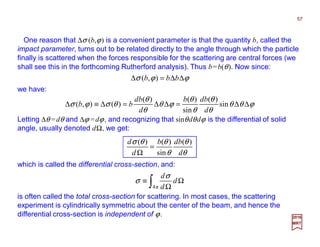
Evidently Planck’s result implies that only certain energies are allowed to an oscillator
in the wall of an enclosure, namely the energies:
38
2017
MRT
ω
2
1
h





+= nEn
with ω the oscillator frequency. This is a radical departure from classical ideas, which
insist that the energy be allowed any value from 0 to ∞, and which do not relate the
energy directly to the frequency of oscillation. If Planck’s result has the significance we
have given it, an oscillator has only a denumerable infinity of possible energy levels,
rather than a nondenumerable infinity. Once again, the phenomenological agreement of
a formula with experimental data forces us to re-examine our intuitive ideas about
physics. As with Einstein’s theory of special relativity, Planck’s law is not based upon
classical ‘first principles’, but it works where the classical laws fail!
A second conclusion to be drawn from the success of Planck’s formula is that the
coupling that was assumed to exist between the oscillators in the walls of the enclosure
and the radiation field does not indeed provide a correct description of the situation.
Thus the electromagnetic field oscillations have energies equal to integer multiples of
the characteristic frequencies of the oscillators in the walls. This can be interpreted as
meaning that the energy in the electromagnetic field corresponds to the energy emitted
by one of the mechanical oscillators as it makes a transition from one state En to another
lower state Em:
_
_
ω)(ω hmnEEE mn −=−=
These conclusions really are more than we should swallow, however. In the first place,
our analysis of the oscillators has been very naïve; they have been one-dimensional
harmonic oscillators, which is hardly physically reasonable. In the second place, a study
of the black-body radiation spectrum is not likely to provide us with much information
concerning the interaction between the field and the oscillator. All we really know is that
Planck’s law works, perhaps in site of the manner in which it was derived, and that
therefore it probably gives a correct description of certain aspects of the behavior of the
electromagnetic field. The oscillators, or whatever may exist in the walls of the cavity,
may do what they please, but the electromagnetic field is evidently restricted to energy
levels differing by integer multiples of hω. This is referred to as the quantization of
energy in the electromagnetic field.
39
2017
MRT
This modest interpretation of Planck’s result still carries the disturbing feature that the
energy in the field is resolved into little bits having energies nhω. In fact, this far-reaching
idea was not fully incorporated into the mathematical structure of quantum theory for
more than twenty-five years after Planck’s discovery; the work of Bohr, de Broglie,
Schrödinger, Dirac, and many others had to be digested before physicists really could
come to grips with the quantum properties of electromagnetic fields.
This brings us to the phenomenon of the photoelectric effect, which, as Einstein showed
in 1905, involves the quantization of energy in the electromagnetic field. Photoelectric
emission was discovered by H. Hertz in 1887, and it was observed independently by J.
J. Thomson (better known for his discovery of the electron in 1887) and P. Lenard in
1899.
40
2017
MRT
In essence, the effect (see Figure) is that when high-frequency light is shone on a
metal surface, electrons are emitted from the surface. The number of electrons emitted
per unit time from the illuminated surface depends upon several factors, but most
strikingly it is proportional to the intensity of the illumination. This is what we might
naïvely expect from the classical pre-Planck’s law theory of electromagnetic fields, for as
the energy deposited on the surface per unit time by the radiation increases, the number
of electrons gaining enough of this energy to overcome the ‘binding’ potential that keeps
them bound to the surface should increase.
The photoelectric effect. (a) Schematic representation of the apparatus; light of frequency ν impinges on
the cathode C of an evacuated tube, yielding electrons (e−) that are accelerated to anode A by a voltage
V, creating a photoelectric current I. (b) Graph of I vs V for two frequencies ν2 and ν1 with ν2 >ν1, and for
several intensities at frequency ν1. (c) Graph of Tmax vs ω for three different cathode materials.
(a) (b) (c)
V
I
C A
e−
e−
+
π2
ω
=νFrequency
Light
−V2
Photoelectriccurrent
Tube Voltage
−V1 V0
ν2>ν1I
Intensity = 0.25
Intensity = 1.00
Intensity = 0.50
ν2
ν1
ν1
ωo1
Maximumkinetic
energyof
photoelectrons
2π⋅Light frequency
Tmax
ωo2 ωo3
Different
cathode
materials
ω
Photons and Electrons
However, three features of the phenomenon are at odds with that one would expect
classically. First, the maximum kinetic energy of electrons emitted is independent of the
intensity of illumination but increases as the frequency of the light waves is increased.
Second, there is a threshold frequency; that is, if a monochromatic beam of light is used,
no electrons will be emitted unless the frequency of the light is above a certain minimum
value that depends on the nature of the emitting surface; this occurs no matter how
intense the beam may be. Third, the emission of electrons begins almost immediately
upon illumination of the surface, again no matter how intense the beam may be.
41
2017
MRT
Classical theory predicts that the kinetic energy of emitted electrons should not have
an upper bound and that the spectrum of electron energies should be independent of
light frequency though closely related to light intensity. it also predicts that no threshold
for illuminating frequency should exist, and that there should be a time lag between the
onset of illumination and the onset of electron emission, this time lag becoming shorter
as intensity increases. These predictions all arise from the proportionality of the radiation
intensity (energy delivered per units area per unit time) to the square of the field strength
of the radiation field. Only after enough energy has been deposited in the vicinity of an
electron for that electron to overcome its binding potential, should an electron escape
from the metal, and as the radiation continues to impinge on the electron, the latter may
continually gain energy. In the pre-Planck theory, no relation between frequency and
energy existed.
Einstein solved this puzzle by applying Planck’s hypothesis to the radiation,
postulating that the incident radiation consisted of ‘energy bundle’, or energy quanta,
each quantum is a monochromatic beam with frequency ν =ω/2π having energy hω=hck.
Furthermore, he assumed that the interaction mechanism between the radiation and the
electron was such that the electron absorbed energy only in these discrete amounts.
Thus, if the potential energy that binds the electron to the metal is Wo, and if the electron
loses energy W′ in working its way from a location in the interior of the metal to the
surface, then the kinetic energy of the electron, upon leaving the surface, is:
42
2017
MRT
WWT ′−−= oωh
For an electron very near the surface, W′ becomes vanishingly small, and such an
electron receives the maximum possible kinetic energy:
)ωω(ω oomax −=−= hh WT
where ωo =Wo/h such that Wo and hence ωo are characteristic of the metal and the
experimental conditions.
The ability of a single electron to absorb energy in a ‘bundle’ or burst is the most
startling feature of this view of the photoelectric process. This means that the energy in
the radiation field can be very well localized, or concentrated in a very small region of
space. This localization of energy is a property associated with particles rather than with
fields in classical theory, and thus Einstein’s analysis seems to give electromagnetic
fields a duality in that they have particle-like and wave-like properties at the same time.
Build into the world-view of classical physics was a dichotomy between particles, with
completely localized energy content, and fields, with widely distributed energy content
(and hence associated with energy densities rather than energy itself). Although there is
no a priori foundation for such a view, it does agree with our normal experiences, and
the dichotomy was very hard to give up. Einstein’s analysis discards this dichotomy.
43
2017
MRT
We might note that the simultaneous localization of energy is a field and the
possession of well-defined frequency by that field really is just as incompatible with
modern quantum theory as it is with the classical world view. The notion that the
radiation field contains well-localized quanta (i.e., their energy densities are proportional
to delta-functions δ 3(x−−−−xo)) with well-defined frequencies ω gave birth to the theory! In
fact, the classical theory of wave fields and quantum theory are both inconsistent with
this notion on basically the same grounds. Einstein’s analysis works because in the
photoelectric effect the frequency need not be completely well-defined, nor is the
electron with which the radiation interacts completely localized; in each there is some
leeway, or uncertainty, and by allowing a certain amount of uncertainty we can obtain a
view that is consistent with the mathematical theory of wave fields. In a given
experiment, says the quantum version of the theory, a phenomenon may be very
particle-like or very wave-like depending upon the nature of the experiment, but no
experiment can be constructed in which the phenomenon is simultaneously as particle-
like and as wave-like as we please; there are limits to the duality of physics.
44
2017
MRT
Another quantum feature of electromagnetic radiation is the Compton effect,
discovered in 1923 by Arthur H. Compton. He observed that when monochromatic X-
rays are scattered from matter there is a strong component of the scattered radiation
having a well-defined frequency different from that of the incident X-rays, bit such that
the scattered frequency is a function of the initial frequency and the angle through which
the radiation is scattered. This is represented schematically in the Figure. A particularly
simple case of this kind of scattering occurs when an X-ray quantum is scattered by a
free electron (or other charged particle); the analysis is carried out most easily in the
frame of reference in which the scattering particle is as rest initially.
45
2017
MRTThe Compton effect. A photon with initial frequency ν =ck/2π is scattered by a free electron and finally
has frequency ν ′=ck′/2π.
Electron
initially at
rest Recoiled
Electron
P′
k′
Scattered
photon
k
Photon
Detector
CollimatorPhoton
source
θ
We know that the electromagnetic field carries momentum, so if we are to represent it
with quanta of energy, we must expect the relationship between the momenta and
energies of the quanta to be the same as that between the momentum and energy of the
electromagnetic field. Thus, since the energy density, E, is related to the momentum
density, P, of the classical electromagnetic field by:
46
2017
MRT
c
E
P kˆ=
which, incidentally, leads to E2 − P2c2 =0, we might expect that a quantum with energy E
=hω would have momentum:
kkkp h
h
===
cc
E ωˆˆ
for electromagnetic quanta. The relativistic equation relating mass, energy and
momentum then leads to:
0222
QuantumneticElectromag =−= cEm p
hence the mass of a quantum of electromagnetic radiation is zero!
It is customary to refer to the particle-like, well-localized representatives of the
electromagnetic field as photons, and to call them massless particles. Thus a photon is
thought of as massless particle traveling at the speed of light and possessing finite
energy and momentum.
Let us treat the collision of a photon and an electron as if both behave like particles,
using the conservation of four-momentum to relate the initial energy (i.e., frequency) of
the photon to its final energy. If the photon momentum pµ =hkµ and the electron
momentum Pµ initially, and finally they have momenta p′µ =hk′µ and P′µ respectively, the
conservation of momentum implies:
47
2017
MRT
µµµµ
PpPp ′+′=+
or:
µµ
)()( PPpp −′=′−
However:






′
′
=′





= kk ,
ω
,
ω
c
k
c
k µµ
and
with:
cc
ωω ′
=′= kk and
and if the electron (rest) mass is mo, then:
],[],[ oo P0 ′′=′= cmPcmP γµµ
and
with:
2
o
1 






 ′
+=′
cm
P
γ
Hence the previous equations yield:
48
2017
MRT










−






 ′
−=′− 11)ωω(
2
o
o
cm
cm
c
Ph
Substituting this last equation into the former and using the relationship between the ks
and ωs, we find:
Pkk ′=′− )(h
and:
)ˆˆωω2ωω(1)ωω(1 22
2
2
o
2
o
kk ′•′−′+








+=′−+
cmcm
hh
Squaring both sides and solving for ω′ yields:
)ˆˆ)(1ω(1
ω
ω 2
o kk ′•−+
=′
cmh
A more familiar form for this relation is obtained by using λ=2πc/ω:
)ˆˆ(1)ˆˆ(1
π2
oo
kkkk ′•−=′•−=′−=∆
cm
h
cm
h
λλλ
and λc ≡h/moc is called the Compton wavelength for a particle of (rest) mass mo.
Sometimes λc/2π=h/moc is called the Compton wavelength, although ‘inverse
Compton wave number’ might be more appropriate.
Evidently the shift in wavelength of a photon scattered by a particle depends only upon
the mass of the scattering particle and upon the angle of scattering:
49
2017
MRT
)ˆˆarccos( kk ′•=θ
In fact, these features of the particle-like scattering of a photon agreed fully with the
experiments of Compton, and this gave striking confirmation to the quantum hypothesis
for electromagnetic radiation.
On a side note, we want to be sure we don’t use the term electron liberally above as if
you know that and electron is, although the essential properties of this ‘particle’ have not
been used in any significant way up to now.
2017
MRT
The electron was discovered in the 1890s when experimenters observed that an
electric current flowed through an evacuated tube when metal plates were placed in the
tube and high voltage applied between the plates. By measuring the deflection of the
current-carrying beam by a known electric field and then measurement the magnetic
field required to restore the beam to its original path. J. J. Thompson (1856-1940) was
above to show that if the beam consisted of charged particles, the ratio e/me of electric
charge to mass of the particle must be e/me =1.76×10⁸ C. He found that the electric
charge must be negative. Incidentally, this value of e/me coincided exactly with that found
for the negatively charged component of the radiation from radioactive materials. The
latter were originally called β-rays, and were discovered independently in 1899 by
several workers, including H. Becquerel (1852-1908), who originally called attention to
the existence of natural radioactivity; it has been shown that electrons and β-rays have
the same physical properties and therefore are identical.
C19
1060.1 −
×=e
50
Later, in 1909, R. Millikan (1868-1953) succeeded, in his famous oil-drop experiment,
in finding the electronic charge to be about:
consequently the electronic (rest) mass is approximately:
kg31
e 1011.9 −
×=m
The knowledge that electrons exist in matter naturally led to the speculation that they
play an important role in the generation of electromagnetic radiation and in mediating the
interactions between matter and the radiation field. On the other hand, most matter that
we ordinarily deal with is electrically neutral; hence there must be positive charges in
matter to offset the negative charges of the electrons. Evidently these positive charges
are not as easily separated from matter in bulk as the electrons, since they are not
readily observed in experiments such as J. J. Thompson’s What is the nature of these
positive charges? What role do they play in producing radiation? How are they and the
electrons ‘attached’ in matter? Can we visualize a model for the microscopic structure of
matter such that the positive charges and electrons play roles that are consistent with
the data that can be obtained from experiments?
51
2017
MRT
Because of the success of the atomic theory of chemistry based on Dalton’s
hypothesis, Gay-Lussac’s law and Avogadro’s rule (all of which were enunciated
between 1903 and 1811) and culminating in Mendeleyev’s periodic table (put together in
1860 when Maxwell was working on the final forms of his electromagnetic theory) it was
mandatory that the microscopic model of matter must involve the positive and negative
charges somehow stuck together in small neutral units. Thompson proposed an atomic
model in which electrons are embedded in blobs of positive charge; this was dubbed the
‘raisin pudding model’, with electrons serving as raisins and the positive charge
representing pudding.
Scattering Problems
Thomson’s model, however, was inconsistent with experiments performed by
Rutherford in 1909, in which metal foils were bombarded with α-particles, the electrically
positive component of emission from neutrally radioactive substances. Rutherford then
proposed in 1911 a model that did fit the data of his experiments. This model, however,
seemed to be inconsistent with the laws of electromagnetism. Two years later, in 1913,
Niels Bohr put forth a bold hypothesis that removed the essential difficulties encountered
in Rutherford’s model, but did so at the expense of intuitive classical notions.
52
2017
MRT
Another perplexing problem was the origin of spectral lines. Atomic species have long
been known to radiate strongly at certain well-defined frequencies and thereby to
produce bright lines in the spectral analysis of light. Absorption of light by matter shows
dark lines also. The bright lines are characteristic of the material being used to produce
the radiation, and dark lines are characteristic of the absorbing material. Balmer and
others in the later 1800s observed certain systematic relationships among the wave
numbers at which the lines occurred for certain pure elements. It seemed rather clear
that some sort of oscillator resonance was involved in the emission and absorption line
phenomena, but the systematics of their frequencies did not elucidate the nature of the
mechanism.
The success of Planck’s quantum hypothesis for the electromagnetic field led to the
suspicion that line spectra were related to quantum effects, but no successful theory for
the normal modes of vibration was forthcoming. Thompson’s model of the atom (see
Figure) provided a system within which the electrons, once displaced from an
equilibrium position, would exercise simple harmonic motion, and therefore would give
off radiation with a frequency characteristic of their oscillations. However, the energy
given up by the electrons as they radiated would have to be compensated by a
corresponding loss in their potential energy elative to the ‘pudding’ of positive charges,
and hence they would tend to ‘sink’ to the center of the positively charged distribution.
Furthermore, Thompson’s model failed to yield oscillation frequencies that were related
according to the known systematics of atomic spectra. The beauty of Bohr’s proposal
was that is unifying Rutherford’s atomic model with quantum ideas, it eliminated the
need for harmonic oscillators to exist within the atom. From Bohr’s simple model, the
basic features of the line spectrum emerged.
53
2017
MRT
Thompson ‘plum pudding’ model of the atom.
Electron
Region of
positive
charge
Rutherford recognized that the fast charged particles emitted from radioactive
substances might be used as probes to check the Thomson theory of the atom. This
technique of using particles as projectiles to probe the structure of mater continues to be
of utmost importance in physics. The procedure is to aim a well-collimated mean of
particles, whose fundamental properties are known, at a sample of matter, and to
observe the angular array of the incident particles after they have struck the target
sample. The scattered array then is characteristic of the geometry of the sample, and
more significantly, of its internal structure (see Figure).
54
2017
MRT
Schematic diagram of scattering experiments.
Target
material
Scattering
angle
θ
Detector
Source of known
particles with
velocity v
Collimators
Let us begin with a collimated beam having cross-sectional area A and containing
known particles whose velocities are all in the direction of the target. The number of
particles per unit volume in the beam will be denoted ρi. Thus the intensity of the beam,
or the number of particles crossing unit area per unit time, is:
55
2017
MRT
AvAI
td
Nd
iρ==
and the number of particles crossing a plane perpendicular to the beam in unit time is:
vI iρ=
Now let us imagine an annulus, centered at an atom or scattering center in the target,
with inside radius b and outside radius b+∆b; further, let us consider an angular sector at
azimuthal angle ϕ and having width ∆ϕ (see Figure).
Diagram for analyzing the scattering of a classical particle incident along the dashed line from the left
and aimed at a point at a distance between b and b+∆b from the scattering center.
x
y
θ
z
∆ϕ
b
∆b
ϕ
The plane of the annulus is perpendicular to the direction of the incident beam. Let us
assume now that we can measure the number of particles aimed directly at the sector of
the annulus just described (whose area is ∆σ (b,ϕ)) in unit time, and denote this number
d[∆N(b)]/dt. From this we could calculate the area ∆σ (b,ϕ), since:
56
2017
MRT
A
b
td
Nd
td
bNd ),()]([ ϕσ∆






=
∆
thus:
v
td
bNd
I
td
bNd
td
Nd
td
bNd
Ab
iρ
ϕσ
)]([)]([)]([
),(
∆
=
∆
=











 ∆
=∆
since I =ρiv and dN/dt =IA =ρi Av, as given above. If we could find a way to measure
d[∆N(b)]/dt, then, we would effectively measure the area ∆σ (b,ϕ). It turns out that
∆σ (b,ϕ) is, in fact, a useful quantity to use in comparing theory with experiment; it
does not involve the irrelevant experimental parameter A.
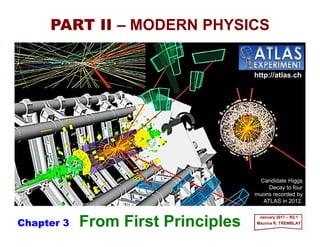
One reason that ∆σ (b,ϕ) is a convenient parameter is that the quantity b, called the
impact parameter, turns out to be related directly to the angle through which the particle
finally is scattered when the forces responsible for the scattering are central forces (we
shall see this in the forthcoming Rutherford analysis). Thus b=b(θ). Now since:
57
2017
MRT
ϕϕσ ∆∆=∆ bbb ),(
we have:
ϕθθ
θ
θ
θ
θ
ϕθ
θ
θ
θσϕσ ∆∆=∆∆=∆≡∆ sin
)(
sin
)()(
)(),(
d
bdb
d
bd
bb
Letting ∆θ =dθ and ∆ϕ =dϕ, and recognizing that sinθdθdϕ is the differential of solid
angle, usually denoted dΩ, we get:
θ
θ
θ
θθσ
d
bdb
d
d )(
sin
)()(
=
Ω
which is called the differential cross-section, and:
is often called the total cross-section for scattering. In most cases, the scattering
experiment is cylindrically symmetric about the center of the beam, and hence the
differential cross-section is independent of ϕ.
Ω
Ω
≡ ∫ d
d
d
π4
σ
σ
Let us consider the vector diagram in which the initial momentum p′1 and the final
momentum p′3 of the projectile are drawn, together with the momentum transfer ∆p′1 =
p′3 −−−−p′1 (see Figure where an alpha α-particle represented by ). If t is the scattering
angle, then the angle between p′3 and ∆p′1 is (π−θ)/2, and:
58
2017
MRT






′=




 −
′=′∆
2
sin2
2
π
cos21
θθ
ppp
Here we assume conservation of energy, so that p′3 =p′1.
Vector diagram for the analysis of central-force scattering.
p′1
p′3
∆p′1
2
π θ−
−
2
π θ−
θ
The Rutherford Cross-Section
Now the change in momentum is related to the force causing that change by:
59
2017
MRT
∫=′∆
f
i
t
t
tdt)(1 Fp
where t is time and ti,tf represent the onset of the interaction causing the momentum
change, and the end of the interaction, respectively. We can change the variable from
time to angular position ϕ using dt=(dt/dϕ)dϕ =[1/ω(ϕ)]dϕ, where ω(ϕ)=dϕ /dt is the
angular velocity, together with ϕi =ϕ(ti), ϕf =ϕ(tf) (see Figure). For the scattering
problem, ϕi =−(π−θ)/2 and ϕf =(π−θ)/2, so that:
Diagram defining variables in the Rutherford scattering analysis. [Notice how this problem is much easily
understood by staring at this picture and visualizing the symetries present in the geometry that was
chosen. This is the basis for understanding things… Visualizing the coordinates that are associated with
the problem’s inherent symmetries.]
∫
−
−−
=′∆
2)π(
2)π(
1 )(
)(ω
1θ
θ
ϕ
ϕ
dtFp
p′1
p′3∆p′1
2
π θ−
−
2
π θ−
ϕ
θ
b
α-particle
Actual
trajectory
b
Nucleus
r
Ze
Z′e
In central force problems, the angular momentum is constant, and in the barycentric
frame it is given by:
60
2017
MRT
bpr 1
2
)(ω ′=ϕµ
with µ the reduced mass of the system (i.e., µ ≡1/mα +1/mN =mα mN /(mα +mN)) and where
the right-hand side is the value of the angular momentum when the incident particle is
very far away. Hence:
bp
r
1
2
)(
)(ω
1
′
=
ϕµ
ϕ
where, as indicated, r only depends on ϕ. Therefore, for central forces:
∫
−
−−′
=′∆
2)π(
2)π(
2
1
1 )()(
θ
θ
ϕϕ
µ
dtr
bp
Fp
or, if n us a unit vector in the direction of ∆p′1:ˆ
∫∫
−
−−
−
−− ′
=•
′
=′∆•=′∆
2)π(
2)π(
2
1
2)π(
2)π(
2
1
11 cos)()()(ˆ)(ˆ
θ
θ
θ
θ
ϕϕϕϕ
µ
ϕϕ
µ
dFr
bp
dtr
bp
p Fnpn
where |F(ϕ)|=F(ϕ). Solving for b and using ∆p′1 =2p′1sin(θ/2) above, we obtain a relation
for the impact parameter:
∫
−
−−′
==
2)π(
2)π(
2
2
1
cos)()(
)2sin(2
)(
θ
θ
ϕϕϕϕ
θ
µ
θ dFr
p
bb
Rutherford’s basic assumption was that the scattering force was essentially the
Coulomb force:
61
2017
MRT
rFF ˆ
επ4
))((
)( 2
or
ZeeZ′
==ϕ
where Z′e is the charge on the projectile and Ze is the positive charge on the nucleus of
an atom in the target. Hence, for the Rutherford problem:
∫
−
−−′
′
=
2)π(
2)π(2
1o
2
cos
)2sin(
1
επ8
)(
θ
θ
ϕϕ
θ
µ
θ d
p
eZZ
b
This yields:






′
′
=
2
cosec
επ42
1)( 2
2
1o
2
θµ
θ
θ
p
eZZ
d
bd
and hence:
)2(sin
sin
επ44
1
2
cosec
2
cotan
2
1
επ4
)(
)( 4
2
2
1o
2
2
2
2
1o
2
θ
θµθθµ
θ
θ
θ








′
′
=



















′
′
=
p
eZZ
p
eZZ
d
bd
b






′
′
=
2
cotan
επ4
)( 2
1o
2
θµ
θ
p
eZZ
b
or, when evaluated:
Substitution of this result into dσ (θ)/dΩ= [b(θ)/sinθ ][db(θ)/dθ] above then gives
Rutherford’s cross-section for a single scattering center:
62
2017
MRT
)2(sin
1
ε6π1 4
2
o
2
NucleusSingle θ
σ








′
′
=





Ω T
eZZ
d
d
where we have written T′=(1/2µ)(p′1)2 as the kinetic energy of the barycentric system.
Using various materials for the targets, notably gold and silver, Rutherford and his
collaborators verified that the above equation gives the correct results provided the
target is sufficiently thin (so that multiple scattering is unimportant) and provided the
scattering angle satisfies cotan(θ/2)>4πεo ⋅4T′/Z′Ze2 (he used α-particles as projectiles,
so that Z′=2). The limitation on angles corresponds to a limitation b>10−14 m on the
impact parameter. This limitation on angles could well result from the actual collision of
the α-particle with the nuclei, or at least from a breakdown of the notion that the nucleus
is infinitesimally small. In any case, the experimental results were consistent with the
existence of a nucleus containing all the positive charges and having a radius of not
more than 10−14 m. The atomic electrons then must be attached to the nucleus at
distances as great as 10−10 m in order for the atom to have a total diameter of about 10−10
m. An amazing consequence of this model is that nearly all the mass of a sample of
condensed matter (solid or liquid) resides in about (10−4)3 =10−12 of its volume!
∼
∼
Rutherford’s notion of the structure of the atom (see Figure), in its most rudimentary
aspects, has survived to the present time. Over the years, however, the model has faced
severe crisis and has undergone drastic modifications. The most important objection to
his original model was that it provided no mechanism whereby an electron could be
restrained from being accelerated toward the nucleus and merging catastrophically. The
only ‘force’ imaginable was the centrifugal effect. According to classical mechanics, an
electron certainly could become a satellite, and a planetary model of the atom is quite
feasible. However, the electromagnetic properties of the electron prevent this. The
continual acceleration of an orbiting electron would cause it to radiate continually, and
thus to move into smaller and smaller orbits in order to maintain mechanical equilibrium.
This process would continue until the electron merged with the nucleus. In fact, classical
physics is incapable of providing a tenable dynamically stable model for the electron-
nucleus system, just as it is incapable of providing a satisfactory model for radiation in
an enclosure.
63
2017
MRT
Rutherford model of the Atom.
Outer region
of negative
charge
Central
positive
charge
Aside from the instability of the Rutherford atom, the problem of predicting correctly the
systematics of line spectra emitted by various species of atoms was not solved by the
Rutherford atom. From the rather complicated arrays of lines within the spectrum of
hydrogen, for example, several distinct series of lines had been isolated. Each of these
had the form:
64
2017
MRT






−
′
= 22
11
π2
nn
Rk
where k is the wave number of the spectral line, R is a constant, called the Rydberg after
a famous spectroscopist and is equal to 109,678×102 m−1, and n′ and n are integers. In a
given series, n′ is fixed and the different lines in the series are characterized by the
integers n>n′. For instance, n′=1 characterizes the Lyman series, the lines of which are
obtained by letting n= 2,3,…; similarly n′=2 characterizes the Balmer series, n′=3 the
Paschen series, n′=4 the Brackett series.
For atoms more complicated than the hydrogen atom with its single electron, similar
spectral regularities were found, except that n′ and n were not always integers in these
more complicated spectra. Nevertheless, whenever a pattern among the lines was
found, it had the general form:
nnk ττ −= ′
where τn′ is fixed and τn <τn′ may take on a denumerably infinite number of values
that decrease with increasing n. The τn′ and τn are called terms of the series.
Bohr’s Model
This is suspiciously similar to the situation in Planck’s model for the enclosed radiation
system, where the frequencies of allowed radiation are differences between the allowed
energies of the oscillators in the walls, divided by h:
65
2017
MRT
ω)(
ω)½(ω)½(
ω 1Oscillator2Oscillator
Radiation nn
nnEE
−′=
+−+′
=
−′
=
h
hh
h
The difficulty is that energies of the simple harmonic oscillators do not lead to radiation
frequencies that are related to one another in the manner that characterizes the
observed line spectra (e.g., k=2πR(1/n′2 −1/n2) above). In particular, as n→∞ the values
of k get closer and closer together, approaching the limit:
2
π2
n
R
k
′
=∞
The existence of such series limits is typical of the observed spectra, and no such limits
exist for the harmonic oscillator model.
Bohr attempted to obtain, from the expression for the energy of a satellite electron, a
formula for the terms τn such that τn is proportional to 1/n2, n being a quantum number,
rather than proportional to n.
The total energy of an electron orbiting about its nucleus is:
66
2017
MRT
r
eZp
E
o
22
επ42
−=
µ
if the charge on the nucleus is Z, and we observe the system in center-of-mass frame so
that µ =memN/(me +mN), me being the electron mass and mN being the mass of the
nucleus. Bohr restricted his first consideration to electrons in circular orbits, so that p2/2µ
=½µr2ω2 where r is the radius of the orbit and ω is the constant angular velocity.
Since the electron here is assumed to be in a stable circular orbit, the attractive
electrostatic potential must compensate exactly for the centrifugal effect of the electron’s
circular motion; hence
r
eZ
r
r
eZ
r
o
2
22
2
o
2
2
επ8
ω
2
1
επ4
ω == µµ or
Therefore:
22
o
2
ω
2
1
επ8
r
r
eZ
E µ−=−=
It is clear from this that if r is proportional to r2 and ω is proportional to n−3, E would
be proportional to 1/n2, as desired. The constant of proportionality, however, must
involve h if we are to make use of Planck’s idea, and h has the units of energy times
time (i.e., J⋅s), or momentum times distance (i.e., Kgms−1 ⋅m=Kgm2s−1).
Now whatever expression we try to quantize, that is restrict its values to integer
multiples of a constant, should be a conserved physical quantity, so that the quantization
will provide the atomic system with stability. Thus the system would remain in a state for
which n is given, until disturbed by some external influence; external disturbances would
be able to produce shifts from one integer n to another integer n′, but not shifts involving
noninteger changes in n.
67
2017
MRT
ω2
rL µ=
The two conserved mechanical quantities involved in the satellite problem are energy
and angular momentum. We do not want to quantize the energy because that would
lead to the old harmonic oscillator energies, and we know already that they do not
provide the proper spectral lines. The other candidate turns out to be ideal for our
purpose because it has the same units as h, namely momentum times distance, and
because it is given by the formula:
for circular orbits; this latter circumstance means that if r∝n2 and ω∝n−3 as we desire,
then L∝n. Hence we let the angular momentum be quantized according to the rule:
hKnrL == ω2
µ
where n is an integer and K is a dimensionless constant.
The equation µrω2 =Ze2/4πεor2 above then yields, upon multiplication by µr3:
68
2017
MRT
2
2
2
o22222242
o
2
επ4
ω
επ4
n
eZ
KrKnLrr
eZ
µ
µ
µ h
h ==== or
so that r∝n2, as we wished. It follows immediately that ω∝n−3. Hence the allowed
energies for the system quantized in this way is:
22
o
22
2
1
)επ4(2
)(1
n
eZ
K
En
h
µ
−=
and the wave number of spectral lines resulting from radiative transitions between these
allowed energy levels are:






−
′







=
−
== ′
22
2
o
2
2
11
επ42
1ω
nn
eZ
cKc
EE
c
k nn
hhh
µ
This provides us with a method for calculating K, since evidently we must have:
2
o
2
2
επ42
1
π2








=
hh
eZ
cK
R
µ
when Z=1 for Hydrogen.
It turns out that e2/4πεohc is a very important constant in atomic physics, and it is given
a name and a symbol:
69
2017
MRT
0360.137
1
επ4 o
2
=≡
c
e
h
α
is dimensionless and is called the fine structure constant. For a Hydrogen atom, with a
single proton as a nucleus, its rest mass is mN =mp =1836.1 me so that µc2/hc=
[1836.1/(1836.1+1)]mec2/hc is just 1836/1837.1 times the electron Compton wave number
(i.e., λc/2π=h/mec=3.86159×10−13 m=3.86159×10⁻³ Å=3.86159×10² F where 1 F=10−13 cm
is called a Fermi, and 1 Å=10−8 cm=10−10 m is the Ångtröm unit), the latter being given
by:
1
m−
×== 12
2
e
e 105896.2
c
cm
k
h
Hence:
1
m−
×== 2
2
2
e
e
2
10678,109
11
K
k
mK
R α
µ
and K=1 yields excellent agreement wit the experimental value of R.
hnL =
and this provides excellent agreement with experiment.
Thus Bohr’s angular momentum quantization postulate, L=µr2ω becomes, with K=1:
The essential results of Bohr’s circular orbit include, then, that the electron in a one-
electron system is restricted to motion in orbits having radii (c.f., r=K2(4πεoh2/µZe2)n2
using K=1):
70
2017
MRT
where:
( )K,3,2,1
1
1
e2
== na
m
Z
nan
µ
m10
e
2
e
2
o
1 10529177.0
1επ4 −
×==≡
kcm
c
e
c
a
α
hh
is the radius of the first (n=1) Bohr orbit in a Hydrogen atom when the mass of the
nucleus is assumed to be infinite. The correction for finite nuclear mass is represented
by the factor me/µ in an above and the correction for having nuclear charge greater than
unity is represented by the factor 1/Z.
Thus the energies of the orbiting electrons are restricted to the values (use K=1 in En =
−(1/K2)[µ(Ze2)2/2(4πεoh)2](1/n2)):
71
2017
MRT
αβ
n
Z
n =
where:
21
e
2 1
n
E
m
ZEn
µ
=
eV6058.13
2
2
e1 −=≡ cmE
α
(1 eV=1 electron-volt=1.6022×10⁻¹⁹ J) is the energy of the first Bohr orbit in Hydrogen
when the nuclear mass is infinite; the mass and nuclear charge correction factors are
evident in En above.
which shows that for small Z or large n, the nonrelativistic approximation should be
adequate.
It is interesting to note that the value of β =v/c for an electron in the n-th Bohr orbit is:
The differences between allowed energy levels therefore are given by:
72
2017
MRT






−
′
=− ′ 221
e
2 11
nn
E
m
ZEE nn
µ
so that when an atom shifts from one energy level to another (which corresponds to an
acceleration of the electron in classical theory, and hence to a radiation-producing
transition of the electron from one state to another) it may be expected to give off
radiation having this energy, or, according to the quantum hypothesis for the radiation,
having wave number:






−
′
=′ 22
1
e
2 11
nnc
E
m
Zk nn
h
µ
We constructed the atomic model (see Figure) in just such a way that this would occur.
Bohr model of the Beryllium 9Be Atom (atomic number A=9) with the nucleus (here Z =4 protons) at the
center and electrons (here 4) in ‘orbits’. Notice how A=number of protons ( ) + number of neutrons ( ).
73
2017
MRT
Energy levels of the Bohr model of Hydrogen, (a), and the observed spectral series, (b) and (c); (b) is a
photograph of the Balmer series. [(a) From L. Kerwin, Atomic Physics, Holt, Rinehart and Winston
(1963), p. 182. (b) From G. Hertzberg, Atomic Spectra and Atomic Structure, Dover Publications Inc.
(1944). (c) From H. Semat, Introduction to Atomic Physics, 4-th Ed., Holt, Rinehart and Winston (1963),
p. 236.]
(a) (b) (c)
The electron states and the radiative transitions are frequently represented by energy
level diagrams (see Figure).
Bohr, Sommerfeld and Wilson generalized these ideas to cover elliptical as well as
circular orbits and to take into account relativistic effects. Also, the theory has been
applied to more complicated atoms than Hydrogen, with some qualitative success; the
gross feature of the spectra generally agree qualitatively with the Bohr model
predictions. Nevertheless, many anomalous features of spectra remain that the Bohr
theory is not sufficiently rich to cope with. Furthermore, as a theory it is quite
unsatisfactory because the quantization hypothesis was invoked in just such a way as to
give agreement with experiment; there was no fundamental basis for quantizing angular
momentum rather than energy. Wilson and Sommerfeld independently developed
quantization rules that were more general and could be applied more systematically than
Bohr’s, but these rules still had no solid theoretical underpinnings. In fact, the rules did
not always seem to give the correct results without further special modifications; the
necessity of replacing the square of the angular momentum n2h2 with n(n+1)h2 in the
analysis of the anomalous Zeeman effect provided an example.
74
2017
MRT
Thus the Bohr model really did not succeed in providing us with a thorough-going
theory for the structure of matter. Rather it provided a very important conceptual
stepping stone from classical to modern physical theory. Most importantly, through its
substantial success, it made clear to physicists that Planck’s constant and the quantum
idea must play a central role in the physics of microscopic systems. A genuine quantum
theory, rather than a series of quantization hypotheses, quite clearly was required.
We saw earlier that the field energy of electromagnetic radiation seems to be ‘bunched
up’ into units of hω and that the electromagnetic field frequently behaves as if it were
localizable in that energy and momentum can be transferred from the field to charged
particles as if the field consisted of particle-like objects; this was the message of the
photoelectric effect and of the Compton effect. On the other hand, we just saw that the
quantum unit h appeared when the angular momentum of an electron was quantized in
the Bohr model. Thus h has application both in the electromagnetic field phenomena and
in phenomena directly involving charged particles with mass. Could it be that both the
electromagnetic wave fields, involving massless ‘particles’, and massive particles like
electrons participate in quantum phenomena in essentially similar ways? That is, can
particles like electrons display wavelike properties, with h supplying the link between
particle-like and wave-like behavior, just as electromagnetic wave fields display particle-
like phenomena? Might not Planck’s constant h (or Dirac’s constant h≡h/2π) help us to
eliminate the wave-particle dichotomy of classical physics and to replace it with a single
unified view of microscopic phenomena?
75
2017
MRT
Following a short discussion of some general properties of waves, we shall apply this
to the famous hypothesis of Louis de Broglie and Albert Einstein, which form the
conceptual foundation of the wave theory of matter. Certain analogies between
electromagnetic radiation and matter waves will be developed to help unify the quantum
theory of light with the quantum theory of massive particles.
Fundamental Properties of Waves
A physical wave is an oscillation, through space and time, of some physical variable. If
the variation in magnitude of the physical quantity, as a function of time, are independent
of the variations as a function of spatial position, then points of constant phase (i.e.,
maxima, minima and nodes in the waves) with be stationary in space, and such waves
are called standing waves. If, however, the time and space oscillations are correlated in
such a way that all points of constant phase move with some variable vph, called the
phase velocity, the waves are called traveling waves.
76
2017
MRT
ωD== νλphv
The mathematical study that deals most directly and appropriately with wave motion is
Fourier analysis and it can be shown that any kind of wave motion can be represented
as a linear superposition of traveling waves with different frequencies and wavelengths.
The phase velocities of these traveling waves need not be equal, but each wave having
fixed wavelength λ and fixed frequency ν has a constant phase velocity vph of
magnitude:
where D=λ/2π is the reduced wavelength and ω=2πν is the angular frequency, as
before.
Thus we may construct any waveform, or what is the same thing, any reasonable well-
behaved function of space and time, from a superposition of monochromatic waves (i.e.,
waves with fixed ω) having constant phase velocities. The monochromatic waves are
represented mathematically by the sinusoidal functions:
77
2017
MRT
or equivalently:
)ωcos()ωsin( xkxk •−•− tt and
)ω()ω(
ee xkxk •−−•− titi
and
since cosξ =[exp(iξ)+exp(−iξ)]/2 and sinξ =[exp(iξ)−exp(−iξ)]/2i, and where:
kvkk ˆωˆ1
D
D
== phand
k being the direction of propagation of the wave and D=λ/2π is the reduced wavelength.ˆ
The quantity:
xk •−= tωφ
called the phase of the wave, provides a concrete interpretation of vph. Thus a point on a
wave train for which φ is constant does not remain stationary in general, for if one waits
for a time ∆t, the point with phase φ will have moved by ∆x such that:
0ωω)()(ω =∆•−∆•−=∆+•−∆+= xkxkxxk tttt orφ
Hence:
kk
x
v ˆωˆω
D==
∆
∆
=
kt
ph
is the velocity with which the wave propagates in the direction k.ˆ
For a monochromatic wave with fixed phase velocity, points at which the magnitudes
of the oscillating physical variable are equal are separated uniformly from one another in
time and are equidistant from one another along the direction of propagation in space.
Hence the information carried by such a wave is meager; it provides an observer with a
standard for distance measurements (the wavelength), a standard for time
measurements (the period), a referred direction (the direction of propagation), and no
more. It cannot even provide a uniquely defined point in space and time that might serve
as a natural origin of coordinates. Thus in order that waves have a great physical
significance, some mechanism must exist for either varying the amplitude of the wave as
a function of space and time (amplitude modulation) or varying the frequency (frequency
modulation) or phase velocity as a function of space and time.
78
2017
MRT
)ωsin(),()ωcos(),(),( xkxxkxx •−+•−= ttbttatf
For example, in the case of amplitude modulation, that we have a wave expressible in
the form:
)ω()ω(
e),(e),(),( xkxk
xxx •−
−
•−
+ += titi
tctctf
or
where we have:
2
),(),(
),(
tbita
tc
xx
x
m
=±
Here f (x,t) represents the oscillating physical variable, and the amplitudes a, b, c+
and c− are functions of x and t, as indicated.
Let us assume now that a dispersion relation exists between ω and k; that is, suppose
that ω=ω(k) is a function of the wave number k. In order to restrict the values of ω to just
those for which ω=ω(k) holds, we write g(k,ω)δ [ω−ω(k)]. Thus a choice of wave
number k determines a value of ω, as desired.
79
2017
MRT
Space and time are the parameters used to describe interference patterns, since
interference patters yield positions in space and time where wave intensities are
maximal or minimal. In the (Fourier) integrals representing f (x,t), these parameters
appear only through the exponential of −φx,t(k) =−i[ω(k)t −k•x].
The amplitude modulation of f (x,t) provides f with a signal, and this signal moves with
some velocity. How shall we find the signal propagation velocity? We no longer can use
the phase velocity, for there are waves with many phase velocities contributing to the
signal; that is, the phase velocity is not unique. The appropriate method for finding signal
velocities, or group velocities, was suggested in 1887 by Lord Kelvin. This method is
understood best by recognizing that the representation of f (x,t) as a superposition of
monochromatic traveling waves is simply the adding together of waves in just such a
way that constructive interference occurs wherever the magnitude of | f (x,t)| is large,
and destructive interference occurs wherever | f (x,t)| becomes small or vanish. Therefore,
in seeking a signal propagation velocity, we are trying to find the velocity of propagation
of a portion of the waveform where constructive (or destructive) interference is maximal,
and destructive (or constructive) interference is minimal, even after this portion of the
wave has moved far away from its initial position or after a long period of time has
elapsed. That is, we wish to find the velocity of persisting prominences in the waveform.
Kelvin suggested that to locate extrema in the wave front that persist in space and
time, we should perform a Taylor expansion of the phase φx,t(k) about some value ko of
k. Thus, letting x ≡[x,y,z]=[x1,x2,x3]≡xi and k ≡[kx ,ky ,kz]=[k1,k2,k3]≡ki, we get:
80
2017
MRT
For simplicity, we shall write the last term as ζko
(k−−−−ko)t. Henceforth you shall be known as:
∑= ∂
∂
=
3
1
ˆ
i
ii
k
xk∇∇∇∇
and diligently letting ki −ki
o→∆k (we call it κκκκ in the integral below to simplify this) we have:
tttt )(])(ω[])(ω[)( ooooo, kkxkxkkkk kkx ∆+∆•+•+=∆ ζφ −−−−∇∇∇∇++++
and (this integral is over the angular frequency ω and κκκκ is used for the ∆k≡k−−−−ko difference):
∫ ∫
∞
∞−
−•−•−−
−=
tititi
gddtf
)(})](ω{[
oo
3])(ω[
2
oooo
ee)](ωω[)ω,(ωe
)π2(
1
),(
κκxkxkk kk
κkκkκx
ζ
δ −−−−∇∇∇∇
++++++++
where g(ko ++++∆k,ω) is the group velocity and the delta function δ [ω−ω(ko ++++∆k)] restri-
cts things to the choice of wavenumberko ++++∆kwhichdeterminesthevalueof ω needed.
∑ ∑
∑
∞
= = =
= =










−−
∂∂
∂
+








−−
∂
∂
+•+=
2
3
1,,
oo
3
1
ooo,
1
11
o
1
o
)()(
)(ω
!
1
)(
)(ω
])(ω[
N jj
jjjj
jj
N
i
iii
it
N
NN
N
tkkkk
kkN
kkxt
k
t
L
L
L kk
kk
x
k
k
xkkφ
Now to explain this mess. The last factor in the integral (i.e., exp[−iζko
(k)t]) is
independent of space and produces interference at all nonzero times. It represents the
spreading, because of this interference, of the initial prominences in the wave amplitude
and unless ζko
(k)=0 the factor exp[−iζko
(k)t] leads to a reduction in the value of | f (x,t)|
for fixed x as t becomes arbitrarily large. This is often referred to as the degradation of
the signal contained in f (x,t) with increasing time. Clearly this effect is determined by the
functional forms of ω(k), and cannot be compensated in any way. Given the dispersion
relation ω=ω(k), we simply must live with this signal degradation.
81
2017
MRT
The next-to-last factor in the integral (i.e., other exp) also represents a potential degra-
ding effect both as time and position change. In fact, the appearance of both time and
position variables in this factor allow us to ‘follow’ the signal, since this factor becomes
unity for those spatial points x such that x=x(t)≡∇∇∇∇k ω(ko)t. That is, an observer whose
position is given by x(t)=vg or whose velocity is vg ≡∇∇∇∇k ω(ko), will appear to be traveling at
the same rate as the most persistent features of the signal. We have not yet discussed
the problem of choosing a value for ko; clearly our choice of ko has a bearing on the
value of vg that we shall obtain. Essentially, a choice of ko is equivalent to a selection of
the signal-carrying portion of the waveform, and we shall want to choose ko in such a
way that it somehow characterizes the signal. In practical problems the choice usually is
obvious; usually one chooses the value of ko that maximizes g[ko,ω(ko)]. Once a choice
is made, we can say with confidence that vg ≡∇∇∇∇k ω(ko) is the velocity of the dominant sig-
nal carried by the wave f (x,t) (with Fourier kernel g(k,ω)). In most problems ω(k)=ω(|k|),
from which is follows that ko =vg, and hence ko is in the direction of signal propagation.ˆˆ
In 1924 a French physics student, Louis de Broglie, asserted in his doctoral dissertation
that massive particles, such as electrons and atoms, might be representable as waves.
He suggested that Einstein’s quantum relations between the energy and frequency and
between momentum and wave number be extended to particles; thus with a particle
having energy E and momentum p would be associated waves having angular
frequency ω=E/h and wave vector k=p/h:
82
2017
MRT
kp hh == andωE
These waves associated with particles having well-defined energy and momentum, and
even waves associated with massive particles in general, often are referred to as the de
Broglie waves.
For free nonrelativistic particles, E= hω and p= hk above imply that the frequency and
wave vector must be related by:
2
o2
ω k
m
h
=
corresponding to E=(1/2mo)p2, where mo is the rest mass of the particle. However, since
the phase velocity is vph =ω/k, we have:
k
m
vph
o2
h
=
for nonrelativistic particles.
The Hypothesis of de Broglie and Einstein
Free relativistic particles similarly must have their wave frequencies and wave vectors
related according to the formula:
83
2017
MRT
corresponding to:
22
o
222
o
1ω
cm
cm kh
h
+=
22
o
2
2
o 1
cm
cmE
p
+=
Again, since the phase velocity is vph =ω/k, we have for relativistic particles:
The relativistic phase velocity then exceeds the speed of light, c, for all massive particles
with finite momenta. This seems to be disallowed by the result from special relativity
requiring that c be an upper bound on particle velocities. It turns out, however, that vph
above does not violate special relativity, because purely monochromatic waves with
fixed phase velocity cannot carry any significant signal and hence cannot propagate any
information about the location of a particle – let alone a ‘message’! The requirements of
special relativity impose no constraint on the phase velocity, but require that the speed
at which information can be propagated be limited by c. Thus vg <c for particles with
nonzero mass, and vg =c for massive particle, are the required limitation.
22
22
o
22
o
22
o
11
k
cm
c
cm
k
k
cm
cvph
h
h
h
+=+=
For electromagnetic waves in vacuo, we have ω=kc so that vg =vph =c, whereas for
relativistic particles with rest mass mo >0, the equation ω=(moc2/h)/[1+(hk/moc)2] above
yields:
84
2017
MRT
vβ
pk
k
k
v k ====
+
== c
E
cc
cm
cmcm
g
22
22
o
22
2
o
2
o
ω1
)(
ω
h
h
h
∇∇∇∇
where v=cββββ=c(pc/E) is the usual particle velocity. Hence the group velocity of the de
Broglie waves representing a free particle is just the velocity of the classical motion of
the particle, and limiting its magnitude to values less than c presents no difficulty. This
seems to vindicate de Broglie’s hypothesis. However, de Broglie’s conjecture remained
merely an interesting idea until 1927, when an experiment by Davisson and Germer
confirmed the existence of wave properties for protons.
It is worth recalling at this point that an alternative to amplitude modulation of the wave
is frequency modulation. If the frequency of a matter wave associated with a particle is
changed as a function of time, then according to de Broglie’s hypothesis, the energy of a
particle will change in proportion. Thus frequency modulation of matter waves is
equivalent to energy modulation, and the existence of frequency modulation in a wave
system for a particle therefore implies the existence of external forces changing the
energy of the particle. In the absence of such external forces, amplitude modulation
alone effectively furnishes a wave train with a signal.
2017
MRT
C. Harper, Introduction to Mathematical Physics, Prentice Hall, 1976.
California State University, Haywood
This is my favorite go-to reference for mathematical physics. Most of the differential equations presentation and solutions, complex
variable and matrix definitions, and most of his examples and problems, &c. served as the primer for this work. Harper’s book is so
concise that you can pretty much read it in about 2 weeks and the presentation is impeccable for this very readable 300 page
mathematical physics volume.
F.K. Richtmyer, E.H. Kennard, and J.N. Cooper, Introduction to Modern Physics, 5-th, McGraw-Hill,1955 (and 6-th, 1969).
F.K. Richtmyer and E.H. Kennard are late Professors of Physics at Cornell University, J.N. Cooper is Professor of Physics at the Naval Postgraduate School
My first heavy introduction to Modern Physics. I can still remember reading the Force and Kinetic Energy & A Relation between Mass
and Energy chapters (5-th) on the kitchen table at my parent’s house when I was 14 and discovering where E = mc2 comes from.
A. Arya, Fundamentals of Atomic Physics, Allyn and Bacon, 1971.
West Virginia University
My first introduction to Atomic Physics. I can still remember reading most of it during a summer while in college.
Schaum’s Outlines, Modern Physics, 2-nd, McGraw-Hill, 1999.
R. Gautreau and W. Savin
Good page turner and lots of solved problems. As the Preface states: “Each chapter consists of a succinct presentation of the
principles and ‘meat’ of a particular subject, followed by a large number of completely solved problems that naturally develop the
subject and illustrate the principles. It is the authors’ conviction that these solved problems are a valuable learning tool. The solved
problems have been made short and to the point…”
T.D. Sanders, Modern Physical Theory, Addison-Wesley, 1970.
Occidental College, Los Angeles
This book forms pretty much the whole Review of Electromagnetism and Relativity chapters. It has been a favorite of mine for many
years. From Chapter 0: “We here begin our studies with an investigation of the mathematical formalism that commonly is used as a
model for classical electromagnetic fields. Subsequently we shall uncover a conflict between this formalism and the picture of the
world that is implicit from classical mechanics. The existence of this conflict indicates that we have failed to include some physical
data in one or the other, or both, of the classical formulations of physics; either Maxwellian electromagnetism or Newtonian
mechanics is incomplete as a description of the real data of physics.”
S. Weinberg, Gravitation and Cosmolgy, Wiley, 1973.
Univeristy of Texas at Austin (Weinberg was at MIT at the time of its publication)
Besides being a classic it still is being used in post-graduate courses because of the ‘Gravitation’ part. As for the Cosmology part,
Weinberg published in 2008 “Cosmology” which filled the experimental gap with all those new discoveries that occurred since 1973.
References
85
PART II.3 - Modern Physics

PART II.3 - Modern Physics

  • 1.
    From First Principles PARTII – MODERN PHYSICS May 2017 – R2.1 Maurice R. TREMBLAY http://atlas.ch Candidate Higgs Decay to four muons recorded by ATLAS in 2012. Chapter 3
  • 2.
    Contents PART II –MODERN PHYSICS Charge and Current Densities Electromagnetic Induction Electromagnetic Potentials Gauge Invariance Maxwell’s Equations Foundations of Special Relativity Tensors of Rank One 4D Formulation of Electromagnetism Plane Wave Solutions of the Wave Equation Special Relativity and Electromagnetism The Special Lorentz Transformations Relativistic Kinematics Tensors in General The Metric Tensor The Problem of Radiation in Enclosures Thermodynamic Considerations 2017 MRT The Wien Displacement Law The Rayleigh-Jeans Law Planck’s Resolution of the Problem Photons and Electrons Scattering Problems The Rutherford Cross-Section Bohr’s Model Fundamental Properties of Waves The Hypothesis of de Broglie and Einstein Appendix: The General Theory of Relativity References 2
  • 3.
    The second ofthe major revolutions in modern physics arose from the attempt to analyze, on the basis of classical theory, the thermodynamic properties of electromag- netic radiation confined to the isothermal enclosure (i.e., isothermal being a process that takes place at constant temperature). Profound discrepancies between predictions based upon fundamental classical law on the one hand, and experimental observations of the other, induced Max Planck to put forward a remarkable hypothesis which effectively resolved the difficulty. This hypothesis became the cornerstone of a whole new interpretation of basic physical phenomena; the interpretation is known as quantum theory, or quantum mechanics, which is the subject of PART III – QUANTUM MECHANICS. 3 2017 MRT Here we shall analyze the radiation contained in an isothermal cavity, with a view toward finding the temperature dependence of the energy density of components of the radiation with different frequencies. This dependence can be checked by experiments, and therefore the analysis provides a valuable experimental check on the classical theory of electromagnetic radiation. An important property of radiation within an isothermal enclosure is that the radiation is isotropic everywhere within the enclosure (i.e., there is just as much electromagnetic radiative momentum being carried in one direction as in any other direction). Since the pressure on the walls of the enclosure is just the momentum per unit area delivered by the radiation per unit time, the isotropicity of radiation means that the radiation pressure on the walls must be uniform. The Problem of Radiation in Enclosures
  • 4.
    Consider a trainof waves moving in the direction k/|k|, and let them be incident on a small element of area, ∆S, of the enclosure wall. Now generate a cylinder with sides parallel to k/|k| and having base ∆S (see Figure); the slant height of the cylinder is ∆l, and it has volume ∆V=∆S•∆llll, where ∆S=n∆S, n being the normal to the surface ∆S, and ∆llll=∆l(k/|k|). Then the amount of radiative momentum carried by the waves we are considering in this cylinder is (momentum density is P =(1/c)(k/|k|)E given P=∆P/∆V): 4 2017 MRT k S c S c S cc V c k kk k kn k k kn k k S k k P θcos ˆˆˆ )( 22 llll r ∆∆= • ∆∆= • ∆∆=∆•∆=∆=∆ EEEEE where k=|k| and cosθ =n•k with k= k/|k|, and all of it is delivered to the element of area ∆S in time ∆t=∆l/c. ˆ ˆ ˆ ˆ ˆ Cylinder generated by a plane surface of area ∆S being displaced along k =k/|k| at an angle θ from the normal to the surface. ˆ ∆l ∆S x y z nˆ k = k/|k|ˆθ
  • 5.
    If ∆S isan element of area on a perfectly smooth, reflecting wall, the change in momentum for radiation moving in direction k during time ∆t=∆l/c is: 5 2017 MRT where θ and ϕ are the polar angles of k/k as measured in terms of a z-axis along n and x- and y-axes in the plane of ∆S. θ2 2 2 cos2 )ˆ( 2ˆ2 ll ∆∆=∆∆ • =∆• SS ck E Ekn Pn because only the normal component of momentum suffers a change, and the direction of that component is reversed, so that the change in the normal component is twice the normal component. Thus the force on ∆S arising from radiation moving along k/k is: nn Pn F ˆcos2ˆ ˆ2 2 θS t ∆= ∆ ∆• = E and the resulting pressure is: θϕθ 2 ˆ cos2 ˆ ),( E= ∆ • =Π=Π S Fn k ˆ
  • 6.
    To find thetotal pressure, we must add together the pressures coming from all possible directions on one side of the surface ∆S. The quantity Πk is actually the pressure arising from waves traveling along direction k≡k/k and coming from a small element of solid angle, dΩ, on a hemisphere covered by ∆S (see Figure). We must add together the pressures arising from waves that come from all such elements of solid angle. Since, from solid analytic geometry and calculus, we know that an element of solid angle is given by dΩ=sinθ dθ dϕ, where θ is the polar angle and ϕ is the azimuthal angle, we find that the total pressure is: 6 2017 MRT E EE E 3 π4 π4sincosπ4 sin)cos2( 1 0 2 2π 0 2 π2 0 2π 0 2 ˆ = == =ΩΠ=Π ∫∫ ∫ ∫∫ xdxd ddd θθθ θθθϕ Hemisphere k Radiation arising from solid angle dΩ strikes the surface ∆S at an angle θ from the normal n. ∆S x y z nˆ kθ dΩ ϕ ˆ ˆ ˆ
  • 7.
    The energy densityin the same hemisphere is the sum of the energy densities arising from all waves moving along k/k and from all waves moving against k/k (i.e., along −k/k), and these must be summed over all directions k/k for the hemisphere. Since the radiation is isotropic, E is independent of θ and ϕ, and we get: 7 2017 MRT as the energy of all the radiation contributing to the pressure Π; more generally, Ψ is simply the energy density at any interior point of the enclosure since the latter is given by: EEE π4sin22 π2 0 2π 0 ==Ω=Ψ ∫ ∫∫ θθϕ ddd Hemisphere EE π4=Ω∫Sphere d The equation for Π and Ψ above together tell us that the pressure on the walls of the enclosure is just one-third the energy density within the enclosure: Ψ=Π 3 1
  • 8.
    Now we maycalculate also the flux of energy at the surface of the isothermal enclosure (i.e., we may find the energy brought up to a surface element of area ∆S in time interval ∆t). This energy is just: 8 2017 MRT tScddtcSd k VU ∆∆=∆∆=Ω∆=∆ ∫ ∫∫ EEE πsincos)( π2 0 2π 0 θθθϕ Hemisphere k where by ∆V(k/k) we mean the volume of a cylinder with base ∆s and sides having length c∆t parallel to k/k (i.e., ∆V(k/k) is the volume swept out by the waves passing through ∆S in direction k/k during time interval ∆t). Thus the desired energy flux is: Ψ== ∆∆ ∆ =Φ 4 π c c tS U E
  • 9.
    It can beshown that a perfectly reflecting enclosure is thermodynamically equivalent to a totally absorbing body, or black body. Hence the emissive power, or radiant emittance of a block body is the same as that for an enclosure such as the one we are analyzing. For such systems, the emissive power e is equal to the absorptive power, a; e and a represent the energy flux given off, and absorbed, respectively, by the system. A black body, by definition, would absorb all the radiation brought up to its surface in a unit of time, and would re-emit exactly the same amount of radiative energy in a unit time. Hence the energy emitted (or absorbed) per unit area per unit time is given by Ψ above: 9 2017 MRT Ψ= 4 c e where e is the radiative emittance of a black body having exactly the same temperature as our isothermal enclosure. Thermodynamic Considerations
  • 10.
    Now the confinedradiation is a thermodynamic system in that it can be described in terms of the thermodynamic variables Π, V, and T (i.e., pressure, volume, and absolute temperature). Therefore, we may utilize the well-known energy equation of thermodynamics: 10 2017 MRT Π−      ∂ Π∂ =      ∂ ∂ VT T T V U where U is the internal energy of the system, U=ΠV, and the subscripts on partial derivatives mean that the variable represented by the subscript is held constant when the derivative is calculated. We have found that Π=⅓Ψ, the energy density Ψ on the right-hand side being independent of volume; hence: Td d TTV U VVT Ψ =      ∂ Ψ∂ =      ∂ Π∂ Ψ=      ∂ ∂ 3 1 3 1 and Substitution of these into the above equation yields: Ψ− Ψ =Ψ 3 1 3 Td dT or: Ψ Ψ = d T Td 4
  • 11.
    Integration of thislast equation gives us: 11 2017 MRT 4 Tb=Ψ where b is a constant. Insertion of this last result into e=(c/4)Ψ above then yields the temperature dependence of the emissive power for a black body as: 4 4 T cb e = Usually the constant bc/4 is designated σ and is called the Stephan-Boltzmann constant, so that: 4 Te σ= where the experimentally determined numerical value of the constant is: 43411 KskgorKcmsecerg −−−−−−− ××= 105.67010670.5 85 σ This law relating e and T was discovered experimentally by Stephan is 1879, and the thermodynamic analysis was carried out later by Boltzmann; it is known as the Stephan- Boltzmann law.
  • 12.
    Now we mayuse the first law of thermodynamics to obtain a relationship between temperature and volume. The differential form for the first law of thermodynamics is: 12 2017 MRT UdUdQd += where dQ is the heat gained by a thermodynamic system, dU is the increase in internal energy, and dW is the amount of work done by the system. We assume that our cavity full of radiation is an isolated system and that no exchange of heat between it and the remainder of the universe is possible. Therefore we take dQ=0; the processes we may consider are adiabatic processes (i.e., without transfer of heat between a thermodyna- mic system and its surroundings; energy is transferred only as work). Also, the internal energy of the system is U=ΠV, and the work done by the system must be dW =ΠdV, where dV is the change in volume that occurs as the process is carried out. Therefore we have: VdVdVdVd )()(0 Π+Ψ+Ψ=Π+Ψ= or using Π=⅓Ψ in this equation: V Vdd 3 4 −= Ψ Ψ The solutions to this equation have the form: 34 22 34 11 34 )constant( VVV Ψ=Ψ=Ψ − or where Ψ1 is the energy density of the system when the volume is V1, and Ψ2 is the energy density of the system when the volume has become V2.
  • 13.
    Our earlier resultscan be used to convert this last equation (i.e., Ψ1V1 4/3=Ψ2V2 4/3) to several different forms. For example if we write Ψ=bT 4 as: 13 2017 MRT 4 2 2 4 1 1 TT Ψ = Ψ and use this in Π=⅓Ψ, we have: 431 22 431 11 )()( VTVT = or since both T and V are real, positive quantities: 31 22 31 11 VTVT = the temperature is proportional to the inverse of the cube root of the volume. Another useful expression of Ψ1V1 4/3=Ψ2V2 4/3 is obtained by using U=ΠV, so that: 31 22 31 11 VUVU = the internal energy also is proportional to the inverse of the cube root of the volume. The Ψ1/T1=Ψ2/T2 and U1V1 1/3 =U2V2 1/3 equations above taken together yield: 2 1 2 1 T T U U = which pretty much says that the internal energy is proportional to the temperature! Duh!
  • 14.
    The energy containedwithin the enclosure is contributed by many components with different wave numbers; thus, if Ψk is the energy density of all waves having wave number k (i.e., k=2π/λ) then Ψ=ΣkΨk. But, if k is allowed to take on all possible real values (which, according to km =(π/Lm)nm for nm =0,1,2,… and m=1,2,3, is possible only if L1,L2,L3 →∞), then the Ψ=ΣkΨk sum is not appropriate, and instead we must write: 14 2017 MRT ∫ ∞ =Ψ 0 )( kdkI where I(k) is the energy density, per unit wave number, of waves having wave numbers between k and k+dk; that is, if we define: )()()( 0 ∞Ψ=Ψ=Ψ ∫ and k kdkIk then it follows that: kd kd k )( )( Ψ =ψ In any case, if the cavity is large, Ψ(k)= ∫0 to k I(k)dk can be used as a good approximation. The Wien Displacement Law
  • 15.
    Similarly, let uswrite the spectral decomposition of the emissive power as: 15 2017 MRT Then, according to e=(c/4)Ψ: ∫ ∞ = 0 )( kdke ε 0)()( 44 0 =      −=−Ψ ∫ ∞ kdkkI c e c ε This suggests that: )( 4 )( kI c k =ε though it does not prove that the relationship of e=(c/4)Ψ can be extended to spectral components but for the purpose of our exposé we shall accept it without further elaboration.
  • 16.
    Now let usconsider the temperature dependence of I(k). In order to do this, we must recall λ = 2L/√(n1 2 +n2 2+n3 2), which can be rewritten as: 16 2017 MRT 31 22 31 11 VkVk = since k=2π/λ. Using T1V1 1/3 =T2V2 1/3 in this equation, we have the result: 2 1 2 1 T T k k = This result holds for the spectral components k1 +dk1 and k2 +dk2; thus: 2 2 2 1 2 1 2 2 2 1 2 1 22 11 2 1 2 1 11 k kd k kd T T k kd k kd k k kdk kdk T T k k + + = + + = + + == or: 2 1 2 1 2 2 2 1 1 k kd T T k kd T T +=      + and hence: 2 2 1 1 kd T T kd =
  • 17.
    This allows usto utilize the relation Ψ1/Ψ2=T1 4/T2 4 in finding the temperature dependence of I(k), for we have: 17 2017 MRT 4 2 1 222 111 2 1 )( )(       == Ψ Ψ ∫ ∫ T T kdkI kdkI which, if we use dk1 =(T1/T2)dk2 above, becomes: 0 )()( 0 )()( 23 2 22 3 1 11 24 2 22 2 1 4 1 11 =         −=         − ∫∫ kd T kI T kI kd T kI T T T kI or By the same kind of plausibility argument that let to ε (k) = (c/4)I(k) above, then, we get: So, I(k) is proportional to the cube of the temperature. If follows from ε (k) = (c/4)I(k), then, that: 3 2 1 22 11 )( )(       = T T kI kI 3 2 2 3 1 1 )()( T k T k εε = also. This is the form of the result that is most valuable to the experimenter because the emissivity per unit wave number, ε (k), is an experimentally observable quantity, as is T.
  • 18.
    Wilhelm Wien (1864-1928)observed that, because of k1/k2 =T1/T2, our last equation could be written in the form: 18 2017 MRT       == T k g T k T k 3 2 2 3 1 1 )()( εε where g(k/T) does not depend independently on either k or T, but rather depends upon the ratio k/T. Wien’s guess for g(k/T) was that is should have the form: 3 e       =      − T k a T k g Tk β where a and β are constants. From this, Wien’s law: 33 3 e 4 e 4 )( 4 )( k c a T T k c a k c kI TkTk ββ ε −− =      == follows. This formula has been found to fit experimental data well at high frequencies (small wavelengths), but it fails for low frequencies (high wavelengths), namely for k<3× 104 cm−1. Rayleigh and Jeans found another form for g(k/T) that works well at very low frequencies, but that fails badly at high frequencies, say k>2.5×103 cm−1. No theory based upon classical physics has been found, that will fit experimental data in the region of frequencies between where the Wien law and the Rayleigh-Jeans law fit the data adequately. ∼ ∼
  • 19.
    Because it servesas an introduction to methods we shall use later, and because it completes the classical picture of radiation in a cavity, the Rayleigh-Jeans analysis deserves our consideration. 19 2017 MRT ∑∑∑∑ ∂∂=== kkk k kkk λ λ λ )()( µ )( 0 0 o 0 0 AA V VTUU A well-known result from classical statistical mechanics is that each independent dynamical coordinate that appears quadratically in the expression for the energy of the system, contributes a mean energy of ½kBT to the system, kB being Boltzmann’s constant. Since for the electromagnetic field we have: where the sum is extended over all values of the wave vector k. It is clear that the ‘coordinate’ ∂0Aλ(k) appears quadratically in the energy. Hence it would seem reasonable to associate with each of the ∂0Aλ(k) a mean energy of ½kBT. However, we can impose the constraints: 00 0 ==• AandAk in some frame of reference, thanks to the freedom allowed us by gauge transformations of the second kind. Therefore only two of the four components of ∂0Aλ(k) are indepen- dent, so that the mean energy contributed by a wave with wave vector k might be expected to be 2⋅½kBT =kBT. But this argument is incorrect since we have used the rules for assigning mean energies to mechanical oscillators, when we are not in fact dealing with mechanical oscillators. The Rayleigh-Jeans Law
  • 20.
    To correct this,we assume that the walls of the container consist of mechanical oscilla- tors (recall that in classical mechanics, a harmonic oscillator is a system that, when dis- placed from its equilibrium position, experiences a restoring force, F, proportional to the displacement, x, F=−kx, where k is a positive constant, and the potential energy stored in a simple harmonic oscillator at position x is U=½kx2, and an object attached to a spring will oscillate such that an ideal massless spring with no damping has a simple and harmonic motion with an angular frequency given by ω=√(k/m), where k is the spring constant, m is the mass of the object, and ω – or ωo – is referred to as the natural frequency), and that each mode of vibration in the walls is responsible for a mode of oscillation in the radiation field. The energy of each oscillator in the walls is given by: 20 2017 MRT 2 2 2 2 ω 2 1 j jj j j j x m p m W += where mj is the mass of the j-th oscillator, ωj is its frequency, and pj and xj are, respectively, the momentum and position coordinates in the direction of the oscillation. Thus the mean energy of each mode of oscillation is 2⋅½kBT, since two quadratic coordinates, pj and xj, are involved. Our error was to assign ½kBT to each quadratic variable of the electromagnetic field rather than to assign kBT to each independent mode of oscillation. This illustrates the care that must be taken in applying the principle of equipartition of energy! Therefore we assign to each wave vector k a mean energy of 2kBT. This corres- ponds to assigning kBT to each of the two polarizations of an electromagnetic wave.
  • 21.
    Now we somehowmust count the number of values of k that lie within the increment ∆k of wave numbers between k and k+∆k. Then if this number is ∆N=N(k)∆k, we shall have the following amount of energy stored in waves having wave numbers between k and k+∆k: 21 2017 MRT kkNTkNTkkkIVkku BB ∆=∆=∆=∆ )(22)()( where u(k) is the energy per unit wave number between k and k+∆k. That is: )( 2 )( kN V Tk kI B =
  • 22.
    The equation km=(π/Lm)nm (nm =0,1,2,… and m=1,2,3) provides us with a basis for finding N(k); it says that the allowed values of k are those for which the components km are integer multiples of π/Lm. We must find out how many such allowed wave vectors correspond to wave numbers between k and k+∆k. To do this, we construct a wave- vector space, or k-space, with orthogonal coordinates corresponding to k1, k2, and k3. Then to each triple of integers (n1,n2,n3), there corresponds a point in this k-space, namely (k1,k2,k3)=(n1π/L1,n2π/L2,n3π/L3). Each such point lies at the tip of an allowed k- vector, and each serves as a corner for eight rectangular parallelepipeds having edges π/L1, π/L2, and π/L3. This is shown in the Figure. 22 2017 MRTPoints in k-space corresponding to allowed values of k. Each such point is a vertex of a rectangular parallelepiped of ‘cell’. k1 k2 k3 1π L 2π L 3π L
  • 23.
    Although each pointis a corner for eight different parallelepipeds, each parallelepiped has eight such corners; thus we may assign each point unambiguously to one parallelepiped. Hence there are as many allowed k-vectors per unit volume of k-space as there are parallelepipeds per unit volume of k-space, namely: 23 2017 MRT 33 321 ππ 1 VLLL Vk == where Vk =(π/L1)(π/L2)(π/L3) is the k-volume of one parallelepiped, and V=L1L2L3 is the volume of the enclosure. The density of allowed wave vectors per unit volume of k- space, η, then, is: 3 π V =η
  • 24.
    If k isa sufficiently large number, we can say that there are: 24 2017 MRT 3 3 3 π3 π4 3 π4 k V kN ==′ η points within a sphere having radius k in k-space. Hence, within a spherical shell of thickness ∆k there are: kk V N ∆=′∆ 2 3 π4 points. Only 1/8 of these points corresponds to allowed wave numbers, however, because only positive values of ni are required to give all possible solutions to the wave equations for radiation in the enclosure; therefore: kkNkk V NN ∆=∆=′∆=∆ )( π28 1 2 2 or: 2 2 π2 )( k V kN =
  • 25.
    Using N(k)=(V/2π2)k2 inI(k)=(2kBT/V )N(k) above, we find that the energy density per unit wave number is given by: 25 2017 MRT 3 2 2 2 2 ππ )( T T kk k Tk kI BB       == This is related the equation ε (k)=(c/4)I(k) above to the observable emissive power of the radiation in the enclosure. For the Rayleigh-Jeans analysis, then, one obtains: 2 2 π4       =      T kkc T k g B The unbounded increase of this function as k increases is known as the ultraviolet catastrophe.
  • 26.
    In the Figurethe Rayleigh-Jeans law and Wien’s hypothesis are compared with the experimental data. The failure of the classical theories is quite apparent. It was in an attempt to resolve this difficulty that Max Planck, in 1901, came upon the quantum hypothesis, which provided an expression for I(k) that fitted the experimental data for all values of k. 26 2017 MRT Comparison of Wien’s law and the Rayleigh-Jeans law with experiment (the vertical scale changes with temperature). The scale of the k-axis was chosen to illustrate the agreement between the Wien law and experiment for high frequencies. 1 2 3 1 2 3 4 0 k [105 cm−1] I(k)[arbitraryunits] 5 Rayleigh-Jeans Law Wien’s Law Experimental data
  • 27.
    It has longbeen known that oscillating charges (e.g., electrons in simple harmonic motion) radiate energy in the form of electromagnetic waves, and that radiation can cause charges to oscillate. Thus there exists an interaction between matter and electromagnetic radiation, and in particular the radiation in an enclosure must be interacting continually with the walls of the container; electrons in the material of the container walls, for example, exchange energy with the radiation field. Realizing this, Planck began his analysis by investigating the oscillators in the walls of the enclosure and also the manner in which they are connected with the radiation field. Later he realized that similar arguments may be used to treat the electromagnetic field itself, in analogy with the manner in which the Rayleigh-Jeans theory was developed. 27 2017 MRT As a preliminary to discussing Planck’s work, we must recall a fundamental result from statistical mechanics, namely that the probability for a system in thermal equilibrium to be in a particular state having energy Es is proportional to exp(−Es /kBT ) when there are many states available to the system. We can indicate how this form for the probability, as a function of energy, is obtained in the case that the probability per unit energy interval varies continuously with the energy. Planck’s Resolution of the Problem
  • 28.
    Let ρ1(E1) bethe probability per unit energy (probability density) that system 1 is in a state with energy E1, and let ρ2(E2) have the corresponding meaning for system 2. Now if the systems are in equilibrium, the total system composed of system 1 and 2 has the probability per unit energy interval ρ(E) of being is a state having energy E=E1 +E2. If we assume that systems 1 and 2 are statistically independent, that is, the probability density ρ(E) for the whole system to be in a state with energy E1 +E2 is proportional to the probability density for system 1 to be in a state with energy E1 multiplied by the probability density for system 2 to be in a state having energy E2, we have: 28 2017 MRT )()()( 221121 EEEE ρραρ =+ Furthermore, if system 1 and 2 are essentially identical (and in fact even if they are not), we may assume that ρ1, ρ2 and ρ have the same functional dependence on energy, so that we can drop the subscripts on the ρs. We then have: 2 2 21 1 121 21 21 )( )( 1)( )( 1 )( )( )( 1 Ed Ed EEd Ed EEEd EEd EE ρ ρ ρ ρ ρ ρ == + + + Hence: E AE Ed Ed E β ρβ ρ ρ − =−== e)(constant )( )( 1 and where A is independent of the energy and β is positive in order that we may get sensible results. The fact that β =1/kBT is found by investigating the possible connections between statistical quantities and thermodynamic variables.
  • 29.
    Planck proposed tostudy the statistical behavior of oscillators when their energies were restricted to values that differed by finite amounts, and then to take the limit as the maximum difference between energy levels approached zero. He found, however, that he obtained a more satisfactory result by not letting the minimum energy difference vanish! 29 2017 MRT TkE ss Bs NCEP − = e)( Let us take: as the probability that our system (an oscillator) has energy Es. Here Ns is the number of states having energy Es, and C is a constant to be determined by the requirement that the probability for the system to have some allowed energy is unity: 1)( =∑s sEP Thus: ∑ − = s TkE s Bs N C e 1 and: ∑ − − = r TkE r TkE s s Br Bs N N EP e e )(
  • 30.
    Now consider aone-dimensional harmonic oscillator with energy: 30 2017 MRT 2 2 2 2 ω 2 1 ),( x m p m xpE += The states having energy E(p,x) can be represented by an ellipse in the px-plane having semi-axes pE=√(2mE) and xE =√(2E/m)(1/ω) all points on this ellipse have energy E (see Figure). Thus all points within an elliptical ring between the ellipses defined by E and E+ ∆E have energy between E and E+∆E; the area of this ring is: The number of states, NE, with energies between E and E+∆E is proportional to this area: Ellipses of constant energy in the px-plane for a harmonic oscillator. The numbers are the indices n =0,1, 2,…, and the area between ellipses is constant, namely h =2π∆E/ω. Expxp EEEEEE ∆=−∆+∆+ ω 2π )(π ENE ∆= ω 2π γ where γ is a constant of proportionality. 10 2 3 4 5 Eh ∆≡= ω 2π Area EpmE =2 ω 12 m E xE =
  • 31.
    The mean energyof an oscillator in this ring is given by: 31 2017 MRT EEEEE E pdxdE E E ∆+=∆+∆ ∆ = ∆ = ∫ 2 1 ])(2[ ω π π2 ω )ωπ2( 1 2 Ring Now let us consider a set of confocal ellipses in the xp-plane, the area between each pair of ellipses being held constant at the value 2π∆E/ω≡h (see previous Figure). Then we shall assign, to all the oscillators within a given ring, an energy equal to their mean energy: ( )K,2,1,0 2 1 =∆+= nEEE nn ω π22 1 2 1 00 h EE =∆+= where n is an index indicating the particular ring under consideration and En is the energy on the interior boundary of the ring. Thus, for the central ring, we have: for the next ring: ω π22 3 2 1 1 h EEE =∆+∆= for the n-th ring: ω π22 1 2 1 h nEnEn       +=∆      += Since we will be repeatedly using the ratio h/2π, we assign to it the symbol h≡h/2π.
  • 32.
    Using En =(n+½)hωin conjunction with P(Es)=Ns exp(−Es/kBT )/Σr Nr exp(−Er/kBT ) and NE =γ (2π/ω)∆E, we get: 32 2017 MRT ξ ξ − =∑ ∞ = 1 1 0k k as the probability that a single oscillator lies in the ring with mean energy En. The sum in the denominator is evaluated easily using the formula by letting ξ=exp(−hω/kBT ): _ ∑∑ ∞ = − − ∞ = − − == 0 ω ω 0 e e e e )( m Tkm Tkn m TkE E TkE E n B B Bm m Bn n N N EP h h _ Thus we obtain: TknTk n BB EP ωω e)e1()( hh −− −=
  • 33.
    The mean energyof an oscillator for which all the energy levels En are available, then, is: 33 2017 MRT 2ω ω 2 000 ω )e1( e )e1( e e1 1 eee Tk Tk n n n n n Tkn B B B d d d d nn h h h − − − − − ∞ = − ∞ = − ∞ = − − = − =      − −=−== ∑∑∑ α α α αα αα Letting α =hω/kBT for the moment, we have: _ ω 2 1 e)e1(ω e)e1(ω 2 1 )( 0 ωω 0 ωω 0 hh h hh hh +−= −      +== ∑ ∑∑ ∞ = −− ∞ = −− ∞ = n TknTk n TknTk n nn BB BB n nEPEE Hence: ω 2 1 1e ω ω h h h + − = TkB E should be the mean energy of the oscillator. This last expression, however, again has a potential ultraviolet catastrophe; the first term vanishes as hω becomes arbitrarily large, whereas the second term becomes arbitrarily large.
  • 34.
    We gain nothingby taking the limit as h→0, for then we get the mean energy that led to the Rayleigh’s formula En →h→0 kBT. On the other hand, if we look for the origin of the ½hω term, we find that it came from taking the energy of the oscillator to be equal to the mean value of all the possible energies when p and x lay within one of the elliptical rings. This means that the lowest energy available to the oscillator would be ½hω. The mean level above the lowest level, then, is: 34 2017 MRT 1e ω ω − =′ TkB E h h This expression with the ½hω term missing is the important one in physical applications. _ Now we have analyzed an oscillator that presumably exists within the wall of the enclosure, but we really are interested in the radiation field. If the radiation field interacts significantly with the oscillators in the walls, it can exchange energy, with an oscillator having frequency ω, only in ‘bundles’ of magnitude nhω, since energy must be conserved in the process of interaction. Therefore we may expect the part of the radiation field that is interacting with an oscillator having frequency ω, to behave like an oscillator with energies nhω (n=0,1,2,…). It is easy to see that the mean energy of this part of the radiation field then would be: 1e ω2 2 ωω − =′= TkB EE h h the factor of 2 in the numerator comes from the presence of two possible polarizations for each electromagnetic wave having frequency ω.
  • 35.
    At this point,let us return to the equation I(k)=(2πT/V)N(k) which gives an expression for the energy density per unit wave number when the mean energy per electromagnetic wave with frequency ω is given by 2kBT. Planck’s analysis suggests that we replace that 2kBT with Eω as given above: 35 2017 MRT Using N(k)=(V/2π2)k2, we get: V kN kN V E kI TkB )( 1e ω2 )()( ω ω − == h h 1eππ1e ω )( ω 3 22 2 ω − = − = TkTk BB kck kI hh hh or: 3 ))(( 3 2 1e )( π )( T Tkc kI Tkkc B − = h h which is Planck’s law. In terms of frequency,ν, since k=2π/λ and λν =c, this becomes: _ 1e π8 )( π2 3 2 − = TkB c I ν ν ν h h
  • 36.
    Planck’s Lλ ∝Τdistribution ∴ Luminescence [W/m²/sr ] is the is the heat flux density or irradiance [W/m2] ; per solid angle [Sr]. Energy [kJ] is work during a period of time [kW⋅s] over a given wavelength range [nm]. Of the three primary colors, green is most luminous, followed by red then blue. Luminescence L is the intensity of a source – in a given direction – divided by the apparent area – in the same given direction (i.e., a unit of luminescence is the Watt per square meter per steradian – [W/m²/sr]) in MKS units. Planck’s Law defines the distribution of the luminosity of monochromatic electromagnetic (i.e., luminance) of thermal radiation of a black body as a function of the thermodynamic temperature T : where cλ =c/nλ is the velocity of the electromagnetic radiation in a medium of refraction index of the medium, nλ, supporting the propagation. The speed of light in free space is c (c = 299,792,458 m/s), Planck’s constant is h (h = 6.62617×10⁻³⁴ J⋅s), Boltz- mann’s constant is kB (kB = 1.38066×10 −23 J/K) and T is the temperature at the surface – in this case, that of the black body – in degrees Kelvin: K = °C −273.15 So, Lλ above is a flux of radiation energy (i.e., the power or luminosity∴ [W]) per unit area (A∴ [m2]), per unit of solid angle (d Ω ∴[sr]) and per unit of wavelength (λ ∴[m]); expressed in MKS units: Watts/meter-squared/steradian/meter or [W/m2/sr/m] [W/m2/sr/m] Surface temperature of the Sun – 5780K: YELLOW ! 2017 MRT 36         − =≡ 1e 21 )( 2 5 Tkch B ch IL λ λ λ λ λ λ I(λ)[KJ/nm] λ [nm]
  • 37.
    In the limitas k→0, we get Eω →2kBT and: 37 2017 MRT 2 2 20 π ~)( T T kk kI B k       → which is Rayleigh’s result, whereas in the limit as k→∞, we get Eω ~2hωexp(−hω/kBT) and: _ _ 3 3 ))(( 2 e π ~)( T T kc kI Tkkc k B      − ∞→ hh which agrees with Wien’s guess as given earlier by I(k)=(4a/c)exp(−k/β T)(k/T)3T 3 if we take a=hc2/4π2 and β =kB/hc. In fact, Planck’sI(k)=(hc/π2)[(k/T)3/{exp[(hc/kB)(k/T)]−1}]T 3 above gives excellent agreement with experimental data for all wave numbers k if we choose: sJ⋅×== −34 1005459.1 π2 h h Thus, by allowing h to remain finite, contrary to the usual classical assumptions, and by fitting the resulting formula for the spectral distribution of energy to the experimental data, Planck was able to obtain good agreement between ‘theory’ and experiment, and to evaluate h as a fundamental physical constant.
  • 38.
    Evidently Planck’s resultimplies that only certain energies are allowed to an oscillator in the wall of an enclosure, namely the energies: 38 2017 MRT ω 2 1 h      += nEn with ω the oscillator frequency. This is a radical departure from classical ideas, which insist that the energy be allowed any value from 0 to ∞, and which do not relate the energy directly to the frequency of oscillation. If Planck’s result has the significance we have given it, an oscillator has only a denumerable infinity of possible energy levels, rather than a nondenumerable infinity. Once again, the phenomenological agreement of a formula with experimental data forces us to re-examine our intuitive ideas about physics. As with Einstein’s theory of special relativity, Planck’s law is not based upon classical ‘first principles’, but it works where the classical laws fail! A second conclusion to be drawn from the success of Planck’s formula is that the coupling that was assumed to exist between the oscillators in the walls of the enclosure and the radiation field does not indeed provide a correct description of the situation. Thus the electromagnetic field oscillations have energies equal to integer multiples of the characteristic frequencies of the oscillators in the walls. This can be interpreted as meaning that the energy in the electromagnetic field corresponds to the energy emitted by one of the mechanical oscillators as it makes a transition from one state En to another lower state Em: _ _ ω)(ω hmnEEE mn −=−=
  • 39.
    These conclusions reallyare more than we should swallow, however. In the first place, our analysis of the oscillators has been very naïve; they have been one-dimensional harmonic oscillators, which is hardly physically reasonable. In the second place, a study of the black-body radiation spectrum is not likely to provide us with much information concerning the interaction between the field and the oscillator. All we really know is that Planck’s law works, perhaps in site of the manner in which it was derived, and that therefore it probably gives a correct description of certain aspects of the behavior of the electromagnetic field. The oscillators, or whatever may exist in the walls of the cavity, may do what they please, but the electromagnetic field is evidently restricted to energy levels differing by integer multiples of hω. This is referred to as the quantization of energy in the electromagnetic field. 39 2017 MRT This modest interpretation of Planck’s result still carries the disturbing feature that the energy in the field is resolved into little bits having energies nhω. In fact, this far-reaching idea was not fully incorporated into the mathematical structure of quantum theory for more than twenty-five years after Planck’s discovery; the work of Bohr, de Broglie, Schrödinger, Dirac, and many others had to be digested before physicists really could come to grips with the quantum properties of electromagnetic fields.
  • 40.
    This brings usto the phenomenon of the photoelectric effect, which, as Einstein showed in 1905, involves the quantization of energy in the electromagnetic field. Photoelectric emission was discovered by H. Hertz in 1887, and it was observed independently by J. J. Thomson (better known for his discovery of the electron in 1887) and P. Lenard in 1899. 40 2017 MRT In essence, the effect (see Figure) is that when high-frequency light is shone on a metal surface, electrons are emitted from the surface. The number of electrons emitted per unit time from the illuminated surface depends upon several factors, but most strikingly it is proportional to the intensity of the illumination. This is what we might naïvely expect from the classical pre-Planck’s law theory of electromagnetic fields, for as the energy deposited on the surface per unit time by the radiation increases, the number of electrons gaining enough of this energy to overcome the ‘binding’ potential that keeps them bound to the surface should increase. The photoelectric effect. (a) Schematic representation of the apparatus; light of frequency ν impinges on the cathode C of an evacuated tube, yielding electrons (e−) that are accelerated to anode A by a voltage V, creating a photoelectric current I. (b) Graph of I vs V for two frequencies ν2 and ν1 with ν2 >ν1, and for several intensities at frequency ν1. (c) Graph of Tmax vs ω for three different cathode materials. (a) (b) (c) V I C A e− e− + π2 ω =νFrequency Light −V2 Photoelectriccurrent Tube Voltage −V1 V0 ν2>ν1I Intensity = 0.25 Intensity = 1.00 Intensity = 0.50 ν2 ν1 ν1 ωo1 Maximumkinetic energyof photoelectrons 2π⋅Light frequency Tmax ωo2 ωo3 Different cathode materials ω Photons and Electrons
  • 41.
    However, three featuresof the phenomenon are at odds with that one would expect classically. First, the maximum kinetic energy of electrons emitted is independent of the intensity of illumination but increases as the frequency of the light waves is increased. Second, there is a threshold frequency; that is, if a monochromatic beam of light is used, no electrons will be emitted unless the frequency of the light is above a certain minimum value that depends on the nature of the emitting surface; this occurs no matter how intense the beam may be. Third, the emission of electrons begins almost immediately upon illumination of the surface, again no matter how intense the beam may be. 41 2017 MRT Classical theory predicts that the kinetic energy of emitted electrons should not have an upper bound and that the spectrum of electron energies should be independent of light frequency though closely related to light intensity. it also predicts that no threshold for illuminating frequency should exist, and that there should be a time lag between the onset of illumination and the onset of electron emission, this time lag becoming shorter as intensity increases. These predictions all arise from the proportionality of the radiation intensity (energy delivered per units area per unit time) to the square of the field strength of the radiation field. Only after enough energy has been deposited in the vicinity of an electron for that electron to overcome its binding potential, should an electron escape from the metal, and as the radiation continues to impinge on the electron, the latter may continually gain energy. In the pre-Planck theory, no relation between frequency and energy existed.
  • 42.
    Einstein solved thispuzzle by applying Planck’s hypothesis to the radiation, postulating that the incident radiation consisted of ‘energy bundle’, or energy quanta, each quantum is a monochromatic beam with frequency ν =ω/2π having energy hω=hck. Furthermore, he assumed that the interaction mechanism between the radiation and the electron was such that the electron absorbed energy only in these discrete amounts. Thus, if the potential energy that binds the electron to the metal is Wo, and if the electron loses energy W′ in working its way from a location in the interior of the metal to the surface, then the kinetic energy of the electron, upon leaving the surface, is: 42 2017 MRT WWT ′−−= oωh For an electron very near the surface, W′ becomes vanishingly small, and such an electron receives the maximum possible kinetic energy: )ωω(ω oomax −=−= hh WT where ωo =Wo/h such that Wo and hence ωo are characteristic of the metal and the experimental conditions.
  • 43.
    The ability ofa single electron to absorb energy in a ‘bundle’ or burst is the most startling feature of this view of the photoelectric process. This means that the energy in the radiation field can be very well localized, or concentrated in a very small region of space. This localization of energy is a property associated with particles rather than with fields in classical theory, and thus Einstein’s analysis seems to give electromagnetic fields a duality in that they have particle-like and wave-like properties at the same time. Build into the world-view of classical physics was a dichotomy between particles, with completely localized energy content, and fields, with widely distributed energy content (and hence associated with energy densities rather than energy itself). Although there is no a priori foundation for such a view, it does agree with our normal experiences, and the dichotomy was very hard to give up. Einstein’s analysis discards this dichotomy. 43 2017 MRT
  • 44.
    We might notethat the simultaneous localization of energy is a field and the possession of well-defined frequency by that field really is just as incompatible with modern quantum theory as it is with the classical world view. The notion that the radiation field contains well-localized quanta (i.e., their energy densities are proportional to delta-functions δ 3(x−−−−xo)) with well-defined frequencies ω gave birth to the theory! In fact, the classical theory of wave fields and quantum theory are both inconsistent with this notion on basically the same grounds. Einstein’s analysis works because in the photoelectric effect the frequency need not be completely well-defined, nor is the electron with which the radiation interacts completely localized; in each there is some leeway, or uncertainty, and by allowing a certain amount of uncertainty we can obtain a view that is consistent with the mathematical theory of wave fields. In a given experiment, says the quantum version of the theory, a phenomenon may be very particle-like or very wave-like depending upon the nature of the experiment, but no experiment can be constructed in which the phenomenon is simultaneously as particle- like and as wave-like as we please; there are limits to the duality of physics. 44 2017 MRT
  • 45.
    Another quantum featureof electromagnetic radiation is the Compton effect, discovered in 1923 by Arthur H. Compton. He observed that when monochromatic X- rays are scattered from matter there is a strong component of the scattered radiation having a well-defined frequency different from that of the incident X-rays, bit such that the scattered frequency is a function of the initial frequency and the angle through which the radiation is scattered. This is represented schematically in the Figure. A particularly simple case of this kind of scattering occurs when an X-ray quantum is scattered by a free electron (or other charged particle); the analysis is carried out most easily in the frame of reference in which the scattering particle is as rest initially. 45 2017 MRTThe Compton effect. A photon with initial frequency ν =ck/2π is scattered by a free electron and finally has frequency ν ′=ck′/2π. Electron initially at rest Recoiled Electron P′ k′ Scattered photon k Photon Detector CollimatorPhoton source θ
  • 46.
    We know thatthe electromagnetic field carries momentum, so if we are to represent it with quanta of energy, we must expect the relationship between the momenta and energies of the quanta to be the same as that between the momentum and energy of the electromagnetic field. Thus, since the energy density, E, is related to the momentum density, P, of the classical electromagnetic field by: 46 2017 MRT c E P kˆ= which, incidentally, leads to E2 − P2c2 =0, we might expect that a quantum with energy E =hω would have momentum: kkkp h h === cc E ωˆˆ for electromagnetic quanta. The relativistic equation relating mass, energy and momentum then leads to: 0222 QuantumneticElectromag =−= cEm p hence the mass of a quantum of electromagnetic radiation is zero! It is customary to refer to the particle-like, well-localized representatives of the electromagnetic field as photons, and to call them massless particles. Thus a photon is thought of as massless particle traveling at the speed of light and possessing finite energy and momentum.
  • 47.
    Let us treatthe collision of a photon and an electron as if both behave like particles, using the conservation of four-momentum to relate the initial energy (i.e., frequency) of the photon to its final energy. If the photon momentum pµ =hkµ and the electron momentum Pµ initially, and finally they have momenta p′µ =hk′µ and P′µ respectively, the conservation of momentum implies: 47 2017 MRT µµµµ PpPp ′+′=+ or: µµ )()( PPpp −′=′− However:       ′ ′ =′      = kk , ω , ω c k c k µµ and with: cc ωω ′ =′= kk and and if the electron (rest) mass is mo, then: ],[],[ oo P0 ′′=′= cmPcmP γµµ and with: 2 o 1         ′ +=′ cm P γ
  • 48.
    Hence the previousequations yield: 48 2017 MRT           −        ′ −=′− 11)ωω( 2 o o cm cm c Ph Substituting this last equation into the former and using the relationship between the ks and ωs, we find: Pkk ′=′− )(h and: )ˆˆωω2ωω(1)ωω(1 22 2 2 o 2 o kk ′•′−′+         +=′−+ cmcm hh Squaring both sides and solving for ω′ yields: )ˆˆ)(1ω(1 ω ω 2 o kk ′•−+ =′ cmh A more familiar form for this relation is obtained by using λ=2πc/ω: )ˆˆ(1)ˆˆ(1 π2 oo kkkk ′•−=′•−=′−=∆ cm h cm h λλλ and λc ≡h/moc is called the Compton wavelength for a particle of (rest) mass mo. Sometimes λc/2π=h/moc is called the Compton wavelength, although ‘inverse Compton wave number’ might be more appropriate.
  • 49.
    Evidently the shiftin wavelength of a photon scattered by a particle depends only upon the mass of the scattering particle and upon the angle of scattering: 49 2017 MRT )ˆˆarccos( kk ′•=θ In fact, these features of the particle-like scattering of a photon agreed fully with the experiments of Compton, and this gave striking confirmation to the quantum hypothesis for electromagnetic radiation.
  • 50.
    On a sidenote, we want to be sure we don’t use the term electron liberally above as if you know that and electron is, although the essential properties of this ‘particle’ have not been used in any significant way up to now. 2017 MRT The electron was discovered in the 1890s when experimenters observed that an electric current flowed through an evacuated tube when metal plates were placed in the tube and high voltage applied between the plates. By measuring the deflection of the current-carrying beam by a known electric field and then measurement the magnetic field required to restore the beam to its original path. J. J. Thompson (1856-1940) was above to show that if the beam consisted of charged particles, the ratio e/me of electric charge to mass of the particle must be e/me =1.76×10⁸ C. He found that the electric charge must be negative. Incidentally, this value of e/me coincided exactly with that found for the negatively charged component of the radiation from radioactive materials. The latter were originally called β-rays, and were discovered independently in 1899 by several workers, including H. Becquerel (1852-1908), who originally called attention to the existence of natural radioactivity; it has been shown that electrons and β-rays have the same physical properties and therefore are identical. C19 1060.1 − ×=e 50 Later, in 1909, R. Millikan (1868-1953) succeeded, in his famous oil-drop experiment, in finding the electronic charge to be about: consequently the electronic (rest) mass is approximately: kg31 e 1011.9 − ×=m
  • 51.
    The knowledge thatelectrons exist in matter naturally led to the speculation that they play an important role in the generation of electromagnetic radiation and in mediating the interactions between matter and the radiation field. On the other hand, most matter that we ordinarily deal with is electrically neutral; hence there must be positive charges in matter to offset the negative charges of the electrons. Evidently these positive charges are not as easily separated from matter in bulk as the electrons, since they are not readily observed in experiments such as J. J. Thompson’s What is the nature of these positive charges? What role do they play in producing radiation? How are they and the electrons ‘attached’ in matter? Can we visualize a model for the microscopic structure of matter such that the positive charges and electrons play roles that are consistent with the data that can be obtained from experiments? 51 2017 MRT Because of the success of the atomic theory of chemistry based on Dalton’s hypothesis, Gay-Lussac’s law and Avogadro’s rule (all of which were enunciated between 1903 and 1811) and culminating in Mendeleyev’s periodic table (put together in 1860 when Maxwell was working on the final forms of his electromagnetic theory) it was mandatory that the microscopic model of matter must involve the positive and negative charges somehow stuck together in small neutral units. Thompson proposed an atomic model in which electrons are embedded in blobs of positive charge; this was dubbed the ‘raisin pudding model’, with electrons serving as raisins and the positive charge representing pudding. Scattering Problems
  • 52.
    Thomson’s model, however,was inconsistent with experiments performed by Rutherford in 1909, in which metal foils were bombarded with α-particles, the electrically positive component of emission from neutrally radioactive substances. Rutherford then proposed in 1911 a model that did fit the data of his experiments. This model, however, seemed to be inconsistent with the laws of electromagnetism. Two years later, in 1913, Niels Bohr put forth a bold hypothesis that removed the essential difficulties encountered in Rutherford’s model, but did so at the expense of intuitive classical notions. 52 2017 MRT Another perplexing problem was the origin of spectral lines. Atomic species have long been known to radiate strongly at certain well-defined frequencies and thereby to produce bright lines in the spectral analysis of light. Absorption of light by matter shows dark lines also. The bright lines are characteristic of the material being used to produce the radiation, and dark lines are characteristic of the absorbing material. Balmer and others in the later 1800s observed certain systematic relationships among the wave numbers at which the lines occurred for certain pure elements. It seemed rather clear that some sort of oscillator resonance was involved in the emission and absorption line phenomena, but the systematics of their frequencies did not elucidate the nature of the mechanism.
  • 53.
    The success ofPlanck’s quantum hypothesis for the electromagnetic field led to the suspicion that line spectra were related to quantum effects, but no successful theory for the normal modes of vibration was forthcoming. Thompson’s model of the atom (see Figure) provided a system within which the electrons, once displaced from an equilibrium position, would exercise simple harmonic motion, and therefore would give off radiation with a frequency characteristic of their oscillations. However, the energy given up by the electrons as they radiated would have to be compensated by a corresponding loss in their potential energy elative to the ‘pudding’ of positive charges, and hence they would tend to ‘sink’ to the center of the positively charged distribution. Furthermore, Thompson’s model failed to yield oscillation frequencies that were related according to the known systematics of atomic spectra. The beauty of Bohr’s proposal was that is unifying Rutherford’s atomic model with quantum ideas, it eliminated the need for harmonic oscillators to exist within the atom. From Bohr’s simple model, the basic features of the line spectrum emerged. 53 2017 MRT Thompson ‘plum pudding’ model of the atom. Electron Region of positive charge
  • 54.
    Rutherford recognized thatthe fast charged particles emitted from radioactive substances might be used as probes to check the Thomson theory of the atom. This technique of using particles as projectiles to probe the structure of mater continues to be of utmost importance in physics. The procedure is to aim a well-collimated mean of particles, whose fundamental properties are known, at a sample of matter, and to observe the angular array of the incident particles after they have struck the target sample. The scattered array then is characteristic of the geometry of the sample, and more significantly, of its internal structure (see Figure). 54 2017 MRT Schematic diagram of scattering experiments. Target material Scattering angle θ Detector Source of known particles with velocity v Collimators
  • 55.
    Let us beginwith a collimated beam having cross-sectional area A and containing known particles whose velocities are all in the direction of the target. The number of particles per unit volume in the beam will be denoted ρi. Thus the intensity of the beam, or the number of particles crossing unit area per unit time, is: 55 2017 MRT AvAI td Nd iρ== and the number of particles crossing a plane perpendicular to the beam in unit time is: vI iρ= Now let us imagine an annulus, centered at an atom or scattering center in the target, with inside radius b and outside radius b+∆b; further, let us consider an angular sector at azimuthal angle ϕ and having width ∆ϕ (see Figure). Diagram for analyzing the scattering of a classical particle incident along the dashed line from the left and aimed at a point at a distance between b and b+∆b from the scattering center. x y θ z ∆ϕ b ∆b ϕ
  • 56.
    The plane ofthe annulus is perpendicular to the direction of the incident beam. Let us assume now that we can measure the number of particles aimed directly at the sector of the annulus just described (whose area is ∆σ (b,ϕ)) in unit time, and denote this number d[∆N(b)]/dt. From this we could calculate the area ∆σ (b,ϕ), since: 56 2017 MRT A b td Nd td bNd ),()]([ ϕσ∆       = ∆ thus: v td bNd I td bNd td Nd td bNd Ab iρ ϕσ )]([)]([)]([ ),( ∆ = ∆ =             ∆ =∆ since I =ρiv and dN/dt =IA =ρi Av, as given above. If we could find a way to measure d[∆N(b)]/dt, then, we would effectively measure the area ∆σ (b,ϕ). It turns out that ∆σ (b,ϕ) is, in fact, a useful quantity to use in comparing theory with experiment; it does not involve the irrelevant experimental parameter A.
  • 57.
    One reason that∆σ (b,ϕ) is a convenient parameter is that the quantity b, called the impact parameter, turns out to be related directly to the angle through which the particle finally is scattered when the forces responsible for the scattering are central forces (we shall see this in the forthcoming Rutherford analysis). Thus b=b(θ). Now since: 57 2017 MRT ϕϕσ ∆∆=∆ bbb ),( we have: ϕθθ θ θ θ θ ϕθ θ θ θσϕσ ∆∆=∆∆=∆≡∆ sin )( sin )()( )(),( d bdb d bd bb Letting ∆θ =dθ and ∆ϕ =dϕ, and recognizing that sinθdθdϕ is the differential of solid angle, usually denoted dΩ, we get: θ θ θ θθσ d bdb d d )( sin )()( = Ω which is called the differential cross-section, and: is often called the total cross-section for scattering. In most cases, the scattering experiment is cylindrically symmetric about the center of the beam, and hence the differential cross-section is independent of ϕ. Ω Ω ≡ ∫ d d d π4 σ σ
  • 58.
    Let us considerthe vector diagram in which the initial momentum p′1 and the final momentum p′3 of the projectile are drawn, together with the momentum transfer ∆p′1 = p′3 −−−−p′1 (see Figure where an alpha α-particle represented by ). If t is the scattering angle, then the angle between p′3 and ∆p′1 is (π−θ)/2, and: 58 2017 MRT       ′=      − ′=′∆ 2 sin2 2 π cos21 θθ ppp Here we assume conservation of energy, so that p′3 =p′1. Vector diagram for the analysis of central-force scattering. p′1 p′3 ∆p′1 2 π θ− − 2 π θ− θ The Rutherford Cross-Section
  • 59.
    Now the changein momentum is related to the force causing that change by: 59 2017 MRT ∫=′∆ f i t t tdt)(1 Fp where t is time and ti,tf represent the onset of the interaction causing the momentum change, and the end of the interaction, respectively. We can change the variable from time to angular position ϕ using dt=(dt/dϕ)dϕ =[1/ω(ϕ)]dϕ, where ω(ϕ)=dϕ /dt is the angular velocity, together with ϕi =ϕ(ti), ϕf =ϕ(tf) (see Figure). For the scattering problem, ϕi =−(π−θ)/2 and ϕf =(π−θ)/2, so that: Diagram defining variables in the Rutherford scattering analysis. [Notice how this problem is much easily understood by staring at this picture and visualizing the symetries present in the geometry that was chosen. This is the basis for understanding things… Visualizing the coordinates that are associated with the problem’s inherent symmetries.] ∫ − −− =′∆ 2)π( 2)π( 1 )( )(ω 1θ θ ϕ ϕ dtFp p′1 p′3∆p′1 2 π θ− − 2 π θ− ϕ θ b α-particle Actual trajectory b Nucleus r Ze Z′e
  • 60.
    In central forceproblems, the angular momentum is constant, and in the barycentric frame it is given by: 60 2017 MRT bpr 1 2 )(ω ′=ϕµ with µ the reduced mass of the system (i.e., µ ≡1/mα +1/mN =mα mN /(mα +mN)) and where the right-hand side is the value of the angular momentum when the incident particle is very far away. Hence: bp r 1 2 )( )(ω 1 ′ = ϕµ ϕ where, as indicated, r only depends on ϕ. Therefore, for central forces: ∫ − −−′ =′∆ 2)π( 2)π( 2 1 1 )()( θ θ ϕϕ µ dtr bp Fp or, if n us a unit vector in the direction of ∆p′1:ˆ ∫∫ − −− − −− ′ =• ′ =′∆•=′∆ 2)π( 2)π( 2 1 2)π( 2)π( 2 1 11 cos)()()(ˆ)(ˆ θ θ θ θ ϕϕϕϕ µ ϕϕ µ dFr bp dtr bp p Fnpn where |F(ϕ)|=F(ϕ). Solving for b and using ∆p′1 =2p′1sin(θ/2) above, we obtain a relation for the impact parameter: ∫ − −−′ == 2)π( 2)π( 2 2 1 cos)()( )2sin(2 )( θ θ ϕϕϕϕ θ µ θ dFr p bb
  • 61.
    Rutherford’s basic assumptionwas that the scattering force was essentially the Coulomb force: 61 2017 MRT rFF ˆ επ4 ))(( )( 2 or ZeeZ′ ==ϕ where Z′e is the charge on the projectile and Ze is the positive charge on the nucleus of an atom in the target. Hence, for the Rutherford problem: ∫ − −−′ ′ = 2)π( 2)π(2 1o 2 cos )2sin( 1 επ8 )( θ θ ϕϕ θ µ θ d p eZZ b This yields:       ′ ′ = 2 cosec επ42 1)( 2 2 1o 2 θµ θ θ p eZZ d bd and hence: )2(sin sin επ44 1 2 cosec 2 cotan 2 1 επ4 )( )( 4 2 2 1o 2 2 2 2 1o 2 θ θµθθµ θ θ θ         ′ ′ =                    ′ ′ = p eZZ p eZZ d bd b       ′ ′ = 2 cotan επ4 )( 2 1o 2 θµ θ p eZZ b or, when evaluated:
  • 62.
    Substitution of thisresult into dσ (θ)/dΩ= [b(θ)/sinθ ][db(θ)/dθ] above then gives Rutherford’s cross-section for a single scattering center: 62 2017 MRT )2(sin 1 ε6π1 4 2 o 2 NucleusSingle θ σ         ′ ′ =      Ω T eZZ d d where we have written T′=(1/2µ)(p′1)2 as the kinetic energy of the barycentric system. Using various materials for the targets, notably gold and silver, Rutherford and his collaborators verified that the above equation gives the correct results provided the target is sufficiently thin (so that multiple scattering is unimportant) and provided the scattering angle satisfies cotan(θ/2)>4πεo ⋅4T′/Z′Ze2 (he used α-particles as projectiles, so that Z′=2). The limitation on angles corresponds to a limitation b>10−14 m on the impact parameter. This limitation on angles could well result from the actual collision of the α-particle with the nuclei, or at least from a breakdown of the notion that the nucleus is infinitesimally small. In any case, the experimental results were consistent with the existence of a nucleus containing all the positive charges and having a radius of not more than 10−14 m. The atomic electrons then must be attached to the nucleus at distances as great as 10−10 m in order for the atom to have a total diameter of about 10−10 m. An amazing consequence of this model is that nearly all the mass of a sample of condensed matter (solid or liquid) resides in about (10−4)3 =10−12 of its volume! ∼ ∼
  • 63.
    Rutherford’s notion ofthe structure of the atom (see Figure), in its most rudimentary aspects, has survived to the present time. Over the years, however, the model has faced severe crisis and has undergone drastic modifications. The most important objection to his original model was that it provided no mechanism whereby an electron could be restrained from being accelerated toward the nucleus and merging catastrophically. The only ‘force’ imaginable was the centrifugal effect. According to classical mechanics, an electron certainly could become a satellite, and a planetary model of the atom is quite feasible. However, the electromagnetic properties of the electron prevent this. The continual acceleration of an orbiting electron would cause it to radiate continually, and thus to move into smaller and smaller orbits in order to maintain mechanical equilibrium. This process would continue until the electron merged with the nucleus. In fact, classical physics is incapable of providing a tenable dynamically stable model for the electron- nucleus system, just as it is incapable of providing a satisfactory model for radiation in an enclosure. 63 2017 MRT Rutherford model of the Atom. Outer region of negative charge Central positive charge
  • 64.
    Aside from theinstability of the Rutherford atom, the problem of predicting correctly the systematics of line spectra emitted by various species of atoms was not solved by the Rutherford atom. From the rather complicated arrays of lines within the spectrum of hydrogen, for example, several distinct series of lines had been isolated. Each of these had the form: 64 2017 MRT       − ′ = 22 11 π2 nn Rk where k is the wave number of the spectral line, R is a constant, called the Rydberg after a famous spectroscopist and is equal to 109,678×102 m−1, and n′ and n are integers. In a given series, n′ is fixed and the different lines in the series are characterized by the integers n>n′. For instance, n′=1 characterizes the Lyman series, the lines of which are obtained by letting n= 2,3,…; similarly n′=2 characterizes the Balmer series, n′=3 the Paschen series, n′=4 the Brackett series. For atoms more complicated than the hydrogen atom with its single electron, similar spectral regularities were found, except that n′ and n were not always integers in these more complicated spectra. Nevertheless, whenever a pattern among the lines was found, it had the general form: nnk ττ −= ′ where τn′ is fixed and τn <τn′ may take on a denumerably infinite number of values that decrease with increasing n. The τn′ and τn are called terms of the series. Bohr’s Model
  • 65.
    This is suspiciouslysimilar to the situation in Planck’s model for the enclosed radiation system, where the frequencies of allowed radiation are differences between the allowed energies of the oscillators in the walls, divided by h: 65 2017 MRT ω)( ω)½(ω)½( ω 1Oscillator2Oscillator Radiation nn nnEE −′= +−+′ = −′ = h hh h The difficulty is that energies of the simple harmonic oscillators do not lead to radiation frequencies that are related to one another in the manner that characterizes the observed line spectra (e.g., k=2πR(1/n′2 −1/n2) above). In particular, as n→∞ the values of k get closer and closer together, approaching the limit: 2 π2 n R k ′ =∞ The existence of such series limits is typical of the observed spectra, and no such limits exist for the harmonic oscillator model. Bohr attempted to obtain, from the expression for the energy of a satellite electron, a formula for the terms τn such that τn is proportional to 1/n2, n being a quantum number, rather than proportional to n.
  • 66.
    The total energyof an electron orbiting about its nucleus is: 66 2017 MRT r eZp E o 22 επ42 −= µ if the charge on the nucleus is Z, and we observe the system in center-of-mass frame so that µ =memN/(me +mN), me being the electron mass and mN being the mass of the nucleus. Bohr restricted his first consideration to electrons in circular orbits, so that p2/2µ =½µr2ω2 where r is the radius of the orbit and ω is the constant angular velocity. Since the electron here is assumed to be in a stable circular orbit, the attractive electrostatic potential must compensate exactly for the centrifugal effect of the electron’s circular motion; hence r eZ r r eZ r o 2 22 2 o 2 2 επ8 ω 2 1 επ4 ω == µµ or Therefore: 22 o 2 ω 2 1 επ8 r r eZ E µ−=−= It is clear from this that if r is proportional to r2 and ω is proportional to n−3, E would be proportional to 1/n2, as desired. The constant of proportionality, however, must involve h if we are to make use of Planck’s idea, and h has the units of energy times time (i.e., J⋅s), or momentum times distance (i.e., Kgms−1 ⋅m=Kgm2s−1).
  • 67.
    Now whatever expressionwe try to quantize, that is restrict its values to integer multiples of a constant, should be a conserved physical quantity, so that the quantization will provide the atomic system with stability. Thus the system would remain in a state for which n is given, until disturbed by some external influence; external disturbances would be able to produce shifts from one integer n to another integer n′, but not shifts involving noninteger changes in n. 67 2017 MRT ω2 rL µ= The two conserved mechanical quantities involved in the satellite problem are energy and angular momentum. We do not want to quantize the energy because that would lead to the old harmonic oscillator energies, and we know already that they do not provide the proper spectral lines. The other candidate turns out to be ideal for our purpose because it has the same units as h, namely momentum times distance, and because it is given by the formula: for circular orbits; this latter circumstance means that if r∝n2 and ω∝n−3 as we desire, then L∝n. Hence we let the angular momentum be quantized according to the rule: hKnrL == ω2 µ where n is an integer and K is a dimensionless constant.
  • 68.
    The equation µrω2=Ze2/4πεor2 above then yields, upon multiplication by µr3: 68 2017 MRT 2 2 2 o22222242 o 2 επ4 ω επ4 n eZ KrKnLrr eZ µ µ µ h h ==== or so that r∝n2, as we wished. It follows immediately that ω∝n−3. Hence the allowed energies for the system quantized in this way is: 22 o 22 2 1 )επ4(2 )(1 n eZ K En h µ −= and the wave number of spectral lines resulting from radiative transitions between these allowed energy levels are:       − ′        = − == ′ 22 2 o 2 2 11 επ42 1ω nn eZ cKc EE c k nn hhh µ This provides us with a method for calculating K, since evidently we must have: 2 o 2 2 επ42 1 π2         = hh eZ cK R µ when Z=1 for Hydrogen.
  • 69.
    It turns outthat e2/4πεohc is a very important constant in atomic physics, and it is given a name and a symbol: 69 2017 MRT 0360.137 1 επ4 o 2 =≡ c e h α is dimensionless and is called the fine structure constant. For a Hydrogen atom, with a single proton as a nucleus, its rest mass is mN =mp =1836.1 me so that µc2/hc= [1836.1/(1836.1+1)]mec2/hc is just 1836/1837.1 times the electron Compton wave number (i.e., λc/2π=h/mec=3.86159×10−13 m=3.86159×10⁻³ Å=3.86159×10² F where 1 F=10−13 cm is called a Fermi, and 1 Å=10−8 cm=10−10 m is the Ångtröm unit), the latter being given by: 1 m− ×== 12 2 e e 105896.2 c cm k h Hence: 1 m− ×== 2 2 2 e e 2 10678,109 11 K k mK R α µ and K=1 yields excellent agreement wit the experimental value of R. hnL = and this provides excellent agreement with experiment. Thus Bohr’s angular momentum quantization postulate, L=µr2ω becomes, with K=1:
  • 70.
    The essential resultsof Bohr’s circular orbit include, then, that the electron in a one- electron system is restricted to motion in orbits having radii (c.f., r=K2(4πεoh2/µZe2)n2 using K=1): 70 2017 MRT where: ( )K,3,2,1 1 1 e2 == na m Z nan µ m10 e 2 e 2 o 1 10529177.0 1επ4 − ×==≡ kcm c e c a α hh is the radius of the first (n=1) Bohr orbit in a Hydrogen atom when the mass of the nucleus is assumed to be infinite. The correction for finite nuclear mass is represented by the factor me/µ in an above and the correction for having nuclear charge greater than unity is represented by the factor 1/Z.
  • 71.
    Thus the energiesof the orbiting electrons are restricted to the values (use K=1 in En = −(1/K2)[µ(Ze2)2/2(4πεoh)2](1/n2)): 71 2017 MRT αβ n Z n = where: 21 e 2 1 n E m ZEn µ = eV6058.13 2 2 e1 −=≡ cmE α (1 eV=1 electron-volt=1.6022×10⁻¹⁹ J) is the energy of the first Bohr orbit in Hydrogen when the nuclear mass is infinite; the mass and nuclear charge correction factors are evident in En above. which shows that for small Z or large n, the nonrelativistic approximation should be adequate. It is interesting to note that the value of β =v/c for an electron in the n-th Bohr orbit is:
  • 72.
    The differences betweenallowed energy levels therefore are given by: 72 2017 MRT       − ′ =− ′ 221 e 2 11 nn E m ZEE nn µ so that when an atom shifts from one energy level to another (which corresponds to an acceleration of the electron in classical theory, and hence to a radiation-producing transition of the electron from one state to another) it may be expected to give off radiation having this energy, or, according to the quantum hypothesis for the radiation, having wave number:       − ′ =′ 22 1 e 2 11 nnc E m Zk nn h µ We constructed the atomic model (see Figure) in just such a way that this would occur. Bohr model of the Beryllium 9Be Atom (atomic number A=9) with the nucleus (here Z =4 protons) at the center and electrons (here 4) in ‘orbits’. Notice how A=number of protons ( ) + number of neutrons ( ).
  • 73.
    73 2017 MRT Energy levels ofthe Bohr model of Hydrogen, (a), and the observed spectral series, (b) and (c); (b) is a photograph of the Balmer series. [(a) From L. Kerwin, Atomic Physics, Holt, Rinehart and Winston (1963), p. 182. (b) From G. Hertzberg, Atomic Spectra and Atomic Structure, Dover Publications Inc. (1944). (c) From H. Semat, Introduction to Atomic Physics, 4-th Ed., Holt, Rinehart and Winston (1963), p. 236.] (a) (b) (c) The electron states and the radiative transitions are frequently represented by energy level diagrams (see Figure).
  • 74.
    Bohr, Sommerfeld andWilson generalized these ideas to cover elliptical as well as circular orbits and to take into account relativistic effects. Also, the theory has been applied to more complicated atoms than Hydrogen, with some qualitative success; the gross feature of the spectra generally agree qualitatively with the Bohr model predictions. Nevertheless, many anomalous features of spectra remain that the Bohr theory is not sufficiently rich to cope with. Furthermore, as a theory it is quite unsatisfactory because the quantization hypothesis was invoked in just such a way as to give agreement with experiment; there was no fundamental basis for quantizing angular momentum rather than energy. Wilson and Sommerfeld independently developed quantization rules that were more general and could be applied more systematically than Bohr’s, but these rules still had no solid theoretical underpinnings. In fact, the rules did not always seem to give the correct results without further special modifications; the necessity of replacing the square of the angular momentum n2h2 with n(n+1)h2 in the analysis of the anomalous Zeeman effect provided an example. 74 2017 MRT Thus the Bohr model really did not succeed in providing us with a thorough-going theory for the structure of matter. Rather it provided a very important conceptual stepping stone from classical to modern physical theory. Most importantly, through its substantial success, it made clear to physicists that Planck’s constant and the quantum idea must play a central role in the physics of microscopic systems. A genuine quantum theory, rather than a series of quantization hypotheses, quite clearly was required.
  • 75.
    We saw earlierthat the field energy of electromagnetic radiation seems to be ‘bunched up’ into units of hω and that the electromagnetic field frequently behaves as if it were localizable in that energy and momentum can be transferred from the field to charged particles as if the field consisted of particle-like objects; this was the message of the photoelectric effect and of the Compton effect. On the other hand, we just saw that the quantum unit h appeared when the angular momentum of an electron was quantized in the Bohr model. Thus h has application both in the electromagnetic field phenomena and in phenomena directly involving charged particles with mass. Could it be that both the electromagnetic wave fields, involving massless ‘particles’, and massive particles like electrons participate in quantum phenomena in essentially similar ways? That is, can particles like electrons display wavelike properties, with h supplying the link between particle-like and wave-like behavior, just as electromagnetic wave fields display particle- like phenomena? Might not Planck’s constant h (or Dirac’s constant h≡h/2π) help us to eliminate the wave-particle dichotomy of classical physics and to replace it with a single unified view of microscopic phenomena? 75 2017 MRT Following a short discussion of some general properties of waves, we shall apply this to the famous hypothesis of Louis de Broglie and Albert Einstein, which form the conceptual foundation of the wave theory of matter. Certain analogies between electromagnetic radiation and matter waves will be developed to help unify the quantum theory of light with the quantum theory of massive particles. Fundamental Properties of Waves
  • 76.
    A physical waveis an oscillation, through space and time, of some physical variable. If the variation in magnitude of the physical quantity, as a function of time, are independent of the variations as a function of spatial position, then points of constant phase (i.e., maxima, minima and nodes in the waves) with be stationary in space, and such waves are called standing waves. If, however, the time and space oscillations are correlated in such a way that all points of constant phase move with some variable vph, called the phase velocity, the waves are called traveling waves. 76 2017 MRT ωD== νλphv The mathematical study that deals most directly and appropriately with wave motion is Fourier analysis and it can be shown that any kind of wave motion can be represented as a linear superposition of traveling waves with different frequencies and wavelengths. The phase velocities of these traveling waves need not be equal, but each wave having fixed wavelength λ and fixed frequency ν has a constant phase velocity vph of magnitude: where D=λ/2π is the reduced wavelength and ω=2πν is the angular frequency, as before.
  • 77.
    Thus we mayconstruct any waveform, or what is the same thing, any reasonable well- behaved function of space and time, from a superposition of monochromatic waves (i.e., waves with fixed ω) having constant phase velocities. The monochromatic waves are represented mathematically by the sinusoidal functions: 77 2017 MRT or equivalently: )ωcos()ωsin( xkxk •−•− tt and )ω()ω( ee xkxk •−−•− titi and since cosξ =[exp(iξ)+exp(−iξ)]/2 and sinξ =[exp(iξ)−exp(−iξ)]/2i, and where: kvkk ˆωˆ1 D D == phand k being the direction of propagation of the wave and D=λ/2π is the reduced wavelength.ˆ The quantity: xk •−= tωφ called the phase of the wave, provides a concrete interpretation of vph. Thus a point on a wave train for which φ is constant does not remain stationary in general, for if one waits for a time ∆t, the point with phase φ will have moved by ∆x such that: 0ωω)()(ω =∆•−∆•−=∆+•−∆+= xkxkxxk tttt orφ Hence: kk x v ˆωˆω D== ∆ ∆ = kt ph is the velocity with which the wave propagates in the direction k.ˆ
  • 78.
    For a monochromaticwave with fixed phase velocity, points at which the magnitudes of the oscillating physical variable are equal are separated uniformly from one another in time and are equidistant from one another along the direction of propagation in space. Hence the information carried by such a wave is meager; it provides an observer with a standard for distance measurements (the wavelength), a standard for time measurements (the period), a referred direction (the direction of propagation), and no more. It cannot even provide a uniquely defined point in space and time that might serve as a natural origin of coordinates. Thus in order that waves have a great physical significance, some mechanism must exist for either varying the amplitude of the wave as a function of space and time (amplitude modulation) or varying the frequency (frequency modulation) or phase velocity as a function of space and time. 78 2017 MRT )ωsin(),()ωcos(),(),( xkxxkxx •−+•−= ttbttatf For example, in the case of amplitude modulation, that we have a wave expressible in the form: )ω()ω( e),(e),(),( xkxk xxx •− − •− + += titi tctctf or where we have: 2 ),(),( ),( tbita tc xx x m =± Here f (x,t) represents the oscillating physical variable, and the amplitudes a, b, c+ and c− are functions of x and t, as indicated.
  • 79.
    Let us assumenow that a dispersion relation exists between ω and k; that is, suppose that ω=ω(k) is a function of the wave number k. In order to restrict the values of ω to just those for which ω=ω(k) holds, we write g(k,ω)δ [ω−ω(k)]. Thus a choice of wave number k determines a value of ω, as desired. 79 2017 MRT Space and time are the parameters used to describe interference patterns, since interference patters yield positions in space and time where wave intensities are maximal or minimal. In the (Fourier) integrals representing f (x,t), these parameters appear only through the exponential of −φx,t(k) =−i[ω(k)t −k•x]. The amplitude modulation of f (x,t) provides f with a signal, and this signal moves with some velocity. How shall we find the signal propagation velocity? We no longer can use the phase velocity, for there are waves with many phase velocities contributing to the signal; that is, the phase velocity is not unique. The appropriate method for finding signal velocities, or group velocities, was suggested in 1887 by Lord Kelvin. This method is understood best by recognizing that the representation of f (x,t) as a superposition of monochromatic traveling waves is simply the adding together of waves in just such a way that constructive interference occurs wherever the magnitude of | f (x,t)| is large, and destructive interference occurs wherever | f (x,t)| becomes small or vanish. Therefore, in seeking a signal propagation velocity, we are trying to find the velocity of propagation of a portion of the waveform where constructive (or destructive) interference is maximal, and destructive (or constructive) interference is minimal, even after this portion of the wave has moved far away from its initial position or after a long period of time has elapsed. That is, we wish to find the velocity of persisting prominences in the waveform.
  • 80.
    Kelvin suggested thatto locate extrema in the wave front that persist in space and time, we should perform a Taylor expansion of the phase φx,t(k) about some value ko of k. Thus, letting x ≡[x,y,z]=[x1,x2,x3]≡xi and k ≡[kx ,ky ,kz]=[k1,k2,k3]≡ki, we get: 80 2017 MRT For simplicity, we shall write the last term as ζko (k−−−−ko)t. Henceforth you shall be known as: ∑= ∂ ∂ = 3 1 ˆ i ii k xk∇∇∇∇ and diligently letting ki −ki o→∆k (we call it κκκκ in the integral below to simplify this) we have: tttt )(])(ω[])(ω[)( ooooo, kkxkxkkkk kkx ∆+∆•+•+=∆ ζφ −−−−∇∇∇∇++++ and (this integral is over the angular frequency ω and κκκκ is used for the ∆k≡k−−−−ko difference): ∫ ∫ ∞ ∞− −•−•−− −= tititi gddtf )(})](ω{[ oo 3])(ω[ 2 oooo ee)](ωω[)ω,(ωe )π2( 1 ),( κκxkxkk kk κkκkκx ζ δ −−−−∇∇∇∇ ++++++++ where g(ko ++++∆k,ω) is the group velocity and the delta function δ [ω−ω(ko ++++∆k)] restri- cts things to the choice of wavenumberko ++++∆kwhichdeterminesthevalueof ω needed. ∑ ∑ ∑ ∞ = = = = =           −− ∂∂ ∂ +         −− ∂ ∂ +•+= 2 3 1,, oo 3 1 ooo, 1 11 o 1 o )()( )(ω ! 1 )( )(ω ])(ω[ N jj jjjj jj N i iii it N NN N tkkkk kkN kkxt k t L L L kk kk x k k xkkφ
  • 81.
    Now to explainthis mess. The last factor in the integral (i.e., exp[−iζko (k)t]) is independent of space and produces interference at all nonzero times. It represents the spreading, because of this interference, of the initial prominences in the wave amplitude and unless ζko (k)=0 the factor exp[−iζko (k)t] leads to a reduction in the value of | f (x,t)| for fixed x as t becomes arbitrarily large. This is often referred to as the degradation of the signal contained in f (x,t) with increasing time. Clearly this effect is determined by the functional forms of ω(k), and cannot be compensated in any way. Given the dispersion relation ω=ω(k), we simply must live with this signal degradation. 81 2017 MRT The next-to-last factor in the integral (i.e., other exp) also represents a potential degra- ding effect both as time and position change. In fact, the appearance of both time and position variables in this factor allow us to ‘follow’ the signal, since this factor becomes unity for those spatial points x such that x=x(t)≡∇∇∇∇k ω(ko)t. That is, an observer whose position is given by x(t)=vg or whose velocity is vg ≡∇∇∇∇k ω(ko), will appear to be traveling at the same rate as the most persistent features of the signal. We have not yet discussed the problem of choosing a value for ko; clearly our choice of ko has a bearing on the value of vg that we shall obtain. Essentially, a choice of ko is equivalent to a selection of the signal-carrying portion of the waveform, and we shall want to choose ko in such a way that it somehow characterizes the signal. In practical problems the choice usually is obvious; usually one chooses the value of ko that maximizes g[ko,ω(ko)]. Once a choice is made, we can say with confidence that vg ≡∇∇∇∇k ω(ko) is the velocity of the dominant sig- nal carried by the wave f (x,t) (with Fourier kernel g(k,ω)). In most problems ω(k)=ω(|k|), from which is follows that ko =vg, and hence ko is in the direction of signal propagation.ˆˆ
  • 82.
    In 1924 aFrench physics student, Louis de Broglie, asserted in his doctoral dissertation that massive particles, such as electrons and atoms, might be representable as waves. He suggested that Einstein’s quantum relations between the energy and frequency and between momentum and wave number be extended to particles; thus with a particle having energy E and momentum p would be associated waves having angular frequency ω=E/h and wave vector k=p/h: 82 2017 MRT kp hh == andωE These waves associated with particles having well-defined energy and momentum, and even waves associated with massive particles in general, often are referred to as the de Broglie waves. For free nonrelativistic particles, E= hω and p= hk above imply that the frequency and wave vector must be related by: 2 o2 ω k m h = corresponding to E=(1/2mo)p2, where mo is the rest mass of the particle. However, since the phase velocity is vph =ω/k, we have: k m vph o2 h = for nonrelativistic particles. The Hypothesis of de Broglie and Einstein
  • 83.
    Free relativistic particlessimilarly must have their wave frequencies and wave vectors related according to the formula: 83 2017 MRT corresponding to: 22 o 222 o 1ω cm cm kh h += 22 o 2 2 o 1 cm cmE p += Again, since the phase velocity is vph =ω/k, we have for relativistic particles: The relativistic phase velocity then exceeds the speed of light, c, for all massive particles with finite momenta. This seems to be disallowed by the result from special relativity requiring that c be an upper bound on particle velocities. It turns out, however, that vph above does not violate special relativity, because purely monochromatic waves with fixed phase velocity cannot carry any significant signal and hence cannot propagate any information about the location of a particle – let alone a ‘message’! The requirements of special relativity impose no constraint on the phase velocity, but require that the speed at which information can be propagated be limited by c. Thus vg <c for particles with nonzero mass, and vg =c for massive particle, are the required limitation. 22 22 o 22 o 22 o 11 k cm c cm k k cm cvph h h h +=+=
  • 84.
    For electromagnetic wavesin vacuo, we have ω=kc so that vg =vph =c, whereas for relativistic particles with rest mass mo >0, the equation ω=(moc2/h)/[1+(hk/moc)2] above yields: 84 2017 MRT vβ pk k k v k ==== + == c E cc cm cmcm g 22 22 o 22 2 o 2 o ω1 )( ω h h h ∇∇∇∇ where v=cββββ=c(pc/E) is the usual particle velocity. Hence the group velocity of the de Broglie waves representing a free particle is just the velocity of the classical motion of the particle, and limiting its magnitude to values less than c presents no difficulty. This seems to vindicate de Broglie’s hypothesis. However, de Broglie’s conjecture remained merely an interesting idea until 1927, when an experiment by Davisson and Germer confirmed the existence of wave properties for protons. It is worth recalling at this point that an alternative to amplitude modulation of the wave is frequency modulation. If the frequency of a matter wave associated with a particle is changed as a function of time, then according to de Broglie’s hypothesis, the energy of a particle will change in proportion. Thus frequency modulation of matter waves is equivalent to energy modulation, and the existence of frequency modulation in a wave system for a particle therefore implies the existence of external forces changing the energy of the particle. In the absence of such external forces, amplitude modulation alone effectively furnishes a wave train with a signal.
  • 85.
    2017 MRT C. Harper, Introductionto Mathematical Physics, Prentice Hall, 1976. California State University, Haywood This is my favorite go-to reference for mathematical physics. Most of the differential equations presentation and solutions, complex variable and matrix definitions, and most of his examples and problems, &c. served as the primer for this work. Harper’s book is so concise that you can pretty much read it in about 2 weeks and the presentation is impeccable for this very readable 300 page mathematical physics volume. F.K. Richtmyer, E.H. Kennard, and J.N. Cooper, Introduction to Modern Physics, 5-th, McGraw-Hill,1955 (and 6-th, 1969). F.K. Richtmyer and E.H. Kennard are late Professors of Physics at Cornell University, J.N. Cooper is Professor of Physics at the Naval Postgraduate School My first heavy introduction to Modern Physics. I can still remember reading the Force and Kinetic Energy & A Relation between Mass and Energy chapters (5-th) on the kitchen table at my parent’s house when I was 14 and discovering where E = mc2 comes from. A. Arya, Fundamentals of Atomic Physics, Allyn and Bacon, 1971. West Virginia University My first introduction to Atomic Physics. I can still remember reading most of it during a summer while in college. Schaum’s Outlines, Modern Physics, 2-nd, McGraw-Hill, 1999. R. Gautreau and W. Savin Good page turner and lots of solved problems. As the Preface states: “Each chapter consists of a succinct presentation of the principles and ‘meat’ of a particular subject, followed by a large number of completely solved problems that naturally develop the subject and illustrate the principles. It is the authors’ conviction that these solved problems are a valuable learning tool. The solved problems have been made short and to the point…” T.D. Sanders, Modern Physical Theory, Addison-Wesley, 1970. Occidental College, Los Angeles This book forms pretty much the whole Review of Electromagnetism and Relativity chapters. It has been a favorite of mine for many years. From Chapter 0: “We here begin our studies with an investigation of the mathematical formalism that commonly is used as a model for classical electromagnetic fields. Subsequently we shall uncover a conflict between this formalism and the picture of the world that is implicit from classical mechanics. The existence of this conflict indicates that we have failed to include some physical data in one or the other, or both, of the classical formulations of physics; either Maxwellian electromagnetism or Newtonian mechanics is incomplete as a description of the real data of physics.” S. Weinberg, Gravitation and Cosmolgy, Wiley, 1973. Univeristy of Texas at Austin (Weinberg was at MIT at the time of its publication) Besides being a classic it still is being used in post-graduate courses because of the ‘Gravitation’ part. As for the Cosmology part, Weinberg published in 2008 “Cosmology” which filled the experimental gap with all those new discoveries that occurred since 1973. References 85