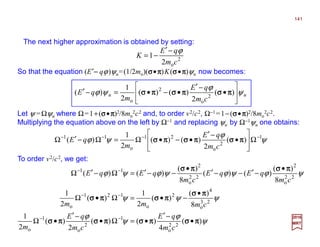
From First Principles
PART IV – QUANTUM FIELDS
March 2017 – R3.0
Maurice R. TREMBLAY
“A poet once said, ‘The whole universe is in a glass of wine.’ We will probably never know in what sense
he meant that, for poets do not write to be understood. But it is true that if we look at a glass of wine
closely enough we see the entire universe. There are the things of physics: the twisting liquid which
evaporates depending on the wind and weather, the reflections in the glass, and our imagination adds the
atoms. The glass is a distillation of the earth’s rocks, and in its composition we see the secrets of the
universe’s age, and the evolution of stars. What strange array of chemicals are in the wine? How did they
come to be? There are the ferments, the enzymes, the substrates, and the products. There in wine is
found the great generalization: all life is fermentation. Nobody can discover the chemistry of wine without
discovering, as did Louis Pasteur, the cause of much disease. How vivid is the claret, pressing its
existence into the consciousness that watches it! If our small minds, for some convenience, divide this
glass of wine, this universe, into parts – physics, biology, geology, astronomy, psychology, and so on –
remember that nature does not know it! So let us put it all back together, not forgetting ultimately what it
is for. Let it give us one more final pleasure: drink it and forget it all! ”
Richard Feynman
Epicatechin
TARTARIC ACID (C4H6O6)
2,3-dihydroxybutanedioic acid
Tartaric acid is, from a winemaking
perspective, the most important in wine
due to the prominent role it plays in
maintaining the chemical stability of the
wine and its color and finally in influencing
the taste of the finished wine. [Wikipedia]
MALIC ACID (C4H6O5)
hydroxybutanedioic acid
Malic acid, along with tartaric acid, is one of the
principal organic acids found in wine grapes. In
the grape vine, malic acid is involved in several
processes which are essential for the health
and sustainability of the vine. [Wikipedia]
CITRIC ACID (C6H8O7)
2-hydroxypropane-1,2,3-tricarboxylic acid
The citric acid most commonly found in wine
is commercially produced acid supplements
derived from fermenting sucrose solutions.
[Wikipedia]
Three primary acids are found in wine grapes:
RESVERATROL DERIVATIVES
trans cis
Malvidin-3-glucoeide
Procyanidin B1 Quercetin
R = H; resueratrol
R = glucose; p Ice Id
TYPICAL WINE FLAVONOIDS
Resveratrol (3,5,4'-trihydroxy-
trans-stilbene) is a stilbenoid,
a type of natural phenol, and
a phytoalexin produced
naturally by several plants.
[Wikipedia]
In red wine, up to 90% of the
wine's phenolic content falls
under the classification of
flavonoids. These phenols,
mainly derived from the
stems, seeds and skins are
often leached out of the
grape during the maceration
period of winemaking. These
compounds contribute to the
astringency, color and
mouthfeel of the wine.
[Wikipedia]
Prolog
2
Contents
PART IV – QUANTUM FIELDS
Review of Quantum Mechanics
Galilean Invariance
Lorentz Invariance
The Relativity Principle
Poincaré Transformations
The Poincaré Algebra
Lorentz Transformations
Lorentz Invariant Scalar
Klein-Gordon & Dirac
One-Particle States
Wigner’s Little Group
Normalization Factor
Mass Positive-Definite
Boosts & Rotations
Mass Zero
The Klein-Gordon Equation
The Dirac Equation
References
“It is more important to have beauty in one’s equations than to have them fit experiment … because the
discrepency may be due to minor features that are not properly taken into account and that will get
cleared up with further development of the theory….” Paul Dirac, Scientific American, May 1963.
2017
MRT
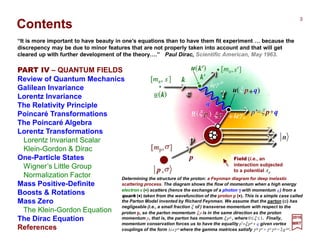
Determining the structure of the proton: a Feynman diagram for deep inelastic
scattering process. The diagram shows the flow of momentum when a high energy
electron e (••••) scatters (hence the exchange of a photon γγγγ with momentum q) from a
quark (••••) taken from the wavefunction of the proton p (••••). This is a simple case called
the Parton Model invented by Richard Feynman. We assume that the parton ( ) has
negligeable (i.e., a small fraction ξ of ) transverse momentum with respect to the
proton p, so the parton momentum ξ p is in the same direction as the proton
momentum p, that is, the parton has momentum ξ pµ , where 0≤ξ ≤1. Finally,
momentum conservation forces us to have the equality p′=ξ pµ + q given vertex
couplings of the form ±ieγ µ where the gamma matrices satisfy γ µ γ ν + γ νγ µ = 2g µν.
3
Field (i.e., an
interaction subjected
to a potential Aµ
2017
MRT
PART V – THE HYDROGEN ATOM
What happens at 10−−−−10 m?
The Hydrogen Atom
Spin-Orbit Coupling
Other Interactions
Magnetic & Electric Fields
Hyperfine Interactions
Multi-Electron Atoms and Molecules
Appendix - Interactions
The Harmonic Oscillator
Electromagnetic Interactions
Quantization of the Radiation Field
Transition Probabilities
Einstein’s Coefficients
Planck’s Law
A Note on Line Broadening
The Photoelectric Effect
Higher Order Electromagnetic Interactions
References
“Quantum field theory is the way it is because […] this is the only way to reconcile the principles of
quantum mechanics […] with those of special relativity. […] The reason that quantum field theory
describes physics at accessible energies is that any relativistic quantum theory will look at sufficiently
low energy like a quantum field theory.” Steven Weinberg, Preface to The Quantum Theory of Fields, Vol. I.
PART III – QUANTUM MECHANICS
Introduction
Symmetries and Probabilities
Angular Momentum
Quantum Behavior
Postulates
Quantum Angular Momentum
Spherical Harmonics
Spin Angular Momentum
Total Angular Momentum
Momentum Coupling
General Propagator
Free Particle Propagator
Wave Packets
Non-Relativistic Particle
Appendix: Why Quantum?
References
4
Review of Quantum Mechanics
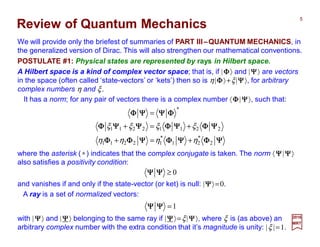
We will provide only the briefest of summaries of PART III–QUANTUM MECHANICS, in
the generalized version of Dirac. This will also strengthen our mathematical conventions.
It has a norm; for any pair of vectors there is a complex number 〈ΦΦΦΦ|ΨΨΨΨ〉, such that:
ΨΨΨΨΦΦΦΦΨΨΨΨΦΦΦΦΨΨΨΨΦΦΦΦΦΦΦΦ
ΨΨΨΨΦΦΦΦΨΨΨΨΦΦΦΦΨΨΨΨΨΨΨΨΦΦΦΦ
ΦΦΦΦΨΨΨΨΨΨΨΨΦΦΦΦ
2
*
21
*
12211
22112211
*
ηηηη
ξξξξ
+=+
+=+
=
POSTULATE #1: Physical states are represented by rays in Hilbert space.
where the asterisk (∗) indicates that the complex conjugate is taken. The norm 〈ΨΨΨΨ|ΨΨΨΨ〉
also satisfies a positivity condition:
A ray is a set of normalized vectors:
A Hilbert space is a kind of complex vector space; that is, if |ΦΦΦΦ〉 and |ΨΨΨΨ〉 are vectors
in the space (often called ‘state-vectors’ or ‘kets’) then so is η|ΦΦΦΦ〉+ξ|ΨΨΨΨ〉, for arbitrary
complex numbers η and ξ.
0≥ΨΨΨΨΨΨΨΨ
and vanishes if and only if the state-vector (or ket) is null: |ΨΨΨΨ〉=0.
with |ΨΨΨΨ〉 and |ΨΨΨΨ〉 belonging to the same ray if |ΨΨΨΨ〉=ξ|ΨΨΨΨ〉, where ξ is (as above) an
arbitrary complex number with the extra condition that it’s magnitude is unity: |ξ |=1.
1=ΨΨΨΨΨΨΨΨ
2017
MRT
5
POSTULATE #2: Observables are represented by Hermitian operators.
The above relation satisfies the reality condition:
ΦΦΦΦΨΨΨΨΦΦΦΦΨΨΨΨ AAA ηξηξ +=+
These are mappings |ΨΨΨΨ〉→A|ΨΨΨΨ〉 of Hilbert space into itself, linear in the sense that:
*†
ΦΦΦΦΨΨΨΨΨΨΨΨΦΦΦΦΨΨΨΨΦΦΦΦΦΦΦΦΦΦΦΦ AAA ===′
AA =†
( )Rinfor ΨΨΨΨΨΨΨΨΨΨΨΨ α=A
The state represented by a ray R has a definite value α for the observable
represented by an operator A if vectors |ΨΨΨΨ〉 belonging to this ray are eigenvalues of A
with eigenvalue α:
An elementary theorem tells us that for A Hermitian, α is real, and eigenvalues with
different αs are orthogonal.
2017
MRT
where the daggar (†) definies the Hermitian Operator and it indicates that the complex
conjugate (i.e., replacing i → −i) and transpose (i.e., matrix elements are ‘transposed’ on
either side of the diagonal, Aij →Aji ), A†=A*T, is taken. For any linear operator A the
adjoint A† is defined by the scalar product of |ΦΦΦΦ〉 and |ΦΦΦΦ′〉=|A†ΨΨΨΨ〉:
6
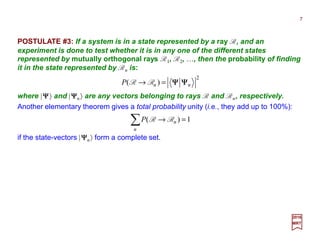
POSTULATE #3: If a system is in a state represented by a ray R, and an
experiment is done to test whether it is in any one of the different states
represented by mutually orthogonal rays R1, R2, …, then the probability of finding
it in the state represented by Rn is:
where |ΨΨΨΨ〉 and |ΨΨΨΨn〉 are any vectors belonging to rays R and Rn, respectively.
2
)( nnP ΨΨΨΨΨΨΨΨ=→ RR
Another elementary theorem gives a total probability unity (i.e., they add up to 100%):
if the state-vectors |ΨΨΨΨn〉 form a complete set.
1)( =→∑n
nP RR
2017
MRT
7
Let us now review symmetries: A symmetry transformation is a change in our
point of view that does not change the result of possible experiments.
For any such transformation R → R of rays we may define an operator U on Hilbert
space H , such that if |ΨΨΨΨ〉 is in ray R then U|ΨΨΨΨ〉 is in the ray R, with U either unitary and
linear:
or else antiunitary and antilinear:
If an inertial observer O (i.e., he ain’t movin’) sees a system in a state represented by
a ray R or R1 or R2, …, then an equivalent observer O (i.e., he’s moving away!) who
looks at the same system will observe it in a different state, represented by R or R1 or
R2, …, respectively, but the two observers must find the same probabilities:
)()( nOnO PP RRRR →=→
ΦΦΦΦΨΨΨΨΦΦΦΦΨΨΨΨ
ΨΨΨΨΦΦΦΦΨΨΨΨΦΦΦΦ
UUU
UU
βαβα +=+
=
ΦΦΦΦΨΨΨΨΦΦΦΦΨΨΨΨ
ΨΨΨΨΦΦΦΦΨΨΨΨΦΦΦΦ
UUU
UU
**
*
βαβα +=+
=
2017
MRT
This is a fundamental theorem from Wigner (1931): Any symmetry transformation can be
represented on the Hilbert spaceof physical states by an operator that is either
linear and unitary or antilinear and antiunitary.
8
As mentionned in the condition 〈ΦΦΦΦ|A†ΨΨΨΨ〉=〈AΦΦΦΦ|ΨΨΨΨ〉=〈ΨΨΨΨ|A†ΦΦΦΦ〉∗ above, the adjoint of a
linear operator L is defined by:
With this definition, the conditions for unitarity or antiunitarity both take the form:
ΨΨΨΨΦΦΦΦΨΨΨΨΦΦΦΦ LL ≡†
ΦΦΦΦΨΨΨΨΨΨΨΨΦΦΦΦΨΨΨΨΦΦΦΦ AAA =≡
*†
1=UU†
and there is always a trivial symmetry transformation R → R, represented by the
identity operator U=1. This operator is, of course, unitary and linear.
Continuity then demands that any symmetry (e.g., a rotation or translation or Lorentz
transformation) that can be made trivial by a continuous change of some
parameters (i.e., like angles or distances or velocities) must be represented by a
linear unitary operator U (rather than one that is antilinear and antiunitary).
This condition cannot be satisfied for an antilinear operator, because in this case the
right-hand side of the above equation would be linear in |ΦΦΦΦ〉, while the left-hand side is
antilinear in |ΦΦΦΦ〉. Instead, the adjoint of an antilinear operator A is defined by:
2017
MRT
1† −
=UU
Multiplying this unitary operator by it’s inverse U−1 wegetU†(UU−1)=1⊗U−1 =U−1. Thus:
9
A symmetry transformation that is infinitesimally close to being trivial can be re-
presented by a linear ‘unitary operator’ that is infinitesimally close to the identity:
The set of symmetry transformations has certain properties that define it as a group. If
T1 is a transformation that takes rays Rn into Rn, and T2 is another transformation that
takes Rn into Rn, then the result of performing both transformations is another symmetry
transformation, which we write T2T1 (T1 then T2) that takes Rn into Rn. Also, a symmetry
transformation T which takes rays Rn into Rn has an inverse, written T−1, which takes
Rn into Rn, and there is an identity transformation T =1, which leaves rays unchanged.
with ε a real infinitesimal (e.g., an infinitesimal change in the coordinates dxµ or an
angle dϕ). For this to be unitary and trivial, T must be Hermitian and linear, so it is a can-
didate for an observable. Indeed, most (and perhaps all) of the observables of physics
(e.g.,angularmomentumormomentum) arise in this way from symmetry transformations.
For φ =0, U(T) furnishes a representation of the group of symmetry transformations.
2017
MRT
The unitary operators U(T) act on vectors in the Hilbert space, rather than on rays. If
T1 takes Rn into Rn, then acting on a vector |ΨΨΨΨn〉 in the ray Rn, U(T1) must yield a vector
U(T1)|ΨΨΨΨn 〉 in the ray Rn, and if T2 takes this ray into Rn, then acting on U(T1)|ΨΨΨΨn〉 it must
yield a vector U(T2)U(T1)|ΨΨΨΨn〉 (again U(T1) then U(T2) but this time on |ΨΨΨΨn〉) in the ray Rn.
But U(T2T1)|ΨΨΨΨn〉 is also in this ray, so these vectors can differ only by a phase φn(T2,T1) :
)(e)()()(e)()( 12
),(
1212
),(
12
1212
TTUTUTUTTUTUTU TTi
n
TTi
n
nn φφ
=⇒= ΨΨΨΨΨΨΨΨ
)( 2
εε OTiU ++= 1
10
where Λµ
ν is a constant matrix (a function of the velocity v of a ‘moving’ frame). Under an
infinitesimal transformation of the variable θ, the coordinate differential dxµ is given by:








==≡+Λ=→ ∑=
c
xfaxxx
v
v βζµµ
ν
ν
ν
µµµ
tanh);()]([
3
0
θθθθ
θ
θ θ
µ
dxd
0=
∂
∂
≡
all
);( θθθθµµµµ
xf
so that the state vector |ψ 〉 will transform according to (i.e., by using Taylor’s expansion):
As an example of symmetry,consideratransformation (parametrizedbythevariableθ,
e.g., an angle ϕ,a translation a or aLorentzboostζ )onthespace-timecoordinates xµ :
in which the real infinitesimal is ε =dθ and the generator for the parameter θ is given by:
∑= =
∂
∂
∂
∂
−=
3
0 0
);(
)(
µ
µ
θ
µ
θ
θ
θ
x
xf
iT
all
ψεεψθψ
θ
θ
θψ
ψ
θ
θ
θψψψψψψ
µµ
µ
µ
θ
µ
µ
µ
µ
µ
θ
µ
µµ
µ
µ
µµµµµ
)]([)()()(
);(
)(
)(
);(
)()()()()(
2
0
0
OTixTdix
x
xf
idix
x
x
xf
dxx
x
dxxxdxx
T
++=+=








∂
∂
∂
∂
−+=
∂
∂
∂
∂
+≡
∂
∂
+≈+=→
∑
∑∑
=
=
111
44444 344444 21
)(Generator
all
all
2017
MRT
11
with f a(θ ,θ) a function of the θs and θs. Taking θ a =0 as the coordinate of the identity,
we must have:
)),(()()( θθθθ fTTT =
aaa
ff θθθ == ),0()0,(
As mentionned above, the transformation of such continuous groups must be represen-
ted on the physical Hilbert space by unitary operators U[T(θ )]. For a Lie group these op-
erators can be represented by a power series (e.g., in the neighborhoodof the identity):
A finite set of real continuous parameters θ a describe a group of transformations T(θ )
with each element of the group connected to the identity by a path (i.e., UU−1=1) within
the group. The group multiplication law U(T2)U(T1)=U(T2T1) thus takes on the form
(i.e., a connected Lie group):
According to f a(θ ,0)= f a(0 ,θ)=θ a above, the expansion of f a(θ ,θ) to second-order must
take the form:
2017
MRT
K+++= ∑∑∑ c b
bc
cb
a
a
a
TTiTU θθθθ
2
1
)]([ 1
where Ta, Tbc =Tcb, &c. are Hermitian operators independent of the θ s. Suppose that the
U[T(θ )] form an ordinary (i.e., φ =0) representation of this group of transformations, i.e.:
))],(([)]([)]([ θθθθ fTUTUTU =
...),( +⊕+= ∑∑c b
cba
bc
aaa
ff θθθθθθ
with real coefficients f a
bc. The addition of the second-order term is emphasized by ⊕.
12
(The Σ were also omitted to get space.) The terms of order 1, θ, θ, and θ 2 automatically
match on both sides of this equation – from the θ θ terms we get a non-trivial condition:
KKKK ++++++++=+++×+++ bc
ccbb
a
cba
bc
aa
bc
cb
a
a
bc
cb
a
a
TTfiTTitti ))(()(][][ 2
1
2
1
2
1 θθθθθθθθθθθθθθ 111
∑−−=
a
a
a
bccbbc TfiTTT
Since we are following Weinberg’s development, he points out that: This shows that if
we are given the structure of the group, i.e., the function f a(θ,θ ), and hence its quadratic
coefficient f a
bc, we can calculate the second-order terms (i.e., Tbc) in U[T(θ)] from the
generators Ta appearing in the first-order terms. (A pretty amazing fact wouldn’t you say?)
Applying the multiplication rule U[T(θ)]U[T(θ)]=U[T( f (θ ,θ )] and using the series
U[T(θ)]=1+iθ a Ta +½θ bθ c Tbc +…above withθ → f a (θ,θ)=θ a +θ a + f a
bc θ b θ c ,we get:
where Ca
bc are a set of real constants known as structure constants:
∑=−≡
a
a
a
bcbccbcb TCiTTTTTT ],[
2017
MRT
However, as he points out: There is a consistency condition: the operator Tbc, must be
symmetricinbandc(becauseitisthesecondderivativeof U[T(θ)]withrespect toθ b andθ c)
so the equation Tbc =−Tb Tc −iΣa f a
bc Ta above requires that the commutation relations be:
a
cb
a
bc
a
bc ffC +−=
Such a set of commutation relations is known as a Lie algebra to mathematicians.
13
This is the case for instance for ‘translations’ in spacetime, or for ‘rotations’ about any
one fixed axis(though not both together).Then the coefficients f a
bc in the function f a(θ,θ )
=θ a +θ a +Σbc f a
bc θ b θ c vanish,and so do the structure constants Ca
bc=− f a
bc+ f a
cb, that is
Ca
bc =0. So, [Tb ,Tc]≡TbTc −TcTb reduces to the fact that the generators then all commute:
aaa
f θθθθ +=),(
N
N
TUTU


















=
θ
θ)]([
Such a group is called Abelian. In this case, it is easy to calculate U[T(θ)] for all θ a.
Again, from the group multiplication rule U[T(θ)]U[T(θ)]=U[T( f (θ ,θ ))] and the function
f a(θ,θ)= θ a +θ a above, and taking ε=θ/N, we have for any integer N:
As a special case of importance, suppose that the function f a(θ,θ) is simply additive:
and hence:
0],[ =cb TT
2017
MRT
Letting N→∞, and keeping only the first-order term in U[T(θ /N)], we have then:
N
a
a
a
N
T
N
iTU
















+= ∑∞→
θ
θ 1lim)]([
TiTi
UTU a a
a
θθ
θθ e)(e)]([ =⇒=
∑
14
Lorentz invariance is needed to replace the principle of Galilean invariance and the
discovery of the non-conservation of parity in weak interactions (1956) has reemphasized
that an invariance principle and its consequences must be experimentally verified.
One key invariance principle in quantum mechanics and quantum field theory is that
(c.f., Review of Quantum Mechanics chapter): Different equivalent observers make
the same predictions as to the outcome of an experiment carried out on a system.
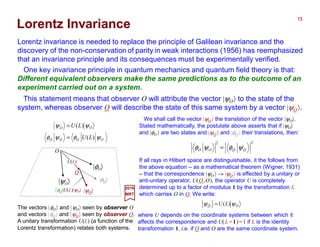
The vectors |φO〉 and |ψO〉 seen by observer O
and vectors |φO〉 and |ψO〉 seen by observer O.
A unitary transformation U(L) (a function of the
Lorentz transformation) relates both systems.
|φO〉
|ψO〉
We shall call the vector |ψO 〉 the translation of the vector |ψO〉.
Stated mathematically, the postulate above asserts that if |ψO〉
and |φO 〉 are two states and |ψO 〉 and |φO 〉 their translations, then:
OO
LU ψψ )(=
where U depends on the coordinate systems between which it
affects the correspondence and U(L ≡1)=1 if L is the identity
transformation 1 (i.e., if O and O are the same coordinate system).
If all rays in Hilbert space are distinguishable, it the follows from
the above equation – as a mathematical theorem (Wigner, 1931)
– that the correspondence |ψO 〉 → |ψO 〉 is effected by a unitary or
anti-unitary operator, U(O,O), the operator U is completely
determined up to a factor of modulus 1 by the transformation L
which carries O in O. We write:
22
OOOO ψφψφ =
|φO〉
|ψO〉
O
O
U(L)
OOOO
OO
LU
LU
ψφψφ
ψψ
)(
)(
=
=
2017
MRT
This statement means that observer O will attribute the vector |ψO〉 to the state of the
system, whereas observer O will describe the state of this same system by a vector |ψO〉.
〈φO |U(L)|ψO〉
Lorentz Invariance
15
U(v)
|ΨΨΨΨO 〉 |ΨΨΨΨO 〉p
σ
v
OO
z,z
sees sees
y
x
p
m
x
For special relativity, as an example, we consider the inhomogeneous Lorentz
transformations. A relativity invariance requires the vector space describing the possible
states of a quantum mechanical system to be invariant under all relativity
transformations (i.e., it must contain together with every |ψ 〉 all transformations U(L)|ψ 〉
where L is any special relativity transformation). The transformed states can always be
obtained from the original state by an actual physical operation on the system.
Consider for example a Lorentz transformation along the z-axis with velocity v. The
transformed state, which arises from the momentum eigenstate |ΨΨΨΨO(p,σ )〉, is given by
U(v)|ΨΨΨΨO(p,σ )〉. This is the state of the system as seen by observer O. It is, however, also
a possible state of the system as seen by O and which can be realized by giving the
system a velocity −v along the z-axis.
The state vector |ΨΨΨΨO〉 seen by observer O and
the vector | ΨΨΨΨO 〉 seen by observer O moving
away from O at velocity v. A unitary trans-
formation U(v) brings state |ΨΨΨΨO〉 into state |ΨΨΨΨO 〉.
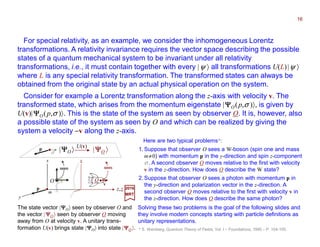
Here are two typical problems*:
1. Suppose that observer O sees a W-boson (spin one and mass
m≠0) with momentum p in the y-direction and spin z-component
σ . A second observer O moves relative to the first with velocity
v in the z-direction. How does O describe the W state?
2. Suppose that observer O sees a photon with momentum p in
the y-direction and polarization vector in the z-direction. A
second observer O moves relative to the first with velocity v in
the z-direction. How does O describe the same photon?
2017
MRT
* S. Weinberg, Quantum Theory of Fields, Vol. I – Foundations, 1995 – P. 104-105.
Solving these two problems is the goal of the following slides and
they involve modern concepts starting with particle definitions as
unitary representations.
16
The Relativity Principle
Einstein’s principle of relativity states the equivalence of certain ‘inertial’ frames of
reference. It is distinguished from the Galilean principle of relativity, obeyed by
Newtonian mechanics, by the transformation connecting coordinate systems in different
inertial frames.
2017
MRT
Here ηµν is the diagonal 4×4 matrix, with elements (i.e., the Minkowski metric): η00 =+1,
η11 =η22 =η33 =−1 and ηµν ≡0 for µ ≠ν. These transformations have the special property
that the speed of light c is the same in all inertial frames (e.g., a light wave traveling at
speed c satisfies |dr/dt|=c or in other words Σµνηµν dxµ dxν =c2dt2 − dr2 =0, from which it
follows that Σµνηµν dxµ dxν =0, and hence |dr /dt|=c).
If the contravariant vector xµ =(ct,r) are the coordinates in one inertial frame (x1, x2, x3)
[i.e., r = xi (i=1,2,3), as Cartesian space coordinates, and x0 =ct a time coordinate, the
speed of light being c] then in any other inertial frame, the coordinates xµ must satisfy:
OO
xdxdxdxd
FrameFrame
∑∑∑∑ = == =
≡
3
0
3
0
3
0
3
0 µ ν
νµ
µν
µ ν
νµ
µν ηη
or equivalently stated as the Principle of covariance:
∑∑ ∂
∂
∂
∂
=
µ ν
µνσ
µ
ρ
µ
σρ ηη
x
x
x
x
The covariant vector can be given as xµ=Σνηµν xν =(ct,−r). The norm of the vector
Σµ xµ xµ =(x0)−Σi(xi)2 =c2t2 −|r|2 is a Lorentz invariant term.
17
Poincaré Transformations
with aµ arbitraryconstants(e.g.,‘leaps’),and Λµ
ν aconstantmatrixsatisfyingthecondition:
Any coordinate transformation xµ → xµ that satisfies Σµνηµν (∂xµ /∂xρ )(∂xν /∂xσ )=ηρσ is
linear and allows us to define the Poincaré Transformations:
2017
MRT
µµµµµµ
ν
ν
ν
µµ
axxxxaxx +Λ+Λ+Λ+Λ=+Λ= ∑=
3
3
2
2
1
1
0
0
3
0
σρ
µ ν
σ
ν
ρ
µ
µν ηη =ΛΛ∑∑
The matrix ηµν has an inverse, written ηµν , which happens to have the same
components: it is also diagonal matrix, with elements: η00 =+1,η11 =η22 =η33 =−1 and
ηµν ≡0 for µ ≠ν.
To save on using summation signs (Σ), we introduce the Summation Convention:
We sum over any space-time index like µ and ν (or i, j or k in three dimensions) which
appears twice in the same term, if they appear only once ‘up’ and also only once ‘down’.
As an example, and while also enforcing this tricky summation convention, we now
multiply ηµµµµνννν Λµµµµ
ρ Λνννν
σ=ηρσ above with ησττττΛκ
ττττ and when inserting parentheses for show:
ρ
κ
ρ
κκ
ρ
κ
ρ
κ
ρ
κ
ρ ηηηηηηηηη µµµµνννν
µνµνµνµν
σσσσ
σσσσ
ττττσσσσ
ττττσσσσ
ττττσσσσ
ττττσσσσ
ννννµµµµ
µνµνµνµν
µνµνµνµν ττττσσσσ
ττττσσσσ
ττττσσσσ
ννννµµµµ
µνµνµνµν Λ=Λ=Λ=Λ=ΛΛΛ=ΛΛΛ∑ ∑ ][)(])[(])[(
44 34421
and now, when multiplying with the inverse of the matrix ηµµµµν Λµµµµ
ρ, we get from this:
ττττσσσσ
ττττσσσσ ηη κνκν
ΛΛ=
( )3,2,1,0=µ
18
2017
MRT
( )νρaxaxx andoversum,ρρρρνννν
νννν
ρρρρ
ρρρρ
ρρρρ
ρρρρ i.e.)( +ΛΛ=+Λ= µµµµ
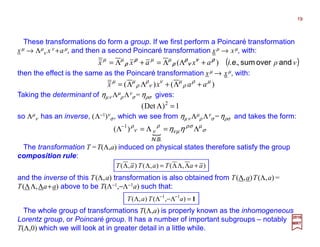
These transformations do form a group. If we first perform a Poincaré transformation
xµ → Λµ
ν xν +aµ, and then a second Poincaré transformation xµ → xµ, with:
)()( µρ
ρ
µν
ν
ρ
ρ
µµ
aaxx +Λ+ΛΛ=
then the effect is the same as the Poincaré transformation xµ → xµ, with:
Taking the determinant of ηµν Λµ
ρ Λν
σ=ηρσ gives:
so Λµ
ν has an inverse, (Λ−1)ν
σ, which we see from ηµν Λµ
ρ Λν
σ=ηρσ and takes the form:
{ σ
µσρ
µν
ρ
νν
ρ
ηη Λ=Λ=Λ−
N.B.
)( 1
1)Det( 2
=Λ
The transformation T =T(Λ,a) induced on physical states therefore satisfy the group
composition rule:
),(),(),( aaTaTaT +ΛΛΛ=ΛΛ
and the inverse of this T(Λ,a) transformation is also obtained from T(Λ,a)T(Λ,a)=
T(ΛΛ,Λa+a) above to be T(Λ−1,−Λ−1a) such that:
The whole group of transformations T(Λ,a) is properly known as the inhomogeneous
Lorentz group, or Poincaré group. It has a number of important subgroups –
notably T(Λ,0) which we will look at in greater detail in a little while.
1=Λ−ΛΛ −−
),(),( 11
aTaT
19
and this unitary operator U satisfies the same group composition rule as T(Λ,a):
So, in accordance with the discussion in the previous slides, the transformations T(Λ,a)
induced a unitary linear transformation on a state vector in the Hilbert space:
For example, we will soon discuss the wave function in its momentum representation:
for which the same composition rule applies:
2017
MRT
)]()([)]([)]([),( 1
pLpLUpLUpLUpU ΛΛΛ=Λ≡Λ −
),(),(),(),;( jjj mppUmpmjp ΨΨΨΨΨΨΨΨΨΨΨΨ Λ=→µ
)(),()()( xaUxx ψψψ µ
Λ=→
),(),(),( aaUaUaU +ΛΛΛ=ΛΛ
20
Now it is time to study three-dimensional rotations and add relativity to the overall
description. To this effect we will exploit pretty much all the group symmetry properties!
2017
MRT
ζζβγ
ζζβγ
sinhcosh)(
sinhcosh)(
03033
22
11
30300
xxxxx
xx
xx
xxxxx
−=−=
=
=
−=−=
and v=|v| is the relative velocity of the two frames.
or (N.B., implicit sum on ν ):
β
ζ
ζ
ζβγβζ
β
ζγ ==





==
−
==
cosh
sinh
tanhsinh
1
1
cosh
2
aswellaswithand
c
v


























−
−
=














3
2
1
0
3
2
1
0
cosh00sinh
0100
0010
sinh00cosh
x
x
x
x
x
x
x
x
ζζ
ζζ
that is, assuming propagation in the direction of the x3-axis. This can be represented in
matrix form as:
Let us recall a few facts about homogeneous Lorentz transformations:
where:
ν
ν
µνµµ
ζ xxxx )],-([Λ=
21
The explicit matrix representation of a restricted homogeneous Lorentz transformation
in the x1-direction (i.e., a rotation in the x0-x1 plane) is given by:
Similarly, the infinitesimal generators M02 and M03 for rotations in the x0-x2 and x0-x3
planes respectively, are given by:
and the infinitesimal generator M10 for this rotation is defined as:












−
−
=
1000
0100
00coshsinh
00sinhcosh
)(Λ[01] ζζ
ζζ
ζ












==≡
=
0000
0000
0001
0010
)(Λ
0
[01]
10
1
ζ
ζ
ζ
d
d
MK












==≡












==≡
==
0001
0000
0000
1000
)(Λ
0000
0001
0000
0100
)(Λ
0
[03]
03
3
0
[02]
02
2
ζζ
ζ
ζ
ζ
ζ
d
d
MK
d
d
MK ,
2017
MRT
22
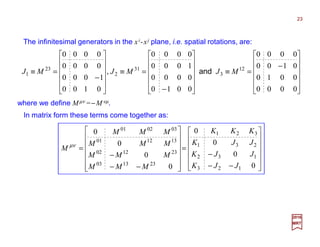
The infinitesimal generators in the xi-xj plane, i.e. spatial rotations, are:
2017
MRT












−
=≡












−
=≡












−
=≡
0000
0010
0100
0000
0010
0000
1000
0000
0100
1000
0000
0000
12
3
31
2
23
1 MJMJMJ and,
where we define Mµν =−Mνµ.
In matrix form these terms come together as:












−−
−
=














−−
−
=
0
0
0
0
0
0
0
0
123
132
231
321
231303
231202
131201
030201
JJK
JJK
JJK
KKK
MMM
MMM
MMM
MMM
M µν
23
The general result for Mµν can now be written alternatively as:
2017
MRT
where we can use ηµν Λµ
ρ Λν
σ=ηρσ to show that ωµν (or ωµ
ν ) is antisymmetric ωµν =−ωνµ :
µν
µν M
i
ω
2
1
1)ω(Λ
h
+=
which implies ωρσ +ωσρ =0 QED.
An arbitrary infinitesimal Lorentz transformation, by expanding according to Λ(ω)=
exp(−½iMµν ωµν /h) in a power series, can be written as:
KζSω •−•=L
and
KζSω •−•
= eA
where ωωωω and ζζζζ are constant 3-vectors.
ρσσρσρ
ρ
µ
σµσ
ν
νρσρ
σ
ν
ρ
µ
σ
ν
ρ
µ
σ
ν
ρ
µ
µν
σ
ν
σ
ν
ρ
µ
ρ
µ
µνσρ
η
ηηη
δδδδη
δδηη
ωω
ωω
)ωω(
)ω)(ω(
++=
++=
++=
++=
24
A finite rotation in the µ -ν plane (in the sense µ toν ), is again obtained by
exponentiation:
2017
MRT
ζνµ µν
ζ M
xx e),-(Λ =
µσνρνρµσµρνσνσµρρσµν
ηηηη MMMMMM −−+=],[
One verifies that the infinitesimal generators, Mµν ,satisfy the following commutation
rules:
25








∂
∂
=
∂
∂
−=
∂
∂
−=
∂
∂
∂
∂
−=•
=
kj
kji
ikji
kji
k
k
k
x
xi
x
xi
x
i
x
xf
i
εε
ζ
ζ
ϕ
µ
)ˆ()ˆ()ˆ(
);(ˆˆ
0
nnrn
Jn
××××
hence:
kj
kjii
x
xiJ
∂
∂
= ε
For the rotation acting on the space-time coordinates, note that the time coordinate is
unaffected (hence only latin indices):



•−=
−•−+=
=
+−+==≡
ζζ
ζζ
ϕϕϕϕµµ
sinhˆcosh
]sinhˆ)1[(coshˆ
]ˆ[sin)]ˆ(ˆ)[cos1()],ˆ([);(
rn
nrnrr
rnrnnn
cttc
ct
xxRxfx kkki
i
k
××××××××××××
in which we made use of the relation xj =ηij xj =−x j, η being the Minkowski 3-metric. It can
be shown that the generators for rotation are equivalent to the generators for the SO(3)
Special Orthogonal group (which are Hermitian). Thus, the representation for a finite
rotation acting on the wavefunction is unitary and it is given by U(R)=exp(−iϕ n•J/h).ˆ
2017
MRT
where v=ctanhζ n. So, we get:ˆ
26
The general Lorentz transformations for a simple spatial rotation, ΛR, is given by:
in which the three-dimensional spatial rotations, Rn(ϕ), are elements in the simple
orthogonal group SO(3). However, this is not relavant for evaluating the Wigner
coefficients since it is trivial to show that both the Wigner transformation and Lorentz
rotation, ΛR, belong to the same little group H(Λ,k).
µν
µν
ω
2
1
e)ω(
M
i
h
−
=Λ
Note that the parameters associated with the Lorentz transformation are given by the
anti-symmetric tensor ωµν. (In addition, the matrix representations of the Lorentz
generators in the four-vector coordinates are given by:






−
=





= iab
i
ai
bi
i
i
J
i
i
K
εδ
δ
0
00
0
0
and
where the indices a, b represent the rows and columns, respectively.)
The convenional way of characterizing the Lorentz transformation, Λ, is described by
the generators for boosts with Ki =M0i =−Mi0 and rotations Ji =½ε ijk Mjk, that is:
ˆ












=Λ
0
)]([0
0
0001
)(
ˆ j
iR
R ϕ
ν
µ
n
2017
MRT
27
in which we recall that coshζ =γ and sinhζ =βγ where γ =1/√(1−β2) and β =v/c. In four-
vector notation we have:














+
+
=


























=














ζζ
ζζ
ζζ
ζζ
coshsinh
sinhcosh
cosh00sinh
0100
0010
sinh00cosh
30
2
1
30
3
2
1
0
3
2
1
0
xx
x
x
xx
x
x
x
x
x
x
x
x
);()]([ ζζ µν
ν
µµ
xfxx ≡Λ=
and the associated generator is given as:
Now, consider a Lorentz boost along the x3-axis:
since Λ0
0|ζ =0 =coshζ |ζ =0=1, &c.






∂
∂
−
∂
∂
=





∂
∂
+
∂
∂
−=








∂
∂
∂
Λ∂
+
∂
∂
∂
Λ∂
+
∂
∂
∂
Λ∂
+
∂
∂
∂
Λ∂
−=
∂
∂
∂
Λ∂
−=
∂
∂
∂
∂
−=
====
==
30033
0
0
3
3
3
0
3
3
3
0
0
0
3
0
3
0
3
0
0
0
0
0
0
00
3
);(
x
x
x
xi
x
x
x
xi
x
x
x
x
x
x
x
xi
x
xi
x
xf
iK
ζζζζ
µ
ν
ζ
ν
µ
µ
ζ
µ
ζζζζ
ζζ
ζ
2017
MRT
28
Similarly:
)( 0000 iiiii xxi
x
x
x
xiK ∂−∂=





∂
∂
−
∂
∂
=
†
00
])([)()()( xKx
x
xx
x
xixK iiii ψψψψ ≠





∂
∂
−
∂
∂
=
Consider that the state-vector of the system is given by |ψ 〉, hence the action of Ki on
the state is:
This implies that the generator for the Lorentz boost, Ki, is not Hermitian and hence the
exponentiation of the generator (i.e., exp(−iζ i Ki /h)) will not be unitary. The
representation of the Lorentz boost acting on the wavefunction is not unitary and hence
is not trace-preserving.
We can summarize the effects of the rotations and the Lorentz boost into one second-
rank covariant tensor:
)( µννµµν ∂−∂= xxiM
in which Ji =½ε ijk Mjk and Ki =Mi0.
2017
MRT
29
These generators (i.e., Pµ and Mµν ) obey the following commutation relations, which
characterize the Lie algebra of the Poincaré group (and adding h and c for reference):
kkjijikkjijikkjiji JiKKKiKJJiJJ εεε hhh −=== ],[],[],[ and;
0],[
)(],[
)(],[
=
−−=
−+−−=
λµ
νµλµνλλµν
νρµσµρνσµσνρνσµρµνρσ
ηη
ηηηη
PP
PPiPM
MMMMiMM
h
h
The rotation Ji and boost Kj generators can be written in covariant notation Mµν and
the commutation relations are then re-written as:
2017
MRT
00
],[],[],[ P
c
iPKcPiPKPiPJ jijiiikkjiji δε
h
hh === and;
0],[0],[0],[ 00
=== jiii PPPPPJ and;
The first of these is the usual set of commutators for angular momentum, the second
says that the boost K transforms as a three-vector under rotations, and the third implies
that a series of boosts can be equivalent to a rotation. Next we have:
where P0c=H, the Hamiltonian, and finally all components of Pµ should commute with
each other:
Together, these equations above form the Lie algebra of the Poincaré group.
30
we get:
µµµµµ
axaxfx +=≡ );(



≠=
==
=
∂
∂
=
νµ
νµ
δ ν
µ
ν
µ
µ when
when
0
1);(
0a
a
axf
and using:
ννµν
µ
ν δ ∂−=
∂
∂
−=
∂
∂
−= hhh i
x
i
x
iP
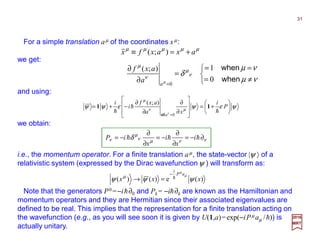
For a simple translation aµ of the coordinates xµ:
that is, the momentum operator. For a finite translation aµ, the state-vector |ψ 〉 of a
relativistic system (expressed by the Dirac wavefunctionψ ) will transform as:
)(e)()( xxx
aP
i
ψψψ
µ
µ
µ h
−
=→
Note that the generators P0 =−ih∂0 and Pk = −ih∂k are known as the Hamiltonian and
momentum operators and they are Hermitian since their associated eigenvalues are
defined to be real. This implies that the representation for a finite translation acting on
the wavefunction (e.g., as you will see soon it is given by U(1,a)=exp(−iPµ aµ /h)) is
actually unitary.
2017
MRT
ψεψεψψ µν
µ
ν






+=








∂
∂
∂
∂
−+=
=
P
i
xa
axf
i
i
a
h
h
h
11
0
);(
all
we obtain:
31
µ
µ
µ
aP
i
aIU h
−
× = e),( 44
00
ωωω iiiji
kjik −=== ζεϕ and
0
2
1
iikj
kjii
MKMJ == andε
The contravariant generators for the space-time translations aµ are defined by Pµ, in
which the time translation, P0 and the spatial translation, Pi are the Hamiltonian and
momentum operators, respectively, of a free particle. The finite translations acting on the
space-time coordinates are well-defined (with no Lorentz transformation):
µν
µν
ω
2
1
e)ω(
M
i
h
−
=Λ
The Lorentz transformation can be described by its generators (without translation):
Here ζ i is the Lorentz boost along the i-th axis, and θk are the parameters involved in
the rotation along the axial vector. The generators for these Lorentz transformations are
given by Mµν have been explicitely derived previously. Here the generators for the
spatial rotation Ji and Lorentz boost Ki are given by:
with the corresponding covariant generators Pµ =ηµν Pν .
The Lorentz transformation Λ can be described by an antisymmetric second-rank
tensor ωµν which is defined by the parameters in Λ:
2017
MRT
32
and it produces the following space-time coordinate transformation:
In general, the elements of the Poincaré group are given as:






+−−−
==Λ
µν
µν
µ
µ
µ
µ
µν
µν ω
2
1
ω
2
1
eee),(
MaP
i
aP
i
M
i
aU hhh
in which Pµ is the momentum of the particle in the new coordinate frame.
µν
ν
µµµ
axxx +Λ=→
µν
ν
µµµ
PPPP +Λ=′→
Similarly, the momentum of a free particle also transforms according to:
By definition, a momentum contravariant four-vector is given by Pµ Pµ =(P0/c)2 −(Pi )2 =
(E/c)2−|p|2 =mo
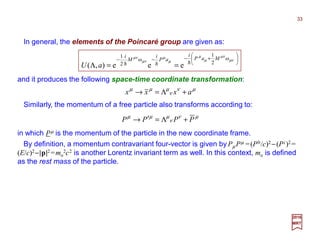
2c2 is another Lorentz invariant term as well. In this context, mo is defined
as the rest mass of the particle.
2017
MRT
33
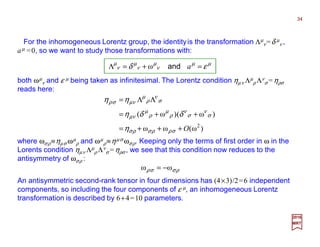
For the inhomogeneous Lorentz group, the identityis the transformation Λµ
ν=δ µ
ν ,
aµ =0, so we want to study those transformations with:
µµ
ν
µ
ν
µ
ν
µ
εδ =+=Λ aandω
where ωσρ≡ηµσ ωµ
ρ and ωµ
ρ≡ηµσ ωσρ. Keeping only the terms of first order in ω in the
Lorents condition ηµν Λµ
ρ Λν
σ=ηρσ , we see that this condition now reduces to the
antisymmetry of ωσρ :
both ωµ
ν and ε µ being taken as infinitesimal. The Lorentz condition ηµν Λµ
ρ Λν
σ=ηρσ
reads here:
An antisymmetric second-rank tensor in four dimensions has (4×3)/2=6 independent
components, so including the four components of ε µ, an inhomogeneous Lorentz
transformation is described by 6+4=10 parameters.
2017
MRT
34
ρσσρ ωω −=
)ω(ωω
)ω()ω(
2
O+++=
++=
ΛΛ=
σρρσρσ
σ
ν
σ
ν
ρ
µ
ρ
µ
µν
σ
ν
ρ
µ
µνσρ
η
δδη
ηη
Since U(1,0) carries any ray into itself, it must be proportional to the unit operator, and
by a choice of phase may be made equal to it.For an infinitesimal Lorentz transformation
Λµ
ν=δ µ
ν +ωµ
ν andaµ =εµ,U(1+ω,ε) must then equal 1 plus terms linear in ωρσ and ερ .We
write this as:
...ω
2
1
),ω( ++−=+ σρ
σρ
ρ
ρεε M
i
P
i
U
hh
11
σρσρρρ
MMPP == ††
)()( and
Since ωρσ is antisymmetric, we can take its coefficients Mρσ to be antisymmetric also:
Here Pρ and Mρσ are ε- and ω-independent operators, respectively, and the dots denote
terms of higher order in ε and/or ω. In order for U(1+ω,ε) to be unitary, the operators Pρ
and Mρσ must be Hermitian:
2017
MRT
As we shall see, P1, P2, and P3 are the components of the momentum operator, M23,
M31, and M12 are the components of the angular momentum vector, and P0 is the energy
operator, or Hamiltonian.
ρσσρ
MM −=
35
]ω,ω)([
]ω)(,ω)([
]ω)(,ω)([
]ω)(,ω)[(),(
])ω)((,ω)[(),(),(),ω(),(),(),ω(),(
11
111
11
ω)(ω)(
11
11
ω
111
11
11
aU
aaaU
aaU
aUaU
aUaUaUUaUaUUaU
aaaa
aaa
−−
−−−
−−
+Λ+−=Λ+=Λ=Λ=Λ
−−
−−
Λ−=Λ=Λ=+=Λ
−−−
ΛΛ−ΛΛ+Λ≡
ΛΛ+Λ+ΛΛ−Λ+Λ=
+Λ+Λ+Λ−Λ+Λ=
+Λ+−Λ+Λ=
+Λ−+Λ+Λ=Λ−Λ+Λ=Λ+Λ
−−
−−
ε
ε
ε
ε
εεε
ε
ε
1
1
11
11
1111
11
1
4444444 34444444 21
4444 34444 21
&;;
&;;
2017
MRT
where Λµ
ν and aµ are here the parameters of a new transformation, unrelated to ω and
ε.
Let us consider the Lorentz transformation properties of Pρ and Mρσ. We consider the
product:
),(),( 1
aUaU Λ+Λ −
),(1 εεεεωωωωU
In the end the transformation rule is given by:
],[),(),(),( 111
aUaUUaU −−−
ΛΛ−ΛΛΛ+≡Λ+Λ ωωωωωωωωωωωω εεεεεεεε 11
since Λ1Λ−1= 1.
According to the composition rule T(Λ,a)T(Λ,a)= T(ΛΛ,Λa+a) with T =U(Λ,a) the
product U(Λ−1,−Λ−1a) U(Λ,a) equals U(1,0), so U(Λ−1,−Λ−1a) = U−1(Λ,a), i.e., U(Λ−1,−Λ−1a)
is the inverse of U(Λ,a). It follows from U(Λ,a)U(Λ,a)= U(ΛΛ,Λa+a) that, in sufficient
detail to show these important group operations so that they be well understood, we have:
36
2017
MRT
Using U(1+ω,ε)=1−(i/h)ερ Pρ +½(i/h)ωρσ Mρσ to first order in ω and ε we have then:
)(ω
2
1
)(
2
1
)(
2
1
ω
ω
2
1
)(ω
2
1
])(ω[
)ω(
2
1
)ω(),(ω
2
1
),(
1
1
111
µννµµνσ
ν
ρ
µρσ
µρ
µρ
µννµνµµνσ
ν
ρ
µρσ
µρ
µρ
µνσ
ν
ρ
µρσ
µν
ν
σ
ρσ
ρ
µ
µν
ν
σ
ρσ
ρ
µ
µ
ρ
ρ
µ
µν
µν
µ
µ
σρ
σρ
ρ
ρ
ε
ε
ε
εε
PaPaM
i
P
i
PaPaPaPa
i
P
i
M
i
M
i
PaP
i
M
i
Pa
i
aUM
i
P
i
aU
−−ΛΛ+Λ−=






++−ΛΛ+
Λ−
ΛΛ+=
ΛΛ+
ΛΛ−Λ−=
ΛΛ+ΛΛ−Λ−=Λ





+−Λ
−
−
−−−
hh
h
h
h
h
h
hhhh
1
1
1
11
Equating coefficients of ωρσ and ερ on both sides of this equation we find:
)(),(),(
),(),(
1
1
µννµµνσ
ν
ρ
µ
σρ
µρ
µ
ρ
PaPaMaUMaU
PaUPaU
−−ΛΛ=ΛΛ
Λ=ΛΛ
−
−
where we have exploited the antisymmetry of ωρσ , i.e., ωρσ =−ωσρ , and we have used
the inverse (Λ−1)ν
σ =Λν
ρ =ηνµ ηρσ Λµ
ρ.
37
Next, let’s apply these rules rules to a transformation that is itself infinitesimal, i.e.,
Λµ
ν=δ µ
ν +ωµ
ν and aµ =ε µ, with infinitesimals ωµ
ν andεµ unrelated to the previous ω
and ε.
2017
MRT
Equating coefficients of ωρσ and ερ on both sides of these equations, we would find
these commutation rules:
µρνσρνµσσνρµµσρνρσµν
ρσµσρµρσµ
ρµ
ηηηη
ηη
MMMMMM
i
PPMP
i
PP
+−+=
−=
=
],[
],[
0],[
h
h
This is the Lie algebra of the Poincaré group.
µρ
µ
ρµ
µ
µν
µν ε PPPM
i
ω,ω
2
1
=





−
h
νρσ
ν
µσρ
µ
ρσσρµνµ
µ
µν
µν εεε MMPPMPM
i
ωω,ω
2
1
+++−=





−
h
and
By using U(1+ω,ε)=1−(i/h)ερ Pρ +½(i/h)ωρσ Mρσ and keeping only terms of first order
in ωµ
ν andε µ, our equations for Pρ and Mρσ become:
38
In quantum mechanics a special role is played by those operators that are conserved,
i.e., that commute with the energy operator H=P0. We just saw that [Pµ,Pρ]=0 and
(i/h)[Pµ,Mρσ ]=ηµρPσ−ηµσ Pρ shows that these are the momentum three-vectors:
2017
MRT
and the angular momentum three-vector:
These are not conserved, which is why we do not use the eigenvalues of K to label
physical states. In a three-dimensional notation, the commutation relations may be
written:
where i, j, k, &c. run over the values 1, 2, and 3, and εijk is the totally antisymmetric
quantity with ε123 =+1. The commutation relation [Ji ,Jj ]=iεijk Jk is the angular-
momentum operator.
],,[ 321
PPP=P
],,[],,[ 211332123123
JJJJJJ −−−==J
and the energy P0 itself. The remaining generators form what is called the ‘boost’ three-
vector:
],,[],,[ 030201302010
JJJJJJ −−−==K
jijikjkiji
kjkijikjkijikjkiji
iiii
HiPKPiPJ
JiKKKiKJJiJJ
PiHKHHHPHJ
δε
εεε
==
−===
====
],[],[
],[],[],[
],[0],[],[],[
and
and,
and
39
Now,* there is one peculiar consequence to one of these commutators – the two boost
generators are:
2017
MRT
This commutator means that two boosts, Bi and Bj , in different directions (i.e., the
indices i and j can’t equal each other at the same time) are not equivalent to a single
boost B:
where B is some boost. The reason things aren’t equal is the factor Wn××××m(Ω), the Wigner
Rotation where Ω is the Wigner Angle (i.e., a true space-time rotation although to be
realistic, for practical reason it is usually an infinitesimal one.)
BWBB )(ˆˆˆˆ Ω= mnmn ××××
kjkiji JiKK ε−=],[
)()()()( ˆˆˆˆ
1
ˆˆˆˆˆˆ Ω=ΩΩΩ= −
mnmnmnmnmn ×××××××××××××××× WBWBWWBB
* Credit for developing this in the way it is shown here (and in the next few slides), with an example of which is given pretty
much as it is, is much due to Entanglement in Relativistic Quantum Mechanics, E. Yakaboylu, arxiv:1005.0846v2, August 2010.
By using B=WBW−1, the expression Bn Bm =Wn××××m (Ω)B above can be re-written as:ˆ
ˆ ˆ
ˆ ˆ ˆ
40
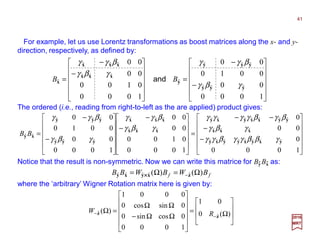
For example, let us use Lorentz transformations as boost matrices along the x- and y-
direction (i.e., along x and y unit vectors), respectively, as defined by:
2017
MRT
Notice that the result is non-symmetric. Now we can write this matrice for By Bx as:
ff BWBWBB )()( ˆˆˆˆˆ Ω=Ω= −zxyxy ××××
where the ‘arbitrary’ Wigner Rotationmatrixhereis givenby(N.B., yes,aroundnegativez):












−
−
−−
=












−
−












−
−
=
1000
0
00
0
1000
0100
00
00
1000
00
0010
00
ˆˆˆˆˆˆˆˆ
ˆˆˆ
ˆˆˆˆˆˆˆ
ˆˆˆ
ˆˆˆ
ˆˆˆ
ˆˆˆ
ˆˆ
yxyxyyxy
xxx
yyxxyxy
xxx
xxx
yyy
yyy
xy
γββγγβγγ
γβγ
βγβγγγγ
γβγ
βγγ
γβγ
βγγ
BB








Ω=












ΩΩ−
ΩΩ
=Ω
−
− )(0
01
1000
0cossin0
0sincos0
0001
)(
ˆ
ˆ
z
z RW
The orderedproduct (i.e.,reading“right-comes-after-left”as the product ByBx is applied)is:












−
−
=












−
−
=
1000
00
0010
00
1000
0100
00
00
ˆˆˆ
ˆˆˆ
ˆ
ˆˆˆ
ˆˆˆ
ˆ
yyy
yyy
y
xxx
xxx
x
γβγ
βγγ
γβγ
βγγ
BB and
ˆ ˆ
41
ˆˆ
ˆ ˆ
ˆ
The result of the (group) matrix multiplication is (N.B., remember that M−1 =η MT η):
2017
MRT
The Wigner angle Ω can be obtained by demanding that the Bf matrix be symmetric in,
say, its M23 and M32 components:
and after solving for the ratio sinΩ/cosΩ=tanΩ we get:












ΩΩ+ΩΩ−Ω−
Ω−Ω−ΩΩ+Ω−
−−
=












−
−
−−












ΩΩ
Ω−Ω
=Ω= −
−
1000
0coscossincossin
0sinsincossincos
0
1000
0
00
0
1000
0cossin0
0sincos0
0001
)(
ˆˆˆˆˆˆˆˆˆˆˆ
ˆˆˆˆˆˆˆˆˆˆˆ
ˆˆˆˆˆˆˆ
ˆˆˆˆˆˆˆˆ
ˆˆˆ
ˆˆˆˆˆˆˆ
ˆˆ
1
ˆ
yxyxyxyxyxx
yxyxyxyxyxx
yyxxyxy
yxyxyyxy
xxx
yyxxyxy
xyz
γββγγγβγγβγ
γββγγγβγγβγ
βγβγγγγ
γββγγβγγ
γβγ
βγβγγγγ
BBWBf
Ω+Ω=Ω− cossinsin ˆˆˆˆˆˆ xyxyxy ββγγγγ
xy
xyxy
ˆˆ
ˆˆˆˆ
tan
γγ
ββγγ
+
−=Ω
or:
1
cos
1
sin
ˆˆ
ˆˆ
ˆˆ
ˆˆˆˆ
+
+
−=Ω
+
−=Ω
xy
xy
xy
xyxy
γγ
γγ
γγ
ββγγ
and
42
By replacing sinΩ and cosΩ in the boost matrix Bf one gets:
2017
MRT
Notice now that this Bf matrix is symmetric. So, as a result in this case (i.e., a boost
along the x-direction followed by a boost in the y-direction), we obtain a boost along
‘some’ direction given by Ω=tan−1[− βxγx βyγ y /(γx+γy)] in the x-y plane.




















+
+
+
−
++
+−
−−
=Ω= −
−
1000
0
1
)(
1
0
11
1
0
)(
ˆˆ
ˆˆˆ
ˆˆ
2
ˆˆˆˆ
ˆˆ
ˆˆ
2
ˆˆˆˆ
ˆˆ
2
ˆ
2
ˆ
2
ˆ
ˆˆˆ
ˆˆˆˆˆˆˆ
ˆˆ
1
ˆ
yx
yxy
yx
yyxx
yy
xy
yyxx
yx
yxx
yxx
yyyxxyx
xyz
γγ
γγγ
γγ
γβγβ
βγ
γγ
γβγβ
γγ
γβγ
γβγ
βγγβγγγ
BBWBf
mnmn ˆˆ
1
ˆˆ )( BBWB Ω= −
××××
Note that we can read BnBm =Wn××××m (Ω)Bf (e.g., By Bx =Wy××××x (Ω)Bf =W−z (Ω)Bf in the
example above) backward to note that any boost B in the n-m (e.g., the x-y plane in the
example above) can be decomposed into two mutually perpendicular boosts (in order)
followed by a Wigner rotation (using group algebra – we mean it’s inverse)*:
ˆ ˆ ˆ ˆ ˆ ˆ ˆ ˆ ˆ
ˆ ˆ ˆ ˆ
* Credit for this notation is based on Generic composition of boosts: An elementary derivation of the Wigner rotation, R.
Ferraro and M. Thibeault, Eur. J. Phys. 20 (1999) 143-151.
This result will be used later when we discuss particle representation in quantum field
theory using Wigner basis states and especially when we calculate one first hand…
ˆ ˆ ˆ ˆ ˆ ˆ ˆ ˆ
43
Since we will be using this soon let us look at a general example. Suppose that a parti-
cle of mass mo is seen from system O with momentum p along the +z-axis. A second ob-
server sees the same particle from a system O moving with velocity v along the +x-axis:












ΩΩ
Ω−Ω−Ω+Ω−−
Ω+ΩΩ−Ω
=












ΩΩ
Ω−Ω
ΩΩ












−
−
=












ΩΩ
Ω−Ω












+
+












−
−
=ΛΛ=Λ −
−−=
cos0sin
0100
sincos0cossin
sincos0cossin
cos0sin
0100
sin0cos0
cos0sin
1000
0100
00
00
cos0sin0
0100
sin0cos0
0001
00
0100
0010
00
1000
0100
00
00
),()()(
ˆˆˆˆ
ˆˆˆˆˆˆˆˆˆˆˆˆˆ
ˆˆˆˆˆˆˆˆˆˆˆˆ
ˆˆˆˆ
ˆˆˆˆˆ
ˆˆˆ
ˆˆˆ
ˆˆˆ
ˆˆˆ
ˆˆˆ
ˆˆˆ
1
ˆˆˆˆˆˆ
zzzz
xzzxxxzzxxzxx
xxzzxxxzzxzx
zzzz
zzzzz
xxx
xxx
zzz
zzz
xxx
xxx
yzxyzx
γγγβ
γγβγβγγβγβγγβ
γβγβγγβγβγγγ
γγγβ
γβγβγ
γγβ
γβγ
γγβ
γβγ
γγβ
γβγ
pWpLpL ××××
2017
MRT







+
−=Ω⇒
+
−=Ω=
Ω
Ω
Ω=Ω+−⇒Ω=Ω−Ω−
zx
zzxx
zx
zzxx
zzxxzxzxzzxx
ˆˆ
ˆˆˆˆ
ˆˆ
ˆˆˆˆ
ˆˆˆˆˆˆˆˆˆˆˆˆ
arctantan
cos
sin
cossin)(sinsincos
γγ
γβγβ
γγ
γβγβ
γβγβγγγγγβγβ
Since Lx××××z(Λp) is symmetric we can extract the [Lx××××z(Λp)]3
2=[Lx××××z(Λp)]2
3 components:ˆ ˆ ˆ ˆ ˆ ˆ
44
px
W−−−−y(Λ,p)
Now, since:
This provides us with the three Cartesian values for the boosted
momentum:
2017
MRT
y
mo
Suppose that observer O sees a particle
(mass mo ≠0) with momentum pz in the z-
direction. A second observer O moves relative
to the first with velocity v in the x-direction.
How does O describe the particle’s motion?
Λp
)ˆˆ(ˆˆ ˆˆˆˆˆoˆˆ kikip zzzxxzx γβγγβ +−=+−=Λ cmpp
pz
Λ(v)
y
x
v ↑












−−
−
=
























−
−
=Λ
zzz
zzxxxzxx
zzxxxzx
zzz
zzz
xxx
xxx
zx
ˆˆˆ
ˆˆˆˆˆˆˆˆ
ˆˆˆˆˆˆˆ
ˆˆˆ
ˆˆˆ
ˆˆˆ
ˆˆˆ
ˆˆ
00
0100
0
0
00
0100
0010
00
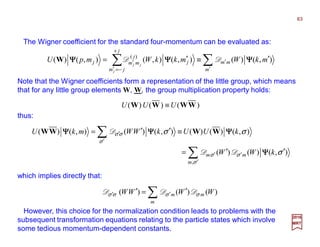
1000
0100
00
00
)(
γγβ
γβγβγγγβ
γβγγβγγ
γγβ
γβγ
γγβ
γβγ
pL












−
=
























−−
−
=Λ
cm
cm
cmcm
kpL
oˆˆ
oˆˆˆ
oˆˆo
ˆˆˆ
ˆˆˆˆˆˆˆˆ
ˆˆˆˆˆˆˆ
ˆˆ
0
0
0
0
00
0100
0
0
)(
zz
zxx
zx
zzz
zzxxxzxx
zzxxxzx
zx
γβ
γγβ
γγ
γγβ
γβγβγγγβ
γβγγβγγ
µ
we then have (N.B., with kµ=[moc,0,0,0]T a standard rest momentum for massive particles):









−
=










Λ
Λ
Λ
zz
zxx
ˆˆo
ˆˆˆo
3
2
1
0
γβ
γγβ
cm
cm
p
p
p
)ˆˆ(ˆˆ ˆˆˆˆˆooˆˆoˆˆˆ kikip zzzxxzzzxx γβγγβγβγγβ +−=+−=Λ cmcmcm
x
z
z
Lz(p)
which when applied in the Figure will look like:
45
The Poincaré Algebra
and is a space-time translation, i.e., as the product operation of a translation by a real
vector aµ =[τ,a] and a homogeneous Lorentz transformation, Λµ
ν (the translation being
performed after the homogeneous Lorentz transformation.) It can conveniently be
represented by the following matrix equation:
The inhomogeneous Lorentz transformation (or Poincaré group), L={Λ,a}, is defined by:
2017
MRT
































ΛΛΛΛ
ΛΛΛΛ
ΛΛΛΛ
ΛΛΛΛ
=
















1100001
3
2
1
0
33
3
3
2
3
1
3
0
22
3
2
2
2
1
2
0
11
3
1
2
1
1
1
0
00
3
0
2
0
1
0
0
3
2
1
0
x
x
x
x
a
a
a
a
x
x
x
x
The commutation rules of these generators with themselves are the Poincaré Algebra:
µν
ν
µµµ
axx +Λ== )( xL
ρµσνρνσµµσµρµσνρρσµνρµ
ηηηη MMMMMMiPP +−−== ],[0],[ and
ρµσσµρσρµ
ηη PPMPi −=],[
where the last coordinate, i.e., 1, has no physical significance and is left invariant by the
transformation. The generators for infinitesimal translations are the Hermitian operators
Pµ, and their commutative relations with the Hermitian generators for ‘rotations’ in the
xµ -xν plane, Mµν =−Mν µ are as expressed in contravariant form:
46
Lorentz Transformations
We note from (detΛ)2=1 above that either detΛ=+1 or detΛ=−1; those transformations
with detΛ=+1 form a subgroup of either the homogeneous or the inhomogeneous
Lorentz group. Furthermore, from the 00-components of ηµν Λµ
ρ Λν
σ=ηρσ and Λν
σ Λκ
τ ηστ
=ηνκ, we have:
These transformations also form a group.
Now, those transformations with aµ =0 form a subgroup with to the Poincaré group:
with i summed over the values 1, 2, and 3. We see that either Λ0
0≥+1 or Λ0
0≤−1. Those
transformations with Λ0
0≥+1 form a subgroup. Note that if Λµ
ν and Λµ
ν are two such Λs,
then:
ii
ii 00
00
2
0
0
11)( ΛΛ+=ΛΛ+=Λ
0
3
3
0
0
2
2
0
0
1
1
0
0
0
0
0
0
0
0
0
)( ΛΛ+ΛΛ+ΛΛ+ΛΛ=ΛΛ≡ΛΛ µ
µ
)0,()0,()0,( ΛΛ=ΛΛ TTT
2017
MRT
Taking the determinant of ηµν Λµ
ρ Λν
σ=ηρσ gives:
so Λµ
ν has an inverse, [Λ−1]ν
σ, which we see from ηµν Λµ
ρ Λν
σ=ηρσ and takes the form:
σ
µσρ
µν
ρ
νν
ρ
ηη Λ=Λ=Λ−
][ 1
These transformations also form a group. known as the homogeneous Lorentz group.
If we first perform a Lorentz transformation Λ:
ν
ν
ρ
ρ
µρ
ρ
µµ
xxx ΛΛ=Λ=
1)det( 2
=Λ
47
The problem of classifying all the irreducible unitary representations of the inhomo-
geneous Lorentz group (i.e., the Poincaré group) can again be formulated in terms of
finding all the representations of the commutation rules above by self-adjoint operators.
commute with all the infinitesimal generators, Mµν and Pµ, and constitute the invariants
of the group.
2017
MRT
ν
µνσ
µσ
σ
σ
µν
µνµ
µ
µ
µ
PPMMPPMMWWWPPP −===
2
122
and
where Wµ is the Pauli-Lubanski vector:
ρσν
µνρσµ ε MPW
2
1
=
They are therefore multiples of the identity for every irreducible representation of the
inhomogeneous Lorentz group and their eigenvalues can be used to classify the
irreducible representations.
The set of all four-dimensional translations is a commutative subgroup of the
inhomogeneous Lorentz group.
Since it is commutative, the irreducible unitary representations of this subgroup are all
one-dimensional and are obtained by exponentiation.
Believe it or not, the following scalar operators:
48
and so:
The subgroup of Lorentz transformations with detΛ=+1 and Λ0
0≥+1 is known as the
proper orthochronous Lorentz group.
1)(1)( 2
0
02
0
0
0
3
3
0
0
2
2
0
0
1
1
0
0
0
−Λ−Λ≤ΛΛ+ΛΛ+ΛΛ≡ΛΛ i
i
But (Λ0
0)2=1+Λi
0Λi
0=1+Λ0
iΛ0
i shows that the three-vector [Λ1
0,Λ2
0,Λ3
0] has length
√[(Λ0
0)2−1], and similarly the three-vector [Λ0
1,Λ0
2,Λ0
3] has length √[(Λ0
0)2−1], so the
scalar product of these two three-vector is bounded by:
1)(1)()( 2
0
02
0
0
0
0
0
0
0
0
−Λ−Λ−ΛΛ≥ΛΛ
2017
MRT
49
If we look over the Lorentz transformation properties of Pρ and Mρσ is the case for
homogeneous Lorentz transformations (i.e., aµ =0), we get:
µνσ
ν
ρ
µ
σρ
µρ
µ
ρ
MaUMaU
PaUPaU
ΛΛ=ΛΛ
Λ=ΛΛ
−
−
),(),(
),(),(
1
1
These transformation rules simply say that Mρσ is a tensor and Pρ is a vector. For pure
translations (i.e., with Λµ
ν =δ µ
ν ), they tell us that Pρ is translation-invariant, but Mρσ is
not.
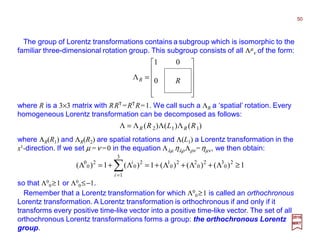
The group of Lorentz transformations contains a subgroup which is isomorphic to the
familiar three-dimensional rotation group. This subgroup consists of all Λµ
ν of the form:
2017
MRT












= RR 0
01
Λ
where ΛR(R1) and ΛR(R2) are spatial rotations and Λ(L1) a Lorentz transformation in the
x1-direction. If we set µ =ν =0 in the equation Λλµ ηλρ Λρν =ηµν, we then obtain:
so that Λ0
0≥1 or Λ0
0≤−1.
where R is a 3×3 matrix with RRT =RTR=1. We call such a ΛR a ‘spatial’ rotation. Every
homogeneous Lorentz transformation can be decomposed as follows:
1)()()(1)(1)( 2
0
32
0
22
0
1
3
1
2
0
2
0
0
≥Λ+Λ+Λ+=Λ+=Λ ∑=i
i
)(Λ)(Λ)(ΛΛ 112 RLR RR=
Remember that a Lorentz transformation for which Λ0
0≥1 is called an orthochronous
Lorentz transformation. A Lorentz transformation is orthochronous if and only if it
transforms every positive time-like vector into a positive time-like vector. The set of all
orthochronous Lorentz transformations forms a group: the orthochronous Lorentz
group.
50
The problem of finding the representation of the ‘restricted’ Lorentz group is equivalent
to finding all the representations of the commutation rules above. The finite dimensional
irreducible representation of the restricted group can be labeled by two discrete indices
which can take on a values the positive integers, the positive half-integers, and zero. To
show this, let us define the operators:
2017
MRT
and their commutation rules are:
From these operators, we can construct these invariants of the group:
( )
( )
( )Boost
momentumAngular
Momentum
],,[
],,[
],,[
030201
211323
321
MMM
MMM
PPP
=
=
=
K
J
P
kijkji
kijkji
kijkji
KKJ
JKK
JJJ
ε
ε
ε
=
−=
=
],[
],[
],[
which commute with all the Ji and Ki. They are therefore the invariants of the group and
they are multiples of the identity in anyirreduciblerepresentation.The representations
can thus be labeled by the values of these operators in the given representation.
and
µν
µν MM2
122
=− KJ
ρσµν
µνρσε MM8
1=•− KJ
51
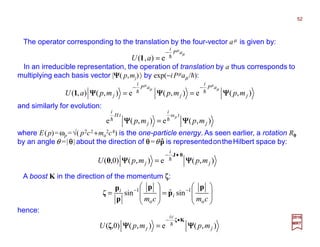
where E(p)=ωp =√( p2c2 +mo
2c4) is the one-particle energy. As seen earlier, a rotation Rθθθθ
by an angleθ =|θθθθ| about the direction of θθθθ=θp is representedontheHilbert space by:
2017
MRT
),(e),(e),(),( j
aP
i
j
aP
i
j mpmpmpaU ΨΨΨΨΨΨΨΨΨΨΨΨ
µ
µ
µ
µ
hh
−−
==1
hence:
),(e),()0,( j
i
j mpmpU ΨΨΨΨΨΨΨΨ
θJ
θ
•−
= h
A boost K in the direction of the momentum ζζζζ:
The operator corresponding to the translation by the four-vector aµ is given by:
),(e),()0,( j
ci
j mpmpU ΨΨΨΨΨΨΨΨ
Kζ
ζ
•−
= h








=








= −−
cmcm
i
i
o
1
o
1
sinˆsin
p
p
p
p
p
ζ
and similarly for evolution:
),(e),(e
ω
j
t
i
j
tH
i
mpmp
p
ΨΨΨΨΨΨΨΨ hh =
In an irreducible representation, the operation of translation by a thus corresponds to
multiplying each basis vector |ΨΨΨΨ( p,mj)〉 by exp(−iPµaµ /h):
µ
µ
aP
i
aU h
−
= e),(1
ˆ
52
which satisfy the following commutation rules:
To make the range of values of the label more transparent, let us introduce the
following generators:
2017
MRT
)(
2
1
)(
2
1
iiiiii KiJiKKiJiJ −=+= and
and
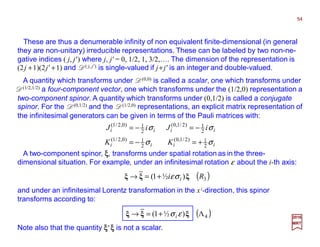
It follows from the commutation rules that a finite dimensional irreducible
representation space, Vjj' can be spanned by a set of (2j +1)(2j' +1) basis vectors
| jmj, j'm'j〉 where j, mj, j' and m'j are integers or half-odd integers, −j ≤ mj ≤ j, −j' ≤ m'j ≤ j'
and in terms of which the J and K operators have the following representation:
0],[
],[
],[
=
=
=
ji
kijkji
kijkji
KJ
JiKK
JiJJ
ε
ε
jjjjj
jjjjjjjj
mjmjmmjmjJ
mjmjmjmjmjmjJiJmjmjJ
′′=′′
′′±+±=′′±=′′±
,;,,;,
,;1,)1)((,;,)(,;,
3
21
h
hm
jjjjj
jjjjjjjj
mjmjmmjmjK
mjmjmjmjmjmjKiKmjmjK
′′′=′′
±′′+′±′′′=′′±=′′±
,;,,;,
1,;,)1)((,;,)(,;,
3
21
h
hm
53
These are thus a denumerable infinity of non equivalent finite-dimensional (in general
they are non-unitary) irreducible representations. These can be labeled by two non-ne-
gative indices ( j, j') where j, j' = 0, 1/2, 1, 3/2,…. The dimension of the representation is
(2j +1)(2j' +1) and D( j, j') is single-valued if j+j' is an integer and double-valued.
A quantity which transforms under D(0,0) is called a scalar, one which transforms under
D(1/2,1/2) a four-component vector, one which transforms under the (1/2,0) representation a
two-component spinor. A quantity which transforms under (0,1/2) is called a conjugate
spinor. For the D(0,1/2) and the D(1/2,0) representations, an explicit matrix representation of
the infinitesimal generators can be given in terms of the Pauli matrices with:
2017
MRT
iiii
iiii
KK
iJiJ
σσ
σσ
2
1
2
1
2
1
2
1
)2/1,0()0,2/1(
)2/1,0()0,2/1(
+=−=
−=−=
Note also that the quantity ξξξξ∗ ξξξξ is not a scalar.
A two-component spinor, ξξξξ, transforms under spatial rotation as in the three-
dimensional situation. For example, under an infinitesimal rotation ε about the i-th axis:
and under an infinitesimal Lorentz transformation in the xi-direction, this spinor
transforms according to:
( )3)½1( Ri i ξξξ σε+=→
( )4Λ)½1( ξξξ εσi+=→
54
∑∫∑∫ ==
+
= jj m
jj
j
m
jj
P
pd
mpψmp
P
pd
xψmpmpψ 0
*
12
1
0
),(),()(),(),( φφφ ΨΨΨΨΨΨΨΨ
Lorentz Invariant Scalar
For the last case, Pµ = 0, the complete system of (infinite dimensional) unitary
representations coincides with the complete system of (infinite dimensional) unitary
representations of the homogeneous Lorentz group which we studied earlier.
The irreducible representations of the inhomogeneous Lorentz group can now be classi-
fied according to whether Pµ is space-like, time-like, or null vector, or Pµ is equal to zero.
The representations of principle interest for physical applications are those for which
P2 =mo
2c2 =positive constant, and those for which P2 =0.
2017
MRT
Defining a Lorentz invariant scalar product within the vector space by integrating over
a set of p (with P2 =mo
2c2, P0 =+√(p2 +mo
2c2)=E/c) and summing over the index mj:
where j =0,1/2,1,3/2,2,…. So, we have hinted that an irreducible representation of the
type P2 >0, P0 >0 is labeled by two indices (mo, j), where mo is a positive number and j is
an integer or half-integer. The index mo characterizes the mass of the elementary
system, the index j the angular momentum in its rest frame, i.e., the spin of the
elementary system. The fact that the irreducible representation is infinite dimensional is
just the expression of the fact that each elementary system is capable of assuming
infinitely many linearly independent states.
Let us first discuss the case P2 =mo
2c2. In that case, P0/|P0|, the sign of the energy,
commutes with all the infinitesimal generators and is therefore an invariant of the group.
55
Klein-Gordon & Dirac
For j = 0, the representation space is spanned by the positive energy solutions of the
relativistically covariant equation for a spin-0 particle – the Klein-Gordon equation:
For each (mo , j) – and a given sign of the energy – there is one and only one irreducible
representation of the inhomogeneous Lorentz group to within unitary equivalence. For j
half-integral, the representation is double-valued.
2017
MRT
For j = 1/2 by the positive energy solution of the Dirac equation (free particle case):
For j = 1 by the positive energy solutions of the Proca equation (not discussed).
),()(
),( 42
o
222
2
2
2
tcmc
t
t
r
r
ϕ
ϕ
+∇−=
∂
∂
− hh
),()(),( 2
o tcmciti rr ΨΨΨΨ∇∇∇∇ααααΨΨΨΨ β+•−= h&h
We will discuss both the Klein-Gordon and Dirac equations later.
)(
2
1
4
1)( 42
o
µν
µ
ν
µ
µ
ν
ν
µ
µ
ν
µ
φφφ
φφφφφ
xcm
xxxxt
x
i








+








∂
∂
−
∂
∂








∂
∂
−
∂
∂
−=
∂
∂
h
0)(2
o =








+∂− ∑ xcmc ψγ
µ
µ
µ
h
)(),()()(),( tdmpxxψt j ΨΨΨΨΨΨΨΨΨΨΨΨ ⋅==≡ ∫
∞+
∞−
ppprr ψµ
or:
such that in what follows,it applies also to states that get acted on by the Dirac equation:
56
One-Particle States
The physical states of particles are described by the Wigner basis states |ΨΨΨΨkmo
( j,mj)〉
(which are equivalent to the states|ΨΨΨΨ(k,mj)〉) for a unitary irreducible representation
of the inhomogeneous Lorentz group (Poincaré group) with Σµ pµ p µ =p02
−p2 =(moc)2.
Thesestatesformthe Hilbert space of the theory and the momentum states |ΨΨΨΨ(p,mj)〉 can
be obtained from the standard state |ΨΨΨΨpmo
( j,mj)〉≡|ΨΨΨΨ( p,mj)〉 by a unitary transformation:
∑
+
−=′
Λ
′−•−
′Λ
Λ
=≡
j
jm
jEp
m
m
j
tE
i
j
j
j
mjpW
pE
pE
xx ),()],([e
)(
)(
)π2(
1
)()( )(
)(
2/3
ΨΨΨΨD
rp
h
h
ψψ µ
Our goal is to find eigenkets of |ΨΨΨΨpmo
( j,mj)〉 as they appear following an homogeneous
Lorentz transformation group U(ΛΛΛΛ,a) product on a state-vector |ΨΨΨΨpmo
( j,mj)〉 is as follows:
where L( p) is some standard Lorentz transformationmatrix that depends on p=pµ and the
momentum states are normalized over intermediate states andweget the coordinate ket:
),()(),( jj mkpLmp ΨΨΨΨΨΨΨΨ =
),()]([)]([)]([)]([
)(
),(
),()]([)]([
)(
),(),(),(
o
oo
1o
o
jmk
jmkjmp
mjpUpLUUpLU
pE
m
aU
mjpUU
pE
m
aUmjaU
ΨΨΨΨ
ΨΨΨΨΨΨΨΨ
LvΛ1
LvΛ1Λ
ΛΛ=
=
−
2017
MRT
The spin j corresponds to the eigenvaluesJ2= j( j +1)h2of J2 and J3 =mj h (mj = j, j −1,…,−j).
Also, U(1,a)|ΨΨΨΨkmo
( j,mj)〉 meansthesamethingas exp(−iΣµ kµ aµ)|ΨΨΨΨkmo
( j,mj)〉(pµ =hkµ ).
57
The Lorentz transformations associated with the Poincaré group can be constructed in
which the quantum state differs by only a mixture of the internal spin indices mj (i.e., run-
ning over the discrete values j, j −1,…,−j) but possess the same physical observables.
The effects of the inhomogeneous Lorentz transformations (e.g., acting on the Dirac
fields) can be elucidated by considering the particle states obtained from the irreducible
unitary representations of the Poincaré group. The unitary operation representing the
Lorentz transformations acting on the Poincaré generators are given by the equations
U(Λ,a)PρU−1(Λ,a)=Σµ[Λ−1]ρ
µPµ & U(Λ,a)MρσU−1(Λ,a)=Σµν [Λ−1]ρ
µ [Λ−1]σ
ν (Mµν−aµ Pν −aν Pµ).
Since the momentum four-vector commutes among each other according to [Pµ ,Pν]=0,
the particle states can be characterized by the four-momentum Pµ together with
additional internal degrees of freedom mj. The internal degrees of freedom pertain to the
spin vector which can be affected by transformations in the space-time coordinates.
and the state transforms accordingly for a space-time translation:
),(),( jj mppmpP ΨΨΨΨΨΨΨΨ µµ
=
),(e),(e),(),( j
ap
i
j
aP
i
j mpmpmpaU ΨΨΨΨΨΨΨΨΨΨΨΨ
∑∑ −−
=≡ µ µ
µ
µ µ
µ
hh1
Thus, the one-particle state is an eigenvector of the momentum operator:
2017
MRT
The components of the energy-momentumfour-vector operator Pµ all commute with each
other (i.e., [Pµ,Pν ]=0), so it is natural to express physical state-vectors in terms of
eigenvectors of the four-momentum.This four-momentum Pµ is a trusted observable!
58
Under space-time translations, the states |ΨΨΨΨ(p,mj)〉 transforms as:
2017
MRT
It is thus natural to identify the states of a specific particle type with the components
of a representation of the inhomogeneous Lorentz group which is irreducible.
Hence U(ΛΛΛΛ)|ΨΨΨΨ(p,mj)〉 must be a linear combination of the state vectors |ΨΨΨΨ(Λp,mj)〉:
We must now consider how these states transform under homogeneous Lorentz
transformations U(ΛΛΛΛ,0)≡U(ΛΛΛΛ) is to produce eigenvectors of the four-momentum with
eigenvalues Λp (where we use U −1 (ΛΛΛΛ,a)Pµ U(ΛΛΛΛ,a)=Σν [Λ−1]µ
ν Pν ):
),()()(),()(
),(][)(),()]()([)(),()( 11
jj
jjj
mpUpmpUp
mpPUmpUPUUmpUP
ΨΨΨΨΨΨΨΨ
ΨΨΨΨΨΨΨΨΨΨΨΨ
ΛΛ
ΛΛΛΛΛ
µ
ν
ν
ν
µ
ν
ν
ν
µµµ
Λ=Λ=








Λ==
∑
∑ −−
),(),( jj mppmpP ΨΨΨΨΨΨΨΨ µµ
=
We now introduce a label mj to denote all other degrees of freedom (i.e., all the other
total angular momentum orientations), and thus consider state-vectors |ΨΨΨΨ(p,mj)〉 with:
),(e),(),( j
ap
i
j mpmpaU ΨΨΨΨΨΨΨΨ
∑−
= µ µ
µ
h1
∑′
′
′ΛΛ=
j
j
j
m
j
m
mj mppCmpU ),()],([),()( ΨΨΨΨΨΨΨΨΛ
59
In other words, if a system is confronted with a homogeneous Lorentz transformation
ΛΛΛΛ, the momentum p is changed to Λp. According to Pµ |ΨΨΨΨ(p,mj)〉=pµ |ΨΨΨΨ(p,mj)〉, the one-
particle state must possess an eigenvalue of Λp as well:
in which U(ΛΛΛΛ,a)Pµ U−1(ΛΛΛΛ,a)=Σν [Λ−1]ν
µ Pν has been used for the Lorentz transformed
momentum generator. It can be seen then that U(ΛΛΛΛ)|ΨΨΨΨ(p,mj)〉 is a linear combination of
the states |ΨΨΨΨ(Λp,m′j)〉, where:
and this, believe it or not, does leave the momenta of all the particle states invariant.
∑∑ ′
′
+
−=′
′
′ΛΛ≡′ΛΛ=
j
jj
j
j
j
m
j
j
mm
j
jm
j
m
m
j
j mppmppmpU ),(),(),()],([),()( )()(
ΨΨΨΨΨΨΨΨΨΨΨΨ DDΛ
),()(),(),( 2
o jjj mpcmmpppmpPP ΨΨΨΨΨΨΨΨΨΨΨΨ == ∑∑ µ
µ
µ
µ
µ
µ
),()()(
),(])[(),()]()()[(),()0,( 1
j
jjj
mpUp
mpPUmpUPUUmpUP
ΨΨΨΨ
ΨΨΨΨΨΨΨΨΨΨΨΨ
Λ
ΛΛΛΛΛ
µ
ν
ν
ν
µµµ
Λ=
Λ== ∑−
in which Dm′jmj
( j) (Λ,p) is termed the Wigner coefficient and, as said previously, they
depend on the irreducible representations of the Poincaré group.
As a special example, the Casimir operator Σµ Pµ Pµ cannot change the value of the
momentum (i.e., its an invariant – as also stated previously):
2017
MRT
60
Hence, to distinguish each state, the standard four-momentum given by kµ =[moc,0,0,0] is
chosen, from which all momenta can be achieved by means of a pure Lorentz boost:
which implies that there exists a subgroup of elements consisting of some arbitrary
Wigner rotations, W, and this subgroup is called the little group.
µ
ν
ν
ν
µ
kkW =∑
Notice that a simple three-dimensional rotation, W (which is an element of the
Poincaré group), will render the standard four-momentum invariant:
It is important to distinguish that this little group is not unique in the Lorentz group but it
is actually isomorphic to other subgroups under a similarity transformation. This is
because there is no well-defined frame for the standard momentum kµ due to the
equivalence principle in special relativity.Thedefinitionofthelittle group is dependent
on the choice of the standard momentum as well as the Lorentz transformation Λ.
Wigner’s Little Group
(N.B., the standard four-momentum is non-unique and it also depends on the charac-
teristics of the particle, e.g., whether it is a massive or a massless particle).
kpLp )(=
2017
MRT
),(),(),(),(),( 2
o jjjjjj mkmmkmkmkcmmkH ΨΨΨΨΨΨΨΨΨΨΨΨΨΨΨΨΨΨΨΨ h=== J0p and&
In this momentum rest frame, the state |ΨΨΨΨ(k,mj)〉 is specified in terms of the eigen-
values of the Hamiltonian H=p0, the momentum p, and the z-component of the total
angular momentum operator J as:
61
When L(p) is
applied to k we
get the momentum
p. When ΛΛΛΛ is applied
next to p it becomes
Λp. When L−1(Λp) is
applied to Λp we
recover k!
So, the only functions of pµ that are left invariant by all proper orthochronous Lorentz
transformations Λµ
ν are the invariant square p2 =Σµν ηµν pµ pν, and p2 ≤ 0, also the sign of
p0. Hence, for each value of p2, and (e.g., for p2 ≤0) each sign of p0, we can choose a
‘standard’ four-momentum, kµ, and express any pµ of this class as:
where Lµ
ν is some standard Lorentz transformation that dependsonpµ,andalso implicitly
on our choice of the standard kµ. We can define the states |ΨΨΨΨ(p,mj)〉 of momentum p by:
∑=
ν
ν
ν
µµ
kpLp )(
Wigner’s little group is the Lorentz transformation
L−1(Λp) ΛΛΛΛL(p) that takes k to L(p)k =p, and then to
Λp, and then back to k, so it belongs to the
subgroup of the homogeneous Lorentz group.
Operating on this equation with an arbitrary homogeneous
Lorentz transformation U(ΛΛΛΛ), we find:
k µ =[moc,0,0,0]
pµ =Σν Lµ
ν ( p)kνΛ p=Σν Λ0
ν pν
L−1(Λ p) L(p)
ΛΛΛΛ
),()]([)(),( jj mkpUpNmp ΨΨΨΨΨΨΨΨ L=
N(p) is a numerical normalization factor to be chosen on the next slideandwhere U[L(p)]
is a unitary operator associated with the pure Lorentz ‘boost’ thattakes[moc,0] into[p0,p].
The transformation Wµ
ν (i.e., L−1(Λp) ΛΛΛΛL(p) = W(Λ, p)) thus
leaves k µ invariant: Σν Wµ
ν kν =kµ. For any Wµ
ν satisfying this
relationship, we have:
),()]()([)]([)(
),()]([)(),()(
1
1
j
jj
mkppUpUpN
mkpUpNmpU
ΨΨΨΨ
ΨΨΨΨΨΨΨΨ
LΛLL
LΛΛ
4444 34444 21
=
−
ΛΛ=
=
∑
+
−=′
′
′Λ=Λ
j
jm
j
j
mmj
j
jj
mkpmkpU ),()],([),()],([ )(
ΨΨΨΨΨΨΨΨ WW D
where the coefficients Dm′j mj
( j ) [W(Λ, p )] furnish the
representation of the little group.
2017
MRT
62
The Wigner coefficient for the standard four-momentum can be evaluated as:
which implies directly that:
)()()( WWWW UUU ≡
Note that the Wigner coefficients form a representation of the little group, which means
that for any little group elements W, W, the group multiplication property holds:
∑∑ ′
′
+
−=′
′
′≡′=
m
mm
j
jm
j
j
mmj mkWmkkWmpU
j
jj
),()(),(),(),()( )(
ΨΨΨΨΨΨΨΨΨΨΨΨ DDW
thus:
∑
∑
′
′′
′
′
′′=
≡′′=
σ
σσ
σ
σσ
σ
σσ
,
),()()(
),()()(),()(),()(
m
mm kWW
kUUkWWmkU
ΨΨΨΨ
ΨΨΨΨΨΨΨΨΨΨΨΨ
DD
D WWWW
∑ ′=′ ′′
m
mm WWWW )()()( σσσσ DDD
However, this choice for the normalization condition leads to problems with the
subsequent transformation equations relating to the particle states which involve
some tedious momentum-dependent constants.
2017
MRT
63
Normalization Factor
Using W=L−1 ΛΛΛΛL and inserting into U(ΛΛΛΛ)|ΨΨΨΨ(p,m)〉=NU[L(Λp)]U[L−1(Λp)ΛΛΛΛL(p)]|ΨΨΨΨ(p,m)〉
and using U(W)|ΨΨΨΨ(k,m)〉=Σm′ Dm′ m(W )|ΨΨΨΨ(k,m′)〉 we get:
or, recalling the definition |ΨΨΨΨ〉=NU[L(p)]|ΨΨΨΨ〉, we finally get:
2017
MRT
for which
The normalization factor N(p) is sometimes chosen to be N(p)=1 but then we would
need to keep track of the p0/k0 factor in scalar products. Instead, the convention is that:
The normalization condition is achieved using the scalar product:
∑′
′ ′ΛΛ
Λ
=
m
mm mppW
pN
pN
mpU ),()],([
)(
)(
),()( ΨΨΨΨΨΨΨΨ DΛ
∑′
′ ′ΛΛ=
m
mm mkpUpWpNmpU ),()]([)],([)(),()( ΨΨΨΨΨΨΨΨ LΛ D
0
0
)(
p
k
pN =
mmmpmp ′−′=′′ δδ )(),(),( ppΨΨΨΨΨΨΨΨ
)()(),(),(
2
kk −′=′′ ′ δδ mmpNmpmp ΨΨΨΨΨΨΨΨ
)(
)()(
)(
)(
)(
)( 0
0
0
0
pE
pE
p
p
pN
pN
p
k
pN
Λ
=
Λ
=
Λ
⇒
Λ
=Λ
and
64
We choose the following normalization condition (c.f., Weinberg QTF I):
which implies that:
This implies that the Wigner coefficients cannot sum up to unity, but instead up to a
phase factor that depends on the momentum of the particle, p, and the Lorentz
transformation,ΛΛΛΛ:
mmpmkmp ′′−=′ δδ )()2(),(),( )3(0
ppΨΨΨΨΨΨΨΨ
σσσσ δ ′′
Λ
=ΛΛ∑ 0
0
*
)(
),(),(
p
p
pp
m
mm DD
mm
mm
mm
mm
mm
pppppp
mpmppppUUp
′
′
′′′
′
′′
∑
∑
ΛΛΛ==′
′ΛΛΛΛ=′
δδσσ
σσ
σσσσ
σσ
,
0*0
,
*†
)2(),(),(2),(),(
),(),(),(),(),()()(),(
DD
DD
ΨΨΨΨΨΨΨΨ
ΨΨΨΨΨΨΨΨΨΨΨΨΨΨΨΨ ΛΛ
and finally:
10
0
†
)(
),(),(
p
p
pp
Λ
=ΛΛ DD
The transformations mentionned above whereby the representations of the Poincaré
group is being derived from the little group is termed as the method of induced
representations.
2017
MRT
65
The explicit form for W(Λ,p) is:
where the angle θ is defined by tanhθ =√[(p0)2 −mo
2c4]/p0 and the components of the
particle momentum are given by pi (i=1,2,3). The Lorentz boost L(p) transforms the
standard momentum kµ to momentum pµ. In addition, the general Lorentz transformation
ΛL for ‘pure boost’ only is written as:
( )ppkpLpLpW pL
Λ→ →ΛΛ=Λ Λ− )(1
)(),(),(








−+
= ji
ji
i
j
ppp
p
pL
ˆˆ)1(coshsinhˆ
sinhˆcosh
)(
θδθ
θθ








−+
=Λ ji
ji
i
j
L
nnn
n
ˆˆ)1(coshsinhˆ
sinhˆcosh
ξδξ
ξξ
and it can be shown that this is an element of the little group associated with the
standard vector kµ. (N.B., L(Λp) is the Lorentz boost of the momentum (Λp)µ from
standard momentum vector kµ ). Then the Wigner transformation corresponding to the
present choice of kµ is a SO(3) rotation. Furthermore, the Lorentz boost L(p) can be
computed from the boost generator Ki =Mi0=ih(xi ∂0 −x0∂i) where L(p)=exp(−icθ p•K/h).
The explicit form of L(p) is given by:
ˆ
where n is a unit vector along the direction of the boost. This transforms the
momentum pµ to a Lorentz-transformed momentum (Λp)µ.
ˆ 2017
MRT
66
One-Particle States – con’d
Considering now a Taylor expansion of the Wigner transformationW(Λ,p)=
L−1(Λp)ΛL(p) as well as the explicit form of the matrix for L(p) just obtained for an
arbitrary Lorentz transformation Λ:
in which the Lorentz boosts, L(p) and L(Λ,p) and the arbitrary Lorentz transformation, Λ,
are parametrized in terms of its generators. In addition, the spatial component of the
Lorentz-transformed momentum is given by pΛ=Λp (N.B., The corresponding Lorentz
boost for the Lorentz transformed momentum starting from the standard vector, kµ, is
given by tanhθ′=|pΛ|/(Λp)0, in which L(Λp)k=Λp).
K+−=Λ µν
µν
Mω
2
1
)ω( 1
thus:
KpKp •−−•′
−
≡
ΛΛ=Λ
ˆω
2
1
ˆ
1
eee
)()(),(
Λ θθ µν
µν
hh
ci
M
ci
pLpLpW
βα
β
αβα
βµν
µναα
pppM
i
pp ]ω[]ω[
2
)( +≡−≅Λ
Consider the inifinitesimal Lorentz transformation being parametrized by the anti-
symmetric tensor ωµν (expressed to first order terms of ω):
2017
MRT
Note that in the above and from now on, we restored the summation convention
where we sum over any space-time index which appears twice in the same term.
67
A Taylor series expansion of the Wigner transformation is considered as fallows:
thus:
In the ‘second term’ of this last equation the expression can be re-written as:
K
K
+
∂
ΛΛ∂
+=
+
∂
Λ∂
+Λ=Λ
=
−
=
=
0ω
1
0ω
0ω
ω
)]()([
ω
ω
),(
ω),(),(
µν
µν
µν
µν
pLpL
pW
pWpW
1
K
K
+











−Λ+








∂
Λ∂
+=
+








∂
Λ∂
Λ+








Λ
∂
Λ∂
+≅Λ
=
−
=
−
=
−
=
−
)(
2
)(ω)(
ω
)(
ω
)(
ω
)ω(
)(ω)()ω(
ω
)(
ω),(
0ω
1
0ω
1
0ω
1
0ω
1
pLM
i
pLpL
pL
pLpLpL
pL
pW
µν
µν
µν
µν
µν
µν
µν
µν
1
1
in which the substitution Λp=p′ has been made and, in general, L−1(p′)=ηηηηLT(p′)ηηηη.
2017
MRT
68






















−+














′
′′








−
′
+
′
−
′
−
′
∂
∂
+=








∂
Λ∂
=
=
−
22
o
0
o
o
2
o
0
0ω
22
o
0
o
o
2
o
0
0ω
1
11
ω
ω)(
ω
)(
ω
p
pp
cm
p
cm
p
cm
p
cm
p
p
pp
cm
p
cm
p
cm
p
cm
p
pL
pL
kj
kj
j
k
ji
ji
j
i
δδ
µν
µν
µν
µν
1
Now, since (Λp)α≅pα−(i/2)[ωµν Mµν]α
β pβ≡pα+[ω]α
β pβ, we get (h=c=1):
and since ξ i =ω0i =−ωi0 and θ k =εijk ωij as well as Ji =εijk Mjk and Ki =Mi0:
βα
β
βα
βµν
µν
µν
α
µν
ppM
ip
]ω[][ω
2ω
)(
ω
0ω
≡−≅








∂
Λ∂
=
in which the axial vector is given by θθθθ=[θ 1,θ 2,θ 3]† and mi =(p××××θθθθ)i as well as:








−
•
≡








−
•
=








−
=
















−
=
+−=++−=
ii
ii
k
jkjii
jj
j
k
kjii
j
k
ki
i
ji
ji
i
i
i
i
p
ppp
p
p
p
pJK
i
pMMM
i
p
mp
ξpp
θpp
ξpp
ξ
ξθεξ
ξ
θεξ
ξ
θξ βββ
β
α
0
00
0
0
0
0
0
)ˆ(
)ˆ(
)ˆ(0
]22[
2
]ωωω[
2
]ω[
××××








−−−=





∂
′∂
∑
= nm
nnmiii
i
pppp
p
][ˆˆ][
1
ω
)ˆ(
ω 00
0ω
mpmp
p
ξξµν
µν
At this junction, the sum Σmn pm[p0ξn −|p|mn] describes the relation between the
components of the momentum and its Lorentz boost.
ˆ
2017
MRT
ˆ
69
Assuming that any sum over the cross-terms is zero for m≠n, that is:
)ˆ(][ˆ 00
ξpmp •=−∑ ppp
nm
nnm
ξ
in which the boost vector is given by ξξξξ=[ξ 1,ξ 2,ξ 3]†. With the axial vector, θθθθ=[θ 1,θ 2,θ 3]†,
θθθθ and ξξξξ become the parameter vectors associated with the infinitesimal Lorentz
transformation Λ. In addition, the vector normal to both the axial and momentum vectors
is given by m=p××××θθθθ.
Jmpξp
p
Km
p
pξpξ
pmξp
p
m
p
ξp
m
p
ξp
ξp
p
m
p
m
p
ξp
p
•








−








−+•








−•








−−≡






















−








−−+•








−
−+•








−
=






















−+






















•







 −
−−








−+−
+−•
=








∂
Λ∂
=
−
))))××××××××
××××××××
ˆ(2)ˆ(1ˆ)ˆ(1
)ˆ(2)ˆ(1ˆ)ˆ(1
ˆ)ˆ(10
ˆˆ1ˆˆ)ˆ(]ω[ˆ]ω[ˆ1
)ˆ(
)(
ω
)(
ω
0
o
0
oo
0
o
0
0
o
0
o
0
oo
0
o
0
oo
0
o
0
o
oo
0
o
0
o
0
oo
0
oo
0
o
0ω
1
p
m
p
i
mm
p
m
p
i
p
m
p
m
p
m
p
m
p
m
p
m
p
m
p
pp
m
p
m
p
m
p
m
p
pp
mp
pppp
m
p
mm
p
mm
p
m
pL
pL
nkinniii
kkk
kj
kj
j
k
jiijjiii
jj
εξ
ξ
δξ
ξ
β
β
β
β
µν
µν
ˆ
Our equation for ωµν [∂L−1(Λp)/∂ωµν ]|ω=0L(p) above (i.e. the ‘second term’) can be
simplified by using the Lorentz boosts from the matrices for L(p) and ΛL further up, and
this can be worked out as:
2017
MRT
70
The third term in our Taylor expansion for W(Λ,p) above (i.e., the term obtained above
ωµν [L−1(Λp)(−½i Mµν )]|ω=0L(p)) can also be simplified in terms of its matrix elements
(Note that the expression (−½i ωµν Mµν ) can be re-written as the matrix [ω]):
Jmpθξp
p
Km
p
pξpξ
mp
p
ξm
p
ξp
m
p
ξp
m
p
ξp
m
p
ξp
•
















−+−−+•








−•








−−−≡
































−+−







−•







 −
−
−+•








−
=














−







 −
+−








−−•







 −
−
−•







 −
−
=






















−+







−














′′








−+
′
−
′
−
′
=′−
))))××××××××
))))××××××××
ˆ(1)ˆ(
2
ˆ)ˆ(1
ˆ(1ˆ)ˆ(
ˆ)ˆ(10
)ˆˆˆˆ(ˆ)ˆ(
)(ˆ)ˆ(0
ˆˆ1
0
ˆˆ1
)](][ω)][([
o
00
oo
0
o
0
o
0
ooo
o
0
o
0
o
0
oo
0
o
o
0
oooo
o
0
o
0
oo
o
0
o
0
o
0
o
oo
0
o
0
o
oo
0
1
m
pp
i
mm
p
m
p
i
m
p
mm
p
m
mp
m
p
m
p
m
p
m
p
pmmp
m
mp
m
p
m
p
m
p
m
mp
m
p
m
p
m
mp
m
p
pp
m
p
m
p
m
p
m
p
pp
m
p
m
p
m
p
m
p
pLpL
mlimm
m
iii
kkk
lilimmlil
il
iiii
lll
lk
lk
k
l
mmkjj
k
ji
ji
i
j
εθξ
ξ
θεξξξ
ξ
δ
θεξ
ξ
δ
in which ωµν [∂( p′)α/∂ωµν]|ω=0 above has been used for the matrix reprentation of the
arbitrary infinitesimal Lorentz transformation Λ(ω).
2017
MRT
71
After some careful re-grouping of the terms from all the matrix elements given in ωµν
[∂L−1(Λp)/∂ωµν]|ω=0L(p) and [L−1(p′)][ω][L(p)] just obtained, the boost terms in our
expansion for W(Λ,p) has cancelled out completely and leaving behind the rotation
terms:
where Ω( p) k =−ε ijk [ωij −(piω0j −pj ω0i)/( p0 +mo)] is the Wigner angle and Jk =½ε ijk Mij
is the rotation generator for the Poincaré group.
Thus, we obtain:
J1
1
1
Jθξp
p
1
•+=








−
−
−+=








−−
−
−=
•








+
−
−≡Λ
)(
)ωω(
)(
1
ω
)(
)(
1
)(
)(
),(
00
o
0
o
0
o
0
pi
Mpp
mp
i
Mpp
mp
i
mp
ipW
ji
ijjiji
jin
njiijji
n
θεξξ
××××


















−
−
−+=Λ njinnmppW εθ)ˆ(
)(
0
00
)],([ o
0
ξp
p
1 ××××
2017
MRT
72
The Wigner angle can be re-written as a sum of the contributions from the rotation and
the boost:
Here the angle of rotation are represented by the Euler angles θk =ε ijk ωij and the boost
parameter ξi =ξ ni =ω0i. The finite Wigner transformation is given by:
)ˆˆ(
)(
o
0
o
0
pn
p
θ
ξp
θ
××××
××××
mp
mp
p
+
−≡
+
−≡
ξ
J•
∞→
=




















Λ=Λ
i
N
N
p
N
WpW
e
,
ω
lim]),ω([
ˆ
2017
MRT
73
The representation matrix Dmjσ
( j) [W(Λ,p)] can be constructed from the angular
momentum generators Ji explicitly, depending on the angular momentum of the particle.
For example, spin-1/2 particles will be considered to have appropriate generators as
given by J=½σσσσ according to the isomorphism between the proper Lorentz group and the
SU(2)⊗SU(2) algebra.
J•
=Λ i
pW e),(
The Wigner transformation corresponding to an arbitrary Lorentz transformation Λ is
given by:
where Ω( p)k =−½ε ijk [(piωj
0 −pj ωi
0)/(p0 +mo)] and Jk =½ε ijk Mjk in the absence of rotation.
This can also be written as:
o
0
o
0
ˆ
)(
mpmp
p
+
=
+
−≡
pnξp ××××××××
ξ
Here the boost parameters are represented by ξi =ξni =ωi
0. For an infinitesimal variation
ωµν, the transformation matrix is (e.g., spin-1/2 case described above):
ˆ
















+
−
+







•+
















+
−=
















−








•+
















−≅















•+







=Λ
×
××
3
o
0
o
0
2
o
022
32
2222
)2/1(
)(2
ˆ
!3
1
)(2
ˆ
)(2
ˆ
!2
1
1
2!3
1
22!2
1
1
2
sin
2
cos)],([
mpmp
i
mp
I
iIiIpW
p
pnpn
σ
pn
σσ
×××××××××××× ξξξ
D
2017
MRT
74
The representation matrix becomes (i.e., spin-1/2 case):
For the sake of convenience, I2×2 is assigned as the 2×2 identity matrix, and σσσσ as the
‘vector’ that is comprized of the Pauli 2×2 matrices [σ1,σ2,σ3]. (Note that the Wigner
angle |ΩΩΩΩ|=Ω is dependent on both the rotation and boost parameters for an arbitrary
Lorentz transformation Λ. In addition, notice that an additional normalization factor of
√[p0/(Λp)0] has been appended to the matrix so as to maintain the condition given
D†(Λ,p) D(Λ,p)=p0/(Λp)0 I2×2).
by using the well known Pauli spin vector σσσσ relation (σσσσ•a)(σσσσ•b)=(a•b)+iσσσσ•(a××××b) and
remembering that ΩΩΩΩ=ΩΩΩΩ /|ΩΩΩΩ|. Thus, with the well known sinξ=ξ−ξ 3/3!+ξ 5/5!−… and cosξ
=1−ξ 2/2!+ξ 4/4!−… identities:
















•+







Λ
=Λ
2
sin)ˆ(
2
cos
)(
)],([ 0
0
)2/1(
σ1 i
p
p
pWD
















+








−•+








+








−
Λ
=








+





•+





•+
Λ
=
Λ
=Λ
×
×
•
KK
K
32
220
0
2
220
0
2
0
0
)2/1(
2!3
1
2
)ˆ(
2!2
1
1
)(
2!2
1
2!1
1
)(
e
)(
)],([
σ
σσ
σ
iI
p
p
iiI
p
p
p
p
pW
i
D
2017
MRT
ˆ
75
In the absence of rotation, the arbitrary Lorentz boost can be parametrized according
to the matrix defined by ΛL above. We can construct the matrix by the associative
property of the representation matrix:
in which:
)]([][)]([
)]()([)],([
)2/1()2/1(1)2/1(
1)2/1()2/1(
pLpL
pLpLpW
DDD
DD
ΛΛ≡
ΛΛ=Λ
−
−
The representation matrix D(1/2)[W(Λ,p)], in the absence of rotation, is this given by:











 Ω
•+




 Ω
Λ
=












•−





•+





+
+Λ+
Λ
=Λ
×
××
2
sin)ˆ(
2
cos
)(
2
sinh)]ˆ([
2
sinh)ˆ(
2
cosh)(
]))[((
)/(
)],([
220
0
22o
0
22
o
0
o
0
00
)2/1(
mσ
npσnp
iI
p
p
iImpI
mpmp
pp
pW
ξξξ
××××D
)ˆˆ(sinhsinh
2
1
coshcosh
2
1
2
1
)ˆˆ(
2
sinh
2
sinh
ˆ
2
sin
)ˆˆ(sinhsinh
2
1
coshcosh
2
1
2
1
)ˆˆ(
2
sinh
2
sinh
2
cosh
2
cosh
2
cos
pn
pn
m
pn
pn
•++












=





•++
•











+











=





θξθξ
θξ
θξθξ
θξθξ
××××
&
where coshθ =p0/mo and m=n××××p represents the axis of rotation of the equivalent Wigner
transformation (e.g., of the Dirac spinors in the spin-½ case). Here the parameters ξ and
n are defined in the same manner as the general Lorentz boost as given by the ΛL
matrix.
ˆ
ˆˆ
2017
MRT
ˆ
76
∑−=′
′
′ΛΛ
Λ
=Λ
j
jm
j
j
mmj
j
jj
mppW
p
p
mpU ),()],([
)(
),()( )(
0
0
ΨΨΨΨΨΨΨΨ D
With the normalization and the understanding of D, our transformation thus becomes:
where Wα
µ (Λ,p)=(L−1)α
σ (Λp)⊗ Λρ
ν Lν
µ (p) is theWigner Rotation,k≡kµ =[k0 =moc,ki =0],
p≡pν =[p0 =E/c,pi ], and since U(W)|ΨΨΨΨ(k,mj)〉=Σm′j
Dm′jmj
( j) [W(Λ,p)]|ΨΨΨΨ(k,m′j)〉:
2017
MRT
since N(Λp)U[L(Λp)]|ΨΨΨΨ(k,m′j)〉=|ΨΨΨΨ(Λp,m′j)〉⇒U[L(Λp)]|ΨΨΨΨ(k,m′j)〉=N−1(Λp)|ΨΨΨΨ(Λp,m′j)〉
where the normalization constant is N(Λp)=√[k0/(Λp)0]. Finally we have:
),()],([)]([),(])()([)]([),()( 0
0
),(
1
0
0
jj
p
j mkpUpLU
p
k
mkpLpLUpLU
p
k
mpU ΨΨΨΨΨΨΨΨΨΨΨΨ ΛΛ=ΛΛ=
Λ
−
WΛΛ
W
44 344 21
444 3444 21
),(
)(
0
0
)(
0
0
),()()],([
),()],([)(),()(
j
j
jj
j
jj
mp
j
m
j
mm
j
m
j
mmj
mkpLpW
p
k
mkpWpL
p
k
mpU
′Λ
′
′
′
′
′ΛΛ=
′ΛΛ=Λ
∑
∑
ΨΨΨΨ
ΨΨΨΨ
ΨΨΨΨΨΨΨΨ
D
D
77
Isn’t this the most beautiful equation you’ve ever seen? So, this is how particle states
|ΨΨΨΨ( p,mj)〉 transform into when a Lorentz transformation Λ acts on it! That is, using a
quantum mechanical unitary operator U(Λ) that changes momentum p and spin mj!
6447481
64748p = L(p)k
Mass Positive-Definite
To define the mass positive-definite, we must recall a few definitions such as the unitary
quantum transformation for coordinate and angular momenta:
where P={P1,P2,P3}, J={M23,M31,M12} and K={M10,M20,M30} and their properties are
P
ρ†
=P
ρ
, M
ρσ †
=M
ρσ
and M
ρσ
=−M
σρ
. Now for the definition of invariance under a unitary
transformation of a homogeneous Lorentz Transformation Λ and a uniform translation a:
...ω
2
1
),ω( ++−=+ ρσ
ρσ
ρ
ρεε M
i
PU
h
11
),(),(),(),ω1(),( 1
jj mpmpaUUaU ΨΨΨΨΨΨΨΨ =Λ+Λ −
ε
which also applies to both momenta:
)(),(),(),(),( 11 µννµµνσ
ν
ρ
µ
µνµρ
µ
µ
PaPaMaUMaUPaUPaU +−ΛΛ=ΛΛΛ=ΛΛ −−
&
For the momentum, they commute with each other:
0],[ =νµ
PP
but for the angular momentum they do not:
ρµσσµρρσµ
ηη PPMPi −=],[
nor do the angular momenta together commute:
ρµσνρνσµνσµρµσνρρσµν
ηηηη MMMMMMi +−−=],[
As comparison, we show the case when Λ=1 then a= 0 and a rotation around the 3-axis:
θµ
µ
pJ ˆ
3 e)0,(e),1(
•−−
== hh
i
aP
i
RUaU and
( ))()0,( Λ=Λ UU
2017
MRT
78
j
i
jj
i
jki
j
mm mjmjmjmjR
jj
,e,,e,)]([
ˆ
)(
Ω•−•−
′ ′=′=Ω
pJJ
hhD
∑∑ ′
′
′
′Ω=′Ω′=Ω
j
jj
j m
j
j
mm
m
jjjj mRmmjRmjmjR )]([,)]([,,)]([ )(
DDD
θϕ
θϕ j
jjjj
j
jj
mi
kmmkmmj
mi
k jjjj
jjjjkj
mm
kmmkmjkmjk
mjmjmjmj
e
2
sin
2
cose
)!()!()!(!
)!()!()!()!(
)1(),,(
222
)(
+−′−′−+
′ 




 Ω





 Ω
+−′−′−−+
′−′+−+
−=Ω ∑D
∑∑∑ Ω=′⇒Ω= ′
l
ll
l
l
l
l
l
ll llll
m
mm
m
mmmmR zpzp ˆ,),,(ˆ,ˆ,,)]([ˆ )(
ϕθDD
2017
MRT
Recall also that your mathematical toolbox consists of these fundamental relations:
and
with
Finally:
jjjjjj
mm
j
kikimm
j
mm M
i
′′′ Ω+=Ω+ ][
2
)( )()(
δ1D
In this instance, we take (i.e., Weinberg’s QFT definition – he also uses Θ for our Ω):
where Rik =δik +Ωik with Ωik =−Ωki infinitesimal and for mj running over j, j−1,…, −j. Also:
jjjjjj
jjjjjj
mmjmm
j
mm
j
z
mmjjmm
jj
mm
jj
mJMJ
mjmjJiJMiMJ
′′′
±′′′±
==⇒
+±=±=±⇒
δ
δ
h
hm
)()(
)1)(()()(
)(
3
)(
12
1
)(
2
)(
1
)(
31
)(
23
79
Now, let us expand |ΨΨΨΨ(Λp; j,mj)〉=|ΨΨΨΨ(Λp)〉|l,s; j,mj 〉 in the case of an electron (s=±½):
2017
MRT
∑ +−−++−−−−+−−+
−+−+−+−
×
+++
+−+−+−+
+=≡
k ss
jjss
k
sjjs
j
mm
kmsjkmjkmskmkjsk
mjmjmsmsmm
sj
jsjsjjs
mmmmjsmmss
)!()!()!()!()!(!
)!()!()!()!()!()!()1(
)!1(
)12()!()!()!(
),(,;,,;,
ll
ll
ll
lll
ll
l
lll
lll
δC
Using Jz|l,s;j,mj 〉=mjh|l,s;j,mj 〉 we found out that that |l,s;j,mj 〉 is an eigenfunction of Jz
and since Jz commutes with J2 the eigenfunction of Jz is simultaneously an eigenfunction
of J2 which means that |l,s;ml,ms 〉 is not an eigenfunction of J2. To get around this, we
constructed a linear combination of |l,s;ml,ms 〉 instead:
such that |l,s; j,mj 〉 is simultaneously an eigenfunction of Jz and J2. The quantities Cj
mlms
=
〈l,s;ml,ms |l,s; j,mj 〉 are numerical coefficients which are known as Clebsch-Gordan (CG)
coefficients – and for our benefit j=l+s and mj =ml +ms. A general formula for these
coefficients is due to Wigner:
with l=0,1,2,…, s=±½, j =0,1/2,1,3/2,…, ml =l,l−1,…,−l, ms =±s & mj = j, j −1,…,−j.
∑ ∑′
′ Λ′Λ
Λ
=ΛΛ
j s
sj
m mm
sj
j
mmmsj pmmsmjspWmms
p
p
mjpU
l
l ll lll )(,;,,;,)],([,;,
)(
),;()( )(
)(0
0
ΨΨΨΨΨΨΨΨ D
∑∑
±=
+=
±=
==
)½(
½
,;,,;,,;,,;,,;,
s
mmm
s
j
mm
mm
jssj
sj
s
s
mmsmjsmmsmmsmjs
l
l
l
l
l
ll lllll C
80
a•+
∂
∂
=
∂
∂
+
∂
∂
+
∂
∂
+
∂
∂
=∇ ∇∇∇∇
t
a
z
a
y
a
x
a
t
a
a tzyxt
µµ
Point P at the tip of the distance vector xµ ={ct,r} is given in 4-dimensional Rectangular
(Cartesian) Coordinates by the intersection of constant x, constant y and constant z
planes and time t. The speed of light c is a constant of motion (the same everywhere!)






∂
∂
=





∂
∂
−
∂
∂
−
∂
∂
−
∂
∂
=∇ φ
φφφφφ
φµ ∇∇∇∇,,,,
tzyxt
x
r
O
The Laplacian ∇∇∇∇• ∇∇∇∇≡∇2 =∂2/∂x2+∂2/∂y2 +∂2/∂z2
leads to the D’Alembertian:
The divergence ∇∇∇∇• A=∂Ax /∂x+∂Ay/∂y +∂Az/∂z gives:
P
2017
MRT
A
],[],,,[ atzyxt aaaaaa ==µ
y
φ
z
If the scalar product is A•B =Ax Bx +Ay By +Az Bz, then:
ba•−=−−−= ttzzyyxxtt babababababa µµ






−
∂
∂
=





∂
∂
−
∂
∂
−
∂
∂
−
∂
∂
∇ ∇∇∇∇,,,,
tzyxt
µ
The gradient ∇∇∇∇ψ =∂ψ/∂xi +∂ψ/∂yj+ ∂ψ/∂zk of a
scalar function ψ :
ˆ ˆ ˆ
Del ∇∇∇∇=∂/∂xi+∂/∂yj+∂/∂zk =[∂/∂x,∂/∂y,∂/∂z] is now:ˆ ˆ ˆ
τ = ct
Boosts & Rotations
Electrodynamics provides the differential equations for the
potentials: φ =ρ /εo and A= j/εo and the continuity
equation: ∂φ/∂t + ∇∇∇∇•A=0. In this new in four-dimensional
notation: Aµ ={φ,A} we get Aµ = jµ/εo and ∇µ Aµ =0.
y
z
x
y
z
x
x0 = ct v
The transformation laws which give φ and A in a moving
system in terms of φ and A in a stationary system. Since
Aµ ={φ,A} is a four-vector, the equation must just look like
t= γ(t −|v|z/c2) and z= γ(z −|v|t) with γ =(1 −|v|2/c2)−1/2 except
that t is replaced by φ, and r is replaced by A. Thus:
v
22
2
)(1)(1 c
A
AAAAA
c
cA z
zxxyy
z
v
v
v
v
−
−
===
−
−
=
φφ
φ ,,,
If the vector A = Axi + Ay j+ Azk =[ Ax , Ay , Az ], then
we have the definition of the 4-vector aµ :
ˆ ˆ ˆ
=∇−
∂
∂
=
∂
∂
−
∂
∂
−
∂
∂
−
∂
∂
=∇∇ 2
2
2
2
2
2
2
2
2
2
2
tzyxt
µµ
So = (1/c2)∂t−∇2 =ηµν ∂µ∂ν =∂µ∂µ with ∂µ =∂/∂µ.
81
ρσ
ρσ
ρ
ρ M
i
P
i
UaU ω
2
1
ε)εω,(),(
hh
+−=+=Λ 11
]ωinTerms[)ωω()ωδ)(ωδ( 2
O+++=++=ΛΛ= ρσσρσρσ
ν
σ
ν
ρ
µ
ρ
µ
µνσ
ν
ρ
µ
µνρσ ηηηη
µµ
ν
µ
ν
µ
ν
µ
εω =+=Λ aδ and














−
−
=


























−+−
−
=Λ==












)(
)(
ˆˆ)1(100
0100
0010
00
2
ctz
y
x
zt
z
y
x
t
c
c
xx
z
y
x
t
v
v
vvv
v
γ
γ
γγ
γγ
νµ
ν
µ
The Lorentz transformation transformsframe xν (say x,y,z,t) intoframe x µ (say x, y,z,t):
assuming the inertial frameis going in the x3 (+z) direction.If both ω µ
ν and εµ are taken to
be an infinitesimal Lorentz transformation and an infinitesimal translation, respectively:
This allows us to study the transformation:
The linear unitary operator U=1+iε T was constructed:
where the generators G of translation (Pµ ) and rotation (Mµν ) are given by P1, P2, and
P3 (the components of the momentum operator), M23, M31, and M12 (the components of
the angular momentum vector), and P0 is the energy operator.
2017
MRT
x2 = y
x3 = z
x1 = x
x2 = y
x3 = z
x1 = x
x0 = ct β =|v|/c
82
2
o
2
o
2
22
o
2
222
2
1
1
1
1
1
1
1
1
1
1
β
γ
γ
γ
β
γ
−
=
+





=
−
=⇒
−
=








−
=
•
−
=
m
m
c
cmcc
p
pvvv
and
2
22
)()(
c
tt
vv
t
vr
vvr
r
vvr
rrrrrrvrr
•
−=
•
=
•
−=−===
||
||||⊥⊥⊥||||
γγ
γγ andorand−−−−
⊥|| += rrr
For a boost in an arbitrary direction with velocity v, it is convenient to decompose the
spatial vector r into components perpendicular and parallel to the velocity v: .
Then only the component in the direction of is ‘warped’ by the gamma factor:
where the gamma factor γ (which is a function of the rapidity β =|v|/c) is:





 •
−=−+=




 •−
= ||⊥ 22
)(
))(1(
c
tttt
v
vr
vrrv
vr
rr γγγ
γ
and−−−−++++
Now r can also be written as:
and the relativistic momentum p can be written as:
vpp
p
o
2
o
2
22
o
2
0
)(
)()(
mcm
c
cmc
c
E
p γ=−=
−
== and
2017
MRT
83
These equations can be expressed in matrix form as:
ν
ν
µ
ν
µµ
γ
γ
γ
γ
x
x
x
x
ctx
ct
c
c
tc
x
x
x
tcx
x Λ=













 =
Λ=
























−+−
−
=












=













 =
=
3
2
1
0
3
2
1
0
ˆˆ)1( rvv1
v
v
r
T
T
where 1 is the identity matrix, v is velocity written as a column vector, vT is its transpose
(i.e., the equivalent of a row vector) and v is its unit vector.






















−+−−−
−−+−−
−−−+−
−−−
=












−+−
−
=Λ
2
2
ˆ
2
ˆˆ
2
ˆˆ
ˆ
2
ˆˆ
2
2
ˆ
2
ˆˆ
ˆ
2
ˆˆ
2
ˆˆ
2
2
ˆ
ˆ
ˆˆˆ
)1(1)1()1(
)1()1(1)1(
)1()1()1(1
ˆˆ)1(
)(
β
β
γ
β
ββ
γ
β
ββ
γγβ
β
ββ
γ
β
β
γ
β
ββ
γγβ
β
ββ
γ
β
ββ
γ
β
β
γγβ
γβγβγβγ
γ
γ
γ
γ
ν
µ
zyzxz
z
zyyxy
y
zxyxx
x
zyx
vv1
v
v
v
T
T
c
c
More generally for a boost in any arbitrary direction [β x =vx/c,β y =vy/c,β z =vz/c]:
2017
MRT
ˆ ˆ ˆ ˆ ˆ ˆ
ˆ
84
















−+−−−
−−+−−
−−−+−
−−−
=












−+−
−
=
2
32313
2
3
32
2
212
2
2
3121
2
1
2
1
2
3
2
2
2
1
2
2
ˆ)1(1ˆˆ)1(ˆˆ)1(1ˆ
ˆˆ)1(ˆ)1(1ˆˆ)1(1ˆ
ˆˆ)1(ˆˆ)1(ˆ)1(11ˆ
1ˆ1ˆ1ˆ
ˆˆ)1(ˆ1
ˆ1
)(
pppppp
pppppp
pppppp
ppp
ppp
p
γγγγ
γγγγ
γγγγ
γγγγ
γδγ
γγ
µ
ν
T
T
jijii
i
pL
Now, since we are using a momentum p represention we generally have for a boost in
any arbitrary direction kµ =[k0 =moc,ki =0] with pν =[p0 =E/c,pi ]:
2017
MRT
where 1 is the unit/identity matrix, p is the momentum written as a column vector, pT is its
transpose (another row vector) and p is the momentum direction unit vector and since γ
=1/√(1−β 2)=1/√(1−|v|2/c2), we have γβ =√(γ 2−1) and p=γ mov with |p|=γ mo|v|. With
these, we also have a unit vector p parallel to the direction of v:
ˆ
ˆ ˆ
o
42
o
22
ˆˆ
m
cmci
iii
+
≡≡⇒=
p
p
p
pppp γand
The result is:
















=
=
=
===
=
333
33
322
33
311
330
0
3
o
3
323
22
222
22
211
220
0
2
o
2
313
11
212
11
111
110
0
1
o
1
3
3
0
o
02
2
0
o
01
1
0
o
00
0
0
o
0
ˆˆ)(ˆˆ)(ˆˆ)(0)(
ˆˆ)(ˆˆ)(ˆˆ)(0)(
ˆˆ)(ˆˆ)(ˆˆ)(0)(
0)(0)(0)()(
)(
pppppp
pppppp
pppppp
pLppLppLpppLmp
pLppLppLpppLmp
pLppLppLpppLmp
ppLmpppLmpppLmpppLmp
pL µ
ν
85
2017
MRT
Since the maximum momentum can be moc and the unit time vector labelled êt (which
allows us to set the standard momentum as p0 =E/c):

















⊗
⊗=
=
z
y
x
t=cvp
k
k
e
e
e
eo
ˆ
ˆ
ˆ
][
]ˆ[][
zyx kkk
cm
µ












=














=
=>
κ
κ
µµ
0
0
0
0
0
0
0
0 oo mm
k
k
k and
and ki ⊗êj is the input standard momentum direction p=hk. This gives us the column
kets:
ˆ ˆ
86
y
x
z
Pr
rˆ
ϕϕϕϕˆ
ϕ θ
Constant ϕ plane
θθθθˆ
Constant r sphere
Constant θ cone
x
z
y
O
ϕ
θ
•
r
rdθ
dr
dθ dllll
rsinθdϕ
dϕ
ϕθθ
θ
θ
ϕθ
∂
∂
+
∂
∂
+
∂
∂
=•
F
r
F
rr
Fr
r
r
sin
1)sin(
sin
1)(1 2
2
F∇∇∇∇
θθ
ϕθθϕθθ
222222
2222222222
sin
sin)sin()(
+=ΩΩ+=
++=++=
dddrdr
drdrdrdrdrdrd
where
l
•
Given the geometry involved, a quick review is required. Point P at the tip of the dis-
tance vector r is determined in Spherical Coordinates by the intersection of a constant
θ (i.e., a cone), constant r (i.e., a sphere) and constant ϕ (i.e., a half-plane) surfaces.
y
x
z
r
rrr ˆ),,( rr == ϕθ
P
dl is an infinitesimal differential
increment of length:
ϕϕϕϕ∇∇∇∇ ˆ
sin
1ˆ1
ˆ
ϕθθ ∂
∂
+
∂
∂
+
∂
∂
=
f
r
f
rr
f
f θr
ϕϕϕϕ
××××∇∇∇∇
ˆ
)(1
ˆ)(
sin
11
ˆ
)sin(
sin
1






∂
∂
−
∂
∂
+
+





∂
∂
−
∂
∂
+
+





∂
∂
−
∂
∂
=
θ
ϕθ
ϕθ
θ
θ
θ
ϕ
θϕ
r
r
F
r
rF
r
r
rFF
r
FF
r
θ
rF
)2
FFF ××××(∇(∇(∇(∇××××∇∇∇∇∇∇∇∇∇∇∇∇ −)•(=∇
ˆ
j
i
O
kˆ
dV is an infinitesimal differential
increment of volume:
2017
MRT
2
2
22
2
2
2
2
sin
1
sin
sin
11
ϕθ
θ
θ
θθ
∂
∂
+
+





∂
∂
∂
∂
+





∂
∂
∂
∂
=∇
f
r
f
rr
f
r
rr
f
Laplacian of a vector function F=F(r,θ ,ϕ ) (identity)
The Laplacian of a scalar function f = f (r,θ ,ϕ )
The vector product of a vector function F = F(r,θ ,ϕ )
The scalar product of a vector function F = F(r,θ ,ϕ )
The gradient of a scalar function f = f (r,θ ,ϕ )
Produces
another
vector
perpendicular
to the plane
formed by ∇∇∇∇
and F with
unit vectors
given.
We can make the following
geometric objects into
physical realities if we
substitute the speed v for
f = f (r,θ,ϕ ) and the
momentum p for the vector
F = F(r,θ,ϕ ).
Manifold
ˆ
p
87
J
To calculate this rotation, we need to choose a standard boost L(p) which carries the
four-momentum from kµ = [moc,0,0,0] to pµ. From above, this is conveniently chosen as:
jijijijij
i
i
i
ii
i
pL
cm
pLpL
cm
p
pL
pppp
p
p
p
ˆˆ)1()1(coshˆˆ)(
ˆ1sinhˆ)()(
cosh)(
2
o
0
0
o
0
0
0
−+=−+=
−====
===
γδθδ
γθ
γθ
where θ =p/moc. Here pi is the same unit vector pi/|p|, and γ =√(|p||||2 +mo
2c2)/moc=p0/moc.ˆ
2017
MRT
hh
hh
jzjjjz
jj
mJmjmmjJ
jjmjjjmj
=⇒=
+⋅=⇒+⋅=
,,
)1(,)1(, 22
JJ
| ΨΨΨΨO ( p,mj )〉
mo
Jz = mj h
p
Suppose that observer O sees a particle
(spin-mj and mass mo ≠0) with momentum p in
the y-direction and spin z-component mj . A
second observer O moves relative to the first
with velocity v in the z-direction. How does O
describe the relativistic particle’s state?
Note that for a massive particle (i.e., of mass mo and four-mo-
mentum pµ =[p0c,p]) the standard boost L(p) may be written as:


































−+







−







−








−







−+







−








−







−







−+
=
2
2
3
2
o
0
2
23
2
o
0
2
13
2
o
0
o
3
2
32
2
o
0
2
2
2
2
o
0
2
12
2
o
0
o
2
2
31
2
o
0
2
21
2
o
0
2
2
1
2
o
0
o
1
o
3
o
2
o
1
2
o
0
1111
1111
1111
)(
p
p
cm
p
p
pp
cm
p
p
pp
cm
p
cm
p
p
pp
cm
p
p
p
cm
p
p
pp
cm
p
cm
p
p
pp
cm
p
p
pp
cm
p
p
p
cm
p
cm
p
cm
p
cm
p
cm
p
cm
p
pL
88
J
]cos,sinsin,cossin[ˆ θϕθϕθ=p
where 0≤θ ≤π and 0≤ϕ ≤2π.
θϕ
θϕ
23
ee)]ˆ([
)()(0
01
)ˆ()ˆ()ˆ(
23
1
J
i
J
i
RU
RR
RRR hh=⇒





==−
pppp RR
Now, suppose we take p to have polar (θ ) and azimutal (ϕ) angles:ˆ
2017
MRT
In this case, for a particle of mass mo =0 and helicity-σ, we have:
with the little-group element W(Λ,p) (the Wigner rotation) given by:
)ˆ()()ˆ()ˆ()ˆ()ˆ()()(),( 1111
ppBpppBpW −−−−
== RRRRpRpRp RRRRRRRR RRRR
Then we can take R(p) as a rotation by angle θ around the 2-axis, which takes [0,0,1]T
into [sinθ ,0,cosθ]T, followed by a rotation by the angle ϕ around the 3-axis:
ˆ
Suppose that observer O sees a massless
particle (helicity-σ and mass mo = 0) with unit
momentum p in the z-direction with basis ket |k〉
=col[0,0,1]. R2(p) rotates |p〉 by angle θ around
the y-axis into col[sinθ ,0, cosθ ]. Then R3(p)
rotates |p〉 by the angle ϕ around the z-axis.
ˆ










1
0
0
)( pB1.
col[sinθ , 0,cosθ ]
y
x
zϕ
First
Rotation
θ
Second
Rotation
|p〉ˆ










1
0
0
)()(2 pBR θ2.
3.










=
1
0
0
)()()()( 23 pBRRpRB θϕ
| k 〉 = col[0,0,1]
U[R(p)]|ΨΨΨΨ(p,mj)〉
U[L(Rp)R(p)B(|p|)]|ΨΨΨΨ(k,mj)〉ˆ
|ΨΨΨΨ( p,mj)〉 = |p〉×|mj 〉ˆ
ˆ
pˆ
∑
∑
∑
′
−−−
′
+
−=′
′
+
−=′
−
′
′=
′=
′=
=
−
j
jj
j
jj
j
jj
m
j
j
mm
j
jm
j
j
mmj
j
jm
j
j
mm
jj
mkRBRRBRB
p
B
mBB
p
B
mpBU
mpB
p
B
mpUB
p
B
mpBU
),(])ˆ()()ˆ()ˆ()()ˆ([)(
)(
),()],([)(
)(
),()(
),(])()([)(
)(
),()()(
)(
),()(
)ˆ(
1
)ˆ(
11)(
0
0
)(
0
0
1)(
0
0
0
0
1
ΨΨΨΨ
ΨΨΨΨΨΨΨΨ
ΨΨΨΨ
ΨΨΨΨΨΨΨΨ
444 8444 764444 84444 76 pLpL
ppppppp
p
ppWp
p
pLpLp
p
p
p
RRRR
RRRR
RRRR
R
RRD
D
RD
R
∑
+
−=′
′′=
j
jm
jjjj
j
mpmjRmjB
p
B
mpBU ),(,)]([,)(
)(
),()( 0
0
ΨΨΨΨΨΨΨΨ θp
p
since Rp = R(p)p and B(|p|) is a Lorentz boost. We finally get:ˆ
ˆ ˆ
ˆ
ˆ
σE/c
≈≈≈≈
89
2017
MRT














−
−
=
γγ
γγ
001
0100
0010
100
)(
2
2
pB
As just shown, it is very important to note that when Λµ
ν is an arbitrary three-
dimensional rotation R(3), the Wigner rotation W(Λ,p) is the same as R(3) for all p. To
see this, note that the boost Lµ
ν (p) above may be expressed as L(p)=R(p)B(|p|)R−1(p),
where R(p) is a rotation that takes the 3-axis into the direction of p, and:
ˆ ˆ
ˆ
)ˆ(
001
0100
0010
100
)ˆ(
1000
0cossin0
0sincos0
0001
)ˆ(
001
0100
0010
100
)ˆ(
)]ˆ()()ˆ([)]ˆ()()ˆ([
)()(),(
1
2
2
1
2
2
1
111
1
pppp
ppBpppBp
LLW
−
−
−
−−−
−














−
−












ΩΩ−
ΩΩ














−
−
=
=
=
RRRR
RRRR
ppp
γγ
γγ
γγ
γγ
RR
RRR
RR RRRR
Then, for a three-dimensional rotation RRRR, we have the following Wigner rotation about
the 3-axis with L(p)=R(p)B(|p|)R−1(p) and L(Bp)=R(Rp)B−1(|p|)R−1(Rp):ˆ ˆ ˆ ˆ
90
2017
MRT
The state of a moving massive particle can be shown to have exactly the same trans-
formation under rotation as in non-relativistic quantum mechanics (i.e., W(Λ= R,p)= R).
)(
100
0cossin
0sincos
100
0cossin
0sincos
cos0sin
010
sin0cos
100
0cossin
0sincos
)ˆ()ˆ( 3
1
ϕϕϕ
ϕϕ
αα
αα
ββ
ββ
γγ
γγ
RRR =










−=










−









 −










−=−
pp RR
ϕ
ϕ
3
e)]ˆ([
)(0
01
)ˆ()ˆ()ˆ(
3
1
J
i
RU
R
RRR h=⇒





==−
pppp RR
Even in this general case, the rotation R−1( Rp) R R(p) takes the 3-axis into the
direction p, and then into the direction Rp, and then back to the 3-axis, so it must
be just a rotation by some azimutal angle ϕ around the 3-axis:
ˆ
ˆˆ
ˆ
444 8444 764444 84444 76 )(
1
)ˆ(
11
)ˆ()()ˆ()ˆ()()ˆ(),(
1
p
RBRRBRp
LpL
ppppppW −−−
−
= RRRR
R
and:
In conclusion, the Wigner’s formula (J3 ∝ϕ)for the d-matrixelementsd m′jmj
( j) (ϕ) still form
a Unitary Group U(ϕ) and most of all, the whole of the dictionary we have learnt already
for the Spherical Harmonics, the Clebsch-Gordan coefficients and the Wigner-Eckart
Theorem apply in the same exact way in relativistic field theory as it does in quantum
mechanics – as it does for any problem in which Dm′jmj
( j) [W(Λ,p)] for all spin-j!
Then, for an arbitrary rotation R we see that R−1( Rp) RR(p) since it is given by:ˆˆ
91
]0,,0,[]0,ˆ,0[ˆ 22
0
ppp cEpcEp =⇒== µ
and
ppp Λ=










Λ⇒Λ=Λ⇒=
0
0
0
)(])([)()( LkLpkpLp µµµ
µ
νν
Now, for the W-boson problem (see Figure). This first problem requires us to take p as:ˆ
2017
MRT
For a particle of rest mass MW >0 and spin σ =1 we have the
one-particle state which is mass positive-definite for the W-boson:
with the Wigner Rotation W(Λ, p), which is given by the following
group multiplication:
])1,()(
)0,()(
)1,()([
)(
),()(
)(
)1,()](
)1(
11
)1(
10
)1(
110
0
1,0,1
)1(
10
0
+ΛΩ+
ΛΩ+
−ΛΩ
Λ
=
′ΛΩ
Λ
=+=Λ
++
+
+−
+−=′
+′∑
p
p
p
p
p
p
p
p
pU
ΨΨΨΨ
ΨΨΨΨ
ΨΨΨΨ
ΨΨΨΨΨΨΨΨ
D
D
D
D
σ
σ σσ












0
0
0
)(
WcM
pL
y
z
Ω
p2
| k 〉 = [MW c,0,0,0]T
ΛΛΛΛL(p)ˆ
We can take |k〉=[0,0,0]T into p2 using L(p) as a boost along p2 followed by a boost Λ(β3)
with rapidity β3 along the 3-axis, which takes [0,p2,0]T into something like [0, p2,−p3]T:
ˆ ˆ
)()(),( 1
ppp LΛLW Λ=Λ −
with E=√[( p2c)2 +(MWc2)2]. and the unit momentum is, by definition for massive particles:
Quantum Fields – Problem 1.
]0,0,0,[ WcMk =µ
Suppose that observer O sees a W boson
(spin-1 and mass MW ≠0) with momentum p2 in
the y-direction and spin z-component Jz = σh =
h. A second observer O moves relative to the
first with velocity v in the z-direction. How does
O describe the |ΨΨΨΨ(p,σ)〉 state?
= [0,p2 , − p3 ]T| Λp 〉 ˆ ˆ MW
ˆ
ˆ
ˆ
ˆ ˆ
92
22
W
2
2 )()( cMcpE +=
where the gamma factor is γ3 =√(1−β3
2)(which is a function of the rapidity β 3 =|v3|/c
along the 3-axis).
2017
MRT
We will first calculate this Wigner Rotation (c.f., Poincaré Transformations chapter):
























−−
+
+
−
=






















+
+













−
−
=Λ
3
W
2
332
W
0
33
2
W
02
W
22
2
W
2
33
W
2
32
W
0
3
2
W
02
W
22
2
W
2
W
2
2
W
0
333
333
23
0
0
)(
10
0010
0
1000
0
)(
10
0010
00
00
0100
0010
00
)(
γγβγβ
γβγγ
γγβ
γβγ
cM
p
cM
p
cMpcM
cp
cM
p
cM
p
cM
p
cMpcM
cp
cM
p
cM
p
cM
p
pL
as anticlockwize around the positive 1-axis. We will need this later. Then we have:
)()(),( 23
1
23123 pLpLpW ΛΛ=Λ −
−= ××××××××
93
2017
MRT


















+−
+
=
























+
−
+
=
























+
−
+
=






















−
=
























⋅−
⋅
⋅
=










































−−
+
+
−
=Λ
22
W
2
233
2
22
W
2
23
42
W
22
2
33
2
42
W
22
2
3
22
W
2
33
2
22
W
2
3
0
33
2
0
3
W2
W
0
33
W
W
2
W2
W
0
3
W
3
W
2
332
W
0
33
2
W
02
W
22
2
W
2
33
W
2
32
W
0
3
23
00
)()(
0
)()(
0
0
0
0
0
0
0
)(
10
0010
0
)(
cMp
p
cMp
c
cMcp
p
c
cMcp
c
cMc
p
c
cMc
c
p
p
c
p
cM
cM
p
cM
cM
p
cM
cM
p
cM
cM
p
cM
p
cMpcM
cp
cM
p
cM
p
cM
p
kpL
γβ
γ
γβ
γ
γβ
γ
γβ
γ
γβ
γ
γγβγβ
γβγγ
µ
p
p
Then we have with the definition of the basis momentum kµ and since p≡p2:










+−
=










Λ
Λ
Λ
+=Λ
22
W
2
233
2
3
2
1
22
W
2
230
0
cMp
p
p
p
p
cMpp
γβ
γ and
and thus:
94
k
v
v
jkjkjip ˆ
)(1
ˆˆ
1
ˆˆˆˆ0
2
22
W
2
2
2
2
3
22
W
2
23
2
22
W
2
2332
c
cMpc
p
cMp
pcMpp
−
+
=
−
+
=+=Λ −−−−−−−−−−−−++++
β
β
γβ
Finally we get the eigenvector for the boosted momentum Λp:
k
v
v
jk
v
v
jkjpp ˆ
1
1
ˆˆ
1
ˆˆˆ
2
W
2
W
2
2
2
22
W
2
2
232






−
+





=






−
+
==Λ≡Λ
c
cM
cM
p
c
p
c
cMp
c
ppp −−−−−−−−−−−−
so that:
x
Λ3(v)
L2(p)
W−1(Ω)
2017
MRT
y
z
| k 〉col[MW c,0,0,0] =
We see that the effect of a Lorentz boost L2(p) on the initial unit
momentum p2 followed by a Lorentz transformation Λ3(v) which
has the effect of creating (as seen from O) a momentum vector p3
in the negative 3-axis direction:
Jz =h
Suppose that observer O sees a W boson
(spin-1 and mass MW ≠0) with momentum p2 in
the y-direction and spin z-component Jz = σh =
h. A second observer O moves relative to the
first with velocity v in the z-direction. How does
O describe the |ΨΨΨΨ(p,σ)〉 state?
p2
p3
2
W
2
W
2
3
1
1






−
+





−=
c
cM
cM
p
c
p
v
v
The effect of the Wigner rotation W(Λ,p) will produce a rotation
(negative in this case) around the 1-axis which results in an angle
Ω between the 2-axis and the boost vector Λp ≡p2 j −−−− p3k.*
J
MW
ˆ
ˆ
ˆ ˆ
*It is sad to say but in many texts authors suggest that to find the answer to this problem you
only have to calculate the Wigner rotation W(Λ, p)=L−1(Λp)ΛL(p), then extract the angle Ω
and calculate D ( j)
m′jmj
=exp(iΩ J/h). The derivation that follows will be a little more practical.
ˆ
95
2017
MRT
Using group properties described earlier, with the vector product of the 3- and 2-axis:
)()(),( 23
1
23123 pLpLpW ΛΛ=Λ −
−= ××××××××
























ΩΩ
Ω








+
+−Ω








+
+
ΩΩ














−
−
=












ΩΩ
Ω−Ω






















+
+













−
−
=ΛΛ=Λ −
−
cossin00
sin
)(W
1cos
)(
10
0010
sincos0
00
0100
0010
00
cossin00
sincos00
0010
0001
1000
0
)(
10
0010
00
00
0100
0010
00
),()()(
2
W
02
22
2
2
W
02
W
22
2
W
2
W
2
W
2
2
W
0
333
333
2
W
02
W
22
2
W
2
W
2
2
W
0
333
333
1
12323
cMpcM
cp
cMpcM
cp
cM
p
cM
p
cM
p
cM
p
cMpcM
cp
cM
p
cM
p
cM
p
pWpLpL
γγβ
γβγ
γγβ
γβγ
××××
and since L(Λp)L−1(Λp)=1 we can then go through the matrix multiplicationwiththe order:
)()()()()( 1
123
1
23
1
1123 ΩΛΛ=ΩΩ −
−
−−
−−= WpLpLWW ××××××××
444 3444 21
1
we get:
)()()]()([)( 1
123
1
232323 ΩΛΛΛ=⋅Λ −
−
−
WpLpLpLpL ×××××××××××× 1
then:
96
2017
MRT
We finally obtain for the boost matrix L3××××2 (Λp) as a function of the deflection angle Ω:






















Ω+Ω−Ω+Ω−
Ω








+
+−Ω








+
+
Ω−ΩΩ+Ω
=Λ
cossinsincos0
sin
)(
1cos
)(
10
0010
cossinsincos0
)(
3
W
2
333
W
2
332
W
0
33
2
W
02
W
22
2
2
W
02
W
22
2
W
2
33
W
2
33
W
2
32
W
0
3
23
γγβγγβγβ
γβγβγγ
cM
p
cM
p
cM
p
cMpcM
cp
cMpcM
cp
cM
p
cM
p
cM
p
cM
p
pL ××××
Ω=Ω
















+
++−
Ω+Ω=Ω








+
+−
cossin
)(
1
sincossin
)(
1
W
2
332
W
02
W
22
2
3
3
W
2
332
W
02
W
22
2
cM
p
cMpcM
cp
cM
p
cMpcM
cp
γβγ
γγβ








+
++
−=Ω
)(
1
tan
2
W
02
W
22
2
3
W
2
33
cMpcM
cp
cM
p
γ
γβ
Since L3××××2 (Λp) is symmetric we can “extract” the [L3××××2 (Λp)]3
2=[L3××××2 (Λp)]2
3 components:
and at first we obtain:
which we can reduce further with the goal of having only to calculate the ratio p2 /MW c.
97
2017
MRT
Going through patiently with the algebra we obtain:




+




 ++−+




 ++





 ++
−=Ω
22
2
2
W
42
W
22
2
2
W
2
3
2
W
42
W
22
2
2
W
2
2
W
42
W
22
23
1
tan
cpcMcMcpcMcMcMcpcM
cpcMcMcp
β
β
















++





+−++





+










+





+
−=Ω
2
W
2
2
W
22
3
2
W
2
W
2
2
W
2
3
11111
11
tan
cM
p
cM
p
cM
p
cM
p
cM
p
β
β




































+
















+





+






+








−−







−≅Ω ...
11
111arctan
2
W
2
2
W
2
2
W
2
cM
p
cM
p
ccM
p
c
vv
Reducing ruther and dividing both the numerator and denominator by MW
2c4 we get:
By dividing by 1+√[(p2/MW c)2 +1] and using the approximation (1+ x)−1 =1−x+… where
x=√[1−(|v|/c)2]×[1+…/(1+√…)] we finally get the Wigner Angle Ω which is given by:
So with only the ratio p2/MW c and |v| we can calculatethis relativisticdeflection angle.
98
Ω−
Ω
±=
Ω
Ω−
±=Ω
2
2
sin1
sin
cos
cos1
tan
Finally, by using the following trigonometric identities relating tanΩ to cosΩ and/or sinΩ:
Ω
Ω+
=
Ω
Ω+
=Ω
Ω+
=
Ω+
=Ω
tan
tan1
tan
tan1
sin
tan1
1
tan1
1
cos
2
2
2
22
and
we find that:
such that the boost matrix becomes:








































Ω+−
+
Ω
Ω+
−
−
Ω
Ω+
−
+
Ω+−
+







−
−
Ω
Ω+
















+





+






+−
Ω+
















+





+






+
Ω+−
−
Ω
Ω+
Ω
Ω+
−
+
Ω+−
+







−
=Λ
22
3
2
W
2
2
3
3
2
2
3
2
W
2
2
3
3
2
W
2
2
3
3
2
2
W
2
2
W
2
22
W
2
2
W
2
W
2
22
3
3
2
W
2
2
2
3
3
2
W
2
2
3
2
W
2
2
3
23
tan1
1
1
1
tan
tan1
1tan
tan1
1
1
tan11
01
1
tan
tan1
11
1
tan1
1
11
10
0010
tan1
1
1tan
tan1
tan
tan1
1tan11
1
01
1
1
)(
ββ
β
ββ
β
β
β
β
β
β
β
ββ
cM
pcM
p
cM
p
cM
p
cM
p
cM
p
cM
p
cM
p
cM
pcM
p
cM
p
pL ××××
2017
MRT
Sparing you the beast of a representation this will give… but now you have a few ways
of calculating it: either by using the relation Ω=arctan{−(|v|/c)(p2/MW c)[1−…]} or the
one above by using tanΩ and its square, with p2/MW c and β3=|v|/c given beforehand.
99
])1,()cos1()0,(sin2)1,()cos1[(1
2
1
)1,()(
4/1
2
2 +ΛΩ++ΛΩ+−ΛΩ−
















−=+Λ
−
ppp
c
pU ΨΨΨΨΨΨΨΨΨΨΨΨΨΨΨΨ
v
σ =+1 σ =0 σ =−1
σ′=+1
σ′ =0
σ′ =−1
We then obtain for the relativistic one-particle state of spin-1 as seen from observer O:
])1,()()0,()()1,()([
),()(
)0)(())(0()0)(0())((
),()],([),()],([)1,()(
)1(
11
)1(
10
)1(
113
1
1
)1(
10
332
0
3
1
1
)1(
10
30
3
20
2
10
1
00
0
1
1
)1(
10
0
2
+ΛΩ+ΛΩ+−ΛΩ=
′ΛΩ
−+++
=
′ΛΛ
Λ+Λ+Λ+Λ
=′ΛΛ
Λ
=+=Λ
++++−
+
−=′
+′
+
−=′
+′
+
−=′
+′
∑
∑∑
ppp
p
p
pp
ppW
p
pppp
ppW
p
p
pU
ΨΨΨΨΨΨΨΨΨΨΨΨ
ΨΨΨΨ
ΨΨΨΨΨΨΨΨΨΨΨΨ
DDD
D
DD
γ
σ
γβγ
σσσ
σ
σ
σ
σ
σ
σ
µ
µ
)cos1(
2
1
Ω+
σσ′
0
)cos1(
2
1
Ω− 0
0
0
0Ωsin
2
2 0
The D( j = 1)
σ′ +1(Ω) were provided by the following representation:
as well as the final representation (with cosΩ and sinΩ or Ω=arctan(…) as given above):
2017
MRT
y
z z
Suppose that observer O sees a W boson
(spin-1 and mass MW ≠0) with momentum p2 in
the y-direction and spin z-component Jz = σh =
+h. A second observer O moves relative to the
first with velocity v in the z-direction. How does
O describe the |ΨΨΨΨ(p,σ)〉 state?
| ΨΨΨΨO (p,σ = +1)〉 | ΨΨΨΨO (Λp,σ ′)〉
∑′
=
+′
Λ
σ
σ ][
)( )1(
10
0
Wj
p
p
D
hh 2)1(ˆ1ˆˆˆ 222
2
12
232 =+=+














−−=−=Λ
−
jjcMp
cc
ppp W Jk
vv
jkjp &
p2
Λ(v)
y
x
v →→→→MW
Jz =hJ
ˆ
Λpˆ
100
2017
MRT
Mass Zero
Weinberg suggests that we first have to ‘work out’ the structure of the little group and
tells us to consider an arbitrary little-group element Wµ
ν , with Wµ
ν kν =kµ, where kµ is
light-like four-vector, the standard four-momentum for this case (i.e., kµ =[0,0,1,1] with c ≡
1). Acting on a time-like four-vector tµ =[0,0,0,1], such that a Lorentz transformation must
yeild a four-vector Wµ
ν tν whose length and scalar product with Wµ
ν kν =kµ are the same
as those of tµ :
1)(1))(( −==−== µ
µ
µ
ν
ν
µ
µ
µ
ρµ
ρν
ν
µ
ktktWtttWtW and
Any four-vector that satisfies the second condition (i.e., (Wµ
ν tν )kµ =−1) may be written:
]1,,,[ ζζβαν
ν
µ
+=tW
and the first condition (i.e., (Wµ
ν tν )(Wρ
µ tρ )=−1) then yeilds the relation:
)( 22
2
1
βαζ +=
It follows that the effect of Wµ
ν on tν is the same as that of the Lorentz transformation:












−
−
−
−+
=
ζβαζ
ββ
αα
ζβαζ
βαν
µ
1
10
01
1
),(S
This does not mean that W equals S(α,β), but it does mean that S−1 (α,β)W is a
Lorentz transformation that leaves tµ invariant (i.e., it is therefore a pure rotation!)
101
2017
MRT
Also, Sµ
ν (α,β) like Wµ
ν leaves kµ invariant, so S−1 (α,β)W must be a rotation by some
angle ϕ around the 3-axis:












−
=
1000
0cossin0
0sincos0
0001
)(
ϕϕ
ϕϕ
ϕν
µ
R
)(),(1
ϕβα RWS =−
where:
The most general element of the little group is therefore of the form:
)(),(),(),( 1
ϕβαβαβα RSWSS =−
When we apply matrix multiplication we get:
hence:
)(),(),,( ϕβαβαϕ RSW =
102












−+−
−−
−
−+−+
=












−












−
−
−
−+
=
ζϕβϕαϕβϕαζ
βϕϕβ
αϕϕα
ζϕβϕαϕβϕαζ
ϕϕ
ϕϕ
ζβαζ
ββ
αα
ζβαζ
βαϕ
1cossinsincos
cossin
sincos
cossinsincos1
1000
0cossin0
0sincos0
0001
1
10
01
1
),,(W
2017
MRT
For ϕ, α, and β infinitesimal, the general group element is:












−−
−
−−
=⇒












−
−−
−
−−−
+












=
→
=
=
=
00
0
0
00
ω
cossin
sincos
1000
0100
0010
0001
0
)0(
1sin
0cos
βα
βϕβ
αϕα
βα
ζβαζ
βϕϕβ
αϕϕα
ζβαζ
ν
µ
ϕ
ζ
ϕ
ϕ
ν
µ
Q
W
ν
µ
ν
µ
ν
µ
δβαϕ ω),,( +=W
where (note that we are using the result for W(ϕ ,α,β) but we use the antisymmetric
properties of ωµ
ν and the equality −α =αcosϕ −βsinϕ and −β =αsinϕ +βcosϕ):
From U(1+ω)=1+½(i/h)ωρσ Mρσ (we consider no translation so that ε =0) we see then
that the corresponding Hilbert space operator is decoupled to 1 followed by 16 terms:
)]ωωωω(
)ωωωω(
)ωωωω(
)ωωωω[(
2
1
)ωωωω(
2
1
ω
2
1
)],,([
33
33
23
23
13
13
03
03
32
32
22
22
12
12
02
02
31
31
21
21
11
11
01
01
30
30
20
20
10
10
00
00
3
3
2
2
1
1
0
0
MMMM
MMMM
MMMM
MMMM
i
MMMM
i
M
i
WU
++++
++++
++++
+++++=
++++=+= ∑∑∑
h
hh
1
11
σ
σ
σ
σ
σ
σ
σ
σ
σ
σ ρ
ρσ
ρσβαϕ
103
Hence, by inserting the components of the ωρσ matrix and factoring for α, β and ϕ :
)]()()([
2
1
)]()()[(
2
1
)(
2
1
)000
000(
2
1
)],,([
12212332022013310110
12212332022013310110
23133212023121012010
3323130332221202
3121110130201000
MMMMMMMMMM
i
MMMMMMMMMM
i
MMMMMMMMMM
i
MMMMMMMM
MMMMMMMM
i
WU
+−+−+−+−+−+=
+−+−+−+−+−+=
−−++−+−−++=
⋅+⋅−⋅−⋅+⋅+⋅+⋅+⋅−
⋅+⋅−⋅+⋅⋅+⋅+⋅+⋅+=
ϕβα
ϕϕββββαααα
βαβϕβαϕαβα
βαβϕβ
αϕαβαβαϕ
h
h
h
h
1
1
1
1
]2)(2)(2[
2
1
)]2()22()22([
2
1
)]()()([
2
1
)],,([
1223021301
1223021301
12122323020213130101
MMMMM
i
MMMMM
i
MMMMMMMMMM
i
WU
ϕβα
ϕβα
ϕβαβαϕ
+−−+−−+=
+−−+−−+=
++−−−−+−−−−+=
h
h
h
1
1
1
In essence this is an acceptable solution:
Recalling that Mµν =−Mνµ, we decompose further:
])()([)],,([ 1223021301
MMMMM
i
WU ϕβαβαϕ +−−+−−+=
h
1 2017
MRT
104
But for the sake of driving things contrary to Weinberg’s notation again, we use
temporal-spacial ordering of indices:
31221
1223021301
)()(
)()()],,([
J
i
JK
i
JK
i
M
i
MM
i
MM
i
WU
ϕβα
ϕβαβαϕ
hhh
hhh
++−++−+=
+−−+−−+=
1
1
)()],,([ 33 ϕβαϕβαβαϕ JBA
i
J
i
B
i
A
i
WU +++=+++=
hhhh
11
So, finally, we have:
where:
2017
MRT












−−
−
=














−−
−
=
0
0
0
0
0
0
0
0
123
132
231
321
231303
231202
131201
030201
JJK
JJK
JJK
KKK
MMM
MMM
MMM
MMM
M µν
where we used the Mµν matrix representation arrived at earlier (especially M12 ≡ J3 ):
12
2302
21
1301
JKMMBJKMMA +−=−−=+−=−−= and
Weinberg defines his A and B as −J2 + K1 and −J1 + K2, respectively.
105
Massless particles are not observed (e.g., in any laboratory experiment) to have any
continuous degree of freedon like an infinitesimal angle ϕ so this means that states are
distinguished by the eigenvalue of the remaining generator:
),(),(3 εεε kkJ ΨΨΨΨΨΨΨΨ =
Since the momentum k is in the 3-direction, ε gives the component of angular
momentum in the direction of motion, or helicity.
We are now in a position to calculate the Lorentz transformation properties of general
massless particles states. The relation U(W)=1+(i/h)Aα +(i/h)Bβ +(i/h)J3ϕ generalises
for finite α and β to:
βα
βα
B
i
A
i
SU hh
+
= e)],([
ϕ
ϕ
3
e)]([
J
i
RU h=
and for finite ϕ to:
2017
MRT
106
An arbitraryelementW of the little groupcan be put in the form W(ϕ,α,β)=S(α ,β)R(ϕ ),
so that:
2017
MRT
and therefore the previously developped equation U(W)|ΨΨΨΨ(k,ε)〉 =Σε' Dε'ε (W)|ΨΨΨΨ(k,ε′)〉
gives:
),(e),(ee),()(
3
εεε
ϕεϕβα
kkkWU
i
J
i
B
i
A
i
ΨΨΨΨΨΨΨΨΨΨΨΨ hhhh ==
+
εε
ϕε
εε δ ′′ = h
i
W e)(D
where ϕ is the angle defined by expressing W as in the equation W(ϕ,α,β)=S(α ,β)R(ϕ ).
The Lorentz transformation rule for a massless particle of arbitrary helicity is now given
by the U(Λ)|ΨΨΨΨ(p, ε )〉 =[N(p)/N(Λp)]Σε' Dε' ε [W(Λ,p)]|ΨΨΨΨ(Λp, ε′)〉 and N(p)=√(k0/p0)
equations (adapted from the Mass Positive-Definite case and replacing mj by ε) as:
),(e
)(
),()(
),(
0
0
εε
ϕε
p
p
p
pU
p
i
Λ
Λ
=Λ
Λ
ΨΨΨΨΨΨΨΨ h
with ϕ(Λ,p) defined by:
)],([)],(),,([)()(),( 1
pRppSpLpLpW ΛΛΛ≡ΛΛ≡Λ −
ϕβα
107
So, for massless particles, the most general element of the little group is of the form:
Massless particles are not observed to have any continuous degree of freedom like θ; to
avoid such a continuum of states, we must require that physical states (called |ΨΨΨΨ(k,ε )〉)
are eigenvectors of A and B. Since the momentum k is in the 3-direction,ε gives the
component of angular momentum in the direction in the direction of motion, or helicity.
For finite α, β and ϕ:
hh ϕβα
ϕβα 3
e)]([e)],([ )( JiBiAi
RUSU == +
and












−
=












−−
−
−
+
==
1000
0cossin0
0sincos0
0001
)(
1
10
01
1
),()(),(),,(
ϕϕ
ϕϕ
ϕ
γβαγ
ββ
αα
γβαγ
βαϕβαβαϕ ν
µ
ν
µ
RSRSW andwhere
Suppose that observer O sees a massless
particle with momentum p in the y-direction
and polarization vector in the z-direction. A
second observer O moves relative to the first
with velocity v in the z-direction. How does O
describe the same relativistic particle’s state?
An arbitrary element W of the little group can be put in the form
W(ϕ,α,β )=S(α,β)R(ϕ), and:
where ϕ is the angle defined by expressing W as in W =S⊗ R
above. The Lorentz transformation rule for a massless particle of
arbitrary helicity ε is given by (with the basis k=kµ = [κ,0,0,κ]):
| ΨΨΨΨO ( p,ε )〉 | ΨΨΨΨO (Λp,ε )〉
2017
MRT
p
εεεε≈≈≈≈
| ΨΨΨΨ≈ 〉
ϕε
h
i
p
p
e
)(
0
0
Λ
),(e),(ee),()( 3
εεε ϕεϕβα
kkkU iJiBiAi
ΨΨΨΨΨΨΨΨΨΨΨΨ hhhh
== +
W
And therefore, with U(W)| ΨΨΨΨ〉 =Σε' Dε'ε (W)| ΨΨΨΨ 〉, we get:
εε
ϕε
εε δ ′
Λ
′ = h),(
e)( pi
WD
),(e
)(
),()(
),(
0
0
εε
ϕε
p
p
p
pU
p
i
Λ
Λ
=
Λ
ΨΨΨΨΨΨΨΨ hΛ
since (Λ p)0 =Λ0
µ pµ and can be found with pµ =[p0,0]=[|p|2, 0].
E/c
O
ΛΛΛΛ(v)
108
2017
MRT
To calculate the little-group element
























+−
−+
=







=
u
u
u
u
u
u
u
u
uB
2
1
00
2
1
0100
0010
2
1
00
2
1
22
22
κ
p
]),,([)],(),,([)],(),,(),,([)()(),( 1
ppRppSpppWpLpLpW ΛΛΛ=ΛΛΛ=ΛΛ≡Λ −
ϕβαβαϕ
for a given Λ and p we need to fix a convention for the standard Lorentz transformation
that take us from k=kµ = [κ,0,0,κ] to p=pµ. This may conveniently be chosen to have the
form:








=
κ
p
p BRpL )ˆ()(
where B(u=|p|/κ ) is a pure boost along the 3-axis (e.g., z-direction):
and R(p) is a pure rotation that carries the 3-axis (e.g., z-direction) into the direction of
the unit vector p.
ˆ
ˆ
109
2017
MRT
Because electromagnetic and gravitational forces obey space inversion symmetry, the
massless particles of helicity ±1 associated with electromagnetic phenomena are both
called photons. The massless particles of helicity ±2 that are believed to be associated
with gravitation are both called gravitons. On the other hand, the supposedly massless
particles of helicity ±1/2 that are emitted in nuclear beta decay have no interactions
(apart from gravitation) that respect the symmetry of space inversion, so these particles
are given different names: neutrino for helicity +1/2 and antineutrino for helicity −1/2.
Note that the helicity is Lorentz invariant; a massless particle of a given helicity ε looks
the same (aside from its momentum) in all inertial frames.
Even though the helicity of a massless particle is Lorentz invariant, the state itself is
not. In particular, because of the helicity-dependent phase factor exp(iεϕ /h) in:
a state formed as a linear superposition of one-particle states with opposite helicities will
be changes by Lorentz transformation into a different superposition.
),(e
)(
),()Λ(
),(0
εε
ϕε
p
cE
p
pU
p
i
Λ
Λ
=
Λ
ΨΨΨΨΨΨΨΨ h
110
2017
MRT
The overall phase of ε+ and ε− has no physical significance, and for linear polarization
may be ajusted so that ε− =ε+
*, but the relative phase is still important. Indeed, for linear
polarizations with ε− =ε+
*, the phase of ε+ may be identified as the angle between the
plane of polarization and some fixed reference direction perpendicular to p. The
equation:
The generic case is one of elliptical polarization, with |ε±| both non-sero and unequal.
Circular polarization is the limiting case where either ε+ or ε− valishes, and linear
polarization is the opposite extreme, with |ε+|=|ε−|.
shows that under a Lorentz transformation Λµ
ν , this angle ϕ rotates by an amount
ϕ(Λ,p).
and has the consequence that a Lorentz transformation Λ rotates the plane of
polarization by an angle 2ϕ(Λ,p).
),(e
)(
),()Λ(
),(0
εε
ϕε
p
cE
p
pU
p
i
Λ
Λ
=
Λ
ΨΨΨΨΨΨΨΨ h
Plane polarized gravitons can be defined in a similar way, and here the equation
above becomes:
),(e
)(
),()Λ(
),(20
εε
ϕε
p
cE
p
pU
p
i
Λ
Λ
=
Λ
ΨΨΨΨΨΨΨΨ h
For instance, a general one-photon state of four-momenta may be written |ΨΨΨΨ(p;ε)〉=
ε+|ΨΨΨΨ(p,+1)〉+ε−|ΨΨΨΨ(p,−1)〉, where |ε+|2 +|ε−|2=1.
111
Again, now for the calculation based on the data provided:
Suppose that observer O sees a photon with
momentum p in the y-direction and polarization
vector in the z-direction. A second observer O
moves relative to the first with velocity v in the
z-direction. How does O describe the same
photon?
| ΨΨΨΨO (p,σ)〉 | ΨΨΨΨO (Λp,σ)〉
2017
MRT
σσσσ
| ΨΨΨΨ≈ 〉
ϕσ
h
i
p
p
e
)(
0
0
Λ
E/c
ν =0 ν =1 ν =2 ν =3
µ = 0
µ = 1
µ = 2
µ = 3
κ
κ
p
p
2
122
+
νµ
In this case, the Β µ
ν are given by (with γ =1/√(1 −β2) and β =v/c ):
κ
κ
p
p
2
122
−
κ
κ
p
p
2
122
−
1
1
κ
κ
p
p
2
122
+
00
00
0
0
0
0
00
Quantum Fields – Problem 2.
O
),(e
)(
),()(
),(
0
0
σσ
ϕσ
p
p
p
pU
pB
i
Λ
Λ
=Λ ΨΨΨΨΨΨΨΨ h
or, by expansion:
where the normalization constant is the same as found in Problem 1 (i.e., √γ3).








−Λ++Λ=Λ
Λ
=Λ
ΛΩ−ΛΩΛΩ
)1,(e)1,(e),(e
)(
),()(
),(),(
3
),(
0
0
ppp
p
p
pU
p
i
p
i
p
i
ΨΨΨΨΨΨΨΨΨΨΨΨΨΨΨΨ hhh γεε
ε
| k 〉
≈≈≈≈p
B(|p|/κκκκ) RRRRL(p)ˆ
col[κ ,0, κ, 0]= ΛΛΛΛ(v)
112
2017
MRT
First we calculate the Lorentz transformation along the 2-axis:


























−
−
+
−+
=




























−
+
−
−
+
−+
=
























+−
−+












−
=








=
1000
001
2
1
0
2
1
00
0
2
1
0
2
1
10090cos
2
1
090cos
2
1
90sin90sin
2
1
090sin
2
1
90cos0
0
2
1
0
2
1
1000
0
2
1
0
2
1
0010
0
2
1
0
2
1
1000
0cossin0
0sincos0
0001
)ˆ()(
2
22
2
2
22
2
2
22
2
2
22
2
2
22
2
2
22
2
2
22
2
2
22
2
2
22
2
2
22
2
2
22
2
2
22
2
2
22
2
2
22
2
2
2332
κ
κ
κ
κ
κ
κ
κ
κ
κ
κ
κ
κ
κ
κ
κ
κ
κ
κ
κ
κ
κ
κ
κ
κ
κ
κ
κ
κ
ϕϕ
ϕϕ
κ
p
p
p
p
p
p
p
p
p
p
p
p
p
p
p
p
p
p
p
p
p
p
p
p
p
p
p
p
p
p
o
ooo
oo
BRpL
i.e., boosting along the photon’s the 2-axis direction and carring it along the direction of p
in the 3-axis direction. The result is:








=
κ
2
2332 )ˆ()(
p
p BRpL
113
where the gamma factor is γ3 =√(1−β3
2)(which is a function of the rapidity β 3 =|v3|/c
along the 3-axis).
Then we calculate the Wigner Rotation:




























−
−
+
−
−
−
+
−
−+
=


























−
−
+
−+














−
−
=Λ
3
2
22
2
33
2
22
2
33
2
22
2
2
22
2
33
2
22
2
3
2
22
2
3
2
22
2
2
22
2
2
22
2
2
22
2
333
333
23
2
1
0
2
1
001
2
1
0
2
1
00
2
1
0
2
1
1000
001
2
1
0
2
1
00
0
2
1
0
2
1
00
0100
0010
00
)(
γ
κ
κ
γβ
κ
κ
γβ
κ
κ
κ
κ
γβ
κ
κ
γ
κ
κ
γ
κ
κ
κ
κ
κ
κ
κ
κ
γγβ
γβγ
p
p
p
p
p
p
p
p
p
p
p
p
p
p
p
p
p
p
p
p
pL
as anticlockwize around the positive 1-axis. We will need this again later. Then we have:
)()(),( 23
1
23123 pLpLpW ΛΛ=Λ −
−= ××××××××
2017
MRT
114




















−








−








+
=




































−−








+−








−








+








−+








+
=
























⋅
−
−⋅
+
−
⋅
−
⋅
+
⋅
−
+⋅
+
=














=
=
























−
−
+
−
−
−
+
−
−+
=Λ
233
2
2
2
2
2
2
2
2
23
2
2
2
2
2
33
2
2
2
2
2
33
2
2
2
2
2
2
2
2
2
2
2
2
2
2
2
3
2
2
2
2
2
3
2
22
2
33
2
22
2
33
2
22
2
2
22
2
2
22
2
3
2
22
2
3
2
0
3
2
22
2
33
2
22
2
33
2
22
2
2
22
2
33
2
22
2
3
2
22
2
3
23
1
2
1
2
2
1
2
1
2
1
2
1
2
1
2
1
2
1
2
1
2
1
2
1
2
1
2
1
0
0
2
1
0
2
1
001
2
1
0
2
1
00
2
1
0
2
1
)(
p
p
p
p
p
p
p
p
p
p
p
p
p
p
p
p
p
p
p
p
p
p
p
p
p
p
p
p
p
p
k
k
p
p
p
p
p
p
p
p
p
p
p
p
kpL
γβ
κ
κ
γ
κ
κ
γβ
κ
κ
γβ
κ
κ
κ
κ
κ
κ
γ
κ
κ
γ
κ
κ
κ
γβκ
κ
κ
γβ
κ
κ
κ
κ
κ
κ
κ
κ
κ
γκ
κ
κ
γ
κ
κ
γ
κ
κ
γβ
κ
κ
γβ
κ
κ
κ
κ
γβ
κ
κ
γ
κ
κ
γ
µ
Then we have with the definition of the basis momentum kµ and since |p2 |=p2:




















−








−








+
=


















Λ
Λ
Λ
=Λ
233
2
2
2
2
2
2
2
2
3
2
1
230 1
2
1
2
p
p
p
p
p
p
p
p
pp
γβ
κ
κ
γ and
and thus:
2017
MRT
115
kjikjip ˆ
1
ˆ1
2
ˆ1
2
ˆˆ1
2
ˆ1
2 2
3
23
2
2
2
2
2
2
2
2
2332
2
2
2
2
2
2
2
β
βκκ
γβ
κκ
−








−








+=








−








+=Λ
p
p
p
p
p
p
p
p
p
p
−−−−++++−−−−++++
Finally we get the eigenvector for the boosted momentum Λp:
k
v
v
jipp
v
ˆ
1
ˆ1
1
2
1ˆ1
1
2
1
1
2
2
22
2
22
2
2
2
0 p
c
c
p
p
p
p
c
p
p






−




















−




















−=Λ≡






−
≡Λ Λ −−−−++++
κκ
and
so that the four-vector (Λp)µ is given by:
x
Λ3(v)
L2(p)
W−1(Ω)
y
z
We see that the effect of a Lorentz boost L2(p) on the initial unit
momentum p2 followed by a Lorentz transformation Λ3(v) which
has the effect of creating (as seen from O) two component
vectors p1 and p2, magnitudes being equal to ½[1−1/(p2 /κ)2]p2, in
the positive 1- and 2-axis directions and a momentum vector p3 in
the negative 3-axis direction:p2
2
2
3
1
p
c
c
p






−
−=
v
v
The effect of the Wigner rotation W(Λ,p) will produce a rotation
(negative in this case) around the 1-axis which results in an angle
Ω between the 2-axis but also some dispersion resulting in the
overall boost vector Λp ≡p1 i ++++ p2 j −−−−p3 k.
ˆ
ˆ
ˆ ˆ
p3ˆ
ˆ
Suppose that observer O sees a photon with
momentum p in the y-direction and polarization
vector in the z-direction. A second observer O
moves relative to the first with velocity v in the
z-direction. How does O describe the same
photon?
ˆ
ˆˆ
2017
MRT
Λpˆ ≈≈≈≈
p2ˆ
p1ˆ
Ω
116
2017
MRT
We can then go through the matrix multiplicationwiththe order described in Problem 1:






















ΩΩ
−
−
Ω
+
−Ω
+
Ω
−
−Ω
−+














−
−
=












ΩΩ
Ω−Ω






















−
−
+
−+














−
−
=ΛΛ=Λ −
−
cossin00
001
2
1)(
sin
2
1)(
cos
2
1)(
00
sin
2
1)(
cos
2
1)(
0
2
1)(
00
0100
0010
00
cossin00
sincos00
0010
0001
1000
001
2
1)(
0
2
1)(
00
0
2
1)(
0
2
1)(
00
0100
0010
00
),()()(
2
2
2
2
2
2
2
2
2
2
2
2
2
2
2
2
2
2
333
333
2
2
2
2
2
2
2
2
2
2
2
2
333
333
1
12323
κ
κ
κ
κ
κ
κ
κ
κ
κ
κ
κ
κ
γγβ
γβγ
κ
κ
κ
κ
κ
κ
κ
κ
γγβ
γβγ
p
p
p
p
p
p
p
p
p
p
p
p
p
p
p
p
p
p
p
p
pWpLpL ××××
117
2017
MRT
We finally obtain for the boost matrix L3××××2 (Λp) as a function of the deflection angle Ω:
























Ω+Ω
−
Ω+Ω
−
−
+
−
−
−
Ω−Ω
+
Ω
−
−Ω−Ω
−+
=Λ
cossin
2
1)(
sincos
2
1)(
0
2
1)(
001
2
1)(
coscos
2
1)(
00
sin
2
1)(
sincos
2
1)(
0
2
1)(
)(
3
2
2
2
333
2
2
2
33
2
2
2
33
2
2
2
33
2
2
2
2
2
2
333
2
2
2
3
2
2
2
3
23
γ
κ
κ
γβγ
κ
κ
γβ
κ
κ
γβ
κ
κ
γβ
κ
κ
κ
κ
γγβ
κ
κ
γ
κ
κ
γ
p
p
p
p
p
p
p
p
p
p
p
p
p
p
p
p
pL ××××
Ω
−
−=Ω−
Ω+Ω
−
−=
cos
2
1)(
sin
sincos
2
1)(
0
2
2
2
333
3
2
2
2
33
κ
κ
γβγ
γ
κ
κ
γβ
p
p
p
p




























−





=Ω⇒














−





=Ω
κ
κ
κ
κ
2
2
2
2
2
2
1
2
1
arctan
1
2
1
tan
p
p
cp
p
c
vv
Since L3××××2 (Λp) is symmetric we can ‘extract’ the [L3××××2 (Λp)]3
2=[L3××××2 (Λp)]2
3 components:
and we obtain:
118
So with only the ratio p2 /κ and |v| we can calculate the photon’s relativistic deflection.
Finally, by using the same trigonometric identities relating tanΩ to cosΩ and/or sinΩ:
Ω
Ω+
=Ω
Ω+
=Ω
tan
tan1
sin
tan1
1
cos
2
2
and
such that the boost matrix becomes:




























Ω+
+
Ω
Ω+−
Ω
Ω+
+
Ω+
−
−
+
−
−
−
Ω+
−
Ω+
+
Ω
Ω+−
−
Ω
Ω+
−
Ω+
−+
=Λ
2
3
2
2
2
2
33
2
3
2
2
2
2
33
2
2
2
33
2
2
2
2
33
22
2
2
2
2
2
2
3
2
33
2
2
2
2
3
2
2
2
3
23
tan1
1
tan
tan1
2
1)(
tan
tan1
tan1
1
2
1)(
0
2
1)(
001
2
1)(
tan1
1
tan1
1
2
1)(
00
tan
tan1
2
1)(
tan
tan1
tan1
1
2
1)(
0
2
1)(
)(
γ
κ
κ
γβγ
κ
κ
γβ
κ
κ
γβ
κ
κ
γβ
κ
κ
κ
κ
γγβ
κ
κ
γ
κ
κ
γ
p
p
p
p
p
p
p
p
p
p
p
p
p
p
p
p
pL ××××
2017
MRT
We can now either use the relation Ω=arctan{½(|v|/c)[( p2/κ)2 −1]/(p2/κ)} or the one
above by using tanΩ and its square, with p2/κ and β3=|v|/c given beforehand to calculate
things.
119
The Klein-Gordon Equation
When Schrödinger wrote down the non-relativistic equation (i.e., ih∂t|ΨΨΨΨ〉=(h2 /2m)|ΨΨΨΨ〉)
now bearing his name, he formulated the corresponding relativistic equation. The
equation is derived by inserting the operator substitution E → ih∂t and p →−ih∇∇∇∇r (with
p=[E/c,p]=ih∂µ where ∂µ =∂/∂xµ ={∂/∂ct,∇∇∇∇} and ∂µ =∂/∂xµ ={∂/∂ct,−∇∇∇∇}) into the
relativistic relation between energy and momentum for a free particle:
where mo is the rest mass of the particle. We then obtain the Klein-Gordon equation:
2017
MRT
42
o
222
cmcE += p
where the d’Alembertian operator is defined as =(1/c2)∂2/∂t2 −∇2 =Σµν ηµν ∂µ ∂ν =Σµ∂µ ∂µ.
The amplitude ϕ is a one-component scalar quantity which under an inhomogeneous
Lorentz transformation, xµ =Λµ
ν xν +aµ, transforms as ϕ (x)=ϕ (x) or equivalently as
ϕ (x) =ϕ [Λ−1(x−a)].
In natural units (i.e., h≡c≡1) and the Dirac notation ϕ (x)=〈x|ϕ〉 with x =xµ =[t,r], we get:
),()(
),( 42
o
2222
tcmc
t
t
r
r
ϕ
ϕ
+∇−=
∂
∂
− hh
0)( 2
o =+ ϕxm
120
In order to give a physical interpretation to the Klein-Gordon equation, by analogy with
the non-relativistic equation, one might try to define a probability density, ρ, and a
probability current, j, in such a way that a continuity equation holds between them. One
is then led to the following expressions for ρ and j:
which by virtue of the Klein-Gordon equation, satisfy:
2017
MRT
)(
2
)(
22
**
o
*
00
*
o
*
*
2
o
ϕϕϕϕϕϕϕϕϕ
ϕϕ
ϕρ ⋅∂−∂⋅=⋅∂−∂⋅=








∂
∂
−
∂
∂
= iii
im
j
cm
i
ttcm
i hhh
and
which for E ≈moc2 indeed reduces to the expression for the probability density in non-
relativistic quantum mechanics. It is, however, to be noted that in general ρ may assume
negative as well as positive values because the Klein-Gordonequationis of second order
in the time variable and therefore ϕ and ∂t ϕ can be prescribed arbitrarily at some time to.
The constants appearing in the density and current have been so determined that
these expressions reduce to the usual expressions for the Schrödinger theory in the
non-relativistic limit. If in the expression for ρ we substitute for ih∂t ϕ, Eϕ we obtain:
0=
∂
∂
+•
t
ρ
j∇∇∇∇
ϕϕρ *
2
ocm
E
=
In 1934, Pauli and Weisskopf reinterpreted the Klein-Gordon equation as a quan-
tum field equation analogous to Maxwell’s equations for the electromagnetic field.
121
The Dirac Equation
The Dirac equation has special importance because it describes particles of spin-½,
and both electrons and protons have spin-½. Many other elementary particles, including
the neutron, the µ meson, &c., have spin-½.
In 1928, Dirac discovered the relativistic equation which now bears his name while trying
to overcome the difficulties of negative probability densities of the Klein-Gordon
equation.
2017
MRT
(where =∂2/∂t2 +∇2) if it is to describe a free particle of rest mass mo, since this equation
implies that the energy momentum relation for a free particle p2 =mo
2c2 is satisfied,
and that in the correspondence limit, classical relativity still remains a valid concept.
The reasoning which led Dirac to the Dirac equation was as follows: If we wish to
prevent the occurrence of negative probabilities densities, we must then avoid
time derivatives in the expression for the probability density ρ. The wave equation
must therefore not contain time derivatives higher than first order. Relativistic
covariance, furthermore, requires that there be essentially complete symmetry in the
treatment of the spatial and time components. We must therefore also require that only
first-order spatial derivatives appear in the wave equation. Thus the Dirac wave function
must satisfy a first-order linear differential equation in all four x≡xµ =[t,r] coordinates.
The linearity is required in order that the superposition principle of quantum mechanics
hold. Finally, we must also require ψ(x) that obey the equation:
0)(2
22
o
=







+ x
cm
ψ
h
122
Let us therefore assume that ψ consists of N components ψα (α = 1, 2, …, N) where
the number N is as yet unspecified; it will turn out to be four. The most general first-order
linear equation is then one which expresses the time derivative of one component as a
linear combination of all the components as well as their spatial derivatives. Inserting the
appropriate dimensional factors (i.e.,c andh≡h/2π),themostgeneralequationpossibleis:
2017
MRT
( )4,,...,2,10
1
4
1
o
3
1
4
1
i.e.N
cmi
xtc
N
k
i
N
ik
ik
==+
∂
∂
+
∂
∂
∑∑∑
=
==
=
=
αψβ
ψ
α
ψ
α
αα
α
α
α
h
In this equation, ψ is a column matrix of N rows, and αααα ≡α i={α1,α2,α3} and β are both
Hermitian matrices of N rows and columns. This is the Dirac equation in itssimplestform!
The Dirac equation can also be written in Hamiltonian (with H also Hermitian) form:
Assuming the homogeneity of space-time, the α i
kα and βkα are dimensionless constants,
independent of the space-time coordinates x0, x1, x2, x3. A natural way to simplify these
equations is to use matrix notation which reduces them to the following equation:






ΛΨ==+
∂
∂
+
=∂
∂ Λ
=
∑ ),(0
)(
0
0
)(o
3
1
0 jp
p
i
i
i
mppx
cmi
xtcx
ψψβ
ψ
α
ψ µ
µµ
h
ψβψ
ψ
)( 2
ocmciH
t
i +•−==
∂
∂
∇∇∇∇ααααh
The probability density, ρ, and a probability current, j, are thus spelled out as:
ψαψψψρ ii
cj **
== and
123
In order to derive the properties of the α and β matrices, we must multiply the equation
(1/c)(∂ψ/∂t)+Σiαi(∂ψ/∂xi)+(imo c/h)βψ =0 by the operator:
which has the effect of introducing second derivatives. The terms with ∂t or mixed
derivatives between space and time cancel and we obtain:
2017
MRT
We have symmetrized the α iα j term, which is permissible since ∂/∂xi and ∂/∂xj
commute. To agree with the Klein-Gordon equation, the right-hand side of the equation
above must reduce to:
This imposes the following conditions:
βα
h
cmi
xtc i
i
i o
3
1
1
−
∂
∂
−
∂
∂
∑=
∑∑∑ == =
∂
∂
++−
∂∂
∂
+=
∂
∂
3
1
o2
2
22
o
3
1
3
1
2
2
1
2
2
2
)()(
1
i
i
ii
i j
ji
ijji
x
cmicm
xxtc
ψ
βαβαψβ
ψ
αααα
ψ
hh
ψψ 2
22
o2
h
cm
−∇
Ii
ii
jiijji
==
=+
=+
βα
βαβα
δαααα
2
2
1
)(
0
)(
i.e., that the ααααs as well as any αi and β anticommute, and that the square of all four
matrices is unity.
124
Without going into the derivations, if I denotes the unit 2×2 matrix, and σσσσ=σ i are the
Pauli matrices, then the 4×4 matrices are given by:
satisfy all our conditions: they are Hermitian and can be seen to anticommute by using
the anticommutative properties of the three Pauli matrices σσσσs (i.e.,σiσj =δij +iεijkσk ).
2017
MRT






−
=





=
I
I
i
i
i
0
0
0
0
β
σ
σ
α and
We can make this equation look even more symmetrical by introducing the matrices γ µ :
0o
3
1
0 =+∂−∂− ∑=
ψψαβψβ cmii
i
i
i
hh




=
=
=
ii
αβγ
βγ
γ µ
0
With these definitions, γ 0 is Hermitian, with (γ 0)2 =+1, and the γ s are anti-Hermitian (i.e.,
(γ i)* =−1with (γ i)2 =−1) so that the γ matrices satisfy the following commutation rule:
( )AlgebraCliffordTheµνµννµνµ
ηγγγγγγ 2},{ =+=
Let us finally put the Dirac equation in covariant form. When the Dirac equation is
written as (1/c)(∂ψ/∂t)+Σiαi(∂ψ/∂xi)+ (imo c/h)βψ =0, the spatial derivatives are
multiplied by a matrix – whereas the time derivatives is not. To eliminate this distinction,
let us multiply (1/c)(∂ψ/∂t)+Σiαi(∂ψ/∂xi)+(imo c/h)βψ =0 by β on the left to obtain:
125
The Dirac (basis) matrices γµ are written (N.B., this is one of the many basis available):
2017
MRT
or in a more abridged way:












−
−
=












−
−
=












=












−
−
=
0
0
0
0
0
0
0
0
10
01
10
01
0
0
0
0
01
10
01
10
10
01
10
01
3210
γγγγ and,,
i
i
i
i






−
==





−
==
0
0
0
0
0
0
σσσσ
σσσσ
i
i
I
I
γγγγ and
By extension, a fifth matrix is defined by:





−
==





−
==−=
I
I
ii
I
I
i
0
0
0
0 3210532105
5 γγγγγγγγγγγ or
We list a few identities for these gamma matrices:
)(4tr4tr νλµσνσµλλσµνσλνµµννµ
ηηηηηηγγγγηγγ +−== and
where tr is the trace – or the sum of diagonal components – andη00 =−1,η11 =η22 =η33 =+1
and ηµν ≡0 for µ ≠ν. And the following identities follow from the basic Clifford identity:
qprrqpqpqppp ///−=///⋅=///−=/ 242: µ
µ
µ
µ
µ
µ
γγγγγγµ and,overSum
which are not really used presently but more often in quantum electrodynamics.
126
In terms of the γ matrices, the equation −ihβ∂0ψ −ihΣiβαi∂iψ +mo cψ =0 now reads:
2017
MRT
pγ •−===⋅=/
00
ppppp γγγγ µ
µµ
µ
where γµ is defined by γµ =ηµν γν . With this notation, natural units (i.e., h≡c≡1) and the
Dirac notation ψ (x)=〈x|ψ〉 with x ≡xµ =[t,r], we get:
0oo
=





+•−=





+∂− ψψγ µ
µ
hh
cm
i
cm
i ∂∂∂∂γ
Feynman has introduced the so-called ‘slash’ notation to simplify the equation even
further. For example, he denoted by p the ‘reduced’ quantity:
0)( o =+∂/− ψxcmi
where ∂≡γ µ ∂µ =γ 0 ∂0 +γγγγ •∇∇∇∇.
where our summation convention has been reintroduced. With this last equation, we
have written the Dirac equation in a covariant form where space and time derivatives are
treated alike.
127
The wave function is now a bi-spinor ψ that holds 4 components:
2017
MRT0)()(
0)()(
0)()(
0)()(
4
2
o21
3
2
o12
2
2
o43
1
2
o34
=+−−+
=+−+−
=−+−+
=−++−
ψψψ
ψψψ
ψψψ
ψψψ
Ecmpcpipc
Ecmpcpipc
Ecmpcpipc
Ecmpcpipc
zyx
zyx
zyx
zyx
The matrices γµ sum-up the notion of spin since they correspond to a generalization of
the Pauli spin matrices. For this reason, the Dirac equation is convenient to the
description of fermions (i.e., half-integer spin particles). In fact, of the 4 degrees of liberty
of the bi-spinor, 2 are used to represent the particle in the states of spin ±½ and the 2
other ones, the antiparticle with states of spin ±½.
Under a more explicit form where the matrices are developed, i.e., a system of 4
coupled equations, we have:
The Dirac equation describes 4 linear coupled differential equations.


























=
4
3
2
1
ψ
ψ
ψ
ψ
ψ
(Primus, u or spin-±½ ‘Matter’)
(Secundus, v or spin-±½ ‘Anti-matter’)
128
The Dirac equation (cαααα•p+βmo c2)ψ =Eψ may also be written in two-component form
by means of the Pauli spin matrices:
2017
MRT
where
so that in place of the 4 coupled equations we have:
With σσσσ =[σx,σy,σz] it is seen that
and the 2×2 identity matrix:






−
=




 −
=





=
10
01
0
0
01
10
zyx
i
i
σσσ and,






=
10
01
I






−
=





=
I
I
0
0
0
0
βand
σσσσ
σσσσ
αααα
0)(
0)(
2
o
2
o
=+−•
=−+•
vu
uv
Ecmc
Ecmc
ψψ
ψψ
p
p
σσσσ
σσσσ






=





=
4
3
2
1
ψ
ψ
ψ
ψ
ψ
ψ vu and
129
The equations cσσσσ•pψv+(moc2 −E)ψu=0 and cσσσσ•pψu−(moc2 +E)ψv=0 provide a useful
starting point for the non-relativistic approximation. From cσσσσ•pψv+(moc2 −E)ψu=0:
2017
MRT
v
c
vm
vmc
v
u 2
½ 2
=≈
ψ
ψ
Consequently, for v/c<<1, the component of interest is ψu, also known as the large
component. Eliminating ψv between the equations cσσσσ•pψv+(mo c2 −E)ψu=0 and
cσσσσ•pψu−(moc2 +E)ψv =0, ψu satisfies:
At non-relativistic energies, we have:
uu cmEcmEc ψψ ))(()( 2
o
2
o
22
+−=•pσσσσ
which enables us to make an estimate of the relative magnitude of ψu and ψv. Approx-
imating σσσσ•p≈mv and E−moc2 ≈½mv2, we get:
vu
cmE
c
ψψ 2
o−
•
=
pσσσσ
2
o
2
o cmcmEE <<−≡′
or
Ecm
cm
E
EcmcmEcmE ′≈






 ′
+′=+− 2
o2
o
2
o
2
o
2
o 2
2
12))((
uu
m
E ψψ
o2
))(( pp ••
=′
σσσσσσσσ
The equation c2(σσσσ•p)2ψu=(E−moc2)(E+moc2)ψu=0 then becomes:
130
Further ψu=[(σσσσ•p)(σσσσ•p)/2mo]ψu reduction of equation is possible with the aid of the
identity (σσσσ•A)(σσσσ•B)=(A•B)+iσσσσ•(A××××B) (which is easily verified from the definitions of
the Pauli matrices – See Landau-Lifshitz Quantum Mechanics). Therefore:
2017
MRT
2
))(( p=•• pp σσσσσσσσ
or, with p=−ih∇∇∇∇:
This equation is still in two-component form since ψu is a two-component function. But
each component of ψu satisfies this equation too so that we can drop all subscripts and
write:
and, substituting in ψu=[(σσσσ•p)(σσσσ•p)/2mo]ψu we get:
uu
m
p
E ψψ
o
2
2
=′
uu
m
E ψψ 2
o
2
2
∇−=′
h
ψψ 2
o
2
2
∇−=′
m
E
h
which is the time-independent Schrödinger equation for a free particle.
131
The states of positive energy and spin ±½ are represented by the solutions u1 =
col[1 0 0 0] and u2=col[0 1 0 0] whereas the states of negative energy and spin ±½ are
represented by the solutions u3=col[0 0 1 0] and u4 =col[0 0 0 1].
2017
MRT
2
o
0
3
2
o
0
3 1
2
0
1
1
0
0
0
1
0
0
0
0
1
cmpcmp
uu
=
−=Σ
=
+=Σ












=












= γγ and
which shows that antifermions (i.e., positrons) have negative parity.
Using a parity transformation such that γ 0ψ (t,−r)=ψ (t,r), we get:
2
o
0
3
2
o
0
3 1
4
0
1
3
0
1
0
0
0
0
1
0
0
cmpcmp
uu
−=
−=Σ
−=
+=Σ












−
=












−
= γγ and
which shows that fermions (i.e., electrons, protons, neutrons) have positive parity
whereas:
132
We are now in a position to investigate the Lorentz invariance of the Dirac equation
and to establish its connection with the representation of the inhomogeneous Lorentz
group. Under an inhomogeneous Lorentz transformation xµ =Λµ
ν xν +aµ with ηµν Λµ
ρ Λν
σ=
ηρσ the Dirac equation will be form-invariant if we define:
and if S(Λ) satisfies the condition S(Λ)−1γ λ S(Λ)=Λλ
µγ µ ; S(Λ) is a 4×4 matrix which
operates on the components of ψ, i.e., the equation above written explicitly reads:
2017
MRT
Let us now exhibit the actual form of S for a given Lorentz transformation. For the
infinitesimal Lorentz transformation Λ=1 +ελ, xµ =xµ +ελ µ
ν xν (λ µν =−λνµ ), we write
S(Λ) to first order in ε as follows: S(1 +ελ)=1 +εT and [S(1 +ελ)]−1=S−1(1 +ελ)=1 −εT.
For the infinitesimal situations, the equation S(Λ)−1γ λ S(Λ)=Λλ
µγ µ can be rewritten as:
where ∂µ =∂/∂xµ . Note that the γ matrices remainunalteredunderLorentz transformation.
The form-invariance of the Dirac equation is the statement that in the new frame ψ
obeys the equation:
)]([)()()()( 1
axSxSx −ΛΛ=Λ= −
ψψψ
∑=
−
−ΛΛ=
4
1
1
)]([)()(
β
βαβα ψψ axSx
0)()( o =+∂− xcmi ψγ µ
µ
ν
ν
µµν
ν
µµµµµµ
γλεγγγγεγεγεγ +=Λ=−+=+−=−
)()1()1(1
TTTTSS
where T must be such that γ µ T− Tγ µ =λµ
ν γν and is given by T =(1/8)λµν (γµ γν − γν γµ ).
133
As an example of a transformation of single-particle states,* consider a free positive-
energy electron (of mass mo) of helicity +1 and momentum p along the positive z-
direction. We choose a barred system in such a way that it will coincide with the rest
system of the electron (see Figure). In the primed system the electron wave function can
be written as:
vO
O z
2017
MRT
* J.J. Sakurai, Advanced Quantum Mechanics, 1967 – P. 101.
y
p3mo
E
c
c
3pv
=
The question is: What is the wave function for the same physical situation in the
unbarred system?
tcm
i
tcm
i
V
x
2
o
2
o
e
0
0
0
1
1
e)()( hh
−−












== xΨΨΨΨψ
)()( 1
xSx ψψ −
= Lorentz
The answer Sakurai derives starts with:
where (Majorana representation for gamma matrices and x4 =ict)












+





=





−





= ×
−
2
sinh
0
0
2
cosh
2
sinh
2
cosh
3
3
4443
1 θ
σ
σθθ
γγ
θ
IiSLorentz
and with the angle θ given by:
cmcm
E
o
3
2
o
2
sinh
2
cosh
p
=





=




 θθ
and
and the Pauli spin matrix:






−
=
10
01
3σ
134
Sakurai obtains:
Then, since
This result is in complete agreement with u(1)(p), with p1 =p2 =0 obtained by solving
directly the Dirac equation.
)(
0
0
1
2
0
0
0
1
2)(2
)(22
0
0
0
1
)1(
2
o
32
o
2
o
2
o
2
o
2
o
2
o
33
2
o
2
o
33
2
2
o
1
p
p
p
p
u
cmE
c
cm
cmE
cm
cmE
cmEcm
c
cmEcm
c
mc
cmE
S
=














+
+
=




























+
+
+
+
=












−
σ
σ
Lorentz
)(2
1
2
cosh
2
sinh
22
1cosh
2
cosh
2
o
2
o
32
2
o
cmEcm
ccmE
+
=−





=




+
=
+
=




 pθθθθ
and
2017
MRT
135
and finds:
As for the spacetime dependence of the wave function, Sakurai points out that:
where he usedV=(mc2/E)V that follows from the Lorentz contraction of the normalization
volume along the direction of motion.
In his own words: Once we know the form of the wave function for a particle at rest,
the correct wave function for a moving particle of definite momentum can be cons-
tructed just be applying S−1. This operation is sometimes known as the Lorentz boost.
tE
ii
tE
i
x
i
tEx
i
tcm
i
tcm
i
u
EV
cm
u
V
cmE
c
Vcm
cmE
S
V
SxSx
hh
hh
hhh
−•
−
−−
−
−
−−
=
=














+
+
=












===
xp
p
p
p
p
px
e)(
e)(
1
e
0
0
1
2
e
0
0
0
1
1
e)()()(
)1(
2
o
)1(
)(
2
o
32
o
2
o111
33
33
2
o
2
o
LorentzLorentzLorentz ΨΨΨΨψψ
32
o
3
2
o
3
sinhcosh
x
cm
t
cm
E
c
x
tt
p
−=
−= θθ
2017
MRT
136
For an infinitesimal rotation through an angle ε about the 1-axis, λ23 =−λ32 =+1 with all
other λµν =0. The generator for such a transformation is given by the equation
T =(1/8)λµν (γµ γν − γν γµ ), and is T =½γ2 γ3 . With the representation of the αααα matrix:
we get:
2017
MRT






+





===
+
2
sinΣ
2
cosee)( 1
Σ)(
1
121 θθθθ
iRS
iRT
with
The S(θ ) corresponding to a rotation through the angleθ about the 1-axis is therefore:
The mapping |ψ〉→ |ψ 〉 for an arbitrary Lorentz transformation is induced by a unitary
operator U(Λ,a):
)]([)(
)(),(),(
1
axS
xaUxaUx
−ΛΛ=
Λ==Λ
−
ψ
ψψψ
ψψ =Λ ),( aU






=≡
0
0
i
i
i
σ
σ
ααααα
1
1
1
322
1
1 Σ
20
0
)(
ii
RT +=





+=−=
σ
σ
αα
h
137
where D, the infinitesimal generator, is determined by using equations xµ =xµ +ελ µ
ν xν
and S(1 +ελ)=1 +εT by equation 〈x|U(Λ,a)|ψ〉=〈x |ψ 〉=U(Λ,a)ψ(x)=S(Λ)ψ [Λ−1(x−a)]:
For an infinitesimal quantum transformation, we write:
2017
MRT
D
i
aU ε
h
+=Λ 1),(
For an infinitesimal rotation about the 3-axis, T=½iΣ3 and only λ21 =−λ12 =+1 are
different from zero, so that:
Thus, a Dirac particle has in addition to its orbital momentum, r××××p, an intrinsic angular
momentum ΣΣΣΣ of magnitude h/2. It is to be noted that the spin operator ½ΣΣΣΣ is not a
constant of motion, since [H,ΣΣΣΣ]≠0.The same is true for the orbital angular momentum;
however, the total angular momentum J=(h/2)ΣΣΣΣ++++(r××××p) is a constant of the motion.
so that
3323 )(Σ pr ××××+= hD
)( ρ
σ
σ
ρ
λ ∂−−= xTiD h
L
L
h
+∂−+=






+
∂
∂
−+=
−+=





+
)()()(
)(
)()()1(
)()1(1
xxTx
x
x
xxT
xxTD
i
ψλεψ
ψ
λεψε
λεψεε
µ
ν
ν
µ
µ
µ
138
We now consider the Dirac equation with electromagnetic coupling.
in which v is the velocity of a particle with positive charge q and rest mass mo, A and ϕ
are the vector and scalar potentials, respectively. The fields are then given by:
2017
MRT
ϕq
c
q
vmL −•+= Av2
o
2
1
It will now be assumed that the same modification can be introduced into the free-
particle Dirac equation (cαααα•p+βmo c2)ψ =Eψ so that the proper equation for a particle in
a field with vector potential A and scalar potential ϕ is:
ϕ∇∇∇∇××××∇∇∇∇ −
∂
∂
−==
tc
A
EAB
1
and
ψϕβψ ])([ 2
o qcmqcE ++−•= Apαααα
In two-component form, by analogy to the equations cσσσσ•pψv+(moc2 −E)ψu=0 and
cσσσσ•pψu−(moc2 +E)ψv =0, we set:
vvu
uuv
Eqcmqc
Eqcmqc
ψψϕψ
ψψϕψ
=−−−•
=++−•
)()(
)()(
2
o
2
o
Ap
Ap
σσσσ
σσσσ
The free-particle Dirac equation (cαααα•p+βmo c2)ψ =Eψ must now be modified to
include effects due to external fields. Classical considerations suggest how this may be
accomplished. In the presence of external fields a possible Lagrangian for the system is:
139
2017
MRT
The identity (σσσσ•A)(σσσσ•B)=(A•B)+iσσσσ•(A××××B) gives (σσσσ•A)2 =ππππ2 +iσσσσ•(ππππ××××ππππ)=[p−(q/c)A]2 −
i(q/c)σσσσ•(p××××A++++A××××p). But p××××A=−ih∇∇∇∇××××A−A××××p, therefore we get:
As in the free particle case, we shall be interested mainly in the ‘large’ component ψu.
From the equations σσσσ•(cp−−−−qA)ψv+(moc2 +qϕ)ψu=Eψu and σσσσ•(cp−−−−qA)ψu−(moc2 −qϕ)ψv=
Eψv, we set:
where
Our objective now is to obtain an approximation to the equation above to order v2/c2.
Ap
c
q
cmqEqcmE
cm
KcmEE −=
−′+
=
−+′
=−=′ ππππand,
]2/)[(1
1
2
2
2
o
2
o
2
o2
o
ϕϕ
uu K
m
qE ψψϕ )()(
2
1
)(
o
ππππσσσσππππσσσσ ••=−′
uu
cm
q
c
q
m
qE ψψϕ








•−





−=−′ AAp ××××∇∇∇∇σσσσ
o
2
o 22
1
)(
h
and the approximation to (E′− qϕ)ψu=(1/2mo)(σσσσ•ππππ)K(σσσσ•ππππ)ψu with K=1 is:
AAp ××××∇∇∇∇σσσσππππσσσσ •−





−=•
cm
q
c
q
o
2
2
2
)(
h
140
2017
MRT
To order v2/c2, we get:
The next higher approximation is obtained by setting:
So that the equation (E′−−−− qϕ)ψu=(1/2mo)(σσσσ•ππππ)K(σσσσ•ππππ)ψu now becomes:
Let ψ =Ωψu where Ω=1+(σσσσ•ππππ)2/8mo
2c2 and, to order v2/c2, Ω−1=1−(σσσσ•ππππ)2/8mo
2c2.
Multiplying the equation above on the left by Ω−1 and replacing ψu by Ω−1ψu one obtains:
2
o2
1
cm
qE
K
ϕ−′
−=
uu
cm
qE
m
qE ψ
ϕ
ψϕ








•
−′
•−•=−′ )(
2
)()(
2
1
)( 2
o
2
o
ππππσσσσππππσσσσππππσσσσ
ψ
ϕ
ψϕ 1
2
o
21
o
11
)(
2
)()(
2
1
)( −−−−
Ω








•
−′
•−•Ω=Ω−′Ω ππππσσσσππππσσσσππππσσσσ
cm
qE
m
qE
ψ
ϕ
ψ
ϕ
ψψψ
ψϕψϕψϕψϕ
)(
4
)()(
2
)(
2
1
8
)(
)(
2
1
)(
2
1
8
)(
)()(
8
)(
)()(
22
o
1
2
o
1
o
23
o
4
2
o
121
o
22
o
2
22
o
2
11
ππππσσσσππππσσσσππππσσσσππππσσσσ
ππππσσσσ
ππππσσσσππππσσσσ
ππππσσσσππππσσσσ
•
−′
•=Ω•
−′
•Ω
•
−•=Ω•Ω
•
−′−−′
•
−−′=Ω−′Ω
−−
−−
−−
cm
qE
cm
qE
m
cmmm
cm
qEqE
cm
qEqE
141
2017
MRT
Substitution of the above simplification into the equation (E′−qϕ)ψ = […]ψ above gives:
Therefore:
Hence, the transformed equation Ω−1(E′−qϕ)Ω−1ψu, to order v2/c2, becomes:
A number of simplifications are possible with the aid of:
ψϕϕ
ϕψϕ



•
−′+•−′•−




−′
•
+•−•=−′
22
o
2
22
o
22
o
2
4
23
o
2
o
8
)(
)())()((
4
1
)(
8
)(
)(
8
1
)(
2
1
)(
cm
qEqE
cm
qE
cmcmm
qE
ππππσσσσ
ππππσσσσππππσσσσ
ππππσσσσ
ππππσσσσππππσσσσ
ϕϕϕϕ
ϕϕϕϕϕ
∇∇∇∇××××ππππσσσσ∇∇∇∇∇∇∇∇ππππσσσσ∇∇∇∇σσσσ∇∇∇∇σσσσππππσσσσ
∇∇∇∇σσσσσσσσσσσσππππσσσσππππσσσσ
•+•−=••−••
•=•−•=•−′−−′•
ii
qiqqqEqE
2))(())((
)())(())((
h
hpp
))()((22
))()((2))]()(())([(
)])(())()[(())(()()(
2
22
ππππσσσσππππσσσσ∇∇∇∇××××ππππσσσσ∇∇∇∇∇∇∇∇
ππππσσσσππππσσσσππππσσσσππππσσσσππππσσσσ
•−′•+•−•=
•−′•+••−′−−′•−
−•−′−−′••=•−′+−′•
ϕϕϕ
ϕϕϕ
ϕϕϕϕ
qEqq
qEqEqE
qEqEqEqE
hh
ψϕϕψϕ








•−•+•−•=−′ ∇∇∇∇××××ππππσσσσ∇∇∇∇∇∇∇∇ππππσσσσππππσσσσ 22
o
22
o
2
4
23
o
2
o 48
)(
8
1
)(
2
1
)(
cm
q
cm
q
cmm
qE
hh
142
Also, from the relation (σσσσ•A)2 =[p–(q/c)A]2−(qh/c)σσσσ•∇∇∇∇××××A obtained earlier, we get:
and, to order v2/c2, we finally have:
2017
MRT
ppp ××××∇∇∇∇))))××××∇∇∇∇∇∇∇∇××××∇∇∇∇∇∇∇∇××××∇∇∇∇××××ππππ
ππππσσσσ
ϕϕϕϕϕ 2222
4
4
4
2
1
(
111
)(
1
c
i
ccc
c
p
c
−=−−==
=•
h
AAp ××××∇∇∇∇σσσσππππσσσσ •−





−=•
cm
q
c
q
mm o
2
o
2
o 22
1
)(
2
1 h
where E′=E−moc2. This equation, which may be regarded as the Schrödinger equation
for an electron interacting with fields describable by the potentials A and ϕ, is the
starting point for discussions of atomic and molecular properties.
With q =−e, where e is the electronic charge, we obtain for an electron to order v2/c2:
ψϕϕ
ψϕ




•−•−−




−•+





+=+′
p
AAp
××××∇∇∇∇σσσσ∇∇∇∇∇∇∇∇
××××∇∇∇∇σσσσ
22
o
22
o
2
23
o
4
o
2
o
488
22
1
)(
cm
e
cm
e
cm
p
cm
e
c
e
m
eE
hh
h
143
This is the energy associated with the scalar potential energy, ϕ (105 cm−1).
This significance of the various terms and their energies, indicated to within an order of
magnitude, are (the ‘cm−1’ scale is given by the wave number 1/λ ≅ 8000 cm−1):
This contains the kinetic energy (i.e., p2 /2mo) and interaction term (i.e., (e/2moc)(p • A + A• p)
+ e2A2/2moc2) with a field represented by a potential vector A (105 cm−1). The interaction terms
are responsible or contribute to numerous physical processes among which are absorption,
emission and scattering of electromagnetic waves, diamagnetism, and the Zeeman effect.
2017
MRT
ϕe
The spin-orbit interaction (10-103 cm−1). More precisely, itis (eh/8moc2){σσσσ •[p −−−− (e/c)A]×××× E −−−−
σσσσ • E ×××× [p −−−− (e/c)A]} and it arises from the fact that the motion of the magnetic moment gives
rise to an electric moment for the particle which then interacts with the electric field.
This term appears in the expression of the relativistic energy:
and is therefore a relativistic correction to the kinetic energy (i.e., p2/2m) (0.1 cm−1).
The interaction of the spin magnetic moment (i.e., µS = 2⋅e/2mo⋅h/2) with a magnetic field B=
∇∇∇∇ ×××× A (1 cm−1). Thus, it is the magnetic moment of one Bohr magneton, eh/2moc
(i.e., µB = 9.2741×10⁻²⁴ A⋅m2 or J/T) with the magnetic field.
2
o2
1






+ Ap
c
e
m
A××××∇∇∇∇σσσσ •
cm
e
o2
h
23
o
4
8 cm
p
L+−+≅+ 23
o
2
2
o
2222
o
82
)(
cm
p
m
p
cmcpcm
4
ϕ∇∇∇∇∇∇∇∇ •− 22
o
2
8 cm
eh
This term produces an energy shift in s-states and is known as the Darwin (1887-1962) term
(< 0.1 cm−1). It is thus a correction to the direct point charge interaction due to the fact that in the
representation (Foldy-Wouthuysen), the particle is not concentrated at a point but is spread out
over a volume with radius whose magnitude is roughly that of a Compton wavelength, h/moc.
p××××∇∇∇∇σσσσ ϕ•− 22
o4 cm
eh
ϕe
c
e
m
−





+
2
o2
1
Ap
As a combination, this term represents the interaction of a point charge with the
electromagnetic field.
144
The solution in the Coulomb field has important applications, particularly to the energy
levels of the hydrogen atom and to the calculation of x-ray spectra due to the K and L
electrons of the heavy elements.
2017
MRT
In the general case of hydrogen-like atoms (e.g., the Hydrogen atom H1 has Z=1), the
energy levels En j are described by the total angular momentum quantum number j with:
2222
22
2
o
])½([
1
Zjn
Z
cmE jn
α
α
−++′
+=
where n′=0,1,2,….; j =1/2,3/2,…; α =e2/4πhc ≅1/137 and can be approximated by:








+





−
+
+−≈ L
njn
Z
n
Z
cmcmE jn
4
3
½
1
1
2
1 2
2
22
2
o
22
o
α
α
and where the principle quantum number n = n′+j +½ =1,2,….
The observed fine structure of the levels of hydrogen and hydrogen-like atoms,
particularly Helium He+, is in good agreement with the Dirac theory. FIN
The atomic number is the number of protons found in the nucleus of an atom and
therefore identical to the charge number of the nucleus. It is conventionally represented
by the symbol Z. The atomic number uniquely identifies a chemical element. In an atom
of neutral charge, the atomic number is also equal to the number of electrons.
145
C. Harper, Introduction to Mathematical Physics, Prentice Hall, 1976.
California State University, Haywood
This is my favorite go-to reference for mathematical physics. Most of the complex variable and matrix definitions, &c. are succinctly
spelled out and the wave packet discussions served as a primer followed by more in-depth discussion reference of Appendix A of
Sakurai’s book below and also the solutions to the wave function (i.e. Radial, Azimutal and Angular) are very well presented and
treated in this very readable 300 page volume.
J.J. Sakurai, Modern Quantum Mechanics, Revised Edition, Addison-Wesley, 1994.
University of California at Los Angeles
Only half (Chapters 1-3 or about the first 200 pages) of this book makes for quite a thorough introduction to modern quantum
mechanics. Most of the mathematical and angular momentum framework (i.e. orbital, spin and total as well as spherical harmonics
discussed earlier) is based on Sakurai’s post-humanous presentation of the subject.
S.S. Schweber, An Introduction to Relativistic Quantum Field Theory, Dover, 1989.
Brandeis University
Quite a voluminous 900 page tome written by a colleague of Hans Bethe. Most of the postulates and rotation invariance discussion,
which was really the base or primer for the rest, is based on the first 50 pages of this book. The other 50 pages formed the basis of
the relativistic material as well as the Klein-Gordon and Dirac equations.
S. Weinberg, Lectures on Quantum Mechanics, Cambridge University Press, 2017.
Josey Regental Chair in Science at the University of Texas at Austin
Soon to become the seminal work on Quantum Mechanics, this ‘course’ from Weinberg fills-in all the gaps in learning and exposition
required to fully understand the theory. Including the Historical Introduction, I would definitely suggest Chapter 2-4 and do the
problems! Once you do, you will have truly mastered the theory to handle the next set of books from Weinberg – especially QFT I & II.
S. Weinberg, The Quantum Theory of Fields, Volume I, Cambridge University Press, 1995.
Josey Regental Chair in Science at the University of Texas at Austin
Volume 1 (of 3) introduces quantum fields in which Chapter 1 serves as a historical introduction whereas the first 5 sections of
Chapter 2 make for quite an elevated introduction to the relativistic quantum mechanics discussed here. Weinberg’s book was crucial
in setting up the notation and the Lorentz and Poincaré transformations and bridging the gap for the relativistic one-particle and mass
zero states using Wigner’s little group. Very high level reading!
M. Weissbluth, Atoms and Molecules, Academic Press, 1978.
Professor Emeritus of Applied Physics at Stanford
Weissbluth’s book starts by knocking you off your chair with Angular Momentum, Rotations and Elements of Group Theory!
The text is mathematical physics throughout but where more than one sentence occurs, the physics (or quantum chemistry)
abounds. Chapter 15 starts Part III – One-electron Atoms with Dirac’s equation and in Chapter 16, it offers most of the
explanation of the coupling terms generated from the Dirac equation.
2017
MRT
References / Study Guide
146
Representation of the molecular wave function showing the border of the atoms in a molecule. The particles of the
quantum theory are undulations, fields that have wavelength the size of the particle and field energy of the particle.
THE FAR SIDE By Gary Larson
“Ohhhhhhh . . . look at that, Schuster . . .
Dogs are so cute when they try to comprehend
quantum field theory.”
Part IV - Quantum Fields

Part IV - Quantum Fields

  • 1.
    From First Principles PARTIV – QUANTUM FIELDS March 2017 – R3.0 Maurice R. TREMBLAY
  • 2.
    “A poet oncesaid, ‘The whole universe is in a glass of wine.’ We will probably never know in what sense he meant that, for poets do not write to be understood. But it is true that if we look at a glass of wine closely enough we see the entire universe. There are the things of physics: the twisting liquid which evaporates depending on the wind and weather, the reflections in the glass, and our imagination adds the atoms. The glass is a distillation of the earth’s rocks, and in its composition we see the secrets of the universe’s age, and the evolution of stars. What strange array of chemicals are in the wine? How did they come to be? There are the ferments, the enzymes, the substrates, and the products. There in wine is found the great generalization: all life is fermentation. Nobody can discover the chemistry of wine without discovering, as did Louis Pasteur, the cause of much disease. How vivid is the claret, pressing its existence into the consciousness that watches it! If our small minds, for some convenience, divide this glass of wine, this universe, into parts – physics, biology, geology, astronomy, psychology, and so on – remember that nature does not know it! So let us put it all back together, not forgetting ultimately what it is for. Let it give us one more final pleasure: drink it and forget it all! ” Richard Feynman Epicatechin TARTARIC ACID (C4H6O6) 2,3-dihydroxybutanedioic acid Tartaric acid is, from a winemaking perspective, the most important in wine due to the prominent role it plays in maintaining the chemical stability of the wine and its color and finally in influencing the taste of the finished wine. [Wikipedia] MALIC ACID (C4H6O5) hydroxybutanedioic acid Malic acid, along with tartaric acid, is one of the principal organic acids found in wine grapes. In the grape vine, malic acid is involved in several processes which are essential for the health and sustainability of the vine. [Wikipedia] CITRIC ACID (C6H8O7) 2-hydroxypropane-1,2,3-tricarboxylic acid The citric acid most commonly found in wine is commercially produced acid supplements derived from fermenting sucrose solutions. [Wikipedia] Three primary acids are found in wine grapes: RESVERATROL DERIVATIVES trans cis Malvidin-3-glucoeide Procyanidin B1 Quercetin R = H; resueratrol R = glucose; p Ice Id TYPICAL WINE FLAVONOIDS Resveratrol (3,5,4'-trihydroxy- trans-stilbene) is a stilbenoid, a type of natural phenol, and a phytoalexin produced naturally by several plants. [Wikipedia] In red wine, up to 90% of the wine's phenolic content falls under the classification of flavonoids. These phenols, mainly derived from the stems, seeds and skins are often leached out of the grape during the maceration period of winemaking. These compounds contribute to the astringency, color and mouthfeel of the wine. [Wikipedia] Prolog 2
  • 3.
    Contents PART IV –QUANTUM FIELDS Review of Quantum Mechanics Galilean Invariance Lorentz Invariance The Relativity Principle Poincaré Transformations The Poincaré Algebra Lorentz Transformations Lorentz Invariant Scalar Klein-Gordon & Dirac One-Particle States Wigner’s Little Group Normalization Factor Mass Positive-Definite Boosts & Rotations Mass Zero The Klein-Gordon Equation The Dirac Equation References “It is more important to have beauty in one’s equations than to have them fit experiment … because the discrepency may be due to minor features that are not properly taken into account and that will get cleared up with further development of the theory….” Paul Dirac, Scientific American, May 1963. 2017 MRT Determining the structure of the proton: a Feynman diagram for deep inelastic scattering process. The diagram shows the flow of momentum when a high energy electron e (••••) scatters (hence the exchange of a photon γγγγ with momentum q) from a quark (••••) taken from the wavefunction of the proton p (••••). This is a simple case called the Parton Model invented by Richard Feynman. We assume that the parton ( ) has negligeable (i.e., a small fraction ξ of ) transverse momentum with respect to the proton p, so the parton momentum ξ p is in the same direction as the proton momentum p, that is, the parton has momentum ξ pµ , where 0≤ξ ≤1. Finally, momentum conservation forces us to have the equality p′=ξ pµ + q given vertex couplings of the form ±ieγ µ where the gamma matrices satisfy γ µ γ ν + γ νγ µ = 2g µν. 3 Field (i.e., an interaction subjected to a potential Aµ
  • 4.
    2017 MRT PART V –THE HYDROGEN ATOM What happens at 10−−−−10 m? The Hydrogen Atom Spin-Orbit Coupling Other Interactions Magnetic & Electric Fields Hyperfine Interactions Multi-Electron Atoms and Molecules Appendix - Interactions The Harmonic Oscillator Electromagnetic Interactions Quantization of the Radiation Field Transition Probabilities Einstein’s Coefficients Planck’s Law A Note on Line Broadening The Photoelectric Effect Higher Order Electromagnetic Interactions References “Quantum field theory is the way it is because […] this is the only way to reconcile the principles of quantum mechanics […] with those of special relativity. […] The reason that quantum field theory describes physics at accessible energies is that any relativistic quantum theory will look at sufficiently low energy like a quantum field theory.” Steven Weinberg, Preface to The Quantum Theory of Fields, Vol. I. PART III – QUANTUM MECHANICS Introduction Symmetries and Probabilities Angular Momentum Quantum Behavior Postulates Quantum Angular Momentum Spherical Harmonics Spin Angular Momentum Total Angular Momentum Momentum Coupling General Propagator Free Particle Propagator Wave Packets Non-Relativistic Particle Appendix: Why Quantum? References 4
  • 5.
    Review of QuantumMechanics We will provide only the briefest of summaries of PART III–QUANTUM MECHANICS, in the generalized version of Dirac. This will also strengthen our mathematical conventions. It has a norm; for any pair of vectors there is a complex number 〈ΦΦΦΦ|ΨΨΨΨ〉, such that: ΨΨΨΨΦΦΦΦΨΨΨΨΦΦΦΦΨΨΨΨΦΦΦΦΦΦΦΦ ΨΨΨΨΦΦΦΦΨΨΨΨΦΦΦΦΨΨΨΨΨΨΨΨΦΦΦΦ ΦΦΦΦΨΨΨΨΨΨΨΨΦΦΦΦ 2 * 21 * 12211 22112211 * ηηηη ξξξξ +=+ +=+ = POSTULATE #1: Physical states are represented by rays in Hilbert space. where the asterisk (∗) indicates that the complex conjugate is taken. The norm 〈ΨΨΨΨ|ΨΨΨΨ〉 also satisfies a positivity condition: A ray is a set of normalized vectors: A Hilbert space is a kind of complex vector space; that is, if |ΦΦΦΦ〉 and |ΨΨΨΨ〉 are vectors in the space (often called ‘state-vectors’ or ‘kets’) then so is η|ΦΦΦΦ〉+ξ|ΨΨΨΨ〉, for arbitrary complex numbers η and ξ. 0≥ΨΨΨΨΨΨΨΨ and vanishes if and only if the state-vector (or ket) is null: |ΨΨΨΨ〉=0. with |ΨΨΨΨ〉 and |ΨΨΨΨ〉 belonging to the same ray if |ΨΨΨΨ〉=ξ|ΨΨΨΨ〉, where ξ is (as above) an arbitrary complex number with the extra condition that it’s magnitude is unity: |ξ |=1. 1=ΨΨΨΨΨΨΨΨ 2017 MRT 5
  • 6.
    POSTULATE #2: Observablesare represented by Hermitian operators. The above relation satisfies the reality condition: ΦΦΦΦΨΨΨΨΦΦΦΦΨΨΨΨ AAA ηξηξ +=+ These are mappings |ΨΨΨΨ〉→A|ΨΨΨΨ〉 of Hilbert space into itself, linear in the sense that: *† ΦΦΦΦΨΨΨΨΨΨΨΨΦΦΦΦΨΨΨΨΦΦΦΦΦΦΦΦΦΦΦΦ AAA ===′ AA =† ( )Rinfor ΨΨΨΨΨΨΨΨΨΨΨΨ α=A The state represented by a ray R has a definite value α for the observable represented by an operator A if vectors |ΨΨΨΨ〉 belonging to this ray are eigenvalues of A with eigenvalue α: An elementary theorem tells us that for A Hermitian, α is real, and eigenvalues with different αs are orthogonal. 2017 MRT where the daggar (†) definies the Hermitian Operator and it indicates that the complex conjugate (i.e., replacing i → −i) and transpose (i.e., matrix elements are ‘transposed’ on either side of the diagonal, Aij →Aji ), A†=A*T, is taken. For any linear operator A the adjoint A† is defined by the scalar product of |ΦΦΦΦ〉 and |ΦΦΦΦ′〉=|A†ΨΨΨΨ〉: 6
  • 7.
    POSTULATE #3: Ifa system is in a state represented by a ray R, and an experiment is done to test whether it is in any one of the different states represented by mutually orthogonal rays R1, R2, …, then the probability of finding it in the state represented by Rn is: where |ΨΨΨΨ〉 and |ΨΨΨΨn〉 are any vectors belonging to rays R and Rn, respectively. 2 )( nnP ΨΨΨΨΨΨΨΨ=→ RR Another elementary theorem gives a total probability unity (i.e., they add up to 100%): if the state-vectors |ΨΨΨΨn〉 form a complete set. 1)( =→∑n nP RR 2017 MRT 7
  • 8.
    Let us nowreview symmetries: A symmetry transformation is a change in our point of view that does not change the result of possible experiments. For any such transformation R → R of rays we may define an operator U on Hilbert space H , such that if |ΨΨΨΨ〉 is in ray R then U|ΨΨΨΨ〉 is in the ray R, with U either unitary and linear: or else antiunitary and antilinear: If an inertial observer O (i.e., he ain’t movin’) sees a system in a state represented by a ray R or R1 or R2, …, then an equivalent observer O (i.e., he’s moving away!) who looks at the same system will observe it in a different state, represented by R or R1 or R2, …, respectively, but the two observers must find the same probabilities: )()( nOnO PP RRRR →=→ ΦΦΦΦΨΨΨΨΦΦΦΦΨΨΨΨ ΨΨΨΨΦΦΦΦΨΨΨΨΦΦΦΦ UUU UU βαβα +=+ = ΦΦΦΦΨΨΨΨΦΦΦΦΨΨΨΨ ΨΨΨΨΦΦΦΦΨΨΨΨΦΦΦΦ UUU UU ** * βαβα +=+ = 2017 MRT This is a fundamental theorem from Wigner (1931): Any symmetry transformation can be represented on the Hilbert spaceof physical states by an operator that is either linear and unitary or antilinear and antiunitary. 8
  • 9.
    As mentionned inthe condition 〈ΦΦΦΦ|A†ΨΨΨΨ〉=〈AΦΦΦΦ|ΨΨΨΨ〉=〈ΨΨΨΨ|A†ΦΦΦΦ〉∗ above, the adjoint of a linear operator L is defined by: With this definition, the conditions for unitarity or antiunitarity both take the form: ΨΨΨΨΦΦΦΦΨΨΨΨΦΦΦΦ LL ≡† ΦΦΦΦΨΨΨΨΨΨΨΨΦΦΦΦΨΨΨΨΦΦΦΦ AAA =≡ *† 1=UU† and there is always a trivial symmetry transformation R → R, represented by the identity operator U=1. This operator is, of course, unitary and linear. Continuity then demands that any symmetry (e.g., a rotation or translation or Lorentz transformation) that can be made trivial by a continuous change of some parameters (i.e., like angles or distances or velocities) must be represented by a linear unitary operator U (rather than one that is antilinear and antiunitary). This condition cannot be satisfied for an antilinear operator, because in this case the right-hand side of the above equation would be linear in |ΦΦΦΦ〉, while the left-hand side is antilinear in |ΦΦΦΦ〉. Instead, the adjoint of an antilinear operator A is defined by: 2017 MRT 1† − =UU Multiplying this unitary operator by it’s inverse U−1 wegetU†(UU−1)=1⊗U−1 =U−1. Thus: 9
  • 10.
    A symmetry transformationthat is infinitesimally close to being trivial can be re- presented by a linear ‘unitary operator’ that is infinitesimally close to the identity: The set of symmetry transformations has certain properties that define it as a group. If T1 is a transformation that takes rays Rn into Rn, and T2 is another transformation that takes Rn into Rn, then the result of performing both transformations is another symmetry transformation, which we write T2T1 (T1 then T2) that takes Rn into Rn. Also, a symmetry transformation T which takes rays Rn into Rn has an inverse, written T−1, which takes Rn into Rn, and there is an identity transformation T =1, which leaves rays unchanged. with ε a real infinitesimal (e.g., an infinitesimal change in the coordinates dxµ or an angle dϕ). For this to be unitary and trivial, T must be Hermitian and linear, so it is a can- didate for an observable. Indeed, most (and perhaps all) of the observables of physics (e.g.,angularmomentumormomentum) arise in this way from symmetry transformations. For φ =0, U(T) furnishes a representation of the group of symmetry transformations. 2017 MRT The unitary operators U(T) act on vectors in the Hilbert space, rather than on rays. If T1 takes Rn into Rn, then acting on a vector |ΨΨΨΨn〉 in the ray Rn, U(T1) must yield a vector U(T1)|ΨΨΨΨn 〉 in the ray Rn, and if T2 takes this ray into Rn, then acting on U(T1)|ΨΨΨΨn〉 it must yield a vector U(T2)U(T1)|ΨΨΨΨn〉 (again U(T1) then U(T2) but this time on |ΨΨΨΨn〉) in the ray Rn. But U(T2T1)|ΨΨΨΨn〉 is also in this ray, so these vectors can differ only by a phase φn(T2,T1) : )(e)()()(e)()( 12 ),( 1212 ),( 12 1212 TTUTUTUTTUTUTU TTi n TTi n nn φφ =⇒= ΨΨΨΨΨΨΨΨ )( 2 εε OTiU ++= 1 10
  • 11.
    where Λµ ν isa constant matrix (a function of the velocity v of a ‘moving’ frame). Under an infinitesimal transformation of the variable θ, the coordinate differential dxµ is given by:         ==≡+Λ=→ ∑= c xfaxxx v v βζµµ ν ν ν µµµ tanh);()]([ 3 0 θθθθ θ θ θ µ dxd 0= ∂ ∂ ≡ all );( θθθθµµµµ xf so that the state vector |ψ 〉 will transform according to (i.e., by using Taylor’s expansion): As an example of symmetry,consideratransformation (parametrizedbythevariableθ, e.g., an angle ϕ,a translation a or aLorentzboostζ )onthespace-timecoordinates xµ : in which the real infinitesimal is ε =dθ and the generator for the parameter θ is given by: ∑= = ∂ ∂ ∂ ∂ −= 3 0 0 );( )( µ µ θ µ θ θ θ x xf iT all ψεεψθψ θ θ θψ ψ θ θ θψψψψψψ µµ µ µ θ µ µ µ µ µ θ µ µµ µ µ µµµµµ )]([)()()( );( )( )( );( )()()()()( 2 0 0 OTixTdix x xf idix x x xf dxx x dxxxdxx T ++=+=         ∂ ∂ ∂ ∂ −+= ∂ ∂ ∂ ∂ +≡ ∂ ∂ +≈+=→ ∑ ∑∑ = = 111 44444 344444 21 )(Generator all all 2017 MRT 11
  • 12.
    with f a(θ,θ) a function of the θs and θs. Taking θ a =0 as the coordinate of the identity, we must have: )),(()()( θθθθ fTTT = aaa ff θθθ == ),0()0,( As mentionned above, the transformation of such continuous groups must be represen- ted on the physical Hilbert space by unitary operators U[T(θ )]. For a Lie group these op- erators can be represented by a power series (e.g., in the neighborhoodof the identity): A finite set of real continuous parameters θ a describe a group of transformations T(θ ) with each element of the group connected to the identity by a path (i.e., UU−1=1) within the group. The group multiplication law U(T2)U(T1)=U(T2T1) thus takes on the form (i.e., a connected Lie group): According to f a(θ ,0)= f a(0 ,θ)=θ a above, the expansion of f a(θ ,θ) to second-order must take the form: 2017 MRT K+++= ∑∑∑ c b bc cb a a a TTiTU θθθθ 2 1 )]([ 1 where Ta, Tbc =Tcb, &c. are Hermitian operators independent of the θ s. Suppose that the U[T(θ )] form an ordinary (i.e., φ =0) representation of this group of transformations, i.e.: ))],(([)]([)]([ θθθθ fTUTUTU = ...),( +⊕+= ∑∑c b cba bc aaa ff θθθθθθ with real coefficients f a bc. The addition of the second-order term is emphasized by ⊕. 12
  • 13.
    (The Σ werealso omitted to get space.) The terms of order 1, θ, θ, and θ 2 automatically match on both sides of this equation – from the θ θ terms we get a non-trivial condition: KKKK ++++++++=+++×+++ bc ccbb a cba bc aa bc cb a a bc cb a a TTfiTTitti ))(()(][][ 2 1 2 1 2 1 θθθθθθθθθθθθθθ 111 ∑−−= a a a bccbbc TfiTTT Since we are following Weinberg’s development, he points out that: This shows that if we are given the structure of the group, i.e., the function f a(θ,θ ), and hence its quadratic coefficient f a bc, we can calculate the second-order terms (i.e., Tbc) in U[T(θ)] from the generators Ta appearing in the first-order terms. (A pretty amazing fact wouldn’t you say?) Applying the multiplication rule U[T(θ)]U[T(θ)]=U[T( f (θ ,θ )] and using the series U[T(θ)]=1+iθ a Ta +½θ bθ c Tbc +…above withθ → f a (θ,θ)=θ a +θ a + f a bc θ b θ c ,we get: where Ca bc are a set of real constants known as structure constants: ∑=−≡ a a a bcbccbcb TCiTTTTTT ],[ 2017 MRT However, as he points out: There is a consistency condition: the operator Tbc, must be symmetricinbandc(becauseitisthesecondderivativeof U[T(θ)]withrespect toθ b andθ c) so the equation Tbc =−Tb Tc −iΣa f a bc Ta above requires that the commutation relations be: a cb a bc a bc ffC +−= Such a set of commutation relations is known as a Lie algebra to mathematicians. 13
  • 14.
    This is thecase for instance for ‘translations’ in spacetime, or for ‘rotations’ about any one fixed axis(though not both together).Then the coefficients f a bc in the function f a(θ,θ ) =θ a +θ a +Σbc f a bc θ b θ c vanish,and so do the structure constants Ca bc=− f a bc+ f a cb, that is Ca bc =0. So, [Tb ,Tc]≡TbTc −TcTb reduces to the fact that the generators then all commute: aaa f θθθθ +=),( N N TUTU                   = θ θ)]([ Such a group is called Abelian. In this case, it is easy to calculate U[T(θ)] for all θ a. Again, from the group multiplication rule U[T(θ)]U[T(θ)]=U[T( f (θ ,θ ))] and the function f a(θ,θ)= θ a +θ a above, and taking ε=θ/N, we have for any integer N: As a special case of importance, suppose that the function f a(θ,θ) is simply additive: and hence: 0],[ =cb TT 2017 MRT Letting N→∞, and keeping only the first-order term in U[T(θ /N)], we have then: N a a a N T N iTU                 += ∑∞→ θ θ 1lim)]([ TiTi UTU a a a θθ θθ e)(e)]([ =⇒= ∑ 14
  • 15.
    Lorentz invariance isneeded to replace the principle of Galilean invariance and the discovery of the non-conservation of parity in weak interactions (1956) has reemphasized that an invariance principle and its consequences must be experimentally verified. One key invariance principle in quantum mechanics and quantum field theory is that (c.f., Review of Quantum Mechanics chapter): Different equivalent observers make the same predictions as to the outcome of an experiment carried out on a system. The vectors |φO〉 and |ψO〉 seen by observer O and vectors |φO〉 and |ψO〉 seen by observer O. A unitary transformation U(L) (a function of the Lorentz transformation) relates both systems. |φO〉 |ψO〉 We shall call the vector |ψO 〉 the translation of the vector |ψO〉. Stated mathematically, the postulate above asserts that if |ψO〉 and |φO 〉 are two states and |ψO 〉 and |φO 〉 their translations, then: OO LU ψψ )(= where U depends on the coordinate systems between which it affects the correspondence and U(L ≡1)=1 if L is the identity transformation 1 (i.e., if O and O are the same coordinate system). If all rays in Hilbert space are distinguishable, it the follows from the above equation – as a mathematical theorem (Wigner, 1931) – that the correspondence |ψO 〉 → |ψO 〉 is effected by a unitary or anti-unitary operator, U(O,O), the operator U is completely determined up to a factor of modulus 1 by the transformation L which carries O in O. We write: 22 OOOO ψφψφ = |φO〉 |ψO〉 O O U(L) OOOO OO LU LU ψφψφ ψψ )( )( = = 2017 MRT This statement means that observer O will attribute the vector |ψO〉 to the state of the system, whereas observer O will describe the state of this same system by a vector |ψO〉. 〈φO |U(L)|ψO〉 Lorentz Invariance 15
  • 16.
    U(v) |ΨΨΨΨO 〉 |ΨΨΨΨO〉p σ v OO z,z sees sees y x p m x For special relativity, as an example, we consider the inhomogeneous Lorentz transformations. A relativity invariance requires the vector space describing the possible states of a quantum mechanical system to be invariant under all relativity transformations (i.e., it must contain together with every |ψ 〉 all transformations U(L)|ψ 〉 where L is any special relativity transformation). The transformed states can always be obtained from the original state by an actual physical operation on the system. Consider for example a Lorentz transformation along the z-axis with velocity v. The transformed state, which arises from the momentum eigenstate |ΨΨΨΨO(p,σ )〉, is given by U(v)|ΨΨΨΨO(p,σ )〉. This is the state of the system as seen by observer O. It is, however, also a possible state of the system as seen by O and which can be realized by giving the system a velocity −v along the z-axis. The state vector |ΨΨΨΨO〉 seen by observer O and the vector | ΨΨΨΨO 〉 seen by observer O moving away from O at velocity v. A unitary trans- formation U(v) brings state |ΨΨΨΨO〉 into state |ΨΨΨΨO 〉. Here are two typical problems*: 1. Suppose that observer O sees a W-boson (spin one and mass m≠0) with momentum p in the y-direction and spin z-component σ . A second observer O moves relative to the first with velocity v in the z-direction. How does O describe the W state? 2. Suppose that observer O sees a photon with momentum p in the y-direction and polarization vector in the z-direction. A second observer O moves relative to the first with velocity v in the z-direction. How does O describe the same photon? 2017 MRT * S. Weinberg, Quantum Theory of Fields, Vol. I – Foundations, 1995 – P. 104-105. Solving these two problems is the goal of the following slides and they involve modern concepts starting with particle definitions as unitary representations. 16
  • 17.
    The Relativity Principle Einstein’sprinciple of relativity states the equivalence of certain ‘inertial’ frames of reference. It is distinguished from the Galilean principle of relativity, obeyed by Newtonian mechanics, by the transformation connecting coordinate systems in different inertial frames. 2017 MRT Here ηµν is the diagonal 4×4 matrix, with elements (i.e., the Minkowski metric): η00 =+1, η11 =η22 =η33 =−1 and ηµν ≡0 for µ ≠ν. These transformations have the special property that the speed of light c is the same in all inertial frames (e.g., a light wave traveling at speed c satisfies |dr/dt|=c or in other words Σµνηµν dxµ dxν =c2dt2 − dr2 =0, from which it follows that Σµνηµν dxµ dxν =0, and hence |dr /dt|=c). If the contravariant vector xµ =(ct,r) are the coordinates in one inertial frame (x1, x2, x3) [i.e., r = xi (i=1,2,3), as Cartesian space coordinates, and x0 =ct a time coordinate, the speed of light being c] then in any other inertial frame, the coordinates xµ must satisfy: OO xdxdxdxd FrameFrame ∑∑∑∑ = == = ≡ 3 0 3 0 3 0 3 0 µ ν νµ µν µ ν νµ µν ηη or equivalently stated as the Principle of covariance: ∑∑ ∂ ∂ ∂ ∂ = µ ν µνσ µ ρ µ σρ ηη x x x x The covariant vector can be given as xµ=Σνηµν xν =(ct,−r). The norm of the vector Σµ xµ xµ =(x0)−Σi(xi)2 =c2t2 −|r|2 is a Lorentz invariant term. 17
  • 18.
    Poincaré Transformations with aµarbitraryconstants(e.g.,‘leaps’),and Λµ ν aconstantmatrixsatisfyingthecondition: Any coordinate transformation xµ → xµ that satisfies Σµνηµν (∂xµ /∂xρ )(∂xν /∂xσ )=ηρσ is linear and allows us to define the Poincaré Transformations: 2017 MRT µµµµµµ ν ν ν µµ axxxxaxx +Λ+Λ+Λ+Λ=+Λ= ∑= 3 3 2 2 1 1 0 0 3 0 σρ µ ν σ ν ρ µ µν ηη =ΛΛ∑∑ The matrix ηµν has an inverse, written ηµν , which happens to have the same components: it is also diagonal matrix, with elements: η00 =+1,η11 =η22 =η33 =−1 and ηµν ≡0 for µ ≠ν. To save on using summation signs (Σ), we introduce the Summation Convention: We sum over any space-time index like µ and ν (or i, j or k in three dimensions) which appears twice in the same term, if they appear only once ‘up’ and also only once ‘down’. As an example, and while also enforcing this tricky summation convention, we now multiply ηµµµµνννν Λµµµµ ρ Λνννν σ=ηρσ above with ησττττΛκ ττττ and when inserting parentheses for show: ρ κ ρ κκ ρ κ ρ κ ρ κ ρ ηηηηηηηηη µµµµνννν µνµνµνµν σσσσ σσσσ ττττσσσσ ττττσσσσ ττττσσσσ ττττσσσσ ννννµµµµ µνµνµνµν µνµνµνµν ττττσσσσ ττττσσσσ ττττσσσσ ννννµµµµ µνµνµνµν Λ=Λ=Λ=Λ=ΛΛΛ=ΛΛΛ∑ ∑ ][)(])[(])[( 44 34421 and now, when multiplying with the inverse of the matrix ηµµµµν Λµµµµ ρ, we get from this: ττττσσσσ ττττσσσσ ηη κνκν ΛΛ= ( )3,2,1,0=µ 18
  • 19.
    2017 MRT ( )νρaxaxx andoversum,ρρρρνννν νννν ρρρρ ρρρρ ρρρρ ρρρρi.e.)( +ΛΛ=+Λ= µµµµ These transformations do form a group. If we first perform a Poincaré transformation xµ → Λµ ν xν +aµ, and then a second Poincaré transformation xµ → xµ, with: )()( µρ ρ µν ν ρ ρ µµ aaxx +Λ+ΛΛ= then the effect is the same as the Poincaré transformation xµ → xµ, with: Taking the determinant of ηµν Λµ ρ Λν σ=ηρσ gives: so Λµ ν has an inverse, (Λ−1)ν σ, which we see from ηµν Λµ ρ Λν σ=ηρσ and takes the form: { σ µσρ µν ρ νν ρ ηη Λ=Λ=Λ− N.B. )( 1 1)Det( 2 =Λ The transformation T =T(Λ,a) induced on physical states therefore satisfy the group composition rule: ),(),(),( aaTaTaT +ΛΛΛ=ΛΛ and the inverse of this T(Λ,a) transformation is also obtained from T(Λ,a)T(Λ,a)= T(ΛΛ,Λa+a) above to be T(Λ−1,−Λ−1a) such that: The whole group of transformations T(Λ,a) is properly known as the inhomogeneous Lorentz group, or Poincaré group. It has a number of important subgroups – notably T(Λ,0) which we will look at in greater detail in a little while. 1=Λ−ΛΛ −− ),(),( 11 aTaT 19
  • 20.
    and this unitaryoperator U satisfies the same group composition rule as T(Λ,a): So, in accordance with the discussion in the previous slides, the transformations T(Λ,a) induced a unitary linear transformation on a state vector in the Hilbert space: For example, we will soon discuss the wave function in its momentum representation: for which the same composition rule applies: 2017 MRT )]()([)]([)]([),( 1 pLpLUpLUpLUpU ΛΛΛ=Λ≡Λ − ),(),(),(),;( jjj mppUmpmjp ΨΨΨΨΨΨΨΨΨΨΨΨ Λ=→µ )(),()()( xaUxx ψψψ µ Λ=→ ),(),(),( aaUaUaU +ΛΛΛ=ΛΛ 20
  • 21.
    Now it istime to study three-dimensional rotations and add relativity to the overall description. To this effect we will exploit pretty much all the group symmetry properties! 2017 MRT ζζβγ ζζβγ sinhcosh)( sinhcosh)( 03033 22 11 30300 xxxxx xx xx xxxxx −=−= = = −=−= and v=|v| is the relative velocity of the two frames. or (N.B., implicit sum on ν ): β ζ ζ ζβγβζ β ζγ ==      == − == cosh sinh tanhsinh 1 1 cosh 2 aswellaswithand c v                           − − =               3 2 1 0 3 2 1 0 cosh00sinh 0100 0010 sinh00cosh x x x x x x x x ζζ ζζ that is, assuming propagation in the direction of the x3-axis. This can be represented in matrix form as: Let us recall a few facts about homogeneous Lorentz transformations: where: ν ν µνµµ ζ xxxx )],-([Λ= 21
  • 22.
    The explicit matrixrepresentation of a restricted homogeneous Lorentz transformation in the x1-direction (i.e., a rotation in the x0-x1 plane) is given by: Similarly, the infinitesimal generators M02 and M03 for rotations in the x0-x2 and x0-x3 planes respectively, are given by: and the infinitesimal generator M10 for this rotation is defined as:             − − = 1000 0100 00coshsinh 00sinhcosh )(Λ[01] ζζ ζζ ζ             ==≡ = 0000 0000 0001 0010 )(Λ 0 [01] 10 1 ζ ζ ζ d d MK             ==≡             ==≡ == 0001 0000 0000 1000 )(Λ 0000 0001 0000 0100 )(Λ 0 [03] 03 3 0 [02] 02 2 ζζ ζ ζ ζ ζ d d MK d d MK , 2017 MRT 22
  • 23.
    The infinitesimal generatorsin the xi-xj plane, i.e. spatial rotations, are: 2017 MRT             − =≡             − =≡             − =≡ 0000 0010 0100 0000 0010 0000 1000 0000 0100 1000 0000 0000 12 3 31 2 23 1 MJMJMJ and, where we define Mµν =−Mνµ. In matrix form these terms come together as:             −− − =               −− − = 0 0 0 0 0 0 0 0 123 132 231 321 231303 231202 131201 030201 JJK JJK JJK KKK MMM MMM MMM MMM M µν 23
  • 24.
    The general resultfor Mµν can now be written alternatively as: 2017 MRT where we can use ηµν Λµ ρ Λν σ=ηρσ to show that ωµν (or ωµ ν ) is antisymmetric ωµν =−ωνµ : µν µν M i ω 2 1 1)ω(Λ h += which implies ωρσ +ωσρ =0 QED. An arbitrary infinitesimal Lorentz transformation, by expanding according to Λ(ω)= exp(−½iMµν ωµν /h) in a power series, can be written as: KζSω •−•=L and KζSω •−• = eA where ωωωω and ζζζζ are constant 3-vectors. ρσσρσρ ρ µ σµσ ν νρσρ σ ν ρ µ σ ν ρ µ σ ν ρ µ µν σ ν σ ν ρ µ ρ µ µνσρ η ηηη δδδδη δδηη ωω ωω )ωω( )ω)(ω( ++= ++= ++= ++= 24
  • 25.
    A finite rotationin the µ -ν plane (in the sense µ toν ), is again obtained by exponentiation: 2017 MRT ζνµ µν ζ M xx e),-(Λ = µσνρνρµσµρνσνσµρρσµν ηηηη MMMMMM −−+=],[ One verifies that the infinitesimal generators, Mµν ,satisfy the following commutation rules: 25
  • 26.
            ∂ ∂ = ∂ ∂ −= ∂ ∂ −= ∂ ∂ ∂ ∂ −=• = kj kji ikji kji k k k x xi x xi x i x xf i εε ζ ζ ϕ µ )ˆ()ˆ()ˆ( );(ˆˆ 0 nnrn Jn ×××× hence: kj kjii x xiJ ∂ ∂ = ε For therotation acting on the space-time coordinates, note that the time coordinate is unaffected (hence only latin indices):    •−= −•−+= = +−+==≡ ζζ ζζ ϕϕϕϕµµ sinhˆcosh ]sinhˆ)1[(coshˆ ]ˆ[sin)]ˆ(ˆ)[cos1()],ˆ([);( rn nrnrr rnrnnn cttc ct xxRxfx kkki i k ×××××××××××× in which we made use of the relation xj =ηij xj =−x j, η being the Minkowski 3-metric. It can be shown that the generators for rotation are equivalent to the generators for the SO(3) Special Orthogonal group (which are Hermitian). Thus, the representation for a finite rotation acting on the wavefunction is unitary and it is given by U(R)=exp(−iϕ n•J/h).ˆ 2017 MRT where v=ctanhζ n. So, we get:ˆ 26
  • 27.
    The general Lorentztransformations for a simple spatial rotation, ΛR, is given by: in which the three-dimensional spatial rotations, Rn(ϕ), are elements in the simple orthogonal group SO(3). However, this is not relavant for evaluating the Wigner coefficients since it is trivial to show that both the Wigner transformation and Lorentz rotation, ΛR, belong to the same little group H(Λ,k). µν µν ω 2 1 e)ω( M i h − =Λ Note that the parameters associated with the Lorentz transformation are given by the anti-symmetric tensor ωµν. (In addition, the matrix representations of the Lorentz generators in the four-vector coordinates are given by:       − =      = iab i ai bi i i J i i K εδ δ 0 00 0 0 and where the indices a, b represent the rows and columns, respectively.) The convenional way of characterizing the Lorentz transformation, Λ, is described by the generators for boosts with Ki =M0i =−Mi0 and rotations Ji =½ε ijk Mjk, that is: ˆ             =Λ 0 )]([0 0 0001 )( ˆ j iR R ϕ ν µ n 2017 MRT 27
  • 28.
    in which werecall that coshζ =γ and sinhζ =βγ where γ =1/√(1−β2) and β =v/c. In four- vector notation we have:               + + =                           =               ζζ ζζ ζζ ζζ coshsinh sinhcosh cosh00sinh 0100 0010 sinh00cosh 30 2 1 30 3 2 1 0 3 2 1 0 xx x x xx x x x x x x x x );()]([ ζζ µν ν µµ xfxx ≡Λ= and the associated generator is given as: Now, consider a Lorentz boost along the x3-axis: since Λ0 0|ζ =0 =coshζ |ζ =0=1, &c.       ∂ ∂ − ∂ ∂ =      ∂ ∂ + ∂ ∂ −=         ∂ ∂ ∂ Λ∂ + ∂ ∂ ∂ Λ∂ + ∂ ∂ ∂ Λ∂ + ∂ ∂ ∂ Λ∂ −= ∂ ∂ ∂ Λ∂ −= ∂ ∂ ∂ ∂ −= ==== == 30033 0 0 3 3 3 0 3 3 3 0 0 0 3 0 3 0 3 0 0 0 0 0 0 00 3 );( x x x xi x x x xi x x x x x x x xi x xi x xf iK ζζζζ µ ν ζ ν µ µ ζ µ ζζζζ ζζ ζ 2017 MRT 28
  • 29.
    Similarly: )( 0000 iiiiixxi x x x xiK ∂−∂=      ∂ ∂ − ∂ ∂ = † 00 ])([)()()( xKx x xx x xixK iiii ψψψψ ≠      ∂ ∂ − ∂ ∂ = Consider that the state-vector of the system is given by |ψ 〉, hence the action of Ki on the state is: This implies that the generator for the Lorentz boost, Ki, is not Hermitian and hence the exponentiation of the generator (i.e., exp(−iζ i Ki /h)) will not be unitary. The representation of the Lorentz boost acting on the wavefunction is not unitary and hence is not trace-preserving. We can summarize the effects of the rotations and the Lorentz boost into one second- rank covariant tensor: )( µννµµν ∂−∂= xxiM in which Ji =½ε ijk Mjk and Ki =Mi0. 2017 MRT 29
  • 30.
    These generators (i.e.,Pµ and Mµν ) obey the following commutation relations, which characterize the Lie algebra of the Poincaré group (and adding h and c for reference): kkjijikkjijikkjiji JiKKKiKJJiJJ εεε hhh −=== ],[],[],[ and; 0],[ )(],[ )(],[ = −−= −+−−= λµ νµλµνλλµν νρµσµρνσµσνρνσµρµνρσ ηη ηηηη PP PPiPM MMMMiMM h h The rotation Ji and boost Kj generators can be written in covariant notation Mµν and the commutation relations are then re-written as: 2017 MRT 00 ],[],[],[ P c iPKcPiPKPiPJ jijiiikkjiji δε h hh === and; 0],[0],[0],[ 00 === jiii PPPPPJ and; The first of these is the usual set of commutators for angular momentum, the second says that the boost K transforms as a three-vector under rotations, and the third implies that a series of boosts can be equivalent to a rotation. Next we have: where P0c=H, the Hamiltonian, and finally all components of Pµ should commute with each other: Together, these equations above form the Lie algebra of the Poincaré group. 30
  • 31.
    we get: µµµµµ axaxfx +=≡);(    ≠= == = ∂ ∂ = νµ νµ δ ν µ ν µ µ when when 0 1);( 0a a axf and using: ννµν µ ν δ ∂−= ∂ ∂ −= ∂ ∂ −= hhh i x i x iP For a simple translation aµ of the coordinates xµ: that is, the momentum operator. For a finite translation aµ, the state-vector |ψ 〉 of a relativistic system (expressed by the Dirac wavefunctionψ ) will transform as: )(e)()( xxx aP i ψψψ µ µ µ h − =→ Note that the generators P0 =−ih∂0 and Pk = −ih∂k are known as the Hamiltonian and momentum operators and they are Hermitian since their associated eigenvalues are defined to be real. This implies that the representation for a finite translation acting on the wavefunction (e.g., as you will see soon it is given by U(1,a)=exp(−iPµ aµ /h)) is actually unitary. 2017 MRT ψεψεψψ µν µ ν       +=         ∂ ∂ ∂ ∂ −+= = P i xa axf i i a h h h 11 0 );( all we obtain: 31
  • 32.
    µ µ µ aP i aIU h − × =e),( 44 00 ωωω iiiji kjik −=== ζεϕ and 0 2 1 iikj kjii MKMJ == andε The contravariant generators for the space-time translations aµ are defined by Pµ, in which the time translation, P0 and the spatial translation, Pi are the Hamiltonian and momentum operators, respectively, of a free particle. The finite translations acting on the space-time coordinates are well-defined (with no Lorentz transformation): µν µν ω 2 1 e)ω( M i h − =Λ The Lorentz transformation can be described by its generators (without translation): Here ζ i is the Lorentz boost along the i-th axis, and θk are the parameters involved in the rotation along the axial vector. The generators for these Lorentz transformations are given by Mµν have been explicitely derived previously. Here the generators for the spatial rotation Ji and Lorentz boost Ki are given by: with the corresponding covariant generators Pµ =ηµν Pν . The Lorentz transformation Λ can be described by an antisymmetric second-rank tensor ωµν which is defined by the parameters in Λ: 2017 MRT 32
  • 33.
    and it producesthe following space-time coordinate transformation: In general, the elements of the Poincaré group are given as:       +−−− ==Λ µν µν µ µ µ µ µν µν ω 2 1 ω 2 1 eee),( MaP i aP i M i aU hhh in which Pµ is the momentum of the particle in the new coordinate frame. µν ν µµµ axxx +Λ=→ µν ν µµµ PPPP +Λ=′→ Similarly, the momentum of a free particle also transforms according to: By definition, a momentum contravariant four-vector is given by Pµ Pµ =(P0/c)2 −(Pi )2 = (E/c)2−|p|2 =mo 2c2 is another Lorentz invariant term as well. In this context, mo is defined as the rest mass of the particle. 2017 MRT 33
  • 34.
    For the inhomogeneousLorentz group, the identityis the transformation Λµ ν=δ µ ν , aµ =0, so we want to study those transformations with: µµ ν µ ν µ ν µ εδ =+=Λ aandω where ωσρ≡ηµσ ωµ ρ and ωµ ρ≡ηµσ ωσρ. Keeping only the terms of first order in ω in the Lorents condition ηµν Λµ ρ Λν σ=ηρσ , we see that this condition now reduces to the antisymmetry of ωσρ : both ωµ ν and ε µ being taken as infinitesimal. The Lorentz condition ηµν Λµ ρ Λν σ=ηρσ reads here: An antisymmetric second-rank tensor in four dimensions has (4×3)/2=6 independent components, so including the four components of ε µ, an inhomogeneous Lorentz transformation is described by 6+4=10 parameters. 2017 MRT 34 ρσσρ ωω −= )ω(ωω )ω()ω( 2 O+++= ++= ΛΛ= σρρσρσ σ ν σ ν ρ µ ρ µ µν σ ν ρ µ µνσρ η δδη ηη
  • 35.
    Since U(1,0) carriesany ray into itself, it must be proportional to the unit operator, and by a choice of phase may be made equal to it.For an infinitesimal Lorentz transformation Λµ ν=δ µ ν +ωµ ν andaµ =εµ,U(1+ω,ε) must then equal 1 plus terms linear in ωρσ and ερ .We write this as: ...ω 2 1 ),ω( ++−=+ σρ σρ ρ ρεε M i P i U hh 11 σρσρρρ MMPP == †† )()( and Since ωρσ is antisymmetric, we can take its coefficients Mρσ to be antisymmetric also: Here Pρ and Mρσ are ε- and ω-independent operators, respectively, and the dots denote terms of higher order in ε and/or ω. In order for U(1+ω,ε) to be unitary, the operators Pρ and Mρσ must be Hermitian: 2017 MRT As we shall see, P1, P2, and P3 are the components of the momentum operator, M23, M31, and M12 are the components of the angular momentum vector, and P0 is the energy operator, or Hamiltonian. ρσσρ MM −= 35
  • 36.
    ]ω,ω)([ ]ω)(,ω)([ ]ω)(,ω)([ ]ω)(,ω)[(),( ])ω)((,ω)[(),(),(),ω(),(),(),ω(),( 11 111 11 ω)(ω)( 11 11 ω 111 11 11 aU aaaU aaU aUaU aUaUaUUaUaUUaU aaaa aaa −− −−− −− +Λ+−=Λ+=Λ=Λ=Λ −− −− Λ−=Λ=Λ=+=Λ −−− ΛΛ−ΛΛ+Λ≡ ΛΛ+Λ+ΛΛ−Λ+Λ= +Λ+Λ+Λ−Λ+Λ= +Λ+−Λ+Λ= +Λ−+Λ+Λ=Λ−Λ+Λ=Λ+Λ −− −− ε ε ε ε εεε ε ε 1 1 11 11 1111 11 1 4444444 34444444 21 444434444 21 &;; &;; 2017 MRT where Λµ ν and aµ are here the parameters of a new transformation, unrelated to ω and ε. Let us consider the Lorentz transformation properties of Pρ and Mρσ. We consider the product: ),(),( 1 aUaU Λ+Λ − ),(1 εεεεωωωωU In the end the transformation rule is given by: ],[),(),(),( 111 aUaUUaU −−− ΛΛ−ΛΛΛ+≡Λ+Λ ωωωωωωωωωωωω εεεεεεεε 11 since Λ1Λ−1= 1. According to the composition rule T(Λ,a)T(Λ,a)= T(ΛΛ,Λa+a) with T =U(Λ,a) the product U(Λ−1,−Λ−1a) U(Λ,a) equals U(1,0), so U(Λ−1,−Λ−1a) = U−1(Λ,a), i.e., U(Λ−1,−Λ−1a) is the inverse of U(Λ,a). It follows from U(Λ,a)U(Λ,a)= U(ΛΛ,Λa+a) that, in sufficient detail to show these important group operations so that they be well understood, we have: 36
  • 37.
    2017 MRT Using U(1+ω,ε)=1−(i/h)ερ Pρ+½(i/h)ωρσ Mρσ to first order in ω and ε we have then: )(ω 2 1 )( 2 1 )( 2 1 ω ω 2 1 )(ω 2 1 ])(ω[ )ω( 2 1 )ω(),(ω 2 1 ),( 1 1 111 µννµµνσ ν ρ µρσ µρ µρ µννµνµµνσ ν ρ µρσ µρ µρ µνσ ν ρ µρσ µν ν σ ρσ ρ µ µν ν σ ρσ ρ µ µ ρ ρ µ µν µν µ µ σρ σρ ρ ρ ε ε ε εε PaPaM i P i PaPaPaPa i P i M i M i PaP i M i Pa i aUM i P i aU −−ΛΛ+Λ−=       ++−ΛΛ+ Λ− ΛΛ+= ΛΛ+ ΛΛ−Λ−= ΛΛ+ΛΛ−Λ−=Λ      +−Λ − − −−− hh h h h h h hhhh 1 1 1 11 Equating coefficients of ωρσ and ερ on both sides of this equation we find: )(),(),( ),(),( 1 1 µννµµνσ ν ρ µ σρ µρ µ ρ PaPaMaUMaU PaUPaU −−ΛΛ=ΛΛ Λ=ΛΛ − − where we have exploited the antisymmetry of ωρσ , i.e., ωρσ =−ωσρ , and we have used the inverse (Λ−1)ν σ =Λν ρ =ηνµ ηρσ Λµ ρ. 37
  • 38.
    Next, let’s applythese rules rules to a transformation that is itself infinitesimal, i.e., Λµ ν=δ µ ν +ωµ ν and aµ =ε µ, with infinitesimals ωµ ν andεµ unrelated to the previous ω and ε. 2017 MRT Equating coefficients of ωρσ and ερ on both sides of these equations, we would find these commutation rules: µρνσρνµσσνρµµσρνρσµν ρσµσρµρσµ ρµ ηηηη ηη MMMMMM i PPMP i PP +−+= −= = ],[ ],[ 0],[ h h This is the Lie algebra of the Poincaré group. µρ µ ρµ µ µν µν ε PPPM i ω,ω 2 1 =      − h νρσ ν µσρ µ ρσσρµνµ µ µν µν εεε MMPPMPM i ωω,ω 2 1 +++−=      − h and By using U(1+ω,ε)=1−(i/h)ερ Pρ +½(i/h)ωρσ Mρσ and keeping only terms of first order in ωµ ν andε µ, our equations for Pρ and Mρσ become: 38
  • 39.
    In quantum mechanicsa special role is played by those operators that are conserved, i.e., that commute with the energy operator H=P0. We just saw that [Pµ,Pρ]=0 and (i/h)[Pµ,Mρσ ]=ηµρPσ−ηµσ Pρ shows that these are the momentum three-vectors: 2017 MRT and the angular momentum three-vector: These are not conserved, which is why we do not use the eigenvalues of K to label physical states. In a three-dimensional notation, the commutation relations may be written: where i, j, k, &c. run over the values 1, 2, and 3, and εijk is the totally antisymmetric quantity with ε123 =+1. The commutation relation [Ji ,Jj ]=iεijk Jk is the angular- momentum operator. ],,[ 321 PPP=P ],,[],,[ 211332123123 JJJJJJ −−−==J and the energy P0 itself. The remaining generators form what is called the ‘boost’ three- vector: ],,[],,[ 030201302010 JJJJJJ −−−==K jijikjkiji kjkijikjkijikjkiji iiii HiPKPiPJ JiKKKiKJJiJJ PiHKHHHPHJ δε εεε == −=== ==== ],[],[ ],[],[],[ ],[0],[],[],[ and and, and 39
  • 40.
    Now,* there isone peculiar consequence to one of these commutators – the two boost generators are: 2017 MRT This commutator means that two boosts, Bi and Bj , in different directions (i.e., the indices i and j can’t equal each other at the same time) are not equivalent to a single boost B: where B is some boost. The reason things aren’t equal is the factor Wn××××m(Ω), the Wigner Rotation where Ω is the Wigner Angle (i.e., a true space-time rotation although to be realistic, for practical reason it is usually an infinitesimal one.) BWBB )(ˆˆˆˆ Ω= mnmn ×××× kjkiji JiKK ε−=],[ )()()()( ˆˆˆˆ 1 ˆˆˆˆˆˆ Ω=ΩΩΩ= − mnmnmnmnmn ×××××××××××××××× WBWBWWBB * Credit for developing this in the way it is shown here (and in the next few slides), with an example of which is given pretty much as it is, is much due to Entanglement in Relativistic Quantum Mechanics, E. Yakaboylu, arxiv:1005.0846v2, August 2010. By using B=WBW−1, the expression Bn Bm =Wn××××m (Ω)B above can be re-written as:ˆ ˆ ˆ ˆ ˆ ˆ 40
  • 41.
    For example, letus use Lorentz transformations as boost matrices along the x- and y- direction (i.e., along x and y unit vectors), respectively, as defined by: 2017 MRT Notice that the result is non-symmetric. Now we can write this matrice for By Bx as: ff BWBWBB )()( ˆˆˆˆˆ Ω=Ω= −zxyxy ×××× where the ‘arbitrary’ Wigner Rotationmatrixhereis givenby(N.B., yes,aroundnegativez):             − − −− =             − −             − − = 1000 0 00 0 1000 0100 00 00 1000 00 0010 00 ˆˆˆˆˆˆˆˆ ˆˆˆ ˆˆˆˆˆˆˆ ˆˆˆ ˆˆˆ ˆˆˆ ˆˆˆ ˆˆ yxyxyyxy xxx yyxxyxy xxx xxx yyy yyy xy γββγγβγγ γβγ βγβγγγγ γβγ βγγ γβγ βγγ BB         Ω=             ΩΩ− ΩΩ =Ω − − )(0 01 1000 0cossin0 0sincos0 0001 )( ˆ ˆ z z RW The orderedproduct (i.e.,reading“right-comes-after-left”as the product ByBx is applied)is:             − − =             − − = 1000 00 0010 00 1000 0100 00 00 ˆˆˆ ˆˆˆ ˆ ˆˆˆ ˆˆˆ ˆ yyy yyy y xxx xxx x γβγ βγγ γβγ βγγ BB and ˆ ˆ 41 ˆˆ ˆ ˆ ˆ
  • 42.
    The result ofthe (group) matrix multiplication is (N.B., remember that M−1 =η MT η): 2017 MRT The Wigner angle Ω can be obtained by demanding that the Bf matrix be symmetric in, say, its M23 and M32 components: and after solving for the ratio sinΩ/cosΩ=tanΩ we get:             ΩΩ+ΩΩ−Ω− Ω−Ω−ΩΩ+Ω− −− =             − − −−             ΩΩ Ω−Ω =Ω= − − 1000 0coscossincossin 0sinsincossincos 0 1000 0 00 0 1000 0cossin0 0sincos0 0001 )( ˆˆˆˆˆˆˆˆˆˆˆ ˆˆˆˆˆˆˆˆˆˆˆ ˆˆˆˆˆˆˆ ˆˆˆˆˆˆˆˆ ˆˆˆ ˆˆˆˆˆˆˆ ˆˆ 1 ˆ yxyxyxyxyxx yxyxyxyxyxx yyxxyxy yxyxyyxy xxx yyxxyxy xyz γββγγγβγγβγ γββγγγβγγβγ βγβγγγγ γββγγβγγ γβγ βγβγγγγ BBWBf Ω+Ω=Ω− cossinsin ˆˆˆˆˆˆ xyxyxy ββγγγγ xy xyxy ˆˆ ˆˆˆˆ tan γγ ββγγ + −=Ω or: 1 cos 1 sin ˆˆ ˆˆ ˆˆ ˆˆˆˆ + + −=Ω + −=Ω xy xy xy xyxy γγ γγ γγ ββγγ and 42
  • 43.
    By replacing sinΩand cosΩ in the boost matrix Bf one gets: 2017 MRT Notice now that this Bf matrix is symmetric. So, as a result in this case (i.e., a boost along the x-direction followed by a boost in the y-direction), we obtain a boost along ‘some’ direction given by Ω=tan−1[− βxγx βyγ y /(γx+γy)] in the x-y plane.                     + + + − ++ +− −− =Ω= − − 1000 0 1 )( 1 0 11 1 0 )( ˆˆ ˆˆˆ ˆˆ 2 ˆˆˆˆ ˆˆ ˆˆ 2 ˆˆˆˆ ˆˆ 2 ˆ 2 ˆ 2 ˆ ˆˆˆ ˆˆˆˆˆˆˆ ˆˆ 1 ˆ yx yxy yx yyxx yy xy yyxx yx yxx yxx yyyxxyx xyz γγ γγγ γγ γβγβ βγ γγ γβγβ γγ γβγ γβγ βγγβγγγ BBWBf mnmn ˆˆ 1 ˆˆ )( BBWB Ω= − ×××× Note that we can read BnBm =Wn××××m (Ω)Bf (e.g., By Bx =Wy××××x (Ω)Bf =W−z (Ω)Bf in the example above) backward to note that any boost B in the n-m (e.g., the x-y plane in the example above) can be decomposed into two mutually perpendicular boosts (in order) followed by a Wigner rotation (using group algebra – we mean it’s inverse)*: ˆ ˆ ˆ ˆ ˆ ˆ ˆ ˆ ˆ ˆ ˆ ˆ ˆ * Credit for this notation is based on Generic composition of boosts: An elementary derivation of the Wigner rotation, R. Ferraro and M. Thibeault, Eur. J. Phys. 20 (1999) 143-151. This result will be used later when we discuss particle representation in quantum field theory using Wigner basis states and especially when we calculate one first hand… ˆ ˆ ˆ ˆ ˆ ˆ ˆ ˆ 43
  • 44.
    Since we willbe using this soon let us look at a general example. Suppose that a parti- cle of mass mo is seen from system O with momentum p along the +z-axis. A second ob- server sees the same particle from a system O moving with velocity v along the +x-axis:             ΩΩ Ω−Ω−Ω+Ω−− Ω+ΩΩ−Ω =             ΩΩ Ω−Ω ΩΩ             − − =             ΩΩ Ω−Ω             + +             − − =ΛΛ=Λ − −−= cos0sin 0100 sincos0cossin sincos0cossin cos0sin 0100 sin0cos0 cos0sin 1000 0100 00 00 cos0sin0 0100 sin0cos0 0001 00 0100 0010 00 1000 0100 00 00 ),()()( ˆˆˆˆ ˆˆˆˆˆˆˆˆˆˆˆˆˆ ˆˆˆˆˆˆˆˆˆˆˆˆ ˆˆˆˆ ˆˆˆˆˆ ˆˆˆ ˆˆˆ ˆˆˆ ˆˆˆ ˆˆˆ ˆˆˆ 1 ˆˆˆˆˆˆ zzzz xzzxxxzzxxzxx xxzzxxxzzxzx zzzz zzzzz xxx xxx zzz zzz xxx xxx yzxyzx γγγβ γγβγβγγβγβγγβ γβγβγγβγβγγγ γγγβ γβγβγ γγβ γβγ γγβ γβγ γγβ γβγ pWpLpL ×××× 2017 MRT        + −=Ω⇒ + −=Ω= Ω Ω Ω=Ω+−⇒Ω=Ω−Ω− zx zzxx zx zzxx zzxxzxzxzzxx ˆˆ ˆˆˆˆ ˆˆ ˆˆˆˆ ˆˆˆˆˆˆˆˆˆˆˆˆ arctantan cos sin cossin)(sinsincos γγ γβγβ γγ γβγβ γβγβγγγγγβγβ Since Lx××××z(Λp) is symmetric we can extract the [Lx××××z(Λp)]3 2=[Lx××××z(Λp)]2 3 components:ˆ ˆ ˆ ˆ ˆ ˆ 44
  • 45.
    px W−−−−y(Λ,p) Now, since: This providesus with the three Cartesian values for the boosted momentum: 2017 MRT y mo Suppose that observer O sees a particle (mass mo ≠0) with momentum pz in the z- direction. A second observer O moves relative to the first with velocity v in the x-direction. How does O describe the particle’s motion? Λp )ˆˆ(ˆˆ ˆˆˆˆˆoˆˆ kikip zzzxxzx γβγγβ +−=+−=Λ cmpp pz Λ(v) y x v ↑             −− − =                         − − =Λ zzz zzxxxzxx zzxxxzx zzz zzz xxx xxx zx ˆˆˆ ˆˆˆˆˆˆˆˆ ˆˆˆˆˆˆˆ ˆˆˆ ˆˆˆ ˆˆˆ ˆˆˆ ˆˆ 00 0100 0 0 00 0100 0010 00 1000 0100 00 00 )( γγβ γβγβγγγβ γβγγβγγ γγβ γβγ γγβ γβγ pL             − =                         −− − =Λ cm cm cmcm kpL oˆˆ oˆˆˆ oˆˆo ˆˆˆ ˆˆˆˆˆˆˆˆ ˆˆˆˆˆˆˆ ˆˆ 0 0 0 0 00 0100 0 0 )( zz zxx zx zzz zzxxxzxx zzxxxzx zx γβ γγβ γγ γγβ γβγβγγγβ γβγγβγγ µ we then have (N.B., with kµ=[moc,0,0,0]T a standard rest momentum for massive particles):          − =           Λ Λ Λ zz zxx ˆˆo ˆˆˆo 3 2 1 0 γβ γγβ cm cm p p p )ˆˆ(ˆˆ ˆˆˆˆˆooˆˆoˆˆˆ kikip zzzxxzzzxx γβγγβγβγγβ +−=+−=Λ cmcmcm x z z Lz(p) which when applied in the Figure will look like: 45
  • 46.
    The Poincaré Algebra andis a space-time translation, i.e., as the product operation of a translation by a real vector aµ =[τ,a] and a homogeneous Lorentz transformation, Λµ ν (the translation being performed after the homogeneous Lorentz transformation.) It can conveniently be represented by the following matrix equation: The inhomogeneous Lorentz transformation (or Poincaré group), L={Λ,a}, is defined by: 2017 MRT                                 ΛΛΛΛ ΛΛΛΛ ΛΛΛΛ ΛΛΛΛ =                 1100001 3 2 1 0 33 3 3 2 3 1 3 0 22 3 2 2 2 1 2 0 11 3 1 2 1 1 1 0 00 3 0 2 0 1 0 0 3 2 1 0 x x x x a a a a x x x x The commutation rules of these generators with themselves are the Poincaré Algebra: µν ν µµµ axx +Λ== )( xL ρµσνρνσµµσµρµσνρρσµνρµ ηηηη MMMMMMiPP +−−== ],[0],[ and ρµσσµρσρµ ηη PPMPi −=],[ where the last coordinate, i.e., 1, has no physical significance and is left invariant by the transformation. The generators for infinitesimal translations are the Hermitian operators Pµ, and their commutative relations with the Hermitian generators for ‘rotations’ in the xµ -xν plane, Mµν =−Mν µ are as expressed in contravariant form: 46
  • 47.
    Lorentz Transformations We notefrom (detΛ)2=1 above that either detΛ=+1 or detΛ=−1; those transformations with detΛ=+1 form a subgroup of either the homogeneous or the inhomogeneous Lorentz group. Furthermore, from the 00-components of ηµν Λµ ρ Λν σ=ηρσ and Λν σ Λκ τ ηστ =ηνκ, we have: These transformations also form a group. Now, those transformations with aµ =0 form a subgroup with to the Poincaré group: with i summed over the values 1, 2, and 3. We see that either Λ0 0≥+1 or Λ0 0≤−1. Those transformations with Λ0 0≥+1 form a subgroup. Note that if Λµ ν and Λµ ν are two such Λs, then: ii ii 00 00 2 0 0 11)( ΛΛ+=ΛΛ+=Λ 0 3 3 0 0 2 2 0 0 1 1 0 0 0 0 0 0 0 0 0 )( ΛΛ+ΛΛ+ΛΛ+ΛΛ=ΛΛ≡ΛΛ µ µ )0,()0,()0,( ΛΛ=ΛΛ TTT 2017 MRT Taking the determinant of ηµν Λµ ρ Λν σ=ηρσ gives: so Λµ ν has an inverse, [Λ−1]ν σ, which we see from ηµν Λµ ρ Λν σ=ηρσ and takes the form: σ µσρ µν ρ νν ρ ηη Λ=Λ=Λ− ][ 1 These transformations also form a group. known as the homogeneous Lorentz group. If we first perform a Lorentz transformation Λ: ν ν ρ ρ µρ ρ µµ xxx ΛΛ=Λ= 1)det( 2 =Λ 47
  • 48.
    The problem ofclassifying all the irreducible unitary representations of the inhomo- geneous Lorentz group (i.e., the Poincaré group) can again be formulated in terms of finding all the representations of the commutation rules above by self-adjoint operators. commute with all the infinitesimal generators, Mµν and Pµ, and constitute the invariants of the group. 2017 MRT ν µνσ µσ σ σ µν µνµ µ µ µ PPMMPPMMWWWPPP −=== 2 122 and where Wµ is the Pauli-Lubanski vector: ρσν µνρσµ ε MPW 2 1 = They are therefore multiples of the identity for every irreducible representation of the inhomogeneous Lorentz group and their eigenvalues can be used to classify the irreducible representations. The set of all four-dimensional translations is a commutative subgroup of the inhomogeneous Lorentz group. Since it is commutative, the irreducible unitary representations of this subgroup are all one-dimensional and are obtained by exponentiation. Believe it or not, the following scalar operators: 48
  • 49.
    and so: The subgroupof Lorentz transformations with detΛ=+1 and Λ0 0≥+1 is known as the proper orthochronous Lorentz group. 1)(1)( 2 0 02 0 0 0 3 3 0 0 2 2 0 0 1 1 0 0 0 −Λ−Λ≤ΛΛ+ΛΛ+ΛΛ≡ΛΛ i i But (Λ0 0)2=1+Λi 0Λi 0=1+Λ0 iΛ0 i shows that the three-vector [Λ1 0,Λ2 0,Λ3 0] has length √[(Λ0 0)2−1], and similarly the three-vector [Λ0 1,Λ0 2,Λ0 3] has length √[(Λ0 0)2−1], so the scalar product of these two three-vector is bounded by: 1)(1)()( 2 0 02 0 0 0 0 0 0 0 0 −Λ−Λ−ΛΛ≥ΛΛ 2017 MRT 49 If we look over the Lorentz transformation properties of Pρ and Mρσ is the case for homogeneous Lorentz transformations (i.e., aµ =0), we get: µνσ ν ρ µ σρ µρ µ ρ MaUMaU PaUPaU ΛΛ=ΛΛ Λ=ΛΛ − − ),(),( ),(),( 1 1 These transformation rules simply say that Mρσ is a tensor and Pρ is a vector. For pure translations (i.e., with Λµ ν =δ µ ν ), they tell us that Pρ is translation-invariant, but Mρσ is not.
  • 50.
    The group ofLorentz transformations contains a subgroup which is isomorphic to the familiar three-dimensional rotation group. This subgroup consists of all Λµ ν of the form: 2017 MRT             = RR 0 01 Λ where ΛR(R1) and ΛR(R2) are spatial rotations and Λ(L1) a Lorentz transformation in the x1-direction. If we set µ =ν =0 in the equation Λλµ ηλρ Λρν =ηµν, we then obtain: so that Λ0 0≥1 or Λ0 0≤−1. where R is a 3×3 matrix with RRT =RTR=1. We call such a ΛR a ‘spatial’ rotation. Every homogeneous Lorentz transformation can be decomposed as follows: 1)()()(1)(1)( 2 0 32 0 22 0 1 3 1 2 0 2 0 0 ≥Λ+Λ+Λ+=Λ+=Λ ∑=i i )(Λ)(Λ)(ΛΛ 112 RLR RR= Remember that a Lorentz transformation for which Λ0 0≥1 is called an orthochronous Lorentz transformation. A Lorentz transformation is orthochronous if and only if it transforms every positive time-like vector into a positive time-like vector. The set of all orthochronous Lorentz transformations forms a group: the orthochronous Lorentz group. 50
  • 51.
    The problem offinding the representation of the ‘restricted’ Lorentz group is equivalent to finding all the representations of the commutation rules above. The finite dimensional irreducible representation of the restricted group can be labeled by two discrete indices which can take on a values the positive integers, the positive half-integers, and zero. To show this, let us define the operators: 2017 MRT and their commutation rules are: From these operators, we can construct these invariants of the group: ( ) ( ) ( )Boost momentumAngular Momentum ],,[ ],,[ ],,[ 030201 211323 321 MMM MMM PPP = = = K J P kijkji kijkji kijkji KKJ JKK JJJ ε ε ε = −= = ],[ ],[ ],[ which commute with all the Ji and Ki. They are therefore the invariants of the group and they are multiples of the identity in anyirreduciblerepresentation.The representations can thus be labeled by the values of these operators in the given representation. and µν µν MM2 122 =− KJ ρσµν µνρσε MM8 1=•− KJ 51
  • 52.
    where E(p)=ωp =√(p2c2 +mo 2c4) is the one-particle energy. As seen earlier, a rotation Rθθθθ by an angleθ =|θθθθ| about the direction of θθθθ=θp is representedontheHilbert space by: 2017 MRT ),(e),(e),(),( j aP i j aP i j mpmpmpaU ΨΨΨΨΨΨΨΨΨΨΨΨ µ µ µ µ hh −− ==1 hence: ),(e),()0,( j i j mpmpU ΨΨΨΨΨΨΨΨ θJ θ •− = h A boost K in the direction of the momentum ζζζζ: The operator corresponding to the translation by the four-vector aµ is given by: ),(e),()0,( j ci j mpmpU ΨΨΨΨΨΨΨΨ Kζ ζ •− = h         =         = −− cmcm i i o 1 o 1 sinˆsin p p p p p ζ and similarly for evolution: ),(e),(e ω j t i j tH i mpmp p ΨΨΨΨΨΨΨΨ hh = In an irreducible representation, the operation of translation by a thus corresponds to multiplying each basis vector |ΨΨΨΨ( p,mj)〉 by exp(−iPµaµ /h): µ µ aP i aU h − = e),(1 ˆ 52
  • 53.
    which satisfy thefollowing commutation rules: To make the range of values of the label more transparent, let us introduce the following generators: 2017 MRT )( 2 1 )( 2 1 iiiiii KiJiKKiJiJ −=+= and and It follows from the commutation rules that a finite dimensional irreducible representation space, Vjj' can be spanned by a set of (2j +1)(2j' +1) basis vectors | jmj, j'm'j〉 where j, mj, j' and m'j are integers or half-odd integers, −j ≤ mj ≤ j, −j' ≤ m'j ≤ j' and in terms of which the J and K operators have the following representation: 0],[ ],[ ],[ = = = ji kijkji kijkji KJ JiKK JiJJ ε ε jjjjj jjjjjjjj mjmjmmjmjJ mjmjmjmjmjmjJiJmjmjJ ′′=′′ ′′±+±=′′±=′′± ,;,,;, ,;1,)1)((,;,)(,;, 3 21 h hm jjjjj jjjjjjjj mjmjmmjmjK mjmjmjmjmjmjKiKmjmjK ′′′=′′ ±′′+′±′′′=′′±=′′± ,;,,;, 1,;,)1)((,;,)(,;, 3 21 h hm 53
  • 54.
    These are thusa denumerable infinity of non equivalent finite-dimensional (in general they are non-unitary) irreducible representations. These can be labeled by two non-ne- gative indices ( j, j') where j, j' = 0, 1/2, 1, 3/2,…. The dimension of the representation is (2j +1)(2j' +1) and D( j, j') is single-valued if j+j' is an integer and double-valued. A quantity which transforms under D(0,0) is called a scalar, one which transforms under D(1/2,1/2) a four-component vector, one which transforms under the (1/2,0) representation a two-component spinor. A quantity which transforms under (0,1/2) is called a conjugate spinor. For the D(0,1/2) and the D(1/2,0) representations, an explicit matrix representation of the infinitesimal generators can be given in terms of the Pauli matrices with: 2017 MRT iiii iiii KK iJiJ σσ σσ 2 1 2 1 2 1 2 1 )2/1,0()0,2/1( )2/1,0()0,2/1( +=−= −=−= Note also that the quantity ξξξξ∗ ξξξξ is not a scalar. A two-component spinor, ξξξξ, transforms under spatial rotation as in the three- dimensional situation. For example, under an infinitesimal rotation ε about the i-th axis: and under an infinitesimal Lorentz transformation in the xi-direction, this spinor transforms according to: ( )3)½1( Ri i ξξξ σε+=→ ( )4Λ)½1( ξξξ εσi+=→ 54
  • 55.
    ∑∫∑∫ == + = jjm jj j m jj P pd mpψmp P pd xψmpmpψ 0 * 12 1 0 ),(),()(),(),( φφφ ΨΨΨΨΨΨΨΨ Lorentz Invariant Scalar For the last case, Pµ = 0, the complete system of (infinite dimensional) unitary representations coincides with the complete system of (infinite dimensional) unitary representations of the homogeneous Lorentz group which we studied earlier. The irreducible representations of the inhomogeneous Lorentz group can now be classi- fied according to whether Pµ is space-like, time-like, or null vector, or Pµ is equal to zero. The representations of principle interest for physical applications are those for which P2 =mo 2c2 =positive constant, and those for which P2 =0. 2017 MRT Defining a Lorentz invariant scalar product within the vector space by integrating over a set of p (with P2 =mo 2c2, P0 =+√(p2 +mo 2c2)=E/c) and summing over the index mj: where j =0,1/2,1,3/2,2,…. So, we have hinted that an irreducible representation of the type P2 >0, P0 >0 is labeled by two indices (mo, j), where mo is a positive number and j is an integer or half-integer. The index mo characterizes the mass of the elementary system, the index j the angular momentum in its rest frame, i.e., the spin of the elementary system. The fact that the irreducible representation is infinite dimensional is just the expression of the fact that each elementary system is capable of assuming infinitely many linearly independent states. Let us first discuss the case P2 =mo 2c2. In that case, P0/|P0|, the sign of the energy, commutes with all the infinitesimal generators and is therefore an invariant of the group. 55
  • 56.
    Klein-Gordon & Dirac Forj = 0, the representation space is spanned by the positive energy solutions of the relativistically covariant equation for a spin-0 particle – the Klein-Gordon equation: For each (mo , j) – and a given sign of the energy – there is one and only one irreducible representation of the inhomogeneous Lorentz group to within unitary equivalence. For j half-integral, the representation is double-valued. 2017 MRT For j = 1/2 by the positive energy solution of the Dirac equation (free particle case): For j = 1 by the positive energy solutions of the Proca equation (not discussed). ),()( ),( 42 o 222 2 2 2 tcmc t t r r ϕ ϕ +∇−= ∂ ∂ − hh ),()(),( 2 o tcmciti rr ΨΨΨΨ∇∇∇∇ααααΨΨΨΨ β+•−= h&h We will discuss both the Klein-Gordon and Dirac equations later. )( 2 1 4 1)( 42 o µν µ ν µ µ ν ν µ µ ν µ φφφ φφφφφ xcm xxxxt x i         +         ∂ ∂ − ∂ ∂         ∂ ∂ − ∂ ∂ −= ∂ ∂ h 0)(2 o =         +∂− ∑ xcmc ψγ µ µ µ h )(),()()(),( tdmpxxψt j ΨΨΨΨΨΨΨΨΨΨΨΨ ⋅==≡ ∫ ∞+ ∞− ppprr ψµ or: such that in what follows,it applies also to states that get acted on by the Dirac equation: 56
  • 57.
    One-Particle States The physicalstates of particles are described by the Wigner basis states |ΨΨΨΨkmo ( j,mj)〉 (which are equivalent to the states|ΨΨΨΨ(k,mj)〉) for a unitary irreducible representation of the inhomogeneous Lorentz group (Poincaré group) with Σµ pµ p µ =p02 −p2 =(moc)2. Thesestatesformthe Hilbert space of the theory and the momentum states |ΨΨΨΨ(p,mj)〉 can be obtained from the standard state |ΨΨΨΨpmo ( j,mj)〉≡|ΨΨΨΨ( p,mj)〉 by a unitary transformation: ∑ + −=′ Λ ′−•− ′Λ Λ =≡ j jm jEp m m j tE i j j j mjpW pE pE xx ),()],([e )( )( )π2( 1 )()( )( )( 2/3 ΨΨΨΨD rp h h ψψ µ Our goal is to find eigenkets of |ΨΨΨΨpmo ( j,mj)〉 as they appear following an homogeneous Lorentz transformation group U(ΛΛΛΛ,a) product on a state-vector |ΨΨΨΨpmo ( j,mj)〉 is as follows: where L( p) is some standard Lorentz transformationmatrix that depends on p=pµ and the momentum states are normalized over intermediate states andweget the coordinate ket: ),()(),( jj mkpLmp ΨΨΨΨΨΨΨΨ = ),()]([)]([)]([)]([ )( ),( ),()]([)]([ )( ),(),(),( o oo 1o o jmk jmkjmp mjpUpLUUpLU pE m aU mjpUU pE m aUmjaU ΨΨΨΨ ΨΨΨΨΨΨΨΨ LvΛ1 LvΛ1Λ ΛΛ= = − 2017 MRT The spin j corresponds to the eigenvaluesJ2= j( j +1)h2of J2 and J3 =mj h (mj = j, j −1,…,−j). Also, U(1,a)|ΨΨΨΨkmo ( j,mj)〉 meansthesamethingas exp(−iΣµ kµ aµ)|ΨΨΨΨkmo ( j,mj)〉(pµ =hkµ ). 57
  • 58.
    The Lorentz transformationsassociated with the Poincaré group can be constructed in which the quantum state differs by only a mixture of the internal spin indices mj (i.e., run- ning over the discrete values j, j −1,…,−j) but possess the same physical observables. The effects of the inhomogeneous Lorentz transformations (e.g., acting on the Dirac fields) can be elucidated by considering the particle states obtained from the irreducible unitary representations of the Poincaré group. The unitary operation representing the Lorentz transformations acting on the Poincaré generators are given by the equations U(Λ,a)PρU−1(Λ,a)=Σµ[Λ−1]ρ µPµ & U(Λ,a)MρσU−1(Λ,a)=Σµν [Λ−1]ρ µ [Λ−1]σ ν (Mµν−aµ Pν −aν Pµ). Since the momentum four-vector commutes among each other according to [Pµ ,Pν]=0, the particle states can be characterized by the four-momentum Pµ together with additional internal degrees of freedom mj. The internal degrees of freedom pertain to the spin vector which can be affected by transformations in the space-time coordinates. and the state transforms accordingly for a space-time translation: ),(),( jj mppmpP ΨΨΨΨΨΨΨΨ µµ = ),(e),(e),(),( j ap i j aP i j mpmpmpaU ΨΨΨΨΨΨΨΨΨΨΨΨ ∑∑ −− =≡ µ µ µ µ µ µ hh1 Thus, the one-particle state is an eigenvector of the momentum operator: 2017 MRT The components of the energy-momentumfour-vector operator Pµ all commute with each other (i.e., [Pµ,Pν ]=0), so it is natural to express physical state-vectors in terms of eigenvectors of the four-momentum.This four-momentum Pµ is a trusted observable! 58
  • 59.
    Under space-time translations,the states |ΨΨΨΨ(p,mj)〉 transforms as: 2017 MRT It is thus natural to identify the states of a specific particle type with the components of a representation of the inhomogeneous Lorentz group which is irreducible. Hence U(ΛΛΛΛ)|ΨΨΨΨ(p,mj)〉 must be a linear combination of the state vectors |ΨΨΨΨ(Λp,mj)〉: We must now consider how these states transform under homogeneous Lorentz transformations U(ΛΛΛΛ,0)≡U(ΛΛΛΛ) is to produce eigenvectors of the four-momentum with eigenvalues Λp (where we use U −1 (ΛΛΛΛ,a)Pµ U(ΛΛΛΛ,a)=Σν [Λ−1]µ ν Pν ): ),()()(),()( ),(][)(),()]()([)(),()( 11 jj jjj mpUpmpUp mpPUmpUPUUmpUP ΨΨΨΨΨΨΨΨ ΨΨΨΨΨΨΨΨΨΨΨΨ ΛΛ ΛΛΛΛΛ µ ν ν ν µ ν ν ν µµµ Λ=Λ=         Λ== ∑ ∑ −− ),(),( jj mppmpP ΨΨΨΨΨΨΨΨ µµ = We now introduce a label mj to denote all other degrees of freedom (i.e., all the other total angular momentum orientations), and thus consider state-vectors |ΨΨΨΨ(p,mj)〉 with: ),(e),(),( j ap i j mpmpaU ΨΨΨΨΨΨΨΨ ∑− = µ µ µ h1 ∑′ ′ ′ΛΛ= j j j m j m mj mppCmpU ),()],([),()( ΨΨΨΨΨΨΨΨΛ 59
  • 60.
    In other words,if a system is confronted with a homogeneous Lorentz transformation ΛΛΛΛ, the momentum p is changed to Λp. According to Pµ |ΨΨΨΨ(p,mj)〉=pµ |ΨΨΨΨ(p,mj)〉, the one- particle state must possess an eigenvalue of Λp as well: in which U(ΛΛΛΛ,a)Pµ U−1(ΛΛΛΛ,a)=Σν [Λ−1]ν µ Pν has been used for the Lorentz transformed momentum generator. It can be seen then that U(ΛΛΛΛ)|ΨΨΨΨ(p,mj)〉 is a linear combination of the states |ΨΨΨΨ(Λp,m′j)〉, where: and this, believe it or not, does leave the momenta of all the particle states invariant. ∑∑ ′ ′ + −=′ ′ ′ΛΛ≡′ΛΛ= j jj j j j m j j mm j jm j m m j j mppmppmpU ),(),(),()],([),()( )()( ΨΨΨΨΨΨΨΨΨΨΨΨ DDΛ ),()(),(),( 2 o jjj mpcmmpppmpPP ΨΨΨΨΨΨΨΨΨΨΨΨ == ∑∑ µ µ µ µ µ µ ),()()( ),(])[(),()]()()[(),()0,( 1 j jjj mpUp mpPUmpUPUUmpUP ΨΨΨΨ ΨΨΨΨΨΨΨΨΨΨΨΨ Λ ΛΛΛΛΛ µ ν ν ν µµµ Λ= Λ== ∑− in which Dm′jmj ( j) (Λ,p) is termed the Wigner coefficient and, as said previously, they depend on the irreducible representations of the Poincaré group. As a special example, the Casimir operator Σµ Pµ Pµ cannot change the value of the momentum (i.e., its an invariant – as also stated previously): 2017 MRT 60
  • 61.
    Hence, to distinguisheach state, the standard four-momentum given by kµ =[moc,0,0,0] is chosen, from which all momenta can be achieved by means of a pure Lorentz boost: which implies that there exists a subgroup of elements consisting of some arbitrary Wigner rotations, W, and this subgroup is called the little group. µ ν ν ν µ kkW =∑ Notice that a simple three-dimensional rotation, W (which is an element of the Poincaré group), will render the standard four-momentum invariant: It is important to distinguish that this little group is not unique in the Lorentz group but it is actually isomorphic to other subgroups under a similarity transformation. This is because there is no well-defined frame for the standard momentum kµ due to the equivalence principle in special relativity.Thedefinitionofthelittle group is dependent on the choice of the standard momentum as well as the Lorentz transformation Λ. Wigner’s Little Group (N.B., the standard four-momentum is non-unique and it also depends on the charac- teristics of the particle, e.g., whether it is a massive or a massless particle). kpLp )(= 2017 MRT ),(),(),(),(),( 2 o jjjjjj mkmmkmkmkcmmkH ΨΨΨΨΨΨΨΨΨΨΨΨΨΨΨΨΨΨΨΨ h=== J0p and& In this momentum rest frame, the state |ΨΨΨΨ(k,mj)〉 is specified in terms of the eigen- values of the Hamiltonian H=p0, the momentum p, and the z-component of the total angular momentum operator J as: 61
  • 62.
    When L(p) is appliedto k we get the momentum p. When ΛΛΛΛ is applied next to p it becomes Λp. When L−1(Λp) is applied to Λp we recover k! So, the only functions of pµ that are left invariant by all proper orthochronous Lorentz transformations Λµ ν are the invariant square p2 =Σµν ηµν pµ pν, and p2 ≤ 0, also the sign of p0. Hence, for each value of p2, and (e.g., for p2 ≤0) each sign of p0, we can choose a ‘standard’ four-momentum, kµ, and express any pµ of this class as: where Lµ ν is some standard Lorentz transformation that dependsonpµ,andalso implicitly on our choice of the standard kµ. We can define the states |ΨΨΨΨ(p,mj)〉 of momentum p by: ∑= ν ν ν µµ kpLp )( Wigner’s little group is the Lorentz transformation L−1(Λp) ΛΛΛΛL(p) that takes k to L(p)k =p, and then to Λp, and then back to k, so it belongs to the subgroup of the homogeneous Lorentz group. Operating on this equation with an arbitrary homogeneous Lorentz transformation U(ΛΛΛΛ), we find: k µ =[moc,0,0,0] pµ =Σν Lµ ν ( p)kνΛ p=Σν Λ0 ν pν L−1(Λ p) L(p) ΛΛΛΛ ),()]([)(),( jj mkpUpNmp ΨΨΨΨΨΨΨΨ L= N(p) is a numerical normalization factor to be chosen on the next slideandwhere U[L(p)] is a unitary operator associated with the pure Lorentz ‘boost’ thattakes[moc,0] into[p0,p]. The transformation Wµ ν (i.e., L−1(Λp) ΛΛΛΛL(p) = W(Λ, p)) thus leaves k µ invariant: Σν Wµ ν kν =kµ. For any Wµ ν satisfying this relationship, we have: ),()]()([)]([)( ),()]([)(),()( 1 1 j jj mkppUpUpN mkpUpNmpU ΨΨΨΨ ΨΨΨΨΨΨΨΨ LΛLL LΛΛ 4444 34444 21 = − ΛΛ= = ∑ + −=′ ′ ′Λ=Λ j jm j j mmj j jj mkpmkpU ),()],([),()],([ )( ΨΨΨΨΨΨΨΨ WW D where the coefficients Dm′j mj ( j ) [W(Λ, p )] furnish the representation of the little group. 2017 MRT 62
  • 63.
    The Wigner coefficientfor the standard four-momentum can be evaluated as: which implies directly that: )()()( WWWW UUU ≡ Note that the Wigner coefficients form a representation of the little group, which means that for any little group elements W, W, the group multiplication property holds: ∑∑ ′ ′ + −=′ ′ ′≡′= m mm j jm j j mmj mkWmkkWmpU j jj ),()(),(),(),()( )( ΨΨΨΨΨΨΨΨΨΨΨΨ DDW thus: ∑ ∑ ′ ′′ ′ ′ ′′= ≡′′= σ σσ σ σσ σ σσ , ),()()( ),()()(),()(),()( m mm kWW kUUkWWmkU ΨΨΨΨ ΨΨΨΨΨΨΨΨΨΨΨΨ DD D WWWW ∑ ′=′ ′′ m mm WWWW )()()( σσσσ DDD However, this choice for the normalization condition leads to problems with the subsequent transformation equations relating to the particle states which involve some tedious momentum-dependent constants. 2017 MRT 63
  • 64.
    Normalization Factor Using W=L−1ΛΛΛΛL and inserting into U(ΛΛΛΛ)|ΨΨΨΨ(p,m)〉=NU[L(Λp)]U[L−1(Λp)ΛΛΛΛL(p)]|ΨΨΨΨ(p,m)〉 and using U(W)|ΨΨΨΨ(k,m)〉=Σm′ Dm′ m(W )|ΨΨΨΨ(k,m′)〉 we get: or, recalling the definition |ΨΨΨΨ〉=NU[L(p)]|ΨΨΨΨ〉, we finally get: 2017 MRT for which The normalization factor N(p) is sometimes chosen to be N(p)=1 but then we would need to keep track of the p0/k0 factor in scalar products. Instead, the convention is that: The normalization condition is achieved using the scalar product: ∑′ ′ ′ΛΛ Λ = m mm mppW pN pN mpU ),()],([ )( )( ),()( ΨΨΨΨΨΨΨΨ DΛ ∑′ ′ ′ΛΛ= m mm mkpUpWpNmpU ),()]([)],([)(),()( ΨΨΨΨΨΨΨΨ LΛ D 0 0 )( p k pN = mmmpmp ′−′=′′ δδ )(),(),( ppΨΨΨΨΨΨΨΨ )()(),(),( 2 kk −′=′′ ′ δδ mmpNmpmp ΨΨΨΨΨΨΨΨ )( )()( )( )( )( )( 0 0 0 0 pE pE p p pN pN p k pN Λ = Λ = Λ ⇒ Λ =Λ and 64
  • 65.
    We choose thefollowing normalization condition (c.f., Weinberg QTF I): which implies that: This implies that the Wigner coefficients cannot sum up to unity, but instead up to a phase factor that depends on the momentum of the particle, p, and the Lorentz transformation,ΛΛΛΛ: mmpmkmp ′′−=′ δδ )()2(),(),( )3(0 ppΨΨΨΨΨΨΨΨ σσσσ δ ′′ Λ =ΛΛ∑ 0 0 * )( ),(),( p p pp m mm DD mm mm mm mm mm pppppp mpmppppUUp ′ ′ ′′′ ′ ′′ ∑ ∑ ΛΛΛ==′ ′ΛΛΛΛ=′ δδσσ σσ σσσσ σσ , 0*0 , *† )2(),(),(2),(),( ),(),(),(),(),()()(),( DD DD ΨΨΨΨΨΨΨΨ ΨΨΨΨΨΨΨΨΨΨΨΨΨΨΨΨ ΛΛ and finally: 10 0 † )( ),(),( p p pp Λ =ΛΛ DD The transformations mentionned above whereby the representations of the Poincaré group is being derived from the little group is termed as the method of induced representations. 2017 MRT 65
  • 66.
    The explicit formfor W(Λ,p) is: where the angle θ is defined by tanhθ =√[(p0)2 −mo 2c4]/p0 and the components of the particle momentum are given by pi (i=1,2,3). The Lorentz boost L(p) transforms the standard momentum kµ to momentum pµ. In addition, the general Lorentz transformation ΛL for ‘pure boost’ only is written as: ( )ppkpLpLpW pL Λ→ →ΛΛ=Λ Λ− )(1 )(),(),(         −+ = ji ji i j ppp p pL ˆˆ)1(coshsinhˆ sinhˆcosh )( θδθ θθ         −+ =Λ ji ji i j L nnn n ˆˆ)1(coshsinhˆ sinhˆcosh ξδξ ξξ and it can be shown that this is an element of the little group associated with the standard vector kµ. (N.B., L(Λp) is the Lorentz boost of the momentum (Λp)µ from standard momentum vector kµ ). Then the Wigner transformation corresponding to the present choice of kµ is a SO(3) rotation. Furthermore, the Lorentz boost L(p) can be computed from the boost generator Ki =Mi0=ih(xi ∂0 −x0∂i) where L(p)=exp(−icθ p•K/h). The explicit form of L(p) is given by: ˆ where n is a unit vector along the direction of the boost. This transforms the momentum pµ to a Lorentz-transformed momentum (Λp)µ. ˆ 2017 MRT 66 One-Particle States – con’d
  • 67.
    Considering now aTaylor expansion of the Wigner transformationW(Λ,p)= L−1(Λp)ΛL(p) as well as the explicit form of the matrix for L(p) just obtained for an arbitrary Lorentz transformation Λ: in which the Lorentz boosts, L(p) and L(Λ,p) and the arbitrary Lorentz transformation, Λ, are parametrized in terms of its generators. In addition, the spatial component of the Lorentz-transformed momentum is given by pΛ=Λp (N.B., The corresponding Lorentz boost for the Lorentz transformed momentum starting from the standard vector, kµ, is given by tanhθ′=|pΛ|/(Λp)0, in which L(Λp)k=Λp). K+−=Λ µν µν Mω 2 1 )ω( 1 thus: KpKp •−−•′ − ≡ ΛΛ=Λ ˆω 2 1 ˆ 1 eee )()(),( Λ θθ µν µν hh ci M ci pLpLpW βα β αβα βµν µναα pppM i pp ]ω[]ω[ 2 )( +≡−≅Λ Consider the inifinitesimal Lorentz transformation being parametrized by the anti- symmetric tensor ωµν (expressed to first order terms of ω): 2017 MRT Note that in the above and from now on, we restored the summation convention where we sum over any space-time index which appears twice in the same term. 67
  • 68.
    A Taylor seriesexpansion of the Wigner transformation is considered as fallows: thus: In the ‘second term’ of this last equation the expression can be re-written as: K K + ∂ ΛΛ∂ += + ∂ Λ∂ +Λ=Λ = − = = 0ω 1 0ω 0ω ω )]()([ ω ω ),( ω),(),( µν µν µν µν pLpL pW pWpW 1 K K +            −Λ+         ∂ Λ∂ += +         ∂ Λ∂ Λ+         Λ ∂ Λ∂ +≅Λ = − = − = − = − )( 2 )(ω)( ω )( ω )( ω )ω( )(ω)()ω( ω )( ω),( 0ω 1 0ω 1 0ω 1 0ω 1 pLM i pLpL pL pLpLpL pL pW µν µν µν µν µν µν µν µν 1 1 in which the substitution Λp=p′ has been made and, in general, L−1(p′)=ηηηηLT(p′)ηηηη. 2017 MRT 68                       −+               ′ ′′         − ′ + ′ − ′ − ′ ∂ ∂ +=         ∂ Λ∂ = = − 22 o 0 o o 2 o 0 0ω 22 o 0 o o 2 o 0 0ω 1 11 ω ω)( ω )( ω p pp cm p cm p cm p cm p p pp cm p cm p cm p cm p pL pL kj kj j k ji ji j i δδ µν µν µν µν 1
  • 69.
    Now, since (Λp)α≅pα−(i/2)[ωµνMµν]α β pβ≡pα+[ω]α β pβ, we get (h=c=1): and since ξ i =ω0i =−ωi0 and θ k =εijk ωij as well as Ji =εijk Mjk and Ki =Mi0: βα β βα βµν µν µν α µν ppM ip ]ω[][ω 2ω )( ω 0ω ≡−≅         ∂ Λ∂ = in which the axial vector is given by θθθθ=[θ 1,θ 2,θ 3]† and mi =(p××××θθθθ)i as well as:         − • ≡         − • =         − =                 − = +−=++−= ii ii k jkjii jj j k kjii j k ki i ji ji i i i i p ppp p p p pJK i pMMM i p mp ξpp θpp ξpp ξ ξθεξ ξ θεξ ξ θξ βββ β α 0 00 0 0 0 0 0 )ˆ( )ˆ( )ˆ(0 ]22[ 2 ]ωωω[ 2 ]ω[ ××××         −−−=      ∂ ′∂ ∑ = nm nnmiii i pppp p ][ˆˆ][ 1 ω )ˆ( ω 00 0ω mpmp p ξξµν µν At this junction, the sum Σmn pm[p0ξn −|p|mn] describes the relation between the components of the momentum and its Lorentz boost. ˆ 2017 MRT ˆ 69
  • 70.
    Assuming that anysum over the cross-terms is zero for m≠n, that is: )ˆ(][ˆ 00 ξpmp •=−∑ ppp nm nnm ξ in which the boost vector is given by ξξξξ=[ξ 1,ξ 2,ξ 3]†. With the axial vector, θθθθ=[θ 1,θ 2,θ 3]†, θθθθ and ξξξξ become the parameter vectors associated with the infinitesimal Lorentz transformation Λ. In addition, the vector normal to both the axial and momentum vectors is given by m=p××××θθθθ. Jmpξp p Km p pξpξ pmξp p m p ξp m p ξp ξp p m p m p ξp p •         −         −+•         −•         −−≡                       −         −−+•         − −+•         − =                       −+                       •         − −−         −+− +−• =         ∂ Λ∂ = − ))))×××××××× ×××××××× ˆ(2)ˆ(1ˆ)ˆ(1 )ˆ(2)ˆ(1ˆ)ˆ(1 ˆ)ˆ(10 ˆˆ1ˆˆ)ˆ(]ω[ˆ]ω[ˆ1 )ˆ( )( ω )( ω 0 o 0 oo 0 o 0 0 o 0 o 0 oo 0 o 0 oo 0 o 0 o oo 0 o 0 o 0 oo 0 oo 0 o 0ω 1 p m p i mm p m p i p m p m p m p m p m p m p m p pp m p m p m p m p pp mp pppp m p mm p mm p m pL pL nkinniii kkk kj kj j k jiijjiii jj εξ ξ δξ ξ β β β β µν µν ˆ Our equation for ωµν [∂L−1(Λp)/∂ωµν ]|ω=0L(p) above (i.e. the ‘second term’) can be simplified by using the Lorentz boosts from the matrices for L(p) and ΛL further up, and this can be worked out as: 2017 MRT 70
  • 71.
    The third termin our Taylor expansion for W(Λ,p) above (i.e., the term obtained above ωµν [L−1(Λp)(−½i Mµν )]|ω=0L(p)) can also be simplified in terms of its matrix elements (Note that the expression (−½i ωµν Mµν ) can be re-written as the matrix [ω]): Jmpθξp p Km p pξpξ mp p ξm p ξp m p ξp m p ξp m p ξp •                 −+−−+•         −•         −−−≡                                 −+−        −•         − − −+•         − =               −         − +−         −−•         − − −•         − − =                       −+        −               ′′         −+ ′ − ′ − ′ =′− ))))×××××××× ))))×××××××× ˆ(1)ˆ( 2 ˆ)ˆ(1 ˆ(1ˆ)ˆ( ˆ)ˆ(10 )ˆˆˆˆ(ˆ)ˆ( )(ˆ)ˆ(0 ˆˆ1 0 ˆˆ1 )](][ω)][([ o 00 oo 0 o 0 o 0 ooo o 0 o 0 o 0 oo 0 o o 0 oooo o 0 o 0 oo o 0 o 0 o 0 o oo 0 o 0 o oo 0 1 m pp i mm p m p i m p mm p m mp m p m p m p m p pmmp m mp m p m p m p m mp m p m p m mp m p pp m p m p m p m p pp m p m p m p m p pLpL mlimm m iii kkk lilimmlil il iiii lll lk lk k l mmkjj k ji ji i j εθξ ξ θεξξξ ξ δ θεξ ξ δ in which ωµν [∂( p′)α/∂ωµν]|ω=0 above has been used for the matrix reprentation of the arbitrary infinitesimal Lorentz transformation Λ(ω). 2017 MRT 71
  • 72.
    After some carefulre-grouping of the terms from all the matrix elements given in ωµν [∂L−1(Λp)/∂ωµν]|ω=0L(p) and [L−1(p′)][ω][L(p)] just obtained, the boost terms in our expansion for W(Λ,p) has cancelled out completely and leaving behind the rotation terms: where Ω( p) k =−ε ijk [ωij −(piω0j −pj ω0i)/( p0 +mo)] is the Wigner angle and Jk =½ε ijk Mij is the rotation generator for the Poincaré group. Thus, we obtain: J1 1 1 Jθξp p 1 •+=         − − −+=         −− − −= •         + − −≡Λ )( )ωω( )( 1 ω )( )( 1 )( )( ),( 00 o 0 o 0 o 0 pi Mpp mp i Mpp mp i mp ipW ji ijjiji jin njiijji n θεξξ ××××                   − − −+=Λ njinnmppW εθ)ˆ( )( 0 00 )],([ o 0 ξp p 1 ×××× 2017 MRT 72
  • 73.
    The Wigner anglecan be re-written as a sum of the contributions from the rotation and the boost: Here the angle of rotation are represented by the Euler angles θk =ε ijk ωij and the boost parameter ξi =ξ ni =ω0i. The finite Wigner transformation is given by: )ˆˆ( )( o 0 o 0 pn p θ ξp θ ×××× ×××× mp mp p + −≡ + −≡ ξ J• ∞→ =                     Λ=Λ i N N p N WpW e , ω lim]),ω([ ˆ 2017 MRT 73
  • 74.
    The representation matrixDmjσ ( j) [W(Λ,p)] can be constructed from the angular momentum generators Ji explicitly, depending on the angular momentum of the particle. For example, spin-1/2 particles will be considered to have appropriate generators as given by J=½σσσσ according to the isomorphism between the proper Lorentz group and the SU(2)⊗SU(2) algebra. J• =Λ i pW e),( The Wigner transformation corresponding to an arbitrary Lorentz transformation Λ is given by: where Ω( p)k =−½ε ijk [(piωj 0 −pj ωi 0)/(p0 +mo)] and Jk =½ε ijk Mjk in the absence of rotation. This can also be written as: o 0 o 0 ˆ )( mpmp p + = + −≡ pnξp ×××××××× ξ Here the boost parameters are represented by ξi =ξni =ωi 0. For an infinitesimal variation ωµν, the transformation matrix is (e.g., spin-1/2 case described above): ˆ                 + − +        •+                 + −=                 −         •+                 −≅                •+        =Λ × ×× 3 o 0 o 0 2 o 022 32 2222 )2/1( )(2 ˆ !3 1 )(2 ˆ )(2 ˆ !2 1 1 2!3 1 22!2 1 1 2 sin 2 cos)],([ mpmp i mp I iIiIpW p pnpn σ pn σσ ×××××××××××× ξξξ D 2017 MRT 74
  • 75.
    The representation matrixbecomes (i.e., spin-1/2 case): For the sake of convenience, I2×2 is assigned as the 2×2 identity matrix, and σσσσ as the ‘vector’ that is comprized of the Pauli 2×2 matrices [σ1,σ2,σ3]. (Note that the Wigner angle |ΩΩΩΩ|=Ω is dependent on both the rotation and boost parameters for an arbitrary Lorentz transformation Λ. In addition, notice that an additional normalization factor of √[p0/(Λp)0] has been appended to the matrix so as to maintain the condition given D†(Λ,p) D(Λ,p)=p0/(Λp)0 I2×2). by using the well known Pauli spin vector σσσσ relation (σσσσ•a)(σσσσ•b)=(a•b)+iσσσσ•(a××××b) and remembering that ΩΩΩΩ=ΩΩΩΩ /|ΩΩΩΩ|. Thus, with the well known sinξ=ξ−ξ 3/3!+ξ 5/5!−… and cosξ =1−ξ 2/2!+ξ 4/4!−… identities:                 •+        Λ =Λ 2 sin)ˆ( 2 cos )( )],([ 0 0 )2/1( σ1 i p p pWD                 +         −•+         +         − Λ =         +      •+      •+ Λ = Λ =Λ × × • KK K 32 220 0 2 220 0 2 0 0 )2/1( 2!3 1 2 )ˆ( 2!2 1 1 )( 2!2 1 2!1 1 )( e )( )],([ σ σσ σ iI p p iiI p p p p pW i D 2017 MRT ˆ 75
  • 76.
    In the absenceof rotation, the arbitrary Lorentz boost can be parametrized according to the matrix defined by ΛL above. We can construct the matrix by the associative property of the representation matrix: in which: )]([][)]([ )]()([)],([ )2/1()2/1(1)2/1( 1)2/1()2/1( pLpL pLpLpW DDD DD ΛΛ≡ ΛΛ=Λ − − The representation matrix D(1/2)[W(Λ,p)], in the absence of rotation, is this given by:             Ω •+      Ω Λ =             •−      •+      + +Λ+ Λ =Λ × ×× 2 sin)ˆ( 2 cos )( 2 sinh)]ˆ([ 2 sinh)ˆ( 2 cosh)( ]))[(( )/( )],([ 220 0 22o 0 22 o 0 o 0 00 )2/1( mσ npσnp iI p p iImpI mpmp pp pW ξξξ ××××D )ˆˆ(sinhsinh 2 1 coshcosh 2 1 2 1 )ˆˆ( 2 sinh 2 sinh ˆ 2 sin )ˆˆ(sinhsinh 2 1 coshcosh 2 1 2 1 )ˆˆ( 2 sinh 2 sinh 2 cosh 2 cosh 2 cos pn pn m pn pn •++             =      •++ •            +            =      θξθξ θξ θξθξ θξθξ ×××× & where coshθ =p0/mo and m=n××××p represents the axis of rotation of the equivalent Wigner transformation (e.g., of the Dirac spinors in the spin-½ case). Here the parameters ξ and n are defined in the same manner as the general Lorentz boost as given by the ΛL matrix. ˆ ˆˆ 2017 MRT ˆ 76
  • 77.
    ∑−=′ ′ ′ΛΛ Λ =Λ j jm j j mmj j jj mppW p p mpU ),()],([ )( ),()( )( 0 0 ΨΨΨΨΨΨΨΨD With the normalization and the understanding of D, our transformation thus becomes: where Wα µ (Λ,p)=(L−1)α σ (Λp)⊗ Λρ ν Lν µ (p) is theWigner Rotation,k≡kµ =[k0 =moc,ki =0], p≡pν =[p0 =E/c,pi ], and since U(W)|ΨΨΨΨ(k,mj)〉=Σm′j Dm′jmj ( j) [W(Λ,p)]|ΨΨΨΨ(k,m′j)〉: 2017 MRT since N(Λp)U[L(Λp)]|ΨΨΨΨ(k,m′j)〉=|ΨΨΨΨ(Λp,m′j)〉⇒U[L(Λp)]|ΨΨΨΨ(k,m′j)〉=N−1(Λp)|ΨΨΨΨ(Λp,m′j)〉 where the normalization constant is N(Λp)=√[k0/(Λp)0]. Finally we have: ),()],([)]([),(])()([)]([),()( 0 0 ),( 1 0 0 jj p j mkpUpLU p k mkpLpLUpLU p k mpU ΨΨΨΨΨΨΨΨΨΨΨΨ ΛΛ=ΛΛ= Λ − WΛΛ W 44 344 21 444 3444 21 ),( )( 0 0 )( 0 0 ),()()],([ ),()],([)(),()( j j jj j jj mp j m j mm j m j mmj mkpLpW p k mkpWpL p k mpU ′Λ ′ ′ ′ ′ ′ΛΛ= ′ΛΛ=Λ ∑ ∑ ΨΨΨΨ ΨΨΨΨ ΨΨΨΨΨΨΨΨ D D 77 Isn’t this the most beautiful equation you’ve ever seen? So, this is how particle states |ΨΨΨΨ( p,mj)〉 transform into when a Lorentz transformation Λ acts on it! That is, using a quantum mechanical unitary operator U(Λ) that changes momentum p and spin mj! 6447481 64748p = L(p)k
  • 78.
    Mass Positive-Definite To definethe mass positive-definite, we must recall a few definitions such as the unitary quantum transformation for coordinate and angular momenta: where P={P1,P2,P3}, J={M23,M31,M12} and K={M10,M20,M30} and their properties are P ρ† =P ρ , M ρσ † =M ρσ and M ρσ =−M σρ . Now for the definition of invariance under a unitary transformation of a homogeneous Lorentz Transformation Λ and a uniform translation a: ...ω 2 1 ),ω( ++−=+ ρσ ρσ ρ ρεε M i PU h 11 ),(),(),(),ω1(),( 1 jj mpmpaUUaU ΨΨΨΨΨΨΨΨ =Λ+Λ − ε which also applies to both momenta: )(),(),(),(),( 11 µννµµνσ ν ρ µ µνµρ µ µ PaPaMaUMaUPaUPaU +−ΛΛ=ΛΛΛ=ΛΛ −− & For the momentum, they commute with each other: 0],[ =νµ PP but for the angular momentum they do not: ρµσσµρρσµ ηη PPMPi −=],[ nor do the angular momenta together commute: ρµσνρνσµνσµρµσνρρσµν ηηηη MMMMMMi +−−=],[ As comparison, we show the case when Λ=1 then a= 0 and a rotation around the 3-axis: θµ µ pJ ˆ 3 e)0,(e),1( •−− == hh i aP i RUaU and ( ))()0,( Λ=Λ UU 2017 MRT 78
  • 79.
    j i jj i jki j mm mjmjmjmjR jj ,e,,e,)]([ ˆ )( Ω•−•− ′ ′=′=Ω pJJ hhD ∑∑′ ′ ′ ′Ω=′Ω′=Ω j jj j m j j mm m jjjj mRmmjRmjmjR )]([,)]([,,)]([ )( DDD θϕ θϕ j jjjj j jj mi kmmkmmj mi k jjjj jjjjkj mm kmmkmjkmjk mjmjmjmj e 2 sin 2 cose )!()!()!(! )!()!()!()!( )1(),,( 222 )( +−′−′−+ ′       Ω       Ω +−′−′−−+ ′−′+−+ −=Ω ∑D ∑∑∑ Ω=′⇒Ω= ′ l ll l l l l l ll llll m mm m mmmmR zpzp ˆ,),,(ˆ,ˆ,,)]([ˆ )( ϕθDD 2017 MRT Recall also that your mathematical toolbox consists of these fundamental relations: and with Finally: jjjjjj mm j kikimm j mm M i ′′′ Ω+=Ω+ ][ 2 )( )()( δ1D In this instance, we take (i.e., Weinberg’s QFT definition – he also uses Θ for our Ω): where Rik =δik +Ωik with Ωik =−Ωki infinitesimal and for mj running over j, j−1,…, −j. Also: jjjjjj jjjjjj mmjmm j mm j z mmjjmm jj mm jj mJMJ mjmjJiJMiMJ ′′′ ±′′′± ==⇒ +±=±=±⇒ δ δ h hm )()( )1)(()()( )( 3 )( 12 1 )( 2 )( 1 )( 31 )( 23 79
  • 80.
    Now, let usexpand |ΨΨΨΨ(Λp; j,mj)〉=|ΨΨΨΨ(Λp)〉|l,s; j,mj 〉 in the case of an electron (s=±½): 2017 MRT ∑ +−−++−−−−+−−+ −+−+−+− × +++ +−+−+−+ +=≡ k ss jjss k sjjs j mm kmsjkmjkmskmkjsk mjmjmsmsmm sj jsjsjjs mmmmjsmmss )!()!()!()!()!(! )!()!()!()!()!()!()1( )!1( )12()!()!()!( ),(,;,,;, ll ll ll lll ll l lll lll δC Using Jz|l,s;j,mj 〉=mjh|l,s;j,mj 〉 we found out that that |l,s;j,mj 〉 is an eigenfunction of Jz and since Jz commutes with J2 the eigenfunction of Jz is simultaneously an eigenfunction of J2 which means that |l,s;ml,ms 〉 is not an eigenfunction of J2. To get around this, we constructed a linear combination of |l,s;ml,ms 〉 instead: such that |l,s; j,mj 〉 is simultaneously an eigenfunction of Jz and J2. The quantities Cj mlms = 〈l,s;ml,ms |l,s; j,mj 〉 are numerical coefficients which are known as Clebsch-Gordan (CG) coefficients – and for our benefit j=l+s and mj =ml +ms. A general formula for these coefficients is due to Wigner: with l=0,1,2,…, s=±½, j =0,1/2,1,3/2,…, ml =l,l−1,…,−l, ms =±s & mj = j, j −1,…,−j. ∑ ∑′ ′ Λ′Λ Λ =ΛΛ j s sj m mm sj j mmmsj pmmsmjspWmms p p mjpU l l ll lll )(,;,,;,)],([,;, )( ),;()( )( )(0 0 ΨΨΨΨΨΨΨΨ D ∑∑ ±= += ±= == )½( ½ ,;,,;,,;,,;,,;, s mmm s j mm mm jssj sj s s mmsmjsmmsmmsmjs l l l l l ll lllll C 80
  • 81.
    a•+ ∂ ∂ = ∂ ∂ + ∂ ∂ + ∂ ∂ + ∂ ∂ =∇ ∇∇∇∇ t a z a y a x a t a a tzyxt µµ PointP at the tip of the distance vector xµ ={ct,r} is given in 4-dimensional Rectangular (Cartesian) Coordinates by the intersection of constant x, constant y and constant z planes and time t. The speed of light c is a constant of motion (the same everywhere!)       ∂ ∂ =      ∂ ∂ − ∂ ∂ − ∂ ∂ − ∂ ∂ =∇ φ φφφφφ φµ ∇∇∇∇,,,, tzyxt x r O The Laplacian ∇∇∇∇• ∇∇∇∇≡∇2 =∂2/∂x2+∂2/∂y2 +∂2/∂z2 leads to the D’Alembertian: The divergence ∇∇∇∇• A=∂Ax /∂x+∂Ay/∂y +∂Az/∂z gives: P 2017 MRT A ],[],,,[ atzyxt aaaaaa ==µ y φ z If the scalar product is A•B =Ax Bx +Ay By +Az Bz, then: ba•−=−−−= ttzzyyxxtt babababababa µµ       − ∂ ∂ =      ∂ ∂ − ∂ ∂ − ∂ ∂ − ∂ ∂ ∇ ∇∇∇∇,,,, tzyxt µ The gradient ∇∇∇∇ψ =∂ψ/∂xi +∂ψ/∂yj+ ∂ψ/∂zk of a scalar function ψ : ˆ ˆ ˆ Del ∇∇∇∇=∂/∂xi+∂/∂yj+∂/∂zk =[∂/∂x,∂/∂y,∂/∂z] is now:ˆ ˆ ˆ τ = ct Boosts & Rotations Electrodynamics provides the differential equations for the potentials: φ =ρ /εo and A= j/εo and the continuity equation: ∂φ/∂t + ∇∇∇∇•A=0. In this new in four-dimensional notation: Aµ ={φ,A} we get Aµ = jµ/εo and ∇µ Aµ =0. y z x y z x x0 = ct v The transformation laws which give φ and A in a moving system in terms of φ and A in a stationary system. Since Aµ ={φ,A} is a four-vector, the equation must just look like t= γ(t −|v|z/c2) and z= γ(z −|v|t) with γ =(1 −|v|2/c2)−1/2 except that t is replaced by φ, and r is replaced by A. Thus: v 22 2 )(1)(1 c A AAAAA c cA z zxxyy z v v v v − − === − − = φφ φ ,,, If the vector A = Axi + Ay j+ Azk =[ Ax , Ay , Az ], then we have the definition of the 4-vector aµ : ˆ ˆ ˆ =∇− ∂ ∂ = ∂ ∂ − ∂ ∂ − ∂ ∂ − ∂ ∂ =∇∇ 2 2 2 2 2 2 2 2 2 2 2 tzyxt µµ So = (1/c2)∂t−∇2 =ηµν ∂µ∂ν =∂µ∂µ with ∂µ =∂/∂µ. 81
  • 82.
    ρσ ρσ ρ ρ M i P i UaU ω 2 1 ε)εω,(),( hh +−=+=Λ11 ]ωinTerms[)ωω()ωδ)(ωδ( 2 O+++=++=ΛΛ= ρσσρσρσ ν σ ν ρ µ ρ µ µνσ ν ρ µ µνρσ ηηηη µµ ν µ ν µ ν µ εω =+=Λ aδ and               − − =                           −+− − =Λ==             )( )( ˆˆ)1(100 0100 0010 00 2 ctz y x zt z y x t c c xx z y x t v v vvv v γ γ γγ γγ νµ ν µ The Lorentz transformation transformsframe xν (say x,y,z,t) intoframe x µ (say x, y,z,t): assuming the inertial frameis going in the x3 (+z) direction.If both ω µ ν and εµ are taken to be an infinitesimal Lorentz transformation and an infinitesimal translation, respectively: This allows us to study the transformation: The linear unitary operator U=1+iε T was constructed: where the generators G of translation (Pµ ) and rotation (Mµν ) are given by P1, P2, and P3 (the components of the momentum operator), M23, M31, and M12 (the components of the angular momentum vector), and P0 is the energy operator. 2017 MRT x2 = y x3 = z x1 = x x2 = y x3 = z x1 = x x0 = ct β =|v|/c 82
  • 83.
    2 o 2 o 2 22 o 2 222 2 1 1 1 1 1 1 1 1 1 1 β γ γ γ β γ − = +      = − =⇒ − =         − = • − = m m c cmcc p pvvv and 2 22 )()( c tt vv t vr vvr r vvr rrrrrrvrr • −= • = • −=−=== || ||||⊥⊥⊥|||| γγ γγ andorand−−−− ⊥|| +=rrr For a boost in an arbitrary direction with velocity v, it is convenient to decompose the spatial vector r into components perpendicular and parallel to the velocity v: . Then only the component in the direction of is ‘warped’ by the gamma factor: where the gamma factor γ (which is a function of the rapidity β =|v|/c) is:       • −=−+=      •− = ||⊥ 22 )( ))(1( c tttt v vr vrrv vr rr γγγ γ and−−−−++++ Now r can also be written as: and the relativistic momentum p can be written as: vpp p o 2 o 2 22 o 2 0 )( )()( mcm c cmc c E p γ=−= − == and 2017 MRT 83
  • 84.
    These equations canbe expressed in matrix form as: ν ν µ ν µµ γ γ γ γ x x x x ctx ct c c tc x x x tcx x Λ=               = Λ=                         −+− − =             =               = = 3 2 1 0 3 2 1 0 ˆˆ)1( rvv1 v v r T T where 1 is the identity matrix, v is velocity written as a column vector, vT is its transpose (i.e., the equivalent of a row vector) and v is its unit vector.                       −+−−− −−+−− −−−+− −−− =             −+− − =Λ 2 2 ˆ 2 ˆˆ 2 ˆˆ ˆ 2 ˆˆ 2 2 ˆ 2 ˆˆ ˆ 2 ˆˆ 2 ˆˆ 2 2 ˆ ˆ ˆˆˆ )1(1)1()1( )1()1(1)1( )1()1()1(1 ˆˆ)1( )( β β γ β ββ γ β ββ γγβ β ββ γ β β γ β ββ γγβ β ββ γ β ββ γ β β γγβ γβγβγβγ γ γ γ γ ν µ zyzxz z zyyxy y zxyxx x zyx vv1 v v v T T c c More generally for a boost in any arbitrary direction [β x =vx/c,β y =vy/c,β z =vz/c]: 2017 MRT ˆ ˆ ˆ ˆ ˆ ˆ ˆ 84
  • 85.
                    −+−−− −−+−− −−−+− −−− =             −+− − = 2 32313 2 3 32 2 212 2 2 3121 2 1 2 1 2 3 2 2 2 1 2 2 ˆ)1(1ˆˆ)1(ˆˆ)1(1ˆ ˆˆ)1(ˆ)1(1ˆˆ)1(1ˆ ˆˆ)1(ˆˆ)1(ˆ)1(11ˆ 1ˆ1ˆ1ˆ ˆˆ)1(ˆ1 ˆ1 )( pppppp pppppp pppppp ppp ppp p γγγγ γγγγ γγγγ γγγγ γδγ γγ µ ν T T jijii i pL Now, since weare using a momentum p represention we generally have for a boost in any arbitrary direction kµ =[k0 =moc,ki =0] with pν =[p0 =E/c,pi ]: 2017 MRT where 1 is the unit/identity matrix, p is the momentum written as a column vector, pT is its transpose (another row vector) and p is the momentum direction unit vector and since γ =1/√(1−β 2)=1/√(1−|v|2/c2), we have γβ =√(γ 2−1) and p=γ mov with |p|=γ mo|v|. With these, we also have a unit vector p parallel to the direction of v: ˆ ˆ ˆ o 42 o 22 ˆˆ m cmci iii + ≡≡⇒= p p p pppp γand The result is:                 = = = === = 333 33 322 33 311 330 0 3 o 3 323 22 222 22 211 220 0 2 o 2 313 11 212 11 111 110 0 1 o 1 3 3 0 o 02 2 0 o 01 1 0 o 00 0 0 o 0 ˆˆ)(ˆˆ)(ˆˆ)(0)( ˆˆ)(ˆˆ)(ˆˆ)(0)( ˆˆ)(ˆˆ)(ˆˆ)(0)( 0)(0)(0)()( )( pppppp pppppp pppppp pLppLppLpppLmp pLppLppLpppLmp pLppLppLpppLmp ppLmpppLmpppLmpppLmp pL µ ν 85
  • 86.
    2017 MRT Since the maximummomentum can be moc and the unit time vector labelled êt (which allows us to set the standard momentum as p0 =E/c):                  ⊗ ⊗= = z y x t=cvp k k e e e eo ˆ ˆ ˆ ][ ]ˆ[][ zyx kkk cm µ             =               = => κ κ µµ 0 0 0 0 0 0 0 0 oo mm k k k and and ki ⊗êj is the input standard momentum direction p=hk. This gives us the column kets: ˆ ˆ 86
  • 87.
    y x z Pr rˆ ϕϕϕϕˆ ϕ θ Constant ϕplane θθθθˆ Constant r sphere Constant θ cone x z y O ϕ θ • r rdθ dr dθ dllll rsinθdϕ dϕ ϕθθ θ θ ϕθ ∂ ∂ + ∂ ∂ + ∂ ∂ =• F r F rr Fr r r sin 1)sin( sin 1)(1 2 2 F∇∇∇∇ θθ ϕθθϕθθ 222222 2222222222 sin sin)sin()( +=ΩΩ+= ++=++= dddrdr drdrdrdrdrdrd where l • Given the geometry involved, a quick review is required. Point P at the tip of the dis- tance vector r is determined in Spherical Coordinates by the intersection of a constant θ (i.e., a cone), constant r (i.e., a sphere) and constant ϕ (i.e., a half-plane) surfaces. y x z r rrr ˆ),,( rr == ϕθ P dl is an infinitesimal differential increment of length: ϕϕϕϕ∇∇∇∇ ˆ sin 1ˆ1 ˆ ϕθθ ∂ ∂ + ∂ ∂ + ∂ ∂ = f r f rr f f θr ϕϕϕϕ ××××∇∇∇∇ ˆ )(1 ˆ)( sin 11 ˆ )sin( sin 1       ∂ ∂ − ∂ ∂ + +      ∂ ∂ − ∂ ∂ + +      ∂ ∂ − ∂ ∂ = θ ϕθ ϕθ θ θ θ ϕ θϕ r r F r rF r r rFF r FF r θ rF )2 FFF ××××(∇(∇(∇(∇××××∇∇∇∇∇∇∇∇∇∇∇∇ −)•(=∇ ˆ j i O kˆ dV is an infinitesimal differential increment of volume: 2017 MRT 2 2 22 2 2 2 2 sin 1 sin sin 11 ϕθ θ θ θθ ∂ ∂ + +      ∂ ∂ ∂ ∂ +      ∂ ∂ ∂ ∂ =∇ f r f rr f r rr f Laplacian of a vector function F=F(r,θ ,ϕ ) (identity) The Laplacian of a scalar function f = f (r,θ ,ϕ ) The vector product of a vector function F = F(r,θ ,ϕ ) The scalar product of a vector function F = F(r,θ ,ϕ ) The gradient of a scalar function f = f (r,θ ,ϕ ) Produces another vector perpendicular to the plane formed by ∇∇∇∇ and F with unit vectors given. We can make the following geometric objects into physical realities if we substitute the speed v for f = f (r,θ,ϕ ) and the momentum p for the vector F = F(r,θ,ϕ ). Manifold ˆ p 87
  • 88.
    J To calculate thisrotation, we need to choose a standard boost L(p) which carries the four-momentum from kµ = [moc,0,0,0] to pµ. From above, this is conveniently chosen as: jijijijij i i i ii i pL cm pLpL cm p pL pppp p p p ˆˆ)1()1(coshˆˆ)( ˆ1sinhˆ)()( cosh)( 2 o 0 0 o 0 0 0 −+=−+= −==== === γδθδ γθ γθ where θ =p/moc. Here pi is the same unit vector pi/|p|, and γ =√(|p||||2 +mo 2c2)/moc=p0/moc.ˆ 2017 MRT hh hh jzjjjz jj mJmjmmjJ jjmjjjmj =⇒= +⋅=⇒+⋅= ,, )1(,)1(, 22 JJ | ΨΨΨΨO ( p,mj )〉 mo Jz = mj h p Suppose that observer O sees a particle (spin-mj and mass mo ≠0) with momentum p in the y-direction and spin z-component mj . A second observer O moves relative to the first with velocity v in the z-direction. How does O describe the relativistic particle’s state? Note that for a massive particle (i.e., of mass mo and four-mo- mentum pµ =[p0c,p]) the standard boost L(p) may be written as:                                   −+        −        −         −        −+        −         −        −        −+ = 2 2 3 2 o 0 2 23 2 o 0 2 13 2 o 0 o 3 2 32 2 o 0 2 2 2 2 o 0 2 12 2 o 0 o 2 2 31 2 o 0 2 21 2 o 0 2 2 1 2 o 0 o 1 o 3 o 2 o 1 2 o 0 1111 1111 1111 )( p p cm p p pp cm p p pp cm p cm p p pp cm p p p cm p p pp cm p cm p p pp cm p p pp cm p p p cm p cm p cm p cm p cm p cm p pL 88
  • 89.
    J ]cos,sinsin,cossin[ˆ θϕθϕθ=p where 0≤θ≤π and 0≤ϕ ≤2π. θϕ θϕ 23 ee)]ˆ([ )()(0 01 )ˆ()ˆ()ˆ( 23 1 J i J i RU RR RRR hh=⇒      ==− pppp RR Now, suppose we take p to have polar (θ ) and azimutal (ϕ) angles:ˆ 2017 MRT In this case, for a particle of mass mo =0 and helicity-σ, we have: with the little-group element W(Λ,p) (the Wigner rotation) given by: )ˆ()()ˆ()ˆ()ˆ()ˆ()()(),( 1111 ppBpppBpW −−−− == RRRRpRpRp RRRRRRRR RRRR Then we can take R(p) as a rotation by angle θ around the 2-axis, which takes [0,0,1]T into [sinθ ,0,cosθ]T, followed by a rotation by the angle ϕ around the 3-axis: ˆ Suppose that observer O sees a massless particle (helicity-σ and mass mo = 0) with unit momentum p in the z-direction with basis ket |k〉 =col[0,0,1]. R2(p) rotates |p〉 by angle θ around the y-axis into col[sinθ ,0, cosθ ]. Then R3(p) rotates |p〉 by the angle ϕ around the z-axis. ˆ           1 0 0 )( pB1. col[sinθ , 0,cosθ ] y x zϕ First Rotation θ Second Rotation |p〉ˆ           1 0 0 )()(2 pBR θ2. 3.           = 1 0 0 )()()()( 23 pBRRpRB θϕ | k 〉 = col[0,0,1] U[R(p)]|ΨΨΨΨ(p,mj)〉 U[L(Rp)R(p)B(|p|)]|ΨΨΨΨ(k,mj)〉ˆ |ΨΨΨΨ( p,mj)〉 = |p〉×|mj 〉ˆ ˆ pˆ ∑ ∑ ∑ ′ −−− ′ + −=′ ′ + −=′ − ′ ′= ′= ′= = − j jj j jj j jj m j j mm j jm j j mmj j jm j j mm jj mkRBRRBRB p B mBB p B mpBU mpB p B mpUB p B mpBU ),(])ˆ()()ˆ()ˆ()()ˆ([)( )( ),()],([)( )( ),()( ),(])()([)( )( ),()()( )( ),()( )ˆ( 1 )ˆ( 11)( 0 0 )( 0 0 1)( 0 0 0 0 1 ΨΨΨΨ ΨΨΨΨΨΨΨΨ ΨΨΨΨ ΨΨΨΨΨΨΨΨ 444 8444 764444 84444 76 pLpL ppppppp p ppWp p pLpLp p p p RRRR RRRR RRRR R RRD D RD R ∑ + −=′ ′′= j jm jjjj j mpmjRmjB p B mpBU ),(,)]([,)( )( ),()( 0 0 ΨΨΨΨΨΨΨΨ θp p since Rp = R(p)p and B(|p|) is a Lorentz boost. We finally get:ˆ ˆ ˆ ˆ ˆ σE/c ≈≈≈≈ 89
  • 90.
    2017 MRT               − − = γγ γγ 001 0100 0010 100 )( 2 2 pB As just shown,it is very important to note that when Λµ ν is an arbitrary three- dimensional rotation R(3), the Wigner rotation W(Λ,p) is the same as R(3) for all p. To see this, note that the boost Lµ ν (p) above may be expressed as L(p)=R(p)B(|p|)R−1(p), where R(p) is a rotation that takes the 3-axis into the direction of p, and: ˆ ˆ ˆ )ˆ( 001 0100 0010 100 )ˆ( 1000 0cossin0 0sincos0 0001 )ˆ( 001 0100 0010 100 )ˆ( )]ˆ()()ˆ([)]ˆ()()ˆ([ )()(),( 1 2 2 1 2 2 1 111 1 pppp ppBpppBp LLW − − − −−− −               − −             ΩΩ− ΩΩ               − − = = = RRRR RRRR ppp γγ γγ γγ γγ RR RRR RR RRRR Then, for a three-dimensional rotation RRRR, we have the following Wigner rotation about the 3-axis with L(p)=R(p)B(|p|)R−1(p) and L(Bp)=R(Rp)B−1(|p|)R−1(Rp):ˆ ˆ ˆ ˆ 90
  • 91.
    2017 MRT The state ofa moving massive particle can be shown to have exactly the same trans- formation under rotation as in non-relativistic quantum mechanics (i.e., W(Λ= R,p)= R). )( 100 0cossin 0sincos 100 0cossin 0sincos cos0sin 010 sin0cos 100 0cossin 0sincos )ˆ()ˆ( 3 1 ϕϕϕ ϕϕ αα αα ββ ββ γγ γγ RRR =           −=           −           −           −=− pp RR ϕ ϕ 3 e)]ˆ([ )(0 01 )ˆ()ˆ()ˆ( 3 1 J i RU R RRR h=⇒      ==− pppp RR Even in this general case, the rotation R−1( Rp) R R(p) takes the 3-axis into the direction p, and then into the direction Rp, and then back to the 3-axis, so it must be just a rotation by some azimutal angle ϕ around the 3-axis: ˆ ˆˆ ˆ 444 8444 764444 84444 76 )( 1 )ˆ( 11 )ˆ()()ˆ()ˆ()()ˆ(),( 1 p RBRRBRp LpL ppppppW −−− − = RRRR R and: In conclusion, the Wigner’s formula (J3 ∝ϕ)for the d-matrixelementsd m′jmj ( j) (ϕ) still form a Unitary Group U(ϕ) and most of all, the whole of the dictionary we have learnt already for the Spherical Harmonics, the Clebsch-Gordan coefficients and the Wigner-Eckart Theorem apply in the same exact way in relativistic field theory as it does in quantum mechanics – as it does for any problem in which Dm′jmj ( j) [W(Λ,p)] for all spin-j! Then, for an arbitrary rotation R we see that R−1( Rp) RR(p) since it is given by:ˆˆ 91
  • 92.
    ]0,,0,[]0,ˆ,0[ˆ 22 0 ppp cEpcEp=⇒== µ and ppp Λ=           Λ⇒Λ=Λ⇒= 0 0 0 )(])([)()( LkLpkpLp µµµ µ νν Now, for the W-boson problem (see Figure). This first problem requires us to take p as:ˆ 2017 MRT For a particle of rest mass MW >0 and spin σ =1 we have the one-particle state which is mass positive-definite for the W-boson: with the Wigner Rotation W(Λ, p), which is given by the following group multiplication: ])1,()( )0,()( )1,()([ )( ),()( )( )1,()]( )1( 11 )1( 10 )1( 110 0 1,0,1 )1( 10 0 +ΛΩ+ ΛΩ+ −ΛΩ Λ = ′ΛΩ Λ =+=Λ ++ + +− +−=′ +′∑ p p p p p p p p pU ΨΨΨΨ ΨΨΨΨ ΨΨΨΨ ΨΨΨΨΨΨΨΨ D D D D σ σ σσ             0 0 0 )( WcM pL y z Ω p2 | k 〉 = [MW c,0,0,0]T ΛΛΛΛL(p)ˆ We can take |k〉=[0,0,0]T into p2 using L(p) as a boost along p2 followed by a boost Λ(β3) with rapidity β3 along the 3-axis, which takes [0,p2,0]T into something like [0, p2,−p3]T: ˆ ˆ )()(),( 1 ppp LΛLW Λ=Λ − with E=√[( p2c)2 +(MWc2)2]. and the unit momentum is, by definition for massive particles: Quantum Fields – Problem 1. ]0,0,0,[ WcMk =µ Suppose that observer O sees a W boson (spin-1 and mass MW ≠0) with momentum p2 in the y-direction and spin z-component Jz = σh = h. A second observer O moves relative to the first with velocity v in the z-direction. How does O describe the |ΨΨΨΨ(p,σ)〉 state? = [0,p2 , − p3 ]T| Λp 〉 ˆ ˆ MW ˆ ˆ ˆ ˆ ˆ 92 22 W 2 2 )()( cMcpE +=
  • 93.
    where the gammafactor is γ3 =√(1−β3 2)(which is a function of the rapidity β 3 =|v3|/c along the 3-axis). 2017 MRT We will first calculate this Wigner Rotation (c.f., Poincaré Transformations chapter):                         −− + + − =                       + +              − − =Λ 3 W 2 332 W 0 33 2 W 02 W 22 2 W 2 33 W 2 32 W 0 3 2 W 02 W 22 2 W 2 W 2 2 W 0 333 333 23 0 0 )( 10 0010 0 1000 0 )( 10 0010 00 00 0100 0010 00 )( γγβγβ γβγγ γγβ γβγ cM p cM p cMpcM cp cM p cM p cM p cMpcM cp cM p cM p cM p pL as anticlockwize around the positive 1-axis. We will need this later. Then we have: )()(),( 23 1 23123 pLpLpW ΛΛ=Λ − −= ×××××××× 93
  • 94.
    2017 MRT                   +− + =                         + − + =                         + − + =                       − =                         ⋅− ⋅ ⋅ =                                           −− + + − =Λ 22 W 2 233 2 22 W 2 23 42 W 22 2 33 2 42 W 22 2 3 22 W 2 33 2 22 W 2 3 0 33 2 0 3 W2 W 0 33 W W 2 W2 W 0 3 W 3 W 2 332 W 0 33 2 W 02 W 22 2 W 2 33 W 2 32 W 0 3 23 00 )()( 0 )()( 0 0 0 0 0 0 0 )( 10 0010 0 )( cMp p cMp c cMcp p c cMcp c cMc p c cMc c p p c p cM cM p cM cM p cM cM p cM cM p cM p cMpcM cp cM p cM p cM p kpL γβ γ γβ γ γβ γ γβ γ γβ γ γγβγβ γβγγ µ p p Then we havewith the definition of the basis momentum kµ and since p≡p2:           +− =           Λ Λ Λ +=Λ 22 W 2 233 2 3 2 1 22 W 2 230 0 cMp p p p p cMpp γβ γ and and thus: 94
  • 95.
    k v v jkjkjip ˆ )(1 ˆˆ 1 ˆˆˆˆ0 2 22 W 2 2 2 2 3 22 W 2 23 2 22 W 2 2332 c cMpc p cMp pcMpp − + = − + =+=Λ −−−−−−−−−−−−++++ β β γβ Finallywe get the eigenvector for the boosted momentum Λp: k v v jk v v jkjpp ˆ 1 1 ˆˆ 1 ˆˆˆ 2 W 2 W 2 2 2 22 W 2 2 232       − +      =       − + ==Λ≡Λ c cM cM p c p c cMp c ppp −−−−−−−−−−−− so that: x Λ3(v) L2(p) W−1(Ω) 2017 MRT y z | k 〉col[MW c,0,0,0] = We see that the effect of a Lorentz boost L2(p) on the initial unit momentum p2 followed by a Lorentz transformation Λ3(v) which has the effect of creating (as seen from O) a momentum vector p3 in the negative 3-axis direction: Jz =h Suppose that observer O sees a W boson (spin-1 and mass MW ≠0) with momentum p2 in the y-direction and spin z-component Jz = σh = h. A second observer O moves relative to the first with velocity v in the z-direction. How does O describe the |ΨΨΨΨ(p,σ)〉 state? p2 p3 2 W 2 W 2 3 1 1       − +      −= c cM cM p c p v v The effect of the Wigner rotation W(Λ,p) will produce a rotation (negative in this case) around the 1-axis which results in an angle Ω between the 2-axis and the boost vector Λp ≡p2 j −−−− p3k.* J MW ˆ ˆ ˆ ˆ *It is sad to say but in many texts authors suggest that to find the answer to this problem you only have to calculate the Wigner rotation W(Λ, p)=L−1(Λp)ΛL(p), then extract the angle Ω and calculate D ( j) m′jmj =exp(iΩ J/h). The derivation that follows will be a little more practical. ˆ 95
  • 96.
    2017 MRT Using group propertiesdescribed earlier, with the vector product of the 3- and 2-axis: )()(),( 23 1 23123 pLpLpW ΛΛ=Λ − −= ××××××××                         ΩΩ Ω         + +−Ω         + + ΩΩ               − − =             ΩΩ Ω−Ω                       + +              − − =ΛΛ=Λ − − cossin00 sin )(W 1cos )( 10 0010 sincos0 00 0100 0010 00 cossin00 sincos00 0010 0001 1000 0 )( 10 0010 00 00 0100 0010 00 ),()()( 2 W 02 22 2 2 W 02 W 22 2 W 2 W 2 W 2 2 W 0 333 333 2 W 02 W 22 2 W 2 W 2 2 W 0 333 333 1 12323 cMpcM cp cMpcM cp cM p cM p cM p cM p cMpcM cp cM p cM p cM p pWpLpL γγβ γβγ γγβ γβγ ×××× and since L(Λp)L−1(Λp)=1 we can then go through the matrix multiplicationwiththe order: )()()()()( 1 123 1 23 1 1123 ΩΛΛ=ΩΩ − − −− −−= WpLpLWW ×××××××× 444 3444 21 1 we get: )()()]()([)( 1 123 1 232323 ΩΛΛΛ=⋅Λ − − − WpLpLpLpL ×××××××××××× 1 then: 96
  • 97.
    2017 MRT We finally obtainfor the boost matrix L3××××2 (Λp) as a function of the deflection angle Ω:                       Ω+Ω−Ω+Ω− Ω         + +−Ω         + + Ω−ΩΩ+Ω =Λ cossinsincos0 sin )( 1cos )( 10 0010 cossinsincos0 )( 3 W 2 333 W 2 332 W 0 33 2 W 02 W 22 2 2 W 02 W 22 2 W 2 33 W 2 33 W 2 32 W 0 3 23 γγβγγβγβ γβγβγγ cM p cM p cM p cMpcM cp cMpcM cp cM p cM p cM p cM p pL ×××× Ω=Ω                 + ++− Ω+Ω=Ω         + +− cossin )( 1 sincossin )( 1 W 2 332 W 02 W 22 2 3 3 W 2 332 W 02 W 22 2 cM p cMpcM cp cM p cMpcM cp γβγ γγβ         + ++ −=Ω )( 1 tan 2 W 02 W 22 2 3 W 2 33 cMpcM cp cM p γ γβ Since L3××××2 (Λp) is symmetric we can “extract” the [L3××××2 (Λp)]3 2=[L3××××2 (Λp)]2 3 components: and at first we obtain: which we can reduce further with the goal of having only to calculate the ratio p2 /MW c. 97
  • 98.
    2017 MRT Going through patientlywith the algebra we obtain:     +      ++−+      ++       ++ −=Ω 22 2 2 W 42 W 22 2 2 W 2 3 2 W 42 W 22 2 2 W 2 2 W 42 W 22 23 1 tan cpcMcMcpcMcMcMcpcM cpcMcMcp β β                 ++      +−++      +           +      + −=Ω 2 W 2 2 W 22 3 2 W 2 W 2 2 W 2 3 11111 11 tan cM p cM p cM p cM p cM p β β                                     +                 +      +       +         −−        −≅Ω ... 11 111arctan 2 W 2 2 W 2 2 W 2 cM p cM p ccM p c vv Reducing ruther and dividing both the numerator and denominator by MW 2c4 we get: By dividing by 1+√[(p2/MW c)2 +1] and using the approximation (1+ x)−1 =1−x+… where x=√[1−(|v|/c)2]×[1+…/(1+√…)] we finally get the Wigner Angle Ω which is given by: So with only the ratio p2/MW c and |v| we can calculatethis relativisticdeflection angle. 98
  • 99.
    Ω− Ω ±= Ω Ω− ±=Ω 2 2 sin1 sin cos cos1 tan Finally, by usingthe following trigonometric identities relating tanΩ to cosΩ and/or sinΩ: Ω Ω+ = Ω Ω+ =Ω Ω+ = Ω+ =Ω tan tan1 tan tan1 sin tan1 1 tan1 1 cos 2 2 2 22 and we find that: such that the boost matrix becomes:                                         Ω+− + Ω Ω+ − − Ω Ω+ − + Ω+− +        − − Ω Ω+                 +      +       +− Ω+                 +      +       + Ω+− − Ω Ω+ Ω Ω+ − + Ω+− +        − =Λ 22 3 2 W 2 2 3 3 2 2 3 2 W 2 2 3 3 2 W 2 2 3 3 2 2 W 2 2 W 2 22 W 2 2 W 2 W 2 22 3 3 2 W 2 2 2 3 3 2 W 2 2 3 2 W 2 2 3 23 tan1 1 1 1 tan tan1 1tan tan1 1 1 tan11 01 1 tan tan1 11 1 tan1 1 11 10 0010 tan1 1 1tan tan1 tan tan1 1tan11 1 01 1 1 )( ββ β ββ β β β β β β β ββ cM pcM p cM p cM p cM p cM p cM p cM p cM pcM p cM p pL ×××× 2017 MRT Sparing you the beast of a representation this will give… but now you have a few ways of calculating it: either by using the relation Ω=arctan{−(|v|/c)(p2/MW c)[1−…]} or the one above by using tanΩ and its square, with p2/MW c and β3=|v|/c given beforehand. 99
  • 100.
    ])1,()cos1()0,(sin2)1,()cos1[(1 2 1 )1,()( 4/1 2 2 +ΛΩ++ΛΩ+−ΛΩ−                 −=+Λ − ppp c pU ΨΨΨΨΨΨΨΨΨΨΨΨΨΨΨΨ v σ=+1 σ =0 σ =−1 σ′=+1 σ′ =0 σ′ =−1 We then obtain for the relativistic one-particle state of spin-1 as seen from observer O: ])1,()()0,()()1,()([ ),()( )0)(())(0()0)(0())(( ),()],([),()],([)1,()( )1( 11 )1( 10 )1( 113 1 1 )1( 10 332 0 3 1 1 )1( 10 30 3 20 2 10 1 00 0 1 1 )1( 10 0 2 +ΛΩ+ΛΩ+−ΛΩ= ′ΛΩ −+++ = ′ΛΛ Λ+Λ+Λ+Λ =′ΛΛ Λ =+=Λ ++++− + −=′ +′ + −=′ +′ + −=′ +′ ∑ ∑∑ ppp p p pp ppW p pppp ppW p p pU ΨΨΨΨΨΨΨΨΨΨΨΨ ΨΨΨΨ ΨΨΨΨΨΨΨΨΨΨΨΨ DDD D DD γ σ γβγ σσσ σ σ σ σ σ σ µ µ )cos1( 2 1 Ω+ σσ′ 0 )cos1( 2 1 Ω− 0 0 0 0Ωsin 2 2 0 The D( j = 1) σ′ +1(Ω) were provided by the following representation: as well as the final representation (with cosΩ and sinΩ or Ω=arctan(…) as given above): 2017 MRT y z z Suppose that observer O sees a W boson (spin-1 and mass MW ≠0) with momentum p2 in the y-direction and spin z-component Jz = σh = +h. A second observer O moves relative to the first with velocity v in the z-direction. How does O describe the |ΨΨΨΨ(p,σ)〉 state? | ΨΨΨΨO (p,σ = +1)〉 | ΨΨΨΨO (Λp,σ ′)〉 ∑′ = +′ Λ σ σ ][ )( )1( 10 0 Wj p p D hh 2)1(ˆ1ˆˆˆ 222 2 12 232 =+=+               −−=−=Λ − jjcMp cc ppp W Jk vv jkjp & p2 Λ(v) y x v →→→→MW Jz =hJ ˆ Λpˆ 100
  • 101.
    2017 MRT Mass Zero Weinberg suggeststhat we first have to ‘work out’ the structure of the little group and tells us to consider an arbitrary little-group element Wµ ν , with Wµ ν kν =kµ, where kµ is light-like four-vector, the standard four-momentum for this case (i.e., kµ =[0,0,1,1] with c ≡ 1). Acting on a time-like four-vector tµ =[0,0,0,1], such that a Lorentz transformation must yeild a four-vector Wµ ν tν whose length and scalar product with Wµ ν kν =kµ are the same as those of tµ : 1)(1))(( −==−== µ µ µ ν ν µ µ µ ρµ ρν ν µ ktktWtttWtW and Any four-vector that satisfies the second condition (i.e., (Wµ ν tν )kµ =−1) may be written: ]1,,,[ ζζβαν ν µ +=tW and the first condition (i.e., (Wµ ν tν )(Wρ µ tρ )=−1) then yeilds the relation: )( 22 2 1 βαζ += It follows that the effect of Wµ ν on tν is the same as that of the Lorentz transformation:             − − − −+ = ζβαζ ββ αα ζβαζ βαν µ 1 10 01 1 ),(S This does not mean that W equals S(α,β), but it does mean that S−1 (α,β)W is a Lorentz transformation that leaves tµ invariant (i.e., it is therefore a pure rotation!) 101
  • 102.
    2017 MRT Also, Sµ ν (α,β)like Wµ ν leaves kµ invariant, so S−1 (α,β)W must be a rotation by some angle ϕ around the 3-axis:             − = 1000 0cossin0 0sincos0 0001 )( ϕϕ ϕϕ ϕν µ R )(),(1 ϕβα RWS =− where: The most general element of the little group is therefore of the form: )(),(),(),( 1 ϕβαβαβα RSWSS =− When we apply matrix multiplication we get: hence: )(),(),,( ϕβαβαϕ RSW = 102             −+− −− − −+−+ =             −             − − − −+ = ζϕβϕαϕβϕαζ βϕϕβ αϕϕα ζϕβϕαϕβϕαζ ϕϕ ϕϕ ζβαζ ββ αα ζβαζ βαϕ 1cossinsincos cossin sincos cossinsincos1 1000 0cossin0 0sincos0 0001 1 10 01 1 ),,(W
  • 103.
    2017 MRT For ϕ, α,and β infinitesimal, the general group element is:             −− − −− =⇒             − −− − −−− +             = → = = = 00 0 0 00 ω cossin sincos 1000 0100 0010 0001 0 )0( 1sin 0cos βα βϕβ αϕα βα ζβαζ βϕϕβ αϕϕα ζβαζ ν µ ϕ ζ ϕ ϕ ν µ Q W ν µ ν µ ν µ δβαϕ ω),,( +=W where (note that we are using the result for W(ϕ ,α,β) but we use the antisymmetric properties of ωµ ν and the equality −α =αcosϕ −βsinϕ and −β =αsinϕ +βcosϕ): From U(1+ω)=1+½(i/h)ωρσ Mρσ (we consider no translation so that ε =0) we see then that the corresponding Hilbert space operator is decoupled to 1 followed by 16 terms: )]ωωωω( )ωωωω( )ωωωω( )ωωωω[( 2 1 )ωωωω( 2 1 ω 2 1 )],,([ 33 33 23 23 13 13 03 03 32 32 22 22 12 12 02 02 31 31 21 21 11 11 01 01 30 30 20 20 10 10 00 00 3 3 2 2 1 1 0 0 MMMM MMMM MMMM MMMM i MMMM i M i WU ++++ ++++ ++++ +++++= ++++=+= ∑∑∑ h hh 1 11 σ σ σ σ σ σ σ σ σ σ ρ ρσ ρσβαϕ 103
  • 104.
    Hence, by insertingthe components of the ωρσ matrix and factoring for α, β and ϕ : )]()()([ 2 1 )]()()[( 2 1 )( 2 1 )000 000( 2 1 )],,([ 12212332022013310110 12212332022013310110 23133212023121012010 3323130332221202 3121110130201000 MMMMMMMMMM i MMMMMMMMMM i MMMMMMMMMM i MMMMMMMM MMMMMMMM i WU +−+−+−+−+−+= +−+−+−+−+−+= −−++−+−−++= ⋅+⋅−⋅−⋅+⋅+⋅+⋅+⋅− ⋅+⋅−⋅+⋅⋅+⋅+⋅+⋅+= ϕβα ϕϕββββαααα βαβϕβαϕαβα βαβϕβ αϕαβαβαϕ h h h h 1 1 1 1 ]2)(2)(2[ 2 1 )]2()22()22([ 2 1 )]()()([ 2 1 )],,([ 1223021301 1223021301 12122323020213130101 MMMMM i MMMMM i MMMMMMMMMM i WU ϕβα ϕβα ϕβαβαϕ +−−+−−+= +−−+−−+= ++−−−−+−−−−+= h h h 1 1 1 In essence this is an acceptable solution: Recalling that Mµν =−Mνµ, we decompose further: ])()([)],,([ 1223021301 MMMMM i WU ϕβαβαϕ +−−+−−+= h 1 2017 MRT 104
  • 105.
    But for thesake of driving things contrary to Weinberg’s notation again, we use temporal-spacial ordering of indices: 31221 1223021301 )()( )()()],,([ J i JK i JK i M i MM i MM i WU ϕβα ϕβαβαϕ hhh hhh ++−++−+= +−−+−−+= 1 1 )()],,([ 33 ϕβαϕβαβαϕ JBA i J i B i A i WU +++=+++= hhhh 11 So, finally, we have: where: 2017 MRT             −− − =               −− − = 0 0 0 0 0 0 0 0 123 132 231 321 231303 231202 131201 030201 JJK JJK JJK KKK MMM MMM MMM MMM M µν where we used the Mµν matrix representation arrived at earlier (especially M12 ≡ J3 ): 12 2302 21 1301 JKMMBJKMMA +−=−−=+−=−−= and Weinberg defines his A and B as −J2 + K1 and −J1 + K2, respectively. 105
  • 106.
    Massless particles arenot observed (e.g., in any laboratory experiment) to have any continuous degree of freedon like an infinitesimal angle ϕ so this means that states are distinguished by the eigenvalue of the remaining generator: ),(),(3 εεε kkJ ΨΨΨΨΨΨΨΨ = Since the momentum k is in the 3-direction, ε gives the component of angular momentum in the direction of motion, or helicity. We are now in a position to calculate the Lorentz transformation properties of general massless particles states. The relation U(W)=1+(i/h)Aα +(i/h)Bβ +(i/h)J3ϕ generalises for finite α and β to: βα βα B i A i SU hh + = e)],([ ϕ ϕ 3 e)]([ J i RU h= and for finite ϕ to: 2017 MRT 106
  • 107.
    An arbitraryelementW ofthe little groupcan be put in the form W(ϕ,α,β)=S(α ,β)R(ϕ ), so that: 2017 MRT and therefore the previously developped equation U(W)|ΨΨΨΨ(k,ε)〉 =Σε' Dε'ε (W)|ΨΨΨΨ(k,ε′)〉 gives: ),(e),(ee),()( 3 εεε ϕεϕβα kkkWU i J i B i A i ΨΨΨΨΨΨΨΨΨΨΨΨ hhhh == + εε ϕε εε δ ′′ = h i W e)(D where ϕ is the angle defined by expressing W as in the equation W(ϕ,α,β)=S(α ,β)R(ϕ ). The Lorentz transformation rule for a massless particle of arbitrary helicity is now given by the U(Λ)|ΨΨΨΨ(p, ε )〉 =[N(p)/N(Λp)]Σε' Dε' ε [W(Λ,p)]|ΨΨΨΨ(Λp, ε′)〉 and N(p)=√(k0/p0) equations (adapted from the Mass Positive-Definite case and replacing mj by ε) as: ),(e )( ),()( ),( 0 0 εε ϕε p p p pU p i Λ Λ =Λ Λ ΨΨΨΨΨΨΨΨ h with ϕ(Λ,p) defined by: )],([)],(),,([)()(),( 1 pRppSpLpLpW ΛΛΛ≡ΛΛ≡Λ − ϕβα 107
  • 108.
    So, for masslessparticles, the most general element of the little group is of the form: Massless particles are not observed to have any continuous degree of freedom like θ; to avoid such a continuum of states, we must require that physical states (called |ΨΨΨΨ(k,ε )〉) are eigenvectors of A and B. Since the momentum k is in the 3-direction,ε gives the component of angular momentum in the direction in the direction of motion, or helicity. For finite α, β and ϕ: hh ϕβα ϕβα 3 e)]([e)],([ )( JiBiAi RUSU == + and             − =             −− − − + == 1000 0cossin0 0sincos0 0001 )( 1 10 01 1 ),()(),(),,( ϕϕ ϕϕ ϕ γβαγ ββ αα γβαγ βαϕβαβαϕ ν µ ν µ RSRSW andwhere Suppose that observer O sees a massless particle with momentum p in the y-direction and polarization vector in the z-direction. A second observer O moves relative to the first with velocity v in the z-direction. How does O describe the same relativistic particle’s state? An arbitrary element W of the little group can be put in the form W(ϕ,α,β )=S(α,β)R(ϕ), and: where ϕ is the angle defined by expressing W as in W =S⊗ R above. The Lorentz transformation rule for a massless particle of arbitrary helicity ε is given by (with the basis k=kµ = [κ,0,0,κ]): | ΨΨΨΨO ( p,ε )〉 | ΨΨΨΨO (Λp,ε )〉 2017 MRT p εεεε≈≈≈≈ | ΨΨΨΨ≈ 〉 ϕε h i p p e )( 0 0 Λ ),(e),(ee),()( 3 εεε ϕεϕβα kkkU iJiBiAi ΨΨΨΨΨΨΨΨΨΨΨΨ hhhh == + W And therefore, with U(W)| ΨΨΨΨ〉 =Σε' Dε'ε (W)| ΨΨΨΨ 〉, we get: εε ϕε εε δ ′ Λ ′ = h),( e)( pi WD ),(e )( ),()( ),( 0 0 εε ϕε p p p pU p i Λ Λ = Λ ΨΨΨΨΨΨΨΨ hΛ since (Λ p)0 =Λ0 µ pµ and can be found with pµ =[p0,0]=[|p|2, 0]. E/c O ΛΛΛΛ(v) 108
  • 109.
    2017 MRT To calculate thelittle-group element                         +− −+ =        = u u u u u u u u uB 2 1 00 2 1 0100 0010 2 1 00 2 1 22 22 κ p ]),,([)],(),,([)],(),,(),,([)()(),( 1 ppRppSpppWpLpLpW ΛΛΛ=ΛΛΛ=ΛΛ≡Λ − ϕβαβαϕ for a given Λ and p we need to fix a convention for the standard Lorentz transformation that take us from k=kµ = [κ,0,0,κ] to p=pµ. This may conveniently be chosen to have the form:         = κ p p BRpL )ˆ()( where B(u=|p|/κ ) is a pure boost along the 3-axis (e.g., z-direction): and R(p) is a pure rotation that carries the 3-axis (e.g., z-direction) into the direction of the unit vector p. ˆ ˆ 109
  • 110.
    2017 MRT Because electromagnetic andgravitational forces obey space inversion symmetry, the massless particles of helicity ±1 associated with electromagnetic phenomena are both called photons. The massless particles of helicity ±2 that are believed to be associated with gravitation are both called gravitons. On the other hand, the supposedly massless particles of helicity ±1/2 that are emitted in nuclear beta decay have no interactions (apart from gravitation) that respect the symmetry of space inversion, so these particles are given different names: neutrino for helicity +1/2 and antineutrino for helicity −1/2. Note that the helicity is Lorentz invariant; a massless particle of a given helicity ε looks the same (aside from its momentum) in all inertial frames. Even though the helicity of a massless particle is Lorentz invariant, the state itself is not. In particular, because of the helicity-dependent phase factor exp(iεϕ /h) in: a state formed as a linear superposition of one-particle states with opposite helicities will be changes by Lorentz transformation into a different superposition. ),(e )( ),()Λ( ),(0 εε ϕε p cE p pU p i Λ Λ = Λ ΨΨΨΨΨΨΨΨ h 110
  • 111.
    2017 MRT The overall phaseof ε+ and ε− has no physical significance, and for linear polarization may be ajusted so that ε− =ε+ *, but the relative phase is still important. Indeed, for linear polarizations with ε− =ε+ *, the phase of ε+ may be identified as the angle between the plane of polarization and some fixed reference direction perpendicular to p. The equation: The generic case is one of elliptical polarization, with |ε±| both non-sero and unequal. Circular polarization is the limiting case where either ε+ or ε− valishes, and linear polarization is the opposite extreme, with |ε+|=|ε−|. shows that under a Lorentz transformation Λµ ν , this angle ϕ rotates by an amount ϕ(Λ,p). and has the consequence that a Lorentz transformation Λ rotates the plane of polarization by an angle 2ϕ(Λ,p). ),(e )( ),()Λ( ),(0 εε ϕε p cE p pU p i Λ Λ = Λ ΨΨΨΨΨΨΨΨ h Plane polarized gravitons can be defined in a similar way, and here the equation above becomes: ),(e )( ),()Λ( ),(20 εε ϕε p cE p pU p i Λ Λ = Λ ΨΨΨΨΨΨΨΨ h For instance, a general one-photon state of four-momenta may be written |ΨΨΨΨ(p;ε)〉= ε+|ΨΨΨΨ(p,+1)〉+ε−|ΨΨΨΨ(p,−1)〉, where |ε+|2 +|ε−|2=1. 111
  • 112.
    Again, now forthe calculation based on the data provided: Suppose that observer O sees a photon with momentum p in the y-direction and polarization vector in the z-direction. A second observer O moves relative to the first with velocity v in the z-direction. How does O describe the same photon? | ΨΨΨΨO (p,σ)〉 | ΨΨΨΨO (Λp,σ)〉 2017 MRT σσσσ | ΨΨΨΨ≈ 〉 ϕσ h i p p e )( 0 0 Λ E/c ν =0 ν =1 ν =2 ν =3 µ = 0 µ = 1 µ = 2 µ = 3 κ κ p p 2 122 + νµ In this case, the Β µ ν are given by (with γ =1/√(1 −β2) and β =v/c ): κ κ p p 2 122 − κ κ p p 2 122 − 1 1 κ κ p p 2 122 + 00 00 0 0 0 0 00 Quantum Fields – Problem 2. O ),(e )( ),()( ),( 0 0 σσ ϕσ p p p pU pB i Λ Λ =Λ ΨΨΨΨΨΨΨΨ h or, by expansion: where the normalization constant is the same as found in Problem 1 (i.e., √γ3).         −Λ++Λ=Λ Λ =Λ ΛΩ−ΛΩΛΩ )1,(e)1,(e),(e )( ),()( ),(),( 3 ),( 0 0 ppp p p pU p i p i p i ΨΨΨΨΨΨΨΨΨΨΨΨΨΨΨΨ hhh γεε ε | k 〉 ≈≈≈≈p B(|p|/κκκκ) RRRRL(p)ˆ col[κ ,0, κ, 0]= ΛΛΛΛ(v) 112
  • 113.
    2017 MRT First we calculatethe Lorentz transformation along the 2-axis:                           − − + −+ =                             − + − − + −+ =                         +− −+             − =         = 1000 001 2 1 0 2 1 00 0 2 1 0 2 1 10090cos 2 1 090cos 2 1 90sin90sin 2 1 090sin 2 1 90cos0 0 2 1 0 2 1 1000 0 2 1 0 2 1 0010 0 2 1 0 2 1 1000 0cossin0 0sincos0 0001 )ˆ()( 2 22 2 2 22 2 2 22 2 2 22 2 2 22 2 2 22 2 2 22 2 2 22 2 2 22 2 2 22 2 2 22 2 2 22 2 2 22 2 2 22 2 2 2332 κ κ κ κ κ κ κ κ κ κ κ κ κ κ κ κ κ κ κ κ κ κ κ κ κ κ κ κ ϕϕ ϕϕ κ p p p p p p p p p p p p p p p p p p p p p p p p p p p p p p o ooo oo BRpL i.e., boosting along the photon’s the 2-axis direction and carring it along the direction of p in the 3-axis direction. The result is:         = κ 2 2332 )ˆ()( p p BRpL 113
  • 114.
    where the gammafactor is γ3 =√(1−β3 2)(which is a function of the rapidity β 3 =|v3|/c along the 3-axis). Then we calculate the Wigner Rotation:                             − − + − − − + − −+ =                           − − + −+               − − =Λ 3 2 22 2 33 2 22 2 33 2 22 2 2 22 2 33 2 22 2 3 2 22 2 3 2 22 2 2 22 2 2 22 2 2 22 2 333 333 23 2 1 0 2 1 001 2 1 0 2 1 00 2 1 0 2 1 1000 001 2 1 0 2 1 00 0 2 1 0 2 1 00 0100 0010 00 )( γ κ κ γβ κ κ γβ κ κ κ κ γβ κ κ γ κ κ γ κ κ κ κ κ κ κ κ γγβ γβγ p p p p p p p p p p p p p p p p p p p p pL as anticlockwize around the positive 1-axis. We will need this again later. Then we have: )()(),( 23 1 23123 pLpLpW ΛΛ=Λ − −= ×××××××× 2017 MRT 114
  • 115.
                        −         −         + =                                     −−         +−         −         +         −+         + =                         ⋅ − −⋅ + − ⋅ − ⋅ + ⋅ − +⋅ + =               = =                         − − + − − − + − −+ =Λ 233 2 2 2 2 2 2 2 2 23 2 2 2 2 2 33 2 2 2 2 2 33 2 2 2 2 2 2 2 2 2 2 2 2 2 2 2 3 2 2 2 2 2 3 2 22 2 33 2 22 2 33 2 22 2 2 22 2 2 22 2 3 2 22 2 3 2 0 3 2 22 2 33 2 22 2 33 2 22 2 2 22 2 33 2 22 2 3 2 22 2 3 23 1 2 1 2 2 1 2 1 2 1 2 1 2 1 2 1 2 1 2 1 2 1 2 1 2 1 2 1 0 0 2 1 0 2 1 001 2 1 0 2 1 00 2 1 0 2 1 )( p p p p p p p p p p p p p p p p p p p p p p p p p p p p p p k k p p p p p p p p p p p p kpL γβ κ κ γ κ κ γβ κ κ γβ κ κ κ κ κ κ γ κ κ γ κ κ κ γβκ κ κ γβ κ κ κ κ κ κ κ κ κ γκ κ κ γ κ κ γ κ κ γβ κ κ γβ κ κ κ κ γβ κ κ γ κ κ γ µ Then we havewith the definition of the basis momentum kµ and since |p2 |=p2:                     −         −         + =                   Λ Λ Λ =Λ 233 2 2 2 2 2 2 2 2 3 2 1 230 1 2 1 2 p p p p p p p p pp γβ κ κ γ and and thus: 2017 MRT 115
  • 116.
    kjikjip ˆ 1 ˆ1 2 ˆ1 2 ˆˆ1 2 ˆ1 2 2 3 23 2 2 2 2 2 2 2 2 2332 2 2 2 2 2 2 2 β βκκ γβ κκ −         −         +=         −         +=Λ p p p p p p p p p p −−−−++++−−−−++++ Finallywe get the eigenvector for the boosted momentum Λp: k v v jipp v ˆ 1 ˆ1 1 2 1ˆ1 1 2 1 1 2 2 22 2 22 2 2 2 0 p c c p p p p c p p       −                     −                     −=Λ≡       − ≡Λ Λ −−−−++++ κκ and so that the four-vector (Λp)µ is given by: x Λ3(v) L2(p) W−1(Ω) y z We see that the effect of a Lorentz boost L2(p) on the initial unit momentum p2 followed by a Lorentz transformation Λ3(v) which has the effect of creating (as seen from O) two component vectors p1 and p2, magnitudes being equal to ½[1−1/(p2 /κ)2]p2, in the positive 1- and 2-axis directions and a momentum vector p3 in the negative 3-axis direction:p2 2 2 3 1 p c c p       − −= v v The effect of the Wigner rotation W(Λ,p) will produce a rotation (negative in this case) around the 1-axis which results in an angle Ω between the 2-axis but also some dispersion resulting in the overall boost vector Λp ≡p1 i ++++ p2 j −−−−p3 k. ˆ ˆ ˆ ˆ p3ˆ ˆ Suppose that observer O sees a photon with momentum p in the y-direction and polarization vector in the z-direction. A second observer O moves relative to the first with velocity v in the z-direction. How does O describe the same photon? ˆ ˆˆ 2017 MRT Λpˆ ≈≈≈≈ p2ˆ p1ˆ Ω 116
  • 117.
    2017 MRT We can thengo through the matrix multiplicationwiththe order described in Problem 1:                       ΩΩ − − Ω + −Ω + Ω − −Ω −+               − − =             ΩΩ Ω−Ω                       − − + −+               − − =ΛΛ=Λ − − cossin00 001 2 1)( sin 2 1)( cos 2 1)( 00 sin 2 1)( cos 2 1)( 0 2 1)( 00 0100 0010 00 cossin00 sincos00 0010 0001 1000 001 2 1)( 0 2 1)( 00 0 2 1)( 0 2 1)( 00 0100 0010 00 ),()()( 2 2 2 2 2 2 2 2 2 2 2 2 2 2 2 2 2 2 333 333 2 2 2 2 2 2 2 2 2 2 2 2 333 333 1 12323 κ κ κ κ κ κ κ κ κ κ κ κ γγβ γβγ κ κ κ κ κ κ κ κ γγβ γβγ p p p p p p p p p p p p p p p p p p p p pWpLpL ×××× 117
  • 118.
    2017 MRT We finally obtainfor the boost matrix L3××××2 (Λp) as a function of the deflection angle Ω:                         Ω+Ω − Ω+Ω − − + − − − Ω−Ω + Ω − −Ω−Ω −+ =Λ cossin 2 1)( sincos 2 1)( 0 2 1)( 001 2 1)( coscos 2 1)( 00 sin 2 1)( sincos 2 1)( 0 2 1)( )( 3 2 2 2 333 2 2 2 33 2 2 2 33 2 2 2 33 2 2 2 2 2 2 333 2 2 2 3 2 2 2 3 23 γ κ κ γβγ κ κ γβ κ κ γβ κ κ γβ κ κ κ κ γγβ κ κ γ κ κ γ p p p p p p p p p p p p p p p p pL ×××× Ω − −=Ω− Ω+Ω − −= cos 2 1)( sin sincos 2 1)( 0 2 2 2 333 3 2 2 2 33 κ κ γβγ γ κ κ γβ p p p p                             −      =Ω⇒               −      =Ω κ κ κ κ 2 2 2 2 2 2 1 2 1 arctan 1 2 1 tan p p cp p c vv Since L3××××2 (Λp) is symmetric we can ‘extract’ the [L3××××2 (Λp)]3 2=[L3××××2 (Λp)]2 3 components: and we obtain: 118 So with only the ratio p2 /κ and |v| we can calculate the photon’s relativistic deflection.
  • 119.
    Finally, by usingthe same trigonometric identities relating tanΩ to cosΩ and/or sinΩ: Ω Ω+ =Ω Ω+ =Ω tan tan1 sin tan1 1 cos 2 2 and such that the boost matrix becomes:                             Ω+ + Ω Ω+− Ω Ω+ + Ω+ − − + − − − Ω+ − Ω+ + Ω Ω+− − Ω Ω+ − Ω+ −+ =Λ 2 3 2 2 2 2 33 2 3 2 2 2 2 33 2 2 2 33 2 2 2 2 33 22 2 2 2 2 2 2 3 2 33 2 2 2 2 3 2 2 2 3 23 tan1 1 tan tan1 2 1)( tan tan1 tan1 1 2 1)( 0 2 1)( 001 2 1)( tan1 1 tan1 1 2 1)( 00 tan tan1 2 1)( tan tan1 tan1 1 2 1)( 0 2 1)( )( γ κ κ γβγ κ κ γβ κ κ γβ κ κ γβ κ κ κ κ γγβ κ κ γ κ κ γ p p p p p p p p p p p p p p p p pL ×××× 2017 MRT We can now either use the relation Ω=arctan{½(|v|/c)[( p2/κ)2 −1]/(p2/κ)} or the one above by using tanΩ and its square, with p2/κ and β3=|v|/c given beforehand to calculate things. 119
  • 120.
    The Klein-Gordon Equation WhenSchrödinger wrote down the non-relativistic equation (i.e., ih∂t|ΨΨΨΨ〉=(h2 /2m)|ΨΨΨΨ〉) now bearing his name, he formulated the corresponding relativistic equation. The equation is derived by inserting the operator substitution E → ih∂t and p →−ih∇∇∇∇r (with p=[E/c,p]=ih∂µ where ∂µ =∂/∂xµ ={∂/∂ct,∇∇∇∇} and ∂µ =∂/∂xµ ={∂/∂ct,−∇∇∇∇}) into the relativistic relation between energy and momentum for a free particle: where mo is the rest mass of the particle. We then obtain the Klein-Gordon equation: 2017 MRT 42 o 222 cmcE += p where the d’Alembertian operator is defined as =(1/c2)∂2/∂t2 −∇2 =Σµν ηµν ∂µ ∂ν =Σµ∂µ ∂µ. The amplitude ϕ is a one-component scalar quantity which under an inhomogeneous Lorentz transformation, xµ =Λµ ν xν +aµ, transforms as ϕ (x)=ϕ (x) or equivalently as ϕ (x) =ϕ [Λ−1(x−a)]. In natural units (i.e., h≡c≡1) and the Dirac notation ϕ (x)=〈x|ϕ〉 with x =xµ =[t,r], we get: ),()( ),( 42 o 2222 tcmc t t r r ϕ ϕ +∇−= ∂ ∂ − hh 0)( 2 o =+ ϕxm 120
  • 121.
    In order togive a physical interpretation to the Klein-Gordon equation, by analogy with the non-relativistic equation, one might try to define a probability density, ρ, and a probability current, j, in such a way that a continuity equation holds between them. One is then led to the following expressions for ρ and j: which by virtue of the Klein-Gordon equation, satisfy: 2017 MRT )( 2 )( 22 ** o * 00 * o * * 2 o ϕϕϕϕϕϕϕϕϕ ϕϕ ϕρ ⋅∂−∂⋅=⋅∂−∂⋅=         ∂ ∂ − ∂ ∂ = iii im j cm i ttcm i hhh and which for E ≈moc2 indeed reduces to the expression for the probability density in non- relativistic quantum mechanics. It is, however, to be noted that in general ρ may assume negative as well as positive values because the Klein-Gordonequationis of second order in the time variable and therefore ϕ and ∂t ϕ can be prescribed arbitrarily at some time to. The constants appearing in the density and current have been so determined that these expressions reduce to the usual expressions for the Schrödinger theory in the non-relativistic limit. If in the expression for ρ we substitute for ih∂t ϕ, Eϕ we obtain: 0= ∂ ∂ +• t ρ j∇∇∇∇ ϕϕρ * 2 ocm E = In 1934, Pauli and Weisskopf reinterpreted the Klein-Gordon equation as a quan- tum field equation analogous to Maxwell’s equations for the electromagnetic field. 121
  • 122.
    The Dirac Equation TheDirac equation has special importance because it describes particles of spin-½, and both electrons and protons have spin-½. Many other elementary particles, including the neutron, the µ meson, &c., have spin-½. In 1928, Dirac discovered the relativistic equation which now bears his name while trying to overcome the difficulties of negative probability densities of the Klein-Gordon equation. 2017 MRT (where =∂2/∂t2 +∇2) if it is to describe a free particle of rest mass mo, since this equation implies that the energy momentum relation for a free particle p2 =mo 2c2 is satisfied, and that in the correspondence limit, classical relativity still remains a valid concept. The reasoning which led Dirac to the Dirac equation was as follows: If we wish to prevent the occurrence of negative probabilities densities, we must then avoid time derivatives in the expression for the probability density ρ. The wave equation must therefore not contain time derivatives higher than first order. Relativistic covariance, furthermore, requires that there be essentially complete symmetry in the treatment of the spatial and time components. We must therefore also require that only first-order spatial derivatives appear in the wave equation. Thus the Dirac wave function must satisfy a first-order linear differential equation in all four x≡xµ =[t,r] coordinates. The linearity is required in order that the superposition principle of quantum mechanics hold. Finally, we must also require ψ(x) that obey the equation: 0)(2 22 o =        + x cm ψ h 122
  • 123.
    Let us thereforeassume that ψ consists of N components ψα (α = 1, 2, …, N) where the number N is as yet unspecified; it will turn out to be four. The most general first-order linear equation is then one which expresses the time derivative of one component as a linear combination of all the components as well as their spatial derivatives. Inserting the appropriate dimensional factors (i.e.,c andh≡h/2π),themostgeneralequationpossibleis: 2017 MRT ( )4,,...,2,10 1 4 1 o 3 1 4 1 i.e.N cmi xtc N k i N ik ik ==+ ∂ ∂ + ∂ ∂ ∑∑∑ = == = = αψβ ψ α ψ α αα α α α h In this equation, ψ is a column matrix of N rows, and αααα ≡α i={α1,α2,α3} and β are both Hermitian matrices of N rows and columns. This is the Dirac equation in itssimplestform! The Dirac equation can also be written in Hamiltonian (with H also Hermitian) form: Assuming the homogeneity of space-time, the α i kα and βkα are dimensionless constants, independent of the space-time coordinates x0, x1, x2, x3. A natural way to simplify these equations is to use matrix notation which reduces them to the following equation:       ΛΨ==+ ∂ ∂ + =∂ ∂ Λ = ∑ ),(0 )( 0 0 )(o 3 1 0 jp p i i i mppx cmi xtcx ψψβ ψ α ψ µ µµ h ψβψ ψ )( 2 ocmciH t i +•−== ∂ ∂ ∇∇∇∇ααααh The probability density, ρ, and a probability current, j, are thus spelled out as: ψαψψψρ ii cj ** == and 123
  • 124.
    In order toderive the properties of the α and β matrices, we must multiply the equation (1/c)(∂ψ/∂t)+Σiαi(∂ψ/∂xi)+(imo c/h)βψ =0 by the operator: which has the effect of introducing second derivatives. The terms with ∂t or mixed derivatives between space and time cancel and we obtain: 2017 MRT We have symmetrized the α iα j term, which is permissible since ∂/∂xi and ∂/∂xj commute. To agree with the Klein-Gordon equation, the right-hand side of the equation above must reduce to: This imposes the following conditions: βα h cmi xtc i i i o 3 1 1 − ∂ ∂ − ∂ ∂ ∑= ∑∑∑ == = ∂ ∂ ++− ∂∂ ∂ += ∂ ∂ 3 1 o2 2 22 o 3 1 3 1 2 2 1 2 2 2 )()( 1 i i ii i j ji ijji x cmicm xxtc ψ βαβαψβ ψ αααα ψ hh ψψ 2 22 o2 h cm −∇ Ii ii jiijji == =+ =+ βα βαβα δαααα 2 2 1 )( 0 )( i.e., that the ααααs as well as any αi and β anticommute, and that the square of all four matrices is unity. 124
  • 125.
    Without going intothe derivations, if I denotes the unit 2×2 matrix, and σσσσ=σ i are the Pauli matrices, then the 4×4 matrices are given by: satisfy all our conditions: they are Hermitian and can be seen to anticommute by using the anticommutative properties of the three Pauli matrices σσσσs (i.e.,σiσj =δij +iεijkσk ). 2017 MRT       − =      = I I i i i 0 0 0 0 β σ σ α and We can make this equation look even more symmetrical by introducing the matrices γ µ : 0o 3 1 0 =+∂−∂− ∑= ψψαβψβ cmii i i i hh     = = = ii αβγ βγ γ µ 0 With these definitions, γ 0 is Hermitian, with (γ 0)2 =+1, and the γ s are anti-Hermitian (i.e., (γ i)* =−1with (γ i)2 =−1) so that the γ matrices satisfy the following commutation rule: ( )AlgebraCliffordTheµνµννµνµ ηγγγγγγ 2},{ =+= Let us finally put the Dirac equation in covariant form. When the Dirac equation is written as (1/c)(∂ψ/∂t)+Σiαi(∂ψ/∂xi)+ (imo c/h)βψ =0, the spatial derivatives are multiplied by a matrix – whereas the time derivatives is not. To eliminate this distinction, let us multiply (1/c)(∂ψ/∂t)+Σiαi(∂ψ/∂xi)+(imo c/h)βψ =0 by β on the left to obtain: 125
  • 126.
    The Dirac (basis)matrices γµ are written (N.B., this is one of the many basis available): 2017 MRT or in a more abridged way:             − − =             − − =             =             − − = 0 0 0 0 0 0 0 0 10 01 10 01 0 0 0 0 01 10 01 10 10 01 10 01 3210 γγγγ and,, i i i i       − ==      − == 0 0 0 0 0 0 σσσσ σσσσ i i I I γγγγ and By extension, a fifth matrix is defined by:      − ==      − ==−= I I ii I I i 0 0 0 0 3210532105 5 γγγγγγγγγγγ or We list a few identities for these gamma matrices: )(4tr4tr νλµσνσµλλσµνσλνµµννµ ηηηηηηγγγγηγγ +−== and where tr is the trace – or the sum of diagonal components – andη00 =−1,η11 =η22 =η33 =+1 and ηµν ≡0 for µ ≠ν. And the following identities follow from the basic Clifford identity: qprrqpqpqppp ///−=///⋅=///−=/ 242: µ µ µ µ µ µ γγγγγγµ and,overSum which are not really used presently but more often in quantum electrodynamics. 126
  • 127.
    In terms ofthe γ matrices, the equation −ihβ∂0ψ −ihΣiβαi∂iψ +mo cψ =0 now reads: 2017 MRT pγ •−===⋅=/ 00 ppppp γγγγ µ µµ µ where γµ is defined by γµ =ηµν γν . With this notation, natural units (i.e., h≡c≡1) and the Dirac notation ψ (x)=〈x|ψ〉 with x ≡xµ =[t,r], we get: 0oo =      +•−=      +∂− ψψγ µ µ hh cm i cm i ∂∂∂∂γ Feynman has introduced the so-called ‘slash’ notation to simplify the equation even further. For example, he denoted by p the ‘reduced’ quantity: 0)( o =+∂/− ψxcmi where ∂≡γ µ ∂µ =γ 0 ∂0 +γγγγ •∇∇∇∇. where our summation convention has been reintroduced. With this last equation, we have written the Dirac equation in a covariant form where space and time derivatives are treated alike. 127
  • 128.
    The wave functionis now a bi-spinor ψ that holds 4 components: 2017 MRT0)()( 0)()( 0)()( 0)()( 4 2 o21 3 2 o12 2 2 o43 1 2 o34 =+−−+ =+−+− =−+−+ =−++− ψψψ ψψψ ψψψ ψψψ Ecmpcpipc Ecmpcpipc Ecmpcpipc Ecmpcpipc zyx zyx zyx zyx The matrices γµ sum-up the notion of spin since they correspond to a generalization of the Pauli spin matrices. For this reason, the Dirac equation is convenient to the description of fermions (i.e., half-integer spin particles). In fact, of the 4 degrees of liberty of the bi-spinor, 2 are used to represent the particle in the states of spin ±½ and the 2 other ones, the antiparticle with states of spin ±½. Under a more explicit form where the matrices are developed, i.e., a system of 4 coupled equations, we have: The Dirac equation describes 4 linear coupled differential equations.                           = 4 3 2 1 ψ ψ ψ ψ ψ (Primus, u or spin-±½ ‘Matter’) (Secundus, v or spin-±½ ‘Anti-matter’) 128
  • 129.
    The Dirac equation(cαααα•p+βmo c2)ψ =Eψ may also be written in two-component form by means of the Pauli spin matrices: 2017 MRT where so that in place of the 4 coupled equations we have: With σσσσ =[σx,σy,σz] it is seen that and the 2×2 identity matrix:       − =      − =      = 10 01 0 0 01 10 zyx i i σσσ and,       = 10 01 I       − =      = I I 0 0 0 0 βand σσσσ σσσσ αααα 0)( 0)( 2 o 2 o =+−• =−+• vu uv Ecmc Ecmc ψψ ψψ p p σσσσ σσσσ       =      = 4 3 2 1 ψ ψ ψ ψ ψ ψ vu and 129
  • 130.
    The equations cσσσσ•pψv+(moc2−E)ψu=0 and cσσσσ•pψu−(moc2 +E)ψv=0 provide a useful starting point for the non-relativistic approximation. From cσσσσ•pψv+(moc2 −E)ψu=0: 2017 MRT v c vm vmc v u 2 ½ 2 =≈ ψ ψ Consequently, for v/c<<1, the component of interest is ψu, also known as the large component. Eliminating ψv between the equations cσσσσ•pψv+(mo c2 −E)ψu=0 and cσσσσ•pψu−(moc2 +E)ψv =0, ψu satisfies: At non-relativistic energies, we have: uu cmEcmEc ψψ ))(()( 2 o 2 o 22 +−=•pσσσσ which enables us to make an estimate of the relative magnitude of ψu and ψv. Approx- imating σσσσ•p≈mv and E−moc2 ≈½mv2, we get: vu cmE c ψψ 2 o− • = pσσσσ 2 o 2 o cmcmEE <<−≡′ or Ecm cm E EcmcmEcmE ′≈        ′ +′=+− 2 o2 o 2 o 2 o 2 o 2 2 12))(( uu m E ψψ o2 ))(( pp •• =′ σσσσσσσσ The equation c2(σσσσ•p)2ψu=(E−moc2)(E+moc2)ψu=0 then becomes: 130
  • 131.
    Further ψu=[(σσσσ•p)(σσσσ•p)/2mo]ψu reductionof equation is possible with the aid of the identity (σσσσ•A)(σσσσ•B)=(A•B)+iσσσσ•(A××××B) (which is easily verified from the definitions of the Pauli matrices – See Landau-Lifshitz Quantum Mechanics). Therefore: 2017 MRT 2 ))(( p=•• pp σσσσσσσσ or, with p=−ih∇∇∇∇: This equation is still in two-component form since ψu is a two-component function. But each component of ψu satisfies this equation too so that we can drop all subscripts and write: and, substituting in ψu=[(σσσσ•p)(σσσσ•p)/2mo]ψu we get: uu m p E ψψ o 2 2 =′ uu m E ψψ 2 o 2 2 ∇−=′ h ψψ 2 o 2 2 ∇−=′ m E h which is the time-independent Schrödinger equation for a free particle. 131
  • 132.
    The states ofpositive energy and spin ±½ are represented by the solutions u1 = col[1 0 0 0] and u2=col[0 1 0 0] whereas the states of negative energy and spin ±½ are represented by the solutions u3=col[0 0 1 0] and u4 =col[0 0 0 1]. 2017 MRT 2 o 0 3 2 o 0 3 1 2 0 1 1 0 0 0 1 0 0 0 0 1 cmpcmp uu = −=Σ = +=Σ             =             = γγ and which shows that antifermions (i.e., positrons) have negative parity. Using a parity transformation such that γ 0ψ (t,−r)=ψ (t,r), we get: 2 o 0 3 2 o 0 3 1 4 0 1 3 0 1 0 0 0 0 1 0 0 cmpcmp uu −= −=Σ −= +=Σ             − =             − = γγ and which shows that fermions (i.e., electrons, protons, neutrons) have positive parity whereas: 132
  • 133.
    We are nowin a position to investigate the Lorentz invariance of the Dirac equation and to establish its connection with the representation of the inhomogeneous Lorentz group. Under an inhomogeneous Lorentz transformation xµ =Λµ ν xν +aµ with ηµν Λµ ρ Λν σ= ηρσ the Dirac equation will be form-invariant if we define: and if S(Λ) satisfies the condition S(Λ)−1γ λ S(Λ)=Λλ µγ µ ; S(Λ) is a 4×4 matrix which operates on the components of ψ, i.e., the equation above written explicitly reads: 2017 MRT Let us now exhibit the actual form of S for a given Lorentz transformation. For the infinitesimal Lorentz transformation Λ=1 +ελ, xµ =xµ +ελ µ ν xν (λ µν =−λνµ ), we write S(Λ) to first order in ε as follows: S(1 +ελ)=1 +εT and [S(1 +ελ)]−1=S−1(1 +ελ)=1 −εT. For the infinitesimal situations, the equation S(Λ)−1γ λ S(Λ)=Λλ µγ µ can be rewritten as: where ∂µ =∂/∂xµ . Note that the γ matrices remainunalteredunderLorentz transformation. The form-invariance of the Dirac equation is the statement that in the new frame ψ obeys the equation: )]([)()()()( 1 axSxSx −ΛΛ=Λ= − ψψψ ∑= − −ΛΛ= 4 1 1 )]([)()( β βαβα ψψ axSx 0)()( o =+∂− xcmi ψγ µ µ ν ν µµν ν µµµµµµ γλεγγγγεγεγεγ +=Λ=−+=+−=− )()1()1(1 TTTTSS where T must be such that γ µ T− Tγ µ =λµ ν γν and is given by T =(1/8)λµν (γµ γν − γν γµ ). 133
  • 134.
    As an exampleof a transformation of single-particle states,* consider a free positive- energy electron (of mass mo) of helicity +1 and momentum p along the positive z- direction. We choose a barred system in such a way that it will coincide with the rest system of the electron (see Figure). In the primed system the electron wave function can be written as: vO O z 2017 MRT * J.J. Sakurai, Advanced Quantum Mechanics, 1967 – P. 101. y p3mo E c c 3pv = The question is: What is the wave function for the same physical situation in the unbarred system? tcm i tcm i V x 2 o 2 o e 0 0 0 1 1 e)()( hh −−             == xΨΨΨΨψ )()( 1 xSx ψψ − = Lorentz The answer Sakurai derives starts with: where (Majorana representation for gamma matrices and x4 =ict)             +      =      −      = × − 2 sinh 0 0 2 cosh 2 sinh 2 cosh 3 3 4443 1 θ σ σθθ γγ θ IiSLorentz and with the angle θ given by: cmcm E o 3 2 o 2 sinh 2 cosh p =      =      θθ and and the Pauli spin matrix:       − = 10 01 3σ 134
  • 135.
    Sakurai obtains: Then, since Thisresult is in complete agreement with u(1)(p), with p1 =p2 =0 obtained by solving directly the Dirac equation. )( 0 0 1 2 0 0 0 1 2)(2 )(22 0 0 0 1 )1( 2 o 32 o 2 o 2 o 2 o 2 o 2 o 33 2 o 2 o 33 2 2 o 1 p p p p u cmE c cm cmE cm cmE cmEcm c cmEcm c mc cmE S =               + + =                             + + + + =             − σ σ Lorentz )(2 1 2 cosh 2 sinh 22 1cosh 2 cosh 2 o 2 o 32 2 o cmEcm ccmE + =−      =     + = + =      pθθθθ and 2017 MRT 135
  • 136.
    and finds: As forthe spacetime dependence of the wave function, Sakurai points out that: where he usedV=(mc2/E)V that follows from the Lorentz contraction of the normalization volume along the direction of motion. In his own words: Once we know the form of the wave function for a particle at rest, the correct wave function for a moving particle of definite momentum can be cons- tructed just be applying S−1. This operation is sometimes known as the Lorentz boost. tE ii tE i x i tEx i tcm i tcm i u EV cm u V cmE c Vcm cmE S V SxSx hh hh hhh −• − −− − − −− = =               + + =             === xp p p p p px e)( e)( 1 e 0 0 1 2 e 0 0 0 1 1 e)()()( )1( 2 o )1( )( 2 o 32 o 2 o111 33 33 2 o 2 o LorentzLorentzLorentz ΨΨΨΨψψ 32 o 3 2 o 3 sinhcosh x cm t cm E c x tt p −= −= θθ 2017 MRT 136
  • 137.
    For an infinitesimalrotation through an angle ε about the 1-axis, λ23 =−λ32 =+1 with all other λµν =0. The generator for such a transformation is given by the equation T =(1/8)λµν (γµ γν − γν γµ ), and is T =½γ2 γ3 . With the representation of the αααα matrix: we get: 2017 MRT       +      === + 2 sinΣ 2 cosee)( 1 Σ)( 1 121 θθθθ iRS iRT with The S(θ ) corresponding to a rotation through the angleθ about the 1-axis is therefore: The mapping |ψ〉→ |ψ 〉 for an arbitrary Lorentz transformation is induced by a unitary operator U(Λ,a): )]([)( )(),(),( 1 axS xaUxaUx −ΛΛ= Λ==Λ − ψ ψψψ ψψ =Λ ),( aU       =≡ 0 0 i i i σ σ ααααα 1 1 1 322 1 1 Σ 20 0 )( ii RT +=      +=−= σ σ αα h 137
  • 138.
    where D, theinfinitesimal generator, is determined by using equations xµ =xµ +ελ µ ν xν and S(1 +ελ)=1 +εT by equation 〈x|U(Λ,a)|ψ〉=〈x |ψ 〉=U(Λ,a)ψ(x)=S(Λ)ψ [Λ−1(x−a)]: For an infinitesimal quantum transformation, we write: 2017 MRT D i aU ε h +=Λ 1),( For an infinitesimal rotation about the 3-axis, T=½iΣ3 and only λ21 =−λ12 =+1 are different from zero, so that: Thus, a Dirac particle has in addition to its orbital momentum, r××××p, an intrinsic angular momentum ΣΣΣΣ of magnitude h/2. It is to be noted that the spin operator ½ΣΣΣΣ is not a constant of motion, since [H,ΣΣΣΣ]≠0.The same is true for the orbital angular momentum; however, the total angular momentum J=(h/2)ΣΣΣΣ++++(r××××p) is a constant of the motion. so that 3323 )(Σ pr ××××+= hD )( ρ σ σ ρ λ ∂−−= xTiD h L L h +∂−+=       + ∂ ∂ −+= −+=      + )()()( )( )()()1( )()1(1 xxTx x x xxT xxTD i ψλεψ ψ λεψε λεψεε µ ν ν µ µ µ 138
  • 139.
    We now considerthe Dirac equation with electromagnetic coupling. in which v is the velocity of a particle with positive charge q and rest mass mo, A and ϕ are the vector and scalar potentials, respectively. The fields are then given by: 2017 MRT ϕq c q vmL −•+= Av2 o 2 1 It will now be assumed that the same modification can be introduced into the free- particle Dirac equation (cαααα•p+βmo c2)ψ =Eψ so that the proper equation for a particle in a field with vector potential A and scalar potential ϕ is: ϕ∇∇∇∇××××∇∇∇∇ − ∂ ∂ −== tc A EAB 1 and ψϕβψ ])([ 2 o qcmqcE ++−•= Apαααα In two-component form, by analogy to the equations cσσσσ•pψv+(moc2 −E)ψu=0 and cσσσσ•pψu−(moc2 +E)ψv =0, we set: vvu uuv Eqcmqc Eqcmqc ψψϕψ ψψϕψ =−−−• =++−• )()( )()( 2 o 2 o Ap Ap σσσσ σσσσ The free-particle Dirac equation (cαααα•p+βmo c2)ψ =Eψ must now be modified to include effects due to external fields. Classical considerations suggest how this may be accomplished. In the presence of external fields a possible Lagrangian for the system is: 139
  • 140.
    2017 MRT The identity (σσσσ•A)(σσσσ•B)=(A•B)+iσσσσ•(A××××B)gives (σσσσ•A)2 =ππππ2 +iσσσσ•(ππππ××××ππππ)=[p−(q/c)A]2 − i(q/c)σσσσ•(p××××A++++A××××p). But p××××A=−ih∇∇∇∇××××A−A××××p, therefore we get: As in the free particle case, we shall be interested mainly in the ‘large’ component ψu. From the equations σσσσ•(cp−−−−qA)ψv+(moc2 +qϕ)ψu=Eψu and σσσσ•(cp−−−−qA)ψu−(moc2 −qϕ)ψv= Eψv, we set: where Our objective now is to obtain an approximation to the equation above to order v2/c2. Ap c q cmqEqcmE cm KcmEE −= −′+ = −+′ =−=′ ππππand, ]2/)[(1 1 2 2 2 o 2 o 2 o2 o ϕϕ uu K m qE ψψϕ )()( 2 1 )( o ππππσσσσππππσσσσ ••=−′ uu cm q c q m qE ψψϕ         •−      −=−′ AAp ××××∇∇∇∇σσσσ o 2 o 22 1 )( h and the approximation to (E′− qϕ)ψu=(1/2mo)(σσσσ•ππππ)K(σσσσ•ππππ)ψu with K=1 is: AAp ××××∇∇∇∇σσσσππππσσσσ •−      −=• cm q c q o 2 2 2 )( h 140
  • 141.
    2017 MRT To order v2/c2,we get: The next higher approximation is obtained by setting: So that the equation (E′−−−− qϕ)ψu=(1/2mo)(σσσσ•ππππ)K(σσσσ•ππππ)ψu now becomes: Let ψ =Ωψu where Ω=1+(σσσσ•ππππ)2/8mo 2c2 and, to order v2/c2, Ω−1=1−(σσσσ•ππππ)2/8mo 2c2. Multiplying the equation above on the left by Ω−1 and replacing ψu by Ω−1ψu one obtains: 2 o2 1 cm qE K ϕ−′ −= uu cm qE m qE ψ ϕ ψϕ         • −′ •−•=−′ )( 2 )()( 2 1 )( 2 o 2 o ππππσσσσππππσσσσππππσσσσ ψ ϕ ψϕ 1 2 o 21 o 11 )( 2 )()( 2 1 )( −−−− Ω         • −′ •−•Ω=Ω−′Ω ππππσσσσππππσσσσππππσσσσ cm qE m qE ψ ϕ ψ ϕ ψψψ ψϕψϕψϕψϕ )( 4 )()( 2 )( 2 1 8 )( )( 2 1 )( 2 1 8 )( )()( 8 )( )()( 22 o 1 2 o 1 o 23 o 4 2 o 121 o 22 o 2 22 o 2 11 ππππσσσσππππσσσσππππσσσσππππσσσσ ππππσσσσ ππππσσσσππππσσσσ ππππσσσσππππσσσσ • −′ •=Ω• −′ •Ω • −•=Ω•Ω • −′−−′ • −−′=Ω−′Ω −− −− −− cm qE cm qE m cmmm cm qEqE cm qEqE 141
  • 142.
    2017 MRT Substitution of theabove simplification into the equation (E′−qϕ)ψ = […]ψ above gives: Therefore: Hence, the transformed equation Ω−1(E′−qϕ)Ω−1ψu, to order v2/c2, becomes: A number of simplifications are possible with the aid of: ψϕϕ ϕψϕ    • −′+•−′•−     −′ • +•−•=−′ 22 o 2 22 o 22 o 2 4 23 o 2 o 8 )( )())()(( 4 1 )( 8 )( )( 8 1 )( 2 1 )( cm qEqE cm qE cmcmm qE ππππσσσσ ππππσσσσππππσσσσ ππππσσσσ ππππσσσσππππσσσσ ϕϕϕϕ ϕϕϕϕϕ ∇∇∇∇××××ππππσσσσ∇∇∇∇∇∇∇∇ππππσσσσ∇∇∇∇σσσσ∇∇∇∇σσσσππππσσσσ ∇∇∇∇σσσσσσσσσσσσππππσσσσππππσσσσ •+•−=••−•• •=•−•=•−′−−′• ii qiqqqEqE 2))(())(( )())(())(( h hpp ))()((22 ))()((2))]()(())([( )])(())()[(())(()()( 2 22 ππππσσσσππππσσσσ∇∇∇∇××××ππππσσσσ∇∇∇∇∇∇∇∇ ππππσσσσππππσσσσππππσσσσππππσσσσππππσσσσ ππππσσσσππππσσσσππππσσσσππππσσσσππππσσσσ •−′•+•−•= •−′•+••−′−−′•− −•−′−−′••=•−′+−′• ϕϕϕ ϕϕϕ ϕϕϕϕ qEqq qEqEqE qEqEqEqE hh ψϕϕψϕ         •−•+•−•=−′ ∇∇∇∇××××ππππσσσσ∇∇∇∇∇∇∇∇ππππσσσσππππσσσσ 22 o 22 o 2 4 23 o 2 o 48 )( 8 1 )( 2 1 )( cm q cm q cmm qE hh 142
  • 143.
    Also, from therelation (σσσσ•A)2 =[p–(q/c)A]2−(qh/c)σσσσ•∇∇∇∇××××A obtained earlier, we get: and, to order v2/c2, we finally have: 2017 MRT ppp ××××∇∇∇∇))))××××∇∇∇∇∇∇∇∇××××∇∇∇∇∇∇∇∇××××∇∇∇∇××××ππππ ππππσσσσ ϕϕϕϕϕ 2222 4 4 4 2 1 ( 111 )( 1 c i ccc c p c −=−−== =• h AAp ××××∇∇∇∇σσσσππππσσσσ •−      −=• cm q c q mm o 2 o 2 o 22 1 )( 2 1 h where E′=E−moc2. This equation, which may be regarded as the Schrödinger equation for an electron interacting with fields describable by the potentials A and ϕ, is the starting point for discussions of atomic and molecular properties. With q =−e, where e is the electronic charge, we obtain for an electron to order v2/c2: ψϕϕ ψϕ     •−•−−     −•+      +=+′ p AAp ××××∇∇∇∇σσσσ∇∇∇∇∇∇∇∇ ××××∇∇∇∇σσσσ 22 o 22 o 2 23 o 4 o 2 o 488 22 1 )( cm e cm e cm p cm e c e m eE hh h 143
  • 144.
    This is theenergy associated with the scalar potential energy, ϕ (105 cm−1). This significance of the various terms and their energies, indicated to within an order of magnitude, are (the ‘cm−1’ scale is given by the wave number 1/λ ≅ 8000 cm−1): This contains the kinetic energy (i.e., p2 /2mo) and interaction term (i.e., (e/2moc)(p • A + A• p) + e2A2/2moc2) with a field represented by a potential vector A (105 cm−1). The interaction terms are responsible or contribute to numerous physical processes among which are absorption, emission and scattering of electromagnetic waves, diamagnetism, and the Zeeman effect. 2017 MRT ϕe The spin-orbit interaction (10-103 cm−1). More precisely, itis (eh/8moc2){σσσσ •[p −−−− (e/c)A]×××× E −−−− σσσσ • E ×××× [p −−−− (e/c)A]} and it arises from the fact that the motion of the magnetic moment gives rise to an electric moment for the particle which then interacts with the electric field. This term appears in the expression of the relativistic energy: and is therefore a relativistic correction to the kinetic energy (i.e., p2/2m) (0.1 cm−1). The interaction of the spin magnetic moment (i.e., µS = 2⋅e/2mo⋅h/2) with a magnetic field B= ∇∇∇∇ ×××× A (1 cm−1). Thus, it is the magnetic moment of one Bohr magneton, eh/2moc (i.e., µB = 9.2741×10⁻²⁴ A⋅m2 or J/T) with the magnetic field. 2 o2 1       + Ap c e m A××××∇∇∇∇σσσσ • cm e o2 h 23 o 4 8 cm p L+−+≅+ 23 o 2 2 o 2222 o 82 )( cm p m p cmcpcm 4 ϕ∇∇∇∇∇∇∇∇ •− 22 o 2 8 cm eh This term produces an energy shift in s-states and is known as the Darwin (1887-1962) term (< 0.1 cm−1). It is thus a correction to the direct point charge interaction due to the fact that in the representation (Foldy-Wouthuysen), the particle is not concentrated at a point but is spread out over a volume with radius whose magnitude is roughly that of a Compton wavelength, h/moc. p××××∇∇∇∇σσσσ ϕ•− 22 o4 cm eh ϕe c e m −      + 2 o2 1 Ap As a combination, this term represents the interaction of a point charge with the electromagnetic field. 144
  • 145.
    The solution inthe Coulomb field has important applications, particularly to the energy levels of the hydrogen atom and to the calculation of x-ray spectra due to the K and L electrons of the heavy elements. 2017 MRT In the general case of hydrogen-like atoms (e.g., the Hydrogen atom H1 has Z=1), the energy levels En j are described by the total angular momentum quantum number j with: 2222 22 2 o ])½([ 1 Zjn Z cmE jn α α −++′ += where n′=0,1,2,….; j =1/2,3/2,…; α =e2/4πhc ≅1/137 and can be approximated by:         +      − + +−≈ L njn Z n Z cmcmE jn 4 3 ½ 1 1 2 1 2 2 22 2 o 22 o α α and where the principle quantum number n = n′+j +½ =1,2,…. The observed fine structure of the levels of hydrogen and hydrogen-like atoms, particularly Helium He+, is in good agreement with the Dirac theory. FIN The atomic number is the number of protons found in the nucleus of an atom and therefore identical to the charge number of the nucleus. It is conventionally represented by the symbol Z. The atomic number uniquely identifies a chemical element. In an atom of neutral charge, the atomic number is also equal to the number of electrons. 145
  • 146.
    C. Harper, Introductionto Mathematical Physics, Prentice Hall, 1976. California State University, Haywood This is my favorite go-to reference for mathematical physics. Most of the complex variable and matrix definitions, &c. are succinctly spelled out and the wave packet discussions served as a primer followed by more in-depth discussion reference of Appendix A of Sakurai’s book below and also the solutions to the wave function (i.e. Radial, Azimutal and Angular) are very well presented and treated in this very readable 300 page volume. J.J. Sakurai, Modern Quantum Mechanics, Revised Edition, Addison-Wesley, 1994. University of California at Los Angeles Only half (Chapters 1-3 or about the first 200 pages) of this book makes for quite a thorough introduction to modern quantum mechanics. Most of the mathematical and angular momentum framework (i.e. orbital, spin and total as well as spherical harmonics discussed earlier) is based on Sakurai’s post-humanous presentation of the subject. S.S. Schweber, An Introduction to Relativistic Quantum Field Theory, Dover, 1989. Brandeis University Quite a voluminous 900 page tome written by a colleague of Hans Bethe. Most of the postulates and rotation invariance discussion, which was really the base or primer for the rest, is based on the first 50 pages of this book. The other 50 pages formed the basis of the relativistic material as well as the Klein-Gordon and Dirac equations. S. Weinberg, Lectures on Quantum Mechanics, Cambridge University Press, 2017. Josey Regental Chair in Science at the University of Texas at Austin Soon to become the seminal work on Quantum Mechanics, this ‘course’ from Weinberg fills-in all the gaps in learning and exposition required to fully understand the theory. Including the Historical Introduction, I would definitely suggest Chapter 2-4 and do the problems! Once you do, you will have truly mastered the theory to handle the next set of books from Weinberg – especially QFT I & II. S. Weinberg, The Quantum Theory of Fields, Volume I, Cambridge University Press, 1995. Josey Regental Chair in Science at the University of Texas at Austin Volume 1 (of 3) introduces quantum fields in which Chapter 1 serves as a historical introduction whereas the first 5 sections of Chapter 2 make for quite an elevated introduction to the relativistic quantum mechanics discussed here. Weinberg’s book was crucial in setting up the notation and the Lorentz and Poincaré transformations and bridging the gap for the relativistic one-particle and mass zero states using Wigner’s little group. Very high level reading! M. Weissbluth, Atoms and Molecules, Academic Press, 1978. Professor Emeritus of Applied Physics at Stanford Weissbluth’s book starts by knocking you off your chair with Angular Momentum, Rotations and Elements of Group Theory! The text is mathematical physics throughout but where more than one sentence occurs, the physics (or quantum chemistry) abounds. Chapter 15 starts Part III – One-electron Atoms with Dirac’s equation and in Chapter 16, it offers most of the explanation of the coupling terms generated from the Dirac equation. 2017 MRT References / Study Guide 146
  • 147.
    Representation of themolecular wave function showing the border of the atoms in a molecule. The particles of the quantum theory are undulations, fields that have wavelength the size of the particle and field energy of the particle.
  • 148.
    THE FAR SIDEBy Gary Larson “Ohhhhhhh . . . look at that, Schuster . . . Dogs are so cute when they try to comprehend quantum field theory.”