Consideration in Formal
Writing

 The question of whom you are writing for
shapes a number of choices, including those
related register.
Audience

 Although all academic writing has the transmission
of information as an important purpose, there is
some difference among genres.
Purpose and strategy

 A number of organizational patterns commonly
occur in academic text.
 The SPSE (situation-problem-solution-evaluation)
structure is common in reports; academic research
articles are often written in some version of the
IMRD(introduction-method results-discussion)
structure.
Organization

 The style in which you write is closely related to the
questions bounding it organizational flow.
Three elements shape the content of each paragraph :
1. Purpose. The reason the writer composes the
paragraph.
2. Tone. The attitude the writer convey about the
paragraph’s subject.
3. Audience. The individual or group whom the writer
intends to address.
Style

 Another important consideration for successful
communication is flow-moving from one statement
in a text to the next. Flow is what keeps the reader
moving forward in a text.
Flow

 Most teacher tolerate small errors in language in
papers written by nonnative speakers-for example,
mistake in article or preposition usage.
• These include the use of an incorrect homophone :
1. too/to/two
2. site/cite/sight
3. seem/seam
4. new/knew
5. their/there/they’re
Presentation

 “Position” or established yourself as a beginner
writer of your chosen field. All of the factors stated
not only help to create a successful academic text,
they help to position the writer within his/her
discourse community.
Positioning

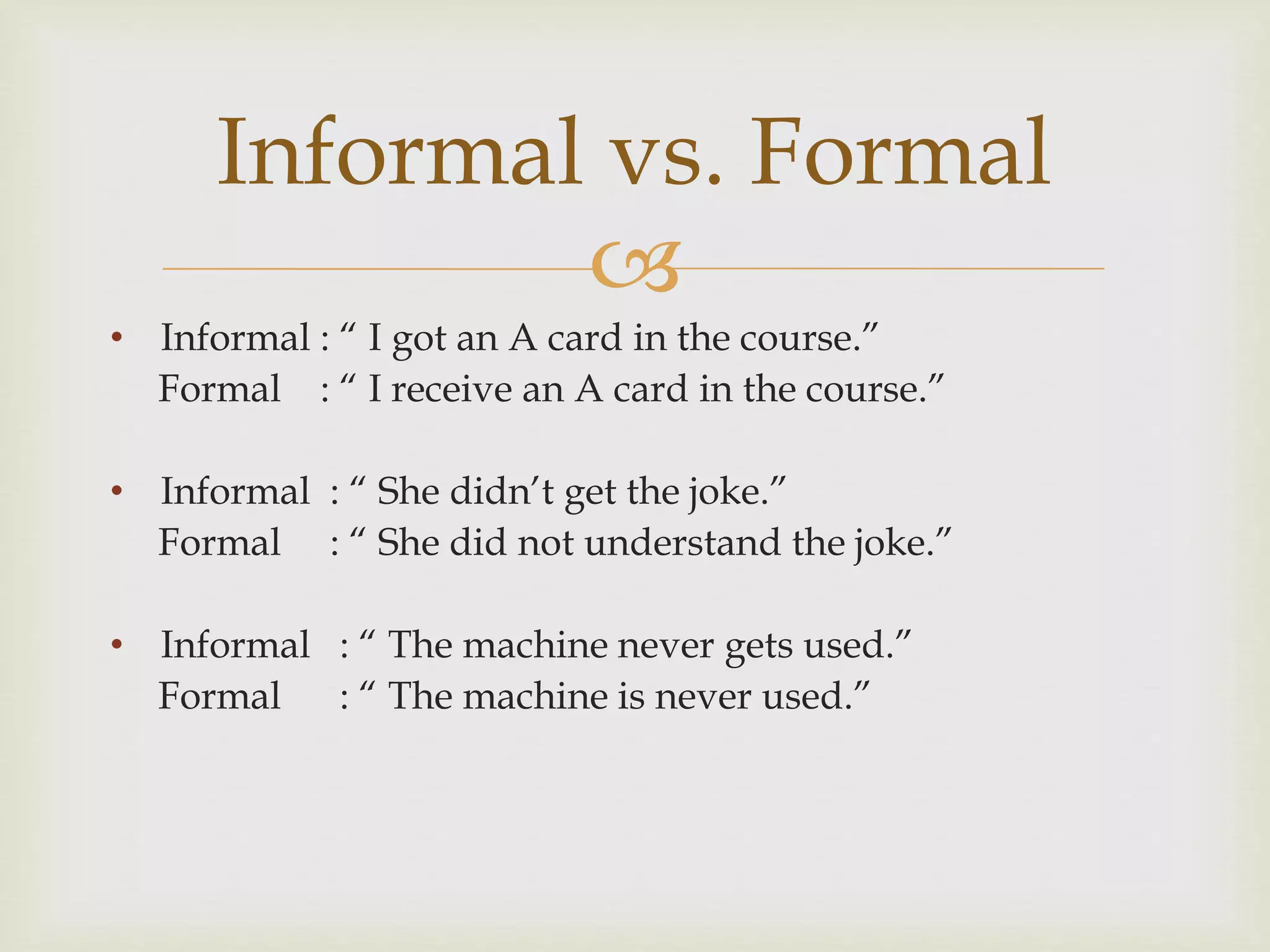
• Informal : “ I got an A card in the course.”
Formal : “ I receive an A card in the course.”
• Informal : “ She didn’t get the joke.”
Formal : “ She did not understand the joke.”
• Informal : “ The machine never gets used.”
Formal : “ The machine is never used.”
Informal vs. Formal

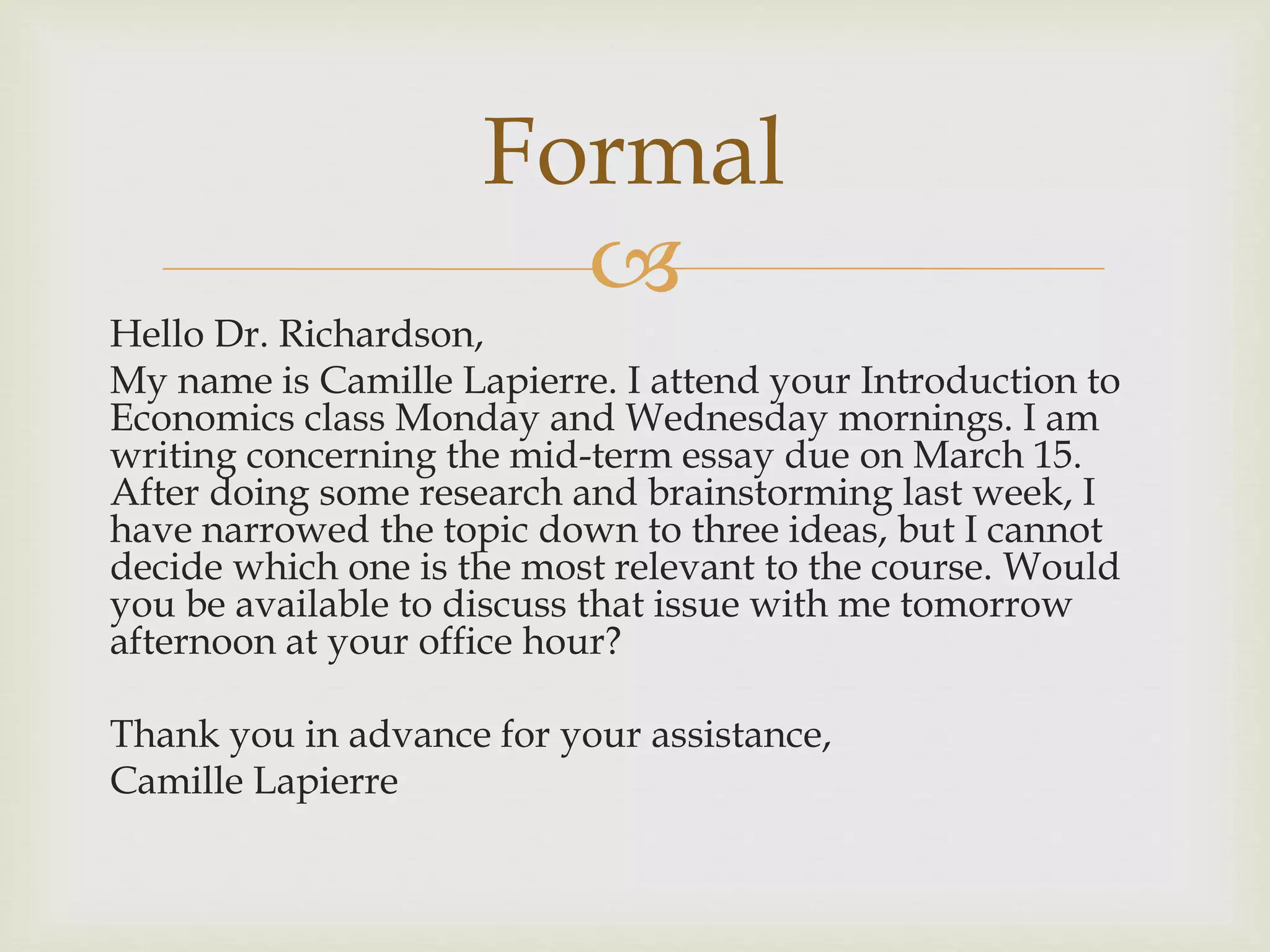
Hello Dr. Richardson,
My name is Camille Lapierre. I attend your Introduction to
Economics class Monday and Wednesday mornings. I am
writing concerning the mid-term essay due on March 15.
After doing some research and brainstorming last week, I
have narrowed the topic down to three ideas, but I cannot
decide which one is the most relevant to the course. Would
you be available to discuss that issue with me tomorrow
afternoon at your office hour?
Thank you in advance for your assistance,
Camille Lapierre
Formal

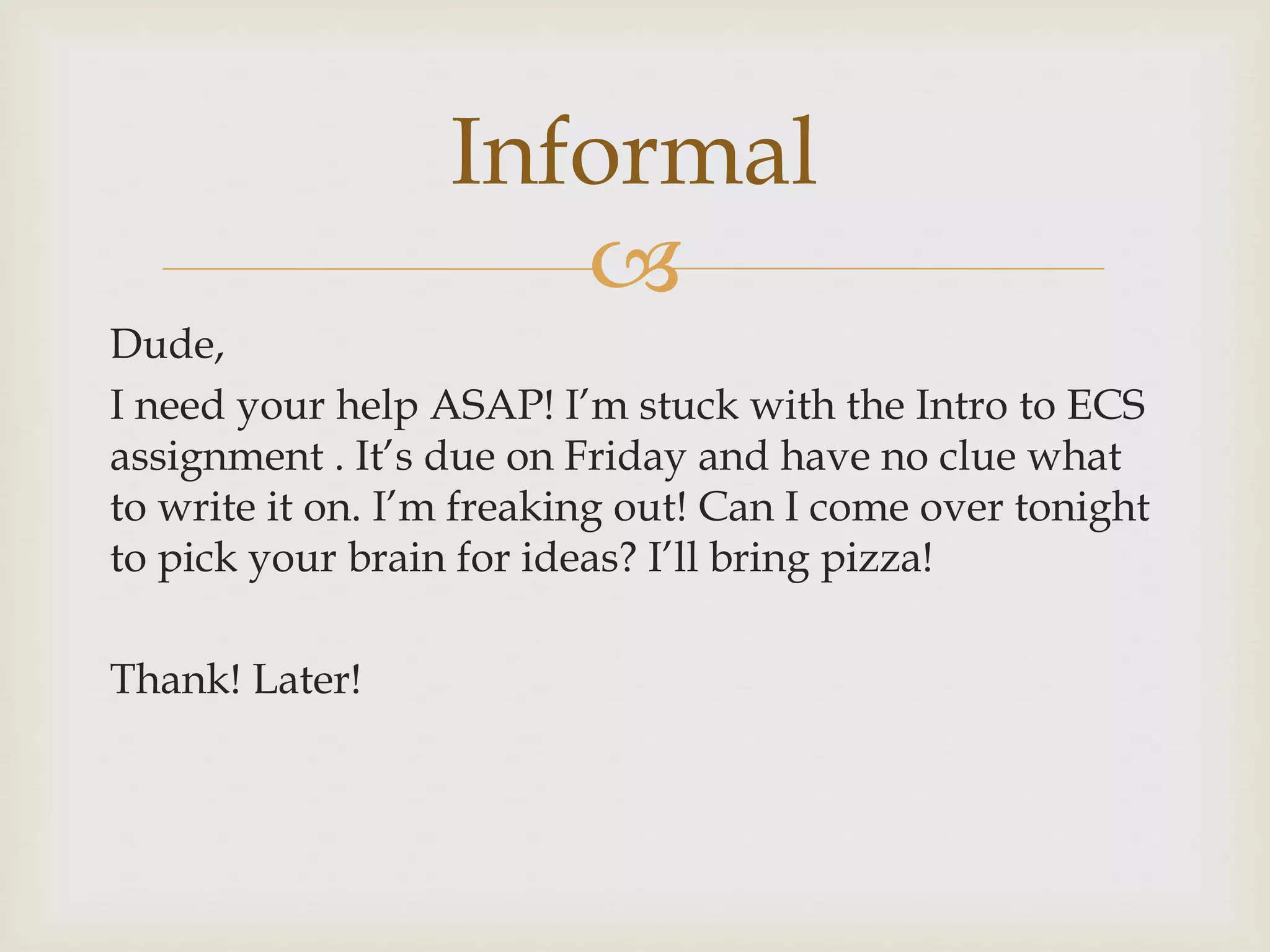
Dude,
I need your help ASAP! I’m stuck with the Intro to ECS
assignment . It’s due on Friday and have no clue what
to write it on. I’m freaking out! Can I come over tonight
to pick your brain for ideas? I’ll bring pizza!
Thank! Later!
Informal

THANK YOU FOR
LISTENING
EVERYONE  !!!

Part 2 unit 1 lesson 5 consideration in formal writing

  • 1.
  • 2.
      The questionof whom you are writing for shapes a number of choices, including those related register. Audience
  • 3.
      Although allacademic writing has the transmission of information as an important purpose, there is some difference among genres. Purpose and strategy
  • 4.
      A numberof organizational patterns commonly occur in academic text.  The SPSE (situation-problem-solution-evaluation) structure is common in reports; academic research articles are often written in some version of the IMRD(introduction-method results-discussion) structure. Organization
  • 5.
      The stylein which you write is closely related to the questions bounding it organizational flow. Three elements shape the content of each paragraph : 1. Purpose. The reason the writer composes the paragraph. 2. Tone. The attitude the writer convey about the paragraph’s subject. 3. Audience. The individual or group whom the writer intends to address. Style
  • 6.
      Another importantconsideration for successful communication is flow-moving from one statement in a text to the next. Flow is what keeps the reader moving forward in a text. Flow
  • 7.
      Most teachertolerate small errors in language in papers written by nonnative speakers-for example, mistake in article or preposition usage. • These include the use of an incorrect homophone : 1. too/to/two 2. site/cite/sight 3. seem/seam 4. new/knew 5. their/there/they’re Presentation
  • 8.
      “Position” orestablished yourself as a beginner writer of your chosen field. All of the factors stated not only help to create a successful academic text, they help to position the writer within his/her discourse community. Positioning
  • 9.
     • Informal :“ I got an A card in the course.” Formal : “ I receive an A card in the course.” • Informal : “ She didn’t get the joke.” Formal : “ She did not understand the joke.” • Informal : “ The machine never gets used.” Formal : “ The machine is never used.” Informal vs. Formal
  • 10.
     Hello Dr. Richardson, Myname is Camille Lapierre. I attend your Introduction to Economics class Monday and Wednesday mornings. I am writing concerning the mid-term essay due on March 15. After doing some research and brainstorming last week, I have narrowed the topic down to three ideas, but I cannot decide which one is the most relevant to the course. Would you be available to discuss that issue with me tomorrow afternoon at your office hour? Thank you in advance for your assistance, Camille Lapierre Formal
  • 11.
     Dude, I need yourhelp ASAP! I’m stuck with the Intro to ECS assignment . It’s due on Friday and have no clue what to write it on. I’m freaking out! Can I come over tonight to pick your brain for ideas? I’ll bring pizza! Thank! Later! Informal
  • 12.