COHERENCE:
Transition Between
Ideas
Lesson
Objectives
 Identify the most common connectives
and conjunctions.
 Use these properly in writing coherent
paragraphs.
13 Purposes in
Using Connecting Words
For a Variety of Writing
Styles
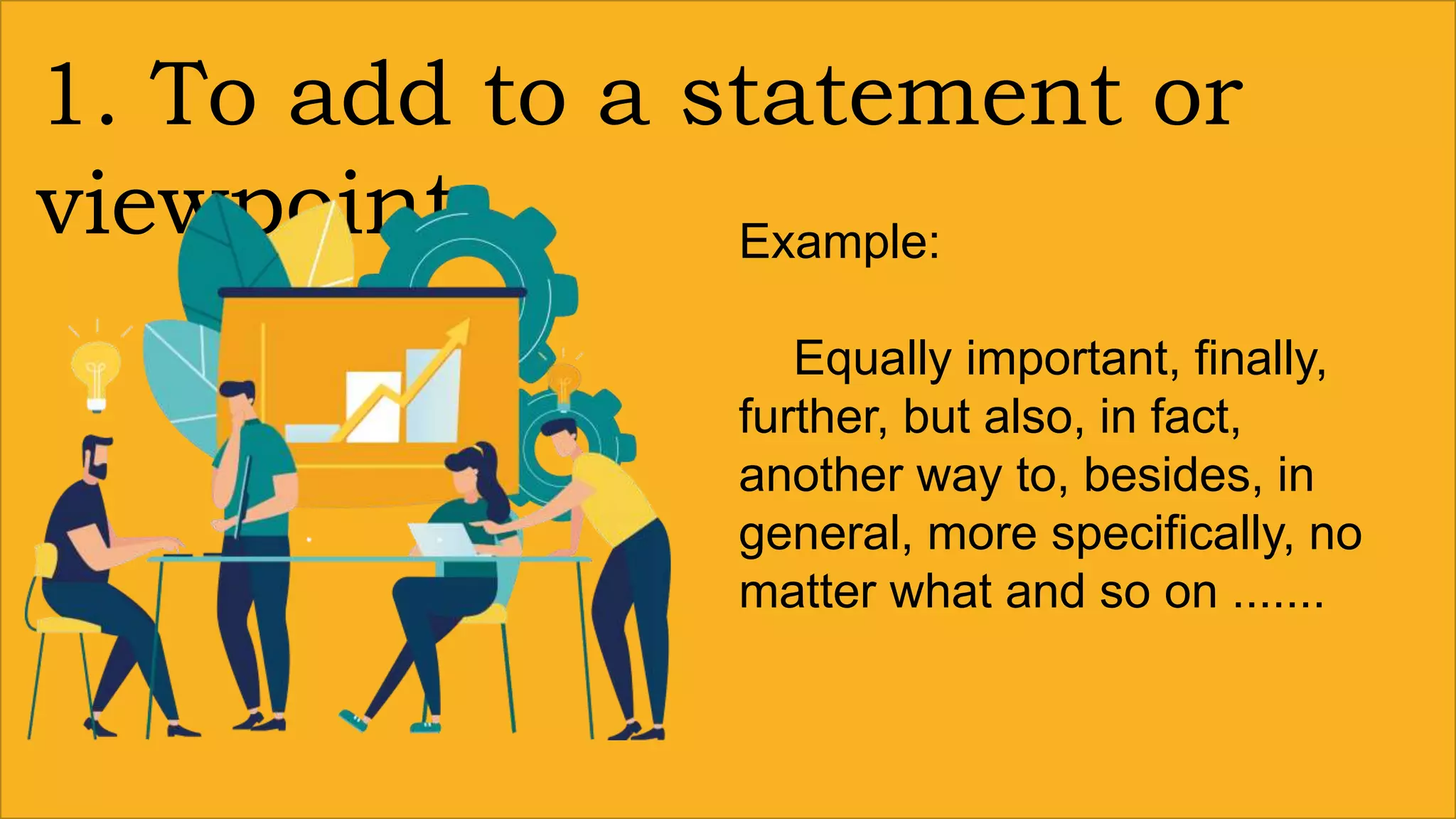
1. To add to a statement or
viewpoint Example:
Equally important, finally,
further, but also, in fact,
another way to, besides, in
general, more specifically, no
matter what and so on .......
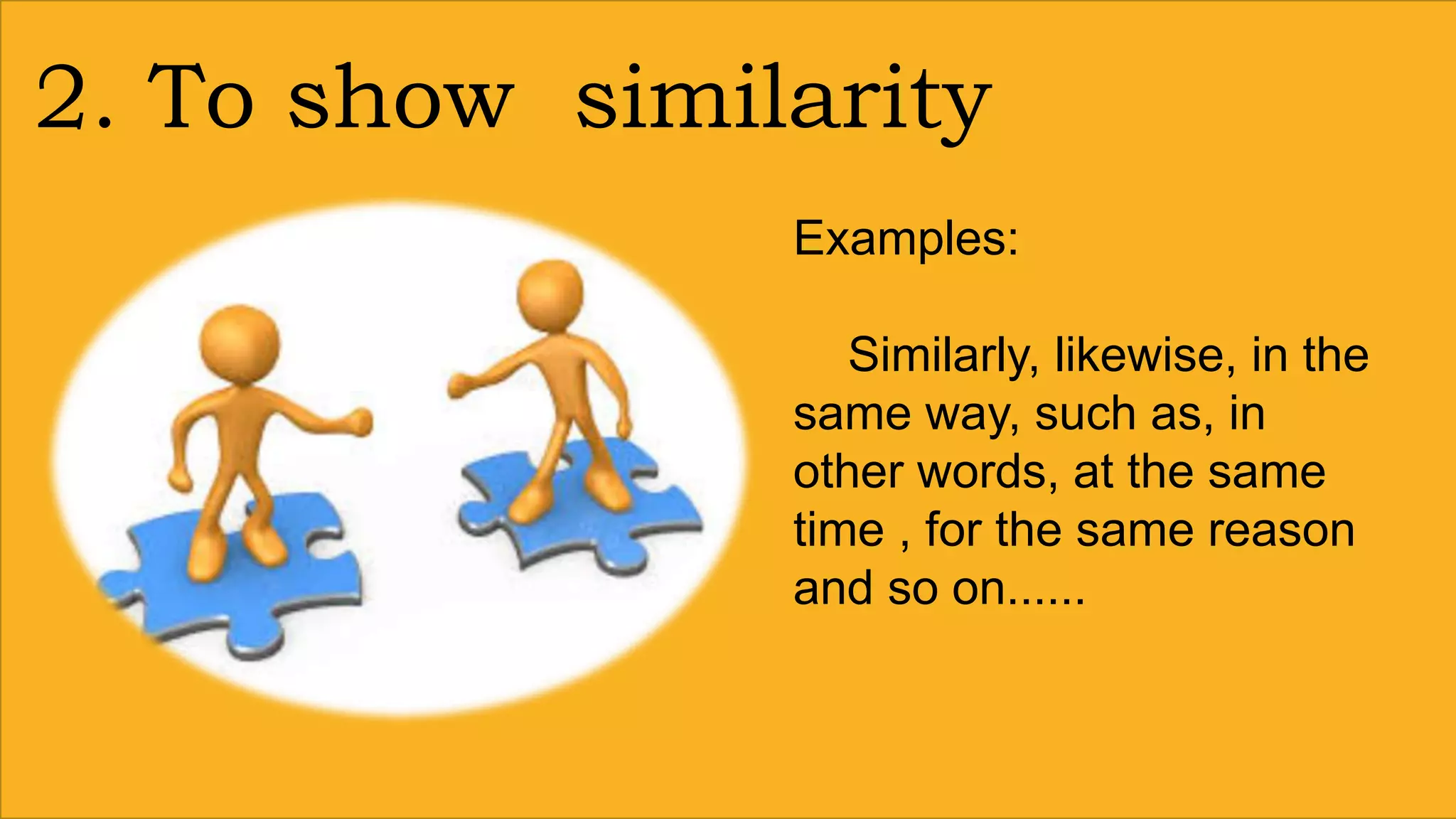
2. To show similarity
Examples:
Similarly, likewise, in the
same way, such as, in
other words, at the same
time , for the same reason
and so on......
3. To contrast
Example:
However, nevertheless, rather,
but, yet, on the other hand,
meanwhile, otherwise, in
contrast, nonetheless, regardless,
in any case, even, despite this,
and so on.
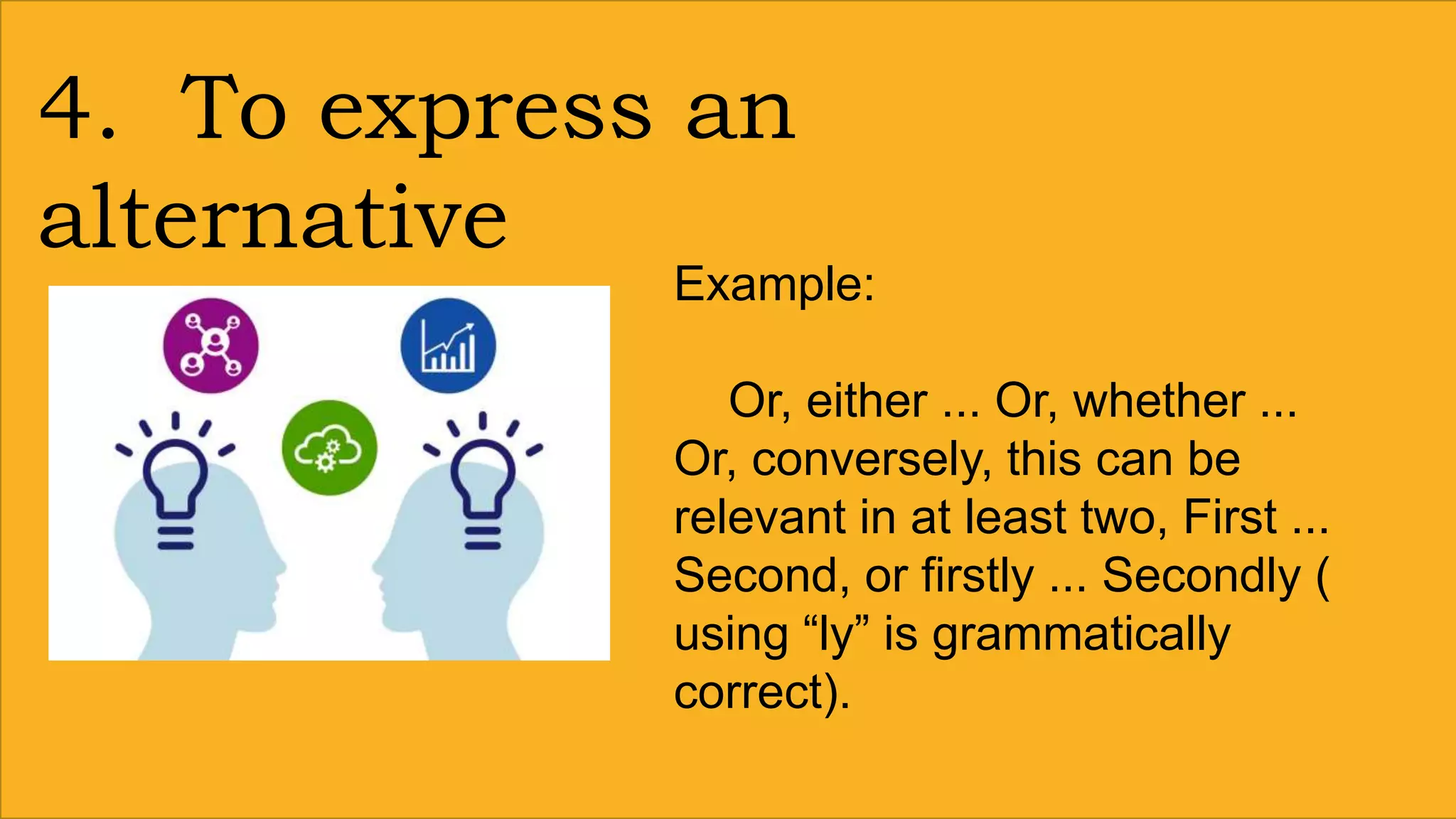
4. To express an
alternative
Example:
Or, either ... Or, whether ...
Or, conversely, this can be
relevant in at least two, First ...
Second, or firstly ... Secondly (
using “ly” is grammatically
correct).
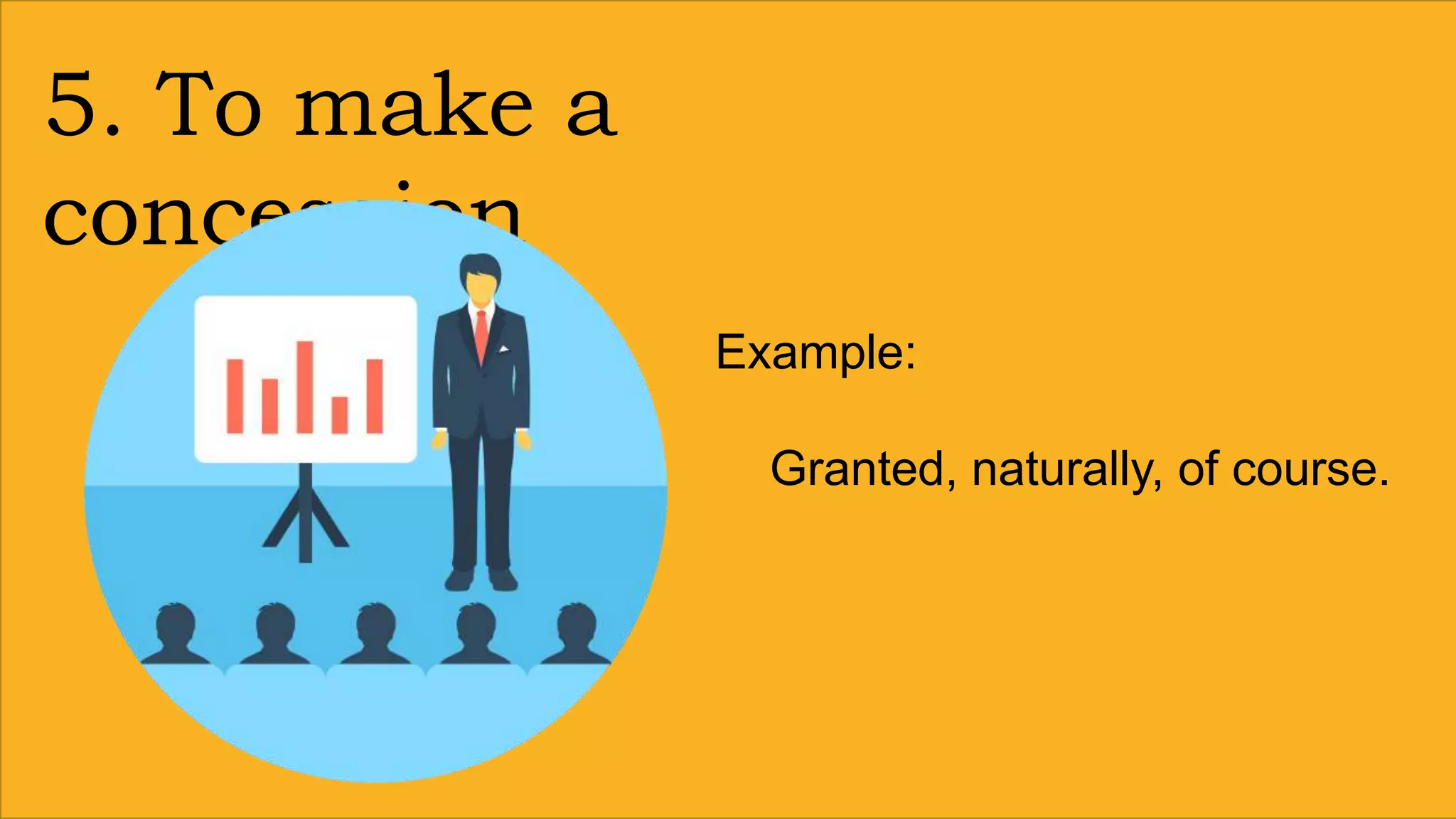
5. To make a
concession
Example:
Granted, naturally, of course.
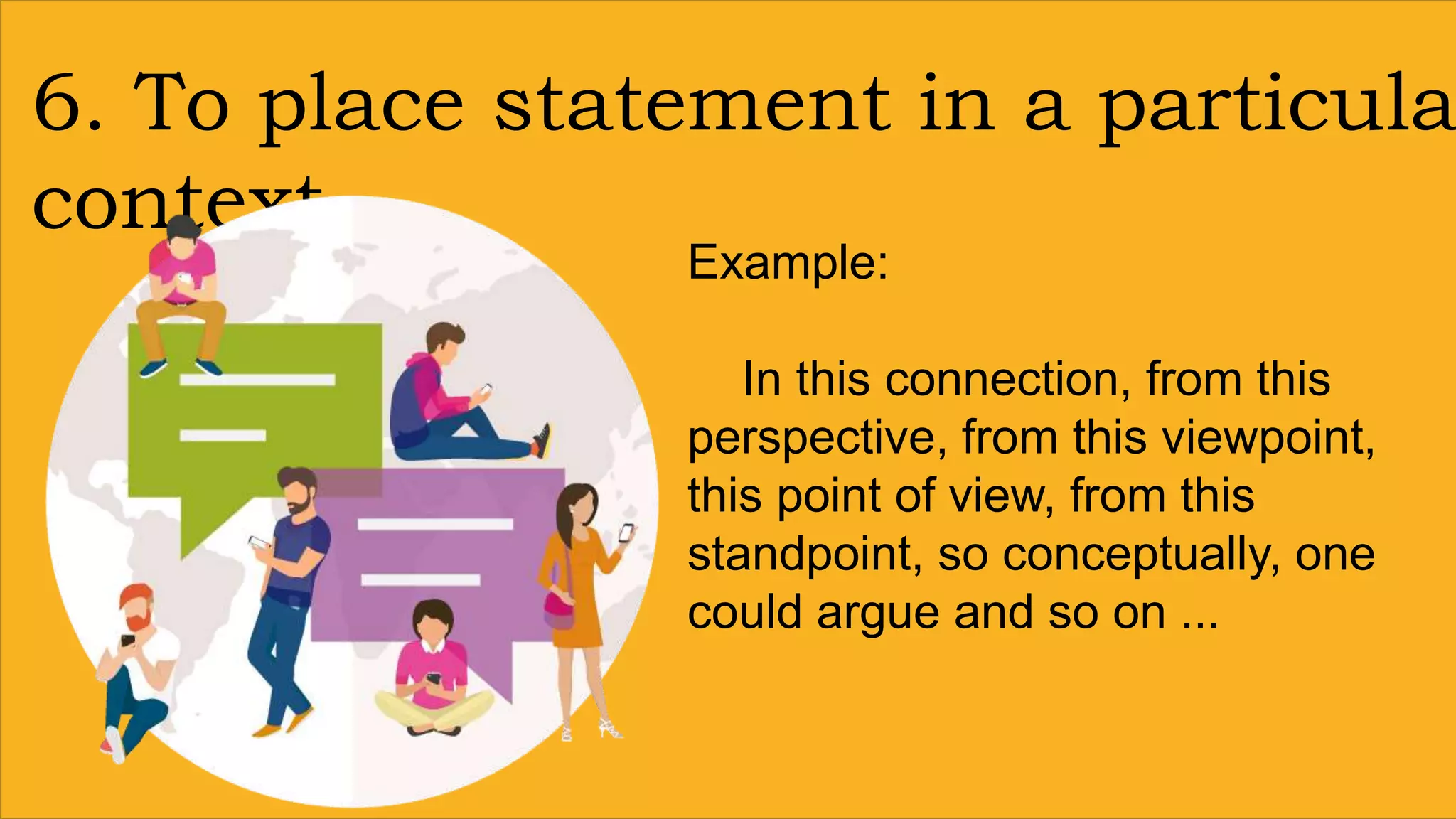
6. To place statement in a particula
context
Example:
In this connection, from this
perspective, from this viewpoint,
this point of view, from this
standpoint, so conceptually, one
could argue and so on ...
7. To place a statement in
a timely fashion
Example:
Previously, before this,
begin with, ultimately, while,
meanwhile, furthermore,
sometimes, summing up,
soon, sometimes, when,
now, once and etc.
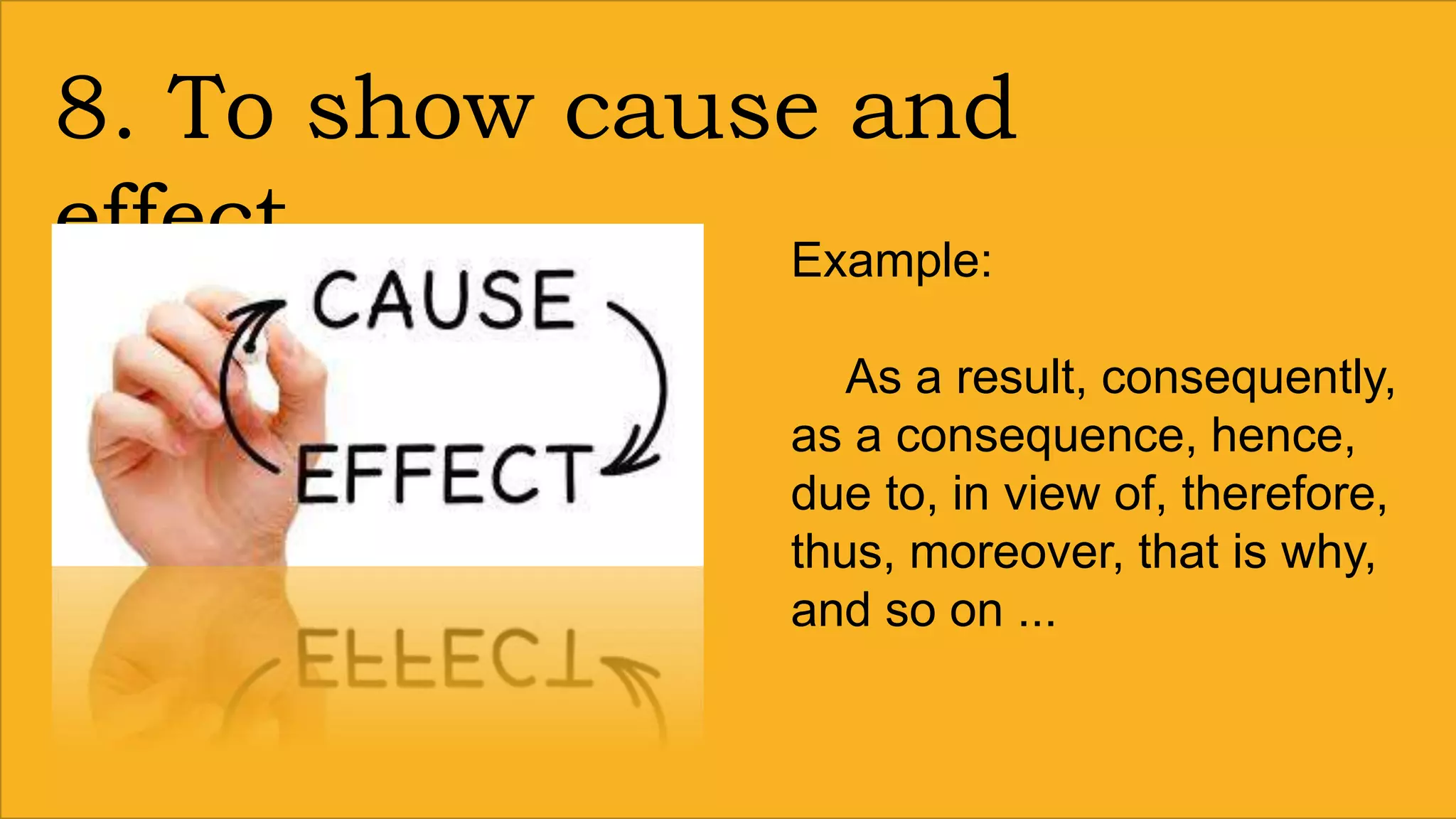
8. To show cause and
effect Example:
As a result, consequently,
as a consequence, hence,
due to, in view of, therefore,
thus, moreover, that is why,
and so on ...
9. To prove a point
Example:
Because, evidently, in fact,
considering, in view of, insofar as,
increasingly, more importantly, even
though, particularly, above all, by far,
even if, and so on ...
10. To give an example of an
earlier
point of viewExample:
For instance, in this case, to
illustrate, as an illustration, to take
another example, namely, that is, as
shown by, as expressed by, and so
on....
11. To repeat, insist on or
refer
an earlier pointExample:
As previously mentioned, as i
have said, in brief, as i have
noted, as been noted and so on
.....
12. To emphasize when
adding
a conditional statementExample:
Indeed, obviously,
apparently, accordingly,
without a doubt, certainly, in
accordance, according to,
otherwise, as far as and so
on....
13. To conclude a
paragraph or
an essayExample:
Thus, lastly, in brief, in short, on
the whole, to sum up, to conclude, in
conclusion, as i have shown, as i
have said, in summary, to summarise,
ultimately.
OBJECTIVES:
• Distinguish between and among techniques in selecting and
organizing information,
• Justify the choice of a certain technique to make a cohesive
presentation,
• Describe the brainstorming process,
• Illustrate the different types of graphic organizer,
• Explain the difference between a topic and a sentence outline,
• Make a cohesive presentation with different graphic organizers,
using data from survey.
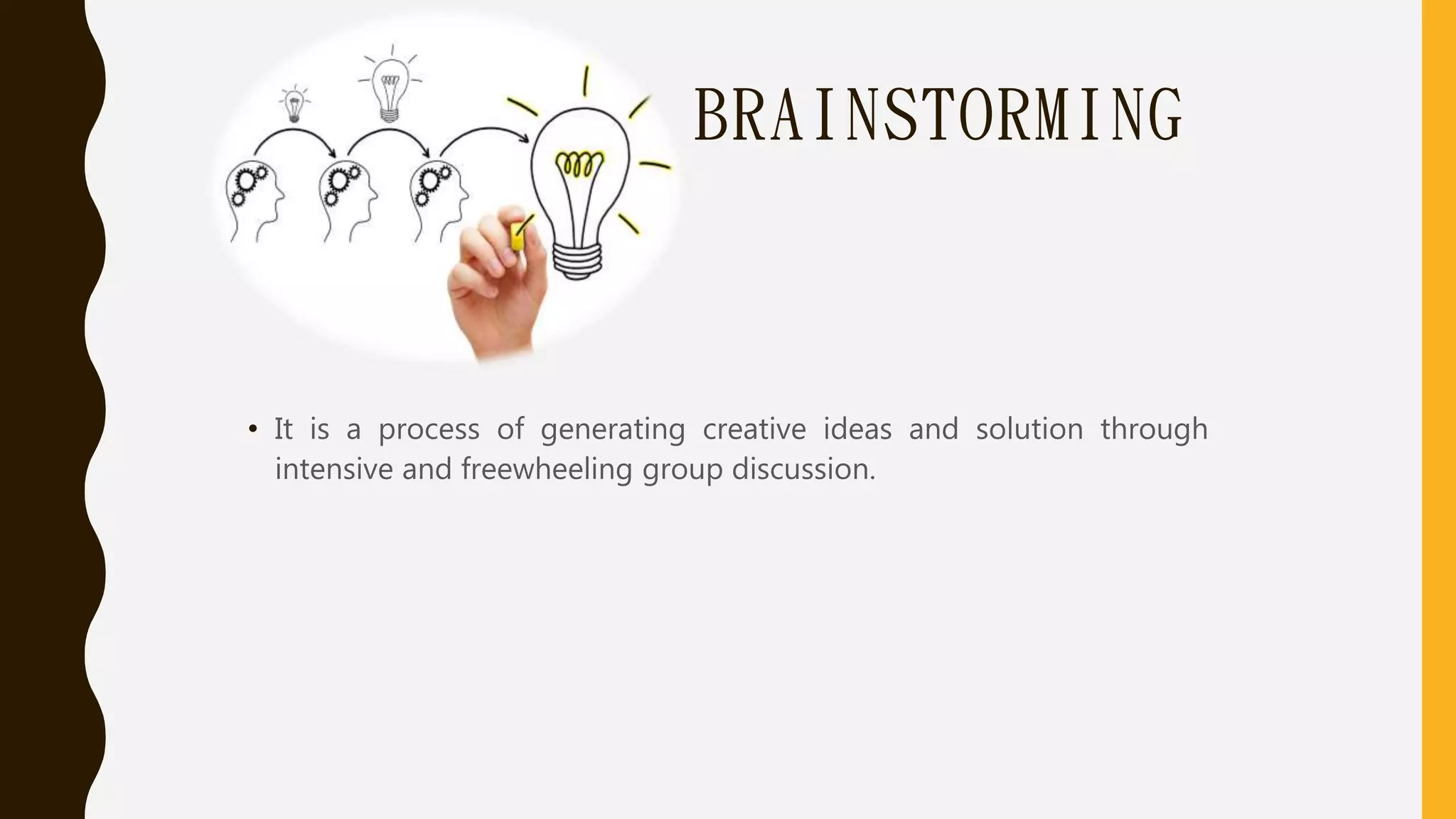
BRAINSTORMING
• It is a process of generating creative ideas and solution through
intensive and freewheeling group discussion.
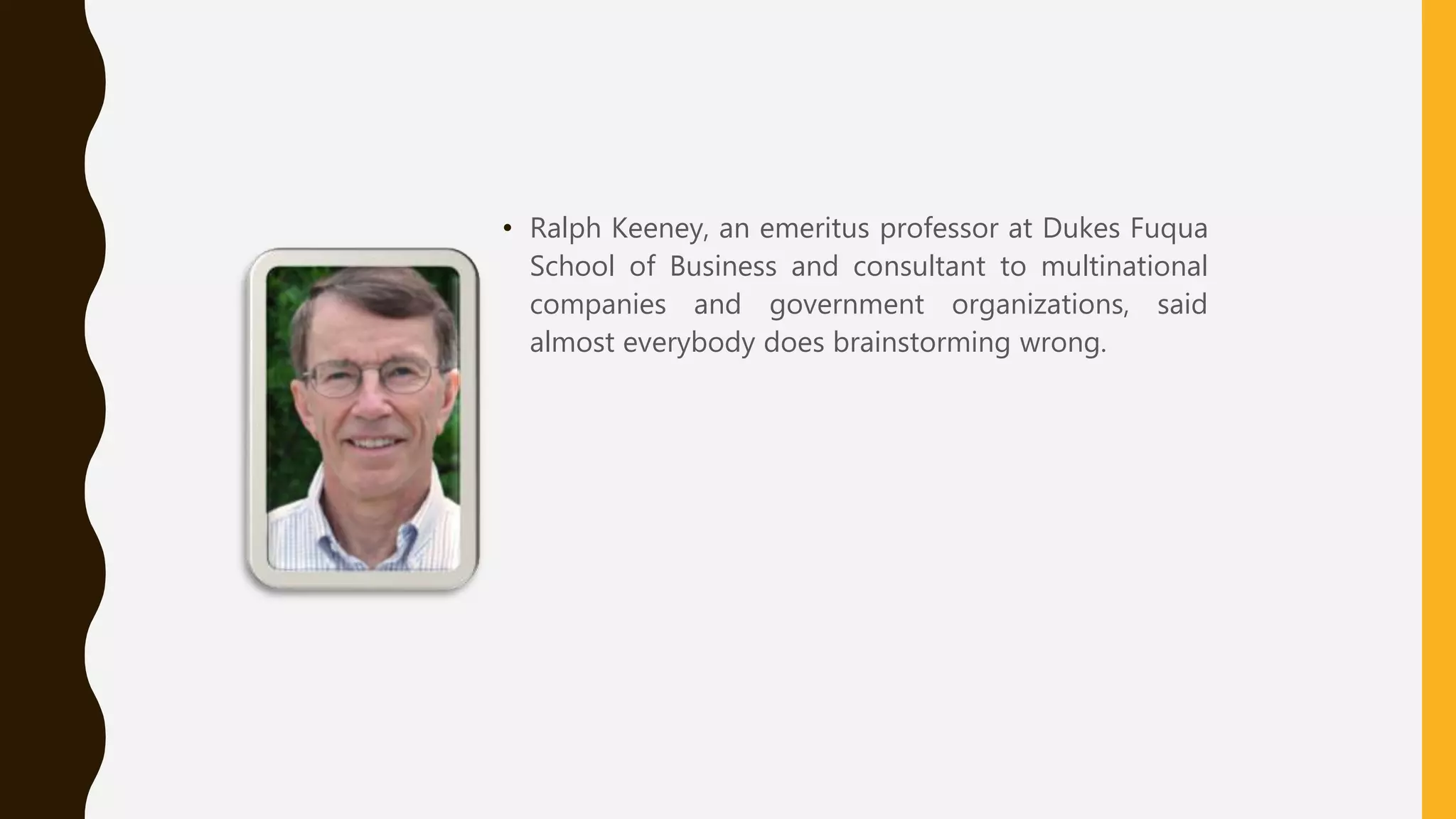
• Ralph Keeney, an emeritus professor at Dukes Fuqua
School of Business and consultant to multinational
companies and government organizations, said
almost everybody does brainstorming wrong.
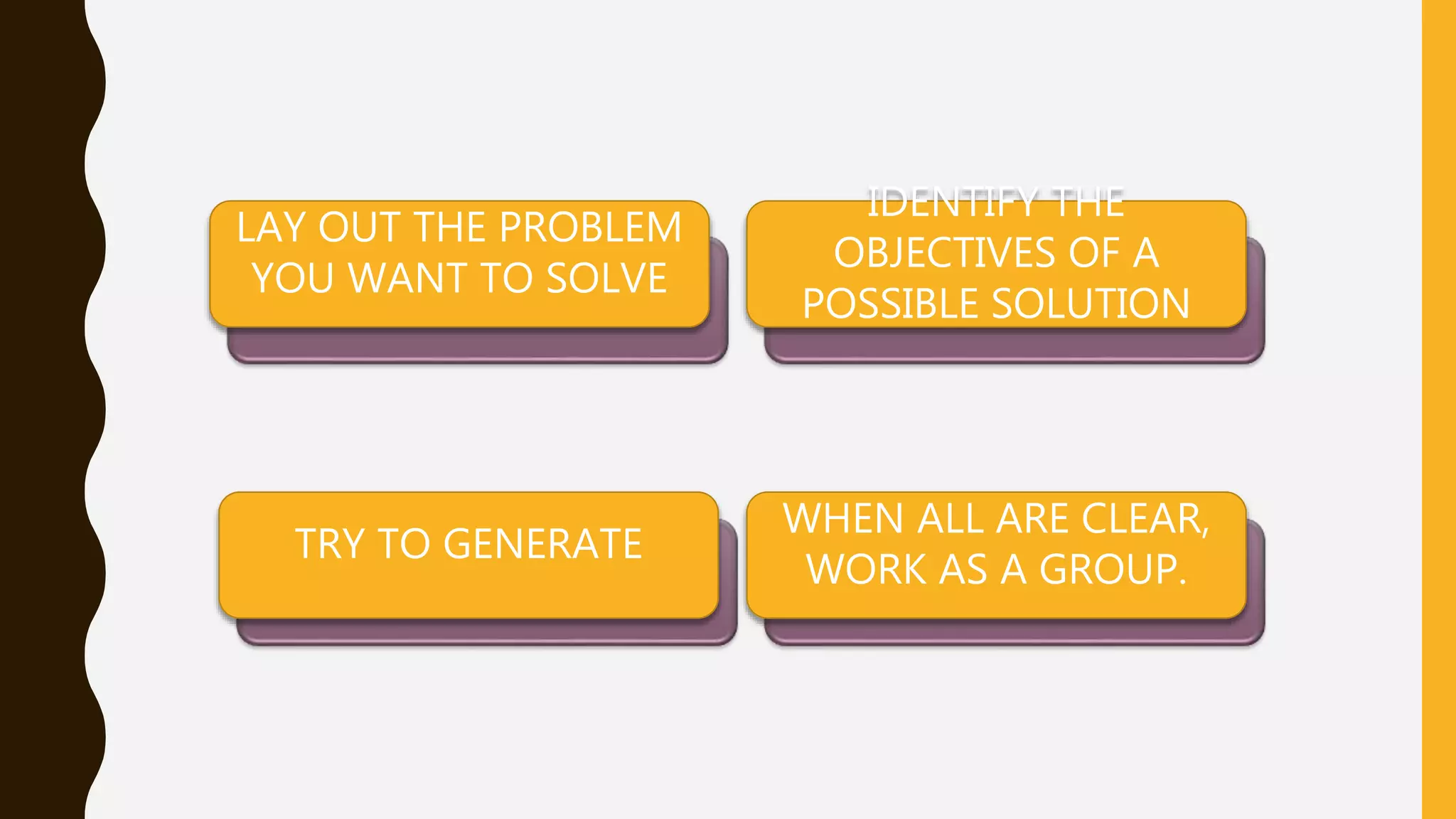
4 BASIC STEPS IN BRAINSTORMING
By: Ralph Keeney
LAY OUT THE PROBLEM
YOU WANT TO SOLVE
IDENTIFY THE
OBJECTIVES OF A
POSSIBLE SOLUTION
TRY TO GENERATE
WHEN ALL ARE CLEAR,
WORK AS A GROUP.
1. LAY OUT THE PROBLEM YOU
WANT TO SOLVE.
• According to Keeney, when dealing with a problem, students should
keep on pushing until they come up with at least 5 alternatives, and
then, considering all of those, “identify your objectives for your study,
evaluate the alternatives and select the best”.
2. IDENTIFY THE OBJECTIVES OF
A POSSIBLE SOLUTION.
• Knowing the goals will help making solutions easier.
3. TRY TO GENERATE SOLUTIONS
INDIVIDUALLY.
• Coming into a group brainstorming with potential solutions reduces
the risk that participants will get bogged down on one objective.
• This will avoid an “anchor”.
4. WHEN YOUR PROBLEMS,
OBJECTIVES AND PERSONAL
SOLUTIONS ARE CLEAR, WORK AS
A GROUP.
• Avoiding an “anchor” is a challenge when brainstorming for solutions
however, according to Keeney, if participants do their homework,
clarifying the problem, identifying the objectives, and individually
trying to come up with solutions, a brainstorming session can be
extremely productive.
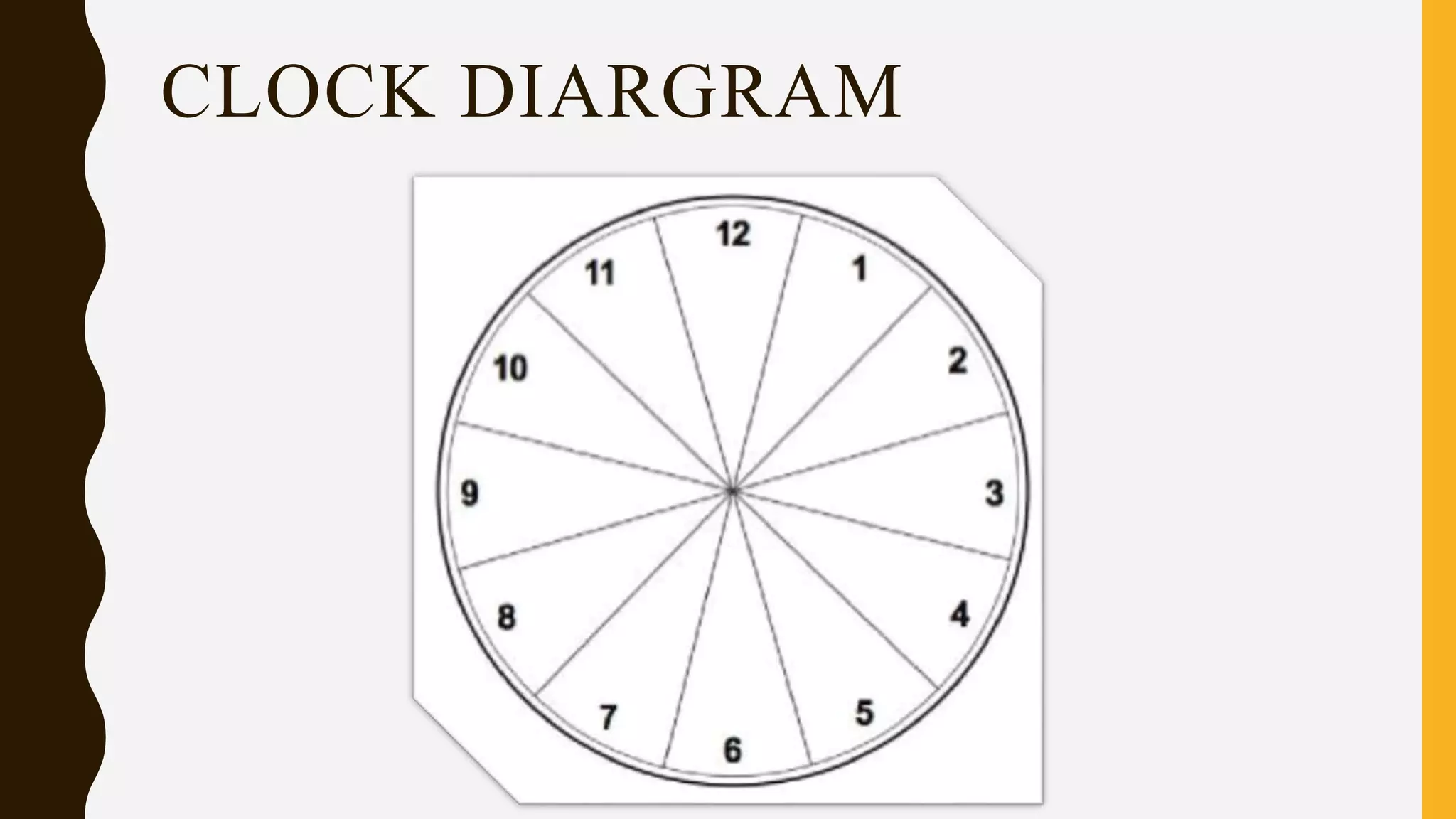
CLOCK DIARGRAM
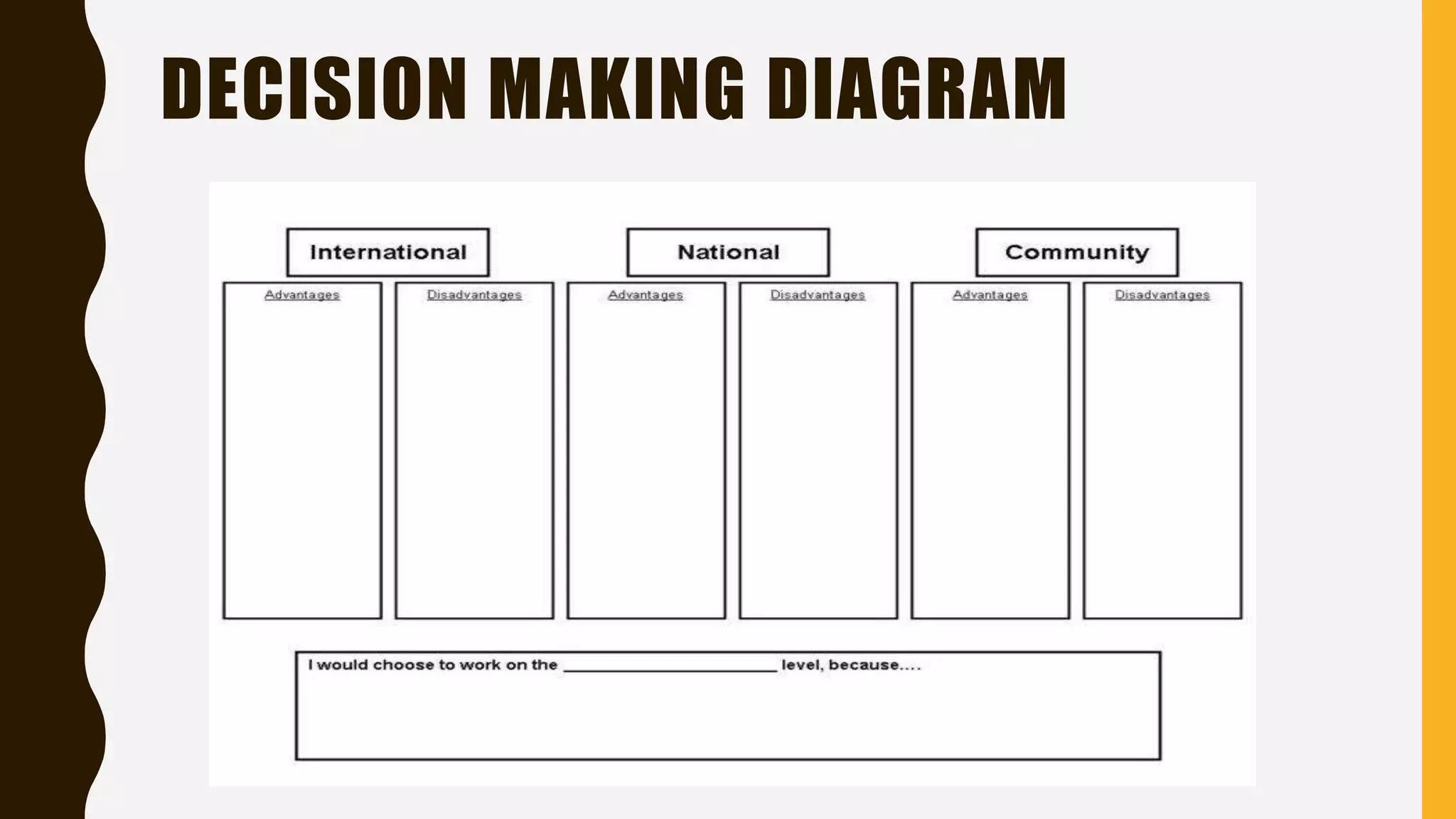
DECISION MAKING DIAGRAM
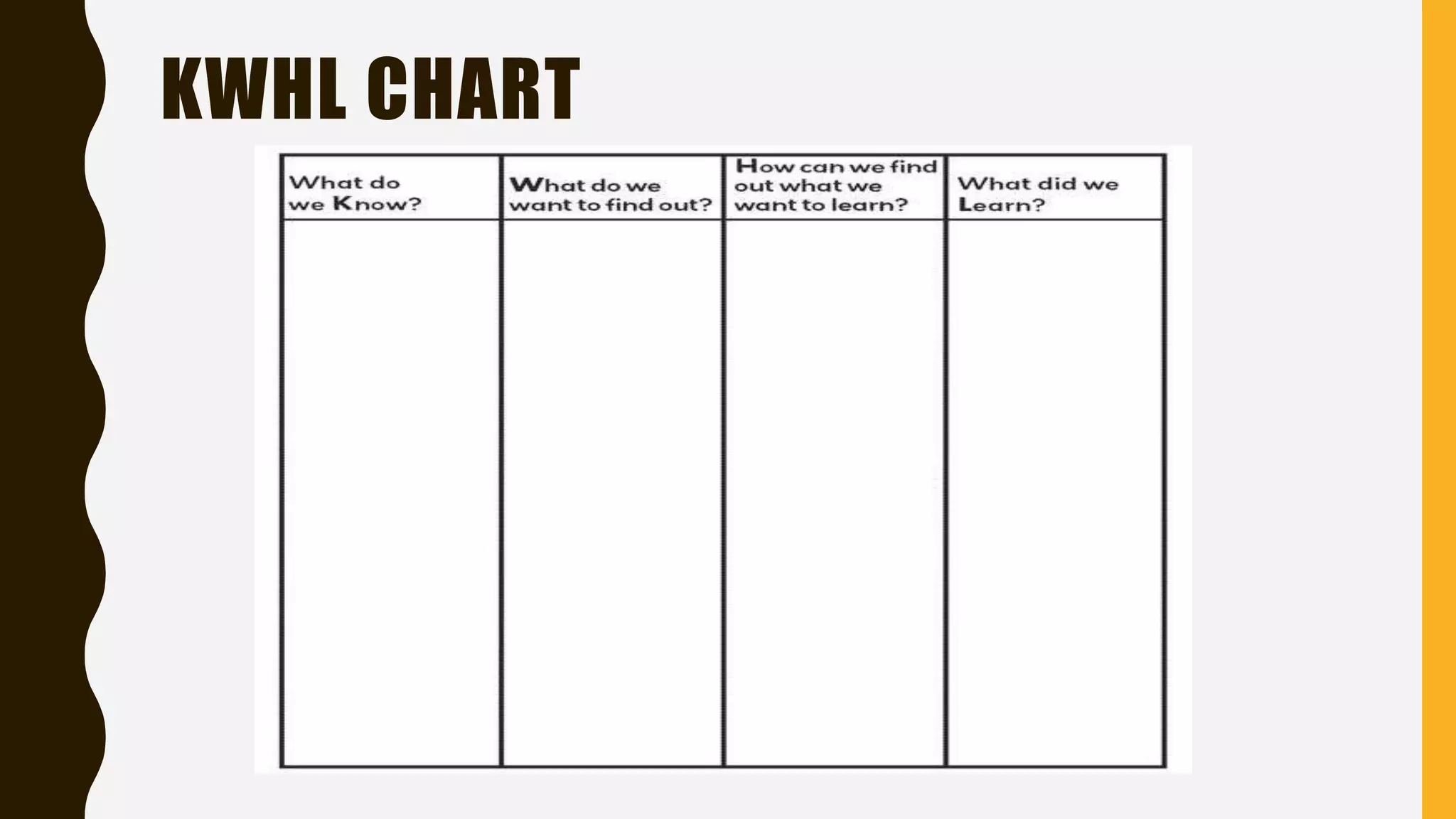
KWHL CHART
Y-CHART
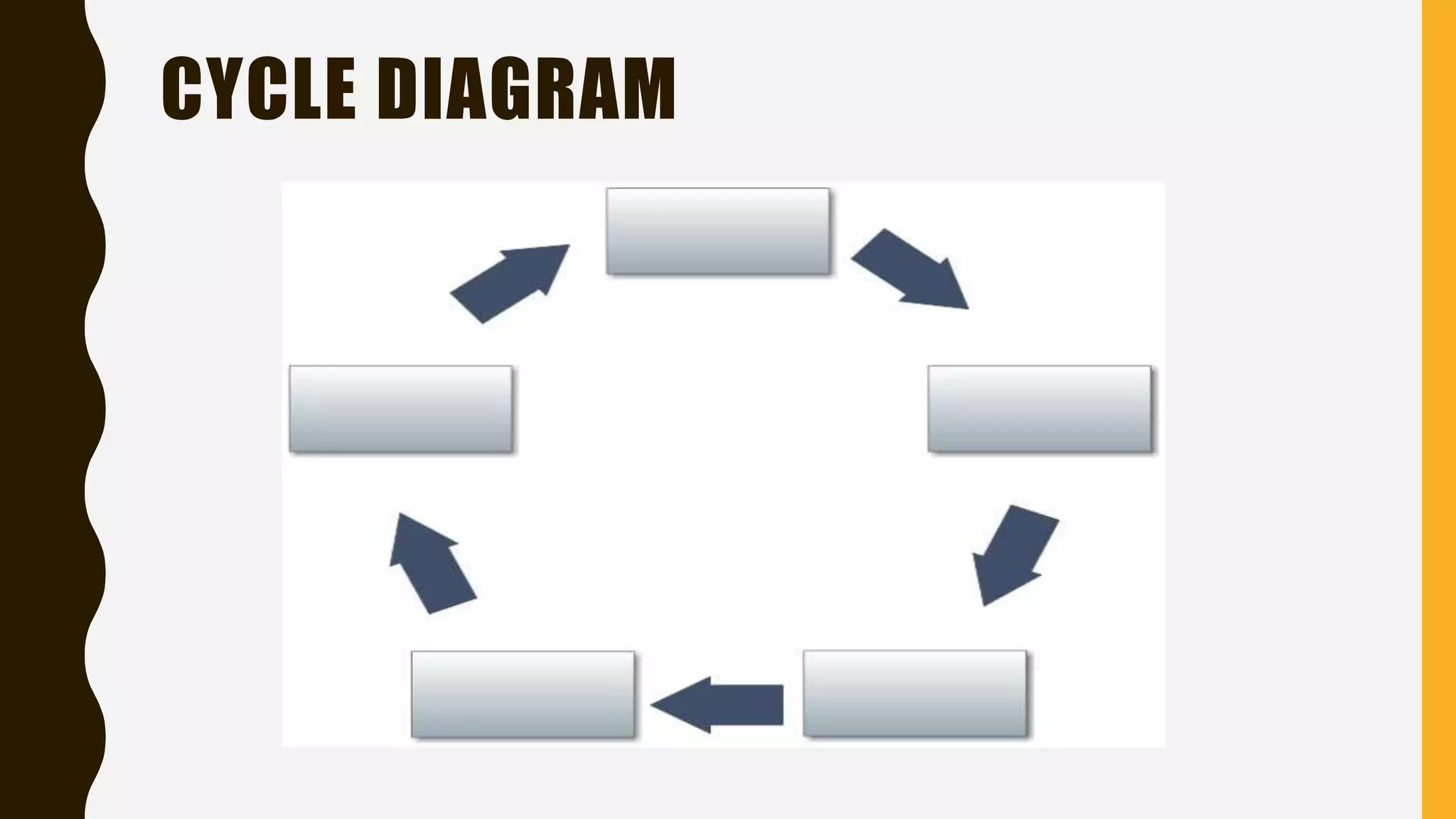
CYCLE DIAGRAM
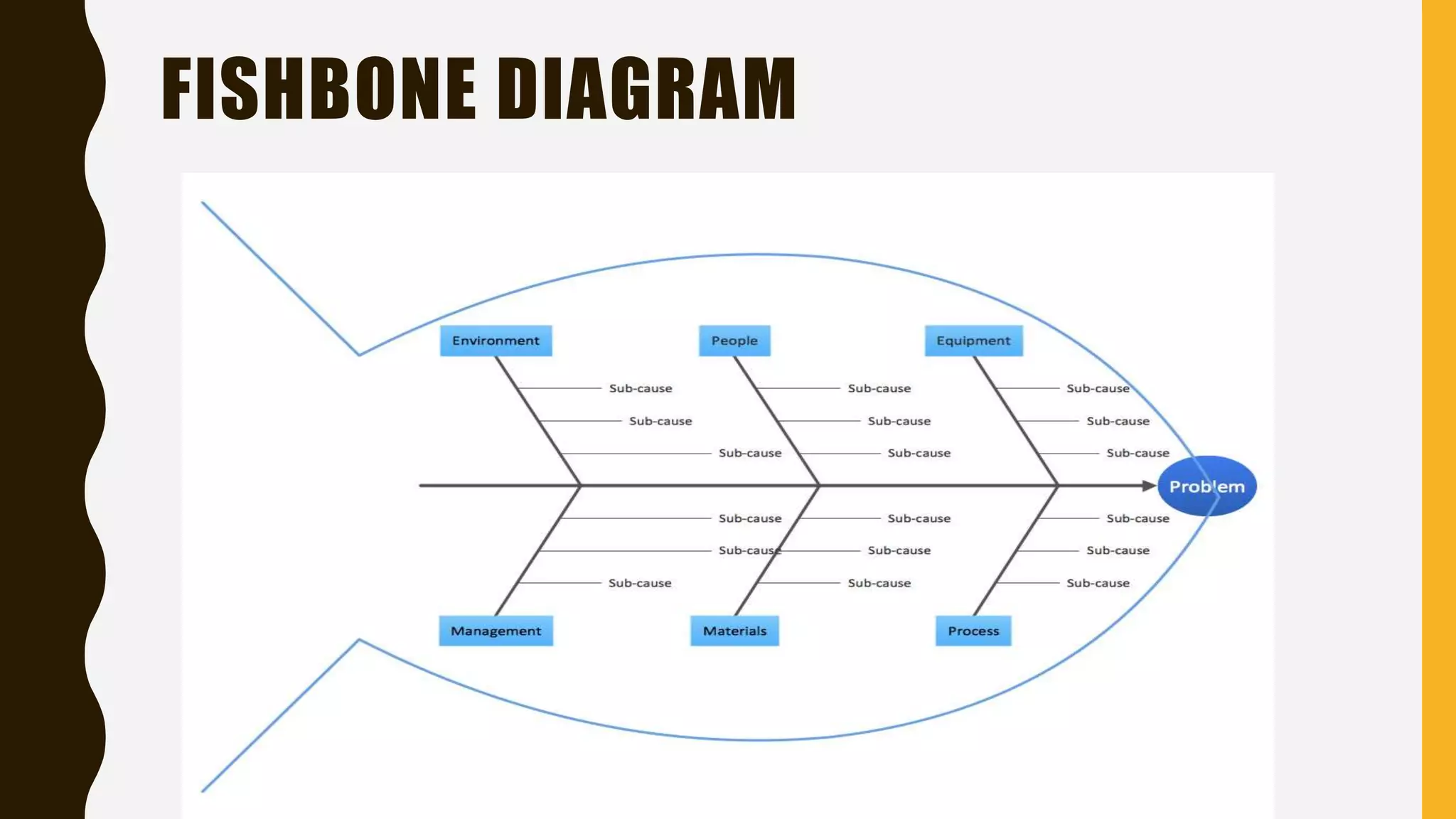
FISHBONE DIAGRAM
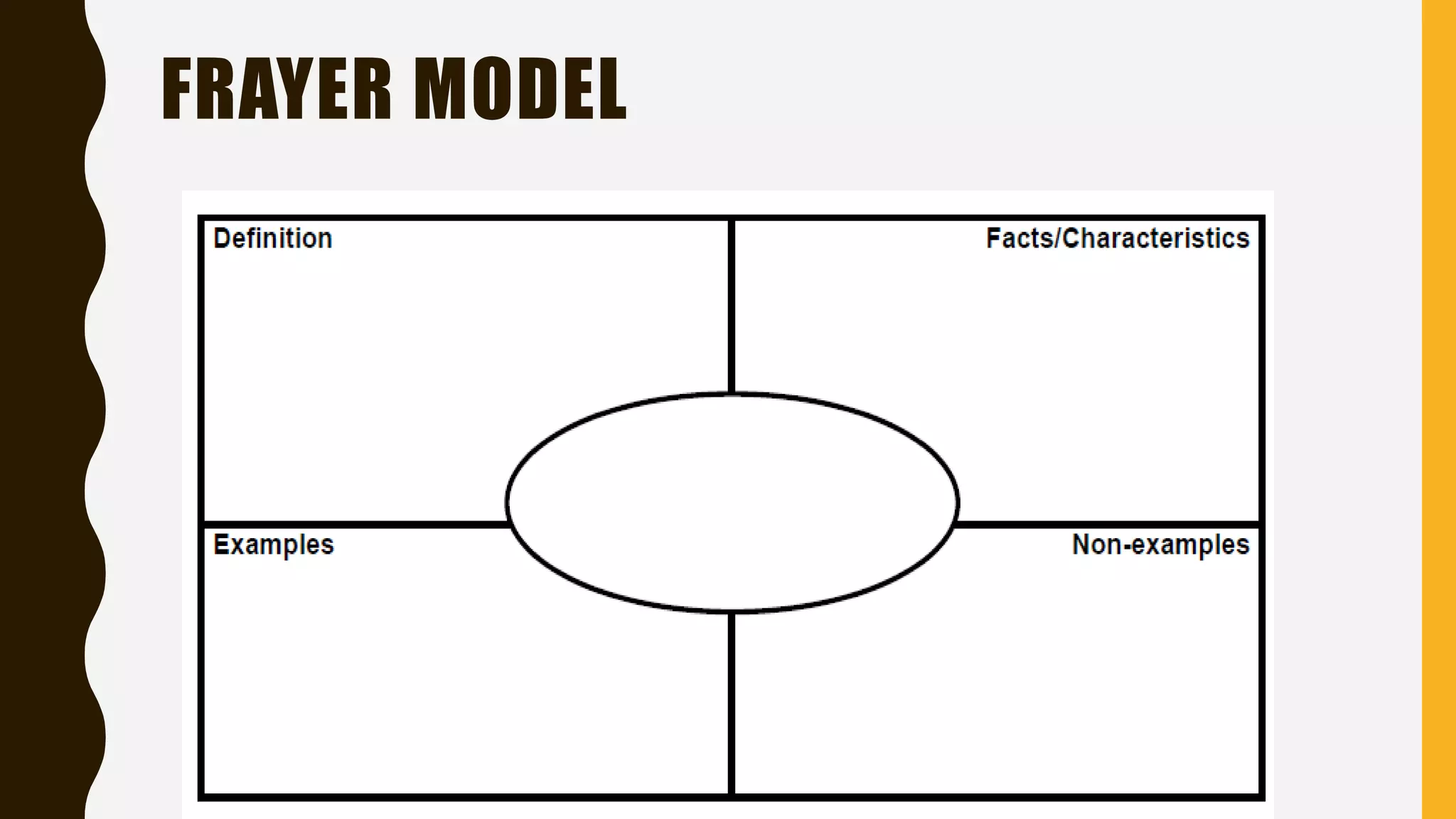
FRAYER MODEL
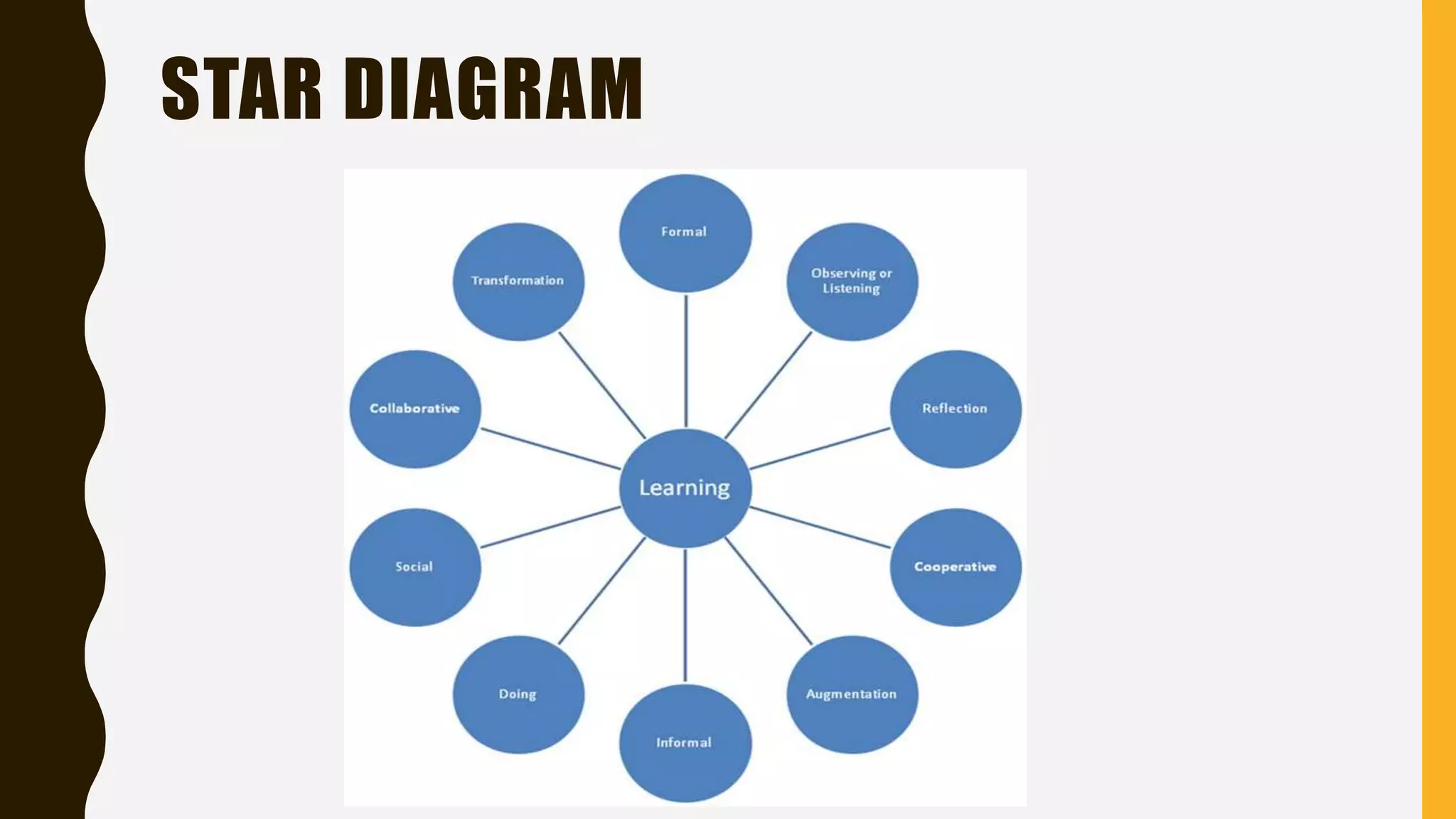
STAR DIAGRAM
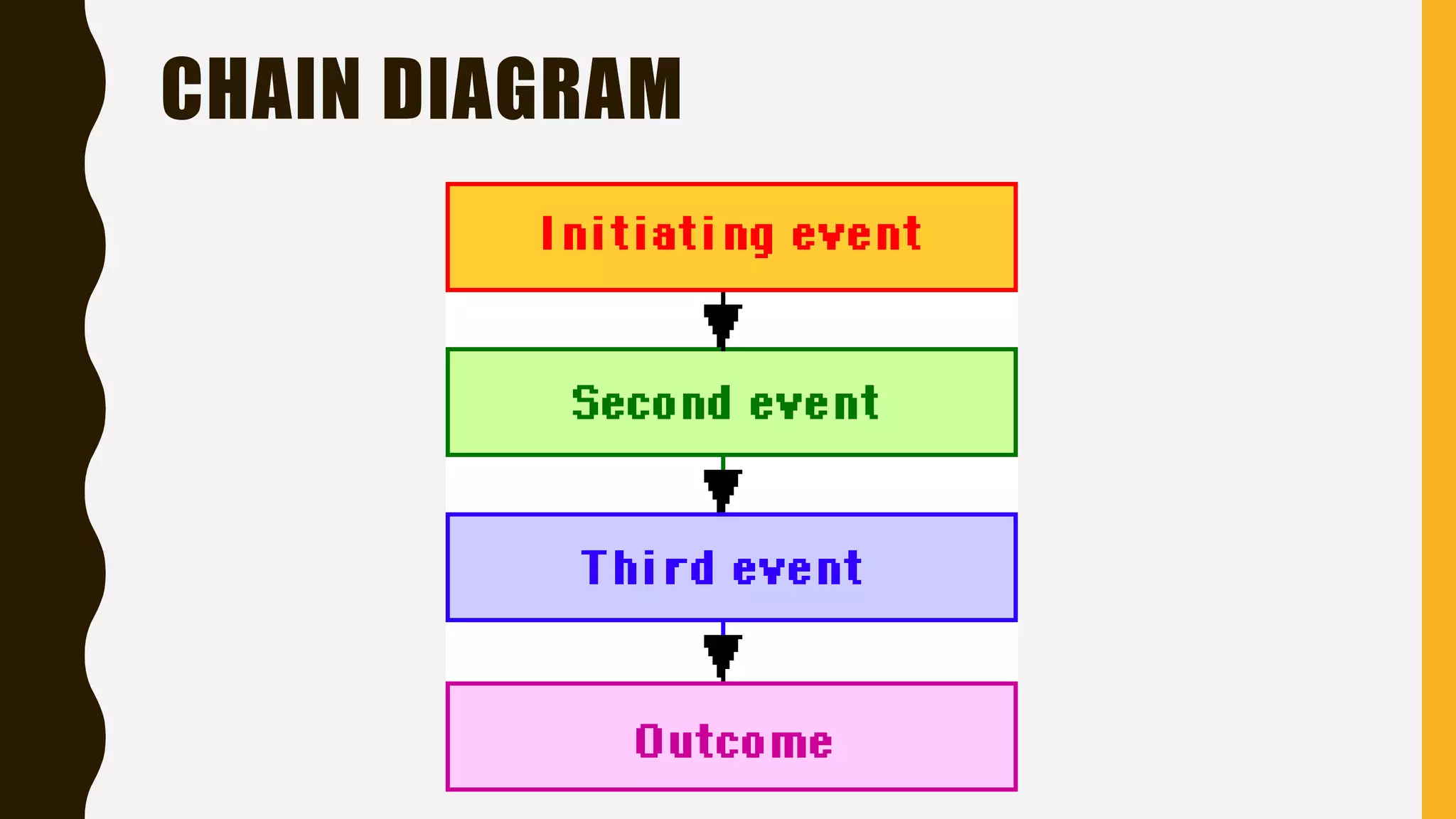
CHAIN DIAGRAM
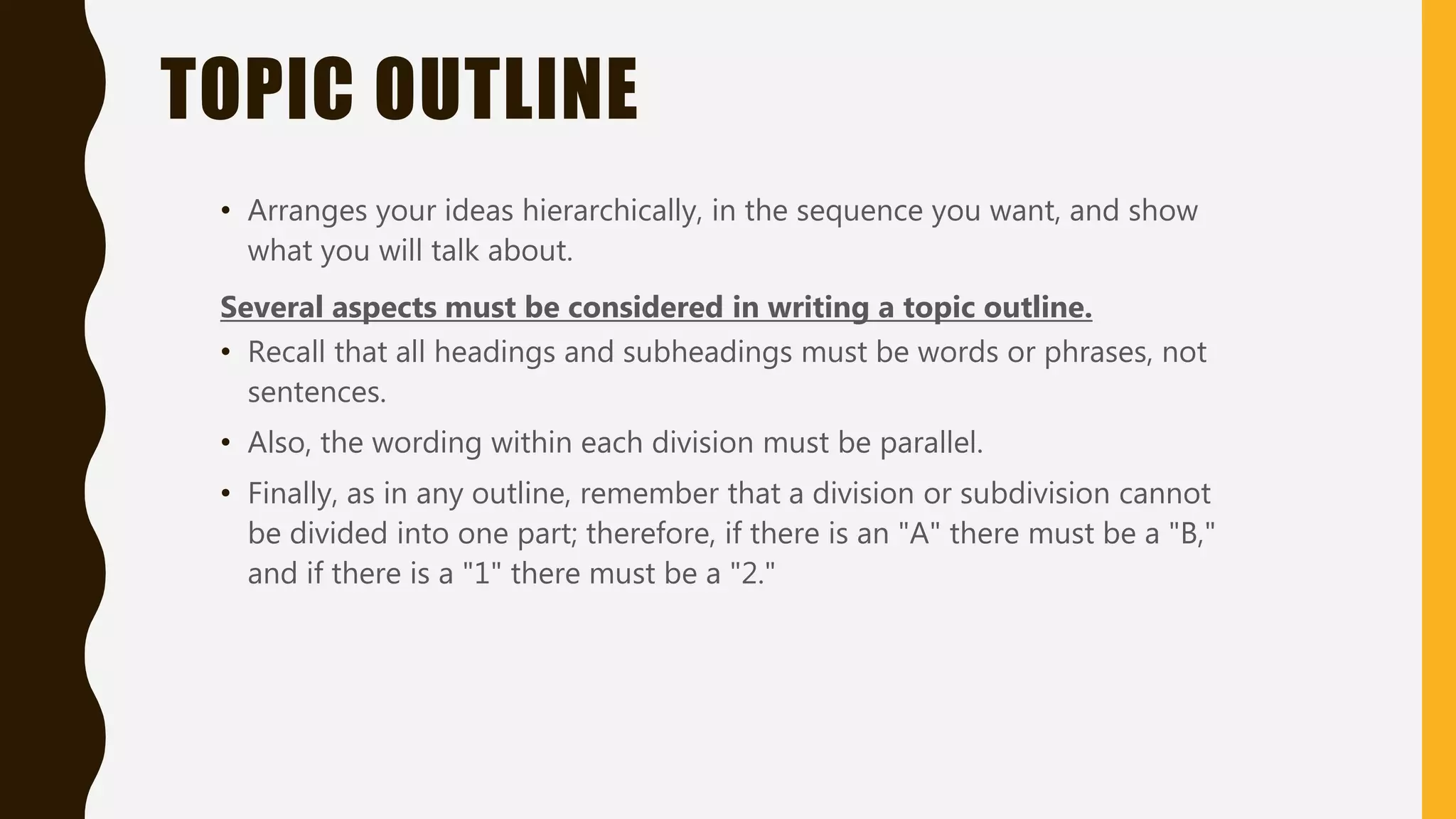
TOPIC OUTLINE
• Arranges your ideas hierarchically, in the sequence you want, and show
what you will talk about.
Several aspects must be considered in writing a topic outline.
• Recall that all headings and subheadings must be words or phrases, not
sentences.
• Also, the wording within each division must be parallel.
• Finally, as in any outline, remember that a division or subdivision cannot
be divided into one part; therefore, if there is an "A" there must be a "B,"
and if there is a "1" there must be a "2."
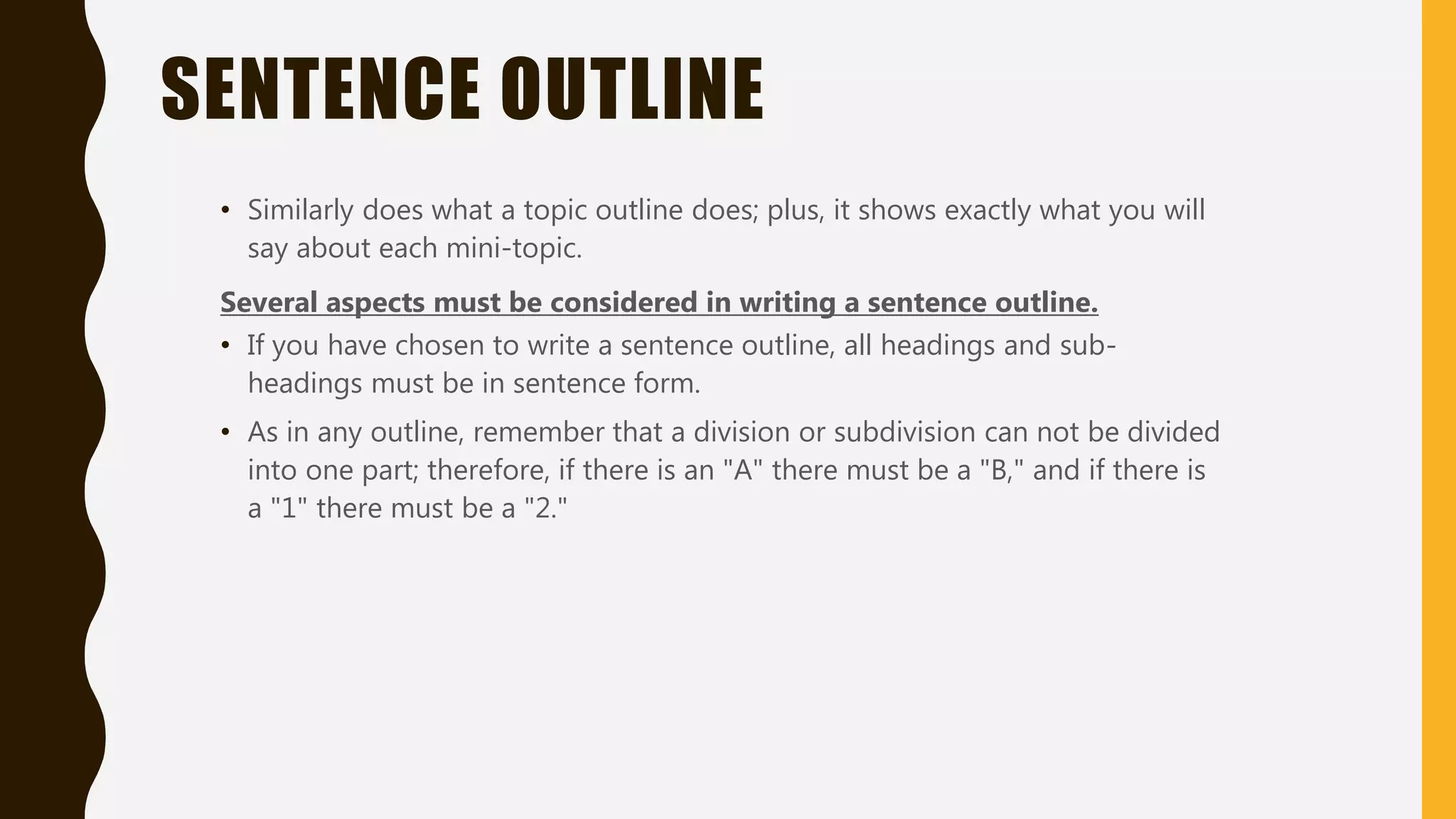
SENTENCE OUTLINE
• Similarly does what a topic outline does; plus, it shows exactly what you will
say about each mini-topic.
Several aspects must be considered in writing a sentence outline.
• If you have chosen to write a sentence outline, all headings and sub-
headings must be in sentence form.
• As in any outline, remember that a division or subdivision can not be divided
into one part; therefore, if there is an "A" there must be a "B," and if there is
a "1" there must be a "2."
IDENTIFYING
ASSUMPTION,
ARGUMENT AND
UNIT 2 LESSON 1
Page 26-29
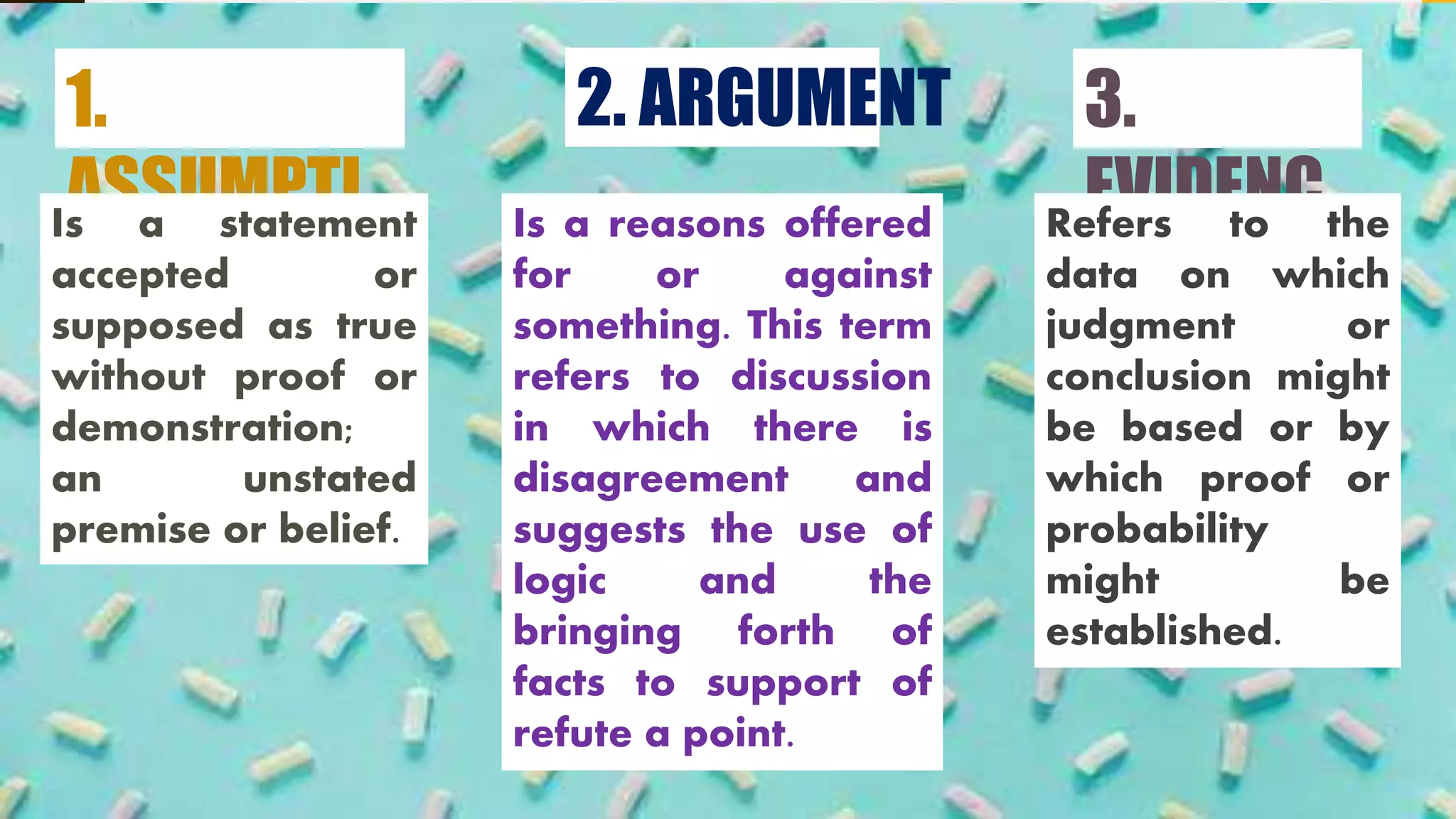
2. ARGUMENT
Is a reasons offered
for or against
something. This term
refers to discussion
in which there is
disagreement and
suggests the use of
logic and the
bringing forth of
facts to support of
refute a point.
1.
ASSUMPTI
ON
Is a statement
accepted or
supposed as true
without proof or
demonstration;
an unstated
premise or belief.
3.
EVIDENC
E
Refers to the
data on which
judgment or
conclusion might
be based or by
which proof or
probability
might be
established.
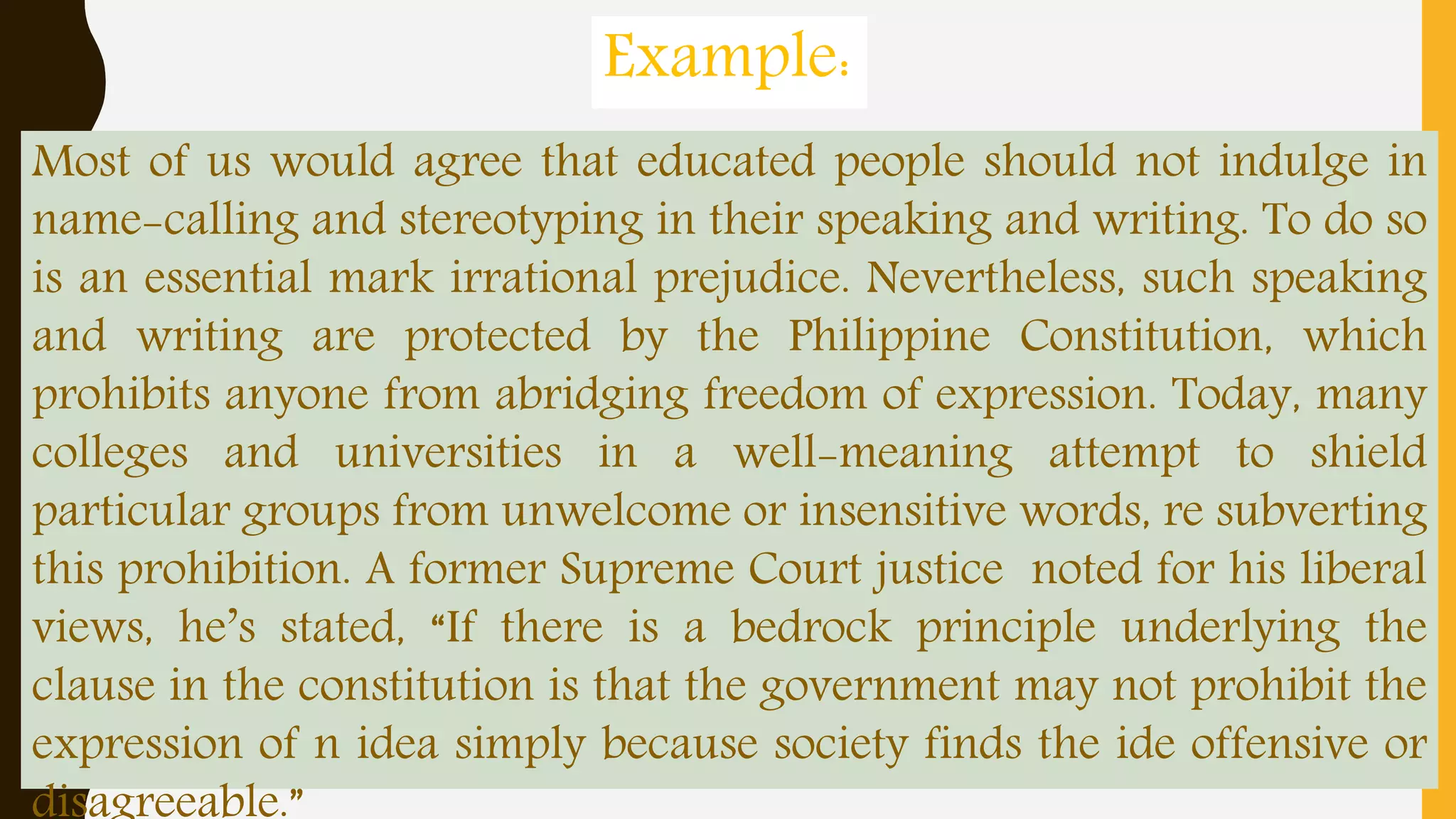
Most of us would agree that educated people should not indulge in
name-calling and stereotyping in their speaking and writing. To do so
is an essential mark irrational prejudice. Nevertheless, such speaking
and writing are protected by the Philippine Constitution, which
prohibits anyone from abridging freedom of expression. Today, many
colleges and universities in a well-meaning attempt to shield
particular groups from unwelcome or insensitive words, re subverting

this prohibition. A former Supreme Court justice noted for his liberal
views, he’s stated, “If there is a bedrock principle underlying the
clause in the constitution is that the government may not prohibit the
expression of n idea simply because society finds the ide offensive or
Example:
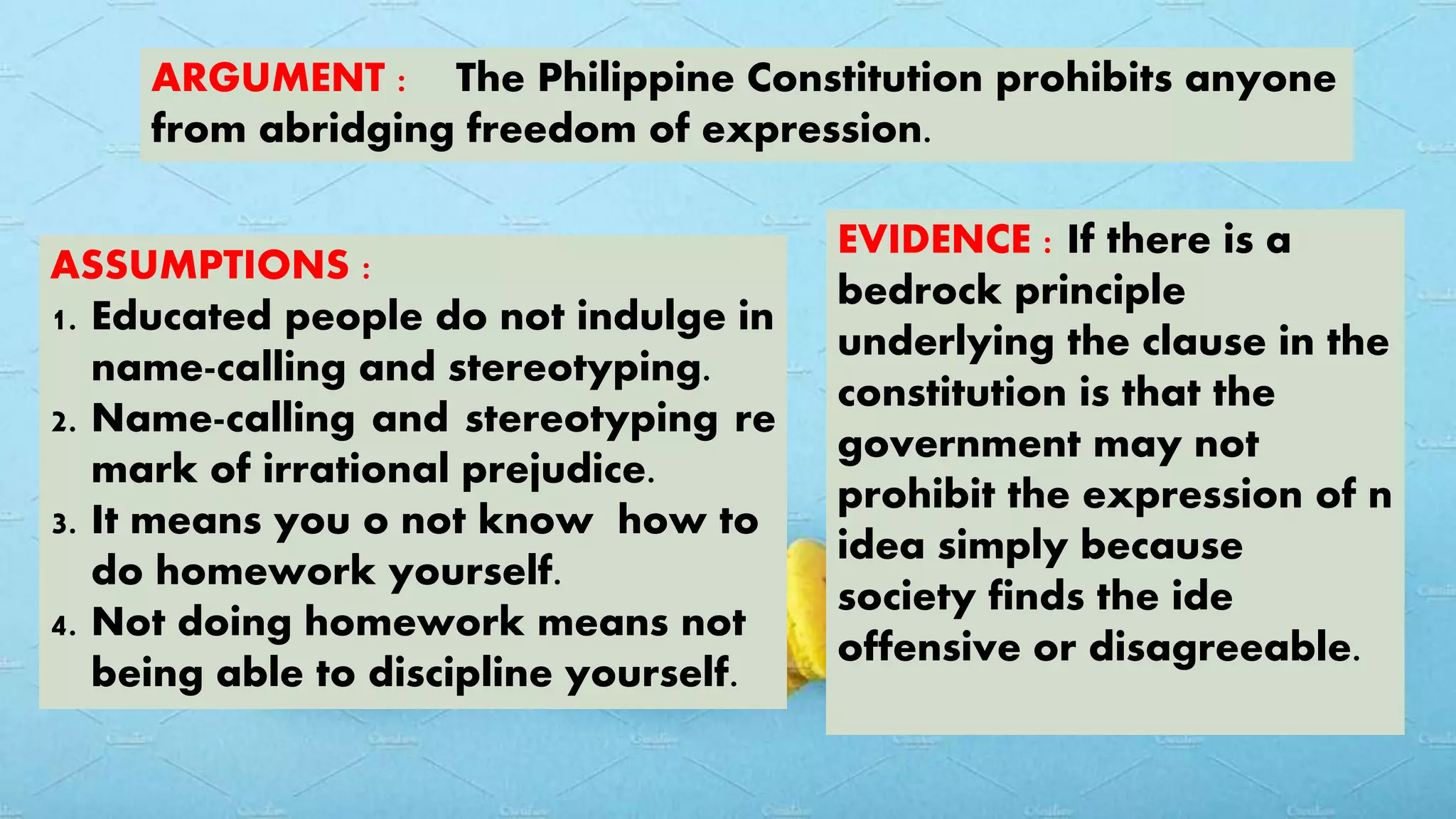
ARGUMENT : The Philippine Constitution prohibits anyone
from abridging freedom of expression.
ASSUMPTIONS :
1. Educated people do not indulge in
name-calling and stereotyping.
2. Name-calling and stereotyping re
mark of irrational prejudice.
3. It means you o not know how to
do homework yourself.
4. Not doing homework means not
being able to discipline yourself.
EVIDENCE : If there is a
bedrock principle
underlying the clause in the
constitution is that the
government may not
prohibit the expression of n
idea simply because
society finds the ide
offensive or disagreeable.
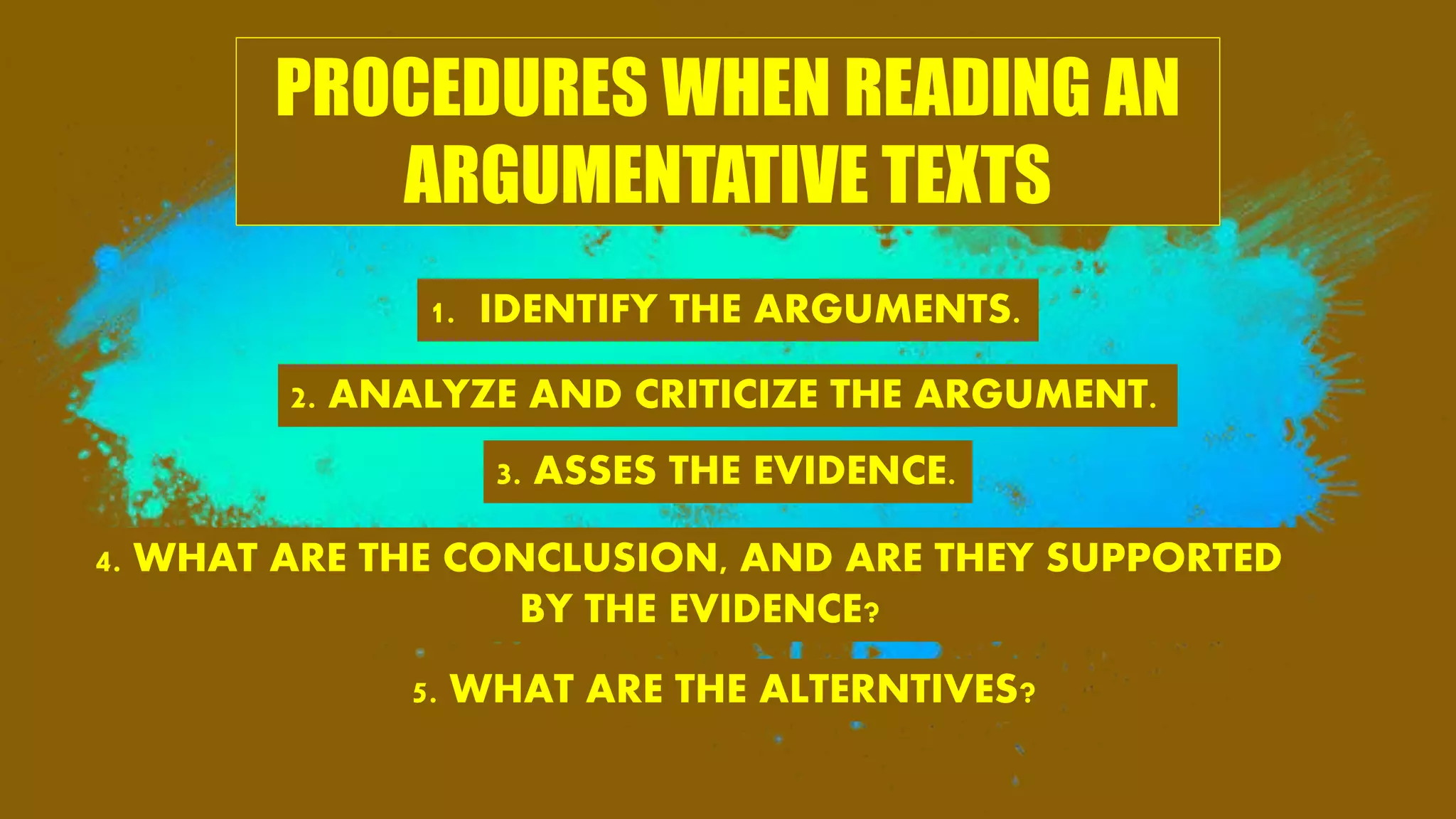
PROCEDURES WHEN READING AN
ARGUMENTATIVE TEXTS
1. IDENTIFY THE ARGUMENTS.
2. ANALYZE AND CRITICIZE THE ARGUMENT.
3. ASSES THE EVIDENCE.
4. WHAT ARE THE CONCLUSION, AND ARE THEY SUPPORTED
BY THE EVIDENCE?
5. WHAT ARE THE ALTERNTIVES?
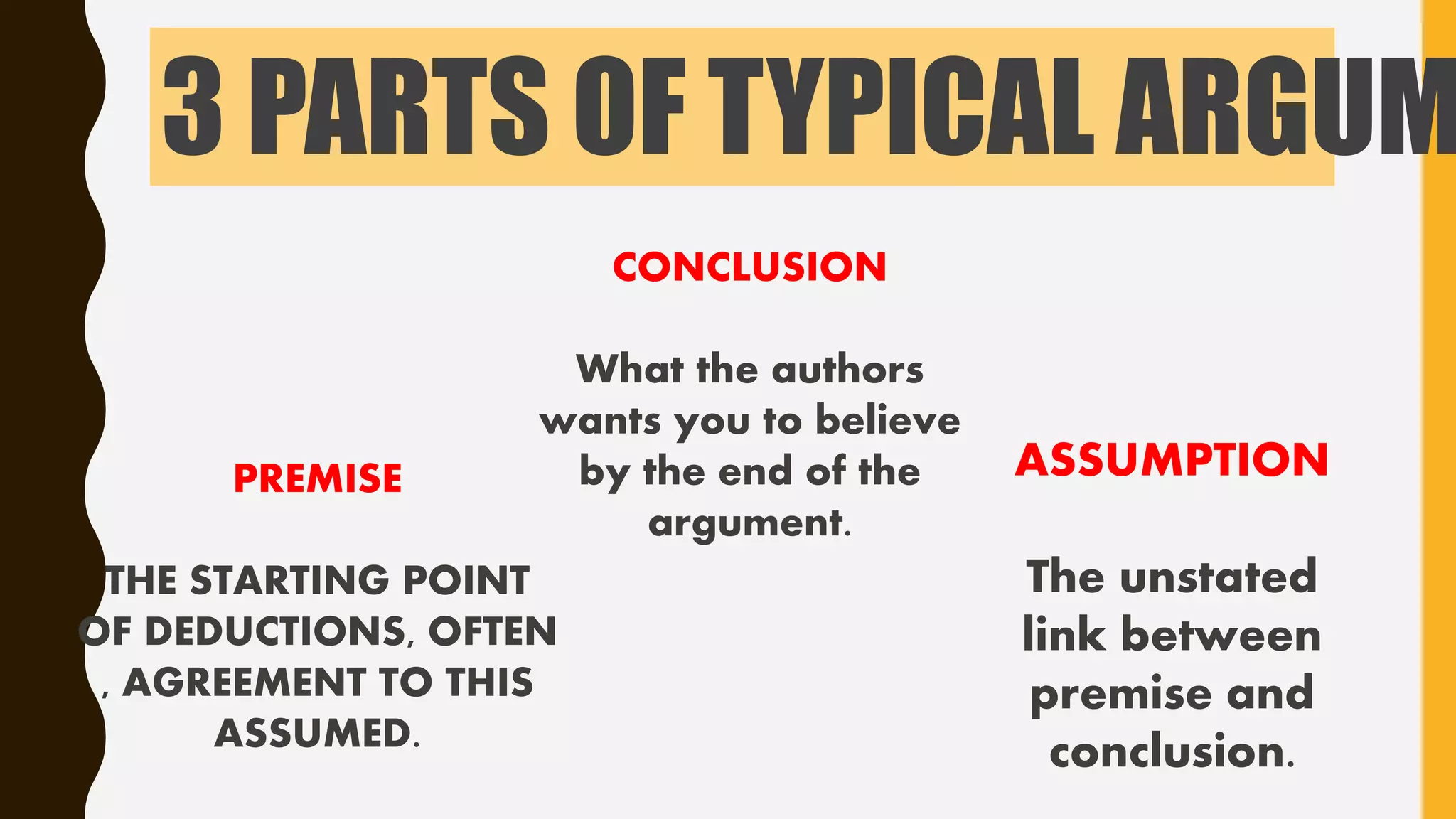
3 PARTS OF TYPICAL ARGUM
PREMISE
THE STARTING POINT
OF DEDUCTIONS, OFTEN
, AGREEMENT TO THIS
ASSUMED.
CONCLUSION
What the authors
wants you to believe
by the end of the
argument.
ASSUMPTION
The unstated
link between
premise and
conclusion.
CLAIMS IN
WRITTEN TEXT
• Claims necessitate the use of language and logic in presenting the veracity of statements, propositions,
and arguments.
• Claims in texts are significant in supporting propositions/arguments.
TYPES OF CLAIMS
CLAIMS OF FACT
• are inferences made based on data, documents, and scientific observation result or research.
EXAMPLE:
“Although it has been largely forgotten, the flu epidemic of 1918-1919 was one of the most
devastating epidemics of all time.”
CLAIMS OF VALUE
• Are value judgment made based on morals, standards, and norms.
EXAMPLE:
“It is immoral to participate in voluntary suicide.”
“ The hunting of animals is barbaric practice.”
CLAIMS OF POLICY
• are specific and measurable actions that need to be done
in order to address issues or concerns presented in an
argument or proposition.
Examples:
Congress should reduce the drinking age to 18.
CLAIMS OF CAUSE AND EFFECT
argue that persons, things and circumstances could produce a result.
EXAMPLE:
• "It's a matter of common sense that people deserve to be treated equally. The Constitution calls it 'self-
evident.' Why, then, should I have been denied a seat because of my disability?
• The moon has gravitational pull, consequently the oceans have tides.
• Since school was canceled, we went to the mall.
IMPORTANT TERMINOLOGIES IN THE STUDY OF CLAIMS.
• Fact
• Opinion
• Argument
• Persuasion
• Debatable Claim
• Evidence
• Credible source
GUIDELINES
• The thesis statement or the claim must debatable.
• The thesis statement or claim must be narrow.
• It must have a credible source.
• Resources must properly cited.
LOGOS
• Or logical appeal is focused on the message content transmitted.
Example:
• "The data is perfectly clear: this investment has consistently turned a profit year-over-year, even in
spite of market declines in other areas."
• "Ladies and gentlemen of the jury: we have not only the fingerprints, the lack of an alibi, a clear
motive, and an expressed desire to commit the robbery… We also have video of the suspect
breaking in. The case could not be more open and shut."
PATHOS
• Or emotional appeal is focused on the audience’s reception of the message transmitted.
Example:
"If we don't move soon, we're all going to die! Can't you see how dangerous it would be to stay?"
"I'm not just invested in this community - I love every building, every business, every hard-working
member of this town."
ETHOS
• Or ethical appeal is focused on the readers’ perception on the credibility and reputation of the writer.
Example:
• "As a doctor, I am qualified to tell you that this course of treatment will likely generate the
best results."
• "My three decades of experience in public service, my tireless commitment to the people
of this community, and my willingness to reach across the aisle and cooperate with the opposition,
make me the ideal candidate for your mayor.”
FOLLOWING STEPS IN PREPARATION FOR YOUR
WRITING
• Be attentive
• Check the facts
• Be keen in language use
• Do cross referencing
WRITING
COHERENT
PARAGRAPHSLESSON 2
(PAGE 70 -74)
LESSON OBJECTIVES
• Discuss the meaning of coherence in a composition.
• Explore a coherent composition.
• Discuss the importance/essence of a cohesive composition.
• Explain the steps in achieving coherent composition.
• Writin a coherent composition.
WITHIN A PARAGRAPH,
TRANSITIONAL WORDS AND
PHRASES OFTEN INDICATE THE
REL ATIONSHIPS AMONG
SENTENCES. BY ESTABLISHING THE
TIME ORDER, SPATIAL ORDER, AND
SEQUENTIAL ORDER OF THE IDEAS
IN A PARAGRAPH, THESE WORDS
AND EXPRESSIONS ENABLE
READERS TO SEE THE CONNECTION
BETWEEN AMONG IDEAS.
COHERENT PARAGRAPHS
• Coherence in a paragraph is the technique of
making words, phrases, and sentences move
smoothly and logically from one to the other.
• In other words, the ideas are so interwoven and
"glued" together that the reader will be able to see the
consistent relationship between them.
SIX CATEGORIES:
•Spatial Order– Used in discriptive writing to signal
spatial relationships, such as above, below, beside,
nearby, beyond, inside, and outside.
•Time Order – Words used in writing narratives, and
instructions to signal chronological sequence, such
before, after, first, next, then, when, finally, while, as,
during, earlier, and meanwhile.
•Numerical Order – Words used in expository
writing to signal order of importance, such as first,
second, also, finally, in addition, equally important,
and more or less importantly.
4. Cause/Effect Order – Words used in expository
writing to signal causal relationships, such as
because, since, for, so, as a result, consequently, thus,
and hence.
5. Comparison/contrast Order - Used in expository
writing to signal similarities and differences, such as
(for similarities) also, additionally, just as, as if, as
though, like, and similarly; and (for differences) but,
yet, only, although, whereas, in contrast, however, on
the other hand, rather, and instead.
6. General/specific Order – Used in discriptive
reports and arguments to signal more specific
elaboration on an idea, such as for example, such as,
like, namely, for instance, in fact, in other words, amd
• A paragraph without them will be difficult to
understand.
• A paragraph is coherent if all its sentences are
arranged in clear, logical order.
You can make a paragraph coherent by
arranging details logically and by supplying
transitional words and phrases that show the
connections between sentences.
USING TRANSITIONAL WORDS AND
PHRASES
1. Words and Phrases That Signal Time Order
after later afterward next at first now
before soon earlier then finally dates
2. Words and Phrases That Signal Sequential Order
although not only… but also
consequently
equally important on the one hand… on the other
hand
similarly furthermore the least
important
the most important last therefore
one..another first…second…third… in addition

Part 1 unit 1 lesson 2 coherence transition between ideas

  • 1.
  • 2.
    Lesson Objectives  Identify themost common connectives and conjunctions.  Use these properly in writing coherent paragraphs.
  • 3.
    13 Purposes in UsingConnecting Words For a Variety of Writing Styles
  • 4.
    1. To addto a statement or viewpoint Example: Equally important, finally, further, but also, in fact, another way to, besides, in general, more specifically, no matter what and so on .......
  • 5.
    2. To showsimilarity Examples: Similarly, likewise, in the same way, such as, in other words, at the same time , for the same reason and so on......
  • 6.
    3. To contrast Example: However,nevertheless, rather, but, yet, on the other hand, meanwhile, otherwise, in contrast, nonetheless, regardless, in any case, even, despite this, and so on.
  • 7.
    4. To expressan alternative Example: Or, either ... Or, whether ... Or, conversely, this can be relevant in at least two, First ... Second, or firstly ... Secondly ( using “ly” is grammatically correct).
  • 8.
    5. To makea concession Example: Granted, naturally, of course.
  • 9.
    6. To placestatement in a particula context Example: In this connection, from this perspective, from this viewpoint, this point of view, from this standpoint, so conceptually, one could argue and so on ...
  • 10.
    7. To placea statement in a timely fashion Example: Previously, before this, begin with, ultimately, while, meanwhile, furthermore, sometimes, summing up, soon, sometimes, when, now, once and etc.
  • 11.
    8. To showcause and effect Example: As a result, consequently, as a consequence, hence, due to, in view of, therefore, thus, moreover, that is why, and so on ...
  • 12.
    9. To provea point Example: Because, evidently, in fact, considering, in view of, insofar as, increasingly, more importantly, even though, particularly, above all, by far, even if, and so on ...
  • 13.
    10. To givean example of an earlier point of viewExample: For instance, in this case, to illustrate, as an illustration, to take another example, namely, that is, as shown by, as expressed by, and so on....
  • 14.
    11. To repeat,insist on or refer an earlier pointExample: As previously mentioned, as i have said, in brief, as i have noted, as been noted and so on .....
  • 15.
    12. To emphasizewhen adding a conditional statementExample: Indeed, obviously, apparently, accordingly, without a doubt, certainly, in accordance, according to, otherwise, as far as and so on....
  • 16.
    13. To concludea paragraph or an essayExample: Thus, lastly, in brief, in short, on the whole, to sum up, to conclude, in conclusion, as i have shown, as i have said, in summary, to summarise, ultimately.
  • 18.
    OBJECTIVES: • Distinguish betweenand among techniques in selecting and organizing information, • Justify the choice of a certain technique to make a cohesive presentation, • Describe the brainstorming process, • Illustrate the different types of graphic organizer, • Explain the difference between a topic and a sentence outline, • Make a cohesive presentation with different graphic organizers, using data from survey.
  • 20.
    BRAINSTORMING • It isa process of generating creative ideas and solution through intensive and freewheeling group discussion.
  • 21.
    • Ralph Keeney,an emeritus professor at Dukes Fuqua School of Business and consultant to multinational companies and government organizations, said almost everybody does brainstorming wrong.
  • 22.
    4 BASIC STEPSIN BRAINSTORMING By: Ralph Keeney
  • 23.
    LAY OUT THEPROBLEM YOU WANT TO SOLVE IDENTIFY THE OBJECTIVES OF A POSSIBLE SOLUTION TRY TO GENERATE WHEN ALL ARE CLEAR, WORK AS A GROUP.
  • 24.
    1. LAY OUTTHE PROBLEM YOU WANT TO SOLVE. • According to Keeney, when dealing with a problem, students should keep on pushing until they come up with at least 5 alternatives, and then, considering all of those, “identify your objectives for your study, evaluate the alternatives and select the best”.
  • 25.
    2. IDENTIFY THEOBJECTIVES OF A POSSIBLE SOLUTION. • Knowing the goals will help making solutions easier.
  • 26.
    3. TRY TOGENERATE SOLUTIONS INDIVIDUALLY. • Coming into a group brainstorming with potential solutions reduces the risk that participants will get bogged down on one objective. • This will avoid an “anchor”.
  • 27.
    4. WHEN YOURPROBLEMS, OBJECTIVES AND PERSONAL SOLUTIONS ARE CLEAR, WORK AS A GROUP. • Avoiding an “anchor” is a challenge when brainstorming for solutions however, according to Keeney, if participants do their homework, clarifying the problem, identifying the objectives, and individually trying to come up with solutions, a brainstorming session can be extremely productive.
  • 29.
  • 31.
  • 32.
  • 33.
  • 34.
  • 35.
  • 36.
  • 37.
  • 38.
  • 40.
    TOPIC OUTLINE • Arrangesyour ideas hierarchically, in the sequence you want, and show what you will talk about. Several aspects must be considered in writing a topic outline. • Recall that all headings and subheadings must be words or phrases, not sentences. • Also, the wording within each division must be parallel. • Finally, as in any outline, remember that a division or subdivision cannot be divided into one part; therefore, if there is an "A" there must be a "B," and if there is a "1" there must be a "2."
  • 41.
    SENTENCE OUTLINE • Similarlydoes what a topic outline does; plus, it shows exactly what you will say about each mini-topic. Several aspects must be considered in writing a sentence outline. • If you have chosen to write a sentence outline, all headings and sub- headings must be in sentence form. • As in any outline, remember that a division or subdivision can not be divided into one part; therefore, if there is an "A" there must be a "B," and if there is a "1" there must be a "2."
  • 42.
  • 43.
    2. ARGUMENT Is areasons offered for or against something. This term refers to discussion in which there is disagreement and suggests the use of logic and the bringing forth of facts to support of refute a point. 1. ASSUMPTI ON Is a statement accepted or supposed as true without proof or demonstration; an unstated premise or belief. 3. EVIDENC E Refers to the data on which judgment or conclusion might be based or by which proof or probability might be established.
  • 44.
    Most of uswould agree that educated people should not indulge in name-calling and stereotyping in their speaking and writing. To do so is an essential mark irrational prejudice. Nevertheless, such speaking and writing are protected by the Philippine Constitution, which prohibits anyone from abridging freedom of expression. Today, many colleges and universities in a well-meaning attempt to shield particular groups from unwelcome or insensitive words, re subverting this prohibition. A former Supreme Court justice noted for his liberal views, he’s stated, “If there is a bedrock principle underlying the clause in the constitution is that the government may not prohibit the expression of n idea simply because society finds the ide offensive or Example:
  • 45.
    ARGUMENT : ThePhilippine Constitution prohibits anyone from abridging freedom of expression. ASSUMPTIONS : 1. Educated people do not indulge in name-calling and stereotyping. 2. Name-calling and stereotyping re mark of irrational prejudice. 3. It means you o not know how to do homework yourself. 4. Not doing homework means not being able to discipline yourself. EVIDENCE : If there is a bedrock principle underlying the clause in the constitution is that the government may not prohibit the expression of n idea simply because society finds the ide offensive or disagreeable.
  • 46.
    PROCEDURES WHEN READINGAN ARGUMENTATIVE TEXTS 1. IDENTIFY THE ARGUMENTS. 2. ANALYZE AND CRITICIZE THE ARGUMENT. 3. ASSES THE EVIDENCE. 4. WHAT ARE THE CONCLUSION, AND ARE THEY SUPPORTED BY THE EVIDENCE? 5. WHAT ARE THE ALTERNTIVES?
  • 47.
    3 PARTS OFTYPICAL ARGUM PREMISE THE STARTING POINT OF DEDUCTIONS, OFTEN , AGREEMENT TO THIS ASSUMED. CONCLUSION What the authors wants you to believe by the end of the argument. ASSUMPTION The unstated link between premise and conclusion.
  • 48.
  • 49.
    • Claims necessitatethe use of language and logic in presenting the veracity of statements, propositions, and arguments. • Claims in texts are significant in supporting propositions/arguments.
  • 50.
  • 51.
    CLAIMS OF FACT •are inferences made based on data, documents, and scientific observation result or research. EXAMPLE: “Although it has been largely forgotten, the flu epidemic of 1918-1919 was one of the most devastating epidemics of all time.”
  • 52.
    CLAIMS OF VALUE •Are value judgment made based on morals, standards, and norms. EXAMPLE: “It is immoral to participate in voluntary suicide.” “ The hunting of animals is barbaric practice.”
  • 53.
    CLAIMS OF POLICY •are specific and measurable actions that need to be done in order to address issues or concerns presented in an argument or proposition. Examples: Congress should reduce the drinking age to 18.
  • 54.
    CLAIMS OF CAUSEAND EFFECT argue that persons, things and circumstances could produce a result. EXAMPLE: • "It's a matter of common sense that people deserve to be treated equally. The Constitution calls it 'self- evident.' Why, then, should I have been denied a seat because of my disability? • The moon has gravitational pull, consequently the oceans have tides. • Since school was canceled, we went to the mall.
  • 55.
    IMPORTANT TERMINOLOGIES INTHE STUDY OF CLAIMS. • Fact • Opinion • Argument • Persuasion • Debatable Claim • Evidence • Credible source
  • 56.
    GUIDELINES • The thesisstatement or the claim must debatable. • The thesis statement or claim must be narrow. • It must have a credible source. • Resources must properly cited.
  • 57.
    LOGOS • Or logicalappeal is focused on the message content transmitted. Example: • "The data is perfectly clear: this investment has consistently turned a profit year-over-year, even in spite of market declines in other areas." • "Ladies and gentlemen of the jury: we have not only the fingerprints, the lack of an alibi, a clear motive, and an expressed desire to commit the robbery… We also have video of the suspect breaking in. The case could not be more open and shut."
  • 58.
    PATHOS • Or emotionalappeal is focused on the audience’s reception of the message transmitted. Example: "If we don't move soon, we're all going to die! Can't you see how dangerous it would be to stay?" "I'm not just invested in this community - I love every building, every business, every hard-working member of this town."
  • 59.
    ETHOS • Or ethicalappeal is focused on the readers’ perception on the credibility and reputation of the writer. Example: • "As a doctor, I am qualified to tell you that this course of treatment will likely generate the best results." • "My three decades of experience in public service, my tireless commitment to the people of this community, and my willingness to reach across the aisle and cooperate with the opposition, make me the ideal candidate for your mayor.”
  • 60.
    FOLLOWING STEPS INPREPARATION FOR YOUR WRITING • Be attentive • Check the facts • Be keen in language use • Do cross referencing
  • 61.
  • 62.
    LESSON OBJECTIVES • Discussthe meaning of coherence in a composition. • Explore a coherent composition. • Discuss the importance/essence of a cohesive composition. • Explain the steps in achieving coherent composition. • Writin a coherent composition.
  • 63.
    WITHIN A PARAGRAPH, TRANSITIONALWORDS AND PHRASES OFTEN INDICATE THE REL ATIONSHIPS AMONG SENTENCES. BY ESTABLISHING THE TIME ORDER, SPATIAL ORDER, AND SEQUENTIAL ORDER OF THE IDEAS IN A PARAGRAPH, THESE WORDS AND EXPRESSIONS ENABLE READERS TO SEE THE CONNECTION BETWEEN AMONG IDEAS.
  • 64.
    COHERENT PARAGRAPHS • Coherencein a paragraph is the technique of making words, phrases, and sentences move smoothly and logically from one to the other. • In other words, the ideas are so interwoven and "glued" together that the reader will be able to see the consistent relationship between them.
  • 65.
    SIX CATEGORIES: •Spatial Order–Used in discriptive writing to signal spatial relationships, such as above, below, beside, nearby, beyond, inside, and outside. •Time Order – Words used in writing narratives, and instructions to signal chronological sequence, such before, after, first, next, then, when, finally, while, as, during, earlier, and meanwhile. •Numerical Order – Words used in expository writing to signal order of importance, such as first, second, also, finally, in addition, equally important, and more or less importantly.
  • 66.
    4. Cause/Effect Order– Words used in expository writing to signal causal relationships, such as because, since, for, so, as a result, consequently, thus, and hence. 5. Comparison/contrast Order - Used in expository writing to signal similarities and differences, such as (for similarities) also, additionally, just as, as if, as though, like, and similarly; and (for differences) but, yet, only, although, whereas, in contrast, however, on the other hand, rather, and instead. 6. General/specific Order – Used in discriptive reports and arguments to signal more specific elaboration on an idea, such as for example, such as, like, namely, for instance, in fact, in other words, amd
  • 67.
    • A paragraphwithout them will be difficult to understand. • A paragraph is coherent if all its sentences are arranged in clear, logical order. You can make a paragraph coherent by arranging details logically and by supplying transitional words and phrases that show the connections between sentences.
  • 68.
    USING TRANSITIONAL WORDSAND PHRASES 1. Words and Phrases That Signal Time Order after later afterward next at first now before soon earlier then finally dates 2. Words and Phrases That Signal Sequential Order although not only… but also consequently equally important on the one hand… on the other hand similarly furthermore the least important the most important last therefore one..another first…second…third… in addition