Claims in Written Text
• Claims necessitate the use of language and logic in presenting the veracity of
statements, propositions, and arguments.
• Claims in texts are significant in supporting propositions/arguments.
TYPES OF CLAIMS
Claims of FACT
• are inferences made based on data, documents, and scientific observation result
or research.
EXAMPLE:
“Although it has been largely forgotten, the flu epidemic of 1918-1919 was one of
the most devastating epidemics of all time.”
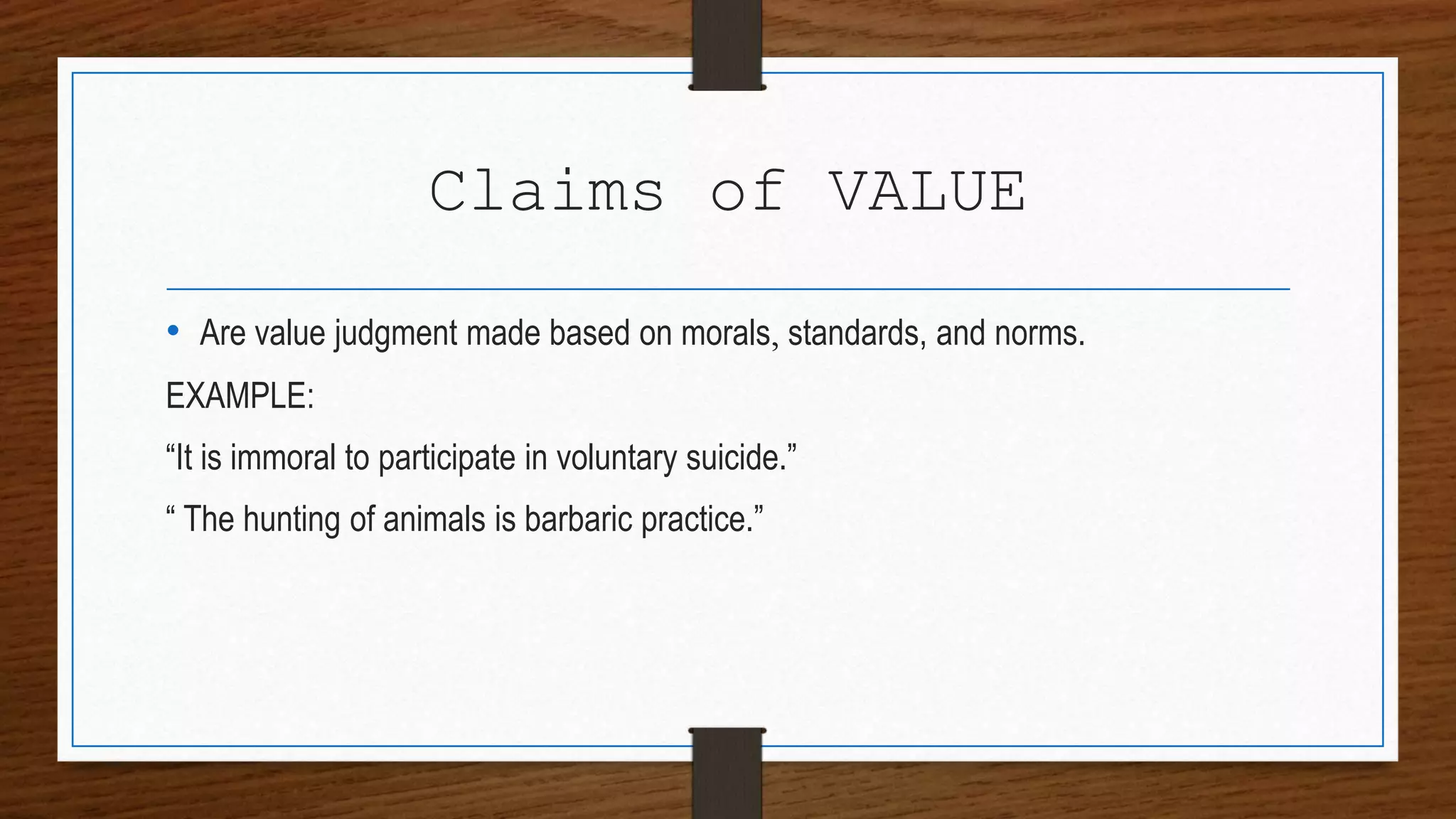
Claims of VALUE
• Are value judgment made based on morals, standards, and norms.
EXAMPLE:
“It is immoral to participate in voluntary suicide.”
“ The hunting of animals is barbaric practice.”
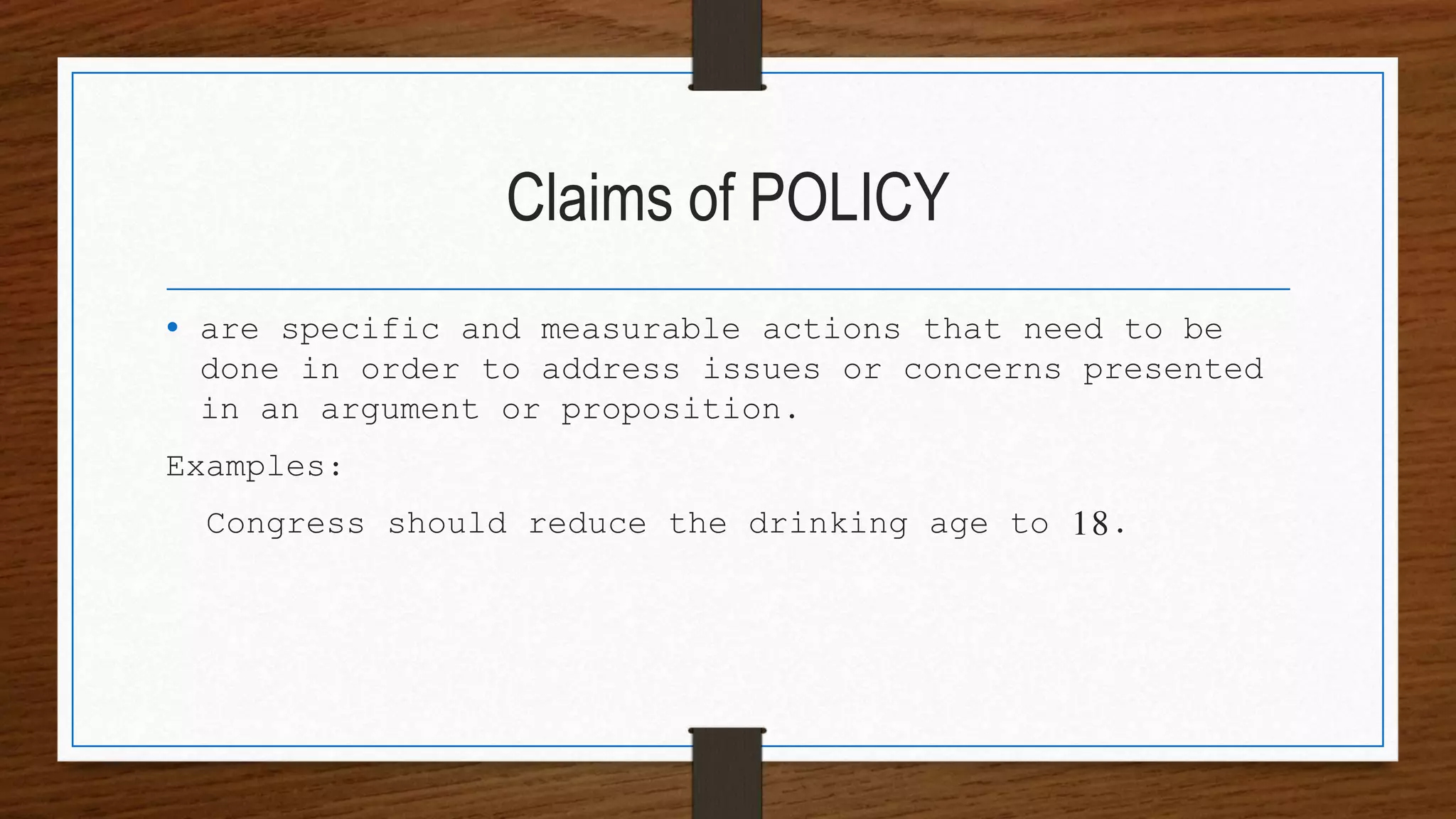
Claims of POLICY
• are specific and measurable actions that need to be
done in order to address issues or concerns presented
in an argument or proposition.
Examples:
Congress should reduce the drinking age to 18.
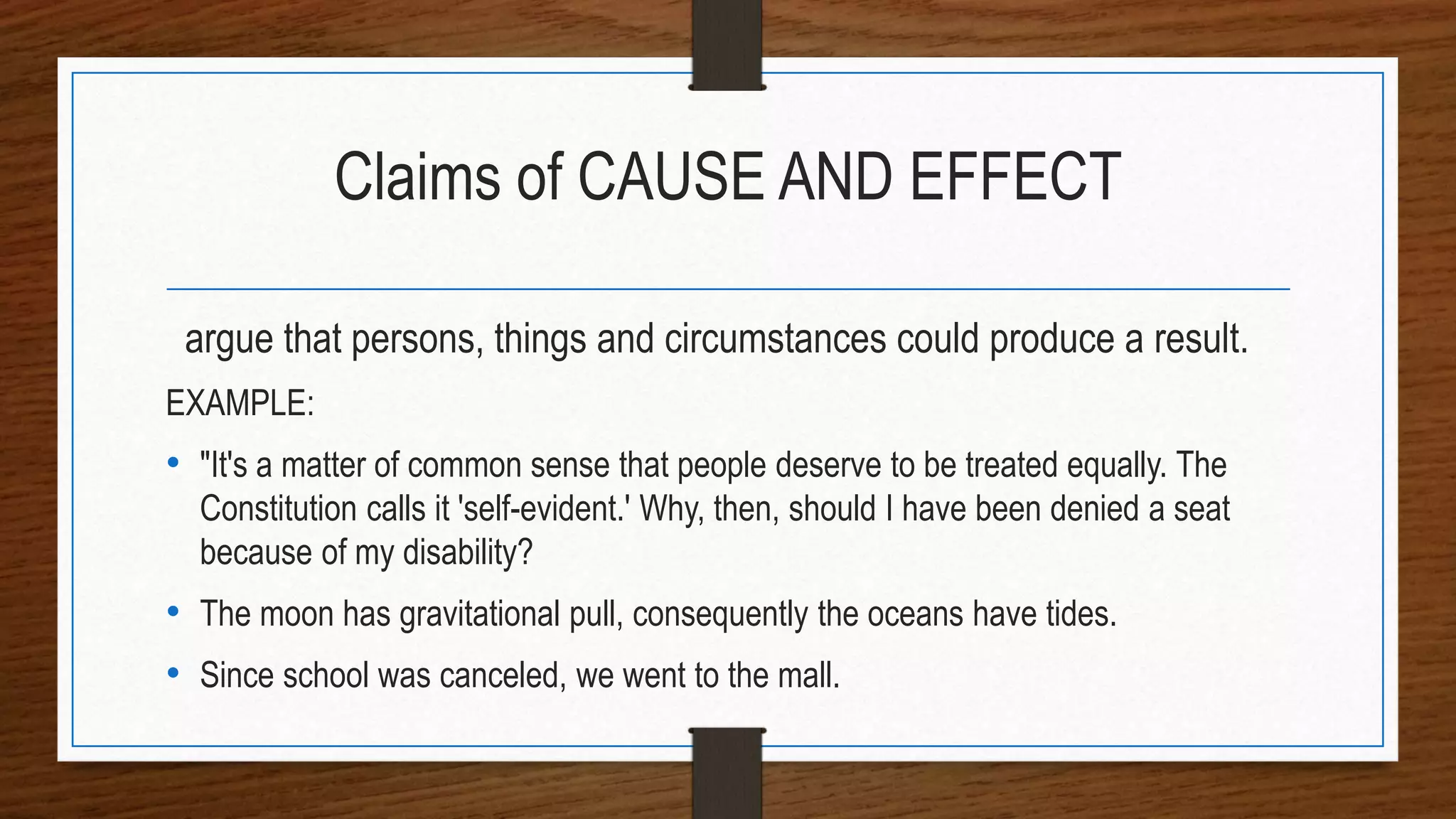
Claims of CAUSE AND EFFECT
argue that persons, things and circumstances could produce a result.
EXAMPLE:
• "It's a matter of common sense that people deserve to be treated equally. The
Constitution calls it 'self-evident.' Why, then, should I have been denied a seat
because of my disability?
• The moon has gravitational pull, consequently the oceans have tides.
• Since school was canceled, we went to the mall.
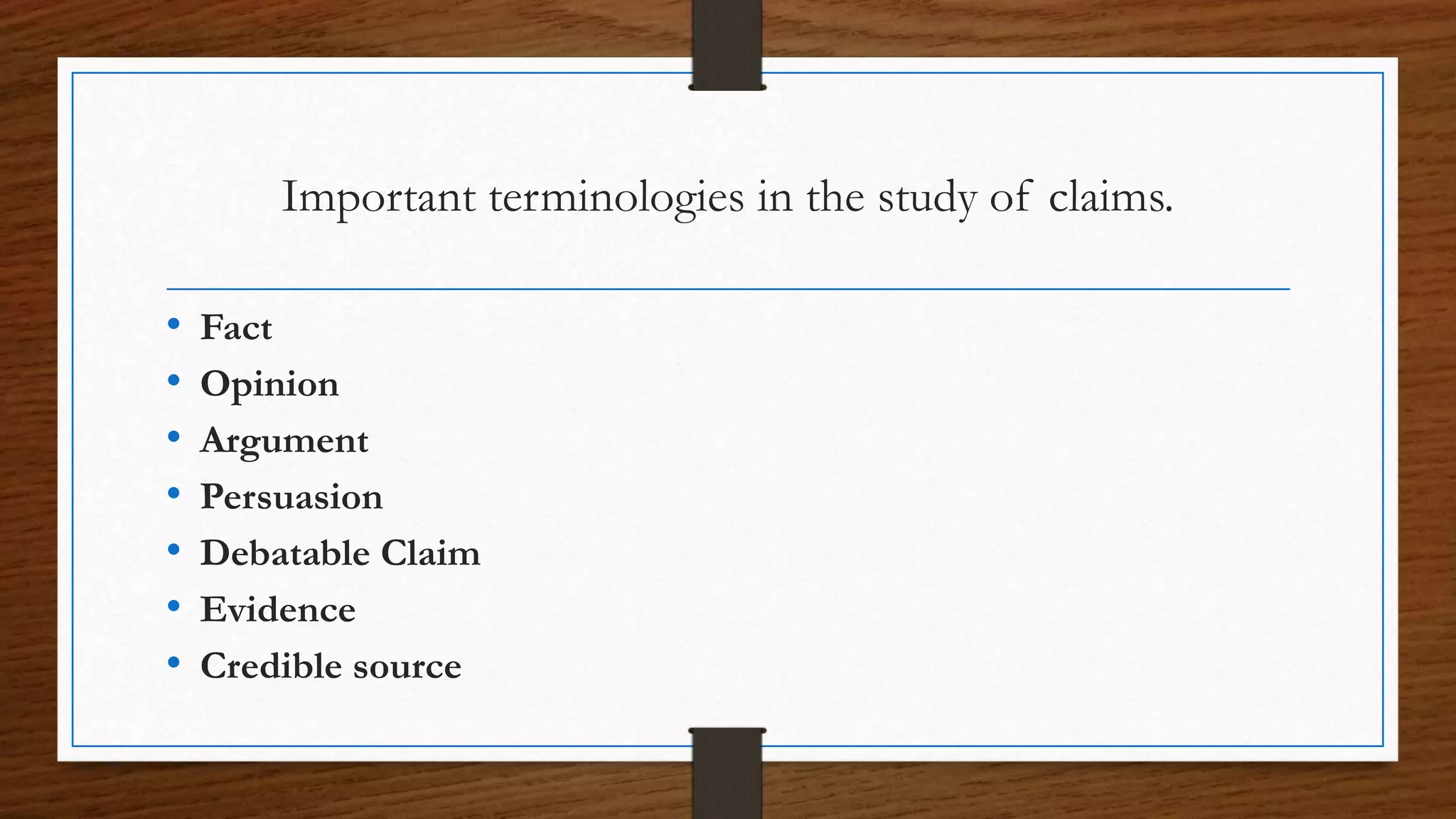
Important terminologies in the study of claims.
• Fact
• Opinion
• Argument
• Persuasion
• Debatable Claim
• Evidence
• Credible source
Guidelines
• The thesis statement or the claim must debatable.
• The thesis statement or claim must be narrow.
• It must have a credible source.
• Resources must properly cited.
Logos
• Or logical appeal is focused on the message content transmitted.
Example:
• "The data is perfectly clear: this investment has consistently turned a profit year-
over-year, even in spite of market declines in other areas."
• "Ladies and gentlemen of the jury: we have not only the fingerprints, the lack of an
alibi, a clear motive, and an expressed desire to commit the robbery… We also
have video of the suspect breaking in. The case could not be more open and
shut."
Pathos
• Or emotional appeal is focused on the audience’s reception of the message
transmitted.
Example:
"If we don't move soon, we're all going to die! Can't you see how dangerous it would be to
stay?"
"I'm not just invested in this community - I love every building, every business, every hard-
working member of this town."
Ethos
• Or ethical appeal is focused on the readers’ perception on the credibility and
reputation of the writer.
Example:
• "As a doctor, I am qualified to tell you that this course of treatment will likely generate the
best results."
• "My three decades of experience in public service, my tireless commitment to the people
of this community, and my willingness to reach across the aisle and cooperate with the
opposition, make me the ideal candidate for your mayor.”
Following steps in preparation for your writing
• Be attentive
• Check the facts
• Be keen in language use
• Do cross referencing
END

Part 1 unit 2 lesson 2 claims in written text

  • 1.
  • 2.
    • Claims necessitatethe use of language and logic in presenting the veracity of statements, propositions, and arguments. • Claims in texts are significant in supporting propositions/arguments.
  • 3.
  • 4.
    Claims of FACT •are inferences made based on data, documents, and scientific observation result or research. EXAMPLE: “Although it has been largely forgotten, the flu epidemic of 1918-1919 was one of the most devastating epidemics of all time.”
  • 5.
    Claims of VALUE •Are value judgment made based on morals, standards, and norms. EXAMPLE: “It is immoral to participate in voluntary suicide.” “ The hunting of animals is barbaric practice.”
  • 6.
    Claims of POLICY •are specific and measurable actions that need to be done in order to address issues or concerns presented in an argument or proposition. Examples: Congress should reduce the drinking age to 18.
  • 7.
    Claims of CAUSEAND EFFECT argue that persons, things and circumstances could produce a result. EXAMPLE: • "It's a matter of common sense that people deserve to be treated equally. The Constitution calls it 'self-evident.' Why, then, should I have been denied a seat because of my disability? • The moon has gravitational pull, consequently the oceans have tides. • Since school was canceled, we went to the mall.
  • 8.
    Important terminologies inthe study of claims. • Fact • Opinion • Argument • Persuasion • Debatable Claim • Evidence • Credible source
  • 9.
    Guidelines • The thesisstatement or the claim must debatable. • The thesis statement or claim must be narrow. • It must have a credible source. • Resources must properly cited.
  • 10.
    Logos • Or logicalappeal is focused on the message content transmitted. Example: • "The data is perfectly clear: this investment has consistently turned a profit year- over-year, even in spite of market declines in other areas." • "Ladies and gentlemen of the jury: we have not only the fingerprints, the lack of an alibi, a clear motive, and an expressed desire to commit the robbery… We also have video of the suspect breaking in. The case could not be more open and shut."
  • 11.
    Pathos • Or emotionalappeal is focused on the audience’s reception of the message transmitted. Example: "If we don't move soon, we're all going to die! Can't you see how dangerous it would be to stay?" "I'm not just invested in this community - I love every building, every business, every hard- working member of this town."
  • 12.
    Ethos • Or ethicalappeal is focused on the readers’ perception on the credibility and reputation of the writer. Example: • "As a doctor, I am qualified to tell you that this course of treatment will likely generate the best results." • "My three decades of experience in public service, my tireless commitment to the people of this community, and my willingness to reach across the aisle and cooperate with the opposition, make me the ideal candidate for your mayor.”
  • 13.
    Following steps inpreparation for your writing • Be attentive • Check the facts • Be keen in language use • Do cross referencing
  • 14.