
EPILEPSY
Prepared by:
Ms. Shivanee Vyas
Assistant professor
SVKM’s NMIMS, School of Pharmacy and Technology
Management
1
Background to understand epilepsy
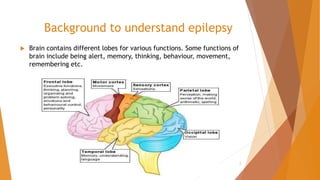
 Brain contains different lobes for various functions. Some functions of
brain include being alert, memory, thinking, behaviour, movement,
remembering etc.
2
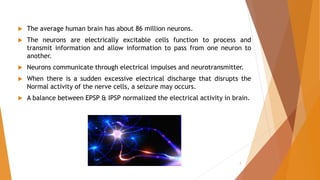
 The average human brain has about 86 million neurons.
 The neurons are electrically excitable cells function to process and
transmit information and allow information to pass from one neuron to
another.
 Neurons communicate through electrical impulses and neurotransmitter.
 When there is a sudden excessive electrical discharge that disrupts the
Normal activity of the nerve cells, a seizure may occurs.
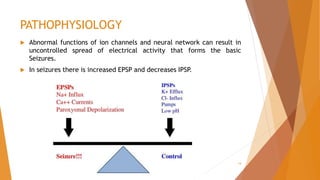
 A balance between EPSP & IPSP normalized the electrical activity in brain.
3
Term EPSP & IPSP
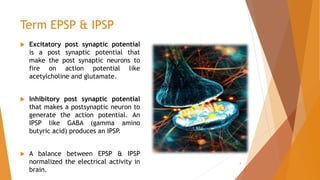
 Excitatory post synaptic potential
is a post synaptic potential that
make the post synaptic neurons to
fire on action potential like
acetylcholine and glutamate.
 Inhibitory post synaptic potential
that makes a postsynaptic neuron to
generate the action potential. An
IPSP like GABA (gamma amino
butyric acid) produces an IPSP
.
 A balance between EPSP & IPSP
normalized the electrical activity in
brain.
4
What is Epilepsy?
 A central nervous system disorder in which brain activity become abnormal
and characterized by recurrent seizure (fits) with or without loss of
conscientiousness or amnesia. (loss of memory)
 During a seizure a person experiences abnormal behavior, change in
sensation, movement and consciousness.
 Seizure is a sudden, excessive, abnormal discharge of cerebral neurons.
 A pattern of repeated seizure is referred as EPILEPSY
 The origin of site of seizure is called EPILEPTIC FOCUS.
 Seizures involve disturbance of neuronal electrical activity which interferes
with the normal brain functions.
5
Causes of Epilepsy
 Epilepsy is caused by a variety of different conditions affecting a
person’s brain
1. Stroke
2. Brain tumor
3. Brain injection
4. Brain injury
5. Loss of oxygen to the brain
6. Certain genetic conditions
7. Alcoholism etc.
6
Seizure Symptoms:
Seizures symptoms vary according to the location of seizure activity. It includes
loss of consciousness.
 Alterations in non-motor functions (sensation, olfaction, vision.
 Change in the higher order functions. (Memory, emotions, language etc.
 A convulsion with no fever.
 Short blackouts or confused memory.
 Temporary unresponsiveness to instructions or questions.
 Sudden stiffness for no apparent reason.
 Sudden falling for no apparent reason.
 Temporarily seeming dazed and unable to communicate.
 Panic or anger.
 Jerking arms, legs, or body, which will appear as a cluster of rapid jerking movements
in babies. 7
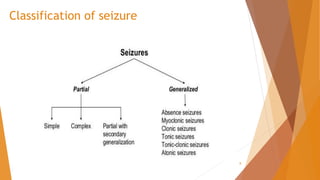
Classification of seizure
8
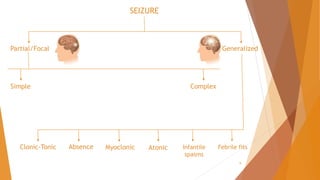
SEIZURE
Generalized
Partial/Focal
Complex
Simple
Clonic-Tonic Absence Atonic
Myoclonic Febrile fits
Infantile
spasms
9
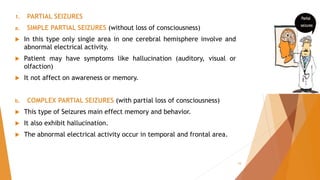
1. PARTIAL SEIZURES
a. SIMPLE PARTIAL SEIZURES (without loss of consciousness)
 In this type only single area in one cerebral hemisphere involve and
abnormal electrical activity.
 Patient may have symptoms like hallucination (auditory, visual or
olfaction)
 It not affect on awareness or memory.
b. COMPLEX PARTIAL SEIZURES (with partial loss of consciousness)
 This type of Seizures main effect memory and behavior.
 It also exhibit hallucination.
 The abnormal electrical activity occur in temporal and frontal area.
10
2. GENERALIZED SEIZURES:
Electrical discharge spread to both hemisphere. In the
seizure immediate loss of consciousness occur.
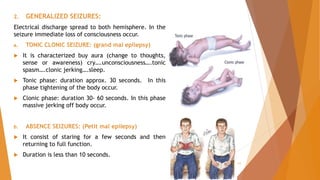
a. TONIC CLONIC SEIZURE: (grand mal epilepsy)
 It is characterized buy aura (change to thoughts,
sense or awareness) cry….unconsciousness….tonic
spasm….clonic jerking….sleep.
 Tonic phase: duration approx. 30 seconds. In this
phase tightening of the body occur.
 Clonic phase: duration 30- 60 seconds. In this phase
massive jerking off body occur.
b. ABSENCE SEIZURES: (Petit mal epilepsy)
 It consist of staring for a few seconds and then
returning to full function.
 Duration is less than 10 seconds.
11
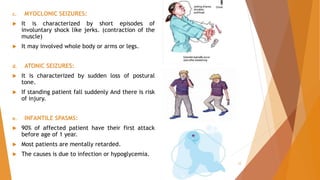
c. MYOCLONIC SEIZURES:
 It is characterized by short episodes of
involuntary shock like jerks. (contraction of the
muscle)
 It may involved whole body or arms or legs.
d. ATONIC SEIZURES:
 It is characterized by sudden loss of postural
tone.
 If standing patient fall suddenly And there is risk
of injury.
e. INFANTILE SPASMS:
 90% of affected patient have their first attack
before age of 1 year.
 Most patients are mentally retarded.
 The causes is due to infection or hypoglycemia.
12
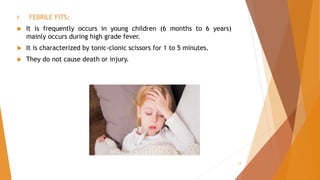
f. FEBRILE FITS:
 It is frequently occurs in young children (6 months to 6 years)
mainly occurs during high grade fever.
 It is characterized by tonic-clonic scissors for 1 to 5 minutes.
 They do not cause death or injury.
13
PATHOPHYSIOLOGY
 Abnormal functions of ion channels and neural network can result in
uncontrolled spread of electrical activity that forms the basic
Seizures.
 In seizures there is increased EPSP and decreases IPSP
.
14
Diagnosis of Epilepsy
 EEG (electro-encephalogram)
 MRI (magnetic resonance imaging)
 PET (positron emission tomography)
 Physical and neurological examination
TREATMENT
Anti-epileptic like phenytoin and valproic acid.
15
16

Epilepsy: Introduction, Classification, Pathophysiology and Treatment

  • 1.
    EPILEPSY Prepared by: Ms. ShivaneeVyas Assistant professor SVKM’s NMIMS, School of Pharmacy and Technology Management 1
  • 2.
    Background to understandepilepsy  Brain contains different lobes for various functions. Some functions of brain include being alert, memory, thinking, behaviour, movement, remembering etc. 2
  • 3.
     The averagehuman brain has about 86 million neurons.  The neurons are electrically excitable cells function to process and transmit information and allow information to pass from one neuron to another.  Neurons communicate through electrical impulses and neurotransmitter.  When there is a sudden excessive electrical discharge that disrupts the Normal activity of the nerve cells, a seizure may occurs.  A balance between EPSP & IPSP normalized the electrical activity in brain. 3
  • 4.
    Term EPSP &IPSP  Excitatory post synaptic potential is a post synaptic potential that make the post synaptic neurons to fire on action potential like acetylcholine and glutamate.  Inhibitory post synaptic potential that makes a postsynaptic neuron to generate the action potential. An IPSP like GABA (gamma amino butyric acid) produces an IPSP .  A balance between EPSP & IPSP normalized the electrical activity in brain. 4
  • 5.
    What is Epilepsy? A central nervous system disorder in which brain activity become abnormal and characterized by recurrent seizure (fits) with or without loss of conscientiousness or amnesia. (loss of memory)  During a seizure a person experiences abnormal behavior, change in sensation, movement and consciousness.  Seizure is a sudden, excessive, abnormal discharge of cerebral neurons.  A pattern of repeated seizure is referred as EPILEPSY  The origin of site of seizure is called EPILEPTIC FOCUS.  Seizures involve disturbance of neuronal electrical activity which interferes with the normal brain functions. 5
  • 6.
    Causes of Epilepsy Epilepsy is caused by a variety of different conditions affecting a person’s brain 1. Stroke 2. Brain tumor 3. Brain injection 4. Brain injury 5. Loss of oxygen to the brain 6. Certain genetic conditions 7. Alcoholism etc. 6
  • 7.
    Seizure Symptoms: Seizures symptomsvary according to the location of seizure activity. It includes loss of consciousness.  Alterations in non-motor functions (sensation, olfaction, vision.  Change in the higher order functions. (Memory, emotions, language etc.  A convulsion with no fever.  Short blackouts or confused memory.  Temporary unresponsiveness to instructions or questions.  Sudden stiffness for no apparent reason.  Sudden falling for no apparent reason.  Temporarily seeming dazed and unable to communicate.  Panic or anger.  Jerking arms, legs, or body, which will appear as a cluster of rapid jerking movements in babies. 7
  • 8.
  • 9.
  • 10.
    1. PARTIAL SEIZURES a.SIMPLE PARTIAL SEIZURES (without loss of consciousness)  In this type only single area in one cerebral hemisphere involve and abnormal electrical activity.  Patient may have symptoms like hallucination (auditory, visual or olfaction)  It not affect on awareness or memory. b. COMPLEX PARTIAL SEIZURES (with partial loss of consciousness)  This type of Seizures main effect memory and behavior.  It also exhibit hallucination.  The abnormal electrical activity occur in temporal and frontal area. 10
  • 11.
    2. GENERALIZED SEIZURES: Electricaldischarge spread to both hemisphere. In the seizure immediate loss of consciousness occur. a. TONIC CLONIC SEIZURE: (grand mal epilepsy)  It is characterized buy aura (change to thoughts, sense or awareness) cry….unconsciousness….tonic spasm….clonic jerking….sleep.  Tonic phase: duration approx. 30 seconds. In this phase tightening of the body occur.  Clonic phase: duration 30- 60 seconds. In this phase massive jerking off body occur. b. ABSENCE SEIZURES: (Petit mal epilepsy)  It consist of staring for a few seconds and then returning to full function.  Duration is less than 10 seconds. 11
  • 12.
    c. MYOCLONIC SEIZURES: It is characterized by short episodes of involuntary shock like jerks. (contraction of the muscle)  It may involved whole body or arms or legs. d. ATONIC SEIZURES:  It is characterized by sudden loss of postural tone.  If standing patient fall suddenly And there is risk of injury. e. INFANTILE SPASMS:  90% of affected patient have their first attack before age of 1 year.  Most patients are mentally retarded.  The causes is due to infection or hypoglycemia. 12
  • 13.
    f. FEBRILE FITS: It is frequently occurs in young children (6 months to 6 years) mainly occurs during high grade fever.  It is characterized by tonic-clonic scissors for 1 to 5 minutes.  They do not cause death or injury. 13
  • 14.
    PATHOPHYSIOLOGY  Abnormal functionsof ion channels and neural network can result in uncontrolled spread of electrical activity that forms the basic Seizures.  In seizures there is increased EPSP and decreases IPSP . 14
  • 15.
    Diagnosis of Epilepsy EEG (electro-encephalogram)  MRI (magnetic resonance imaging)  PET (positron emission tomography)  Physical and neurological examination TREATMENT Anti-epileptic like phenytoin and valproic acid. 15
  • 16.