
Parkinson's disease
PRESENTED BY-
MR. ABHAY RAJPOOT
DEFINITION:
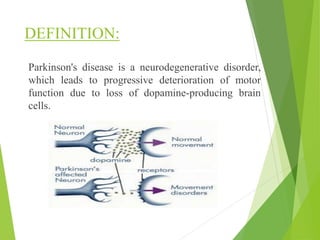
Parkinson's disease is a neurodegenerative disorder,
which leads to progressive deterioration of motor
function due to loss of dopamine-producing brain
cells.
INCIDENCE:
Approximately 60,000 Americans are
diagnosed with PD each year. More than
10 million people worldwide are living
with PD. Incidence of Parkinson’s disease
increase with age, but an estimated 4 % of
people with PD are diagnosed before 50
years.
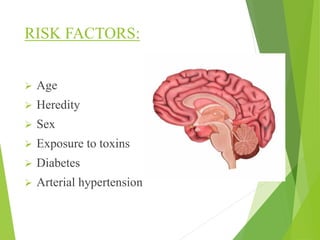
RISK FACTORS:
 Age
 Heredity
 Sex
 Exposure to toxins
 Diabetes
 Arterial hypertension
CAUSES:
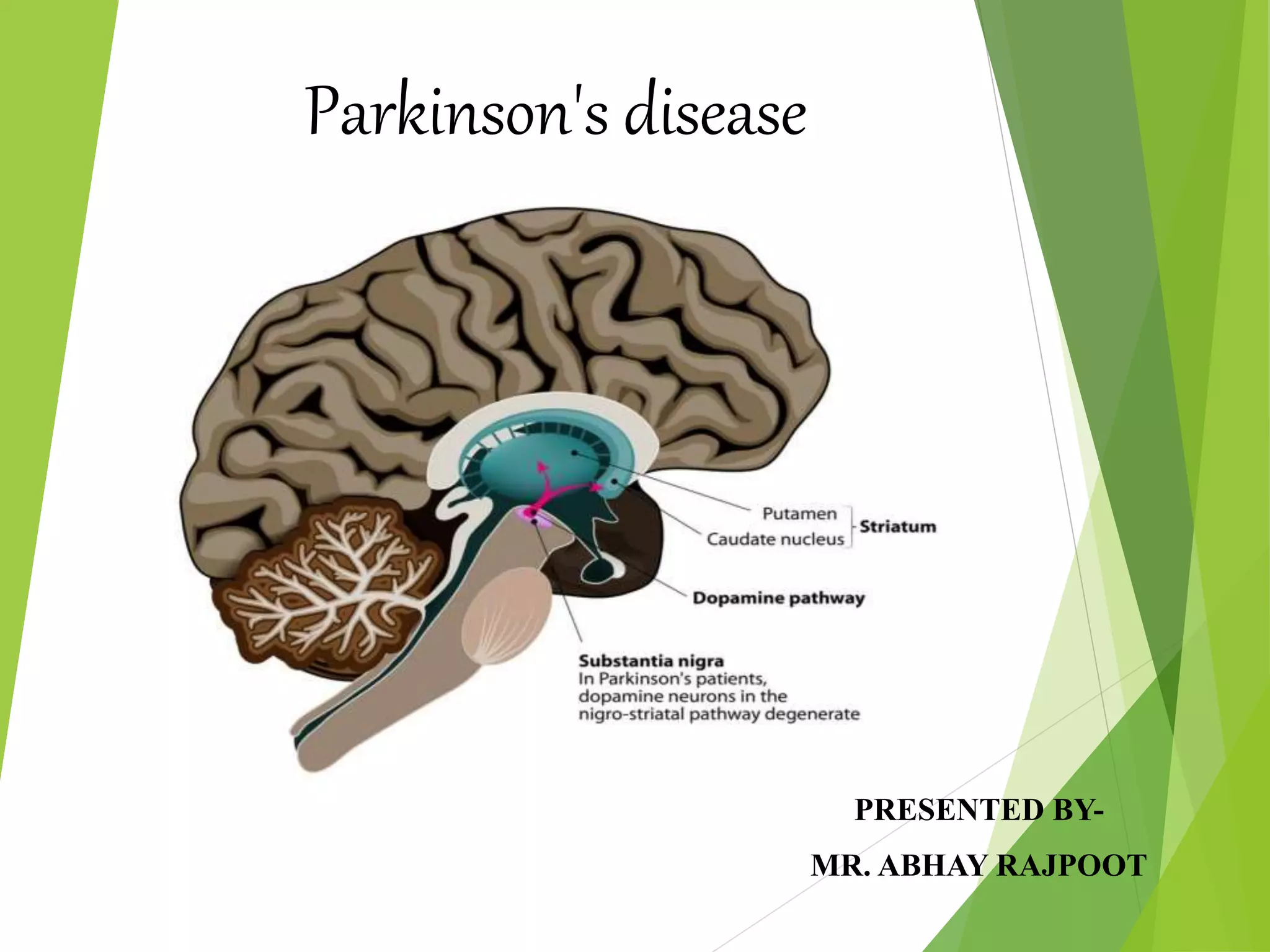
In Parkinson's disease, certain nerve cells (neurons) in
the brain gradually break down or die. Many of the
symptoms are due to a loss of neurons that produce a
chemical messenger in the brain called dopamine. When
dopamine levels decrease, it causes abnormal brain
activity, leading to signs of Parkinson's disease.
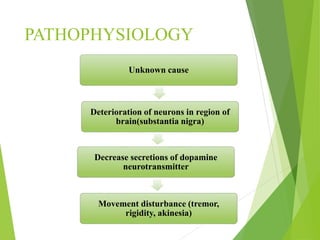
PATHOPHYSIOLOGY
Unknown cause
Deterioration of neurons in region of
brain(substantia nigra)
Decrease secretions of dopamine
neurotransmitter
Movement disturbance (tremor,
rigidity, akinesia)
SYMPTOMS
 Tremor - tremor, or shaking, usually begins in a limb, often
your hand or fingers
 Slowed movement (bradykinesia)
 Rigid muscles
 Impaired posture and balance
 Loss of automatic movements
 Speech changes
 Writing changes
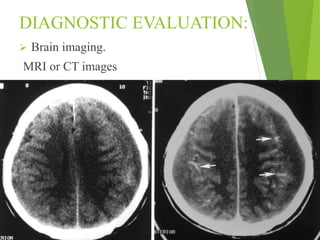
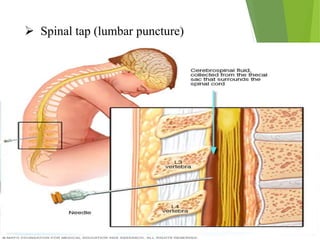
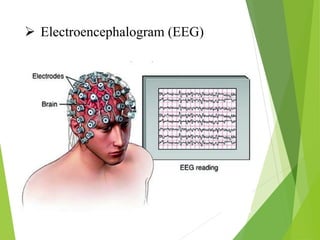
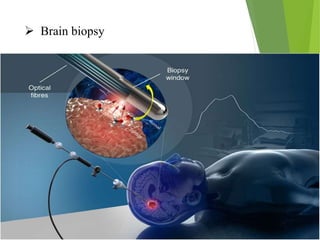
DIAGNOSTIC EVALUATION:
 Brain imaging.
MRI or CT images
 Spinal tap (lumbar puncture)
 Electroencephalogram (EEG)
 Brain biopsy
COMPLICATIONS:
 Thinking difficulties
 Depression and emotional changes
 Swallowing problems
 Sleep problems and sleep disorders
 Constipation
 Blood pressure changes
 Smell dysfunction
 Fatigue
 Pain
 Sexual dysfunction
PREVENTION:
Some research have shown that caffeine — which is found
in coffee, tea and cola — may reduce the risk of developing
Parkinson's disease. Green tea also may reduce the risk of
developing Parkinson's disease.
MEDICAL MANAGEMENT:
 Carbidopa-levodopa.
 Carbidopa-levodopa infusion.
 Dopamine agonists.
 Catechol-O-methyltransferase (COMT)
inhibitors.
 Anticholinergics.
 Amantadine.
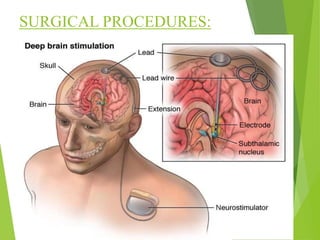
SURGICAL PROCEDURES:
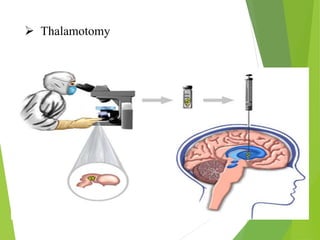
 Thalamotomy
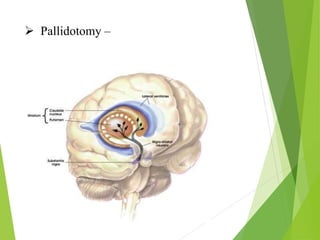
 Pallidotomy –
NURSING CARE:
 Ineffective airway clearance related to excessive secretions as
evidenced by dyspnea
 Disturbed thought process related to parkinsonian medications
as evidenced by inaccurate interpretation of environment
 Imbalanced nutrition less than body requirement related to
inability to take food as evidenced by weight loss
 Impaired physical mobility related to tremors as evidenced by
inability to perform daily activity.
BIBLIOGRAPHY:
 https://www.atrainceu.com/course-module/2440950-
143_parkinsons-module-14
 http://pdcenter.neurology.ucsf.edu/patients-
guide/overview-parkinsons-disease
 https://www.medicinenet.com/parkinsons_disease/article.
htm#is_there_a_test_to_diagnose_parkinsons_disease
 https://www.mayoclinic.org/diseases-
conditions/parkinsons-disease/symptoms-causes/syc-
20376055
 https://www.webmd.com/parkinsons-disease/default.htm
Parkinson's

Parkinson's