‫باريتو‬ ‫تحليل‬
Pareto Analysis
80/20 Rule
Abdelrahman Elsheikh Seedahmed , M.sc, PMOC,CBAP, PMP, RMP, ACP, PMI-SP,
KPI-A, EVM,CPRE, MCITP, MCTS, OCP, OCA, ITIL v3, CTFL, ISO20000, ISO27002
Abdelrahman Elsheikh Bio
 15 years experience as Strategic PMO Director, Strategy Execution
Consultant, PMO Consultant, Project Manager, Business Analyst and
Software Engineer.
• Master Degree in Software Engineering.
• Project Management Office Certification (PMOC).
• Certified Project Management Professional (PMP).
• Agile Certified Practitioner (PMI-ACP).
• Risk Management Professional (PMI-RMP).
• Schedule Professional (PMI-SP).
• Certified Business Analyst Professional (CBAP).
• Microsoft Certified IT Professional (MCITP).
• Key Performance Indicator Associate (KPI-A).
• OCP and OCA.
• Certified Professional for Requirement Engineer (CPRE).
• Certified Tester Foundation Level (CTFL).
• Earned Value Project Management (EVM).
• ISO/IEC 20000 Foundation.
• ISO/IEC 27002 Foundation.
• Certified ITIL Foundation Level.
Agenda
• Parito Analysis Definition.
• Parito Analysis Procedure.
• Parito Analysis in Project Management.
• Parito Analysis in Business Analysis.
• Parito Analysis in Operation and Business.
Agenda
• Parito Analysis Definition.
• Parito Analysis Procedure.
• Parito Analysis in Project Management.
• Parito Analysis in Business Analysis.
• Parito Analysis in Operation and Business.
Joseph Juran
• Joseph Moses Juran was a Romanian-born American engineer and
management consultant.
• He was an evangelist for quality and quality management, having
written several books on those subjects.
• In the late 1940s Joseph M. Juran suggested the principle (Pareto
principle) and named it after Italian economist Vilfredo Pareto.
Vilfredo Pareto
• Vilfredo Federico Damaso Pareto was an Italian engineer,
sociologist, economist, political scientist, and philosopher, now also
known for the 80/20 rule, named after him as the Pareto principle.
• Vilfredo Pareto observed that 80% of income in Italy went to 20% of
the population.
• Pareto later carried out surveys in some other countries and found
to his surprise that a similar distribution applied.
Pareto Principle (80/20 rule)
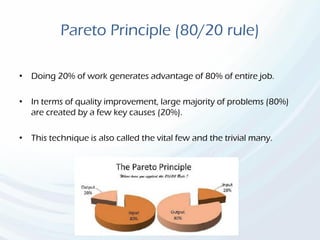
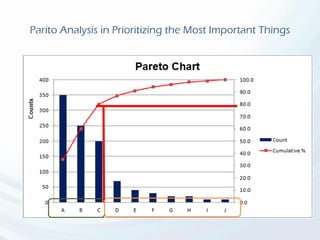
• Doing 20% of work generates advantage of 80% of entire job.
• In terms of quality improvement, large majority of problems (80%)
are created by a few key causes (20%).
• This technique is also called the vital few and the trivial many.
Pareto Principle (80/20 rule)
• We can apply the 80/20 rule to almost anything:
– 80% of customer complaints arise from 20% of your products and
services.
– 80% of delays in the schedule result from 20% of the possible causes
of the delays.
– 20% of your products and services account for 80% of your profit.
– 20% of your sales force produces 80% of your company revenues.
– 20% of a systems defects cause 80% of its problems.
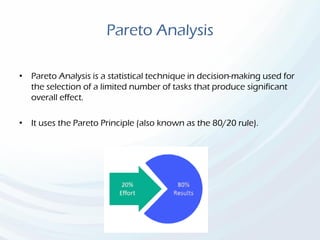
Pareto Analysis
• Pareto Analysis is a statistical technique in decision-making used for
the selection of a limited number of tasks that produce significant
overall effect.
• It uses the Pareto Principle (also known as the 80/20 rule).
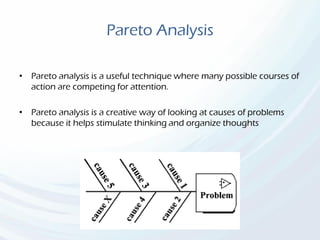
Pareto Analysis
• Pareto analysis is a useful technique where many possible courses of
action are competing for attention.
• Pareto analysis is a creative way of looking at causes of problems
because it helps stimulate thinking and organize thoughts
Pareto Analysis
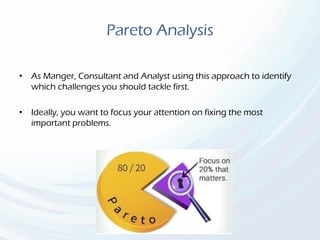
• As Manger, Consultant and Analyst using this approach to identify
which challenges you should tackle first.
• Ideally, you want to focus your attention on fixing the most
important problems.
Pareto Analysis
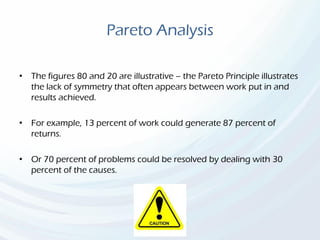
• The figures 80 and 20 are illustrative – the Pareto Principle illustrates
the lack of symmetry that often appears between work put in and
results achieved.
• For example, 13 percent of work could generate 87 percent of
returns.
• Or 70 percent of problems could be resolved by dealing with 30
percent of the causes.
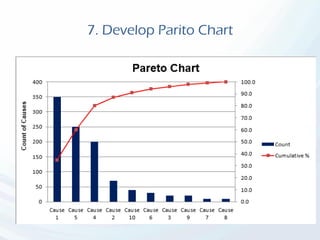
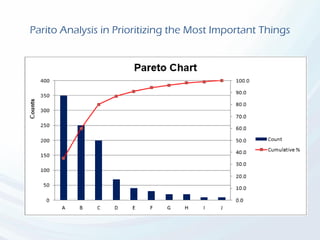
Pareto Chart
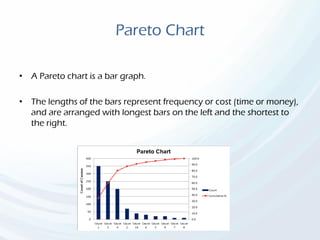
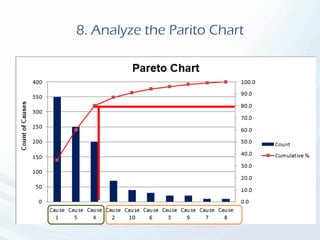
• A Pareto chart is a bar graph.
• The lengths of the bars represent frequency or cost (time or money),
and are arranged with longest bars on the left and the shortest to
the right.
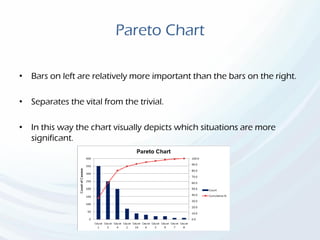
Pareto Chart
• Bars on left are relatively more important than the bars on the right.
• Separates the vital from the trivial.
• In this way the chart visually depicts which situations are more
significant.
Agenda
• Parito Analysis Definition.
• Parito Analysis Procedure.
• Parito Analysis in Project Management.
• Parito Analysis in Business Analysis.
• Parito Analysis in Operation and Business.
Parito Analysis Procedure
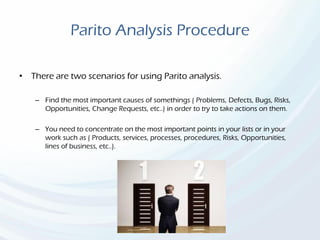
• There are two scenarios for using Parito analysis.
– Find the most important causes of somethings ( Problems, Defects, Bugs, Risks,
Opportunities, Change Requests, etc..) in order to try to take actions on them.
– You need to concentrate on the most important points in your lists or in your
work such as ( Products, services, processes, procedures, Risks, Opportunities,
lines of business, etc..).
Parito Analysis in Prioritizing the Most Important Causes
• Parito Analysis Procedure steps:
1. Identify and List Problems.
2. Identify the Root Cause of Each problem.
3. Score Problems.
4. Group Problems Together By Root cause.
5. Add up the Scores for Each Group.
6. Develop Parito Table.
7. Develop Parito Chart.
8. Analyze the Parito Chart.
9. Take Action.
Parito Analysis in Prioritizing the Most Important Points
• Parito Analysis Procedure steps:
1. Identify and List Things.
2. Score Things.
3. Develop Parito Table.
4. Develop Parito Chart.
5. Analyze the Parito Chart.
6. Take Action.
Parito Analysis in Prioritizing the Most Important Causes
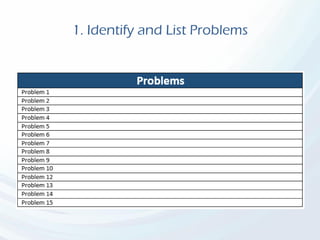
1. Identify and List Problems
• Write a list of all of the problems ( Defects, Risks, Opportunities, etc..)
that you need to consider.
• Where possible, talk to clients, stakeholders and team members to
get their input, and draw on surveys and helpdesk logs, such like,
where these are available.
1. Identify and List Problems
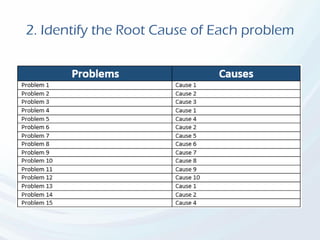
2. Identify the Root Cause of Each problem
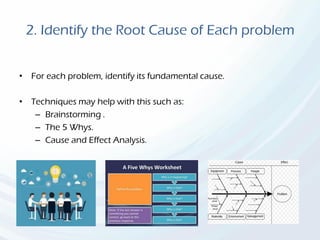
• For each problem, identify its fundamental cause.
• Techniques may help with this such as:
– Brainstorming .
– The 5 Whys.
– Cause and Effect Analysis.
2. Identify the Root Cause of Each problem
3. Score Problems
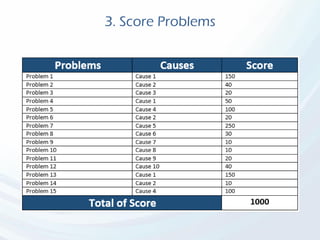
• Now you need to score each problem.
• The scoring method you use depends on the sort of problem you're
trying to solve.
• For example, if you're trying to improve profits, you might score
problems on the basis of how much they are costing you.
• Alternatively, if you're trying to improve customer satisfaction, you
might score them on the basis of the number of complaints
eliminated by solving the problem.
3. Score Problems
4. Group Problems Together By Root cause
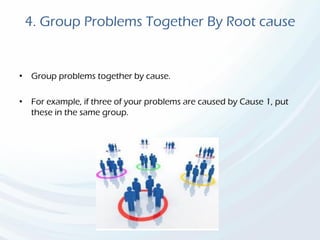
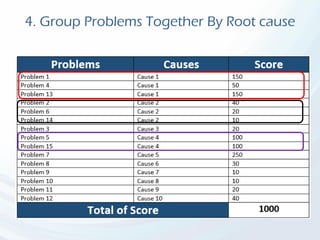
• Group problems together by cause.
• For example, if three of your problems are caused by Cause 1, put
these in the same group.
4. Group Problems Together By Root cause
5. Add up the Scores for Each Group
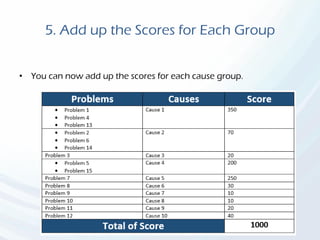
• You can now add up the scores for each cause group.
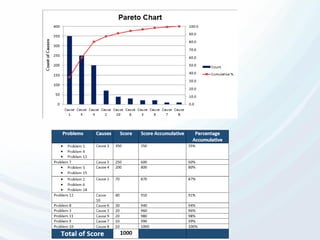
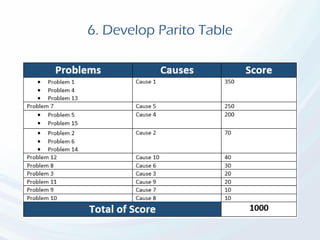
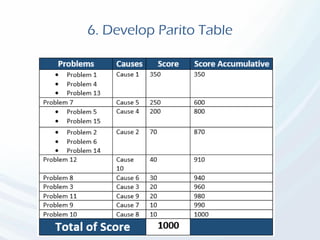
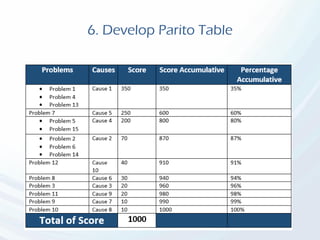
6. Develop Parito Table
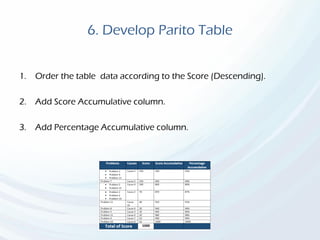
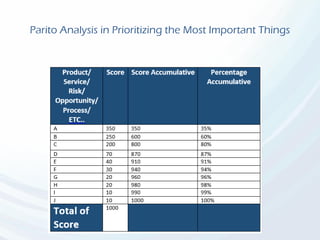
1. Order the table data according to the Score (Descending).
2. Add Score Accumulative column.
3. Add Percentage Accumulative column.
6. Develop Parito Table
7. Develop Parito Chart
8. Analyze the Parito Chart
9. Take Action
• Now you need to deal with the causes of your problems, dealing
with your top-priority problem, or group of problems, first.
• Keep in mind that low scoring problems may not even be worth
bothering with - solving these problems may cost you more than the
solutions are worth.
9. Take Action
• While this approach is great for identifying the most important root
cause to deal with, it doesn't take into account the cost of doing so.
• Where costs are significant, you'll need to use techniques such as
Cost/Benefit Analysis , and use IRRs and NPVs to determine which
changes you should implement.
Parito Analysis in Prioritizing the Most Important Points
• Parito Analysis Procedure steps:
1. Identify and List Things.
2. Score Things.
3. Develop Parito Table.
4. Develop Parito Chart.
5. Analyze the Parito Chart.
6. Take Action.
Parito Analysis in Prioritizing the Most Important Things
Agenda
• Parito Analysis Definition.
• Parito Analysis Procedure.
• Parito Analysis in Project Management.
• Parito Analysis in Business Analysis.
• Parito Analysis in Operation and Business.
Parito Analysis in Project Management
• The value of the Pareto Principle for a project manager is that it
reminds you to focus on the 20% of things that matter.
• Of the things you do during your project, only 20% are really
important.
Parito Analysis in Project Management
• Those 20% produce 80% of your results.
• Identify and focus on those things first, but don't totally ignore the
remaining 80% of causes.
Parito Analysis in Project Management
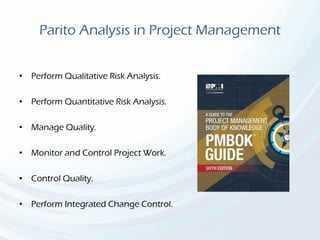
• Perform Qualitative Risk Analysis.
• Perform Quantitative Risk Analysis.
• Manage Quality.
• Monitor and Control Project Work.
• Control Quality.
• Perform Integrated Change Control.
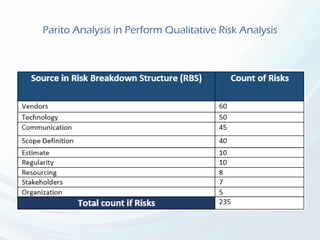
Parito Analysis in Perform Qualitative Risk Analysis
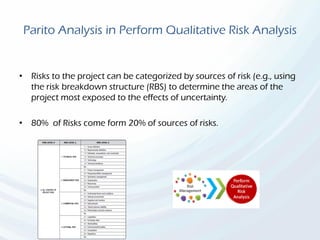
• Risks to the project can be categorized by sources of risk (e.g., using
the risk breakdown structure (RBS) to determine the areas of the
project most exposed to the effects of uncertainty.
• 80% of Risks come form 20% of sources of risks.
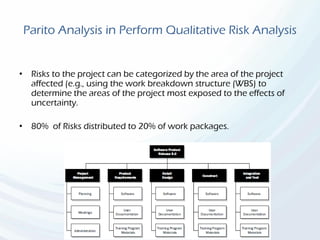
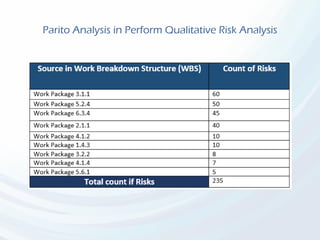
Parito Analysis in Perform Qualitative Risk Analysis
• Risks to the project can be categorized by the area of the project
affected (e.g., using the work breakdown structure (WBS) to
determine the areas of the project most exposed to the effects of
uncertainty.
• 80% of Risks distributed to 20% of work packages.
Parito Analysis in Perform Qualitative Risk Analysis
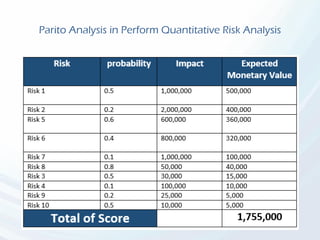
Parito Analysis in Perform Quantitative Risk Analysis
• Risks can also be categorized by expected monetary value to
monitor the most important risks.
• 20% of Risks needs 80% of project expected monetary value.
Parito Analysis in Perform Quantitative Risk Analysis
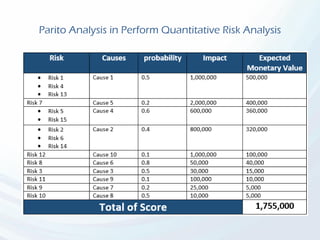
• Risks can also be categorized by common root causes to monitor the
most important risks.
• 20% of Causes produce 80% of project Risks.
Parito Analysis in Perform Quantitative Risk Analysis
Parito Analysis in Manage Quality
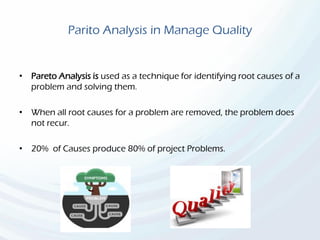
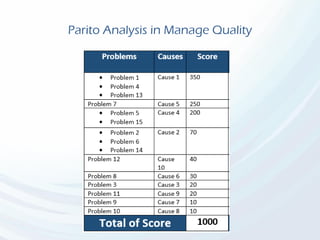
• Pareto Analysis is used as a technique for identifying root causes of a
problem and solving them.
• When all root causes for a problem are removed, the problem does
not recur.
• 20% of Causes produce 80% of project Problems.
Parito Analysis in Manage Quality
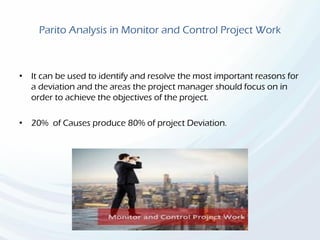
Parito Analysis in Monitor and Control Project Work
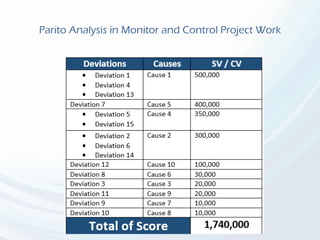
• It can be used to identify and resolve the most important reasons for
a deviation and the areas the project manager should focus on in
order to achieve the objectives of the project.
• 20% of Causes produce 80% of project Deviation.
Parito Analysis in Monitor and Control Project Work
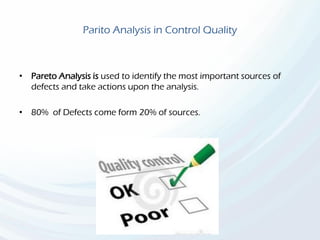
Parito Analysis in Control Quality
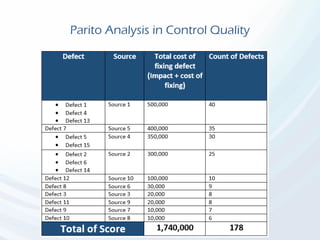
• Pareto Analysis is used to identify the most important sources of
defects and take actions upon the analysis.
• 80% of Defects come form 20% of sources.
Parito Analysis in Control Quality
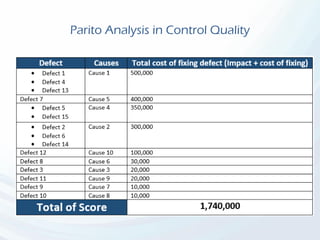
• Pareto Analysis is also may used to identify the most important
causes of defects in order to find solution to proactively mitigate
appearance of defects.
• 20% of Causes produce 80% of project defects.
Parito Analysis in Control Quality
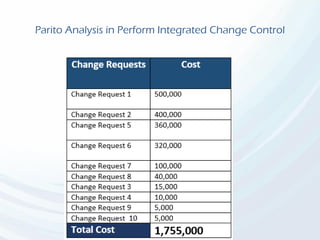
Parito Analysis in Perform Integrated Change Control
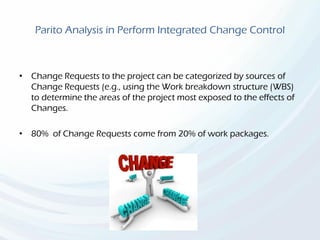
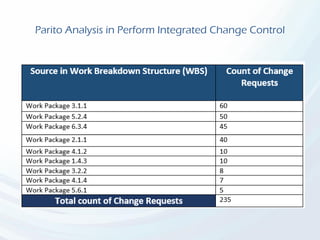
• Change Requests to the project can be categorized by sources of
Change Requests (e.g., using the Work breakdown structure (WBS)
to determine the areas of the project most exposed to the effects of
Changes.
• 80% of Change Requests come from 20% of work packages.
Parito Analysis in Perform Integrated Change Control
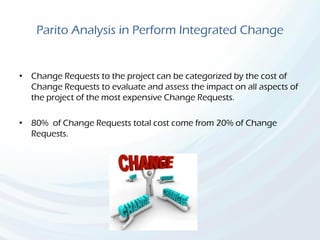
Parito Analysis in Perform Integrated Change
• Change Requests to the project can be categorized by the cost of
Change Requests to evaluate and assess the impact on all aspects of
the project of the most expensive Change Requests.
• 80% of Change Requests total cost come from 20% of Change
Requests.
Parito Analysis in Perform Integrated Change Control
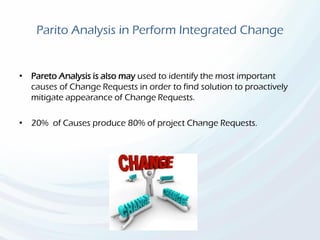
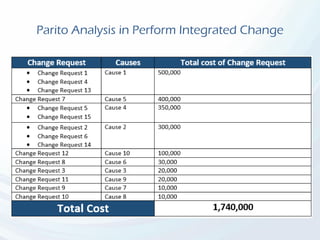
Parito Analysis in Perform Integrated Change
• Pareto Analysis is also may used to identify the most important
causes of Change Requests in order to find solution to proactively
mitigate appearance of Change Requests.
• 20% of Causes produce 80% of project Change Requests.
Parito Analysis in Perform Integrated Change
Agenda
• Parito Analysis Definition.
• Parito Analysis Procedure.
• Parito Analysis in Project Management.
• Parito Analysis in Business Analysis.
• Parito Analysis in Operation and Business.
Parito Analysis in Business Analysis
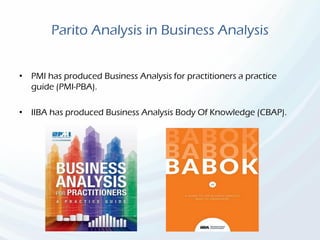
• PMI has produced Business Analysis for practitioners a practice
guide (PMI-PBA).
• IIBA has produced Business Analysis Body Of Knowledge (CBAP).
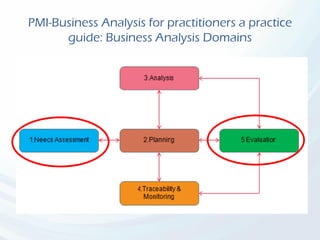
PMI-Business Analysis for practitioners a practice
guide: Business Analysis Domains
Needs Assessment
• This domain includes the business analysis work that is conducted to
analyze a current business problem or opportunity and to assess the
current internal and external environments of the organization for
the purpose of understanding what needs to occur in order to attain
the desired future state.
Identify Problem or Opportunity
• Part of the work performed within needs assessment is to identify
the problem being solved or the opportunity that needs to be
addressed.
• To avoid focusing on the solution too soon, emphasis is placed on
understanding the current environment and analyzing the
information uncovered.
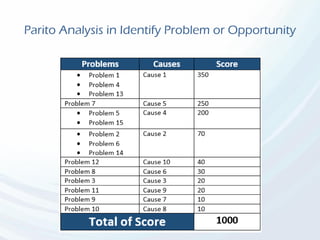
Parito Analysis in Identify Problem or Opportunity
• Pareto Analysis is used as a technique for identifying root causes of a
problems and solving them.
• When all root causes for a problems are removed, the problems
does not recur.
• 20% of Causes produce 80% of Problems.
Parito Analysis in Identify Problem or Opportunity
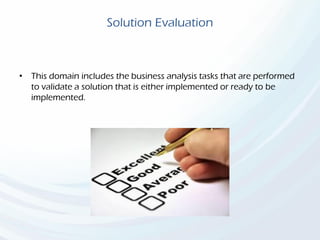
Solution Evaluation
• This domain includes the business analysis tasks that are performed
to validate a solution that is either implemented or ready to be
implemented.
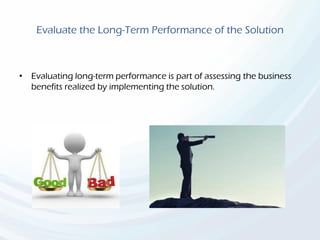
Evaluate the Long-Term Performance of the Solution
• Evaluating long-term performance is part of assessing the business
benefits realized by implementing the solution.
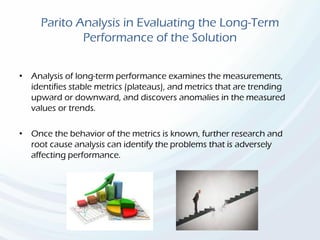
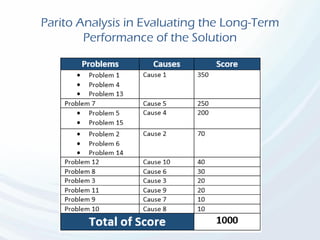
Parito Analysis in Evaluating the Long-Term
Performance of the Solution
• Analysis of long-term performance examines the measurements,
identifies stable metrics (plateaus), and metrics that are trending
upward or downward, and discovers anomalies in the measured
values or trends.
• Once the behavior of the metrics is known, further research and
root cause analysis can identify the problems that is adversely
affecting performance.
Parito Analysis in Evaluating the Long-Term
Performance of the Solution
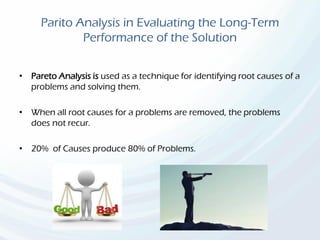
• Pareto Analysis is used as a technique for identifying root causes of a
problems and solving them.
• When all root causes for a problems are removed, the problems
does not recur.
• 20% of Causes produce 80% of Problems.
Parito Analysis in Evaluating the Long-Term
Performance of the Solution
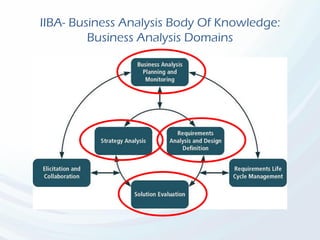
IIBA- Business Analysis Body Of Knowledge:
Business Analysis Domains
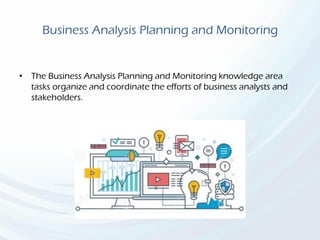
Business Analysis Planning and Monitoring
• The Business Analysis Planning and Monitoring knowledge area
tasks organize and coordinate the efforts of business analysts and
stakeholders.
Identify Business Analysis Performance Improvements
• The purpose is to assess business analysis work and to plan to
improve processes where required.
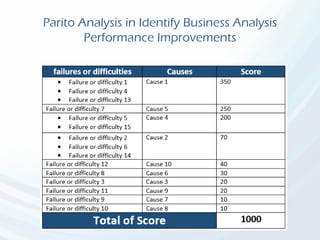
Parito Analysis in Identify Business Analysis
Performance Improvements
• Pareto Analysis is used to help identify the underlying cause of
failures or difficulties in accomplishing business analysis work.
• 20% of Causes produce 80% of failures or difficulties .
Parito Analysis in Identify Business Analysis
Performance Improvements
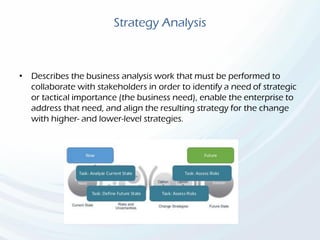
Strategy Analysis
• Describes the business analysis work that must be performed to
collaborate with stakeholders in order to identify a need of strategic
or tactical importance (the business need), enable the enterprise to
address that need, and align the resulting strategy for the change
with higher- and lower-level strategies.
Analyze Current State
• The purpose of Analyze Current State is to understand the reasons
why an enterprise needs to change some aspect of how it operates
and what would be directly or indirectly affected by the change.
Parito Analysis in Analyze Current State
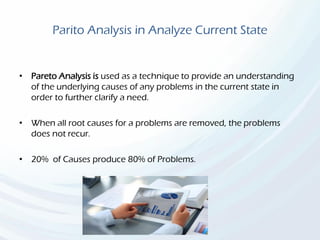
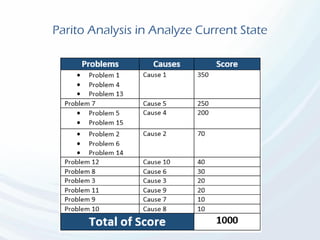
• Pareto Analysis is used as a technique to provide an understanding
of the underlying causes of any problems in the current state in
order to further clarify a need.
• When all root causes for a problems are removed, the problems
does not recur.
• 20% of Causes produce 80% of Problems.
Parito Analysis in Analyze Current State
Assess Risks
• The purpose of Assess Risks is to understand the undesirable
consequences of internal and external forces on the enterprise
during a transition to, or once in, the future state.
• An understanding of the potential impact of those forces can be
used to make a recommendation about a course of action.
Parito Analysis in Assess Risks
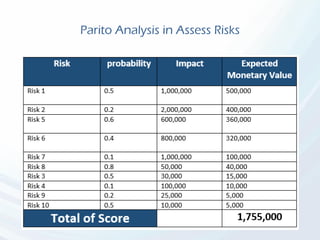
• Pareto Analysis is used as a technique to used to identify and
address the impact of the risks.
• 20% of risks result in 80% of impact.
Parito Analysis in Assess Risks
Requirements Analysis and Design Definition
• describes the tasks that business analysts perform to structure and
organize requirements discovered during elicitation activities, specify
and model requirements and designs, validate and verify
information, identify solution options that meet business needs, and
estimate the potential value that could be realized for each solution
option.
Specify and Model Requirements
• The purpose of Specify and Model Requirements is to analyze,
synthesize, and refine elicitation results into requirements and
designs.
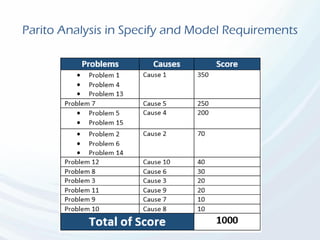
Parito Analysis in Specify and Model Requirements
• Pareto Analysis is used as a technique to used to model the root
causes of a problems as part of rationale.
• 20% of Causes produce 80% of Problems.
Parito Analysis in Specify and Model Requirements
Define Design Options
• The purpose of Define Design Options is to define the solution
approach, identify opportunities to improve the business, allocate
requirements across solution components, and represent design
options that achieve the desired future state.
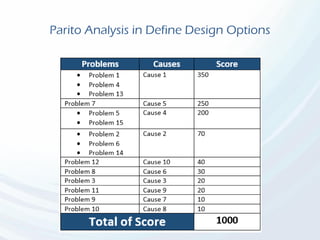
Parito Analysis in Define Design Options
• Pareto Analysis is used as a technique to understand the underlying
cause of the problems being addressed in the change to propose
solutions to address them.
• 20% of Causes produce 80% of Problems.
Parito Analysis in Define Design Options
Solution Evaluation
• Describes the tasks that business analysts perform to assess the
performance of and value delivered by a solution in use by the
enterprise, and to recommend removal of barriers or constraints that
prevent the full realization of the value.
Analyze Performance Measures
• The purpose of Analyze Performance Measures is to provide insights
into the performance of a solution in relation to the value it brings.
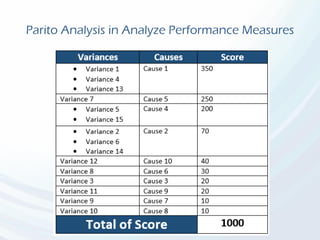
Parito Analysis in Analyze Performance Measures
• Pareto Analysis is used as a technique to determine the underlying
causes of performance variances.
• 20% of Causes produce 80% of variances.
Parito Analysis in Analyze Performance Measures
Assess Solution Limitations
• The purpose of Assess Solution Limitations is to determine the
factors internal to the solution that restrict the full realization of
value.
Parito Analysis in Assess Solution Limitations
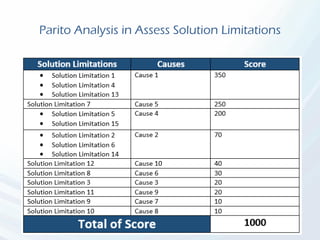
• Pareto Analysis is used as a technique to identify and understand
the combination of factors and their underlying causes that led to
the solution being unable to deliver its potential value.
• 20% of Causes result in 80% of Solution Limitations.
Parito Analysis in Assess Solution Limitations
Assess Enterprise Limitations
• The purpose of Assess Enterprise Limitations is to determine how
factors external to the solution are restricting value realization.
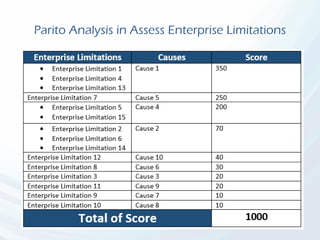
Parito Analysis in Assess Enterprise Limitations
• Pareto Analysis is used as a technique to determine if the underlying
causes may be related to enterprise limitations.
• 20% of Causes result in 80% of enterprise limitations.
Parito Analysis in Assess Enterprise Limitations
Agenda
• Parito Analysis Definition.
• Parito Analysis Procedure.
• Parito Analysis in Project Management.
• Parito Analysis in Business Analysis.
• Parito Analysis in Operation and Business.
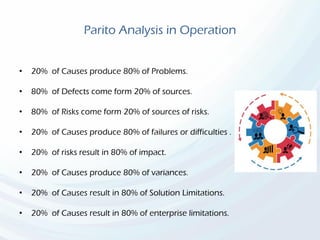
Parito Analysis in Operation
• 20% of Causes produce 80% of Problems.
• 80% of Defects come form 20% of sources.
• 80% of Risks come form 20% of sources of risks.
• 20% of Causes produce 80% of failures or difficulties .
• 20% of risks result in 80% of impact.
• 20% of Causes produce 80% of variances.
• 20% of Causes result in 80% of Solution Limitations.
• 20% of Causes result in 80% of enterprise limitations.
Parito Analysis in Business
• 20 percent of marketing messages produce 80 percent of your
campaign results.
• 80% of sales come from 20% of your clients.
• 80% of sales come from 20% of your products.
• 80% of sales come from 20% of your salespeople.
• 80% of your complaints come from 20% of your customers.
• 20% of employees are responsible for 80% of the results.
Agenda
• Parito Analysis Definition.
• Parito Analysis Procedure.
• Parito Analysis in Project Management.
• Parito Analysis in Business Analysis.
• Parito Analysis in Operation and Business.
https://www.facebook.com/abdelrahmansida/
https://www.youtube.com/c/abdelrahmanelsheikh
https://www.linkedin.com/in/abdelrahmanelsheikh/
https://twitter.com/AbdelrahmanSida
https://www.slideshare.net/abdelrahmanelsheikh1
Pareto analysis  تحليل باريتو

Pareto analysis تحليل باريتو

  • 1.
    ‫باريتو‬ ‫تحليل‬ Pareto Analysis 80/20Rule Abdelrahman Elsheikh Seedahmed , M.sc, PMOC,CBAP, PMP, RMP, ACP, PMI-SP, KPI-A, EVM,CPRE, MCITP, MCTS, OCP, OCA, ITIL v3, CTFL, ISO20000, ISO27002
  • 2.
    Abdelrahman Elsheikh Bio 15 years experience as Strategic PMO Director, Strategy Execution Consultant, PMO Consultant, Project Manager, Business Analyst and Software Engineer. • Master Degree in Software Engineering. • Project Management Office Certification (PMOC). • Certified Project Management Professional (PMP). • Agile Certified Practitioner (PMI-ACP). • Risk Management Professional (PMI-RMP). • Schedule Professional (PMI-SP). • Certified Business Analyst Professional (CBAP). • Microsoft Certified IT Professional (MCITP). • Key Performance Indicator Associate (KPI-A). • OCP and OCA. • Certified Professional for Requirement Engineer (CPRE). • Certified Tester Foundation Level (CTFL). • Earned Value Project Management (EVM). • ISO/IEC 20000 Foundation. • ISO/IEC 27002 Foundation. • Certified ITIL Foundation Level.
  • 3.
    Agenda • Parito AnalysisDefinition. • Parito Analysis Procedure. • Parito Analysis in Project Management. • Parito Analysis in Business Analysis. • Parito Analysis in Operation and Business.
  • 4.
    Agenda • Parito AnalysisDefinition. • Parito Analysis Procedure. • Parito Analysis in Project Management. • Parito Analysis in Business Analysis. • Parito Analysis in Operation and Business.
  • 5.
    Joseph Juran • JosephMoses Juran was a Romanian-born American engineer and management consultant. • He was an evangelist for quality and quality management, having written several books on those subjects. • In the late 1940s Joseph M. Juran suggested the principle (Pareto principle) and named it after Italian economist Vilfredo Pareto.
  • 6.
    Vilfredo Pareto • VilfredoFederico Damaso Pareto was an Italian engineer, sociologist, economist, political scientist, and philosopher, now also known for the 80/20 rule, named after him as the Pareto principle. • Vilfredo Pareto observed that 80% of income in Italy went to 20% of the population. • Pareto later carried out surveys in some other countries and found to his surprise that a similar distribution applied.
  • 7.
    Pareto Principle (80/20rule) • Doing 20% of work generates advantage of 80% of entire job. • In terms of quality improvement, large majority of problems (80%) are created by a few key causes (20%). • This technique is also called the vital few and the trivial many.
  • 8.
    Pareto Principle (80/20rule) • We can apply the 80/20 rule to almost anything: – 80% of customer complaints arise from 20% of your products and services. – 80% of delays in the schedule result from 20% of the possible causes of the delays. – 20% of your products and services account for 80% of your profit. – 20% of your sales force produces 80% of your company revenues. – 20% of a systems defects cause 80% of its problems.
  • 9.
    Pareto Analysis • ParetoAnalysis is a statistical technique in decision-making used for the selection of a limited number of tasks that produce significant overall effect. • It uses the Pareto Principle (also known as the 80/20 rule).
  • 10.
    Pareto Analysis • Paretoanalysis is a useful technique where many possible courses of action are competing for attention. • Pareto analysis is a creative way of looking at causes of problems because it helps stimulate thinking and organize thoughts
  • 11.
    Pareto Analysis • AsManger, Consultant and Analyst using this approach to identify which challenges you should tackle first. • Ideally, you want to focus your attention on fixing the most important problems.
  • 12.
    Pareto Analysis • Thefigures 80 and 20 are illustrative – the Pareto Principle illustrates the lack of symmetry that often appears between work put in and results achieved. • For example, 13 percent of work could generate 87 percent of returns. • Or 70 percent of problems could be resolved by dealing with 30 percent of the causes.
  • 13.
    Pareto Chart • APareto chart is a bar graph. • The lengths of the bars represent frequency or cost (time or money), and are arranged with longest bars on the left and the shortest to the right.
  • 14.
    Pareto Chart • Barson left are relatively more important than the bars on the right. • Separates the vital from the trivial. • In this way the chart visually depicts which situations are more significant.
  • 16.
    Agenda • Parito AnalysisDefinition. • Parito Analysis Procedure. • Parito Analysis in Project Management. • Parito Analysis in Business Analysis. • Parito Analysis in Operation and Business.
  • 17.
    Parito Analysis Procedure •There are two scenarios for using Parito analysis. – Find the most important causes of somethings ( Problems, Defects, Bugs, Risks, Opportunities, Change Requests, etc..) in order to try to take actions on them. – You need to concentrate on the most important points in your lists or in your work such as ( Products, services, processes, procedures, Risks, Opportunities, lines of business, etc..).
  • 18.
    Parito Analysis inPrioritizing the Most Important Causes • Parito Analysis Procedure steps: 1. Identify and List Problems. 2. Identify the Root Cause of Each problem. 3. Score Problems. 4. Group Problems Together By Root cause. 5. Add up the Scores for Each Group. 6. Develop Parito Table. 7. Develop Parito Chart. 8. Analyze the Parito Chart. 9. Take Action.
  • 19.
    Parito Analysis inPrioritizing the Most Important Points • Parito Analysis Procedure steps: 1. Identify and List Things. 2. Score Things. 3. Develop Parito Table. 4. Develop Parito Chart. 5. Analyze the Parito Chart. 6. Take Action.
  • 20.
    Parito Analysis inPrioritizing the Most Important Causes
  • 21.
    1. Identify andList Problems • Write a list of all of the problems ( Defects, Risks, Opportunities, etc..) that you need to consider. • Where possible, talk to clients, stakeholders and team members to get their input, and draw on surveys and helpdesk logs, such like, where these are available.
  • 22.
    1. Identify andList Problems
  • 23.
    2. Identify theRoot Cause of Each problem • For each problem, identify its fundamental cause. • Techniques may help with this such as: – Brainstorming . – The 5 Whys. – Cause and Effect Analysis.
  • 24.
    2. Identify theRoot Cause of Each problem
  • 25.
    3. Score Problems •Now you need to score each problem. • The scoring method you use depends on the sort of problem you're trying to solve. • For example, if you're trying to improve profits, you might score problems on the basis of how much they are costing you. • Alternatively, if you're trying to improve customer satisfaction, you might score them on the basis of the number of complaints eliminated by solving the problem.
  • 26.
  • 27.
    4. Group ProblemsTogether By Root cause • Group problems together by cause. • For example, if three of your problems are caused by Cause 1, put these in the same group.
  • 28.
    4. Group ProblemsTogether By Root cause
  • 29.
    5. Add upthe Scores for Each Group • You can now add up the scores for each cause group.
  • 30.
    6. Develop ParitoTable 1. Order the table data according to the Score (Descending). 2. Add Score Accumulative column. 3. Add Percentage Accumulative column.
  • 31.
  • 32.
  • 33.
  • 34.
  • 35.
    8. Analyze theParito Chart
  • 36.
    9. Take Action •Now you need to deal with the causes of your problems, dealing with your top-priority problem, or group of problems, first. • Keep in mind that low scoring problems may not even be worth bothering with - solving these problems may cost you more than the solutions are worth.
  • 37.
    9. Take Action •While this approach is great for identifying the most important root cause to deal with, it doesn't take into account the cost of doing so. • Where costs are significant, you'll need to use techniques such as Cost/Benefit Analysis , and use IRRs and NPVs to determine which changes you should implement.
  • 38.
    Parito Analysis inPrioritizing the Most Important Points • Parito Analysis Procedure steps: 1. Identify and List Things. 2. Score Things. 3. Develop Parito Table. 4. Develop Parito Chart. 5. Analyze the Parito Chart. 6. Take Action.
  • 39.
    Parito Analysis inPrioritizing the Most Important Things
  • 40.
    Parito Analysis inPrioritizing the Most Important Things
  • 41.
    Parito Analysis inPrioritizing the Most Important Things
  • 42.
    Agenda • Parito AnalysisDefinition. • Parito Analysis Procedure. • Parito Analysis in Project Management. • Parito Analysis in Business Analysis. • Parito Analysis in Operation and Business.
  • 43.
    Parito Analysis inProject Management • The value of the Pareto Principle for a project manager is that it reminds you to focus on the 20% of things that matter. • Of the things you do during your project, only 20% are really important.
  • 44.
    Parito Analysis inProject Management • Those 20% produce 80% of your results. • Identify and focus on those things first, but don't totally ignore the remaining 80% of causes.
  • 45.
    Parito Analysis inProject Management • Perform Qualitative Risk Analysis. • Perform Quantitative Risk Analysis. • Manage Quality. • Monitor and Control Project Work. • Control Quality. • Perform Integrated Change Control.
  • 46.
    Parito Analysis inPerform Qualitative Risk Analysis • Risks to the project can be categorized by sources of risk (e.g., using the risk breakdown structure (RBS) to determine the areas of the project most exposed to the effects of uncertainty. • 80% of Risks come form 20% of sources of risks.
  • 47.
    Parito Analysis inPerform Qualitative Risk Analysis
  • 48.
    Parito Analysis inPerform Qualitative Risk Analysis • Risks to the project can be categorized by the area of the project affected (e.g., using the work breakdown structure (WBS) to determine the areas of the project most exposed to the effects of uncertainty. • 80% of Risks distributed to 20% of work packages.
  • 49.
    Parito Analysis inPerform Qualitative Risk Analysis
  • 50.
    Parito Analysis inPerform Quantitative Risk Analysis • Risks can also be categorized by expected monetary value to monitor the most important risks. • 20% of Risks needs 80% of project expected monetary value.
  • 51.
    Parito Analysis inPerform Quantitative Risk Analysis
  • 52.
    Parito Analysis inPerform Quantitative Risk Analysis • Risks can also be categorized by common root causes to monitor the most important risks. • 20% of Causes produce 80% of project Risks.
  • 53.
    Parito Analysis inPerform Quantitative Risk Analysis
  • 54.
    Parito Analysis inManage Quality • Pareto Analysis is used as a technique for identifying root causes of a problem and solving them. • When all root causes for a problem are removed, the problem does not recur. • 20% of Causes produce 80% of project Problems.
  • 55.
    Parito Analysis inManage Quality
  • 56.
    Parito Analysis inMonitor and Control Project Work • It can be used to identify and resolve the most important reasons for a deviation and the areas the project manager should focus on in order to achieve the objectives of the project. • 20% of Causes produce 80% of project Deviation.
  • 57.
    Parito Analysis inMonitor and Control Project Work
  • 58.
    Parito Analysis inControl Quality • Pareto Analysis is used to identify the most important sources of defects and take actions upon the analysis. • 80% of Defects come form 20% of sources.
  • 59.
    Parito Analysis inControl Quality
  • 60.
    Parito Analysis inControl Quality • Pareto Analysis is also may used to identify the most important causes of defects in order to find solution to proactively mitigate appearance of defects. • 20% of Causes produce 80% of project defects.
  • 61.
    Parito Analysis inControl Quality
  • 62.
    Parito Analysis inPerform Integrated Change Control • Change Requests to the project can be categorized by sources of Change Requests (e.g., using the Work breakdown structure (WBS) to determine the areas of the project most exposed to the effects of Changes. • 80% of Change Requests come from 20% of work packages.
  • 63.
    Parito Analysis inPerform Integrated Change Control
  • 64.
    Parito Analysis inPerform Integrated Change • Change Requests to the project can be categorized by the cost of Change Requests to evaluate and assess the impact on all aspects of the project of the most expensive Change Requests. • 80% of Change Requests total cost come from 20% of Change Requests.
  • 65.
    Parito Analysis inPerform Integrated Change Control
  • 66.
    Parito Analysis inPerform Integrated Change • Pareto Analysis is also may used to identify the most important causes of Change Requests in order to find solution to proactively mitigate appearance of Change Requests. • 20% of Causes produce 80% of project Change Requests.
  • 67.
    Parito Analysis inPerform Integrated Change
  • 68.
    Agenda • Parito AnalysisDefinition. • Parito Analysis Procedure. • Parito Analysis in Project Management. • Parito Analysis in Business Analysis. • Parito Analysis in Operation and Business.
  • 69.
    Parito Analysis inBusiness Analysis • PMI has produced Business Analysis for practitioners a practice guide (PMI-PBA). • IIBA has produced Business Analysis Body Of Knowledge (CBAP).
  • 70.
    PMI-Business Analysis forpractitioners a practice guide: Business Analysis Domains
  • 71.
    Needs Assessment • Thisdomain includes the business analysis work that is conducted to analyze a current business problem or opportunity and to assess the current internal and external environments of the organization for the purpose of understanding what needs to occur in order to attain the desired future state.
  • 72.
    Identify Problem orOpportunity • Part of the work performed within needs assessment is to identify the problem being solved or the opportunity that needs to be addressed. • To avoid focusing on the solution too soon, emphasis is placed on understanding the current environment and analyzing the information uncovered.
  • 73.
    Parito Analysis inIdentify Problem or Opportunity • Pareto Analysis is used as a technique for identifying root causes of a problems and solving them. • When all root causes for a problems are removed, the problems does not recur. • 20% of Causes produce 80% of Problems.
  • 74.
    Parito Analysis inIdentify Problem or Opportunity
  • 75.
    Solution Evaluation • Thisdomain includes the business analysis tasks that are performed to validate a solution that is either implemented or ready to be implemented.
  • 76.
    Evaluate the Long-TermPerformance of the Solution • Evaluating long-term performance is part of assessing the business benefits realized by implementing the solution.
  • 77.
    Parito Analysis inEvaluating the Long-Term Performance of the Solution • Analysis of long-term performance examines the measurements, identifies stable metrics (plateaus), and metrics that are trending upward or downward, and discovers anomalies in the measured values or trends. • Once the behavior of the metrics is known, further research and root cause analysis can identify the problems that is adversely affecting performance.
  • 78.
    Parito Analysis inEvaluating the Long-Term Performance of the Solution • Pareto Analysis is used as a technique for identifying root causes of a problems and solving them. • When all root causes for a problems are removed, the problems does not recur. • 20% of Causes produce 80% of Problems.
  • 79.
    Parito Analysis inEvaluating the Long-Term Performance of the Solution
  • 80.
    IIBA- Business AnalysisBody Of Knowledge: Business Analysis Domains
  • 81.
    Business Analysis Planningand Monitoring • The Business Analysis Planning and Monitoring knowledge area tasks organize and coordinate the efforts of business analysts and stakeholders.
  • 82.
    Identify Business AnalysisPerformance Improvements • The purpose is to assess business analysis work and to plan to improve processes where required.
  • 83.
    Parito Analysis inIdentify Business Analysis Performance Improvements • Pareto Analysis is used to help identify the underlying cause of failures or difficulties in accomplishing business analysis work. • 20% of Causes produce 80% of failures or difficulties .
  • 84.
    Parito Analysis inIdentify Business Analysis Performance Improvements
  • 85.
    Strategy Analysis • Describesthe business analysis work that must be performed to collaborate with stakeholders in order to identify a need of strategic or tactical importance (the business need), enable the enterprise to address that need, and align the resulting strategy for the change with higher- and lower-level strategies.
  • 86.
    Analyze Current State •The purpose of Analyze Current State is to understand the reasons why an enterprise needs to change some aspect of how it operates and what would be directly or indirectly affected by the change.
  • 87.
    Parito Analysis inAnalyze Current State • Pareto Analysis is used as a technique to provide an understanding of the underlying causes of any problems in the current state in order to further clarify a need. • When all root causes for a problems are removed, the problems does not recur. • 20% of Causes produce 80% of Problems.
  • 88.
    Parito Analysis inAnalyze Current State
  • 89.
    Assess Risks • Thepurpose of Assess Risks is to understand the undesirable consequences of internal and external forces on the enterprise during a transition to, or once in, the future state. • An understanding of the potential impact of those forces can be used to make a recommendation about a course of action.
  • 90.
    Parito Analysis inAssess Risks • Pareto Analysis is used as a technique to used to identify and address the impact of the risks. • 20% of risks result in 80% of impact.
  • 91.
    Parito Analysis inAssess Risks
  • 92.
    Requirements Analysis andDesign Definition • describes the tasks that business analysts perform to structure and organize requirements discovered during elicitation activities, specify and model requirements and designs, validate and verify information, identify solution options that meet business needs, and estimate the potential value that could be realized for each solution option.
  • 93.
    Specify and ModelRequirements • The purpose of Specify and Model Requirements is to analyze, synthesize, and refine elicitation results into requirements and designs.
  • 94.
    Parito Analysis inSpecify and Model Requirements • Pareto Analysis is used as a technique to used to model the root causes of a problems as part of rationale. • 20% of Causes produce 80% of Problems.
  • 95.
    Parito Analysis inSpecify and Model Requirements
  • 96.
    Define Design Options •The purpose of Define Design Options is to define the solution approach, identify opportunities to improve the business, allocate requirements across solution components, and represent design options that achieve the desired future state.
  • 97.
    Parito Analysis inDefine Design Options • Pareto Analysis is used as a technique to understand the underlying cause of the problems being addressed in the change to propose solutions to address them. • 20% of Causes produce 80% of Problems.
  • 98.
    Parito Analysis inDefine Design Options
  • 99.
    Solution Evaluation • Describesthe tasks that business analysts perform to assess the performance of and value delivered by a solution in use by the enterprise, and to recommend removal of barriers or constraints that prevent the full realization of the value.
  • 100.
    Analyze Performance Measures •The purpose of Analyze Performance Measures is to provide insights into the performance of a solution in relation to the value it brings.
  • 101.
    Parito Analysis inAnalyze Performance Measures • Pareto Analysis is used as a technique to determine the underlying causes of performance variances. • 20% of Causes produce 80% of variances.
  • 102.
    Parito Analysis inAnalyze Performance Measures
  • 103.
    Assess Solution Limitations •The purpose of Assess Solution Limitations is to determine the factors internal to the solution that restrict the full realization of value.
  • 104.
    Parito Analysis inAssess Solution Limitations • Pareto Analysis is used as a technique to identify and understand the combination of factors and their underlying causes that led to the solution being unable to deliver its potential value. • 20% of Causes result in 80% of Solution Limitations.
  • 105.
    Parito Analysis inAssess Solution Limitations
  • 106.
    Assess Enterprise Limitations •The purpose of Assess Enterprise Limitations is to determine how factors external to the solution are restricting value realization.
  • 107.
    Parito Analysis inAssess Enterprise Limitations • Pareto Analysis is used as a technique to determine if the underlying causes may be related to enterprise limitations. • 20% of Causes result in 80% of enterprise limitations.
  • 108.
    Parito Analysis inAssess Enterprise Limitations
  • 109.
    Agenda • Parito AnalysisDefinition. • Parito Analysis Procedure. • Parito Analysis in Project Management. • Parito Analysis in Business Analysis. • Parito Analysis in Operation and Business.
  • 110.
    Parito Analysis inOperation • 20% of Causes produce 80% of Problems. • 80% of Defects come form 20% of sources. • 80% of Risks come form 20% of sources of risks. • 20% of Causes produce 80% of failures or difficulties . • 20% of risks result in 80% of impact. • 20% of Causes produce 80% of variances. • 20% of Causes result in 80% of Solution Limitations. • 20% of Causes result in 80% of enterprise limitations.
  • 111.
    Parito Analysis inBusiness • 20 percent of marketing messages produce 80 percent of your campaign results. • 80% of sales come from 20% of your clients. • 80% of sales come from 20% of your products. • 80% of sales come from 20% of your salespeople. • 80% of your complaints come from 20% of your customers. • 20% of employees are responsible for 80% of the results.
  • 112.
    Agenda • Parito AnalysisDefinition. • Parito Analysis Procedure. • Parito Analysis in Project Management. • Parito Analysis in Business Analysis. • Parito Analysis in Operation and Business.
  • 113.