Pareto Principle
“The Vital Few and Trivial Many Rule”
“Predictable Imbalance”
“80:20 Rule”
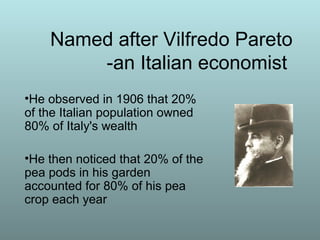
Named after Vilfredo Pareto
-an Italian economist
•He observed in 1906 that 20%
of the Italian population owned
80% of Italy's wealth
•He then noticed that 20% of the
pea pods in his garden
accounted for 80% of his pea
crop each year
The Pareto Principle
• A small number of causes is responsible for a
large percentage of the effect-
-usually a 20-percent to 80-percent ratio.
• This basic principle translates well into quality
problems - most quality problems result from a
small number of causes.
• You can apply this ratio to almost anything,
from the science of management to the physical
world
Addressing the most troublesome 20% of the
problem will solve 80% of it.
Within your process, 20% of the individuals will
cause 80% of your headaches.
Of all the solutions you identify, about 20% are
likely to remain viable after adequate analysis.
80% of the work is usually done by 20% of the
people.
80% of the quality can be gotten in 20% of the
time -- perfection takes 5 times longer
20% of the defects cause 80% of the problems.
Project Managers know that 20% of the work
(the first 10% and the last 10%) consume 80%
of the time and resources.
A Pareto chart is a useful tool for graphically
depicting these and other relationships
It is a simple Histogram style graph that ranks
problems in order of magnitude to determine the
priorities for improvement activities
The goal is to target the largest potential
improvement area then move on to the next, then
next, and in so doing address the area of most
benefit first
The chart can help show you where allocating
time, human, and financial resources will yield
the best results.
While the rule is not an absolute, one
should use it as a guide and reference
point to ask whether or not you are truly
focusing on:
20% - The Vital Few
or
80% - The Trivial Many
True progress results from a consistent
focus on the 20% most critical
objectives.
the
The simplicity of the Pareto concept
makes it prone to be underestimated
and overlooked as a key tool for
quality improvement.
Generally, individuals tend to think
they know the important problem areas
requiring attention……
if they really know, why do problem
areas still exist?
Although the idea is quite
simple, to gain a working
knowledge of the Pareto
Principle and its application, it
is necessary to understand the
following basic elements:
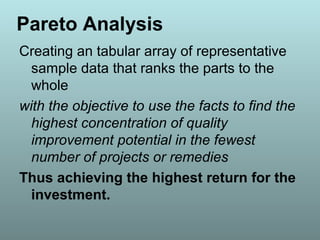
Pareto Analysis
Creating an tabular array of representative
sample data that ranks the parts to the
whole
with the objective to use the facts to find the
highest concentration of quality
improvement potential in the fewest
number of projects or remedies
Thus achieving the highest return for the
investment.
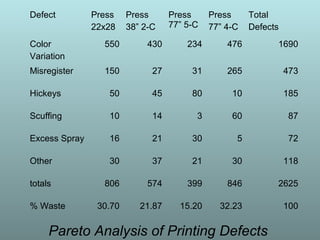
Defect Press
22x28
Press
38” 2-C
Press
77” 5-C
Press
77” 4-C
Total
Defects
Color
Variation
550 430 234 476 1690
Misregister 150 27 31 265 473
Hickeys 50 45 80 10 185
Scuffing 10 14 3 60 87
Excess Spray 16 21 30 5 72
Other 30 37 21 30 118
totals 806 574 399 846 2625
% Waste 30.70 21.87 15.20 32.23 100
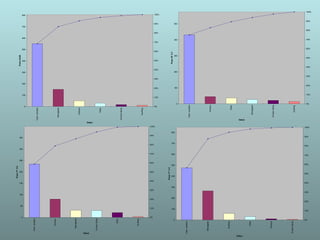
Pareto Analysis of Printing Defects
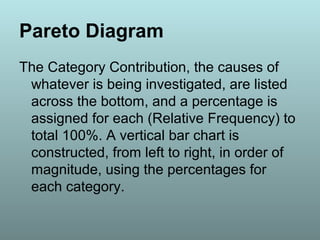
Pareto Diagram
The Category Contribution, the causes of
whatever is being investigated, are listed
across the bottom, and a percentage is
assigned for each (Relative Frequency) to
total 100%. A vertical bar chart is
constructed, from left to right, in order of
magnitude, using the percentages for
each category.
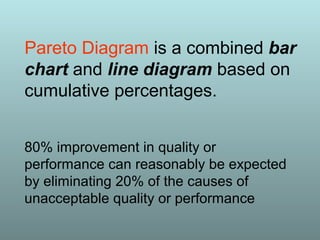
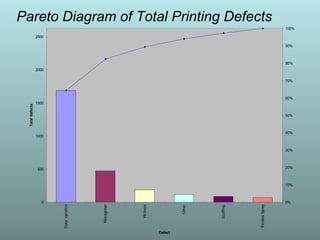
Pareto Diagram is a combined bar
chart and line diagram based on
cumulative percentages.
80% improvement in quality or
performance can reasonably be expected
by eliminating 20% of the causes of
unacceptable quality or performance
Pareto Diagram of Total Printing Defects
0
500
1000
1500
2000
2500
Colorvariation
Misregister
Hickeys
Other
Scuffing
ExcessSpray
Defect
Totaldefects
0%
10%
20%
30%
40%
50%
60%
70%
80%
90%
100%
0
100
200
300
400
500
600
700
800
Colorvariation
Misregister
Hickeys
Other
ExcessSpray
Scuffing
Defect
Press22x28
0%
10%
20%
30%
40%
50%
60%
70%
80%
90%
100%
0
100
200
300
400
500
Colorvariation
Hickeys
Other
Misregister
ExcessSpray
Scuffing
Defect
Press38'2-C
0%
10%
20%
30%
40%
50%
60%
70%
80%
90%
100%
0
50
100
150
200
250
300
350
Colorvariation
Hickeys
Misregister
ExcessSpray
Other
Scuffing
Defect
Press77"5-C
0%
10%
20%
30%
40%
50%
60%
70%
80%
90%
100%
0
100
200
300
400
500
600
700
800
Colorvariation
Misregister
Scuffing
Other
Hickeys
ExcessSpray
Defect
Press77"4-C
0%
10%
20%
30%
40%
50%
60%
70%
80%
90%
100%
Relative Frequency
[(Category Contribution) / (Total of all
Categories)] x 100 expressed in bar chart
form.
Cumulative Frequency
[(Relative Frequency of Category
Contribution) + (Previous Cumulative
Frequency)] expressed as a line graph
Break Point
The percentage point on the line graph for
Cumulative Frequency at which there is a
significant decrease in the slope of the
plotted line
Vital Few
Category Contributions that appear to the
left of the Break Point account for the bulk
of the effect
Trivial Many
Category Contributions that appear to the
right of the Break Point, which account for
the least of the effect.
Pareto Diagram Analysis
• Pareto analysis provides the mechanism
to control and direct effort by fact, not by
emotion.
• It helps to clearly establish top priorities
and to identify both profitable and
unprofitable targets.
• In addition to selecting and defining
key quality improvement programs:
• Prioritize problems, goals, and objectives
• Identify root causes
• Select key customer relations and service programs
• Select key employee relations improvement
programs
• Select and define key performance improvement
programs
• Address the Vital Few and the Trivial Many causes
of nonconformance
• Maximize research and product development time
• Verify operating procedures and manufacturing
processes
• Product or services sales and distribution
• Allocate physical, financial and human resources
The value of the Pareto Principle is
that it focuses efforts on the 20 percent
that matters.
Of the things you do during your day,
only 20 percent really matter. Those
20 percent produce 80 percent of your
results.
Identify and focus on those things.
For a General Manager
To Create a Pareto Chart:
Select the items (problems, issues, actions,
defects, etc.) to be compared.
Select a standard for measurement.
Gather necessary data
Arrange the items on the horizontal axis in a
descending order according to the
measurements you selected.
Draw a bar graph where the height is the
measurement you selected.

Pareto chart importance & making

  • 1.
    Pareto Principle “The VitalFew and Trivial Many Rule” “Predictable Imbalance” “80:20 Rule”
  • 2.
    Named after VilfredoPareto -an Italian economist •He observed in 1906 that 20% of the Italian population owned 80% of Italy's wealth •He then noticed that 20% of the pea pods in his garden accounted for 80% of his pea crop each year
  • 3.
    The Pareto Principle •A small number of causes is responsible for a large percentage of the effect- -usually a 20-percent to 80-percent ratio. • This basic principle translates well into quality problems - most quality problems result from a small number of causes. • You can apply this ratio to almost anything, from the science of management to the physical world
  • 4.
    Addressing the mosttroublesome 20% of the problem will solve 80% of it. Within your process, 20% of the individuals will cause 80% of your headaches. Of all the solutions you identify, about 20% are likely to remain viable after adequate analysis. 80% of the work is usually done by 20% of the people.
  • 5.
    80% of thequality can be gotten in 20% of the time -- perfection takes 5 times longer 20% of the defects cause 80% of the problems. Project Managers know that 20% of the work (the first 10% and the last 10%) consume 80% of the time and resources.
  • 6.
    A Pareto chartis a useful tool for graphically depicting these and other relationships It is a simple Histogram style graph that ranks problems in order of magnitude to determine the priorities for improvement activities The goal is to target the largest potential improvement area then move on to the next, then next, and in so doing address the area of most benefit first The chart can help show you where allocating time, human, and financial resources will yield the best results.
  • 7.
    While the ruleis not an absolute, one should use it as a guide and reference point to ask whether or not you are truly focusing on: 20% - The Vital Few or 80% - The Trivial Many True progress results from a consistent focus on the 20% most critical objectives. the
  • 8.
    The simplicity ofthe Pareto concept makes it prone to be underestimated and overlooked as a key tool for quality improvement. Generally, individuals tend to think they know the important problem areas requiring attention…… if they really know, why do problem areas still exist?
  • 9.
    Although the ideais quite simple, to gain a working knowledge of the Pareto Principle and its application, it is necessary to understand the following basic elements:
  • 10.
    Pareto Analysis Creating antabular array of representative sample data that ranks the parts to the whole with the objective to use the facts to find the highest concentration of quality improvement potential in the fewest number of projects or remedies Thus achieving the highest return for the investment.
  • 11.
    Defect Press 22x28 Press 38” 2-C Press 77”5-C Press 77” 4-C Total Defects Color Variation 550 430 234 476 1690 Misregister 150 27 31 265 473 Hickeys 50 45 80 10 185 Scuffing 10 14 3 60 87 Excess Spray 16 21 30 5 72 Other 30 37 21 30 118 totals 806 574 399 846 2625 % Waste 30.70 21.87 15.20 32.23 100 Pareto Analysis of Printing Defects
  • 12.
    Pareto Diagram The CategoryContribution, the causes of whatever is being investigated, are listed across the bottom, and a percentage is assigned for each (Relative Frequency) to total 100%. A vertical bar chart is constructed, from left to right, in order of magnitude, using the percentages for each category.
  • 13.
    Pareto Diagram isa combined bar chart and line diagram based on cumulative percentages. 80% improvement in quality or performance can reasonably be expected by eliminating 20% of the causes of unacceptable quality or performance
  • 14.
    Pareto Diagram ofTotal Printing Defects 0 500 1000 1500 2000 2500 Colorvariation Misregister Hickeys Other Scuffing ExcessSpray Defect Totaldefects 0% 10% 20% 30% 40% 50% 60% 70% 80% 90% 100%
  • 15.
  • 16.
    Relative Frequency [(Category Contribution)/ (Total of all Categories)] x 100 expressed in bar chart form.
  • 17.
    Cumulative Frequency [(Relative Frequencyof Category Contribution) + (Previous Cumulative Frequency)] expressed as a line graph
  • 18.
    Break Point The percentagepoint on the line graph for Cumulative Frequency at which there is a significant decrease in the slope of the plotted line
  • 19.
    Vital Few Category Contributionsthat appear to the left of the Break Point account for the bulk of the effect
  • 20.
    Trivial Many Category Contributionsthat appear to the right of the Break Point, which account for the least of the effect.
  • 21.
    Pareto Diagram Analysis •Pareto analysis provides the mechanism to control and direct effort by fact, not by emotion. • It helps to clearly establish top priorities and to identify both profitable and unprofitable targets. • In addition to selecting and defining key quality improvement programs:
  • 22.
    • Prioritize problems,goals, and objectives • Identify root causes • Select key customer relations and service programs • Select key employee relations improvement programs • Select and define key performance improvement programs • Address the Vital Few and the Trivial Many causes of nonconformance • Maximize research and product development time • Verify operating procedures and manufacturing processes • Product or services sales and distribution • Allocate physical, financial and human resources
  • 23.
    The value ofthe Pareto Principle is that it focuses efforts on the 20 percent that matters. Of the things you do during your day, only 20 percent really matter. Those 20 percent produce 80 percent of your results. Identify and focus on those things. For a General Manager
  • 24.
    To Create aPareto Chart: Select the items (problems, issues, actions, defects, etc.) to be compared. Select a standard for measurement. Gather necessary data Arrange the items on the horizontal axis in a descending order according to the measurements you selected. Draw a bar graph where the height is the measurement you selected.