Parentese and Baby Talk
Abdulaziz B Assanosi
Prince Sattam ibn Abdulaziz University Saudi Arabia
Review
 What comes first: speech production or speech comprehension?
 The absence of utterance IS NOT indicator of to lack of language
knowledge, prove.
 What are the three cases of speech comprehension?
 Describe the relationship between production, thought and speech
comprehension?
 What are the characteristics of the language that directed to children?
25/08/37Abdulaziz B Assanosi. azizsanosi@gmail.com 2
Important Concepts
Before we starts there are two concepts to
understand:
Innatism
Input
25/08/37Abdulaziz B Assanosi. azizsanosi@gmail.com 3
Innatism
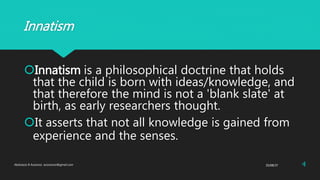
Innatism is a philosophical doctrine that holds
that the child is born with ideas/knowledge, and
that therefore the mind is not a 'blank slate' at
birth, as early researchers thought.
It asserts that not all knowledge is gained from
experience and the senses.
25/08/37Abdulaziz B Assanosi. azizsanosi@gmail.com 4
Innatism
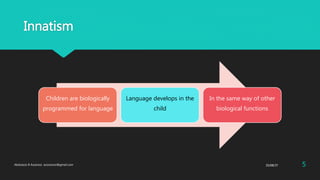
Children are biologically
programmed for language
Language develops in the
child
In the same way of other
biological functions
25/08/37Abdulaziz B Assanosi. azizsanosi@gmail.com 5
Innatism
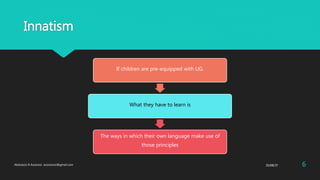
If children are pre-equipped with UG.
What they have to learn is
The ways in which their own language make use of
those principles
25/08/37Abdulaziz B Assanosi. azizsanosi@gmail.com 6
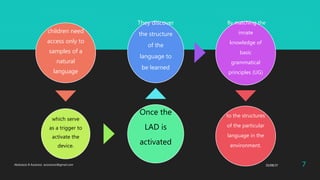
children need
access only to
samples of a
natural
language
which serve
as a trigger to
activate the
device.
Once the
LAD is
activated
They discover
the structure
of the
language to
be learned
By matching the
innate
knowledge of
basic
grammatical
principles (UG)
to the structures
of the particular
language in the
environment.
25/08/37Abdulaziz B Assanosi. azizsanosi@gmail.com 7
Characteristics of INPUT
Children “know” certain things of the language just by being
exposed to a limited number of samples.
 This sample is sometimes called (INPUT)
The language children are exposed to does not
contain examples of all the linguistic rules and
patterns.
In Psycholinguistics, it is called (motherese, or
parentese) language
25/08/37Abdulaziz B Assanosi. azizsanosi@gmail.com 8
Parentese
 The nature of the speech and environmental input which children receive
is essential for language learning.
 The input should be suitable and personal.
 Limited and impersonal input distort language acquisition.
 Parentese is [the sort of speech that children receive when they are young]
 Parentese [mothese – caregiver speech – child-directed speech] has
special characteristics.
25/08/37Abdulaziz B Assanosi. azizsanosi@gmail.com 9
Characteristics of Parentese
1. Immediacy and Concreteness:
Parents talk to their children about things related to
their immediate environment.
These include their human needs [food-drinks-
cleaning]
They include things around them [clothes-toys-pets]
This feature is called immediacy.
I m m e d i a c y a n d c o n c r e t e n e s s
25/08/37 10Abdulaziz B Assanosi. azizsanosi@gmail.com
Characteristics of Parentese
1. Immediacy and Concreteness:
Parentese is also about concrete things.
Parents talk about things that children can touch,hear
Abstract things are not included in parentese [pride-
anger-change-development-hope-history or future]
This make it easy to children to realize language.
I m m e d i a c y a n d c o n c r e t e n e s s
25/08/37 11Abdulaziz B Assanosi. azizsanosi@gmail.com
Characteristics of Parentese
 2- Grammaticality of input
 The speech directed to children is grammatical and simplified.
 Parents do not use ungrammatical sentences.
 Grammaticality help children to discover and apply structures that
govern sentences.
 There are rare cases where ungrammatical sentences occur.
 This doesn’t affect the acquisition of language by children.
G r a m m a t i c a l i t y o f i n p u t
25/08/37Abdulaziz B Assanosi. azizsanosi@gmail.com 12
Characteristics of Parentese
2- Grammaticality of input
Parents sometimes commit mistakes while they are
talking. (slips of the tongue).
Children do not imitate these mistakes and they are
not influenced by them.
This was a further evidence that support innatess
theory.
G r a m m a t i c a l i t y o f i n p u t
25/08/37 13Abdulaziz B Assanosi. azizsanosi@gmail.com
Characteristics of Parentese
3- Short Sentences and Simple Structures:
Parents use simple sentences when they talk to children
[Subject,Verb,Object]
Compound and complex sentences are not found in parentese.
The cat drank milk.
The cat which you like drank milk.
That the cat drink milk is a good thing to see.
S h o r t & S i m p l e S e n t e n c e s
25/08/37Abdulaziz B Assanosi. azizsanosi@gmail.com 14
Characteristics of Parentese
4- Short and simple Vocabulary:
Parents use simple words when they talk to children [common
words]
Technical, formal and scientific words are not found in
parentese.
Give / provide.
See / notice
Hard / tough
S h o r t & S i m p l e V o c a b u l a r y
25/08/37 15Abdulaziz B Assanosi. azizsanosi@gmail.com
Characteristics of Parentese
4- Short and simple Vocabulary:
Parents also use simplified phonology and structure of
words.
byebye not good bye
wawa not water
mama not mother
granma not grandmother
S h o r t & S i m p l e V o c a b u l a r y
25/08/37 16Abdulaziz B Assanosi. azizsanosi@gmail.com
Characteristics of Parentese
5- Exaggerated phonology:
This include exaggerate intonation.. Slow tempo ..
And high pitch.
Stress is sometimes overused to make children
understand.
Pauses are also used repeatedly to enable children to
follow the parents’ speech.
E x a g g e r a t e d p h o n o l o g y
25/08/37Abdulaziz B Assanosi. azizsanosi@gmail.com 17
Characteristics of Parentese
5- Exaggerated phonology:
These feature are used more with younger children.
The language that is directed to 2-year-old child is
different from that which is directed to 6-year-old.
Example of parentese….
E x a g g e r a t e d p h o n o l o g y
25/08/37Abdulaziz B Assanosi. azizsanosi@gmail.com 18
Checkpoint
 Define [perentese].
 Name other terms used to indicate parentese.
 What are the features of parentese?
 Why should parentese be immediate and concrete?
 Explain the crammatical status of parentese
 Describe the vocabulary of parentese.
 Explain the phonology of parentese
25/08/37Abdulaziz B Assanosi. azizsanosi@gmail.com 19
Example of parentese / baby talk
First I saw the white bear, then I saw the black bear then I
saw the camel with a hump on his black then I saw the
gray wolf with muttin in his ma that is his mouth. Then I
saw the one bat waddle in the stra yes waddling along.
Then I saw the elephant and waving of his trunk. Yes the
elephant waves his trunk. Then I saw the monkeys, mercy
how unpleasantly they smelt. Yak, monkeys smelly.
25/08/37Abdulaziz B Assanosi. azizsanosi@gmail.com 20
Baby talk
It is a form of parentese, but it contained an overly
simplified vocabulary and syntax.
Originally baby talk is taken from children language.
Some children words are standardized as vocabulary
from baby talk.
Each language and culture has its own language and
vocabulary.
25/08/37Abdulaziz B Assanosi. azizsanosi@gmail.com 21
Baby talk
Parents use this language to make speech easy-to-
understand for children.
It is also used to build relationships between parents and
children.
It is used by children to speak to younger children.
These words are transmitted over generations.
Baby talk influence vocabulary and syntax.
25/08/37Abdulaziz B Assanosi. azizsanosi@gmail.com 22
Baby talk
1- Vocabulary:
Generally, words are modified to suit children abilities.
Then they are used by parents.
Sometimes they imitate the sounds made by the entity it refers
to [ bow-wow] for dog [mow for cat] [choo-choo] for train [vurr
vurr] for car.
Sometimes baby talk vocabulary are formed by adding [ie] to
the end of the word like [kitty, ducky, horsey]
25/08/37Abdulaziz B Assanosi. azizsanosi@gmail.com 23
Baby talk
1- vocabulary:
Most baby talk word are formed by duplication of
specific syllable of words [da da, baba, mama, dodo,
dum dum]
This feature is universal [found in every world
language] can you provide example/s from Arabic?
dum-dum
25/08/37Abdulaziz B Assanosi. azizsanosi@gmail.com 24
Baby talk
2- Syntax:
Syntax is less important in baby talk.
Parents use speech that looks like
telegraphic speech [remember the
characteristics of telegraphic speech?]
Names are used instead of personal
pronouns. [mummy love Charlie, instead
of [I love you].
Fixed proper nouns are easier than
pronouns
[ I ] is confusing
because every one
uses it !!!!, and who is
SHE !! How many HEs
in Charlie’s family!!!]
25/08/37Abdulaziz B Assanosi. azizsanosi@gmail.com 25
Baby talk
3- Topics:
Generally, baby talk is about specific topics:
The usual topics are: (members of the family, animals, parts of the
body, food, and clothing].
These topic are interesting to babies.
Conversations with children are mostly about the present and
the here-and-now, rather than topics pertaining to another
time, past or future.
25/08/37Abdulaziz B Assanosi. azizsanosi@gmail.com 26
Baby talk
1- Examples:
A Peke, the ickle angel pet, wiv his gweat big soulful eyes
and his ickle black nosie — oh so ducky-duck!.
Pekke, the little angel pet, waved his great big soulful
eyes and his little black nose. Oh what a great duck!!
25/08/37Abdulaziz B Assanosi. azizsanosi@gmail.com 27
Imitation
Imitation is important, but language is not learned by imitation
only.
Imitation can apply only to speech production [not
comprehension].
Therefor, imitation is not involved in primary language learning.
Children cannot imitate rules [because rules are abstract and
cannot be copied] they imitate the output only.
25/08/37Abdulaziz B Assanosi. azizsanosi@gmail.com 28
productivity by rule
Imitation can not explain utterances like: [ foots*, tooths*,
goed*, drived*] or [what we can do?*] [she is eating what]
This is called [productivity by rule] children formulated
rules in their minds, and helearns exception to the rules
later.
Some times children may even produce words like
wented* - droved*
25/08/37Abdulaziz B Assanosi. azizsanosi@gmail.com 29
Terminus
What are the characteristics of baby talk vocabulary?
Where do baby talk originated from?
Describe the syntax of baby talk?
What is the role of imitation in language learning: in details?
Why do children sometimes produce structures like [writed.
Sleeped and sheeps]. 25/08/37Abdulaziz B Assanosi. azizsanosi@gmail.com 30
Thank you
 This presentation is for classroom usage, it contains gaps to be filled by classroom discussion. For
more detailed information, consult the reference book:
 An introduction to Psycholinguistics, second edition (2006)Danny Steinberg and Natalia, Sciarini.
 The audio file for the [example of parentese and baby talk] is available on blackboard.
25/08/37Abdulaziz B Assanosi. azizsanosi@gmail.com 31

Parentese and Baby Talk

  • 1.
    Parentese and BabyTalk Abdulaziz B Assanosi Prince Sattam ibn Abdulaziz University Saudi Arabia
  • 2.
    Review  What comesfirst: speech production or speech comprehension?  The absence of utterance IS NOT indicator of to lack of language knowledge, prove.  What are the three cases of speech comprehension?  Describe the relationship between production, thought and speech comprehension?  What are the characteristics of the language that directed to children? 25/08/37Abdulaziz B Assanosi. azizsanosi@gmail.com 2
  • 3.
    Important Concepts Before westarts there are two concepts to understand: Innatism Input 25/08/37Abdulaziz B Assanosi. azizsanosi@gmail.com 3
  • 4.
    Innatism Innatism is aphilosophical doctrine that holds that the child is born with ideas/knowledge, and that therefore the mind is not a 'blank slate' at birth, as early researchers thought. It asserts that not all knowledge is gained from experience and the senses. 25/08/37Abdulaziz B Assanosi. azizsanosi@gmail.com 4
  • 5.
    Innatism Children are biologically programmedfor language Language develops in the child In the same way of other biological functions 25/08/37Abdulaziz B Assanosi. azizsanosi@gmail.com 5
  • 6.
    Innatism If children arepre-equipped with UG. What they have to learn is The ways in which their own language make use of those principles 25/08/37Abdulaziz B Assanosi. azizsanosi@gmail.com 6
  • 7.
    children need access onlyto samples of a natural language which serve as a trigger to activate the device. Once the LAD is activated They discover the structure of the language to be learned By matching the innate knowledge of basic grammatical principles (UG) to the structures of the particular language in the environment. 25/08/37Abdulaziz B Assanosi. azizsanosi@gmail.com 7
  • 8.
    Characteristics of INPUT Children“know” certain things of the language just by being exposed to a limited number of samples.  This sample is sometimes called (INPUT) The language children are exposed to does not contain examples of all the linguistic rules and patterns. In Psycholinguistics, it is called (motherese, or parentese) language 25/08/37Abdulaziz B Assanosi. azizsanosi@gmail.com 8
  • 9.
    Parentese  The natureof the speech and environmental input which children receive is essential for language learning.  The input should be suitable and personal.  Limited and impersonal input distort language acquisition.  Parentese is [the sort of speech that children receive when they are young]  Parentese [mothese – caregiver speech – child-directed speech] has special characteristics. 25/08/37Abdulaziz B Assanosi. azizsanosi@gmail.com 9
  • 10.
    Characteristics of Parentese 1.Immediacy and Concreteness: Parents talk to their children about things related to their immediate environment. These include their human needs [food-drinks- cleaning] They include things around them [clothes-toys-pets] This feature is called immediacy. I m m e d i a c y a n d c o n c r e t e n e s s 25/08/37 10Abdulaziz B Assanosi. azizsanosi@gmail.com
  • 11.
    Characteristics of Parentese 1.Immediacy and Concreteness: Parentese is also about concrete things. Parents talk about things that children can touch,hear Abstract things are not included in parentese [pride- anger-change-development-hope-history or future] This make it easy to children to realize language. I m m e d i a c y a n d c o n c r e t e n e s s 25/08/37 11Abdulaziz B Assanosi. azizsanosi@gmail.com
  • 12.
    Characteristics of Parentese 2- Grammaticality of input  The speech directed to children is grammatical and simplified.  Parents do not use ungrammatical sentences.  Grammaticality help children to discover and apply structures that govern sentences.  There are rare cases where ungrammatical sentences occur.  This doesn’t affect the acquisition of language by children. G r a m m a t i c a l i t y o f i n p u t 25/08/37Abdulaziz B Assanosi. azizsanosi@gmail.com 12
  • 13.
    Characteristics of Parentese 2-Grammaticality of input Parents sometimes commit mistakes while they are talking. (slips of the tongue). Children do not imitate these mistakes and they are not influenced by them. This was a further evidence that support innatess theory. G r a m m a t i c a l i t y o f i n p u t 25/08/37 13Abdulaziz B Assanosi. azizsanosi@gmail.com
  • 14.
    Characteristics of Parentese 3-Short Sentences and Simple Structures: Parents use simple sentences when they talk to children [Subject,Verb,Object] Compound and complex sentences are not found in parentese. The cat drank milk. The cat which you like drank milk. That the cat drink milk is a good thing to see. S h o r t & S i m p l e S e n t e n c e s 25/08/37Abdulaziz B Assanosi. azizsanosi@gmail.com 14
  • 15.
    Characteristics of Parentese 4-Short and simple Vocabulary: Parents use simple words when they talk to children [common words] Technical, formal and scientific words are not found in parentese. Give / provide. See / notice Hard / tough S h o r t & S i m p l e V o c a b u l a r y 25/08/37 15Abdulaziz B Assanosi. azizsanosi@gmail.com
  • 16.
    Characteristics of Parentese 4-Short and simple Vocabulary: Parents also use simplified phonology and structure of words. byebye not good bye wawa not water mama not mother granma not grandmother S h o r t & S i m p l e V o c a b u l a r y 25/08/37 16Abdulaziz B Assanosi. azizsanosi@gmail.com
  • 17.
    Characteristics of Parentese 5-Exaggerated phonology: This include exaggerate intonation.. Slow tempo .. And high pitch. Stress is sometimes overused to make children understand. Pauses are also used repeatedly to enable children to follow the parents’ speech. E x a g g e r a t e d p h o n o l o g y 25/08/37Abdulaziz B Assanosi. azizsanosi@gmail.com 17
  • 18.
    Characteristics of Parentese 5-Exaggerated phonology: These feature are used more with younger children. The language that is directed to 2-year-old child is different from that which is directed to 6-year-old. Example of parentese…. E x a g g e r a t e d p h o n o l o g y 25/08/37Abdulaziz B Assanosi. azizsanosi@gmail.com 18
  • 19.
    Checkpoint  Define [perentese]. Name other terms used to indicate parentese.  What are the features of parentese?  Why should parentese be immediate and concrete?  Explain the crammatical status of parentese  Describe the vocabulary of parentese.  Explain the phonology of parentese 25/08/37Abdulaziz B Assanosi. azizsanosi@gmail.com 19
  • 20.
    Example of parentese/ baby talk First I saw the white bear, then I saw the black bear then I saw the camel with a hump on his black then I saw the gray wolf with muttin in his ma that is his mouth. Then I saw the one bat waddle in the stra yes waddling along. Then I saw the elephant and waving of his trunk. Yes the elephant waves his trunk. Then I saw the monkeys, mercy how unpleasantly they smelt. Yak, monkeys smelly. 25/08/37Abdulaziz B Assanosi. azizsanosi@gmail.com 20
  • 21.
    Baby talk It isa form of parentese, but it contained an overly simplified vocabulary and syntax. Originally baby talk is taken from children language. Some children words are standardized as vocabulary from baby talk. Each language and culture has its own language and vocabulary. 25/08/37Abdulaziz B Assanosi. azizsanosi@gmail.com 21
  • 22.
    Baby talk Parents usethis language to make speech easy-to- understand for children. It is also used to build relationships between parents and children. It is used by children to speak to younger children. These words are transmitted over generations. Baby talk influence vocabulary and syntax. 25/08/37Abdulaziz B Assanosi. azizsanosi@gmail.com 22
  • 23.
    Baby talk 1- Vocabulary: Generally,words are modified to suit children abilities. Then they are used by parents. Sometimes they imitate the sounds made by the entity it refers to [ bow-wow] for dog [mow for cat] [choo-choo] for train [vurr vurr] for car. Sometimes baby talk vocabulary are formed by adding [ie] to the end of the word like [kitty, ducky, horsey] 25/08/37Abdulaziz B Assanosi. azizsanosi@gmail.com 23
  • 24.
    Baby talk 1- vocabulary: Mostbaby talk word are formed by duplication of specific syllable of words [da da, baba, mama, dodo, dum dum] This feature is universal [found in every world language] can you provide example/s from Arabic? dum-dum 25/08/37Abdulaziz B Assanosi. azizsanosi@gmail.com 24
  • 25.
    Baby talk 2- Syntax: Syntaxis less important in baby talk. Parents use speech that looks like telegraphic speech [remember the characteristics of telegraphic speech?] Names are used instead of personal pronouns. [mummy love Charlie, instead of [I love you]. Fixed proper nouns are easier than pronouns [ I ] is confusing because every one uses it !!!!, and who is SHE !! How many HEs in Charlie’s family!!!] 25/08/37Abdulaziz B Assanosi. azizsanosi@gmail.com 25
  • 26.
    Baby talk 3- Topics: Generally,baby talk is about specific topics: The usual topics are: (members of the family, animals, parts of the body, food, and clothing]. These topic are interesting to babies. Conversations with children are mostly about the present and the here-and-now, rather than topics pertaining to another time, past or future. 25/08/37Abdulaziz B Assanosi. azizsanosi@gmail.com 26
  • 27.
    Baby talk 1- Examples: APeke, the ickle angel pet, wiv his gweat big soulful eyes and his ickle black nosie — oh so ducky-duck!. Pekke, the little angel pet, waved his great big soulful eyes and his little black nose. Oh what a great duck!! 25/08/37Abdulaziz B Assanosi. azizsanosi@gmail.com 27
  • 28.
    Imitation Imitation is important,but language is not learned by imitation only. Imitation can apply only to speech production [not comprehension]. Therefor, imitation is not involved in primary language learning. Children cannot imitate rules [because rules are abstract and cannot be copied] they imitate the output only. 25/08/37Abdulaziz B Assanosi. azizsanosi@gmail.com 28
  • 29.
    productivity by rule Imitationcan not explain utterances like: [ foots*, tooths*, goed*, drived*] or [what we can do?*] [she is eating what] This is called [productivity by rule] children formulated rules in their minds, and helearns exception to the rules later. Some times children may even produce words like wented* - droved* 25/08/37Abdulaziz B Assanosi. azizsanosi@gmail.com 29
  • 30.
    Terminus What are thecharacteristics of baby talk vocabulary? Where do baby talk originated from? Describe the syntax of baby talk? What is the role of imitation in language learning: in details? Why do children sometimes produce structures like [writed. Sleeped and sheeps]. 25/08/37Abdulaziz B Assanosi. azizsanosi@gmail.com 30
  • 31.
    Thank you  Thispresentation is for classroom usage, it contains gaps to be filled by classroom discussion. For more detailed information, consult the reference book:  An introduction to Psycholinguistics, second edition (2006)Danny Steinberg and Natalia, Sciarini.  The audio file for the [example of parentese and baby talk] is available on blackboard. 25/08/37Abdulaziz B Assanosi. azizsanosi@gmail.com 31