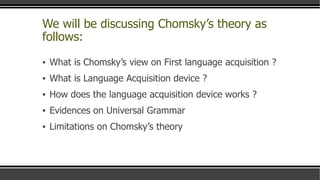
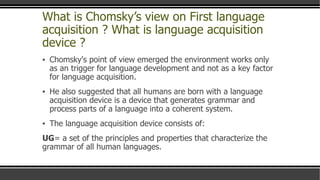
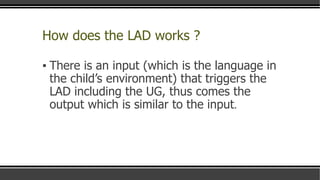
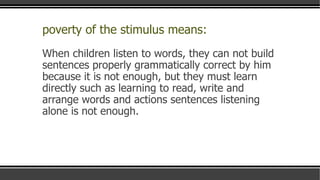
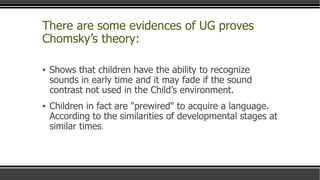
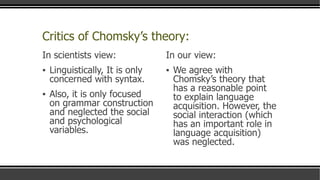
Chomsky's theory of language acquisition proposes that humans are born with an innate language acquisition device (LAD) that contains a universal grammar (UG). The LAD allows children to learn language by triggering the UG in response to linguistic input from their environment. According to Chomsky, the linguistic environment alone is not sufficient for language learning, and children must rely on an innate, biological predisposition to acquire language. Evidence for Chomsky's theory includes similarities in children's developmental stages and their ability to distinguish sounds not present in their native language. However, critics argue that Chomsky's theory neglects the important role of social interaction and psychological factors in language acquisition.



![nomchomsky ....manisha pandey - Copy [Autosaved]_1 (1).pptx](https://cdn.slidesharecdn.com/ss_thumbnails/nomchomsky-250121051926-3c44f025-thumbnail.jpg?width=640&height=640&fit=bounds)


![Theories Of Language Acquisition[1]](https://cdn.slidesharecdn.com/ss_thumbnails/theories-of-language-acquisition1-1225480010904742-8-thumbnail.jpg?width=640&height=640&fit=bounds)
![Theories%20of%20 Language%20 Acquisition[1]](https://cdn.slidesharecdn.com/ss_thumbnails/theories20of20language20acquisition1-1225479043858786-9-thumbnail.jpg?width=640&height=640&fit=bounds)
![Theories Of Language Acquisition[1]](https://cdn.slidesharecdn.com/ss_thumbnails/theories-of-language-acquisition1-1225479040063582-9-thumbnail.jpg?width=640&height=640&fit=bounds)


