1
1
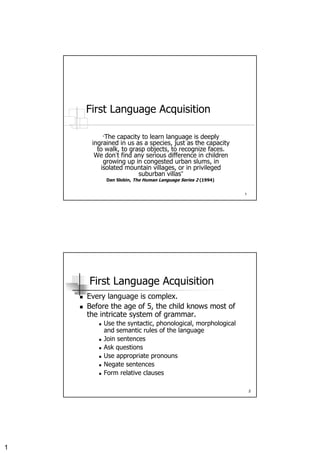
First Language Acquisition
“The capacity to learn language is deeply
ingrained in us as a species, just as the capacity
to walk, to grasp objects, to recognize faces.
We don’t find any serious difference in children
growing up in congested urban slums, in
isolated mountain villages, or in privileged
suburban villas”
Dan Slobin, The Human Language Series 2 (1994)
2
First Language Acquisition
Every language is complex.
Before the age of 5, the child knows most of
the intricate system of grammar.
Use the syntactic, phonological, morphological
and semantic rules of the language
Join sentences
Ask questions
Use appropriate pronouns
Negate sentences
Form relative clauses
2
3
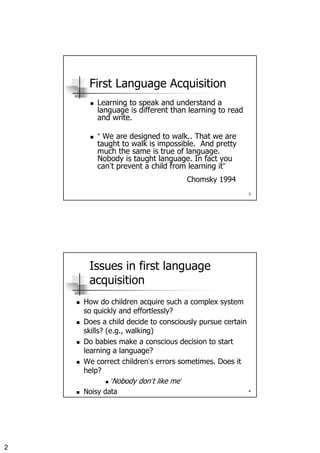
First Language Acquisition
Learning to speak and understand a
language is different than learning to read
and write.
“ We are designed to walk.. That we are
taught to walk is impossible. And pretty
much the same is true of language.
Nobody is taught language. In fact you
can’t prevent a child from learning it”
Chomsky 1994
4
Issues in first language
acquisition
How do children acquire such a complex system
so quickly and effortlessly?
Does a child decide to consciously pursue certain
skills? (e.g., walking)
Do babies make a conscious decision to start
learning a language?
We correct children’s errors sometimes. Does it
help?
‘Nobody don’t like me’
Noisy data
3
5
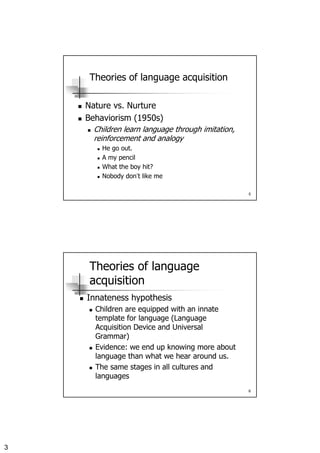
Theories of language acquisition
Nature vs. Nurture
Behaviorism (1950s)
Children learn language through imitation,
reinforcement and analogy
He go out.
A my pencil
What the boy hit?
Nobody don’t like me
6
Theories of language
acquisition
Innateness hypothesis
Children are equipped with an innate
template for language (Language
Acquisition Device and Universal
Grammar)
Evidence: we end up knowing more about
language than what we hear around us.
The same stages in all cultures and
languages
4
7
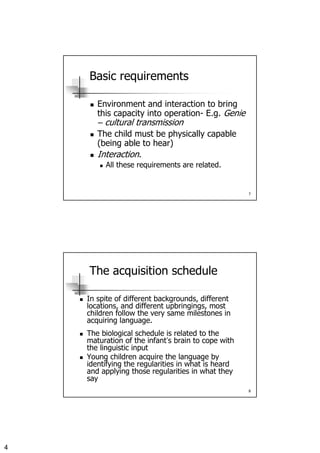
Basic requirements
Environment and interaction to bring
this capacity into operation- E.g. Genie
– cultural transmission
The child must be physically capable
(being able to hear)
Interaction.
All these requirements are related.
8
The acquisition schedule
In spite of different backgrounds, different
locations, and different upbringings, most
children follow the very same milestones in
acquiring language.
The biological schedule is related to the
maturation of the infant’s brain to cope with
the linguistic input
Young children acquire the language by
identifying the regularities in what is heard
and applying those regularities in what they
say
5
9
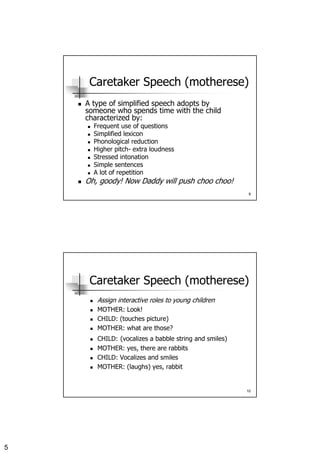
Caretaker Speech (motherese)
A type of simplified speech adopts by
someone who spends time with the child
characterized by:
Frequent use of questions
Simplified lexicon
Phonological reduction
Higher pitch- extra loudness
Stressed intonation
Simple sentences
A lot of repetition
Oh, goody! Now Daddy will push choo choo!
10
Caretaker Speech (motherese)
Assign interactive roles to young children
MOTHER: Look!
CHILD: (touches picture)
MOTHER: what are those?
CHILD: (vocalizes a babble string and smiles)
MOTHER: yes, there are rabbits
CHILD: Vocalizes and smiles
MOTHER: (laughs) yes, rabbit
6
11
L1 acquisition
sentence structures of lexical
words no functional or
grammatical morphemes
24-30
months
Telegraphic stage
"mini-sentences" with
simple semantic relations
18-20
months
Two-word stage
Single open-class words or
word stems
12-18
months
One-word stage
Grammatical or functional
structures emerge
30+
months
Later multiword stage
Repetitive CV patterns6-10
months
babbling
Vowel-like sounds3-5
months
cooing
descriptionTypical
age
Stage
12
Cooing
Few weeks: cooing and gurgling, playing with
sounds. Their abilities are constrained by
physiological limitations
They seem to be discovering phonemes at this point.
Producing sequences of vowel-like sounds- high
vowels [i] and [u].
4 months- sounds similar to velar consonants [k] &
[g]
5 months: distinguish between [a] and [i] and the
syllables [ba] and [ga], so their perception skills are
good.
7
13
Babbling
Different vowels and consonants ba-ba-ba and ga-ga-
ga
9-10 months- intonation patterns and combination of
ba-ba-ba-da-da
Nasal sounds also appear ma-ma-ma
10-11- use of vocalization to express emotions
Late stage- complex syllable combination (ma-da-ga-
ba)
Even deaf children babble
The most common cross-linguistic sounds and patterns
babbled the most, but later on they babble less
common sounds
14
The word stage (holophrastic)
Single terms are uttered for everyday objects
‘milk’, ‘cookie’, ‘cat’
Produce utterance such as ‘Sara bed’ but not
yet capable of producing a phrase.
Differ from adult language
[da] dog
[sa] sock
[aj] light
[daw] down
Convey a more complex message
8
15
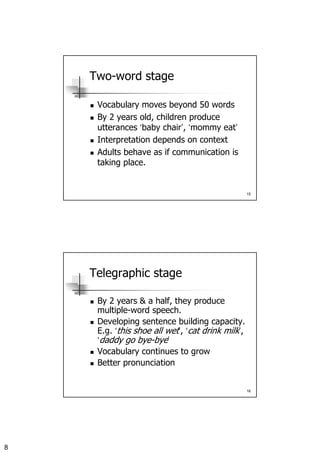
Two-word stage
Vocabulary moves beyond 50 words
By 2 years old, children produce
utterances ‘baby chair’, ‘mommy eat’
Interpretation depends on context
Adults behave as if communication is
taking place.
16
Telegraphic stage
By 2 years & a half, they produce
multiple-word speech.
Developing sentence building capacity.
E.g. ‘this shoe all wet’, ‘cat drink milk’,
‘daddy go bye-bye’
Vocabulary continues to grow
Better pronunciation
9
17
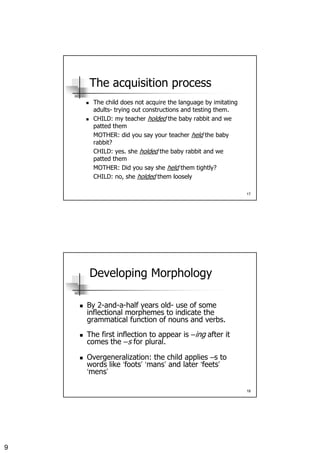
The acquisition process
The child does not acquire the language by imitating
adults- trying out constructions and testing them.
CHILD: my teacher holded the baby rabbit and we
patted them
MOTHER: did you say your teacher held the baby
rabbit?
CHILD: yes. she holded the baby rabbit and we
patted them
MOTHER: Did you say she held them tightly?
CHILD: no, she holded them loosely
18
Developing Morphology
By 2-and-a-half years old- use of some
inflectional morphemes to indicate the
grammatical function of nouns and verbs.
The first inflection to appear is –ing after it
comes the –s for plural.
Overgeneralization: the child applies –s to
words like ‘foots’ ‘mans’ and later ‘feets’
‘mens’
10
19
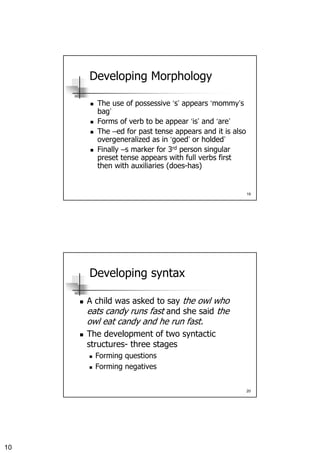
Developing Morphology
The use of possessive ‘s’ appears ‘mommy’s
bag’
Forms of verb to be appear ‘is’ and ‘are’
The –ed for past tense appears and it is also
overgeneralized as in ‘goed’ or holded’
Finally –s marker for 3rd person singular
preset tense appears with full verbs first
then with auxiliaries (does-has)
20
Developing syntax
A child was asked to say the owl who
eats candy runs fast and she said the
owl eat candy and he run fast.
The development of two syntactic
structures- three stages
Forming questions
Forming negatives
11
21
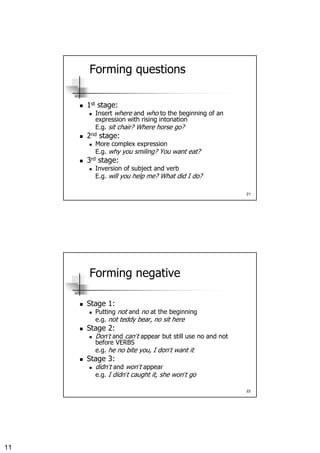
Forming questions
1st stage:
Insert where and who to the beginning of an
expression with rising intonation
E.g. sit chair? Where horse go?
2nd stage:
More complex expression
E.g. why you smiling? You want eat?
3rd stage:
Inversion of subject and verb
E.g. will you help me? What did I do?
22
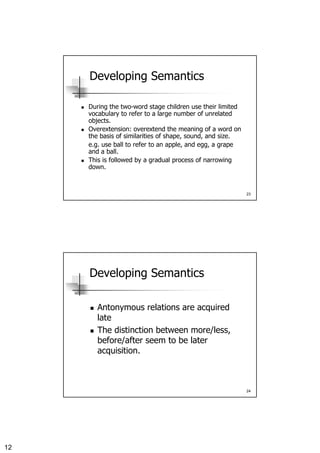
Forming negative
Stage 1:
Putting not and no at the beginning
e.g. not teddy bear, no sit here
Stage 2:
Don’t and can’t appear but still use no and not
before VERBS
e.g. he no bite you, I don’t want it
Stage 3:
didn’t and won’t appear
e.g. I didn’t caught it, she won’t go
12
23
Developing Semantics
During the two-word stage children use their limited
vocabulary to refer to a large number of unrelated
objects.
Overextension: overextend the meaning of a word on
the basis of similarities of shape, sound, and size.
e.g. use ball to refer to an apple, and egg, a grape
and a ball.
This is followed by a gradual process of narrowing
down.
24
Developing Semantics
Antonymous relations are acquired
late
The distinction between more/less,
before/after seem to be later
acquisition.
13
25
Thank you
See you next class
Read chapter 15

First language acquisition

  • 1.
    1 1 First Language Acquisition “Thecapacity to learn language is deeply ingrained in us as a species, just as the capacity to walk, to grasp objects, to recognize faces. We don’t find any serious difference in children growing up in congested urban slums, in isolated mountain villages, or in privileged suburban villas” Dan Slobin, The Human Language Series 2 (1994) 2 First Language Acquisition Every language is complex. Before the age of 5, the child knows most of the intricate system of grammar. Use the syntactic, phonological, morphological and semantic rules of the language Join sentences Ask questions Use appropriate pronouns Negate sentences Form relative clauses
  • 2.
    2 3 First Language Acquisition Learningto speak and understand a language is different than learning to read and write. “ We are designed to walk.. That we are taught to walk is impossible. And pretty much the same is true of language. Nobody is taught language. In fact you can’t prevent a child from learning it” Chomsky 1994 4 Issues in first language acquisition How do children acquire such a complex system so quickly and effortlessly? Does a child decide to consciously pursue certain skills? (e.g., walking) Do babies make a conscious decision to start learning a language? We correct children’s errors sometimes. Does it help? ‘Nobody don’t like me’ Noisy data
  • 3.
    3 5 Theories of languageacquisition Nature vs. Nurture Behaviorism (1950s) Children learn language through imitation, reinforcement and analogy He go out. A my pencil What the boy hit? Nobody don’t like me 6 Theories of language acquisition Innateness hypothesis Children are equipped with an innate template for language (Language Acquisition Device and Universal Grammar) Evidence: we end up knowing more about language than what we hear around us. The same stages in all cultures and languages
  • 4.
    4 7 Basic requirements Environment andinteraction to bring this capacity into operation- E.g. Genie – cultural transmission The child must be physically capable (being able to hear) Interaction. All these requirements are related. 8 The acquisition schedule In spite of different backgrounds, different locations, and different upbringings, most children follow the very same milestones in acquiring language. The biological schedule is related to the maturation of the infant’s brain to cope with the linguistic input Young children acquire the language by identifying the regularities in what is heard and applying those regularities in what they say
  • 5.
    5 9 Caretaker Speech (motherese) Atype of simplified speech adopts by someone who spends time with the child characterized by: Frequent use of questions Simplified lexicon Phonological reduction Higher pitch- extra loudness Stressed intonation Simple sentences A lot of repetition Oh, goody! Now Daddy will push choo choo! 10 Caretaker Speech (motherese) Assign interactive roles to young children MOTHER: Look! CHILD: (touches picture) MOTHER: what are those? CHILD: (vocalizes a babble string and smiles) MOTHER: yes, there are rabbits CHILD: Vocalizes and smiles MOTHER: (laughs) yes, rabbit
  • 6.
    6 11 L1 acquisition sentence structuresof lexical words no functional or grammatical morphemes 24-30 months Telegraphic stage "mini-sentences" with simple semantic relations 18-20 months Two-word stage Single open-class words or word stems 12-18 months One-word stage Grammatical or functional structures emerge 30+ months Later multiword stage Repetitive CV patterns6-10 months babbling Vowel-like sounds3-5 months cooing descriptionTypical age Stage 12 Cooing Few weeks: cooing and gurgling, playing with sounds. Their abilities are constrained by physiological limitations They seem to be discovering phonemes at this point. Producing sequences of vowel-like sounds- high vowels [i] and [u]. 4 months- sounds similar to velar consonants [k] & [g] 5 months: distinguish between [a] and [i] and the syllables [ba] and [ga], so their perception skills are good.
  • 7.
    7 13 Babbling Different vowels andconsonants ba-ba-ba and ga-ga- ga 9-10 months- intonation patterns and combination of ba-ba-ba-da-da Nasal sounds also appear ma-ma-ma 10-11- use of vocalization to express emotions Late stage- complex syllable combination (ma-da-ga- ba) Even deaf children babble The most common cross-linguistic sounds and patterns babbled the most, but later on they babble less common sounds 14 The word stage (holophrastic) Single terms are uttered for everyday objects ‘milk’, ‘cookie’, ‘cat’ Produce utterance such as ‘Sara bed’ but not yet capable of producing a phrase. Differ from adult language [da] dog [sa] sock [aj] light [daw] down Convey a more complex message
  • 8.
    8 15 Two-word stage Vocabulary movesbeyond 50 words By 2 years old, children produce utterances ‘baby chair’, ‘mommy eat’ Interpretation depends on context Adults behave as if communication is taking place. 16 Telegraphic stage By 2 years & a half, they produce multiple-word speech. Developing sentence building capacity. E.g. ‘this shoe all wet’, ‘cat drink milk’, ‘daddy go bye-bye’ Vocabulary continues to grow Better pronunciation
  • 9.
    9 17 The acquisition process Thechild does not acquire the language by imitating adults- trying out constructions and testing them. CHILD: my teacher holded the baby rabbit and we patted them MOTHER: did you say your teacher held the baby rabbit? CHILD: yes. she holded the baby rabbit and we patted them MOTHER: Did you say she held them tightly? CHILD: no, she holded them loosely 18 Developing Morphology By 2-and-a-half years old- use of some inflectional morphemes to indicate the grammatical function of nouns and verbs. The first inflection to appear is –ing after it comes the –s for plural. Overgeneralization: the child applies –s to words like ‘foots’ ‘mans’ and later ‘feets’ ‘mens’
  • 10.
    10 19 Developing Morphology The useof possessive ‘s’ appears ‘mommy’s bag’ Forms of verb to be appear ‘is’ and ‘are’ The –ed for past tense appears and it is also overgeneralized as in ‘goed’ or holded’ Finally –s marker for 3rd person singular preset tense appears with full verbs first then with auxiliaries (does-has) 20 Developing syntax A child was asked to say the owl who eats candy runs fast and she said the owl eat candy and he run fast. The development of two syntactic structures- three stages Forming questions Forming negatives
  • 11.
    11 21 Forming questions 1st stage: Insertwhere and who to the beginning of an expression with rising intonation E.g. sit chair? Where horse go? 2nd stage: More complex expression E.g. why you smiling? You want eat? 3rd stage: Inversion of subject and verb E.g. will you help me? What did I do? 22 Forming negative Stage 1: Putting not and no at the beginning e.g. not teddy bear, no sit here Stage 2: Don’t and can’t appear but still use no and not before VERBS e.g. he no bite you, I don’t want it Stage 3: didn’t and won’t appear e.g. I didn’t caught it, she won’t go
  • 12.
    12 23 Developing Semantics During thetwo-word stage children use their limited vocabulary to refer to a large number of unrelated objects. Overextension: overextend the meaning of a word on the basis of similarities of shape, sound, and size. e.g. use ball to refer to an apple, and egg, a grape and a ball. This is followed by a gradual process of narrowing down. 24 Developing Semantics Antonymous relations are acquired late The distinction between more/less, before/after seem to be later acquisition.
  • 13.
    13 25 Thank you See younext class Read chapter 15