PARENTERAL PRODUCTS
 DEFINITION
 TYPES
 ADVANTAGES & DISADVANTAGES
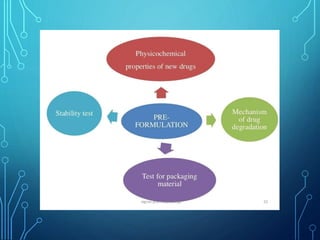
 PREFORMULATION FACTORS
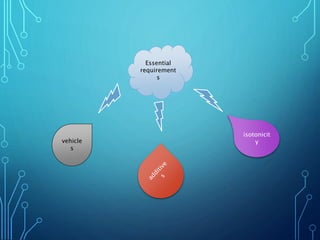
 ESSENTIAL REQUIREMENTS
INTRODUCTION
DEFINITION:
 The term parenteral has been derived from
greek word
 PARA ENTERON - outside the intestine
.
 Parenterals are sterile preparations intended for
administration under or through one or more layers
of skin or mucous memberane .
TYPES
 BASED ON FORMULATION
 INJECTIONS : It contains sterile solutions and
prepared by dissolving the active ingredient and
other substances in water for injection or other
suitable non aqueous base .
 INFUSIONS : These preparation are free from
bacterial endotoxins or pyrogens and are turned
isotonic with blood.
 POWDER FOR INJECTION :
These are solid compounds that are
distributed in their final volume when container or vital
are shaken to form a clear particle .
 CONCENTRATED SOLUTION FOR INJECTION:
These are diluted with water for injection
before injected through IV route .
 IMPLANTS :
The solid sterile preparations are implanted in
the tissue in order to release the active ingredient for
long periods .
 BASED ON DOSE
 SINGLE DOSE PREPARATIONS :
 These can be used only once .
 Contains sufficient quantity.
 Administration of volume specified on the
label
 MULTI DOSE PREPARATIONS :
 Multi dosing , chances of contamination is less
because it contains antimicrobial preservative
in appropriate conc.
 Preservative not exceed than 30ml .
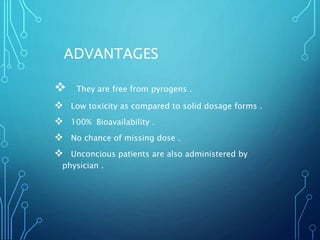
ADVANTAGES
 They are free from pyrogens .
 Low toxicity as compared to solid dosage forms .
 100% Bioavailability .
 No chance of missing dose .
 Unconcious patients are also administered by
physician .
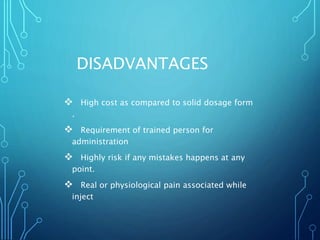
DISADVANTAGES
 High cost as compared to solid dosage form
.
 Requirement of trained person for
administration
 Highly risk if any mistakes happens at any
point.
 Real or physiological pain associated while
inject
Essential
requirement
s
vehicle
s
isotonicit
y
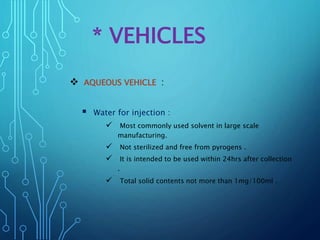
* VEHICLES
 AQUEOUS VEHICLE :
 Water for injection :
 Most commonly used solvent in large scale
manufacturing.
 Not sterilized and free from pyrogens .
 It is intended to be used within 24hrs after collection
.
 Total solid contents not more than 1mg/100ml .
 Sterile water for injection :
 It must be pyrogen free .
 Endotoxin level is not more than 0.25 USP .
 Single dose container not larger than 1 liter .
 Bacteriostatic water for injection :
 One or more suitable antimicrobial agents .
 It is packaged in prefilled syringes or in vials .
 Not more than 30 ml of water .
Non –Aqueous vehicle :
They should be .,
 Non-irritant .
 Non-toxic .
 Pharmacologically inert .
 Non-senstising .
 Metabolise easily .
 Less viscous to allow syringability .
eg: ethyl oleate , isopropyl myristate ,
benzyl benzoate , dimethylacetamide
ADDITIVES
 Solubilizing agents :
 Maintain the solubility of slightly soluble
drugs by increasing their solubility .
 ( EX ; polysorbates , PEG 40 , ethanol )
 Anti-oxidants :
 The substances that act against oxidants .
 (EX ; thiourea , ascorbic acid )
 Buffering agents :
 Formulations must be maintain the intended
Ph.
 (Eg; acetone ,citrate ,phosphate )
 Antimicrobial agents :
 Used for prevention of microbes in multiple
packaging .
 ( Eg; phenol or chlorobutanol )
 Chelating agents :
 Form complexes with the metal ion and
dissolve in the solvent , thus preventing the
metal ion from interferring in the manufacturing
process .
 (Eg; EDTA )
IMPORTANCE OF
ISOTONICITY
 It is important because if the solution is isotonic
with blood , the possibility of the product
penetrating the RBC’s and causing hemolysis is
reduced .
 In hypotonic solution ( 0.2% w/v of NaCl ),
water diffuses into the RBC’s causing swell and
burst i.e., hemolysis .
 In hypertonic solution ( 2 % w/v of NaCl),
water diffuses out of RBC’s causing them to
shrink .
 In isotonic solution ( 0.9 % w/v of NaCl
solution), that maintains their tonicity of RBC .
THANK
YOU

UNIT- 4 (PARENTERAL PRODUCTS).pptx

  • 1.
  • 2.
     DEFINITION  TYPES ADVANTAGES & DISADVANTAGES  PREFORMULATION FACTORS  ESSENTIAL REQUIREMENTS
  • 3.
    INTRODUCTION DEFINITION:  The termparenteral has been derived from greek word  PARA ENTERON - outside the intestine .  Parenterals are sterile preparations intended for administration under or through one or more layers of skin or mucous memberane .
  • 4.
    TYPES  BASED ONFORMULATION  INJECTIONS : It contains sterile solutions and prepared by dissolving the active ingredient and other substances in water for injection or other suitable non aqueous base .  INFUSIONS : These preparation are free from bacterial endotoxins or pyrogens and are turned isotonic with blood.
  • 5.
     POWDER FORINJECTION : These are solid compounds that are distributed in their final volume when container or vital are shaken to form a clear particle .  CONCENTRATED SOLUTION FOR INJECTION: These are diluted with water for injection before injected through IV route .  IMPLANTS : The solid sterile preparations are implanted in the tissue in order to release the active ingredient for long periods .
  • 6.
     BASED ONDOSE  SINGLE DOSE PREPARATIONS :  These can be used only once .  Contains sufficient quantity.  Administration of volume specified on the label  MULTI DOSE PREPARATIONS :  Multi dosing , chances of contamination is less because it contains antimicrobial preservative in appropriate conc.  Preservative not exceed than 30ml .
  • 7.
    ADVANTAGES  They arefree from pyrogens .  Low toxicity as compared to solid dosage forms .  100% Bioavailability .  No chance of missing dose .  Unconcious patients are also administered by physician .
  • 8.
    DISADVANTAGES  High costas compared to solid dosage form .  Requirement of trained person for administration  Highly risk if any mistakes happens at any point.  Real or physiological pain associated while inject
  • 16.
  • 18.
    * VEHICLES  AQUEOUSVEHICLE :  Water for injection :  Most commonly used solvent in large scale manufacturing.  Not sterilized and free from pyrogens .  It is intended to be used within 24hrs after collection .  Total solid contents not more than 1mg/100ml .
  • 19.
     Sterile waterfor injection :  It must be pyrogen free .  Endotoxin level is not more than 0.25 USP .  Single dose container not larger than 1 liter .  Bacteriostatic water for injection :  One or more suitable antimicrobial agents .  It is packaged in prefilled syringes or in vials .  Not more than 30 ml of water .
  • 20.
    Non –Aqueous vehicle: They should be .,  Non-irritant .  Non-toxic .  Pharmacologically inert .  Non-senstising .  Metabolise easily .  Less viscous to allow syringability . eg: ethyl oleate , isopropyl myristate , benzyl benzoate , dimethylacetamide
  • 21.
    ADDITIVES  Solubilizing agents:  Maintain the solubility of slightly soluble drugs by increasing their solubility .  ( EX ; polysorbates , PEG 40 , ethanol )  Anti-oxidants :  The substances that act against oxidants .  (EX ; thiourea , ascorbic acid )
  • 22.
     Buffering agents:  Formulations must be maintain the intended Ph.  (Eg; acetone ,citrate ,phosphate )  Antimicrobial agents :  Used for prevention of microbes in multiple packaging .  ( Eg; phenol or chlorobutanol )  Chelating agents :  Form complexes with the metal ion and dissolve in the solvent , thus preventing the metal ion from interferring in the manufacturing process .  (Eg; EDTA )
  • 23.
    IMPORTANCE OF ISOTONICITY  Itis important because if the solution is isotonic with blood , the possibility of the product penetrating the RBC’s and causing hemolysis is reduced .  In hypotonic solution ( 0.2% w/v of NaCl ), water diffuses into the RBC’s causing swell and burst i.e., hemolysis .  In hypertonic solution ( 2 % w/v of NaCl), water diffuses out of RBC’s causing them to shrink .  In isotonic solution ( 0.9 % w/v of NaCl solution), that maintains their tonicity of RBC .
  • 24.