Disease of parathyroidDisease of parathyroid
glands.glands.
Hyperparathyroidism andHyperparathyroidism and
hypoparathyroidism.hypoparathyroidism.
SponsoredSponsored
Medical Lecture Notes –Medical Lecture Notes – All SubjectsAll Subjects
USMLE Exam (America) –USMLE Exam (America) – PracticePractice
PLAN OF THE LECTUREPLAN OF THE LECTURE
1.1. PhysiologyPhysiology of parathyroid glands.of parathyroid glands.
2.2. Functions of parathyroid hormone.Functions of parathyroid hormone.
3.3. Hyperparathyroidism. Etiology, pathogenesisHyperparathyroidism. Etiology, pathogenesis
and classification.and classification.
4.4. Clinical featuresClinical features of hyperparathyroidism.of hyperparathyroidism.
5.5. Principle of treatment of hyperparathyroidism.Principle of treatment of hyperparathyroidism.
6.6. Hypoparathyroidism. Etiology, pathogenesisHypoparathyroidism. Etiology, pathogenesis
and classification.and classification.
7.7. Clinical featuresClinical features of hypoparathyroidism.of hypoparathyroidism.
8.8. Principle of treatment of hypoparathyroidism.Principle of treatment of hypoparathyroidism.
9.9. Fist aid of acute attackFist aid of acute attack
of tetany.of tetany.
CLINICAL CASECLINICAL CASE
A patient T., 45 years old, consult a doctor withA patient T., 45 years old, consult a doctor with
complaintscomplaints ofof fast fatigue, muscular weakness,fast fatigue, muscular weakness,
pain in muscles, spine, thirst, poliuria, loss of teeth.pain in muscles, spine, thirst, poliuria, loss of teeth.
A leg fracture has occurredA leg fracture has occurred 8 months ago after damage8 months ago after damage
and bad synostosis.and bad synostosis.
The patient hasThe patient has gastric ulcer and nodular goitergastric ulcer and nodular goiter in hisin his
life history.life history.
Laboratory:Laboratory: erythrocytes - 3x10erythrocytes - 3x101212
/L,/L, Hb - 100 g/L,Hb - 100 g/L,
leucocytes - 4,4xl0leucocytes - 4,4xl099
/L,/L, ESR - 28 mm/h, serum calcium -ESR - 28 mm/h, serum calcium -
2,9 mmol/L, serum phosphate - 0,4 mmol/L.2,9 mmol/L, serum phosphate - 0,4 mmol/L.
X-ray examination of bone:X-ray examination of bone: systemic osteoporosis,systemic osteoporosis,
subperiosteal resorption of bones, cysts, spinesubperiosteal resorption of bones, cysts, spine
deformation.deformation.
Determine possible diagnosisDetermine possible diagnosis
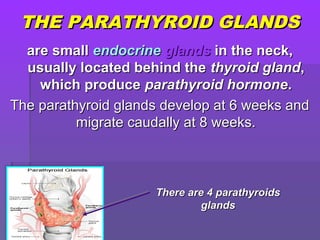
THE PARATHYROID GLANDSTHE PARATHYROID GLANDS
are smallare small endocrineendocrine glandsglands in the neck,in the neck,
usually located behind theusually located behind the thyroid glandthyroid gland,,
which producewhich produce parathyroid hormoneparathyroid hormone..
The parathyroid glands develop at 6 weeks andThe parathyroid glands develop at 6 weeks and
migrate caudally at 8 weeks.migrate caudally at 8 weeks.
There are 4 parathyroidsThere are 4 parathyroids
glandsglands
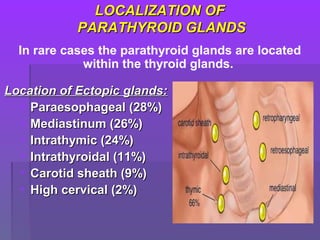
LOCALIZATION OFLOCALIZATION OF
PARATHYROID GLANDSPARATHYROID GLANDS
Location of Ectopic glands:Location of Ectopic glands:
• Paraesophageal (28%)Paraesophageal (28%)
• Mediastinum (26%)Mediastinum (26%)
• Intrathymic (24%)Intrathymic (24%)
• Intrathyroidal (11%)Intrathyroidal (11%)
• Carotid sheath (9%)Carotid sheath (9%)
• High cervical (2%)High cervical (2%)
In rare cases the parathyroid glands are located
within the thyroid glands.
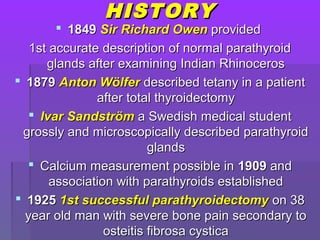
HISTORYHISTORY
 18491849 Sir RichardSir Richard OwenOwen providedprovided
1st accurate description of normal parathyroid1st accurate description of normal parathyroid
glands after examining Indian Rhinocerosglands after examining Indian Rhinoceros
 18791879 Anton WölferAnton Wölfer described tetany in a patientdescribed tetany in a patient
after total thyroidectomyafter total thyroidectomy
 Ivar SandströmIvar Sandström a Swedish medical studenta Swedish medical student
grossly and microscopically described parathyroidgrossly and microscopically described parathyroid
glandsglands
 Calcium measurement possible inCalcium measurement possible in 19091909 andand
association with parathyroids establishedassociation with parathyroids established
 19251925 1st successful parathyroidectomy1st successful parathyroidectomy on 38on 38
year old man with severe bone pain secondary toyear old man with severe bone pain secondary to
osteitis fibrosa cysticaosteitis fibrosa cystica
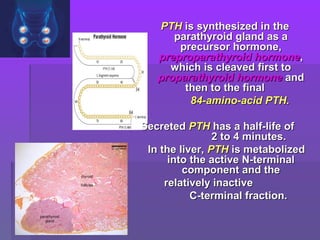
PTHPTH is synthesized in theis synthesized in the
parathyroid gland as aparathyroid gland as a
precursor hormone,precursor hormone,
preproparathyroid hormonepreproparathyroid hormone,,
which is cleaved first towhich is cleaved first to
proparathyroid hormoneproparathyroid hormone andand
then to the finalthen to the final
84-amino-acid PTH.84-amino-acid PTH.
SecretedSecreted PTHPTH has a half-life ofhas a half-life of
2 to 4 minutes.2 to 4 minutes.
In the liver,In the liver, PTHPTH is metabolizedis metabolized
into the active N-terminalinto the active N-terminal
component and thecomponent and the
relatively inactiverelatively inactive
C-terminal fraction.C-terminal fraction.
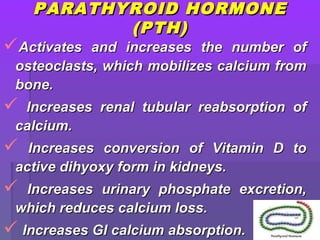
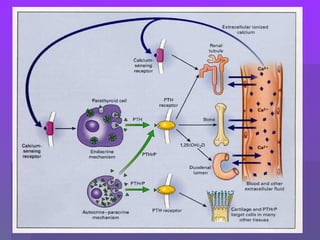
PARATHYROID HORMONEPARATHYROID HORMONE
(PTH)(PTH)
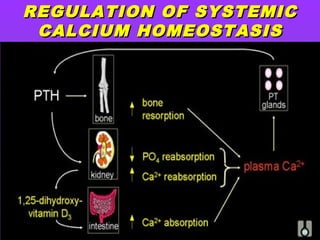
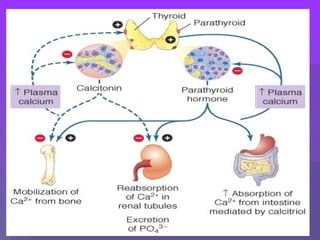
Activates and increases the number ofActivates and increases the number of
osteoclasts, which mobilizes calcium fromosteoclasts, which mobilizes calcium from
bone.bone.
 Increases renal tubular reabsorption ofIncreases renal tubular reabsorption of
calcium.calcium.
 Increases conversion of Vitamin D toIncreases conversion of Vitamin D to
active dihyoxy form in kidneys.active dihyoxy form in kidneys.
 Increases urinary phosphate excretion,Increases urinary phosphate excretion,
which reduces calcium loss.which reduces calcium loss.
 Increases GI calcium absorption.Increases GI calcium absorption.
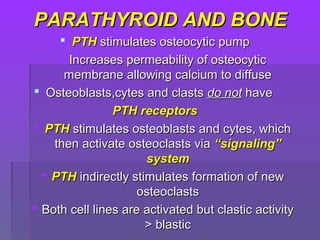
PARATHYROID AND BONEPARATHYROID AND BONE
 PTHPTH stimulates osteocytic pumpstimulates osteocytic pump
 Increases permeability of osteocyticIncreases permeability of osteocytic
membrane allowing calcium to diffusemembrane allowing calcium to diffuse
 Osteoblasts,cytes and clastsOsteoblasts,cytes and clasts do notdo not havehave
PTH receptorsPTH receptors
 PTHPTH stimulates osteoblasts and cytes, whichstimulates osteoblasts and cytes, which
then activate osteoclasts viathen activate osteoclasts via “signaling”“signaling”
systemsystem
 PTHPTH indirectly stimulates formation of newindirectly stimulates formation of new
osteoclastsosteoclasts
 Both cell lines are activated but clastic activityBoth cell lines are activated but clastic activity
> blastic> blastic
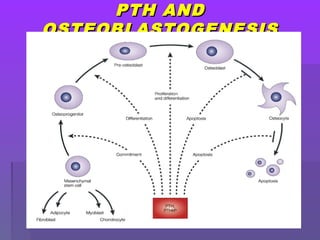
PTH ANDPTH AND
OSTEOBLASTOGENESISOSTEOBLASTOGENESIS
REGULATION OF SYSTEMICREGULATION OF SYSTEMIC
CALCIUM HOMEOSTASISCALCIUM HOMEOSTASIS
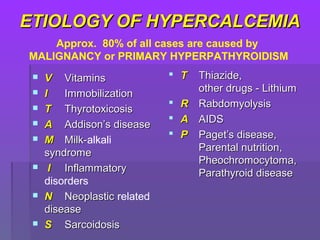
ETIOLOGY OF HYPERCALCEMIAETIOLOGY OF HYPERCALCEMIA
 TT Thiazide,Thiazide,
other drugs - Lithiumother drugs - Lithium
 RR RabdomyolysisRabdomyolysis
 AA AIDSAIDS
 PP Paget’s disease,Paget’s disease,
Parental nutrition,Parental nutrition,
Pheochromocytoma,Pheochromocytoma,
Parathyroid diseaseParathyroid disease
Approx. 80% of all cases are caused by
MALIGNANCY or PRIMARY HYPERPATHYROIDISM
 VV VitaminsVitamins
 II ImmobilizationImmobilization
 TT ThyrotoxicosisThyrotoxicosis
 AA Addison’s diseaseAddison’s disease
 MM Milk-Milk-alkali
syndromesyndrome
 II InflammatoryInflammatory
disorders
 NN NeoplasticNeoplastic related
diseasedisease
 SS SarcoidosisSarcoidosis
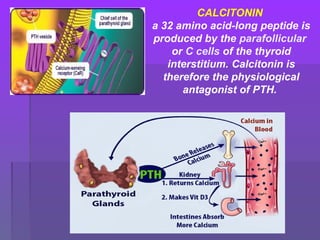
CALCITONIN
a 32 amino acid-long peptide is
produced by the parafollicular
or C cells of the thyroid
interstitium. Calcitonin is
therefore the physiological
antagonist of PTH.
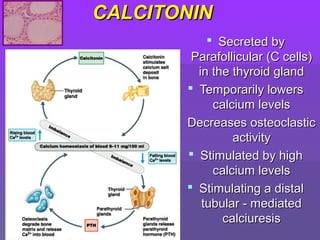
CALCITONINCALCITONIN
 Secreted bySecreted by
Parafollicular (C cells)Parafollicular (C cells)
in the thyroid glandin the thyroid gland
 Temporarily lowersTemporarily lowers
calcium levelscalcium levels
 Decreases osteoclasticDecreases osteoclastic
activityactivity
 Stimulated by highStimulated by high
calcium levelscalcium levels
 Stimulating a distalStimulating a distal
tubular - mediatedtubular - mediated
calciuresiscalciuresis
HYPERPARATHYROIDISMHYPERPARATHYROIDISM
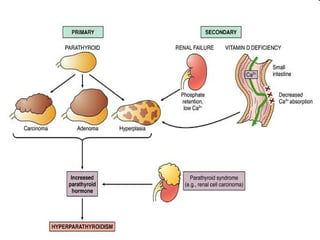
PRIMARY HYPERPARATHYROIDISMPRIMARY HYPERPARATHYROIDISM is theis the
unregulated overproduction of PTH resulting inunregulated overproduction of PTH resulting in
abnormal calcium homeostasis.abnormal calcium homeostasis.
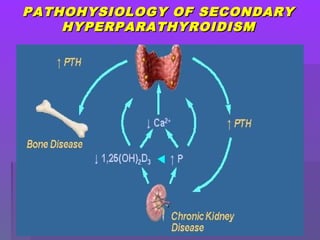
SECONDARY HYPERPARATHYROIDISMSECONDARY HYPERPARATHYROIDISM isis
the overproduction of PTH secondary to a chronicthe overproduction of PTH secondary to a chronic
abnormal stimulus for its production.abnormal stimulus for its production.
TERTIARY HYPERPARATHYROIDISMTERTIARY HYPERPARATHYROIDISM isis
characterized by the development of autonomouscharacterized by the development of autonomous
hypersecretion of PTH causing hypercalcemia.hypersecretion of PTH causing hypercalcemia.
PRIMARYPRIMARY
HYPERPARATHYROIDISHYPERPARATHYROIDIS
MM
EpidemiologyEpidemiology
 IncidenceIncidence 27 cases annually27 cases annually
per 100,000per 100,000
 Prevalence PH general populationPrevalence PH general population
0.1%-0.3%0.1%-0.3%
 Prevalence women >60 yearsPrevalence women >60 years
more than 1%more than 1%
 50,00050,000 new casesnew cases yearlyyearly
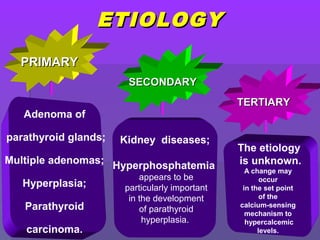
ETIOLOGYETIOLOGY
PRIMARYPRIMARY
SECONDARYSECONDARY
TERTIARYTERTIARY
Adenoma of
parathyroid glands;
Multiple adenomas;
Hyperplasia;
Parathyroid
carcinoma.
Kidney diseases;
Hyperphosphatemia
appears to be
particularly important
in the development
of parathyroid
hyperplasia.
The etiology
is unknown.
A change may
occur
in the set point
of the
calcium-sensing
mechanism to
hypercalcemic
levels.
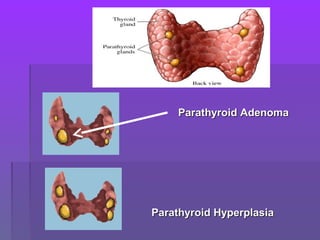
Parathyroid AdenomaParathyroid Adenoma
Parathyroid HyperplasiaParathyroid Hyperplasia
PATHOHYSIOLOGY OF SECONDARYPATHOHYSIOLOGY OF SECONDARY
HYPERPARATHYROIDISMHYPERPARATHYROIDISM
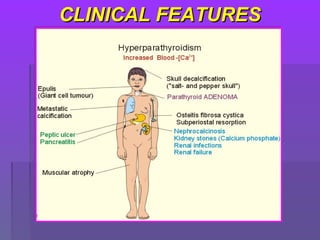
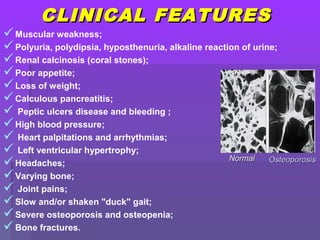
CLINICAL FEATURESCLINICAL FEATURES
Muscular weakness;
Polyuria, polydipsia, hyposthenuria, alkaline reaction of urine;
Renal calcinosis (coral stones);
Poor appetite;
Loss of weight;
Calculous pancreatitis;
 Peptic ulcers disease and bleeding ;
High blood pressure;
 Heart palpitations and arrhythmias;
 Left ventricular hypertrophy;
Headaches;
Varying bone;
 Joint pains;
Slow and/or shaken "duck" gait;
Severe osteoporosis and osteopenia;
Bone fractures.
NormalNormal OsteoporosisOsteoporosis
HYPERPARATHYROIDISMHYPERPARATHYROIDISM
 STONESSTONES
 BONESBONES
 GROANSGROANS
 MOANSMOANS
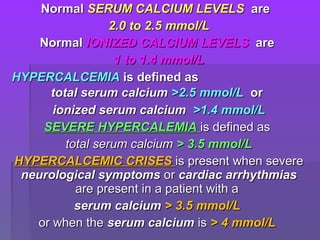
NormalNormal SERUM CALCIUM LEVELSSERUM CALCIUM LEVELS areare
2.0 to 2.5 mmol/L2.0 to 2.5 mmol/L
NormalNormal IONIZED CALCIUM LEVELSIONIZED CALCIUM LEVELS areare
1 to 1.4 mmol/L1 to 1.4 mmol/L
HYPERCALCEMIAHYPERCALCEMIA is defined asis defined as
total serum calciumtotal serum calcium >2.5 mmol/L>2.5 mmol/L oror
ionized serum calciumionized serum calcium >1.4 mmol/L>1.4 mmol/L
SEVERE HYPERCALEMIASEVERE HYPERCALEMIA is defined asis defined as
total serum calciumtotal serum calcium > 3.5 mmol/L> 3.5 mmol/L
HYPERCALCEMIC CRISESHYPERCALCEMIC CRISES is present when severeis present when severe
neurological symptomsneurological symptoms oror cardiac arrhythmiascardiac arrhythmias
are present in a patient with aare present in a patient with a
serum calciumserum calcium > 3.5 mmol/L> 3.5 mmol/L
or when theor when the serum calciumserum calcium isis > 4 mmol/L> 4 mmol/L
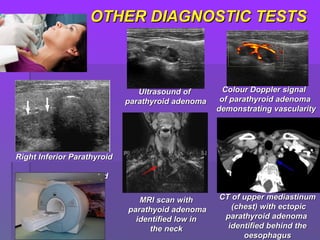
Right Inferior ParathyroidRight Inferior Parathyroid
Adenoma by UltrasoundAdenoma by Ultrasound
Ultrasound ofUltrasound of
parathyroid adenomaparathyroid adenoma
Colour Doppler signalColour Doppler signal
of parathyroid adenomaof parathyroid adenoma
demonstrating vascularitydemonstrating vascularity
CT of upper mediastinumCT of upper mediastinum
(chest) with ectopic(chest) with ectopic
parathyroid adenomaparathyroid adenoma
identified behind theidentified behind the
oesophagusoesophagus
MRI scan withMRI scan with
parathyoid adenomaparathyoid adenoma
identified low inidentified low in
the neckthe neck
OTHER DIAGNOSTIC TESTSOTHER DIAGNOSTIC TESTS
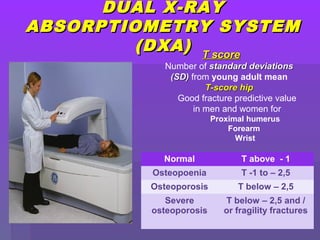
DUAL X-RAYDUAL X-RAY
ABSORPTIOMETRY SYSTEMABSORPTIOMETRY SYSTEM
(DXA)(DXA) T scoreT score
Number of standard deviationsstandard deviations
(SD)(SD) from young adult mean
T-score hipT-score hip
Good fracture predictive value
in men and women for
Proximal humerus
Forearm
Wrist
Normal T above - 1
Osteopoenia T -1 to – 2,5
Osteoporosis T below – 2,5
Severe
osteoporosis
T below – 2,5 and /
or fragility fractures
COMPLICATIONS OF HYPERCALCEMIACOMPLICATIONS OF HYPERCALCEMIA
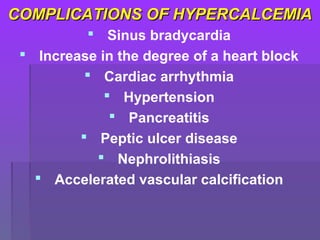
 Sinus bradycardia
 Increase in the degree of a heart block
 Cardiac arrhythmia
 Hypertension
 Pancreatitis
 Peptic ulcer disease
 Nephrolithiasis
 Accelerated vascular calcification
HYPERCALCEMICHYPERCALCEMIC
SYNDROMESYNDROME
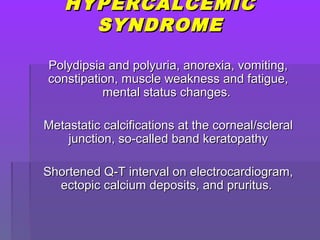
Polydipsia and polyuria, anorexia, vomiting,Polydipsia and polyuria, anorexia, vomiting,
constipation, muscle weakness and fatigue,constipation, muscle weakness and fatigue,
mental status changes.mental status changes.
Metastatic calcifications at the corneal/scleralMetastatic calcifications at the corneal/scleral
junction, so-called band keratopathyjunction, so-called band keratopathy
Shortened Q-T interval on electrocardiogram,Shortened Q-T interval on electrocardiogram,
ectopic calcium deposits, and pruritus.ectopic calcium deposits, and pruritus.
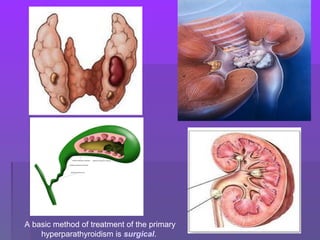
A basic method of treatment of the primary
hyperparathyroidism is surgical.
PRIMARYPRIMARY
HYPERPARATHYROIDISMHYPERPARATHYROIDISM
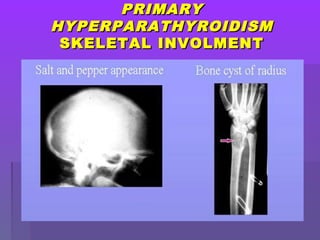
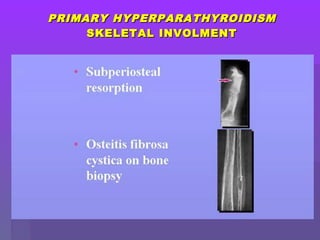
SKELETAL INVOLMENTSKELETAL INVOLMENT
PRIMARY HYPERPARATHYROIDISMPRIMARY HYPERPARATHYROIDISM
SKELETAL INVOLMENTSKELETAL INVOLMENT
HYPERPARATHYROIDISMHYPERPARATHYROIDISM
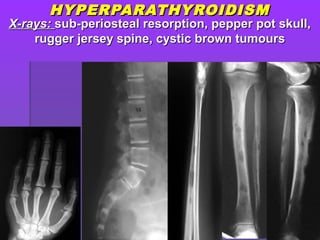
X-rays:X-rays: sub-periosteal resorption, pepper pot skull,sub-periosteal resorption, pepper pot skull,
rugger jersey spine, cystic brown tumoursrugger jersey spine, cystic brown tumours
HYPERPARATHYROIDISMHYPERPARATHYROIDISM
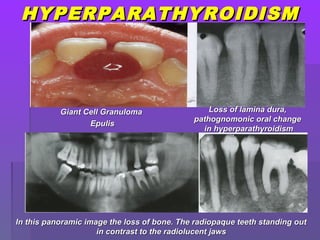
Giant Cell GranulomaGiant Cell Granuloma
EpulisEpulis
Loss of lamina dura,Loss of lamina dura,
pathognomonic oral changepathognomonic oral change
in hyperparathyroidismin hyperparathyroidism
In this panoramic image the loss of bone. The radiopaque teeth standing outIn this panoramic image the loss of bone. The radiopaque teeth standing out
in contrast to the radiolucent jawsin contrast to the radiolucent jaws
FINDINGS WITH HYPERCALCEMIAFINDINGS WITH HYPERCALCEMIA
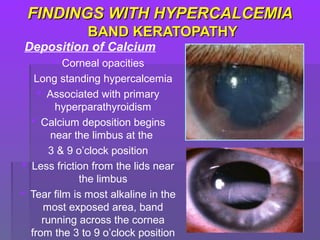
BAND KERATOPATHYBAND KERATOPATHY
Deposition of Calcium
 Corneal opacities
 Long standing hypercalcemia
 Associated with primary
hyperparathyroidism
 Calcium deposition begins
near the limbus at the
3 & 9 o’clock position
 Less friction from the lids near
the limbus
 Tear film is most alkaline in the
most exposed area, band
running across the cornea
from the 3 to 9 o’clock position
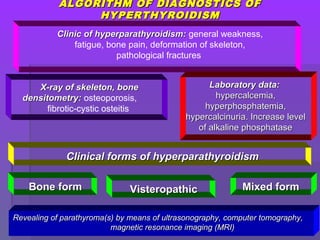
ALGORITHM OF DIAGNOSTICS OFALGORITHM OF DIAGNOSTICS OF
HYPERTHYROIDISMHYPERTHYROIDISM
Clinic of hyperparathyroidism:Clinic of hyperparathyroidism: general weakness,
fatigue, bone pain, deformation of skeleton,
pathological fractures
X-ray of skeleton, boneX-ray of skeleton, bone
densitometry:densitometry: osteoporosis,
fibrotic-cystic osteitis
Laboratory data:Laboratory data:
hypercalcemia,hypercalcemia,
hyperphosphatemia,hyperphosphatemia,
hypercalcinuria. Increase levelhypercalcinuria. Increase level
of alkaline phosphataseof alkaline phosphatase
Clinical forms of hyperparathyroidismClinical forms of hyperparathyroidism
Bone formBone form VisteropathicVisteropathic Mixed formMixed form
Revealing of parathyroma(s) by means of ultrasonography, computer tomography,Revealing of parathyroma(s) by means of ultrasonography, computer tomography,
magnetic resonance imaging (MRI)magnetic resonance imaging (MRI)
MEDICAL TREATMENT OFMEDICAL TREATMENT OF
THE HYPERCALCAEMIATHE HYPERCALCAEMIA
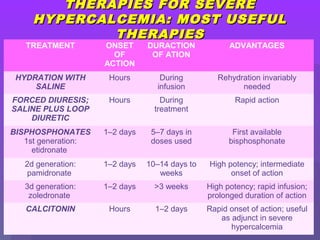
In acute severe forms the main stay ofIn acute severe forms the main stay of
therapy istherapy is adequate hydrationadequate hydration withwith
salinesaline andand forced diuresisforced diuresis by diureticsby diuretics
to increase the urinary excretion ofto increase the urinary excretion of
calcium rapidly along with sodium andcalcium rapidly along with sodium and
prevent its reabsorption by the renalprevent its reabsorption by the renal
tubules.tubules.
THERAPIES FOR SEVERETHERAPIES FOR SEVERE
HYPERCALCEMIA: MOST USEFULHYPERCALCEMIA: MOST USEFUL
THERAPIESTHERAPIES
TREATMENT ONSET
OF
ACTION
DURACTION
OF ATION
ADVANTAGES
HYDRATION WITH
SALINE
Hours During
infusion
Rehydration invariably
needed
FORCED DIURESIS;
SALINE PLUS LOOP
DIURETIC
Hours During
treatment
Rapid action
BISPHOSPHONATES
1st generation:
etidronate
1–2 days 5–7 days in
doses used
First available
bisphosphonate
2d generation:
pamidronate
1–2 days 10–14 days to
weeks
High potency; intermediate
onset of action
3d generation:
zoledronate
1–2 days >3 weeks High potency; rapid infusion;
prolonged duration of action
CALCITONIN Hours 1–2 days Rapid onset of action; useful
as adjunct in severe
hypercalcemia
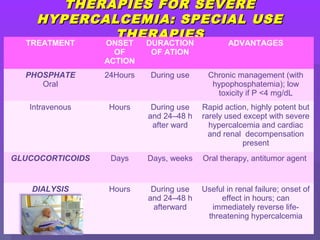
THERAPIES FOR SEVERETHERAPIES FOR SEVERE
HYPERCALCEMIA: SPECIAL USEHYPERCALCEMIA: SPECIAL USE
THERAPIESTHERAPIES
TREATMENT ONSET
OF
ACTION
DURACTION
OF ATION
ADVANTAGES
PHOSPHATE
Oral
24Hours During use Chronic management (with
hypophosphatemia); low
toxicity if P <4 mg/dL
Intravenous Hours During use
and 24–48 h
after ward
Rapid action, highly potent but
rarely used except with severe
hypercalcemia and cardiac
and renal decompensation
present
GLUCOCORTICOIDS Days Days, weeks Oral therapy, antitumor agent
DIALYSIS Hours During use
and 24–48 h
afterward
Useful in renal failure; onset of
effect in hours; can
immediately reverse life-
threatening hypercalcemia
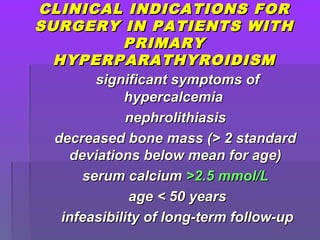
CLINICAL INDICATIONS FORCLINICAL INDICATIONS FOR
SURGERY IN PATIENTS WITHSURGERY IN PATIENTS WITH
PRIMARYPRIMARY
HYPERPARATHYROIDISMHYPERPARATHYROIDISM
significant symptoms ofsignificant symptoms of
hypercalcemiahypercalcemia
nephrolithiasisnephrolithiasis
decreased bone mass (> 2 standarddecreased bone mass (> 2 standard
deviations below mean for age)deviations below mean for age)
serum calciumserum calcium >2.5 mmol/L>2.5 mmol/L
age < 50 yearsage < 50 years
infeasibility of long-term follow-upinfeasibility of long-term follow-up
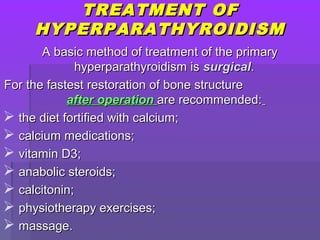
TREATMENT OFTREATMENT OF
HYPERPARATHYROIDISMHYPERPARATHYROIDISM
A basic method of treatment of the primaryA basic method of treatment of the primary
hyperparathyroidism ishyperparathyroidism is surgicalsurgical..
For the fastest restoration of bone structureFor the fastest restoration of bone structure
after operationafter operation are recommended:are recommended:
 the diet fortified with calcium;the diet fortified with calcium;
 calcium medications;calcium medications;
 vitamin D3;vitamin D3;
 anabolic steroids;anabolic steroids;
 calcitonin;calcitonin;
 physiotherapy exercises;physiotherapy exercises;
 massage.massage.
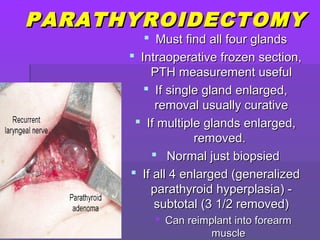
PARATHYROIDECTOMYPARATHYROIDECTOMY
 Must find all four glandsMust find all four glands
 Intraoperative frozen section,Intraoperative frozen section,
PTH measurement usefulPTH measurement useful
 If single gland enlarged,If single gland enlarged,
removal usually curativeremoval usually curative
 If multiple glands enlarged,If multiple glands enlarged,
removed.removed.
 Normal just biopsiedNormal just biopsied
 If all 4 enlarged (generalizedIf all 4 enlarged (generalized
parathyroid hyperplasia) -parathyroid hyperplasia) -
subtotal (3 1/2 removed)subtotal (3 1/2 removed)
 Can reimplant into forearmCan reimplant into forearm
musclemuscle
HYPOPARATHYROIDISMHYPOPARATHYROIDISM
is the state ofis the state of decreased secretiondecreased secretion
or activity of parathyroid hormoneor activity of parathyroid hormone
(PTH).(PTH).
Synonyms:Synonyms: Tetany, Hypocalcemia,Tetany, Hypocalcemia,
DiGeorge SyndromeDiGeorge Syndrome
Osteomalacia,Osteomalacia,
PseudohypoparathyroidismPseudohypoparathyroidism
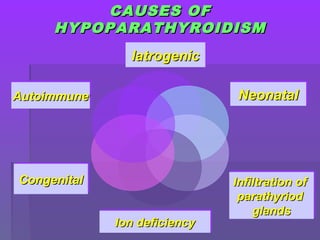
CAUSES OFCAUSES OF
HYPOPARATHYROIDISMHYPOPARATHYROIDISM
IatrogenicIatrogenicIatrogenicIatrogenic
NeonatalNeonatalNeonatalNeonatal
IInfiltrationnfiltration ofof
parathyriodparathyriod
glandsglands
IInfiltrationnfiltration ofof
parathyriodparathyriod
glandsglands
Ion deficiencyIon deficiencyIon deficiencyIon deficiency
CongenitalCongenitalCongenitalCongenital
AutoimmuneAutoimmuneAutoimmuneAutoimmune
IATROGENIC CAUSESIATROGENIC CAUSES::
Post SurgicalPost Surgical
 operations designed to remove
parathyroid glands for
hyperparathyroidism;
 postoperative hypoparathyroidism ispostoperative hypoparathyroidism is
total thyroidectomytotal thyroidectomy;;
 surgery in the treatment of thyroid,surgery in the treatment of thyroid,
laryngeal, or other neck malignancy;laryngeal, or other neck malignancy;
 extensive irradiationextensive irradiation to the face,to the face,
neck, or mediastinum ;neck, or mediastinum ;
 thethe "hungry bone syndrome""hungry bone syndrome"
develops after a parathyroidectomydevelops after a parathyroidectomy
for hyperparathyroidism.for hyperparathyroidism.
AUTOIMMUNEAUTOIMMUNE
CAUSESCAUSES::
Autoimmune hypoparathyroidismAutoimmune hypoparathyroidism
may exist alone or in sporadic ormay exist alone or in sporadic or
familial forms. Autoimmune primaryfamilial forms. Autoimmune primary
hypoparathyroidism, the averagehypoparathyroidism, the average
age for development ofage for development of
hypocalcemia is 7 years, with ahypocalcemia is 7 years, with a
range of 6 months to 20 years.range of 6 months to 20 years.
Type 1 autoimmuneType 1 autoimmune
polyglandular syndromepolyglandular syndrome
(also referred to as(also referred to as HAMHAM
syndromesyndrome) includes primary) includes primary
hypoparathyroidism that is due tohypoparathyroidism that is due to
destruction of the parathyroiddestruction of the parathyroid
glands.glands.
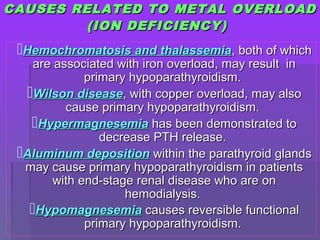
CAUSES RELATED TO METAL OVERLOADCAUSES RELATED TO METAL OVERLOAD
(ION DEFICIENCY)(ION DEFICIENCY)
Hemochromatosis and thalassemiaHemochromatosis and thalassemia, both of which, both of which
are associated with iron overload, may result inare associated with iron overload, may result in
primary hypoparathyroidism.primary hypoparathyroidism.
Wilson diseaseWilson disease, with copper overload, may also, with copper overload, may also
cause primary hypoparathyroidism.cause primary hypoparathyroidism.
HypermagnesemiaHypermagnesemia has been demonstrated tohas been demonstrated to
decrease PTH release.decrease PTH release.
Aluminum depositionAluminum deposition within the parathyroid glandswithin the parathyroid glands
may cause primary hypoparathyroidism in patientsmay cause primary hypoparathyroidism in patients
with end-stage renal disease who are onwith end-stage renal disease who are on
hemodialysis.hemodialysis.
HypomagnesemiaHypomagnesemia causes reversible functionalcauses reversible functional
primary hypoparathyroidism.primary hypoparathyroidism.
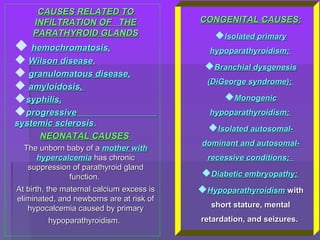
CAUSES RELATED TOCAUSES RELATED TO
INFILTRATION OF THEINFILTRATION OF THE
PARATHYROID GLANDSPARATHYROID GLANDS
 hemochromatosis,hemochromatosis,
 Wilson diseaseWilson disease,,
 granulomatous disease,granulomatous disease,
 amyloidosis,amyloidosis,
syphilis,syphilis,
progressiveprogressive
systemic sclerosissystemic sclerosis..
NEONATAL CAUSESNEONATAL CAUSES
The unborn baby of aThe unborn baby of a mother withmother with
hypercalcemiahypercalcemia has chronichas chronic
suppression of parathyroid glandsuppression of parathyroid gland
function.function.
At birth, the maternal calcium excess isAt birth, the maternal calcium excess is
eliminated, and newborns are at risk ofeliminated, and newborns are at risk of
hypocalcemia caused by primaryhypocalcemia caused by primary
hypoparathyroidism.hypoparathyroidism.
CONGENITAL CAUSESCONGENITAL CAUSES::
Isolated primaryIsolated primary
hypoparathyroidismhypoparathyroidism;;
Branchial dysgenesisBranchial dysgenesis
(DiGeorge syndrome)(DiGeorge syndrome);;
MonogenicMonogenic
hypoparathyroidismhypoparathyroidism;;
Isolated autosomal-Isolated autosomal-
dominantdominant andand autosomal-autosomal-
recessive conditionsrecessive conditions;;
Diabetic embryopathyDiabetic embryopathy;;
HypoparathyroidismHypoparathyroidism withwith
short stature, mentalshort stature, mental
retardation, and seizures.retardation, and seizures.
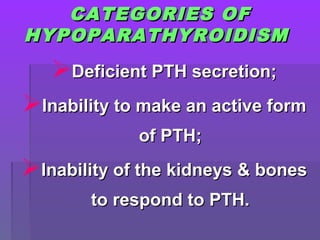
CATEGORIES OFCATEGORIES OF
HYPOPARATHYROIDISMHYPOPARATHYROIDISM
Deficient PTH secretion;Deficient PTH secretion;
Inability to make an active formInability to make an active form
of PTH;of PTH;
Inability of the kidneys & bonesInability of the kidneys & bones
to respond to PTH.to respond to PTH.
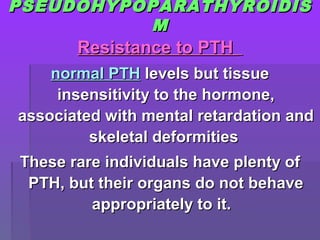
PSEUDOHYPOPARATHYROIDISPSEUDOHYPOPARATHYROIDIS
MM
Resistance to PTHResistance to PTH
normal PTHnormal PTH levels but tissuelevels but tissue
insensitivity to the hormone,insensitivity to the hormone,
associated with mental retardation andassociated with mental retardation and
skeletal deformitiesskeletal deformities
These rare individuals have plenty ofThese rare individuals have plenty of
PTH, but their organs do not behavePTH, but their organs do not behave
appropriately to it.appropriately to it.
CLINICAL FEATURESCLINICAL FEATURES
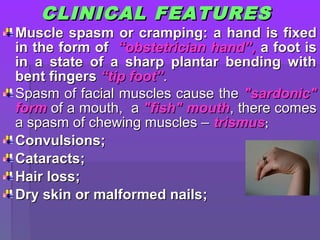
Muscle spasm or cramping:Muscle spasm or cramping: a hand is fixeda hand is fixed
in the form ofin the form of “obstetrician hand”“obstetrician hand”,, a foot isa foot is
in a state of a sharp plantar bending within a state of a sharp plantar bending with
bent fingersbent fingers “tip foot”“tip foot”..
Spasm of facial muscles cause theSpasm of facial muscles cause the "sardonic""sardonic"
formform of a mouthof a mouth,, aa "fish" mouth"fish" mouth, there comes, there comes
a spasm of chewing muscles –a spasm of chewing muscles – trismustrismus;;
ConvulsionsConvulsions;;
CataractsCataracts;;
Hair lossHair loss;;
Dry skin or malformed nailsDry skin or malformed nails;;
CLINICAL FEATURESCLINICAL FEATURES
AnxietyAnxiety;;
ParesthesiasParesthesias - abnormal sensations such as- abnormal sensations such as
numbness, tingling, or burning, especiallynumbness, tingling, or burning, especially
around the mouth and fingers;around the mouth and fingers;
Hoarseness (due to laryngospasm)Hoarseness (due to laryngospasm);;
Wheezing and dyspnea (due toWheezing and dyspnea (due to
bronchospasm);bronchospasm);
Resistance to digitalis;Resistance to digitalis;
Hypotension;Hypotension;
Refractory heart failure with cardiomegally canRefractory heart failure with cardiomegally can
occur;occur;
Candidiasis (yeast infection);Candidiasis (yeast infection);
Poor tooth development in childrenPoor tooth development in children..
SIGNS AND SYMPTOMSSIGNS AND SYMPTOMS
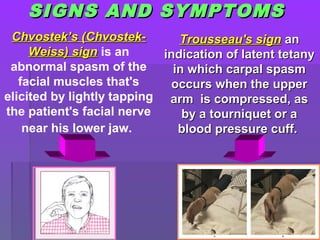
CChvostek’s (hvostek’s (Chvostek-Chvostek-
Weiss) signWeiss) sign is an
abnormal spasm of the
facial muscles that's
elicited by lightly tapping
the patient's facial nerve
near his lower jaw.
Trousseau's signTrousseau's sign anan
indication of latent tetanyindication of latent tetany
in which carpal spasmin which carpal spasm
occurs when the upperoccurs when the upper
arm is compressed, asarm is compressed, as
by a tourniquet or aby a tourniquet or a
blood pressure cuff.blood pressure cuff.
SIGNS AND SYMPTOMSSIGNS AND SYMPTOMS
Schlesinger's symptomSchlesinger's symptom in tetany, if thein tetany, if the
patient's lower limb is held at the kneepatient's lower limb is held at the knee
joint and flexed strongly at the hip joint,joint and flexed strongly at the hip joint,
there will soon be an extensor spasm atthere will soon be an extensor spasm at
the knee joint, with extreme supinationthe knee joint, with extreme supination
of the foot.of the foot.
Hoffmann's signs increased excitability
to electrical stimulation in the sensory
nerves; the ulnar nerve is usually tested.
StridorStridor due to obstruction in the larynx,
trachea or bronchi.
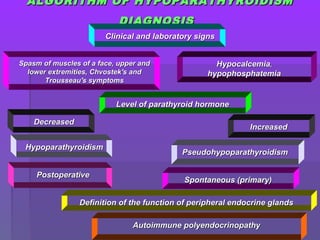
ALGORITHM OF HYPOPARATHYROIDISMALGORITHM OF HYPOPARATHYROIDISM
DIAGNOSISDIAGNOSIS
Clinical and laboratory signsClinical and laboratory signs
Spasm of muscles of a face, upper andSpasm of muscles of a face, upper and
lower extremities,lower extremities, Chvostek's andChvostek's and
Trousseau's symptomsTrousseau's symptoms
HypocalcemiaHypocalcemia,,
hypophosphatemiahypophosphatemia
Level of parathyroid hormoneLevel of parathyroid hormone
DecreasedDecreased
InIncreasedcreased
HypoparathyroidismHypoparathyroidism
PostoperativePostoperative
PseudohypoparathyroidismPseudohypoparathyroidism
Spontaneous (primary)Spontaneous (primary)
Definition of the function of peripheral endocrine glandsDefinition of the function of peripheral endocrine glands
Autoimmune polyendocrinopathyAutoimmune polyendocrinopathy
LABLABORATORYORATORY STUDIESSTUDIES
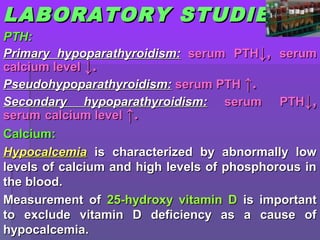
PTH:PTH:
Primary hypoparathyroidism:Primary hypoparathyroidism: serumserum PTHPTH↓,↓, serumserum
calcium levelcalcium level ↓.↓.
Pseudohypoparathyroidism:Pseudohypoparathyroidism: serumserum PTHPTH ↑.↑.
Secondary hypoparathyroidism:Secondary hypoparathyroidism: serumserum PTHPTH↓,↓,
serumserum calcium levelcalcium level ↑.↑.
CalciumCalcium::
HypocalcemiaHypocalcemia is characterized by abnormally lowis characterized by abnormally low
levels of calcium and high levels of phosphorous inlevels of calcium and high levels of phosphorous in
the blood.the blood.
Measurement ofMeasurement of 25-hydroxy vitamin D25-hydroxy vitamin D is importantis important
to exclude vitamin D deficiency as a cause ofto exclude vitamin D deficiency as a cause of
hypocalcemia.hypocalcemia.
LABLABORATORYORATORY STUDIESSTUDIES
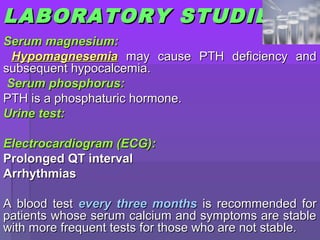
Serum magnesium:Serum magnesium:
HypomagnesemiaHypomagnesemia may cause PTH deficiency andmay cause PTH deficiency and
subsequent hypocalcemia.subsequent hypocalcemia.
Serum phosphorus:Serum phosphorus:
PTH is a phosphaturic hormone.PTH is a phosphaturic hormone.
Urine test:Urine test:
Electrocardiogram (ECG):Electrocardiogram (ECG):
Prolonged QT intervalProlonged QT interval
ArrhythmiasArrhythmias
A blood testA blood test every three monthsevery three months is recommended foris recommended for
patients whose serum calcium and symptoms are stablepatients whose serum calcium and symptoms are stable
with more frequent tests for those who are not stable.with more frequent tests for those who are not stable.
TREATMENTTREATMENT OFOF
HYPOPARATHYRIOIDISMHYPOPARATHYRIOIDISM
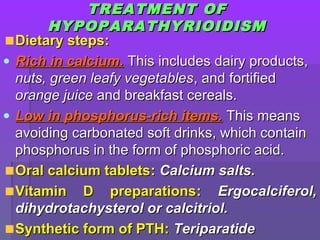
Dietary steps:Dietary steps:
• Rich in calcium.Rich in calcium. This includes dairy products,This includes dairy products,
nuts, green leafy vegetablesnuts, green leafy vegetables, and fortified, and fortified
orange juiceorange juice and breakfast cereals.and breakfast cereals.
• Low in phosphorus-rich items.Low in phosphorus-rich items. This meansThis means
avoiding carbonated soft drinks, which containavoiding carbonated soft drinks, which contain
phosphorus in the form of phosphoric acid.phosphorus in the form of phosphoric acid.
Oral calcium tabletsOral calcium tablets:: Calcium salts.Calcium salts.
Vitamin D preparationsVitamin D preparations:: Ergocalciferol,Ergocalciferol,
dihydrotachysterol or calcitriol.dihydrotachysterol or calcitriol.
Synthetic form of PTH:Synthetic form of PTH: TeriparatideTeriparatide
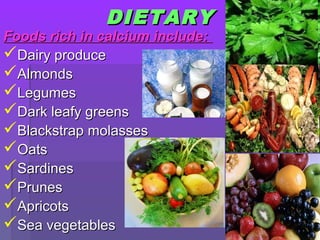
DIETARYDIETARY
Foods rich in calcium include:Foods rich in calcium include:
Dairy produceDairy produce
AlmondsAlmonds
LegumesLegumes
Dark leafy greensDark leafy greens
Blackstrap molassesBlackstrap molasses
OatsOats
SardinesSardines
PrunesPrunes
ApricotsApricots
Sea vegetablesSea vegetables
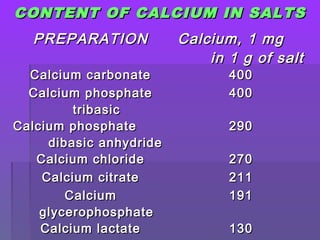
CONTENT OF CALCIUM IN SALTSCONTENT OF CALCIUM IN SALTS
PREPARATIONPREPARATION Calcium, 1 mgCalcium, 1 mg
in 1 g of saltin 1 g of salt
Calcium carbonateCalcium carbonate 400400
Calcium phosphateCalcium phosphate
tribasictribasic
400400
Calcium phosphateCalcium phosphate
dibasic anhydridedibasic anhydride
290290
Calcium chlorideCalcium chloride 270270
Calcium citrateCalcium citrate 211211
CalciumCalcium
glycerophosphateglycerophosphate
191191
Calcium lactateCalcium lactate 130130
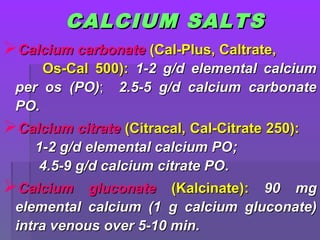
CALCIUM SALTSCALCIUM SALTS
Calcium carbonateCalcium carbonate (Cal-Plus, Caltrate,(Cal-Plus, Caltrate,
Os-Cal 500):Os-Cal 500): 1-2 g/d elemental calcium1-2 g/d elemental calcium
per os (per os (POPO));; 2.5-5 g/d calcium carbonate2.5-5 g/d calcium carbonate
POPO..
Calcium citrateCalcium citrate (Citracal, Cal-Citrate 250):(Citracal, Cal-Citrate 250):
1-21-2 g/d elemental calcium POg/d elemental calcium PO;;
4.5-9 g/d calcium citrate PO4.5-9 g/d calcium citrate PO..
Calcium gluconateCalcium gluconate (Kalcinate)(Kalcinate):: 90 mg90 mg
elemental calcium (1elemental calcium (1 g calcium gluconate)g calcium gluconate)
intra venousintra venous over 5-10 minover 5-10 min..
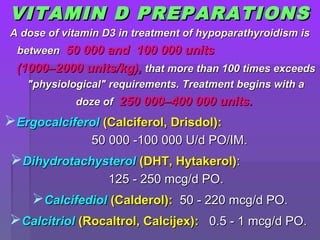
VITAMIN D PREPARATIONSVITAMIN D PREPARATIONS
A dose of vitamin D3 in treatment of hypoparathyroidism isA dose of vitamin D3 in treatment of hypoparathyroidism is
betweenbetween 50 000 and 100 000 units50 000 and 100 000 units
(1000–2000 units/kg),(1000–2000 units/kg), that more than 100 times exceedsthat more than 100 times exceeds
"physiological" requirements. Treatment begins with a"physiological" requirements. Treatment begins with a
doze ofdoze of 250 000–400 000 units.250 000–400 000 units.
ErgocalciferolErgocalciferol (Calciferol, Drisdol)(Calciferol, Drisdol)::
5050 000000 -100-100 000 U/d PO/IM000 U/d PO/IM..
DihydrotachysterolDihydrotachysterol (DHT, Hytakerol)(DHT, Hytakerol)::
125125 -- 250 mcg/d PO250 mcg/d PO..
CalcifediolCalcifediol (Calderol)(Calderol):: 5050 -- 220 mcg/d PO220 mcg/d PO..
CalcitriolCalcitriol (Rocaltrol, Calcijex)(Rocaltrol, Calcijex):: 0.50.5 -- 1 mcg/d PO1 mcg/d PO..
BISPHOSPHONATEBISPHOSPHONATE
were developed in the 19th century but were first investigated
in the 1960s for use in disorders of bone metabolism.
Only in the 1990s was their actual mechanism of action
demonstrated with the initial launch
of FosamaxFosamax (alendronate) by Merck.
Bisphosphonate-based drugs' specificity comes from the two
phosphonate groups (and possibly a hydroxyl at R1) that work
together to coordinate calcium ions. Bisphosphonate
molecules preferentially "stick" to calcium and bind to it.
Alendronate (Fosamax)Alendronate (Fosamax)
Ibandronate (Boniva)Ibandronate (Boniva)
Risedronate (Actonel)Risedronate (Actonel)
Zoledronate (Zometa, Aclasta)Zoledronate (Zometa, Aclasta)
ACUTE ATTACKACUTE ATTACK
OF TETANYOF TETANY
is supervised by intravenous administration ofis supervised by intravenous administration of
10–60 ml of 10% calcium gluconate10–60 ml of 10% calcium gluconate
diluted in 50 mL of 5% dextrose or 0.9%diluted in 50 mL of 5% dextrose or 0.9%
sodium chloride, given IV over 5 min.sodium chloride, given IV over 5 min.
CONTINUING HYPOCALCEMIACONTINUING HYPOCALCEMIA often requiresoften requires
a constanta constant IV infusion: typically 10 ampulsIV infusion: typically 10 ampuls
of calcium gluconate or 900 mg ofof calcium gluconate or 900 mg of
calcium in 1 L of 5% dextrose or 0.9%calcium in 1 L of 5% dextrose or 0.9%
sodium chloride administered over 24 h.sodium chloride administered over 24 h.
Hyperparathyroidism & Hypoparathyroidism

Hyperparathyroidism & Hypoparathyroidism

  • 1.
    Disease of parathyroidDiseaseof parathyroid glands.glands. Hyperparathyroidism andHyperparathyroidism and hypoparathyroidism.hypoparathyroidism.
  • 2.
    SponsoredSponsored Medical Lecture Notes–Medical Lecture Notes – All SubjectsAll Subjects USMLE Exam (America) –USMLE Exam (America) – PracticePractice
  • 3.
    PLAN OF THELECTUREPLAN OF THE LECTURE 1.1. PhysiologyPhysiology of parathyroid glands.of parathyroid glands. 2.2. Functions of parathyroid hormone.Functions of parathyroid hormone. 3.3. Hyperparathyroidism. Etiology, pathogenesisHyperparathyroidism. Etiology, pathogenesis and classification.and classification. 4.4. Clinical featuresClinical features of hyperparathyroidism.of hyperparathyroidism. 5.5. Principle of treatment of hyperparathyroidism.Principle of treatment of hyperparathyroidism. 6.6. Hypoparathyroidism. Etiology, pathogenesisHypoparathyroidism. Etiology, pathogenesis and classification.and classification. 7.7. Clinical featuresClinical features of hypoparathyroidism.of hypoparathyroidism. 8.8. Principle of treatment of hypoparathyroidism.Principle of treatment of hypoparathyroidism. 9.9. Fist aid of acute attackFist aid of acute attack of tetany.of tetany.
  • 4.
    CLINICAL CASECLINICAL CASE Apatient T., 45 years old, consult a doctor withA patient T., 45 years old, consult a doctor with complaintscomplaints ofof fast fatigue, muscular weakness,fast fatigue, muscular weakness, pain in muscles, spine, thirst, poliuria, loss of teeth.pain in muscles, spine, thirst, poliuria, loss of teeth. A leg fracture has occurredA leg fracture has occurred 8 months ago after damage8 months ago after damage and bad synostosis.and bad synostosis. The patient hasThe patient has gastric ulcer and nodular goitergastric ulcer and nodular goiter in hisin his life history.life history. Laboratory:Laboratory: erythrocytes - 3x10erythrocytes - 3x101212 /L,/L, Hb - 100 g/L,Hb - 100 g/L, leucocytes - 4,4xl0leucocytes - 4,4xl099 /L,/L, ESR - 28 mm/h, serum calcium -ESR - 28 mm/h, serum calcium - 2,9 mmol/L, serum phosphate - 0,4 mmol/L.2,9 mmol/L, serum phosphate - 0,4 mmol/L. X-ray examination of bone:X-ray examination of bone: systemic osteoporosis,systemic osteoporosis, subperiosteal resorption of bones, cysts, spinesubperiosteal resorption of bones, cysts, spine deformation.deformation. Determine possible diagnosisDetermine possible diagnosis
  • 5.
    THE PARATHYROID GLANDSTHEPARATHYROID GLANDS are smallare small endocrineendocrine glandsglands in the neck,in the neck, usually located behind theusually located behind the thyroid glandthyroid gland,, which producewhich produce parathyroid hormoneparathyroid hormone.. The parathyroid glands develop at 6 weeks andThe parathyroid glands develop at 6 weeks and migrate caudally at 8 weeks.migrate caudally at 8 weeks. There are 4 parathyroidsThere are 4 parathyroids glandsglands
  • 6.
    LOCALIZATION OFLOCALIZATION OF PARATHYROIDGLANDSPARATHYROID GLANDS Location of Ectopic glands:Location of Ectopic glands: • Paraesophageal (28%)Paraesophageal (28%) • Mediastinum (26%)Mediastinum (26%) • Intrathymic (24%)Intrathymic (24%) • Intrathyroidal (11%)Intrathyroidal (11%) • Carotid sheath (9%)Carotid sheath (9%) • High cervical (2%)High cervical (2%) In rare cases the parathyroid glands are located within the thyroid glands.
  • 7.
    HISTORYHISTORY  18491849 SirRichardSir Richard OwenOwen providedprovided 1st accurate description of normal parathyroid1st accurate description of normal parathyroid glands after examining Indian Rhinocerosglands after examining Indian Rhinoceros  18791879 Anton WölferAnton Wölfer described tetany in a patientdescribed tetany in a patient after total thyroidectomyafter total thyroidectomy  Ivar SandströmIvar Sandström a Swedish medical studenta Swedish medical student grossly and microscopically described parathyroidgrossly and microscopically described parathyroid glandsglands  Calcium measurement possible inCalcium measurement possible in 19091909 andand association with parathyroids establishedassociation with parathyroids established  19251925 1st successful parathyroidectomy1st successful parathyroidectomy on 38on 38 year old man with severe bone pain secondary toyear old man with severe bone pain secondary to osteitis fibrosa cysticaosteitis fibrosa cystica
  • 8.
    PTHPTH is synthesizedin theis synthesized in the parathyroid gland as aparathyroid gland as a precursor hormone,precursor hormone, preproparathyroid hormonepreproparathyroid hormone,, which is cleaved first towhich is cleaved first to proparathyroid hormoneproparathyroid hormone andand then to the finalthen to the final 84-amino-acid PTH.84-amino-acid PTH. SecretedSecreted PTHPTH has a half-life ofhas a half-life of 2 to 4 minutes.2 to 4 minutes. In the liver,In the liver, PTHPTH is metabolizedis metabolized into the active N-terminalinto the active N-terminal component and thecomponent and the relatively inactiverelatively inactive C-terminal fraction.C-terminal fraction.
  • 9.
    PARATHYROID HORMONEPARATHYROID HORMONE (PTH)(PTH) Activatesand increases the number ofActivates and increases the number of osteoclasts, which mobilizes calcium fromosteoclasts, which mobilizes calcium from bone.bone.  Increases renal tubular reabsorption ofIncreases renal tubular reabsorption of calcium.calcium.  Increases conversion of Vitamin D toIncreases conversion of Vitamin D to active dihyoxy form in kidneys.active dihyoxy form in kidneys.  Increases urinary phosphate excretion,Increases urinary phosphate excretion, which reduces calcium loss.which reduces calcium loss.  Increases GI calcium absorption.Increases GI calcium absorption.
  • 10.
    PARATHYROID AND BONEPARATHYROIDAND BONE  PTHPTH stimulates osteocytic pumpstimulates osteocytic pump  Increases permeability of osteocyticIncreases permeability of osteocytic membrane allowing calcium to diffusemembrane allowing calcium to diffuse  Osteoblasts,cytes and clastsOsteoblasts,cytes and clasts do notdo not havehave PTH receptorsPTH receptors  PTHPTH stimulates osteoblasts and cytes, whichstimulates osteoblasts and cytes, which then activate osteoclasts viathen activate osteoclasts via “signaling”“signaling” systemsystem  PTHPTH indirectly stimulates formation of newindirectly stimulates formation of new osteoclastsosteoclasts  Both cell lines are activated but clastic activityBoth cell lines are activated but clastic activity > blastic> blastic
  • 11.
  • 13.
    REGULATION OF SYSTEMICREGULATIONOF SYSTEMIC CALCIUM HOMEOSTASISCALCIUM HOMEOSTASIS
  • 15.
    ETIOLOGY OF HYPERCALCEMIAETIOLOGYOF HYPERCALCEMIA  TT Thiazide,Thiazide, other drugs - Lithiumother drugs - Lithium  RR RabdomyolysisRabdomyolysis  AA AIDSAIDS  PP Paget’s disease,Paget’s disease, Parental nutrition,Parental nutrition, Pheochromocytoma,Pheochromocytoma, Parathyroid diseaseParathyroid disease Approx. 80% of all cases are caused by MALIGNANCY or PRIMARY HYPERPATHYROIDISM  VV VitaminsVitamins  II ImmobilizationImmobilization  TT ThyrotoxicosisThyrotoxicosis  AA Addison’s diseaseAddison’s disease  MM Milk-Milk-alkali syndromesyndrome  II InflammatoryInflammatory disorders  NN NeoplasticNeoplastic related diseasedisease  SS SarcoidosisSarcoidosis
  • 16.
    CALCITONIN a 32 aminoacid-long peptide is produced by the parafollicular or C cells of the thyroid interstitium. Calcitonin is therefore the physiological antagonist of PTH.
  • 17.
    CALCITONINCALCITONIN  Secreted bySecretedby Parafollicular (C cells)Parafollicular (C cells) in the thyroid glandin the thyroid gland  Temporarily lowersTemporarily lowers calcium levelscalcium levels  Decreases osteoclasticDecreases osteoclastic activityactivity  Stimulated by highStimulated by high calcium levelscalcium levels  Stimulating a distalStimulating a distal tubular - mediatedtubular - mediated calciuresiscalciuresis
  • 18.
    HYPERPARATHYROIDISMHYPERPARATHYROIDISM PRIMARY HYPERPARATHYROIDISMPRIMARY HYPERPARATHYROIDISMis theis the unregulated overproduction of PTH resulting inunregulated overproduction of PTH resulting in abnormal calcium homeostasis.abnormal calcium homeostasis. SECONDARY HYPERPARATHYROIDISMSECONDARY HYPERPARATHYROIDISM isis the overproduction of PTH secondary to a chronicthe overproduction of PTH secondary to a chronic abnormal stimulus for its production.abnormal stimulus for its production. TERTIARY HYPERPARATHYROIDISMTERTIARY HYPERPARATHYROIDISM isis characterized by the development of autonomouscharacterized by the development of autonomous hypersecretion of PTH causing hypercalcemia.hypersecretion of PTH causing hypercalcemia.
  • 19.
    PRIMARYPRIMARY HYPERPARATHYROIDISHYPERPARATHYROIDIS MM EpidemiologyEpidemiology  IncidenceIncidence 27cases annually27 cases annually per 100,000per 100,000  Prevalence PH general populationPrevalence PH general population 0.1%-0.3%0.1%-0.3%  Prevalence women >60 yearsPrevalence women >60 years more than 1%more than 1%  50,00050,000 new casesnew cases yearlyyearly
  • 20.
    ETIOLOGYETIOLOGY PRIMARYPRIMARY SECONDARYSECONDARY TERTIARYTERTIARY Adenoma of parathyroid glands; Multipleadenomas; Hyperplasia; Parathyroid carcinoma. Kidney diseases; Hyperphosphatemia appears to be particularly important in the development of parathyroid hyperplasia. The etiology is unknown. A change may occur in the set point of the calcium-sensing mechanism to hypercalcemic levels.
  • 21.
    Parathyroid AdenomaParathyroid Adenoma ParathyroidHyperplasiaParathyroid Hyperplasia
  • 23.
    PATHOHYSIOLOGY OF SECONDARYPATHOHYSIOLOGYOF SECONDARY HYPERPARATHYROIDISMHYPERPARATHYROIDISM
  • 24.
  • 25.
    CLINICAL FEATURESCLINICAL FEATURES Muscularweakness; Polyuria, polydipsia, hyposthenuria, alkaline reaction of urine; Renal calcinosis (coral stones); Poor appetite; Loss of weight; Calculous pancreatitis;  Peptic ulcers disease and bleeding ; High blood pressure;  Heart palpitations and arrhythmias;  Left ventricular hypertrophy; Headaches; Varying bone;  Joint pains; Slow and/or shaken "duck" gait; Severe osteoporosis and osteopenia; Bone fractures. NormalNormal OsteoporosisOsteoporosis
  • 26.
  • 27.
    NormalNormal SERUM CALCIUMLEVELSSERUM CALCIUM LEVELS areare 2.0 to 2.5 mmol/L2.0 to 2.5 mmol/L NormalNormal IONIZED CALCIUM LEVELSIONIZED CALCIUM LEVELS areare 1 to 1.4 mmol/L1 to 1.4 mmol/L HYPERCALCEMIAHYPERCALCEMIA is defined asis defined as total serum calciumtotal serum calcium >2.5 mmol/L>2.5 mmol/L oror ionized serum calciumionized serum calcium >1.4 mmol/L>1.4 mmol/L SEVERE HYPERCALEMIASEVERE HYPERCALEMIA is defined asis defined as total serum calciumtotal serum calcium > 3.5 mmol/L> 3.5 mmol/L HYPERCALCEMIC CRISESHYPERCALCEMIC CRISES is present when severeis present when severe neurological symptomsneurological symptoms oror cardiac arrhythmiascardiac arrhythmias are present in a patient with aare present in a patient with a serum calciumserum calcium > 3.5 mmol/L> 3.5 mmol/L or when theor when the serum calciumserum calcium isis > 4 mmol/L> 4 mmol/L
  • 28.
    Right Inferior ParathyroidRightInferior Parathyroid Adenoma by UltrasoundAdenoma by Ultrasound Ultrasound ofUltrasound of parathyroid adenomaparathyroid adenoma Colour Doppler signalColour Doppler signal of parathyroid adenomaof parathyroid adenoma demonstrating vascularitydemonstrating vascularity CT of upper mediastinumCT of upper mediastinum (chest) with ectopic(chest) with ectopic parathyroid adenomaparathyroid adenoma identified behind theidentified behind the oesophagusoesophagus MRI scan withMRI scan with parathyoid adenomaparathyoid adenoma identified low inidentified low in the neckthe neck OTHER DIAGNOSTIC TESTSOTHER DIAGNOSTIC TESTS
  • 29.
    DUAL X-RAYDUAL X-RAY ABSORPTIOMETRYSYSTEMABSORPTIOMETRY SYSTEM (DXA)(DXA) T scoreT score Number of standard deviationsstandard deviations (SD)(SD) from young adult mean T-score hipT-score hip Good fracture predictive value in men and women for Proximal humerus Forearm Wrist Normal T above - 1 Osteopoenia T -1 to – 2,5 Osteoporosis T below – 2,5 Severe osteoporosis T below – 2,5 and / or fragility fractures
  • 30.
    COMPLICATIONS OF HYPERCALCEMIACOMPLICATIONSOF HYPERCALCEMIA  Sinus bradycardia  Increase in the degree of a heart block  Cardiac arrhythmia  Hypertension  Pancreatitis  Peptic ulcer disease  Nephrolithiasis  Accelerated vascular calcification
  • 31.
    HYPERCALCEMICHYPERCALCEMIC SYNDROMESYNDROME Polydipsia and polyuria,anorexia, vomiting,Polydipsia and polyuria, anorexia, vomiting, constipation, muscle weakness and fatigue,constipation, muscle weakness and fatigue, mental status changes.mental status changes. Metastatic calcifications at the corneal/scleralMetastatic calcifications at the corneal/scleral junction, so-called band keratopathyjunction, so-called band keratopathy Shortened Q-T interval on electrocardiogram,Shortened Q-T interval on electrocardiogram, ectopic calcium deposits, and pruritus.ectopic calcium deposits, and pruritus.
  • 32.
    A basic methodof treatment of the primary hyperparathyroidism is surgical.
  • 33.
  • 34.
  • 35.
    HYPERPARATHYROIDISMHYPERPARATHYROIDISM X-rays:X-rays: sub-periosteal resorption,pepper pot skull,sub-periosteal resorption, pepper pot skull, rugger jersey spine, cystic brown tumoursrugger jersey spine, cystic brown tumours
  • 36.
    HYPERPARATHYROIDISMHYPERPARATHYROIDISM Giant Cell GranulomaGiantCell Granuloma EpulisEpulis Loss of lamina dura,Loss of lamina dura, pathognomonic oral changepathognomonic oral change in hyperparathyroidismin hyperparathyroidism In this panoramic image the loss of bone. The radiopaque teeth standing outIn this panoramic image the loss of bone. The radiopaque teeth standing out in contrast to the radiolucent jawsin contrast to the radiolucent jaws
  • 37.
    FINDINGS WITH HYPERCALCEMIAFINDINGSWITH HYPERCALCEMIA BAND KERATOPATHYBAND KERATOPATHY Deposition of Calcium  Corneal opacities  Long standing hypercalcemia  Associated with primary hyperparathyroidism  Calcium deposition begins near the limbus at the 3 & 9 o’clock position  Less friction from the lids near the limbus  Tear film is most alkaline in the most exposed area, band running across the cornea from the 3 to 9 o’clock position
  • 38.
    ALGORITHM OF DIAGNOSTICSOFALGORITHM OF DIAGNOSTICS OF HYPERTHYROIDISMHYPERTHYROIDISM Clinic of hyperparathyroidism:Clinic of hyperparathyroidism: general weakness, fatigue, bone pain, deformation of skeleton, pathological fractures X-ray of skeleton, boneX-ray of skeleton, bone densitometry:densitometry: osteoporosis, fibrotic-cystic osteitis Laboratory data:Laboratory data: hypercalcemia,hypercalcemia, hyperphosphatemia,hyperphosphatemia, hypercalcinuria. Increase levelhypercalcinuria. Increase level of alkaline phosphataseof alkaline phosphatase Clinical forms of hyperparathyroidismClinical forms of hyperparathyroidism Bone formBone form VisteropathicVisteropathic Mixed formMixed form Revealing of parathyroma(s) by means of ultrasonography, computer tomography,Revealing of parathyroma(s) by means of ultrasonography, computer tomography, magnetic resonance imaging (MRI)magnetic resonance imaging (MRI)
  • 39.
    MEDICAL TREATMENT OFMEDICALTREATMENT OF THE HYPERCALCAEMIATHE HYPERCALCAEMIA In acute severe forms the main stay ofIn acute severe forms the main stay of therapy istherapy is adequate hydrationadequate hydration withwith salinesaline andand forced diuresisforced diuresis by diureticsby diuretics to increase the urinary excretion ofto increase the urinary excretion of calcium rapidly along with sodium andcalcium rapidly along with sodium and prevent its reabsorption by the renalprevent its reabsorption by the renal tubules.tubules.
  • 40.
    THERAPIES FOR SEVERETHERAPIESFOR SEVERE HYPERCALCEMIA: MOST USEFULHYPERCALCEMIA: MOST USEFUL THERAPIESTHERAPIES TREATMENT ONSET OF ACTION DURACTION OF ATION ADVANTAGES HYDRATION WITH SALINE Hours During infusion Rehydration invariably needed FORCED DIURESIS; SALINE PLUS LOOP DIURETIC Hours During treatment Rapid action BISPHOSPHONATES 1st generation: etidronate 1–2 days 5–7 days in doses used First available bisphosphonate 2d generation: pamidronate 1–2 days 10–14 days to weeks High potency; intermediate onset of action 3d generation: zoledronate 1–2 days >3 weeks High potency; rapid infusion; prolonged duration of action CALCITONIN Hours 1–2 days Rapid onset of action; useful as adjunct in severe hypercalcemia
  • 41.
    THERAPIES FOR SEVERETHERAPIESFOR SEVERE HYPERCALCEMIA: SPECIAL USEHYPERCALCEMIA: SPECIAL USE THERAPIESTHERAPIES TREATMENT ONSET OF ACTION DURACTION OF ATION ADVANTAGES PHOSPHATE Oral 24Hours During use Chronic management (with hypophosphatemia); low toxicity if P <4 mg/dL Intravenous Hours During use and 24–48 h after ward Rapid action, highly potent but rarely used except with severe hypercalcemia and cardiac and renal decompensation present GLUCOCORTICOIDS Days Days, weeks Oral therapy, antitumor agent DIALYSIS Hours During use and 24–48 h afterward Useful in renal failure; onset of effect in hours; can immediately reverse life- threatening hypercalcemia
  • 42.
    CLINICAL INDICATIONS FORCLINICALINDICATIONS FOR SURGERY IN PATIENTS WITHSURGERY IN PATIENTS WITH PRIMARYPRIMARY HYPERPARATHYROIDISMHYPERPARATHYROIDISM significant symptoms ofsignificant symptoms of hypercalcemiahypercalcemia nephrolithiasisnephrolithiasis decreased bone mass (> 2 standarddecreased bone mass (> 2 standard deviations below mean for age)deviations below mean for age) serum calciumserum calcium >2.5 mmol/L>2.5 mmol/L age < 50 yearsage < 50 years infeasibility of long-term follow-upinfeasibility of long-term follow-up
  • 43.
    TREATMENT OFTREATMENT OF HYPERPARATHYROIDISMHYPERPARATHYROIDISM Abasic method of treatment of the primaryA basic method of treatment of the primary hyperparathyroidism ishyperparathyroidism is surgicalsurgical.. For the fastest restoration of bone structureFor the fastest restoration of bone structure after operationafter operation are recommended:are recommended:  the diet fortified with calcium;the diet fortified with calcium;  calcium medications;calcium medications;  vitamin D3;vitamin D3;  anabolic steroids;anabolic steroids;  calcitonin;calcitonin;  physiotherapy exercises;physiotherapy exercises;  massage.massage.
  • 44.
    PARATHYROIDECTOMYPARATHYROIDECTOMY  Must findall four glandsMust find all four glands  Intraoperative frozen section,Intraoperative frozen section, PTH measurement usefulPTH measurement useful  If single gland enlarged,If single gland enlarged, removal usually curativeremoval usually curative  If multiple glands enlarged,If multiple glands enlarged, removed.removed.  Normal just biopsiedNormal just biopsied  If all 4 enlarged (generalizedIf all 4 enlarged (generalized parathyroid hyperplasia) -parathyroid hyperplasia) - subtotal (3 1/2 removed)subtotal (3 1/2 removed)  Can reimplant into forearmCan reimplant into forearm musclemuscle
  • 45.
    HYPOPARATHYROIDISMHYPOPARATHYROIDISM is the stateofis the state of decreased secretiondecreased secretion or activity of parathyroid hormoneor activity of parathyroid hormone (PTH).(PTH). Synonyms:Synonyms: Tetany, Hypocalcemia,Tetany, Hypocalcemia, DiGeorge SyndromeDiGeorge Syndrome Osteomalacia,Osteomalacia, PseudohypoparathyroidismPseudohypoparathyroidism
  • 46.
    CAUSES OFCAUSES OF HYPOPARATHYROIDISMHYPOPARATHYROIDISM IatrogenicIatrogenicIatrogenicIatrogenic NeonatalNeonatalNeonatalNeonatal IInfiltrationnfiltrationofof parathyriodparathyriod glandsglands IInfiltrationnfiltration ofof parathyriodparathyriod glandsglands Ion deficiencyIon deficiencyIon deficiencyIon deficiency CongenitalCongenitalCongenitalCongenital AutoimmuneAutoimmuneAutoimmuneAutoimmune
  • 47.
    IATROGENIC CAUSESIATROGENIC CAUSES:: PostSurgicalPost Surgical  operations designed to remove parathyroid glands for hyperparathyroidism;  postoperative hypoparathyroidism ispostoperative hypoparathyroidism is total thyroidectomytotal thyroidectomy;;  surgery in the treatment of thyroid,surgery in the treatment of thyroid, laryngeal, or other neck malignancy;laryngeal, or other neck malignancy;  extensive irradiationextensive irradiation to the face,to the face, neck, or mediastinum ;neck, or mediastinum ;  thethe "hungry bone syndrome""hungry bone syndrome" develops after a parathyroidectomydevelops after a parathyroidectomy for hyperparathyroidism.for hyperparathyroidism. AUTOIMMUNEAUTOIMMUNE CAUSESCAUSES:: Autoimmune hypoparathyroidismAutoimmune hypoparathyroidism may exist alone or in sporadic ormay exist alone or in sporadic or familial forms. Autoimmune primaryfamilial forms. Autoimmune primary hypoparathyroidism, the averagehypoparathyroidism, the average age for development ofage for development of hypocalcemia is 7 years, with ahypocalcemia is 7 years, with a range of 6 months to 20 years.range of 6 months to 20 years. Type 1 autoimmuneType 1 autoimmune polyglandular syndromepolyglandular syndrome (also referred to as(also referred to as HAMHAM syndromesyndrome) includes primary) includes primary hypoparathyroidism that is due tohypoparathyroidism that is due to destruction of the parathyroiddestruction of the parathyroid glands.glands.
  • 48.
    CAUSES RELATED TOMETAL OVERLOADCAUSES RELATED TO METAL OVERLOAD (ION DEFICIENCY)(ION DEFICIENCY) Hemochromatosis and thalassemiaHemochromatosis and thalassemia, both of which, both of which are associated with iron overload, may result inare associated with iron overload, may result in primary hypoparathyroidism.primary hypoparathyroidism. Wilson diseaseWilson disease, with copper overload, may also, with copper overload, may also cause primary hypoparathyroidism.cause primary hypoparathyroidism. HypermagnesemiaHypermagnesemia has been demonstrated tohas been demonstrated to decrease PTH release.decrease PTH release. Aluminum depositionAluminum deposition within the parathyroid glandswithin the parathyroid glands may cause primary hypoparathyroidism in patientsmay cause primary hypoparathyroidism in patients with end-stage renal disease who are onwith end-stage renal disease who are on hemodialysis.hemodialysis. HypomagnesemiaHypomagnesemia causes reversible functionalcauses reversible functional primary hypoparathyroidism.primary hypoparathyroidism.
  • 49.
    CAUSES RELATED TOCAUSESRELATED TO INFILTRATION OF THEINFILTRATION OF THE PARATHYROID GLANDSPARATHYROID GLANDS  hemochromatosis,hemochromatosis,  Wilson diseaseWilson disease,,  granulomatous disease,granulomatous disease,  amyloidosis,amyloidosis, syphilis,syphilis, progressiveprogressive systemic sclerosissystemic sclerosis.. NEONATAL CAUSESNEONATAL CAUSES The unborn baby of aThe unborn baby of a mother withmother with hypercalcemiahypercalcemia has chronichas chronic suppression of parathyroid glandsuppression of parathyroid gland function.function. At birth, the maternal calcium excess isAt birth, the maternal calcium excess is eliminated, and newborns are at risk ofeliminated, and newborns are at risk of hypocalcemia caused by primaryhypocalcemia caused by primary hypoparathyroidism.hypoparathyroidism. CONGENITAL CAUSESCONGENITAL CAUSES:: Isolated primaryIsolated primary hypoparathyroidismhypoparathyroidism;; Branchial dysgenesisBranchial dysgenesis (DiGeorge syndrome)(DiGeorge syndrome);; MonogenicMonogenic hypoparathyroidismhypoparathyroidism;; Isolated autosomal-Isolated autosomal- dominantdominant andand autosomal-autosomal- recessive conditionsrecessive conditions;; Diabetic embryopathyDiabetic embryopathy;; HypoparathyroidismHypoparathyroidism withwith short stature, mentalshort stature, mental retardation, and seizures.retardation, and seizures.
  • 50.
    CATEGORIES OFCATEGORIES OF HYPOPARATHYROIDISMHYPOPARATHYROIDISM DeficientPTH secretion;Deficient PTH secretion; Inability to make an active formInability to make an active form of PTH;of PTH; Inability of the kidneys & bonesInability of the kidneys & bones to respond to PTH.to respond to PTH.
  • 51.
    PSEUDOHYPOPARATHYROIDISPSEUDOHYPOPARATHYROIDIS MM Resistance to PTHResistanceto PTH normal PTHnormal PTH levels but tissuelevels but tissue insensitivity to the hormone,insensitivity to the hormone, associated with mental retardation andassociated with mental retardation and skeletal deformitiesskeletal deformities These rare individuals have plenty ofThese rare individuals have plenty of PTH, but their organs do not behavePTH, but their organs do not behave appropriately to it.appropriately to it.
  • 52.
    CLINICAL FEATURESCLINICAL FEATURES Musclespasm or cramping:Muscle spasm or cramping: a hand is fixeda hand is fixed in the form ofin the form of “obstetrician hand”“obstetrician hand”,, a foot isa foot is in a state of a sharp plantar bending within a state of a sharp plantar bending with bent fingersbent fingers “tip foot”“tip foot”.. Spasm of facial muscles cause theSpasm of facial muscles cause the "sardonic""sardonic" formform of a mouthof a mouth,, aa "fish" mouth"fish" mouth, there comes, there comes a spasm of chewing muscles –a spasm of chewing muscles – trismustrismus;; ConvulsionsConvulsions;; CataractsCataracts;; Hair lossHair loss;; Dry skin or malformed nailsDry skin or malformed nails;;
  • 53.
    CLINICAL FEATURESCLINICAL FEATURES AnxietyAnxiety;; ParesthesiasParesthesias- abnormal sensations such as- abnormal sensations such as numbness, tingling, or burning, especiallynumbness, tingling, or burning, especially around the mouth and fingers;around the mouth and fingers; Hoarseness (due to laryngospasm)Hoarseness (due to laryngospasm);; Wheezing and dyspnea (due toWheezing and dyspnea (due to bronchospasm);bronchospasm); Resistance to digitalis;Resistance to digitalis; Hypotension;Hypotension; Refractory heart failure with cardiomegally canRefractory heart failure with cardiomegally can occur;occur; Candidiasis (yeast infection);Candidiasis (yeast infection); Poor tooth development in childrenPoor tooth development in children..
  • 54.
    SIGNS AND SYMPTOMSSIGNSAND SYMPTOMS CChvostek’s (hvostek’s (Chvostek-Chvostek- Weiss) signWeiss) sign is an abnormal spasm of the facial muscles that's elicited by lightly tapping the patient's facial nerve near his lower jaw. Trousseau's signTrousseau's sign anan indication of latent tetanyindication of latent tetany in which carpal spasmin which carpal spasm occurs when the upperoccurs when the upper arm is compressed, asarm is compressed, as by a tourniquet or aby a tourniquet or a blood pressure cuff.blood pressure cuff.
  • 55.
    SIGNS AND SYMPTOMSSIGNSAND SYMPTOMS Schlesinger's symptomSchlesinger's symptom in tetany, if thein tetany, if the patient's lower limb is held at the kneepatient's lower limb is held at the knee joint and flexed strongly at the hip joint,joint and flexed strongly at the hip joint, there will soon be an extensor spasm atthere will soon be an extensor spasm at the knee joint, with extreme supinationthe knee joint, with extreme supination of the foot.of the foot. Hoffmann's signs increased excitability to electrical stimulation in the sensory nerves; the ulnar nerve is usually tested. StridorStridor due to obstruction in the larynx, trachea or bronchi.
  • 56.
    ALGORITHM OF HYPOPARATHYROIDISMALGORITHMOF HYPOPARATHYROIDISM DIAGNOSISDIAGNOSIS Clinical and laboratory signsClinical and laboratory signs Spasm of muscles of a face, upper andSpasm of muscles of a face, upper and lower extremities,lower extremities, Chvostek's andChvostek's and Trousseau's symptomsTrousseau's symptoms HypocalcemiaHypocalcemia,, hypophosphatemiahypophosphatemia Level of parathyroid hormoneLevel of parathyroid hormone DecreasedDecreased InIncreasedcreased HypoparathyroidismHypoparathyroidism PostoperativePostoperative PseudohypoparathyroidismPseudohypoparathyroidism Spontaneous (primary)Spontaneous (primary) Definition of the function of peripheral endocrine glandsDefinition of the function of peripheral endocrine glands Autoimmune polyendocrinopathyAutoimmune polyendocrinopathy
  • 57.
    LABLABORATORYORATORY STUDIESSTUDIES PTH:PTH: Primary hypoparathyroidism:Primaryhypoparathyroidism: serumserum PTHPTH↓,↓, serumserum calcium levelcalcium level ↓.↓. Pseudohypoparathyroidism:Pseudohypoparathyroidism: serumserum PTHPTH ↑.↑. Secondary hypoparathyroidism:Secondary hypoparathyroidism: serumserum PTHPTH↓,↓, serumserum calcium levelcalcium level ↑.↑. CalciumCalcium:: HypocalcemiaHypocalcemia is characterized by abnormally lowis characterized by abnormally low levels of calcium and high levels of phosphorous inlevels of calcium and high levels of phosphorous in the blood.the blood. Measurement ofMeasurement of 25-hydroxy vitamin D25-hydroxy vitamin D is importantis important to exclude vitamin D deficiency as a cause ofto exclude vitamin D deficiency as a cause of hypocalcemia.hypocalcemia.
  • 58.
    LABLABORATORYORATORY STUDIESSTUDIES Serum magnesium:Serummagnesium: HypomagnesemiaHypomagnesemia may cause PTH deficiency andmay cause PTH deficiency and subsequent hypocalcemia.subsequent hypocalcemia. Serum phosphorus:Serum phosphorus: PTH is a phosphaturic hormone.PTH is a phosphaturic hormone. Urine test:Urine test: Electrocardiogram (ECG):Electrocardiogram (ECG): Prolonged QT intervalProlonged QT interval ArrhythmiasArrhythmias A blood testA blood test every three monthsevery three months is recommended foris recommended for patients whose serum calcium and symptoms are stablepatients whose serum calcium and symptoms are stable with more frequent tests for those who are not stable.with more frequent tests for those who are not stable.
  • 59.
    TREATMENTTREATMENT OFOF HYPOPARATHYRIOIDISMHYPOPARATHYRIOIDISM Dietary steps:Dietarysteps: • Rich in calcium.Rich in calcium. This includes dairy products,This includes dairy products, nuts, green leafy vegetablesnuts, green leafy vegetables, and fortified, and fortified orange juiceorange juice and breakfast cereals.and breakfast cereals. • Low in phosphorus-rich items.Low in phosphorus-rich items. This meansThis means avoiding carbonated soft drinks, which containavoiding carbonated soft drinks, which contain phosphorus in the form of phosphoric acid.phosphorus in the form of phosphoric acid. Oral calcium tabletsOral calcium tablets:: Calcium salts.Calcium salts. Vitamin D preparationsVitamin D preparations:: Ergocalciferol,Ergocalciferol, dihydrotachysterol or calcitriol.dihydrotachysterol or calcitriol. Synthetic form of PTH:Synthetic form of PTH: TeriparatideTeriparatide
  • 60.
    DIETARYDIETARY Foods rich incalcium include:Foods rich in calcium include: Dairy produceDairy produce AlmondsAlmonds LegumesLegumes Dark leafy greensDark leafy greens Blackstrap molassesBlackstrap molasses OatsOats SardinesSardines PrunesPrunes ApricotsApricots Sea vegetablesSea vegetables
  • 61.
    CONTENT OF CALCIUMIN SALTSCONTENT OF CALCIUM IN SALTS PREPARATIONPREPARATION Calcium, 1 mgCalcium, 1 mg in 1 g of saltin 1 g of salt Calcium carbonateCalcium carbonate 400400 Calcium phosphateCalcium phosphate tribasictribasic 400400 Calcium phosphateCalcium phosphate dibasic anhydridedibasic anhydride 290290 Calcium chlorideCalcium chloride 270270 Calcium citrateCalcium citrate 211211 CalciumCalcium glycerophosphateglycerophosphate 191191 Calcium lactateCalcium lactate 130130
  • 62.
    CALCIUM SALTSCALCIUM SALTS CalciumcarbonateCalcium carbonate (Cal-Plus, Caltrate,(Cal-Plus, Caltrate, Os-Cal 500):Os-Cal 500): 1-2 g/d elemental calcium1-2 g/d elemental calcium per os (per os (POPO));; 2.5-5 g/d calcium carbonate2.5-5 g/d calcium carbonate POPO.. Calcium citrateCalcium citrate (Citracal, Cal-Citrate 250):(Citracal, Cal-Citrate 250): 1-21-2 g/d elemental calcium POg/d elemental calcium PO;; 4.5-9 g/d calcium citrate PO4.5-9 g/d calcium citrate PO.. Calcium gluconateCalcium gluconate (Kalcinate)(Kalcinate):: 90 mg90 mg elemental calcium (1elemental calcium (1 g calcium gluconate)g calcium gluconate) intra venousintra venous over 5-10 minover 5-10 min..
  • 63.
    VITAMIN D PREPARATIONSVITAMIND PREPARATIONS A dose of vitamin D3 in treatment of hypoparathyroidism isA dose of vitamin D3 in treatment of hypoparathyroidism is betweenbetween 50 000 and 100 000 units50 000 and 100 000 units (1000–2000 units/kg),(1000–2000 units/kg), that more than 100 times exceedsthat more than 100 times exceeds "physiological" requirements. Treatment begins with a"physiological" requirements. Treatment begins with a doze ofdoze of 250 000–400 000 units.250 000–400 000 units. ErgocalciferolErgocalciferol (Calciferol, Drisdol)(Calciferol, Drisdol):: 5050 000000 -100-100 000 U/d PO/IM000 U/d PO/IM.. DihydrotachysterolDihydrotachysterol (DHT, Hytakerol)(DHT, Hytakerol):: 125125 -- 250 mcg/d PO250 mcg/d PO.. CalcifediolCalcifediol (Calderol)(Calderol):: 5050 -- 220 mcg/d PO220 mcg/d PO.. CalcitriolCalcitriol (Rocaltrol, Calcijex)(Rocaltrol, Calcijex):: 0.50.5 -- 1 mcg/d PO1 mcg/d PO..
  • 64.
    BISPHOSPHONATEBISPHOSPHONATE were developed inthe 19th century but were first investigated in the 1960s for use in disorders of bone metabolism. Only in the 1990s was their actual mechanism of action demonstrated with the initial launch of FosamaxFosamax (alendronate) by Merck. Bisphosphonate-based drugs' specificity comes from the two phosphonate groups (and possibly a hydroxyl at R1) that work together to coordinate calcium ions. Bisphosphonate molecules preferentially "stick" to calcium and bind to it. Alendronate (Fosamax)Alendronate (Fosamax) Ibandronate (Boniva)Ibandronate (Boniva) Risedronate (Actonel)Risedronate (Actonel) Zoledronate (Zometa, Aclasta)Zoledronate (Zometa, Aclasta)
  • 65.
    ACUTE ATTACKACUTE ATTACK OFTETANYOF TETANY is supervised by intravenous administration ofis supervised by intravenous administration of 10–60 ml of 10% calcium gluconate10–60 ml of 10% calcium gluconate diluted in 50 mL of 5% dextrose or 0.9%diluted in 50 mL of 5% dextrose or 0.9% sodium chloride, given IV over 5 min.sodium chloride, given IV over 5 min. CONTINUING HYPOCALCEMIACONTINUING HYPOCALCEMIA often requiresoften requires a constanta constant IV infusion: typically 10 ampulsIV infusion: typically 10 ampuls of calcium gluconate or 900 mg ofof calcium gluconate or 900 mg of calcium in 1 L of 5% dextrose or 0.9%calcium in 1 L of 5% dextrose or 0.9% sodium chloride administered over 24 h.sodium chloride administered over 24 h.

Editor's Notes

  • #17 The parathyroid cells rely on a G-protein-coupled membrane receptor designated the calcium-sensing receptor (CASR), to regulate PTH secretion by sensing extracellular calcium levels PTH secretion also is stimulated by low levels of 1,25-dihydroxy vitamin D, catecholamines, and hypomagnesemia. The hormone is released from the cell by exocytosis.
  • #18 Decreases osteoclastic activity thus promoting bone deposition. PTH stronger stimulus thus Calcitonin plays a minor role in calcium homeostasis. Perhaps a larger role in children due to growth and more osteoblastic activity. After thyroidectomy, the absence of calcitonin does not alter calcium levels.
  • #30 Fig. 195.2 Full table dual X-ray absorptiometry system.
  • #36 Plain X-ray of hands can be diagnostic showing subperiosteal bone resorption usually on the radial surfacy of the distal phalanx with distal phalangeal tufting as well as cysts formation and generalzed osteopenia.
  • #66 Calcium gluconate does not cause irritation of a vascular wall and necrosis at its casual injection in perivascular tissues, but contains less than 50% of Са2+ per unit of volume of 10% solution, therefore its dose should be doubled in comparison with a doze of calcium chloride.